Blogs

Dinosaur-Killing Asteroid Wiped Out Forests, Too, Study Finds

Wednesday, May 30, 2018

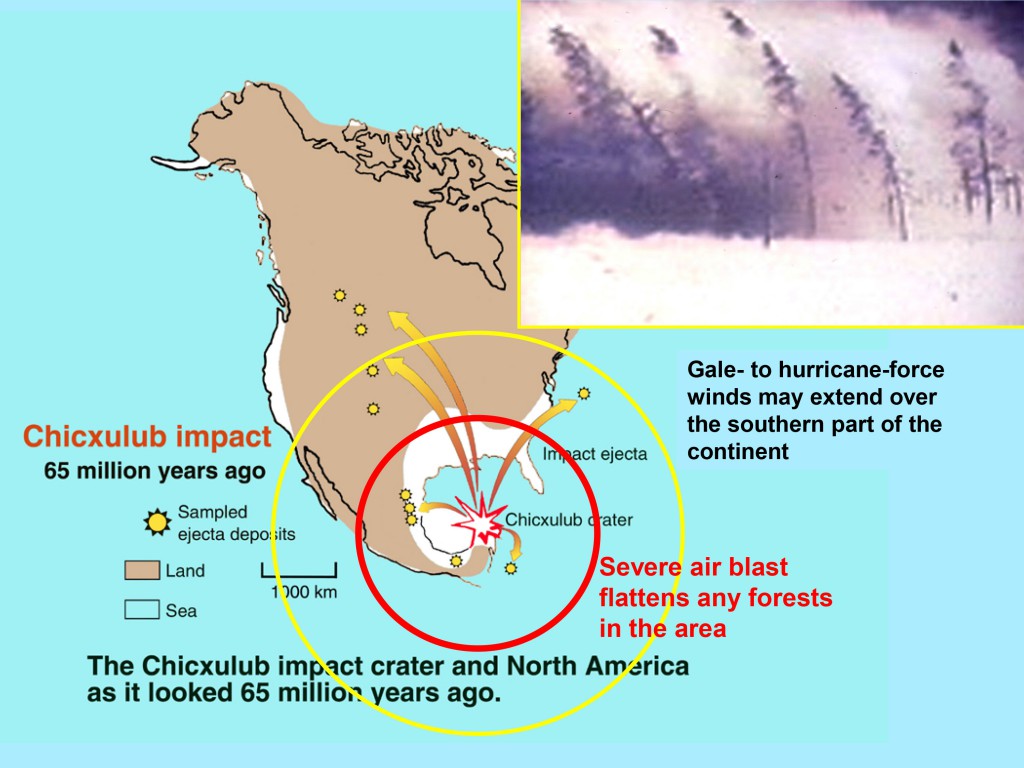
Chicxulub Impact Effects

A research team with a Chicago connection has uncovered new evidence about the devastating impact of the dinosaur-killing asteroid that struck Earth about 66 million years ago.

The asteroid, which hit the planet with a force one million times larger than the most powerful atomic bomb, caused the extinction of dinosaurs, ending what is known as the Cretaceous period. But the nearly 10-mile-wide asteroid also decimated the Earth’s forests, leading to the extinction of tree-dwelling birds, according to a new study co-authored by Field Museum paleontologist Regan Dunn.

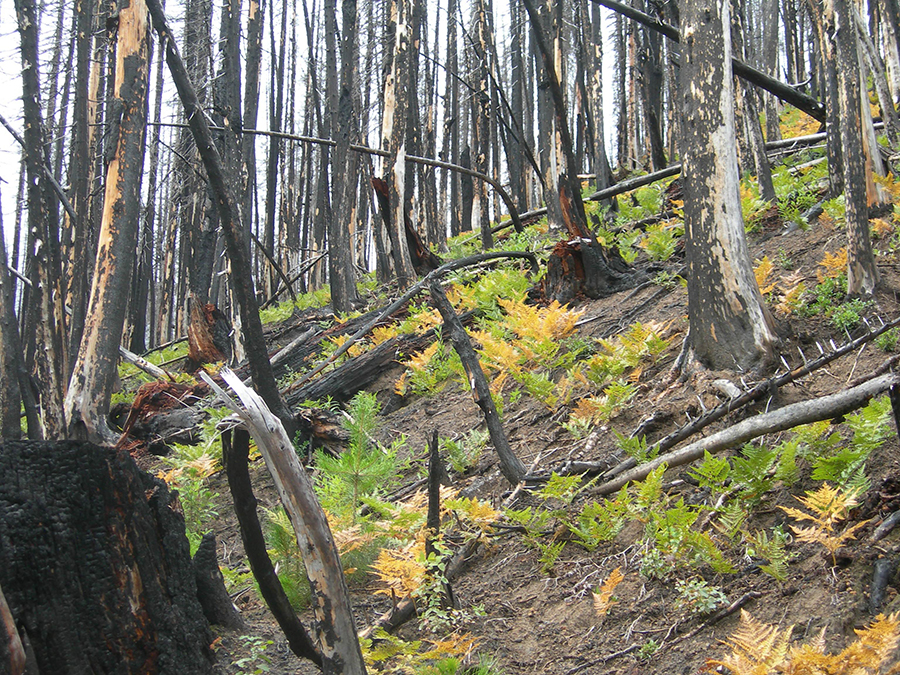
For the study, which will be published next month in the journal Current Biology, Dunn and other scientists examined fossil records showing the charcoal remains of burnt trees. Coupled with other research on plants and birds, the evidence suggested that once the asteroid hit, forest canopies collapsed, wiping out the Cretaceous period equivalent of robins, sparrows and other birds with small, delicate legs designed for perching on tree branches.

“Perching birds went extinct because there were no more perches,” Dunn said in a statement.

Ferns in a burned forest illustrate the effects of the asteroid that wiped out tree-dwelling birds about 66 million years ago. (Regan Dunn / The Field Museum)

The surviving birds, meanwhile, were ground-dwellers equipped with sturdier legs, similar to modern ground birds like kiwis and emus. Only a handful of bird lineages survived the mass extinction caused by the asteroid, and these birds serve as ancestors for all of the nearly 11,000 living bird species found on Earth today.

While the study’s findings shed new light on the plight of birds following the Earth-changing event known as the Chicxulub asteroid, Dunn said it also highlights the importance of plants, which are often overlooked compared to fossil studies of animals like dinosaurs and birds.

“Plants are the context in which all terrestrial life evolves and survives,” she said in a statement. “They make energy available to all life forms by capturing it from the sun – we can’t do that.

“It’s important for us to understand what happens when you destroy an ecosystem, like with deforestation and climate change, so we can know how our actions will affect what comes after us," she said. 

Scientists from the University of Bath, the Smithsonian Institution, Cornell University, the University of Rhode Island, the Denver Museum of Nature and Science the Swedish Museum of Natural History and Yale University also contributed to the study.

Source: https://chicagotonight.wttw.com

Utah Fossil Breaks Open Theories About Origins of Early Mammals

Wednesday, May 30, 2018

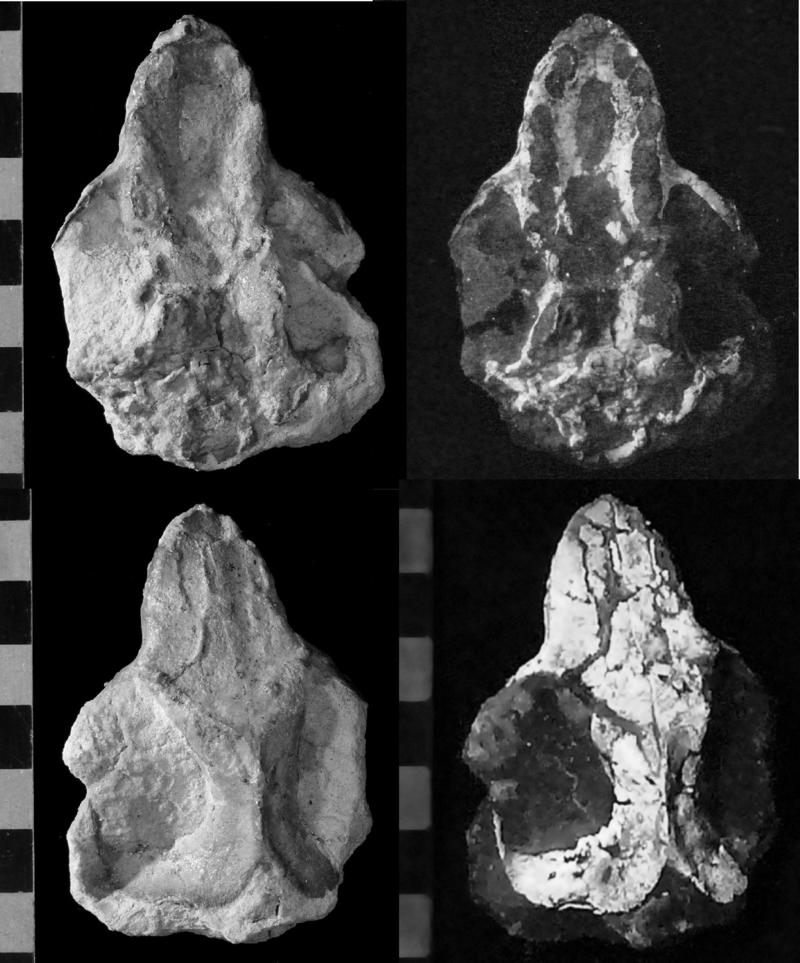
Images of haramiyid skull known as Cifelliodon wahkarmoosuch. UTAH GEOLOGICAL SURVEY

A recent discovery of a 130-million-year-old fossilized skull in eastern Utah is shaking up what researchers know about evolutionary history.

Back in 2006, Jim Kirkland and a few other paleontologists were studying a block of earth and dinosaurs they’d excavated from a site near Cisco, a ghost town in eastern Utah. Kirkland, the Utah State Paleontologist, said one of the researchers flipped over a dinosaur foot bone when she saw something underneath.

"She calls me over and says ‘Jim, I think we have another skull!’" Kirkland recalled.

What the paleontologists found surprised them. It was a nearly complete skull of a creature from a group of animals called haramiyids, an early mammal relative. The skull was the first of its kind found anywhere in North America.

"This animal completes the prize. We get the first skull and it’s a total oddball. First animal of its group every found here," Kirkland said.

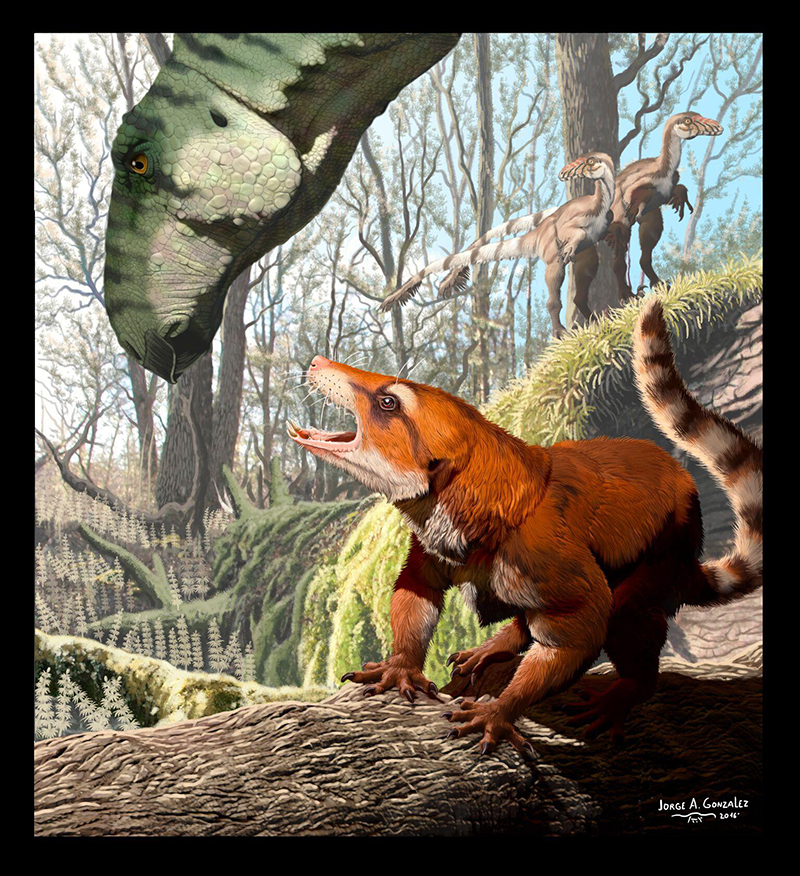
Artists rendering of Cifelliodon wahkarmoosuch, a mammal relative known as Haramiyida. CREDIT UTAH GEOLOGICAL SURVEY

What that oddball tells paleontologists is this small mammal relative that looks like a rodent was alive later than other haramiyid fossils that have been found in Europe and China.

That expands where these creatures were believed to have lived to a whole new continent and a different era. It also changes when researchers thought the supercontinent called Pangea separated.

"Well this shows that the breakup had to occur later than we had thought previously from the north and the south," Kirkland said.

Estimates about Pangea’s breaking apart are about 15 million years later.

A paper about the discovery was published last week in the journal Nature.

Source: http://kuer.org

The Dino-Sized Scientific Issues Behind 'Jurassic Park'

Tuesday, May 29, 2018

Dinosaurs make for great suspense films, but don't rely on their science.

This article, along with others celebrating the 25th anniversary of the groundbreaking franchise, is featured in Newsweek's Special Edition: Jurassic Park

Bigger and badder? 

It was cool to see Jurassic Park’s biggest monster taken out by a larger dino in the third installment (pictured above). But Jurassic Park III’s Spinosaurus would have probably lost the fight. Although it’s much bigger, the Spinosaurus’s jaw was meant to catch fish, while the T. rex had a 12,000-pound bite force intended to down larger prey.

Bugging out

Extracting complete DNA from mosquitos would have been impossible because DNA does not stay intact for millions of years. Mosquitos were buzzing around 170 million years ago when dinos were still around, but there’s a problem with the particular species shown in the movie: The Toxorhynchites rutilusdoesn’t feed on blood.

A question of ratios

When Grant et al. first take in the splendor of Jurassic Park, a Brachiosaurus is depicted standing on its hind legs in order to reach leaves. Based on its anatomy, supporting its enormous weight in this manner would have been impossible. It’s also endearing to see one of these massive creatures sneeze, but as far as scientists know, dinosaurs didn’t say “Achoo!”

Move a muscle 

Even if the T. rex did have motion-based vision—all signs point to this not being the case—the dino’s sense of smell was likely so strong that standing still and hoping to go unnoticed would have been a fatal mistake.

Giant continuity issue 

The T. rex, Velociraptor and many of the other prominent dinosaurs came from the late Cretaceous rather than the Jurassic Period, making the name of the park the first of its foibles.

What a load of... 

The pile of Triceratops droppings depicted in Jurassic Park was about the size of an actual Triceratops. Dinosaurs were impressive, but no creature can make that happen.

Busted 

Though Lex claims to be a vegetarian, she is also memorably seen eating Jell-O, which contains gelatin, an animal byproduct.

Dinos gotta eat! 

The first clue in Jurassic Park that something is amiss comes when an extinct plant makes an appearance in the Jurassic Park tour. It’s a nice cinematic device, but no one ever actually explains how the InGen scientists gathered or replicated extinct plant DNA.

Quiet dinos bite hard 

The T. rex makes a very imposing entrance in Jurassic Park, but experts believe the lizard king would have actually been a sneaky predator rather than one who relied on intimidation.

Snafu in paradise 

None of the Dominican Republic’s amber is old enough to have existed during the time of the dinosaurs, yet the Caribbean country is stated as the source of InGen’s amber.

Size matters 

Real life velociraptors were about the size of turkeys. Jurassic Park’s terrifying raptors have more in common with the Deinonychus.

Frogwash 

Frog DNA, used in the film, would actually be a terrible choice to fill in the dinosaurs’ genetic gaps. Humans and dinosaurs are more closely related than dinos and frogs.

Source: www.newsweek.com

7 Reasons Jurassic Park Fans Should be Excited for Jurassic World Evolution

Tuesday, May 29, 2018

Jurassic World Evolution

We've decided to endorse your park.

If you’re not sure what Jurassic World Evolution is yet, we’ve been bringing you a month’s worth of announcements and awesome features on the new game which sticks you in charge of your own version of Jurassic World. This fulfils the dreams of most Jurassic Park fans, despite the fact that dinosaurs and theme parks have a vibrant history of not getting along.

If you’re a huge fan of the films, here are 7 reasons why you should be particularly excited

1. Visit Each Island Known as The Five Deaths

This is a biggie because for the first time you’ll get a proper look at the other islands of Las Cinco Muertes, the chain of islands that were introduced in The Lost World. Until now all we’ve seen in the movies is Isla Sorna, where the events of The Lost World take place, but Evolution will take you to the other four islands too. You’ll be able to build a park on each island, which have their own unique problems to deal with.

So far we’ve played on Isla Matanceros, which is the first island you take control of and serves as an introduction to the challenges you’ll face. It takes its name from the Spanish word for slaughter which kind of gives you an impression about where things are going.

We’ve also played Isla Muerta (aka The Dead Island) where you’re regularly hit by tropical storms which turn your lovely park into a literal island of death as the dinosaurs inevitably escape and go on the rampage.

We’ve also seen the nighttime Isla Pena and also Isla Tacano, though we’re yet to see the familiar terrain of Isla Sorna, which game director Michael Brookes says will be the biggest playable island in the game. Thank God for Site B.

2. It Preserves Hammond’s Legacy

We saw in Jurassic World that John Hammond has been remembered with a lovely statue which took pride of place in Jurassic World in front of the ‘John Hammond Creation Lab’. It’s clear that the Masrani corporation who took over InGen after Hammond’s death were keen to preserve Hammond’s memory (forget that the Hammond Creation Lab is next to something called the ‘Samsung Innovation Centre’) and Jurassic World Evolution carries on that legacy.

In the game all of our dinosaurs are created in Hammond Creation Labs, ensuring that the dreams of the great man are never far from your mind.

3. Solve the Problems the Films Couldn’t

The unfortunate events of the original Jurassic Park can be put down to terrible project management, and since Jurassic World Evolution is one massive management simulation, you finally have a chance to fix the errors you’ve seen people make time and time again in the films.

Ever wondered why the scientists at Jurassic Park never had an infinite amount of back-up generators in order to keep power running to the fences and enclosures? Well, you can fix that because Jurassic World Evolution helps all of your logistical dreams come true.

4. Stays True to the Weird Science of the Film

So much of the science behind Jurassic World doesn’t make sense. From the lack of feathers that most dinosaurs apparently had, to giant piles of poop the dinos on the island produce all the way through to the just made up state on the Dilophosaurus. Jurassic World Evolution hasn’t moved the science into the real world – all the genetic tinkering remains true to Jurassic Park.

One of our favourite aspects is how the first Jurassic Park boffins used genes from from frogs to fill in the gaps in the genomes of the dinosaurs they had sequenced. Jurassic World took that one step further, throwing in a bunch of other species to spice things up for returning visitors. And Jurassic World Evolution lets you add a whole range of other creatures into the mix, from sharks to bats, in attempt to come up with the next big attraction.

5. Developers Had Access to the Universal Archives

We know Frontier have been working extremely close with Universal Pictures on almost all aspects of Jurassic World Evolution with the movie studio ensuring that players get an authentic Jurassic Park experience. Recently we spoke to the team at Frontier about the incredible access they had with the original sound files used to make the effects for the dinosaurs. We got to hear some of the recordings that when blended together make up the iconic roar of the T.rex in the original Jurassic Park movie.

6. Free Jurassic World: Fallen Kingdom DLC

We know Jeff Goldblum, Bryce Dallas Howard and B.D. Wong all appear in the game as their movie characters but recently the Jurassic World Evolution team revealed in a developer diary that we’re going to be getting a free update to the game based around the release of the new film, Jurassic World: Fallen Kingdom. Although we don’t have much information on it, presumably it will feature the dinosaurs we know we’ll see in movie, including the Carnotaurus and hopefully the mysterious Indoraptor.

7. Fingers Crossed for Easter Eggs

We’re also hoping that we’ll get a boat load of Easter Eggs scattered throughout the game. We’ve seen movie quotes adorn the top of loading screens so far but our favourite has to be one we found on the Jurassic World Evolution website. Head to a specific part of the site, chuck in the Konami code and treat yourself to a little Nedry-flavoured nugget. Turns out the people making Jurassic World Evolution are even bigger nerds about the movie than you are, and you stayed until the end of this article.

Source: www.ign.com

Jurassic World: Why Hollywood Monsters Have Lost Their Bite

Friday, June 29, 2018

 Creature comforts: Rampage (inset), Jurassic World: Fallen Kingdom Composite: The Guide

Now more empathic than ever, could film’s fantastic beasts be doing themselves out of a job?


It used to be so simple with movie monsters: they tried to kill us and we tried to kill them back, which worked fine with elemental classics such as JawsAlien and Godzilla. But now we seem to have found a new method for killing movie monsters: empathy, which is spreading through the beast community like a virus.

The latest victims are the dinosaurs of Jurassic World, returning in forthcoming sequel Fallen Kingdom. Our hero Chris Pratt, you may remember, learned to communicate with his buddies the velociraptors. He wept at the death of an apatosaurus, but understood how dinosaurs only rampaged because of how we treated them. He felt their pain. Expect more of the same this time: rebooter-in-chief Colin Trevorrow has said that the Jurassic franchise is really about “our responsibility to the living creatures that we share the planet with”. You can’t argue with that. Although it kind of takes dinosaurs out of the monster category altogether.

They are not the only ones. A very similar scenario played out in the recent Rampage, with Dwayne Johnson and his giant white gorilla buddy, George, who helped save the world from the other monsters. And again in Kong: Skull Island. Kong wasn’t a monster; he was just lonely, and decent enough to save the humans from other monsters. Even the rebooted Godzilla turned out to be a saviour of humanity. And as for The Shape of Water – well, that saw humans and monsters get much, much closer.

Children’s movie monsters are similarly empathetic. More often than not, the message is “there’s nothing to be afraid of”. Dragons make good pets; giants are Big and Friendly; Dracula is a lonely single parent (in Hotel Transylvania 3); and the monsters of Monsters Inc don’t really want to scare children. In that movie’s cop-out ending, they discover children’s laughter works better than screams. Jurassic World: Fallen Kingdom’s director, JA Bayona, peddled similar sentiments in his previous film, A Monster Calls, in which a giant tree creature helps out a traumatised boy.

That is not to say that any of these are bad movies, but monsters wanna monster! They used to represent the unknown, the uncanny, the unspeakable. If we reclassify them as simply misunderstood non-humans, we’re effectively putting them out of a job. There is still hope: witness the terrifying predators of A Quiet Place, or – later this summer – the return of old-school giant sharks (The Meg), and alien manhunters (The Predator). But if it turns out that the giant shark is “just protecting her young”, or the Predators only wanted to test out their newly acquired massage skills, then I’m going on the rampage.

Jurassic World: Fallen Kingdom is in UK cinemas from 6 Jun.

Source: www.theguardian.com

‘Gangly-Looking House Cats’: The Humble Beginnings of Earth’s Most Dominant Species

Wednesday, May 30, 2018

THEY dominated the planet for around 150 million years but not before supervolcanoes scarred the planet leaving a Game of Thrones-style battle.

WHEN you think of dinosaurs, your mind immediately goes to the impressive might of the Tyrannosaurus rex or maybe the huge size of the Brontosaurus.

These iconic dinosaurs have become synonymous with the species that dominated the planet for about 150 million years — but they weren’t always the force of nature they grew to be.

“We used to have little idea about how animals like T. rex and Brontosaurus rose up to dominance,” paleontologist Dr Steve Brusatte told news.com.au. “But now we know that dinosaurs started humbly, as gangly-looking, house-cat-sized creatures staking their claim in the brave new world after millions of years of supervolcanoes scarred the planet.”

But before they could rise up, they had to best their rivals.

“They started small, humble, anonymous, living in the shadows, and they gradually overcome their competitors over tens of millions of years. It’s like Game of Thrones, but it actually happened.”

In the end, they became one of the most dominant species our planet has ever known. Homo sapiens have existed for less than 200,000 years and already we’re talking about planetary extinction. The dinosaurs reigned for 750 times that.

“The dinosaurs were an empire. That’s how we should think of them,” Dr Brusatte said.

Dr Brusatte, 34, is widely recognised as one of the leading palaeontologists of his generation. Currently working at the University of Edinburgh, he has written over 100 peer-reviewed scientific papers during his decade of research in the field and has also named and described more than 10 new species of dinosaurs.

Fossils are being unearthed at a dizzying rate, leading us to learn new things about our predecessors who were wiped from the face of the earth some 66 million years ago.


Dr Brusatte believes we’re in a “golden age of paleontology” and helps bring these recent (and not so recent) discoveries to life in a new book called The Rise And Fall Of The Dinosaurs: A New History Of A Lost World. The book aims to tell the incredible story of how we’ve pieced together the life and times of the dinosaur empire — a story which most adults may not be so familiar with.

“There are so many books about dinosaurs for children,” Dr Brusatte said. “But there aren’t so many books for adults, and that’s a shame.”

The book gives insight into the life of a palaeontologist in the field. It introduces readers to a cast of fossil hunters and details current research, both Dr Brusatte’s own and that of his colleagues.

It chronicles the paleontologist’s journey from a dinosaur-loving child to making some truly remarkable discoveries including primitive human-sized tyrannosaurs, monstrous carnivores even larger than T. rex and feathered raptor dinosaurs preserved in lava from China.

“You can never predict what the next discovery will be, and that makes palaeontology such an addictive pursuit,” he told news.com.au.

While he’s used to being surprised by what he digs up, he still has a couple of ideas about what he’d love to discover.

“For me, what I would love to find is the world’s oldest bird,” he said. “Birds evolved from small meat-eating dinosaurs, sometime in the Middle Jurassic. Every year my team and I head up to the Scottish Hebrides islands, where there are Middle Jurassic rocks, on the hunt for the first bird.”

If they ever do make that discovery, it might require another book.

The Rise And Fall Of The Dinosaurs by Dr Steve Brusatte, published by Macmillan. Available now.

Source: www.news.com.au

Science Finds a Way to Bring Back Extinct Animals

Monday, May 28, 2018

Illustration The Print CollectorGetty Images

With more than 5.6 million articles, Wikipedia is an invaluable resource, whether you’re throwing a term paper together at the last minute, or checking to see if Netflix has any plans to bring Dinosaurs back from extinction. We explore some of Wikipedia’s oddities in our 5,656,989-week series, Wiki Wormhole.

This week’s entry: De-extinction

What it’s about: Jurassic Park! While Michael Crichton’s dinosaur-DNA-in-amber scenario turns out to not be possible (even well-preserved DNA degrades beyond repair after a few million years), we actually do have the technology to bring back more recently extinct species like the passenger pigeon or the wooly mammoth. Within a few years, “going the way of the dodo” could be slang for a miraculous comeback.

Biggest controversy: Your scientists were so preoccupied with whether or not they could, they didn’t stop to think if they should. Much like Jurassic Park, scientists are concerned that even if we can resurrect a species, we can’t re-create its original habitat or learned behavior, which could be detrimental to both the new animals and their new environment. There’s no telling if resurrected animals could become invasive species, wreaking havoc on an environment that’s been without them for centuries.

Strangest fact: De-extinction could actually help fight climate change. One of the Earth’s biggest problem spots is Siberia, where millennia-old permafrost is beginning to thaw. Restoring the region’s wooly mammoth population could help, as the animals eat dead grass, allowing new grass to grow more easily. They’d also crush layers of snow, which paradoxically would help keep the ground cold, as snow acts as a layer of insulation—in essence, it acts as a giant igloo for the ground.

Thing we were happiest to learn: We have several ways of going about de-extinction. Cloning uses a preserved cell to create an embryo of the extinct animal, which would be carried to term by a similar species. Genome editing inserts missing DNA into a similar species’ genome, re-creating an animal with the same traits as the lost species (though, on a genetic level, not exactly the same species).

Selective breeding is the least high-tech, but perhaps the most practical. When species go extinct, similar animals still contain much of the same DNA, so those animals can be bred to favor traits from the extinct animal—modern breeds of cattle could be cross-bred until their offspring resembles the auroch, a relative of the cow and bison that went extinct in 1627. Centuries ago, aurochs were domesticated into zebu cattle in India and taurine cattle in the Middle East, so those subspecies still carry many auroch traits and could be used to revive them.

While the first two methods are largely theoretical, selective breeding has already been used to revive the quagga, a zebra variety that’s striped only on its head. As the new quagga are similar, but not directly related to the originals, they’re referred to as Rau quagga. Scientists now have their sights set on reviving an extinct tortoise originally discovered by Charles Darwin, Chelonoidis elephantopus.

Thing we were unhappiest to learn: Not everything that comes back is friendly. The related list of resurrected species includes a few selectively bred animals, and two species that were thawed from Arctic ice after 30,000 years. One is Silene stenophylla, an Arctic wildflower. The other, more ominously, is Pithovirus sibericum, a giant virus that infects amoebae. While scientists dispute the idea that a thawed-out virus could create a pandemic, you can bet Roland Emmerich has a team of screenwriters working on the concept as we speak.

Also noteworthy: De-extinction technologies can also help endangered species. Once a species’ population dips below a certain number, it’s impossible to sustain a healthy gene pool. But the same genetic engineering that can turn an existing species’ DNA into that of a long-lost relative, could also be used to broaden genetic diversity within a species. Also, just as an elephant could be made to give birth to a cloned wooly mammoth, a southern white rhinoceros (the least endangered rhino) could give birth to a cloned northern white (on the verge of extinction), bolstering the latter’s population.

Best link to elsewhere on Wikipedia: There were once billions of passenger pigeons in North America, but between hunting and deforestation, it only took humans a few decades to drive them to extinction. The last bird died in captivity in 1914. The surviving passenger pigeon DNA on record is too degraded to clone new birds, but efforts are underway to genetically modify the band-tailed pigeon, the passenger’s closest living relative, to bring back the extinct birds. Revive & Restore, the non-profit behind the effort, claims its can produce birds for captive breeding by 2024, and create a wild population by 2030.

Source: www.avclub.com

Extinct Doggos' Bone-Crushing Diet Preserved in Fossil Poop

Saturday, May 26, 2018

An artist's conception of feeding by a pack of bone-crushing dogs of the species Borophagus secundus, a relative of Borophagus parvus Credit: Maurició Anton

Long-extinct relatives of today's dogs and wolves may have used their powerful jaws to crush bones, and the proof is in the animals' fossilized poop.

Domestic dogs are known to enjoy chewing large bones, but they lack the jaw strength to pulverize them. In fact, in today's ecosystems, the only large predators with skulls and jaws powerful enough to splinter bones are hyenas. But that wasn't the case millions of years ago, researchers reported in a new study.

Scientists had known from years of analyzing fossils of a wolf-size species of wild dog called Borophagus parvus — which lived from about 16 million to 2 million years ago — that its skull and powerful jawbone shared many features with those of bone-crunching spotted hyenas (Crocuta crocuta), according to the study. While this suggested the canid also could crush bones, scientists still couldn't be sure that was true, study co-author Jack Tseng, a functional anatomist at the University at Buffalo, told Live Science in an email.

"You could say we were scientifically constipated," Tseng said.

However, the floodgates were opened with the discovery of a cache of coprolites — 14 pieces of fossilized poop — at a site in California's Mehrten Formation. The location dates to the late Miocene epoch, about 5.3 million to 6.4 million years ago, and is known for being rich in Borophagus fossils; the coprolites, which are much rarer than bones, are thought to be about 2 million years old, the study authors reported.

Using micro-computed X-ray tomography (micro-CT) scans to peer inside the ancient poop, the researchers discovered plenty of bone splinters and fragments in all of the specimens, adding up to an average of 5 percent of the coprolites' mass.

"Rarely do paleontologists get the chance to validate our skull-centric research using the other end," Tseng said. And in this instance, the coprolites also told the researchers that Borophagus' eating habits didn't resemble spotted hyenas' as much as they'd thought.

Spotted hyenas thoroughly digest swallowed bones; consequently, when they poop, they produce "mochi-like balls of feces that are full of bone powder," Tseng said. Borophagus poop, on the other hand, held fragments of undissolved bone, suggesting that while the extinct dogs may have swallowed bones like spotted hyenas, they digested them like striped hyenas (Hyaena hyaena) and brown hyenas (Hyaena brunnea), which don't process bones as efficiently as their spotted cousins, Tseng said.

As well as providing clues to Borophagus' diet and digestion, the fossilized poo also testified to how they may have lived. Coprolites were found in communal "latrines" used by multiple individuals, suggesting Borophaguswere social, territorial animals, according to the study. Modern hyenas, which are also social hunters, offer a glimpse of how that behavior might be linked to bone crushing after a successful hunt, study lead author Xiaoming Wang, a curator in the Department of Vertebrate Paleontology at the Natural History Museum in Los Angeles, told Live Science in an email.

"While social hunting helps in overcoming large prey, once the prey is secured, the feeding itself is also highly competitive. So competitive, in fact, that individual hyenas have no time to chew their meat, and they simply break down the prey in large enough chunks and quickly swallow bones and meat together, in order to grab the next bite of food," Wang explained.

The findings were published online May 22 in the journal eLife.

Original article on Live Science.

10 Best Jurassic Park Gifts and Merchandise

Saturday, May 26, 2018

It’s 25 years since Steven Spielberg pulled off a cinematic miracle: bringing dinosaurs back from extinction and onto the big screen in his blockbuster classic Jurassic Park. Now the saga is about to continue in Jurassic World: Fallen Kingdom, bringing Owen and Claire back to Isla Nublar, and featuring Jeff Goldblum's return as Ian Malcolm. There’s all kinds of Jurassic merchandise, gifts, replicas and more out there that's been patented, packed, and slapped on a plastic lunchbox (disclaimer: no lunchboxes feature on the list), so whether you’re treating yourself or the clever girl / boy in your life, here’s our pick of the best products. Spare no expense, and hold onto your butts.

LEGO Jurassic Park – Velociraptor Chase

It’s taken what feels like 65 million years for LEGO to produce an original Jurassic Park set, but they’ve made up for lost time with this 3-in-1 set that’s part raptors-in-the-kitchen, part control centre, and part DNA lab. As well as a bunch of classic minifigures (Alan Grant! Ellie Sattler! Lex and Tim!), there are plenty of fun nods to Spielberg’s classic: green jelly blobs, a Barbasol canister, Nedry’s screensaver, and, for some reason, a sausage.

Jurassic Park 25th Anniversary Collection – Blu-ray

Look, you’ve probably got all four Jurassic movies on Blu-ray already. But does your current collection come in a fancy box that blasts John Williams’ theme music? Well, the anniversary collection does – and it has a bunch of Fallen Kingdom art cards in there for good measure.


Funko Pop – Ian Malcolm, Alan Grant, and the Dilophosaurus

Jurassic fan? Funko Pop collector? The two have been genetically combined (science may not be 100% accurate) in a range of Park and World figures with impressive attention to detail – Alan has his raptor claw in hand, Ian has his shirt unbuttoned, Hammond has his amber-topped cane. And there’s dinosaurs too! Our pick is the Dilophosaurus, with his colourful frills outstretched. There's no Ellie Sattler figure for now, but one is currently being cooked up in the Funko lab.


Laura Dern - Girls on Tops T-Shirt

God creates dinosaurs. God destroys dinosaurs. God creates man. Man destroys God. Man creates dinosaurs. Dinosaurs eat man. Woman inherits the earth. Girls on Tops creates Laura Dern t-shirt to celebrate cinematic icon. Jurassic Park fans buy t-shirt. Laura Dern becomes rightful queen of the universe.


Jurassic Park Audiobook

Like Jaws and Ready Player One, Spielberg’s Jurassic Park is a loose adaptation of the book. Even if you know the film inside-out, there are plenty of extra sequences in Michael Crichton’s novel to enjoy (some of which, like the opening Compy attack and Pterosaur sequence, inspired moments from The Lost World and Jurassic Park III). It’s darker and bleaker too — the description of Nedry’s death at the hands (claws?) of the Dilophosaurus is true nightmare fuel.


InGen pin

If the Jurassic Park films have taught us anything, it’s that InGen’s de-extinction of the dinosaurs was probably a bad move. You know, because of all the death. But there’s also no denying that Dr. Wu and his team pulled off a mightily impressive feat, so show your support of InGen’s bold and experimental science with this pin badge.


Jurassic World: Evolution

Fancy yourself as the new John Hammond or Simon Masrani? The latest Jurassic video game (from the creators of RollerCoaster Tycoon, no less) gives you all the tools you need to create your own biological preserve – and it’s entirely up to you whether you decide to set those prehistoric predators on your unsuspecting guests. Pre-order now, terrorise your punters in July.


LEGO Jurassic World – Indoraptor Rampage at Lockwood Estate

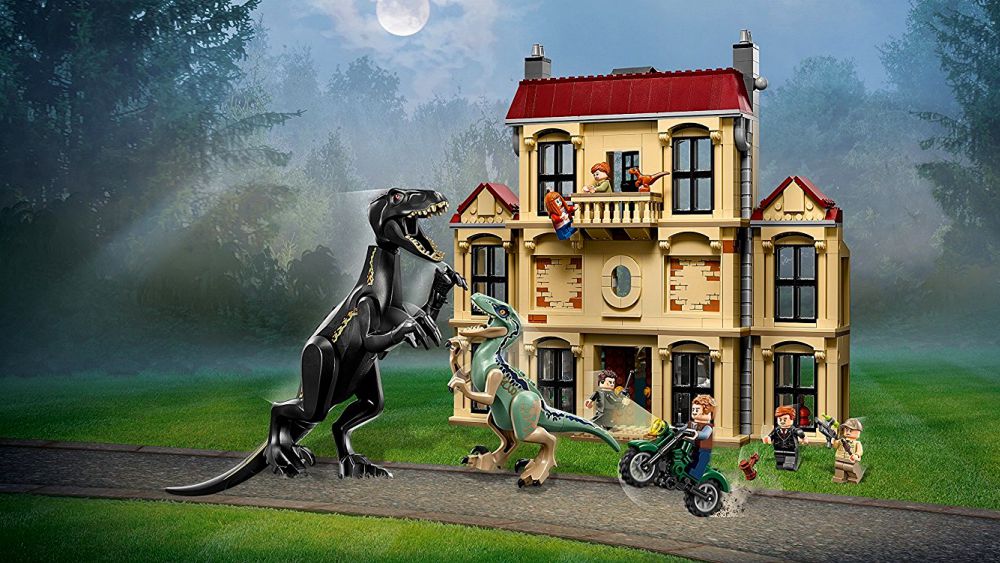
Thought the Indominus Rex had a nasty temper? Wait until you see Fallen Kingdom’s Indoraptor, a sleeker, scarier and more skittish hybrid that’s about to induce all-new dino nightmares in kids big and small. Thankfully it’s slightly less scary in LEGO form – and this massive set also includes minifigures of Owen and Claire, an adorable Blue figure, a buildable Triceratops skull, and the grandiose Lockwood Estate.


Night Vision Goggles Replica

The cutting-edge tech of Jurassic Park is loveably quaint these days (“It’s an interactive CD-ROM!”), but no JP gadget is quite as desirable as the night vision goggles that Tim finds in the Jeep. This replica set perfectly recreates them at 1:1 scale, though they don’t actually function as night vision goggles. Warning: Gennaro’s prediction that ‘if they’re heavy, they’re expensive’ proves to be true here – these will set you back a fair chunk.


LEGO Jurassic World video game

As great as Jurassic World Evolution looks, running your own park comes with its own set of responsibilities. For a more laid-back Jurassic gaming experience, LEGO Jurassic World recreates the first four films and renders all the classic set-pieces in brick form. Oh, and it re-imagines Alan’s Jurassic Park III raptor dream with this extra slice of genius.


Source: www.empireonline.com

Interactive, Animatronic Dinosaur Exhibit Opening at Witte Museum

Friday, May 25, 2018

Dinosaurs Alive - Witte Museum San Antonio, Texas

World premiere of Texas dinosaur exhibition opens Saturday.

The Witte Museum is bringing the world premiere of "Predators vs. Prey: Dinosaurs on the Land Before Texas" to the public.

Visitors will encounter life-size animatronic dinosaurs and see real fossils — all with a Texas connection.

“Dinosaurs are always fascinating, and 'Predators vs. Prey' adds more drama by featuring dinosaurs that walked on what we now call Texas,” Marise McDermott, president and CEO of the Witte Museum said. 

The dinosaurs on display are depicted in the environment in which they lived and are grouped together with other dinosaurs that they would have interacted with, be it good or bad.

Augmented reality applications let visitors see themselves with 3D versions of the dinosaurs, and there’s also a play area for future paleontologists to unearth fossils.

The exhibit will be on display at the Witte Museum starting Saturday and will stay through Sept. 3.

Source: www.ksat.com

Pages