Blogs

400-Million Year-Old Fish Discovered is Ancestor of Dinosaurs, Humans

Saturday, June 2, 2018

An illustration of the earliest known bony fish, Ligulalepis. BRIAN CHOO, FLINDERS UNIVERSITY PALAEONTOLOGY

Paleontologists have discovered fossilized remains of the world’s oldest bony fish, which swam the Devonian seas 400 million years ago.

As the earliest known bony fish, “Ligulalepis” is closely related to our own ancestors. A group of animals called osteichthians have bony skeletons and jaws, and include many modern fish and all amphibians, reptiles, birds and mammals. As Ligulalepis is near the bottom of the branch of osteichthians, it is more or less an ancestor of humans. And sheep. And salamanders. 98 percent of living vertebrates sprung from this branch of the tree of life.

Researchers at Flinder’s University in Adelaide, Australia worked with an international team of researchers to uncover and study the fossil remains of this fish. They found two fossilized skulls in Australia, neither of which were perfect—400 million years in the earth will leave remains with some wear and tear.

However, using 3D scans and micro-CT data, researchers created a digital model of the brain, based on the shape it would have taken inside the skull. They were also able to determine the shape of the skull roof and nasal and ear canals, illuminating details about how one of our earliest ancestors evolved.

According to a press release, the animal also was likely starting to develop bones in frontal fins, which would ultimately evolve into arm, wrist and finger bones. The researchers published a paper on the animal in the journal Evolutionary Biology.

The last few years have yielded several important discoveries for evolutionary biologists trying to understand details about the tree of life. Scientists recently discovered an even older ancestor of ours, resting at the base of the branch where non-bony fish (like sharks) split from bony fish (like mackerel.) Scientists have also discovered that some forms of ancient life lived without oxygen and that all animals descended from sponge-like ancestors.

Source: www.newsweek.com

Jurassic Park 25th Anniversary Collection (4k UHD Review)

Thursday, June 7, 2018

Jurassic Park: 25th Anniversary

DIRECTOR

Steven Spielberg, Joe Johnston, Colin Trevorrow

RELEASE DATE(S)

1993-2015 (May 22, 2018)

STUDIO(S)

Amblin Entertainment/Legendary Pictures (Universal Studios)

  • Film/Program Grade: See Below
  • Video Grade: See Below
  • Audio Grade: See Below
  • Extras Grade: B
  • Overall Grade: B

REVIEW


As popular as the Jurassic Park franchise has become over the years, and this being the 25th anniversary of the original Steven Spielberg classic, it’s no surprise that these films would be an obvious target for release on the 4K Ultra HD format by Universal. But doing so poses a unique set of challenges, as evident in the studio’s new Jurassic Park 25th Anniversary Collection, which presents the first four films in this series in both 4K and standard Blu-ray in a single package.

I should note up front that this has been one of the more complicated 4K Ultra HD reviews I’ve done yet at The Digital Bits. A certain sense of perspective has to be maintained here and expectations have to be managed a bit. The first three titles in this set, Jurassic ParkThe Lost World: Jurassic Park, and Jurassic Park III were all produced at a time when digital visual effects and post production technology was relatively primitive and limited in resolution (sub-2K, and just 1K in the case of the original film).

In general, the way the pre-Digital Intermediate post production process worked was this: Once final editing decisions were made on a film by the director and editor, the original camera negative would be edited to conform to those choices in a cut negative. Fades, transitions, titles were done in an optical printer – the original camera negative for those shots would be copied to an interpositive, from which an internegative (sometimes called a dupe negative) would be created. Those internegative elements would be run through the optical printer and re-photographed onto another internegative with those transitions now built in – that piece of film would then be edited into the cut negative with the original camera neg. Visual effects, produced digitally in a computer, would be scanned out to original negative, then copied to interpositive and then to internegative – again, that piece of film would be edited into the cut negative with the original camera neg. Once you had a cut negative that included all the finished visuals, a new and properly color-timed interpositive would be created of the final film (this is essentially your finished master element). From that, several more internegatives (or dupe negatives) would be created and it’s from those that release prints would be made.

To release a film produced this way in 4K Ultra HD, the studio typically goes back and scans the original cut negative (which again, includes both original camera negative and internegative with finished visual effects and optical transitions) to create a 4K file – that’s going to get you the best possible image. This is then digitally restored to remove dust, artifacts, and age related damage, and to ensure the proper color timing. An additional grade is done for high dynamic range and wide color gamut. The result is a final Digital Intermediate or master element. Now, the explanation I’ve just offered is simplified a bit and there are always exceptions. I’m sure more expert readers will pick a nit or two, but I’m trying to boil things down for those readers who may love 4K Ultra HD but aren’t cine-nerds like some of the rest of us. The point is, what I’ve described is the general process to keep in mind.

Now again, for the first three films (finished in 1993, 1997, and 2001, respectively) the visual effects resolution was sub 2K and often 1K. As such, short of extraordinary efforts (specifically, completely re-doing all of the visual effects in native 4K resolution – which has not happened here), those shots are just not going to look as good as the rest of the film. Some of you may be wondering: Why not re-do all of the visual effects in native 4K resolution? There are a few reasons. Cost, for one (but that’s not as often the driver as you’d think). There’s also the fact that doing so would alter the original experience of the film… and keep in mind that the original Jurassic Park’s visual effects – primitive though they are by today’s standards – were revolutionary at the time. But often the biggest obstacle is simply this: It’s possible that many of the original digital animation files no longer exist. Either no one ever thought they’d be needed again so they weren’t saved, or they may have become corrupted (as can happen to magnetic media over time), or the surviving files may be incompatible with today’s rendering software.

As an example, I wrote a lot of term papers in back in college (in the early 90s) on an Apple IIe and saved them to floppy discs. Even if I still had those discs, which I don’t, I certainly don’t have a floppy disc drive to read them. A few printed copies are all that’s left. In the case of the Jurassic Park films, the equivalent are those pieces of internegative with digital VFX printed on them… low resolution warts and all.

So what’s the point of all this? When evaluating these films on 4K Ultra HD, you have to keep all of the above in mind. Some of this stuff is just not going to compare to modern films released on the Ultra HD format. Ultimately, the question becomes this: Does the picture and sound experience here on UHD improve upon the previous Blu-ray editions in a substantial way? And the answer here is yes… mostly… especially if you’re a diehard Jurassic Park fan. But you can’t expect miracles and the degree of improvement depends on the specific film you’re talking about.

All right, with all of that context established, let’s look at the films in this box set one by one…


JURASSIC PARK (1993)

Based on the novel by Michael Crichton, Steven Spielberg’s Jurassic Park tells the story of a group of scientists (played by Sam Neill, Laura Dern, and Jeff Goldblum) who are invited to preview a new theme park on an island near Costa Rica by the billionaire philanthropist John Hammond (Richard Attenborough, brother of the famed naturalist David Attenborough). But this isn’t just any old theme park; using genetic technology and DNA found in insects trapped in amber for millions of years, Hammond and his team have filled this “Jurassic Park” with living, breathing dinosaurs. Joining the scientists on their tour are Hammond’s young grandchildren, who are eager to see Tyrannosaurs, Brontosaurs, and all the rest. And see them they will, because life will find a way… and it appears that Hammond and his team have forgotten Murphy’s Law.

Jurassic Park was shot on 35 mm film using Panavision Panaflex Platinum cameras and Primo spherical lenses. Whatever film element was scanned in 4K for Jurassic Park, it’s been given a high dynamic range grade in HDR10, and is presented on Ultra HD at the proper 1.85:1 theatrical aspect ratio. One would certainly hope that Universal went back to the original camera negative for 4K scanning (and the original dupe neg for visual effects shots), though all of the first three films in this set have a softness to their grain structure that suggests the interpositives could have been scanned instead (it’s hard to say for sure and that’s just a guess). In the case of this film, it looks like some of the live action footage may have been de-grained a tiny bit via digital noise reduction to better match the low resolution of the optically-printed transitions and visual effects shots. The strange thing is, some of the live action looks terrific, just as you’d expect, while other portions have a slightly-digital, slightly-processed look. There’s decent image detail overall, but there’s sometimes an absence of the finest detail you’d normally see in faces and skin tones. Select shots also occasionally have slight contrast haloing. Of course, the visual effects shots have obvious edge enhancement baked into them – but that’s not new, it’s always been there and is to be expected. So from a detail standpoint alone, the improvement over standard Blu-ray with this film is relatively minimal. On the other hand, the HDR does enhance the experience a good deal, with somewhat deeper blacks and genuinely brighter highlights. But the biggest improvement by far is gained in the 4K’s wider color gamut, which results in much more stable, accurate, and vibrant color, with noticeably greater nuance and variety of subtle gradations. This film has certainly never looked better that it does here, but the Ultra HD presentation has a frustratingly hit-or-miss quality that suggests the process was a bit rushed, or that a few too many compromises were made.

The great news is that the 4K disc sounds fantastic. Primary audio is included in a new object-based English DTS:X mix that delivers all the “Wow” factor you’re hoping for. The soundstage is huge and highly atmospheric, with lively surround activity, smooth panning and thunderous low end. Dialogue is clean and natural, environmental cues and ambient sounds are ever-present, and John Williams’ beloved score is presented in fine clarity and fidelity. The height channels engage often, not just in the obvious scenes (helicopter flights, dinosaur attacks, etc) but also to add more subtle immersion. Of course, when the famed T-Rex roars, you’ll feel it in your chest. Additional audio options include French, Spanish, Japanese, and Portuguese 5.1 DTS, with optional subtitles in English SDH, French, Spanish, Japanese, and Portuguese.

There are no extras on the 4K disc itself, but the film is included in 1080p HD on Blu-ray as well. It’s not mastered from the new presentation, but is rather the exact same disc released previously. It includes the following extras (most produced for the original DVD release and so in SD):

  • Return to Jurassic Park: Dawn of a New Era (HD – 25:25)
  • Return to Jurassic Park: Making Prehistory (HD – 20:16)
  • Return to Jurassic Park: The Next Step in Evolution (HD – 15:03)
  • The Making of Jurassic Park (SD – 49:39)
  • Original Featurette on the Making of the Film (SD – 4:50)
  • Steven Spielberg Directs Jurassic Park (SD – 9:07)
  • Hurricane in Kauai (SD – 2:09)
  • Early Pre-Production Meetings (SD – 6:20)
  • Location Scouting (SD – 1:59)
  • Phil Tippett Animatics: Raptors in the Kitchen (SD – 3:04)
  • Animatics: T-Rex Attack (SD – 7:21)
  • ILM and Jurassic Park: Before and After the Visual Effects (SD – 6:32)
  • Foley Artists (SD – 1:25)
  • Storyboards (5 galleries)
  • Production Archives (3 galleries)
  • Theatrical Trailer (SD – 1:18)
  • Jurassic Park: Making the Game (HD – 4:43)

The Blu-ray also offers D-Box motion code, for those who have such systems. And there’s a paper insert in the packaging that includes Movies Anywhere digital codes for all four films in this set. The packaging itself is essentially a cardboard book, with pages that house each disc, and a slipcover to protect it all.

Jurassic Park looks better than ever, and its color and contrast are strongly improved over the previous Blu-ray release, though it’s certainly not up to the level of most other films in 4K in terms of image detail. It does, however, deliver a damn great DTS:X audio experience, so there’s that.

Film: B+
Video/Audio/Extras: B/A/A

THE LOST WORLD: JURASSIC PARK (1997)

Also based on a novel by Michael Crichton, and again directed by Steven Spielberg, The Lost World: Jurassic Park begins with a rich family that’s vacationing on a different island near Costa Rica. While there, their young daughter is injured by a swarm of tiny dinosaurs, so her parents file a lawsuit against Hammond’s company InGen. It turns out that this second island was where the dinosaurs were originally created, but it was abandoned after a hurricane. Now, after the failure of Jurassic Park, InGen’s new CEO (who is also Hammond’s nephew) wants to exploit that original island to save the company. But in a turnabout, Hammond wants it left alone as a kind of prehistoric nature reserve. So he contacts Dr. Malcolm (Jeff Goldblum) for help. But Malcolm soon learns that another scientist (Julianne Moore) is already on the island to document the ecosystem there… his own girlfriend. So he agrees to lead an expedition to the island, not to help Hammond but to rescue his girlfriend. Meanwhile, InGen’s CEO is sending an expedition of his own to the island. He plans to capture the dinosaurs there and bring them to a new Jurassic Park… in San Diego of all places.

Like the original, The Lost World: Jurassic Park was shot on 35 mm film using Panavision Panaflex Platinum cameras and Primo spherical lenses. It was scanned in native 4K, given a high dynamic range grade in HDR10, and is presented on Ultra HD at the proper 1.85:1 theatrical aspect ratio. The good news is that this film looks spectacular. Save for its visual effects shots, which were again produced in the low resolution of the time, there’s much more fine detail visible in this image and it’s more consistent as well. Even the film’s optically-printed shots (titles and dissolves) look better here, with improved detail and grain density. But the visual effects shots look better too, still low resolution but better than the original film, which one can probably attribute to simple technology improvements between 1993 and 1997. The high dynamic range greatly improves the contrast here, with truly deep blacks and naturally bright highlights. And once again, the wider color gamut adds much greater vibrance, accuracy, and subtle gradations to the film’s color palette. The Blu-ray version of this film was good, but this is significantly better – a pleasing upgrade.

What’s more, the object-based English DTS:X mix here is even better that the original, genuinely reference quality. It delivers a big wide soundstage, with terrific clarity and dynamics. Bass is both tremendous and effortless, while the surrounds are lively with smooth effects panning and atmospheric cues. There are many scenes that reveal the precision of object-based audio, including the Velociraptor attack in the tall grass and the swarm of tiny Compsognathus that surround the little girl in the film’s opening. The height channels engage often for both subtle and bombastic sounds during various dinosaur encounters – especially the twin T-Rex attack on the research trailers – not to mention the Stegosaurus battle, and during the second expedition’s effort to herd and capture various dinosaurs. Again, John Williams’ score sounds terrific. Additional audio options include French, Spanish, Japanese, and Portuguese 5.1 DTS, with optional subtitles available in English SDH, French, Spanish, Japanese, and Portuguese.

As with the first film, there are no extras on the 4K disc itself, but the package includes the film in 1080p HD on Blu-ray (the same edition released previously). That disc includes the following extras (most produced for the original DVD release and so in SD):

  • Deleted Scenes (SD – 7:09)
  • Return to Jurassic Park: Finding The Lost World (HD – 27:40)
  • Return to Jurassic Park: Something Survived (HD – 16:30)
  • The Making of The Lost World (SD – 53:14)
  • Original Featurette on the Making of the Film (SD – 13:17)
  • The Jurassic Park Phenomenon: A Discussion with Author Michael Crichton (SD – 15:27)
  • The Compie Dance Number: Thank You Steven Spielberg from ILM (SD – 1:38)
  • ILM & The Lost World: Before & After the Visual Effects (SD – 20:44)
  • Production Archives (6 galleries)
  • Storyboards (12 galleries)
  • Theatrical Trailer (SD – 1:58)

Again, there’s also D-Box motion code and the aforementioned Movies Anywhere digital code.

The Lost World: Jurassic Park in 4K is a significant upgrade over the previous Blu-ray edition and a worthy Ultra HD release in its own right.

Film: C+
Video/Audio/Extras: A-/A+/A

DIRECTOR

Steven Spielberg, Joe Johnston, Colin Trevorrow

RELEASE DATE(S)

1993-2015 (May 22, 2018)

STUDIO(S)

Amblin Entertainment/Legendary Pictures (Universal Studios)

  • Film/Program Grade: See Below
  • Video Grade: See Below
  • Audio Grade: See Below
  • Extras Grade: B
  • Overall Grade: B

REVIEW


JURASSIC PARK III (2001)

Jurassic Park III was directed by Joe Johnston (The RocketeerOctober Sky, and Captain America: The First Avenger) from an original script. Unfortunately, it’s not nearly as compelling a story as it may have been had there been a further Michael Crichton novel to adapt. This time around, yet another rich couple (played by William H. Macy and Téa Leoni) has allowed their teenaged son to go wind surfing with a family friend near the same island seen in The Lost World. Naturally, something goes wrong and the pair ends up stuck on the island. So the rich couple seeks out Dr. Alan Grant (Sam Neill, reprising his role from the original film) and pays him to come to the island with them under false pretenses. They tell him they want him to give them a guided aerial tour of the island, but they actually mean to land and rescue their son. Once again, things go wrong and soon they’re all fighting for survival.

As with the first two films, Jurassic Park III was shot on 35 mm film, this time with Panavision and Arriflex cameras and Panavision spherical lenses. It was scanned in native 4K, given a high dynamic range grade in HDR10, and is presented on Ultra HD at the proper 1.85:1 theatrical aspect ratio. The resulting image is good, but oddly not as good looking as the previous film and it’s hard to say why. Again, there’s a slight lack in the finest detail in the image, with some shots that look as if they’ve been grain-reduced a bit. The visual effects here are improved over those of the previous two films in both detail and resolution, but they still aren’t up to modern standards. That, of course, is to be expected. More troubling though is the fact that the high dynamic range grade feels very restrained; it’s almost like it was done by another company. The blacks aren’t as nearly deep as the previous film in 4K, nor are the highlights as brightly natural. The wider color gamut is okay, with some enrichment of the film’s color palette, but not nearly as much as you’d expect. This is really a rather dull and lifeless image, not at all what you expect from the Ultra HD format. In every respect, it’s only minimally improved over the previous Blu-ray edition.

At least the new object-based English DTS:X mix is great, though it’s not quite as impressive as the two previous films. But again it offers a big and wide soundstage, with terrific atmospherics and smooth, natural panning. The height channels are active not just in the usual ground-based dinosaur attacks, but also in the plane crash sequence, and especially in the Pteranodon aviary. Dialogue is clean and clear, and the score by Don David is treated well. Additional audio options include French, Spanish, Japanese, and Portuguese 5.1 DTS, with optional subtitles in English SDH, French, Spanish, Japanese, and Portuguese.

This time around, the 4K disc actually includes a bonus feature (carried over from the previous Blu-ray edition):

  • Audio commentary with the Special Effects Team

You also get the film in 1080p HD on Blu-ray (the same disc as before). It includes the same commentary and adds the following extras (most in the original SD):

  • Return to Jurassic Park: The Third Adventure (HD – 25:20)
  • The Making of Jurassic Park III (SD – 22:43)
  • The Dinosaurs of Jurassic Park III (SD – 7:52)
  • The Special Effects of Jurassic Park III (SD – 10:21)
  • The Industrial Light & Magic Press Reel (SD – 10:14)
  • The Sounds of Jurassic Park III (SD – 13:35)
  • The Art of Jurassic Park III (SD – 7:55)
  • Montana: Finding New Dinosaurs (SD – 4:21)
  • Tour of Stan Winston Studio (SD – 3:14)
  • Spinosaurus Attacks the Plane (SD – 1:48)
  • Raptors Attack Udesky (SD – :59)
  • The Lake (SD – 1:38)
  • A Visit to ILM: Concepts (SD – 4 segments – 5:35 in all)
  • A Visit to ILM: The Process (SD – 12 segments – 4:23 in all)
  • A Visit to ILM: Muscle Simulation (SD – 2 segments – 2:32 in all)
  • A Visit to ILM: Compositing (SD – 2 segments – 1:59 in all)
  • Dinosaur Turntables (SD – 12 segments – 6:23 in all)
  • Storyboards to Final Feature Comparison (SD – 3 segments – 6:08 in all)
  • Production Photographs (SD – 2:50)
  • Theatrical Trailer (SD – 1:16)

It’s a lot of material to be sure, but it’s also a lot drier than the extras for the previous films. Again, there’s D-Box motion code on the Blu-ray and you get a Movies Anywhere digital code.

Though mildly entertaining, Jurassic Park III is a pale shadow of the original film, essentially re-treading much of its plot elements and adding only the thrill of new locations and dinosaurs. Sadly, this 4K Ultra HD release is a complete disappointment from a visual standpoint, though its DTS:X mix is quite nice.

Film: C
Video/Audio/Extras: C+/A-/B

JURASSIC WORLD (2015)

Intended as both a sequel and a franchise re-launch, Colin Trevorrow’s Jurassic World takes place some twenty-two years after the original film. Isla Nubar, the original location of Jurassic Park, has been completely overhauled with an entirely new, grander, and more fully-realized theme park known as Jurassic World, funded by the billionaire Simon Masrani (Irrfan Khan). Bryce Dallas Howard plays the administrator of Jurassic World, whose young nephews have come to visit for the weekend. Chris Pratt is on board too, as a US Navy veteran who’s attempting to train Velociraptors in a side project on the island. But while the overall commercial venture has been wildly successful, it seems that garden variety dinosaurs aren’t enough to thrill the kids anymore. So new, larger, and more terrible creatures must be engineered genetically to keep the profits rolling in… and unfortunately they’re a lot smarter than anyone expected. Naturally, chaos ensues.

Jurassic World was shot on photochemical film in a combination of Super 35 (most of the film) and 65 mm (for large-scale exteriors) using Arriflex and Panavision cameras with Panavision lenses, though a very few shots were apparently captured digitally in Redcode RAW (at 6K) using the Red Epic Dragon camera. The film was finished as a Digital Intermediate in 2.4K, upsampled to 4K and given a high dynamic range grade in HDR10. The result is presented here on Ultra HD in the original 2.00:1 theatrical aspect ratio. The result is a genuinely beautiful image from start to finish. Obviously, it’s still not full native 4K and the Super 35 footage tends to impart a stronger grain structure, but overall image detail is very nice and the addition of 65 mm footage really boosts the fine detail in a number of sequences – the first full vista of Jurassic World seem a hotel balcony is a perfect example. The high dynamic range enhances the contrast significantly with very deep and detailed blacks, truly bright highlights, and a more naturally-luminous image throughout. Colors are bold and vibrant, ever accurate, and richly-nuanced. The image isn’t quite reference quality, but it’s easily the highlight of this 4K box set, and the slightly more refined detail, HDR, and wider color gamut are a notable improvement upon the already good Blu-ray edition.

Primary audio on the 4K disc is offered in a fine English DTS:X object-based mix that delivers sonic muscularity but also lots of subtlety in the quieter moments. There’s a constant immersion early in the film, with soft crowd sounds, control room chatter, and jungle atmospherics. Staging is precise, with smooth and natural dialogue, crisp sound cues and panning, and a more restrained use of the height channels to complete the soundfield overhead. Michael Giacchino delivers a sparkling score that honors the original John Williams themes nicely while creating its own musical space. Additional audio options include French, Spanish, Japanese, and Portuguese 5.1 DTS, along with optional subtitles in English SDH, French, Spanish, Japanese, and Portuguese.

Once again, there are no extras on the 4K disc itself, but you also get the film in 1080p HD on Blu-ray. That disc offers the following bonus features, all of them in full HD:

  • Deleted Scenes (HD – 6:08)
  • Chris & Colin Take on the World (HD – 8:57)
  • Welcome to Jurassic World (HD – 29:52)
  • Dinosaurs Roam Once Again (HD – 16:29)
  • Jurassic World: All-Access Pass (HD – 10:11)
  • Innovation Center Tour with Chris Pratt (HD – 2:01)
  • Jurassic’s Closest Shaves – Presented by Barbasol (HD – 3:00)

Unfortunately, this content is all of a more glossy and EPK variety. There are a couple of decent items but nothing especially interesting. There’s also preview trailers for a number of other films and home video releases that play when you start the disc, though this film’s trailer is not included. Don’t forget that you also get a Movie’s Anywhere digital code.

Jurassic World isn’t exactly ground-breaking storytelling, but it does manage to be a fun and even somewhat refreshing take on familiar material. What’s more, the 4K Ultra HD release is the high water mark of this box set, quality-wise.

Film: B
Video/Audio/Extras: A/A/C

There you have it then... Universal’s new Jurassic Park 25th Anniversary Collection box set in a nutshell. Is this a must-have 4K Ultra HD release? No. But if you’re a diehard fan of this franchise and you can get it for the right price, it does offer a modest (and occasionally significant) image upgrade over the previous Blu-ray experience, with outstanding DTS:X audio presentations across the board, and you don’t lose any extras in the swap. So… call that a qualified recommendation.

Source: www.thedigitalbits.com

Over 700,000 Lego Bricks Built this Dino-Sized Jurassic World: Fallen Kingdom Tribute

Saturday, June 2, 2018

Credit: Lego via Twitter

Unless you’ve been living on Isla Nublar or fearfully hiding in Lockwood Manor, you’ve probably noticed that dinosaur merch has taken over just about everywhere in anticipation of Jurassic World: Fallen Kingdom, which opens June 22. That includes LEGO sets. Except this one.

This incredible sculpt of trained raptor Blue, perched victoriously on the overturned and overgrown Explorer from the first doomed attempt at genetically engineering a prehistoric theme park, isn’t lurking on any toy store shelves. It lives in front of Stage 18 at Universal Studios Hollywood, as LEGO proudly showcases it on Twitter.

Credit: LEGO via Twitter

Life obviously found a way to emerge at Universal. Its DNA is 703,855 LEGO bricks that devoured the better part of 2,548 hours to take the form of the star velociraptor and the car the creature has now conquered. At 3,560 pounds, it weighs about half as much as the average triceratops did when they still roamed the earth. You obviously can’t fit that into a Cryocan.

Credit: LEGO via Twitter

While there is nowhere else on the planet you’ll find this LEGO creature, you can still relive scenes from Jurassic World with the Carnotaurus GyrosphereBlue’s Helicopter Pursuit, and Stygimoloch Breakout sets, and preview the sequel with Indoraptor Rampage at Lockwood.

Oh, and a LEGO version of the Jurassic Park: Fallen Kingdom trailer actually exists.

There’s another reason you have to stampede over to Universal Hollywood like, yesterday. The Jurassic Park ride will go the way of the dinosaurs by Sept. 3, so if you want to re-experience the massive animatronic lizards that freaked you out in the ‘90s, do it before they turn into fossils. It will soon evolve into a Jurassic World ride that may or may not take you around in a gyrosphere or put you within inches of the jaws of Indominus Rex.

Credit: LEGO via Twitter

Nobody knows how long the Blue LEGO sculpt will stay alive, but you can be sure it will silently hiss at parkgoers throughout the summer. LEGO and Universal, if you’re reading this, please tell every Jurassic Park fan out there that this thing will never go extinct.

Source: www.syfy.com

How Did the 'Dinosaur Birds' Survive? New Findings Trace a Surprising Story

Friday, June 1, 2018

A hypothetical surviving bird lineage — small-bodied and specialized for a ground-dwelling lifestyle​ ​ —​ ​ flees a burning forest in the aftermath of the asteroid strike. Courtesy of the Field Museum/Phillip M. Krzeminski

When an asteroid whacked this planet 66 million years ago, ending the balmy Cretaceous period and wiping out three-quarters of all plants and animals, how did certain feathered species of dinosaurs manage to survive conditions that killed all the others, and become today’s blue jays and buntings?

Instinctively, you might imagine it had to do with their ability to fly long distances, endure temperature ranges from arctic to tropical, find safety in the treetops … that sort of thing. But you would be reasoning backward from the gifts of modern birds.

Science has found that neither feathers nor flight guaranteed survival, as plenty of avian dinosaurs also vanished in the asteroid’s wake — including the largest single grouping, known as Enantiornithes or “backward birds” from the atypical way certain of their joints come together. Rather, researchers have speculated, the advantage might have been with birds of small size (and appetite), or those with untoothed bills (the better to forage on seeds and grains that remained after the apocalypse).

Now a fascinating piece of evolutionary detective work, published last week in the journal Current Biology, concludes that all 11,000 species of modern birds — from owls and hawks to robins and chickadees — can trace their lineage to just five groups of Chicxulub survivors. And all five were ground dwellers, less akin to a soaring eagle than to a turkey, an ostrich or a grouse.

Not exactly flightless, these avians could take to the air when necessary. But they much preferred to walk, and to nest at ground level, which would give them a big edge over perching birds. Then, as now, the perching types made up a majority of avian species — until the asteroid flattened forests to a radius of almost 1,000 miles, then initiated a reign of global wildfire that wiped out pretty much all the perches still standing.

Over the next thousand years, as the forests recovered, descendants of these ground-dwellers began to fly (and perch) again. But this was a result of newly evolving bodies and behaviors, and part of an evolutionary success story that has no rival I can think of.

As a taxonomical grouping, birds are remarkably “speciose,” or diverse; at 11,000 or so recorded types on the planet today, they far outnumber  reptiles (8,700), mammals (5,500) and amphibians (6,500). Among all the world’s 65,000 animal species equipped with a backbone, about half are fish; among all the others, about one in three is a bird.

This despite their relative fragility, as individuals and species; nearly 1,000 are thought to have gone extinct under human pressures, especially in the tropics. But all of our clearcutting and polluting and general trashing of the natural world add up — so far — to disruption that seems trivial compared to Chicxulub.

Forests burn worldwide

It is difficult to conceive, really, the immense upheaval in the evolutionary record that science calls the Chicxulub event, also known as the K-Pg event because it marks a boundary between the Cretaceous period, with its lush profusion of terrestrial life, and Paleogene era of darkness followed by recovery.

Here’s an admirable effort from Audubon magazine’s Hannah Waters, one of several articles in prominent nature- and science-minded publications that have given these new findings a high profile:

Sixty-six million years ago, when a large asteroid struck what is now Mexico’s Yucatan Peninsula, the world’s forests were devastated by fire and ash—and the era of modern birds began.

It was the end of the Cretaceous, though the dinosaurs—T. rex, Triceratops, Velociraptor, and bird-like Ichthyornis and Confuciusornis —that ruled Earth wouldn’t have known that. The climate was warm and humid, the poles had no ice sheets, sea level was hundreds of feet higher than today, and an ocean filled what is now central North America.

Then, the asteroid struck, forming a crater 93 miles wide and 12 miles deep. The impact itself generated shockwaves emanating out in a 930-mile radius from the site, says Daniel Field, a paleobiologist at the Milner Center for Evolution at the University of Bath. “Trees would have been flattened from the force.”

Catastrophic earthquakes and volcanic eruptions were triggered by the shockwaves, and widespread fires likely accompanied the impact, setting forests ablaze. Ash and debris filled the skies, blocking the sun for several years. “Photosynthesis on a large scale would have shut down,” Field says. The result is that most of the world’s forests likely died.

Field, of Britain's University of Bath, is the principal author of the paper, produced by a team that followed two converging paths from modern times back to the asteroid impact.

First, a group of paleobiologists and ornithologists grouped modern birds by similarities in their body plans — with special focus on the legs — and current ecological niches. Then they traced them backward through the fossil record, seeing their apparent ancestries converge into fewer and fewer strands. It was like tracing a family tree from the leafy crown down to the roots, and here was the first surprise: It appeared that as few as five groups of birds from dinosaur times, all ground dwellers, could account for all of the descendants alive today.

Meanwhile, a second group of paleobotanists looked through the fossil record for plant pollens and spores, which are plentifully preserved and easily dated in sediment layers all over the world. Both were abundant before the asteroid event; immediately afterward, pollen became scarce and spore quantities exploded, indicating that the complex plant communities of the woodlands had been wiped out and their former habitats colonized by a far simpler, more adaptable plant grouping in what botanists call a “fern spike.”

Ferns as ‘disaster flora’

Antoine Bercovici, a paleobotanist at the Smithsonian Institution, said his team found this pattern in the fossil record from New Zealand, Japan, Europe and North America. And he told National Geographic that this conquest by “disaster flora” is still “seen today when ferns recolonize lava flows in Hawaii or landslides after volcanic eruptions.” (Mount St. Helens and Krakatoa, too, by the way.)

Also, the fossil record at the time of the impact is liberally coated in charcoal, leading to the conclusion that the asteroid set off a pattern of global forest fire that covered the earth in a smoky, cooling haze.

The surviving birds were long-legged examples in various sizes, most closely resembled among modern-day descendants by pheasants, chickens, ducks and a little Costa Rican species called the tinamou, which looks kinda like a miniaturized kiwi (without the long beak) or emu (without such an elongated neck).

The upshot, Field says in an announcement of his findings, is this:

Today, birds are the most diverse and globally widespread group of terrestrial vertebrate animals. … Only a handful of ancestral bird lineages succeeded in surviving the mass extinction event 66 million years ago, and all of today's amazing living bird diversity can be traced to these ancient survivors.

In a somewhat more personal piece he wrote for The Conversation, Field asks, “What does it all mean?”

First, it tells us that, although so many modern bird species make their home in the trees, the ancestors of all tree-dwelling bird groups moved there from the ground up.

More broadly, this work emphasizes how close the world was to losing its bird life entirely. It has become common knowledge that dinosaurs did not go completely extinct at the K-Pg, since living birds are dinosaurian descendants. But increasingly, evidence suggests the very survival of birds through the K-Pg extinction was highly improbable.

So, show some gratitude for the mere presence of our feathered friends. We were almost robbed of the robins and finches in our gardens (and the seagull who made off with your hotdog) before they ever evolved.

* * *

The full paper, “Early Evolution of Modern Birds Structured by Global Forest Collapse at the End-Cretaceous Mass Extinction,” can be read here without charge.

Source: www.minnpost.com

'Biggest Dinosaur Ever Found' on Display at Chicago Museum

Saturday, June 2, 2018

The biggest dinosaur called Maximo is exhibited at the Field Museum in Chicago. (Photo provided by Jian Ping to China Daily USA)

The cast of the biggest dinosaur ever discovered stands tall and extends far beyond the area that used to be taken by the popular fossil of SUE the T. rex in the large Stanley Field Hall at the Field Museum.

The new dinosaur is made from the fossil bones of a long-necked Patagotitan mayorum from Argentina, part of a group of dinosaurs called titanosaurs.

"The installation took three days," said Bill Simpson, head of geological collections at the museum, as two workers finished the final phase of installation by connecting the dinosaur's head to its long neck on May 25.

The dinosaur is called Maximo, meaning "maximum" in Spanish. From head to tail, it stretches 122 feet. It is so tall that its head overlooks the second-floor balcony of the museum, where visitors can easily take a selfie with it.

Simpson said that the red-colored cast reflects the actual fossil color because the soil where the dinosaur was discovered is rich in iron.

The dinosaur is so enormous that it makes the two elephants on display next to it look small.

The biggest dinosaur called Maximo is exhibited at the Field Museum in Chicago. (Photo provided by Jian Ping to China Daily USA)

"What's so special about Maximo is its size," Simpson said. "Stanley Field Hall is 300 feet long. People can really get a good sense of its scale."

The dinosaur exhibit will open to the public on June 1. Five pieces of the dinosaur's real fossils also will be displayed by its side for two years.

"Different from SUE, the cast will allow visitors to walk under it and touch it," said Hillary Hansen, senior exhibitions project manager, the first-ever display to permit such access by visitors.

Hansen said that five people from Museo Egidio Feruglio, the museum in Patagonia, Argentina that owns the titanosaur fossils, are in Chicago to provide assistance for the move and installation.

It is the second Patagotitan on display. The other cast is at the American Museum of Natural History in New York.

Simpson said that due to its size and the limitation of space, the head and tail of the Patagotitan in New York are in two different rooms.

Meanwhile, SUE the T. rex will be moved to the Field Museum's permanent exhibition, The Griffin Halls of Evolving Planet.

"Evolving Planet will showcase SUE and reveal the story of her life on Earth," said Hansen.

According to Hansen, the revamped showroom for SUE will feature multimedia technology and digital interactivities.

"The most dramatic change to SUE will be the addition of her gastralia," added Hansen.

Gastralia is a set of bones that look like an additional set of ribs stretched across the belly.

Hansen said that gastralia are rarely preserved in tyrannosaurs, and scientists weren't quite sure how to position them when SUE's skeleton was first mounted in 2000.

The addition of SUE's gastralia will change her look, explained Associate Curator of Dinosaurs Pete Makovicky.

"T. rex had a bulging belly – it wasn't sleek and gazelle-like the way you might think from looking at SUE now without her gastralia," said Makovicky.

SUE will be unveiled in her new home in the Evolving Planet exhibition in early 2019.

The arrival of Maximo is part of the celebration of the Field Museum's 125th anniversary and was made possible by a $16.5 million gift from the Kenneth C. Griffin Charitable Fund.

"Field Museum has always been a leader in displaying dinosaurs," said Simpson. "We want to continue to be the leader in the field."

Source: www.ecns.cn

New Dinosaur Park Opens in Kansas

Friday, June 1, 2018

Copyright: Field Station: Dinosaurs (Derby, KS)

Field Station: Dinosaurs opened on May 26th, 2018. It's located about ten minutes south of Wichita on Rock Road in Derby.

Officials say the new park, which spans 14 acres, has more than 40 life-sized, moving, realistic dinosaurs. They also tout the new park as the largest animatronic dinosaur park in North America.

The dinosaurs were engineered and designed by roboticists and the park's artists. Officials say visitors can also take part in live shows, games and other activities.

If you're interested in working there, the park is also hiring.

Click here for more information and hours for the park.

Source: www.koamtv.com

Fossil of Egg-Laying Mammal in Utah Challenges Theory of When Continents Divided

Friday, June 1, 2018

Cifelliodon Meets Hippodraco JORGE A. GONZALEZ / COURTESY UTAH GEOLOGICAL SURVEY

An article published in the journal, Nature, this month explains how a 130 million year old fossilized skull is shaking up scientists’ understanding of how and when the earth’s continents broke apart.

The skull was from a small fur-covered, egg-laying mammal that co-existed with the dinosaurs called the Cifelliodon wakarmoosuch.

James Kirkland is the state paleontologist for Utah. He was part of the crew that dug up the Cifelliodon skull from the ground near Utah’s Arches national park in 2005. Kirkland says he was excited because this was the first mammal they’d ever found in these rocks.

But Kirkland doesn’t specialize in mammals, so he handed it over to another paleontologist, who studied the fossil for more than a decade. That led to a new theory about when Pangea, the original landmass on earth, split apart. 

“Basically,” he said, “it shows us that Pangea had not split in half at the end of the Jurassic as we had thought but there were still connections up into the early Cretaceous millions of years later.”

They know this because this early mammal was related to fossils found in Europe, North Africa, and parts of the southern hemisphere.

This story was produced by the Mountain West News Bureau, a collaboration between Wyoming Public Media, Boise State Public Radio in Idaho, Yellowstone Public Radio in Montana,  KUER in Salt Lake City and KRCC and KUNC in Colorado.

Source: http://krcc.org

Take a Look at this Wee Spinosaurus Fossil!

Friday, June 1, 2018

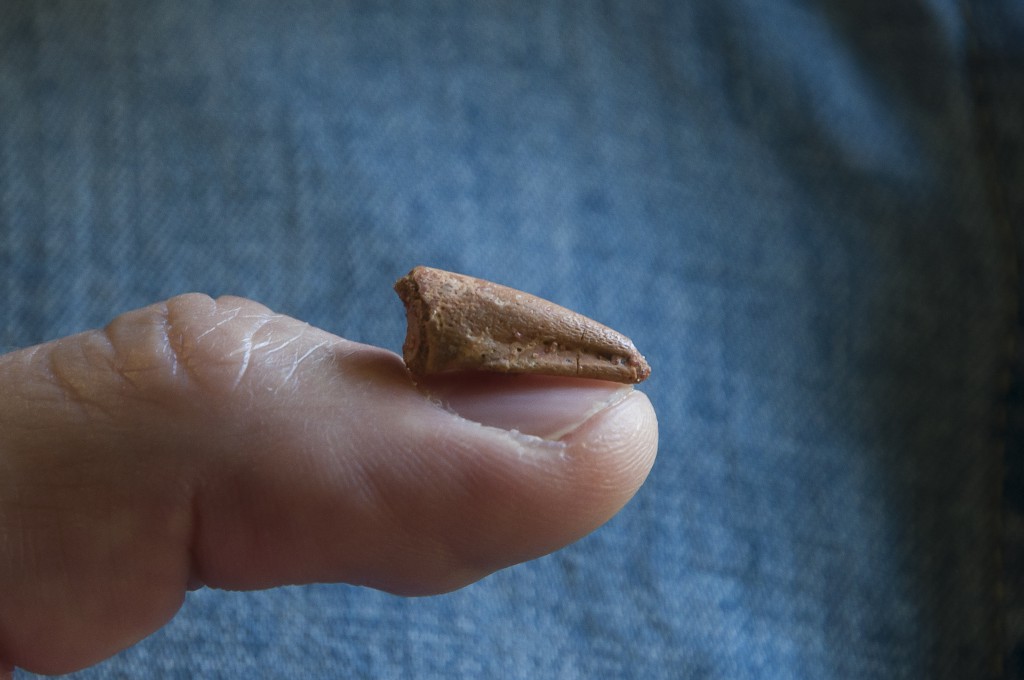
This tiny toe tip of a baby Spinosaurus reveals a surprisingly big piece of information about the famous dinosaur. (Credit G. Bindellini)

Big paleontological news can come in teensy packages, as shown by a new study on a fragment of a very young Spinosaurus, one of the most fascinating flesh-eating (in this case, fish-eating) dinosaurs.

You remember Spinosaurus, right? And I’m not talking about its cheesy guest role in the worst of the Jurassic Park sequels.

I’m talking about the animal believed to be the largest carnivorous dinosaur, lost to science in WWII and then rediscovered with a whirl of controversy over whether it was aquatic, semi-aquatic or even a legitimate species. Research earlier this year that provided further evidence Spinosaurus was primarily a fish-eater boosted the case for its watery ways, but its lifestyle choices continue to be contested by some paleontologists.

Well, it’s back in the news, this time in fun-size form.

Researchers this week described single ungual bone — essentially, the tip of one of the tiny toes on its back foot — as having a shape identical to the same bone in adult Spinosaurus.

That shape, suggesting feet that were flatter, broader and paddle-like, is distinctly spinosaurid and was one of the traits that led researchers to believe the massive sail-backed fish-eaters spent most if not all of their time in the broad river systems of North Africa during the middle of the Cretaceous period.

Some modern dinosaurs have a similarly shaped foot: shorebirds that walk on sandy beaches and other soft surfaces.

By analyzing pitting present on the bone that is seen in hatchlings (but disappears as the animal matures), the researchers believe the toe tip belonged to a very young Spinosaurus. Despite its age, if juvenile proportions are similar to those of adults, the animal was likely about 1.78 meters long; that’s about the height of the average American adult male.

The 100-million-year-old toe bit is not new to science; it was found in 1999 during an excavation of Morocco’s famously fossiliferous Kem Kem Beds and sat on a museum shelf in Milan for nearly 20 years.

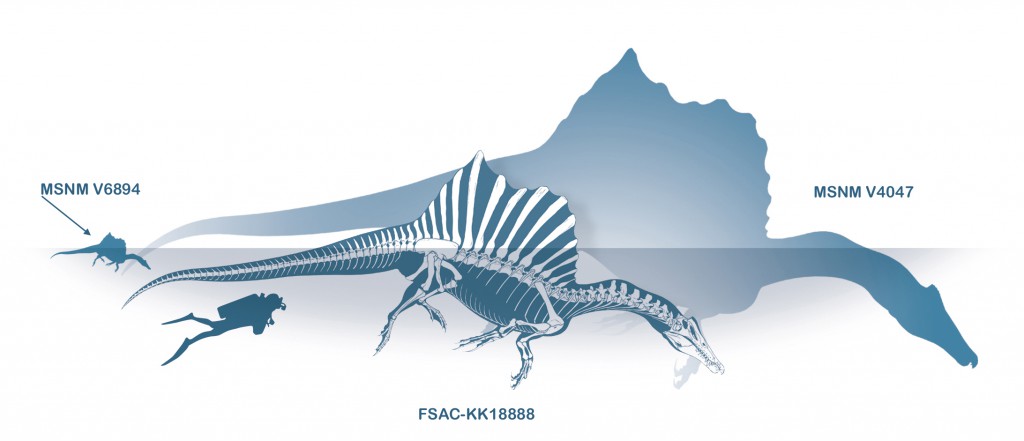
Size matters: compare this trio of Spinosaurus reconstructions based on fossil finds from Morocco: a baby, MSNM V6894, based on the newly described fossil, and two other examples, including the largest, MSNM V4047 (known from a snout fragment), with a puny human (1.75 m tall) for scale. (Credit Marco Auditore and Prehistoric Minds)

Though the poor little Spinobaby’s time on Earth was brief, it left a legacy: the adult-like shape of its specialized toe suggests that the juvenile Spinosaurus spent as much time swimming and shore-strolling as the big’uns.

Although fragmentary finds make it difficult to say with confidence, this little guy appears to be the latest example of a dinosaur that came into the world essentially looking like a mini-adult and grew to epic size.

The open access study was published this week in PeerJ.

Source: http://blogs.discovermagazine.com

Not all Dinosaurs are Extinct

Friday, June 1, 2018

Mesozoic maniraptoran dinosaurs that possess all kinds of bird-like and not-so-bird-like combinations of anatomical characters are published all the time. This reconstruction, by Emily Willoughby, depicts Serikornis from the Upper Jurassic of China. According to its describers, it is not a bird. Credit: Emily Willoughby Wikimedia (CC BY-SA 4.0)

One of the topics surrounding dinosaurs that often gets more than its fair share of attention is how they became extinct. While the event of their disappearance is so often the dramatic coda of books and documentaries, it might be surprising to know that the extinction of the dinosaurs is usually one of the least interesting questions out there to many paleontologists. Not only do we actually have a fairly good idea as to what happened at the end of the Cretaceous to cause such a big die-off, most of us in the paleontology world are much more concerned about how dinosaurs lived and evolved than how they died out.

Of course, not all the dinosaurs are extinct. Birds are just a group of feathery theropod dinosaurs that managed to pull through to the present day, and it’s much more tantalizing to ponder how modern birds were able to survive when all their close cousins died out. There’s all sorts of wonderful fossil birds filling in the spectrum between non-avian dinosaurs (those that aren’t classified as birds) and todays modern bird species. Some of these were really weird, like the fully aquatic four-foot tall “Hesperornis” with its wingless body, powerful swimming legs, and toothed beak. There was also a group of prehistoric birds called the enantiornithines, or ‘opposite ‘birds’. Despite having clawed wings and toothed beaks, these prehistoric birds were capable of flight, lived in trees, and probably would have looked very similar to today’s modern birds, which we call the neornithines. This lifestyle may have actually led to the downfall of most fossil birds. 
 
In a recent study published in “Current Biology”, Daniel Field and colleagues determined that at the time of the end-Cretaceous extinction, a significant amount of tree cover around the world was destroyed by the effects of the meteorite impact. This was determined by studying tree pollen in the late Cretaceous and noticing there was a significant drop in tree abundance during the time of the extinction event. This spelled bad news for most birds at the time, including the enantiornithines who were so dependent on living in trees for survival. 
 
However, the authors point out that the early neornithines, the ancestors of today’s birds, spent most of their time on the ground, finding food and shelter in the underbrush. Low-lying plants such as ferns and shrubs weren’t as badly affected by the meteorite disaster, and research by the Philip J. Currie Dinosaur Museum’s own Derek Larson has indicated that early modern birds were well adapted to eating seeds in the undergrowth. Here they were able to hunker down and survive, while the rest of the dinosaurs around them died out in the rapid environmental change. 
 
After the meteor event filtered out the creatures not destined for survival in the Paleocene world, the neornithines were quick to spread and diversify. Once the early modern birds had the skies to themselves, it didn’t take them long to branch out from meek ground-dwellers into the myriad of specialized forms we see today. It goes to show that today’s birds aren’t just beautiful to watch, they’re also hardened survivors and worthy successors of the dinosaur lineage. 
 
Reference: Field et al., Early Evolution of Modern Birds Structured by Global Forest Collapse at the End-Cretaceous Mass Extinction, Current Biology (2018), https://doi.org/10.1016/j.cub.2018.04.062

Source: www.dailyheraldtribune.com

Could Scientists Bring Dinosaurs Back to Life?

Friday, June 1, 2018

Crocodiles share a common ancestor with dinosaurs, so could they hold the key to bringing these extinct reptiles back? © Alias 0591 from the Netherlands/ Wikimedia Commons (CC BY 2.0)

Dinosaurs dominated Earth for over 140 million years before having their reign ended by a colossal asteroid impact.

Is it possible to bring these long gone reptiles back from the dead and, if we could, would we really want to?

Dr Susie Maidment, a dinosaur researcher at the Museum, explains just how difficult it would be to resurrect ancient reptiles Jurassic Park style.

Is Jurassic Park possible?

The classic concept for dinosaur resurrection starts with a DNA-filled mosquito that has been preserved in amber for millions of years. But is this a scientific possibility or strictly resigned to fiction?

Amber is tree resin that has fossilised due to high pressure and temperature, conditions experienced when spending thousands of years covered by layers of sediment. Over time the resin hardens to form a gemstone that has been coveted by humans for thousands of years.

The dinosaur DNA that could be preserved inside amber-entombed blood-sucking insects is of interest as DNA contains the genetic information for the growth and function of all living things. Could ancient DNA recovered from amber could serve as a genetic blueprint for recreating the extinct animals?

Susie says, 'We do have mosquitos and biting flies from the time of the dinosaurs and they do preserve in amber. But when amber preserves things, it tends to preserve the husk, not the soft tissues. So you don't get blood preserved inside mosquitos in amber.'

This Lebanese amber specimen dates back to the Early Cretaceous period. It is around 120 million years old.

This means that Jurassic Park is probably not possible exactly as Michael Crichton wrote it. But the search for dinosaur DNA doesn't end there. Blood residue has been found inside ancient insects - they just weren't found in amber.

'A couple of years ago a paper came out about a mosquito from the Eocene - that's around 45 million years ago, so around 20 million years after the dinosaurs died out. The mosquito was preserved in lake sediments and had a red pigment in its abdomen. When they tested that pigment chemically they discovered haemoglobin-derived porphyrins.'

These are the breakdown products of haemoglobin, which is the red protein that carries oxygen around the body in the blood of almost all vertebrates.

'The idea that we may one day find a mosquito or biting fly from the Mesozoic with some parts of the blood still preserved is not outrageous,' says Susie.

Blood but no DNA

When under specific circumstances blood does preserve, it doesn't mean that scientists will find DNA in it. So even if a dinosaur's blood was found inside an ancient insect, an opportunity to recreate the reptile from it isn't guaranteed.

In 2015, Susie and her colleagues discovered what they interpreted to be red blood cells inside a Cretaceous dinosaur fossil bone.

'We don't think it is from modern contamination. The blood cells have nuclei and you don't find those in mammals, so it must be a reptilian red blood cell. We compared it with red blood cells from birds and it showed some morphological similarities.

'We sectioned the cells using a focused ion beam, which is like a really high-powered, ultra-small knife and we stained the nuclei to see if there was any DNA - but we didn't find anything.

'Even if you find blood or soft tissue, you don't necessarily find DNA.'

Ancient DNA has so far been recovered from permafrost, as well as from subfossils - bones or body parts that have not yet fossilised.

But DNA is vulnerable and breaks down rapidly. Sunlight has negative effects and water can also accelerate deterioration. Modern contamination is also a problem. DNA has to be handled under strictly controlled conditions.

Currently the oldest DNA to have been found is around one million years old, although it is possibly younger. DNA 66 times older would have to be found to get to the age of dinosaurs.

Crossing dinosaurs with frogs

If dinosaur DNA were found, what happens next? If you work at Jurassic Park's genetic engineering facility you simply combine it with frog DNA and recreate an extinct reptile.

'In Jurassic Park, they say that they found fragmented DNA. They identified where the holes are and filled them with frog DNA. But the problem is that you don't know where the holes are if you don't have the whole genome,' explains Susie.

A genome is the complete set of DNA of a living thing. Without the full genome, it would be impossible to tell which parts of the DNA have been found and therefore impossible to fill the gaps to build a whole animal.

'But if you did have the whole genome and you were going to fill the holes in fragments, then you definitely wouldn't do it with frogs, because frogs are amphibians. If you were going to do it, you'd use bird DNA, because birds are dinosaurs. Or you might do it with crocodile DNA, because they share a common ancestor.'

Could we clone a dinosaur?

DNA breaks down over time. The dinosaurs went extinct around 66 million years ago and with so much time having passed it is very unlikely that any dinosaur DNA would remain today. While dinosaur bones can survive for millions of years, dinosaur DNA almost certainly does not.

But some scientists continue to search for it - just in case.

So it looks like cloning a dinosaur is off the table, but an alternate way to recreate the extinct animals would be to reverse-engineer one. This involves starting with a living animal and working backwards towards ancient reptiles, attempting to reverse at least 66 million years of evolution.

Susie explains, 'You could take a chicken and genetically engineer it so it has teeth or a long tail. But even if you do, it's not a dinosaur, because it was reverse engineered.'

However, recreating dinosaurs or any other extinct animal, can throw up some ethical dilemmas.

'You could be interested in the genetic basis for various living things or in sequences of correlated characters - for example if you grow teeth, do you automatically grow claws as well? But an animal that died out naturally, perhaps 150 million years ago, is not going to recognise anything in this world if you bring it back.

'What is it going to eat when grass hadn't evolved back then? What is its function, where do we put it, does anyone own it?'

An attempt to resurrect dinosaurs presents many caveats scientifically and ethically - making things to put in zoos or amusement parks like Jurassic World likely isn't the answer. So for now dinosaurs are probably going to remain safely in the past. But using genetic engineering to bring back extinct animals might be considered reasonable in some circumstances.

'I think there is potentially an argument for bringing back something that we humans made extinct. So if someone was going to bring back the passenger pigeon, then I think you could justify that. They were living in a modern ecosystem and could fit in.'

Jurassic Park may not have got dinosaur resurrection quite right, but nevertheless it did make one particularly worthy point, Susie concludes:

'As Dr Malcolm says in Jurassic Park - "just because you can, doesn't mean that you should."'

Source: www.nhm.ac.uk

Pages