Blogs

Worst 'Jurassic' Film Ever?: Here's What Critics Are Saying About 'Jurassic World: Fallen Kingdom'

Thursday, June 7, 2018

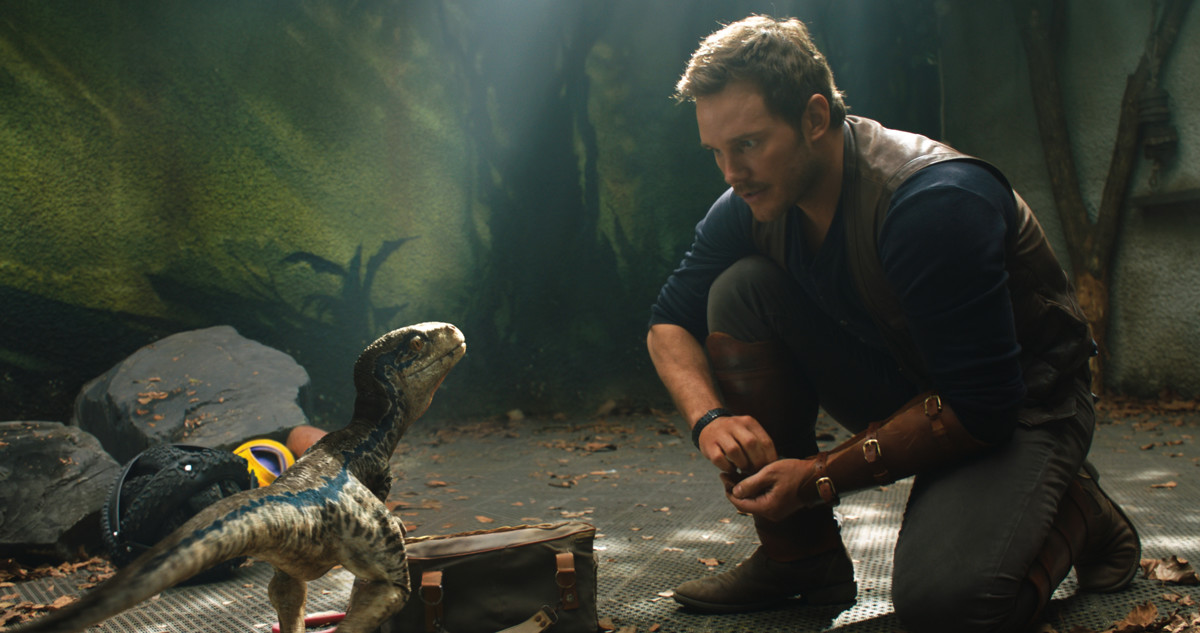
Owen (CHRIS PRATT) with a baby Velociraptor in "Jurassic World: Fallen Kingdom." When the island’s dormant volcano begins roaring to life, Owen and Claire (BRYCE DALLAS HOWARD) mount a campaign to rescue the remaining dinosaurs from this extinction-level event. Welcome to "Jurassic World: Fallen Kingdom." Universal Pictures

The first reviews for “Jurassic World: Fallen Kingdom” dropped already, and reviews are mixed.

“Fallen Kingdom” stars Chris Pratt and Bryce Dallas Howard, who return to the Jurassic World park to find it completely destroyed. Then, a once-dormant volcano erupts and causes everyone to scramble to save the dinosaurs.

J.A. Bayona directed the film, while Colin Trevorrow and Derek Connolly penned the script.

So what do critics think of the new film? The film, a direct sequel to the 2015 hit “Jurassic World,” has garnered a 69 percent on Rotten Tomatoes with an average critic rating of 6.1 out of 10.

The first “Jurassic World” has a 71 percent on Rotten Tomatoes with an average rating of 6.1 out of 10. Audiences, meanwhile, gave that film a 78 percent overall score.

We’ve collected some quotes from multiple reviews to share an idea of how it has been received so far.

Multiple reviewers said the film stuck to the “Jurassic World” and “Jurassic Park” template.

Phil De Semlyen of Time Out: “This fun, pacy addition to the dino disaster franchise doesn't do much that's particularly new — though what it does, it does with a fair whack of panache.”

Rafer Guzman of Newsday: “'Fallen Kingdom' sticks to the series' dependable template.”

Others said the new film improves the franchise’s catalog.

Molly Freeman of ScreenRant: “In 'Fallen Kingdom,' Bayona balances horror with action and adventure for some of the more thrilling sequences in the entire 'Jurassic Park' franchise.”

Emma Stefansky of Uproxx: “There is a little bit of the wonder and joy that made the original so special embedded deep within 'Fallen Kingdom,' which I credit to Bayona, whose primary drive ... has always been to sprinkle just enough emotion into the stories he tells.”

More critical writers said the plot falls apart and doesn’t make much sense, and characters are a little underwhelming.

Eric Kohn of IndieWire: “The franchise's latest entry takes its cues from the knuckleheaded plotting and CGI overload of 'Jurassic World,' where super-sized dinos face dumb capitalists and bleeding-heart environmentalists toil to save the day. We all know the drill.”

Matt Singer of ScreenCrush: “The only characters who behave rationally are the dinosaurs.”

Bilge Ebiri of Village Voice: “It all just hangs there like so much else in this movie, undeveloped concepts that could one day be turned into a genuinely exciting, surprising film. 'Jurassic World: Fallen Kingdom' is, sadly, not it.”

One reviewer, Pajiba’s Kristy Puchko, said it was the worst “Jurassic” film ever.

“‘Jurassic World: Fallen Kingdom’ gives us no heroes worth rooting for. No action sequences that will stick with us the way (Steven) Spielberg’s did. What it offers are lazy re-creations, lazier screenwriting, and sneering disrespect for our love of the original. I did not think I could hate a 'Jurassic Park' movie more than I hated the last. But here we are. Trevorrow found a way.”

However, the film appears to be a classic thrill ride that improves on the predecessor.

John DeFore of The Hollywood Reporter: "Audiences put off by some dumb characterizations in the last film have much less to complain about here, while those requiring only some spectacular predators and exciting chase scenes should greet this outing as warmly as its predecessor.”

Source: www.deseretnews.com

Dinosaurs After ‘Jurassic Park’: Paleontologists on What’s Changed, 25 Years Later

Monday, June 18, 2018

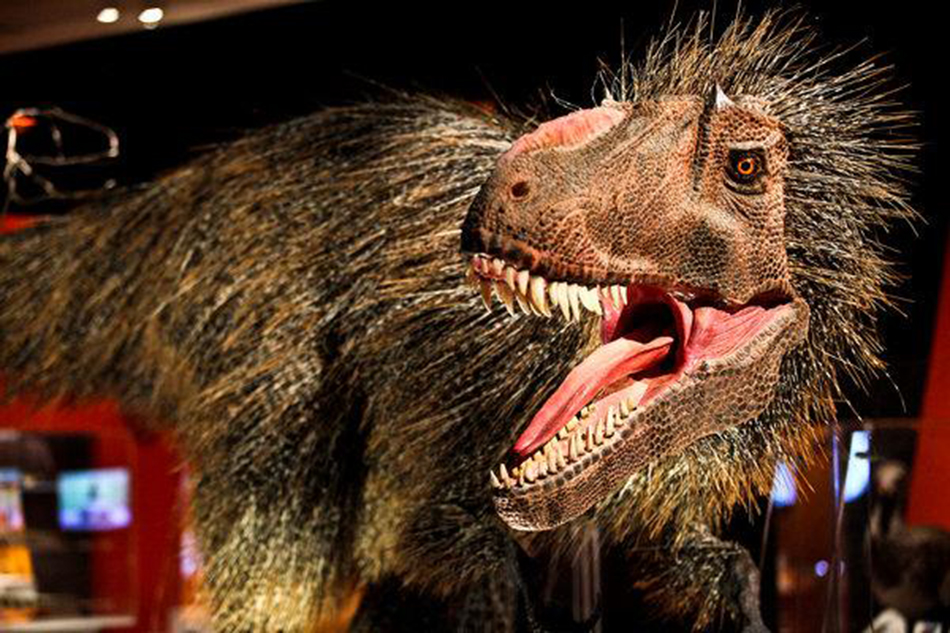
Yutyrannus huali, a feathered tyrannosaur discovered in China, at the American Museum of Natural History in New York. EDEN, JANINE AND JEN UNDER ATTRIBUTION 2.0 GENERIC (CC BY 2.0)

25 years ago, on June 11, 1993, Jurassic Park premiered in theaters across the United States. The film was indomitable from release, its financial success and enduring place in the culture assured. Princess Diana attended the London premiere. A thousand products made by a hundred companies—video games, figures, sleeping bags, fanny packs—were timed to the release, at the time the second widest ever, with only Batman Returns shipping more prints to theaters.

Despite opening like a monster movie—an armored crate emerges from the fog, the mysterious monster inside screeching and snorting—Jurassic Park was conceived, from its origins as the latest in a long line of Michael Crichton technothrillers (“I was writing the most expensive movie ever made,” Crichton would jokingly tell people before Steven Spielberg bought the movie rights for $1.5 million), with scientific fidelity in mind. Spielberg wanted to show people real dinosaurs, as they lived in the Mesozoic Era.

“This isn’t The Beast from 20,000 Fathoms, you know?” Spielberg said from the London premiere red carpet, referencing a 1953 movie about a city-stomping lizard awoken by an atomic bomb test. “This is really a movie that I think is really happening as I’m watching it.”

He wasn’t alone. A whole generation of paleontologists can describe just where they were when they first saw Jurassic Park and just what it meant to them.

Kristi Curry Rogers Ph.D., Professor in the Biology & Geology Departments of Macalester College, was an undergraduate at Montana State University in 1993. Her advisor: Jack Horner, a paleontologist who discovered the duck-billed Maiasaura and described its nurturing nesting habits, part of a wave of revisionist research that dramatically recharacterized animals once seen as slow, dumb lizards. A technical advisor on Jurassic Park, Horner secured a Bozeman premiere for the movie. “It was some of Jack’s discoveries of dinosaur nesting sites in Montana that really prompted my first interest in paleontology as a kid,” Rogers told Newsweek.

“I was a first-year college student,” Rogers said. “I got to see the movie with Jack.” That same summer, Rogers began fieldwork at Egg Mountain, the bonebed where Horner made some of his most consequential discoveries. The dig site became the basis for Snakewater, Montana, where Jurassic Park founder John Hammond (Richard Attenborough, who Spielberg convinced to take up acting again after a 15-year hiatus) first invites Dr. Alan Grant (Sam Neill) and Dr. Ellie Sattler (Laura Dern) to inspect his “biological preserve” and “maybe even pen a wee testimony.”

“It was the first time in a long time a pop culture venue actually seemed to take the science seriously and take the animals seriously. And they accomplished that with very little embellishment,” Thomas Carr Ph.D., Associate Professor of Biology and Director of the Carthage Institute of Paleontology told Newsweek.

When Jurassic Park came out, Carr was working on a senior thesis focused on Tyrannosaurus growth, a subject that continues to animate his work. He remembered one shot in particular—the escaped T.rex stepping in front of a Jeep, its immense body visible through the windshield—as a “magical moment.”

“It carried me away,” Carr said. “It does the animals justice.”

“I think most of us felt our hearts flutter when we saw the scene with the Ornithomimus running across the field,” said Karen Chin Ph.D., Associate Professor and Curator of Paleontology at University of Colorado, Boulder. “We’ve been working on dinosaurs for so long and we’ll never see them in their natural habitat. That’s a scene you would expect to see if you were transported back in time by a time machine: a herd of dinosaurs, perhaps startled by something.”

Others were still a bit too young. “I was not liking the scary dinosaurs,” Caleb Brown Ph.D., a postdoctoral researcher at Canada’s Royal Tyrrell Museum of Paleontology in Drumheller, Alberta, recalls of his first viewing. “A lot of people in paleontology who are my age or slightly older were almost all influenced to get into the field because of Jurassic Park. I’m kind of the opposite. I liked dinosaurs before that, but it almost put me off them because it was so scary.”

And Jurassic Park didn’t get everything right. The Brachiosaurus was too big. So were the Velociraptors (that annoying kid who compares the predator to “a six-foot turkey” would be closer to the real scale, if only he dropped the “six-foot”). It’s not true that T.rex “visual acuity is based on movement,” as Grant says. (“That poor kid,” one paleontologist commented. “If that were a real T.rex that kid would have been sensed and eaten instantaneously.”)

Even that pile of poop was too big.

“When I first saw that scene I just burst out laughing, I think what they meant was they had kind of shoveled it all together?” Chin said. An expert in coprolites, or fossilized feces, the largest dung mass Chin has seen was between 7-9 liters in volume, just enough to overflow a dutch oven. “It’s quite possible the sauropods produce a larger fecal mass,” she said.

But Jurassic Park wasn’t going for perfect realism, nor would perfect realism have been possible. Technical advisers like Horner and Robert T. Bakker, an early proponent of swift, warm-blooded dinosaurs, were able to offer the most up-to-date science, but there’s a limit to our understanding. There was no way to get everything right, and in some ways it wasn’t supposed to, something Spielberg knew. “There’s a mystery about dinosaurs. I think that’s why the uncovering of bones in Montana or in Canada or wherever they find dinosaur bones today, is like a great mystery. What we did with this was, we sort of fleshed them out,” Spielberg said at the London premiere. At a certain point, choices become more about storytelling than scientific extrapolation.

“The sauropod eyes look like cow eyes and the Velociraptor eyes look like lizard eyes. And T. rex eyes kind of look like the eyes of a lion,” Rogers said. “There are all of these subtle things, if you’ve seen Jurassic Park as many times as I have, there are all these subtle hints of how we are supposed to feel.” (Rogers said she’s seen Jurassic Park 10 times, but after some reflection upgraded to “12, maybe more.”)

Where some dinosaurs were designed to remind us of more familiar animals with anthropomorphic associations, others were tweaked to feel more alien, particularly the Dilophosaurus that kills Dennis Nedry (Wayne Knight).

“A little hopping creature that spits venom and has a big neck frill: that was created for the movie,” John Scannella Ph.D., the John R. Horner Curator of Paleontology at the Museum of the Rockies in Bozeman said. “It’s so fantastical, but that helps raise questions about what possible things could these animals have going on that we wouldn’t necessarily know about? How would we find evidence of that in a fossil?”

“I love the film, I’m not going to sit and nitpick about it,” Stephen Brusatte Ph.D., an Associate Professor in the School of GeoSciences at the University of Edinburgh and author of the recently released The Rise and Fall of the Dinosaurs told Newsweek. "Jurassic Park is probably the best thing that ever happened to paleontology.”

But while Jurassic Park depicted dinosaurs as close to the true state of paleontological understanding in 1993, the field has changed a lot in the intervening 25 years. New technology, new research and new discoveries have expanded our understanding of not just individual dinosaur species, but an entire ancient ecosystem of astounding diversity and complexity.

Feathers

Though feathers have yet to infiltrate the Jurassic Park sequels, the connection between dinosaur and birds was in the series from the very beginning. When Grant speculates, “maybe dinosaurs have more in common with present-day birds than they do with reptiles,” he was voicing a growing consensus in the field, Jurassic Park once again situating itself right on the frontier of the science. And though a narrow clade of feathered species, including Archaeopteryx, pointed to the evolutionary continuity between dinosaur and birds, widespread dinosaur feathers were still just a supposition.

That changed in 1996, when Li Yumin, a farmer and amateur fossil hunter, uncovered Sinosauropteryx in China’s Liaoning Province, where volcanic ash from Mesozoic eruptions preserved spectacular fossils. Sinosauropteryx was a bipedal predator and close relative of the Compsognathus (seen in Jurassic Park sequel The Lost World killing Peter Stormare), smaller than a house cat, believed to feed on small lizards and mammals. It was also covered in short feathers, close to the thickness of fur, but likely coarser. We even have an idea what color it was: reddish-brown, its tail striped with chestnut and rust.

Sinosauropteryx was just the beginning. Further discoveries made in Liaoning’s Yixian Formation included dinosaurs with not just feathers, but wings. “They probably couldn’t fly, but instead used them for display,” Brusatte said. What had once been theoretical now has extensive fossil evidence. New research even pointed to feathered, fully-plumed Velociraptor.

“Now it’s almost a common occurence to find feathers on dinosaurs and it further strengthens the link between non-avian dinosaurs and birds,” Scannella said.

“Meateaters, by and large, had feathers, but not all of them,” Carr said. “Things like T.rex were actually scaly, not feathery. And that was normal for dinosaurs. The big theropods (bipedal predators, including the raptors), StegosaurusAnkylosaurus.” But while not all dinosaurs were feathered, Carr pointed out an essential difference in our new understanding: unfeathered dinosaurs likely represent evolutionary reversals from their feathered predecessors. Carr pointed to the discovery of a feathered tyrannosaurid, once again in Liaoning Province—not Tyrannosaurus rex, but Yutyrannus huali, which was “only” 30 feet long and 3,000 pounds—as evidence toward large, featherless predators having reversed from feathered forebears.

The conversation has essentially flipped, with dinosaurs now often discussed as presumptively feathered, with a deepening fossil record pointing to the evolution of feathers in a common ancestor to pterosaurs (winged reptiles) and dinosaurs. Which means, as much as Jurassic Park sequels may not want to embrace the feathers, the fuzzy, plumed dinosaur isn’t going away. Instead, they’ve become as central to our modern understanding of dinosaurs as was the warm-blooded, nurturing animals of Bakker, Horner and John Ostrom’s “Dinosaur Renaissance” in the decades leading up to Jurassic Park.

“Why not show accurate dinosaurs?” Carr asked. “Hell, I’d say a feathery Velociraptor that could do a short glide, that’s a scary animal. Why not?”

Dinosaurs are like Birds

Dinosaurs are like Crocodiles

Dinosaurs are like Dinosaurs

While modern-day birds are dinosaurs, there’s another category of living vertebrates that also bear comparative similarities to dinosaurs: the crocodilians. Rather than evolving from dinosaurs, like birds, the evolution of crocodilians split off early in the Triassic, to form a clade known as Pseudosuchia.

“They were doing a greater range of body sizes and behaviors. There were crocodiles the size of buses, some that ate plants, some covered in armor and spikes and some that walked on two legs,” Brusatte said. “The dinosaurs were playing second fiddle to them.”

But 200 million years ago, at the end of the Triassic, there was another mass extinction event—probably a combination of factors, including supervolcanoes, the resulting runaway global warming and the breakup of the supercontinent Pangaea—that wiped out the Psuedosuchia, all except a narrow group of crocodilians.

The close evolutionary lineage of the crocodiles makes them a useful comparison point for understanding dinosaurs. Modern techniques, like high-resolution CT-scanning, have enabled paleontologists to reach astoundingly specific behavioral conclusions.

“Tyrannosaur facial skin is highly innervated, and we know that because the entire snout is shot through with really tiny holes that allowed nerves through to skin to bring the sensation of touch back to the brain,” Carr said, comparing the complex weave of nerve canals running from its brain to facial skin to the snouts of alligators, crocodiles and caimans.

With facial skin more sensitive than human fingertips, Tyrannosaurus likely used its head for far more than scent and a powerful bite. Like crocodiles, high facial sensitivity would have made them sensual animals, prone to communicating by touch. “It’s not hard to imagine that tyrannosaurs would have used their snouts in the same way,” Carr said. “They will be rubbing snouts with each other, they will be monitoring their nest, they will be touching carcasses they’re feeding on.”

With birds in their direct lineage and crocodilians as close cousins, a diagnostic practice known as “extant phylogenetic bracketing” has deepened our understanding of dinosaurs since Jurassic Park. In extant phylogenetic bracketing, an extinct taxon is compared to, and bracketed by, its nearest living relatives. The method, introduced in 1995 by Lawrence Witmer, Professor of Paleontology at Ohio University, allows researchers to infer traits to an extinct species, by looking for traits common to the living relatives that bracket it. Extant phylogenetic bracketing provides a common framework and set of standards for paleontologists extrapolating from the present for insight into these distant past. These inferences can be scaled to various confidence-levels based on the strength of bone or soft tissue evidence available and whether a proposed trait, such as warm-bloodedness, matches with one or both bracket taxons.

“We always try and frame our arguments, especially about things that aren’t so easy to preserve in the fossil record, using this comparative model,” Rogers said. “Sometimes dinosaurs are more like crocodiles than they are like birds, and sometimes more like birds. We really need to think about dinosaurs as dinosaurs.”

Rogers offered dinosaur growth rates as an example. “All dinosaurs grow faster than living reptiles, some of them grow more than 50 times faster than living reptiles,” she said. Yet, no dinosaur growth rate has been discovered that matches the much-faster growth rate found in birds. The slower and faster growth rates on either side of a dinosaur’s phylogenetic bracketing form theoretical bounds.

“Comparative method helps us find the places where they are uniquely dinosaur,” Rogers said. “Dinosaurs are different, they’re doing their own thing.”

Which means there’s always room for the unexpected.

CAT Scans and the Rise of Molecular Paleontology

Jurassic Park had its own vision of the future of paleontological fieldwork. “A few more years development and we won’t even have to dig anymore,” a technician says in the film, excited at the prospect of sonar imaging in the field. But that never really came to pass.

“It’s still pretty basic, it’s still jackhammers, we don’t use any fancy sonar,” Rogers said. “But mapping techniques have gotten more specific. GPS is really important to people in the field.”

But if digging up dinosaur bones remains low-tech, the same can’t be said of lab analysis techniques developed since 1993. CT scans, which computer-process multiple X-ray measurements into virtual “slices” of a 3D object, like a dinosaur skull, have become a major driver of new discoveries.

"If we CAT scan the skulls of dinosaurs we can build digital models of the brain, of the ear, of the blood vessels and all the things that are hidden in the head,” explained Brusatte.

From dinosaur cochlea, paleontologists can extrapolate the sound-space in which individual dinosaur species existed. Their immense olfactory bulbs have granted researchers insight into the primacy of smell in the lives of raptors and tyrannosaurs.

In 2007, Prof. Mary Higby Schweitzer and her colleagues announced the discovery of proteins recovered from the fossilized femur of a Tyrannosaur rex. Paleontologists had previously believed fossilization didn’t preserve cellular structures. Now a variety of biochemical markers can be extracted from dinosaur fossils, including protein fragments called peptides, amino acids and nucleotides.

“We are learning things about dinosaurs we thought we would never be able to tell for certain,” Schweitzer told Newsweek. “We have learned a lot about how things preserve, what kinds of information fossils can yield at the molecular level, and new ways to analyze dinosaur tissues.”

“It’s opened up a whole new field of, basically, biochemistry for dinosaurs,” Carr said. “She just thought about fossils in a different way.”

A Quick Aside About Cloning

The Jurassic Park scenario—recovering dinosaur DNA from mosquitoes trapped in amber—no longer seems viable. The blossoming of molecular-scale paleontological research has lead to a disappointing conclusion: DNA and RNA strands simply don’t survive for millions of years.

Horner’s 2009 book How to Build a Dinosaur proposes an alternate strategy: awakening dormant genes in modern birds and reversing evolution, trait-by-trait. In 2015, scientists identified and activated a gene in chickens that matched “ ancestral fossil forms,” creating a chicken embryo with a dinosaur-like snout instead of a beak—the first step toward a “chickenosaurus.” It’s still uncertain whether enough of these atavistic genes can be found and activated within the chicken genome to fully recreate an extinct species.

Growing up Dinosaur

Studying microscopic structures in dinosaur bones, known as histology, has become a commonplace paleontological practice, a change from the more anatomical and taxonomic focus of generations preceding Jurassic Park. One particularly promising new technique is microscopic examination of what Brown described as “lines of arrested growth,” where minute variations in the cellular structure of a dinosaur bone seem to correlate to annual growth cycles, giving deeper insights into how dinosaurs grew and what they looked like at various life-stages.

“There’s been a lot more research looking inside bones to examine the microstructures and see how bones are remodeling and transforming as these animals grew,” Scannella said. “Now it’s clear dinosaurs underwent very dramatic transformations as they grew from babies to adults. A baby T.rex probably looked very different than the adult.”

Combine this refinement in research with an ever-deepening fossil record and you’ll find the basis of the several headline cases of multiple dinosaur species collapsed into a narrower grouping, most famously Triceratops and Torosaurus, now believed to be younger and older examples of the same genus.

The International Dinosaur

Headline-grabbing finds in Liaoning Province have made China the epicenter of global paleontology. “China is the place where the most and the most exciting discoveries are happening right now, probably half, if not more. But people are finding dinosaurs all over the world now,” Brusatte said. “One species a week, which is just nuts. It’s a crazy pace.”

Major finds in Mongolia, Argentina, Brazil, even north of the Arctic Circle have made paleontology more international, resulting in both a widespread collaborative network of researchers and a large enough data set to better understand the total Mesozoic ecosystem, which could provide insight into some of the biggest unanswered questions in paleontology.

For example, was the boloid that struck Mexico’s Yucatán peninsula solely responsible for the death of the dinosaurs? While an asteroid or meteor striking the Earth at the same time the dinosaurs went extinct seems like more than coincidence, there are many different possible interpretations of the catastrophic event. “Were they already on the way out? Or were they moving along just fine and then KABAM, they’re done?” Brown asked, characterizing the open questions that remain.

“There are still so many things to do and so many things to discover. The field is far from finished,” Rogers said. “I’m constantly struck by how many exciting, new things we learn every time we ask a new question or use a new tool.”

Paleontology Survived “Jurassic Park”

In a 1993 issue of The New York Review of Books, Stephen Jay Gould, the paleontologist and popular science writer, fretted over the potential downsides of over-popularizing a scientific field. He writes:

“For paleontologists, Jurassic Park is both our greatest opportunity and our most oppressive incubus—a spur for unparalleled general interest in our subject, and the source of a commercial flood that may truly extinguish dinosaurs by turning them from sources of awe into clichés and commodities. Will we have strength to stand up in this deluge?”

Gould’s concern was not entirely unfounded. There have been downsides, notably a sprawling black market for dinosaur fossils. In 1997, the largest and best preserved Tyrannosaurus rex ever discovered, nicknamed Sue, was auctioned by Sotheby’s and sold for $8.3 million to Chicago’s Field Museum of Natural History. However, many specimens wind up in private hands and inaccessible to researchers.

“Dinosaur fossils on private land in the United States do not have any legal protection,” Carr said, “oftentimes they make it to market.”

Despite dedicated efforts by countries like Mongolia to repatriate fossils smuggled out of the country and sold in black markets, there’s only so much paleontologists can accomplish against buyers who have transformed dinosaurs into luxury market items.

“Fossils are information and when they buy fossils they’re depriving humanity from learning about dinosaurs. Because we don’t know everything!” Carr added. “I can get 11,000 data points from a singleTyrannosaurus skull. So there’s a dozen privately-owned T.rex, so I lose 132,000 data points because those fossils aren’t in real museums.”

While Jurassic Park has helped transform dinosaurs into objects of private desire, Gould’s more spiritual concerns—that our awe will fade—now seem unfounded. A generation later, paleontology is more vibrant than ever, thanks in part to the influx of new scientists whose imaginations were set aflame by the movie.

“More jobs, more funding, that came from Jurassic Park,” Brusatte said. “I don’t think we can overstate how important that was to paleontology. I probably wouldn’t have my job and a lot of my colleagues wouldn’t either.”

And though they’ve been extinct for tens of millions of years, understanding dinosaurs could help us understand ourselves. “They were enormously successful. They survived periods of global warming and global cooling, changing CO2 levels, continental shifts, changing food sources and changing habitats. They adapted to a range of conditions humans have not yet seen,” Schweitzer pointed out. “It behooves us to use every method and tool and source of information at our disposal to see just exactly how they rose to these challenges."

Source: www.newsweek.com

Rare Footprints Found in Chinese Village Reveal Dinosaurs’ ‘Social Activities’

Tuesday, June 19, 2018

Rare footprints found in Chinese village reveal dinosaurs' 'social activities' - Global Times

About 300 footprints discovered in hilly Shandong village.

Over 300 dinosaur footprints from seven species, including the same species of the dinosaur named "Blue" in the film, Jurassic World: Fallen Kingdom, were found in a village in East China's Shandong Province.

The dinosaur tracks, which include around 70 footprints of dromaeosaurid, a two-legged feathered dinosaur, confirms for the first time that the species lived in groups, Xing Lida, a dinosaur footprints expert at Beijing-based China University of Geosciences, told the Global Times on Monday.

"The diversity in the site is also remarkable. Footprints of birds and seven dinosaur species, including animal- and plant-eating ones, were spotted together," said Xing, who first investigated the site in April last year.

"Normally only one or three dinosaur species could be found at a site," he added.

The site, which sits in a mountainous area in Shandong's Tancheng county, is in well-preserved, though the site has no protection at all, Tang Yonggang, a well-known "dinosaur hunter" and a visiting professor at Linyi University in Shandong, told the Global Times after visiting the site on Monday.

The four trackways, each footprint about 8 centimeters long, suggest the dinosaurs traveled together, a typical sign that they lived in groups, Xing said.

Feathered dinosaurs or dromaeosaurids range in length from 0.7 meters to over 6 meters. They first appeared in the mid-Jurassic Period (167 million years ago) and survived until the end of the Cretaceous (65.5 million years ago) period, according to online database Encyclopedia of Life.

"Although the film's depictions of dinosaurs - that they are highly intelligent and capable of showing empathy - are imaginary, the species are indeed agile and smart. They could be at the top of the food chain if they acted in groups," Xing said.

Footprint clues

Footprints and fossilized bones are the two major sources of dinosaur study, scientists said.

"Footprints can tell the dinosaur's movements, such as whether it is running or walking and at what speed. They can suggest geographical conditions, such as whether a place is wet or dry, in mountainous areas or along waterways, and help the study of the species' evolution and migration by comparing them to footprints found elsewhere," Xing added.

"They can also reveal the dinosaurs' social activities, such as whether they were swimming, from the shape, shade and arrangement of the footprints," Tang said.

Scientists said that although China has found dinosaur footprints in over 100 places, many are not well-preserved due to lack of funding or natural conditions.

Dinosaur footprints are normally protected on site and require ventilation and drainage, Xing said. Another preferred manner is to build a digital model of the footprints, which means the footprints could be printed using 3D printers even after being damaged, Xing told the Global Times on Monday.

Tang said since a dinosaur's footprint could be as large as 80 centimeters in diameter and the footprints could stretch miles, it is quite challenging to preserve the tracks because of weather conditions and landslides.  

Businessmen also target the footprints and fossils.

A nine meter-long skeleton of an unidentified type of dinosaur was sold at an auction in Paris for more than $2.3 million on June 4, Reuters reported. For dinosaur tracks, the online price for one piece ranges from around $50 to over $1,000. China has pioneered in the study of dinosaurs, including samples and scientific research, but it also needs to better preserve fossils and footprints, especially in rural areas, Tang said.

Experts from China and Greece started joint preservation work on more than 170 dinosaur footprints discovered in a Beijing suburb, the Xinhua News Agency reported in May. The footprints were believed to have been left by dinosaurs that lived 140 to 150 million years ago in the late Jurassic Period.

Source: www.globaltimes.cn

T-Rex Model to Bring Terrifying Predator to Life at Dinosaur Museum

Tuesday, June 19, 2018

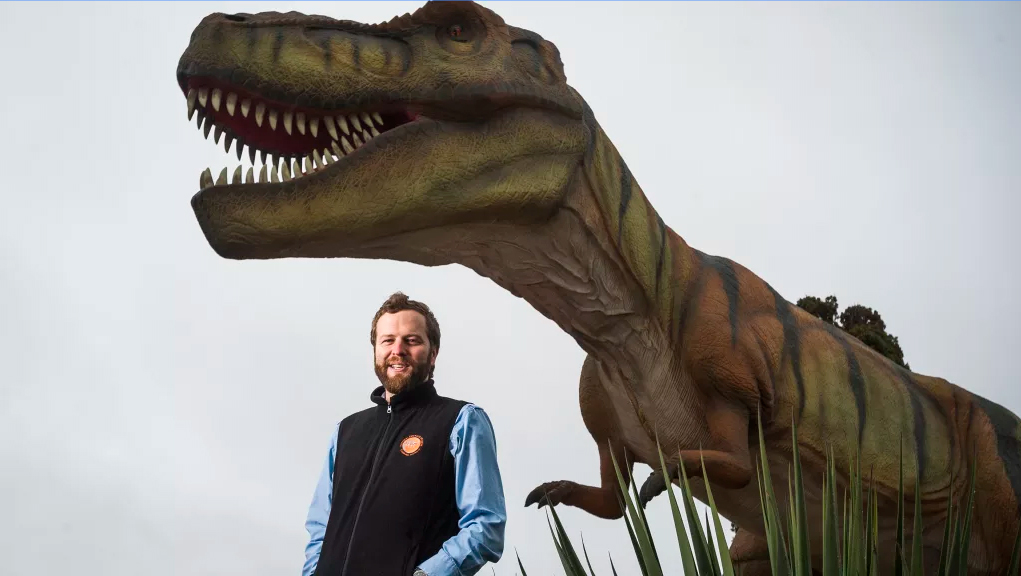
Ben Wardle is excited to announce the new T-Rex model at the popular National Dinosaur Museum.  Photo: Dion Georgopoulos

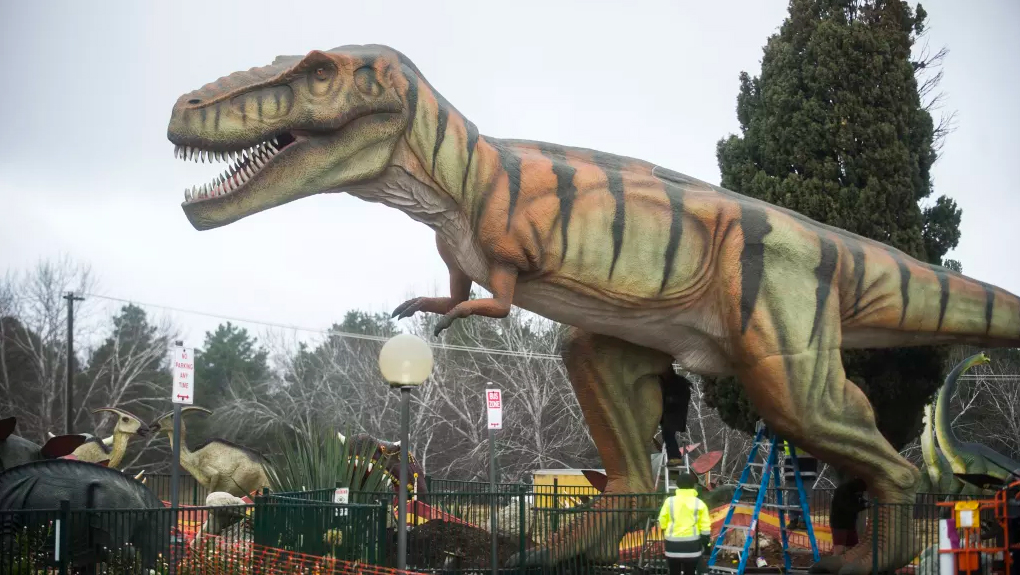
An eight-metre high, 20-metres long Tyrannosaurus rex newly-installed at Canberra's popular dinosaur museum would have towered above the real thing millions of years ago.

The new animatronic version of the species that terrified its Cretaceous prey stands outside the attraction greeting visitors as a temporary addition to its collection of models.

Children at the neighbouring daycare centre have watched at the fence as the T-Rex took shape while a crane helped assemble its body, according to National Dinosaur Museum manager Ben Wardle.

“It is the biggest thing to happen at the museum in a long time – no pun intended,” he said.

“Dinosaurs grab the imagination of kids, they get taken away by it."

The new dinosaur model, the largest in Australia, was designed to be what “the public expected to see”.

“This is probably an outdated image... there is a lot of evidence to these dinosaurs being feathered,” Mr Wardle said.

But this meant museum staff could talk about differences between dinosaurs in movies, and how science imagined them.

The T-Rex will be larger than its real life counterparts once were, at up to six metres tall and 12 metres long.

The model is 20 metres long and was assembled with a crane.  Photo: Dion Georgopoulos

It came in several parts, and museum staff helped piece the giant beast together. The Tyrannosaurus is made of a large steel frame, weighs 3.8 tonnes and is coated with silicon rubber.

Staff hand-stitched the tail, legs, body and head together, using more than 10,000 stitches.

The animatronic T-Rex will help mark the museum’s 25th anniversary, and the same milestone since audiences first saw the species chase the hapless humans of Jurassic Park.

While the museum's new T-Rex doesn’t have a nickname, Mr Wardle said it would get one when it was installed.

The museum, which has 23 complete skeletons and more than 300 displays of individual fossils, will have the model for between six and 12 months before it is moved on.

Source: www.canberratimes.com.au

Girl Meets Dinosaur She Designed in Coloring Contest

Sunday, June 17, 2018

Marissa France, 12, met the dinosaur on Saturday she designed at the North Carolina Aquarium at Fort Fisher as part of a dinosaur coloring contest.

A full-size, animatronic stegosaurus, colored with green, yellows, and purple hues was the final result of France’s watercolor design.

“It was really surreal because I’m thinking, wow, I drew that, and now it’s in person, it’s really cool,” said France.

France’s design was selected out of more than 60 entries. She received a prize kit from the North Carolina Aquarium at Fort Fisher as part of her win.

“My parents are both artists, it runs in the family,” said France. “I love doing art. It’s all I ever do in school. It’s all I can ever think about. I love music, I love art, I love anything that has to do with art pretty much.”

Copyright 2018 WECT.

Electrorana limoae: Burmese Amber Preserves 99-Million-Year-Old Tropical Frogs

Saturday, June 16, 2018

About 99 million years ago, a tiny juvenile frog in what is today Myanmar was suddenly trapped in sap with a beetle, perhaps its intended next meal. Image credit: University of Florida, Gainesville.

In a paper published this week in the journal Scientific Reports, paleontologists have described an extinct genus and species of frog, Electrorana limoae, preserved in mid-Cretaceous (99 million years old) amber from Myanmar.

Four amber-preserved specimens of Electrorana were acquired in the area of Angbamo in Kachin Province of northern Myanmar in 2015.

They provide the earliest direct evidence of frogs living in a wet tropical forest ecosystem and are oldest-known examples of frogs preserved in amber, with the only two previous reports from Cenozoic amber deposits of the Dominican Republic.

“It’s almost unheard of to get a fossil frog from this time period that is small, has preservation of small bones and is mostly 3D. This is pretty special,” said co-author Dr. David Blackburn, associate curator of herpetology at the Florida Museum of Natural History.

“But what’s most exciting about this animal is its context. These frogs were part of a tropical ecosystem that, in some ways, might not have been that different to what we find today — minus the dinosaurs.”

Photographs of four fossil frog specimens referred to Electrorana, including the holotype (A) and three additional specimens (B-D); specimens in (B) and (D) are presented with two views of the amber specimen and the oval in (D) indicates the presence of the frog specimen. Scale bars – 5 mm. Image credit: Xing et al, doi: 10.1038/s41598-018-26848-w.

Electrorana limoae is a very small frog, about 0.8 inches (2.2 cm) in snout-vent length.

Clearly visible in the amber are the frog’s skull, its forelimbs, part of its backbone, a partial hind limb and the unidentified beetle.

Electrorana raises more questions than it answers,” Dr. Blackburn said.

“Many characteristics herpetologists use to discern details of a frog’s life history and determine how it’s related to other frogs are either missing or were not yet fully developed in the juvenile frog.”

“The existing bones provide clues about Electrorana’s possible living relatives, but the results are puzzling: species that have similar features include fire-bellied toads and midwife toads — Eurasian species that live in temperate, not tropical, ecosystems.”

“The discovery of Electrorana helps add to our understanding of frogs in the Cretaceous period, showing they have inhabited wet, tropical forests for at least 99 million years,” the researchers said.

_____

Lida Xing et al. 2018. The earliest direct evidence of frogs in wet tropical forests from Cretaceous Burmese amber. Scientific Reports 8, article number: 8770; doi: 10.1038/s41598-018-26848-w


Source: www.sci-news.com

11 of the Worst Dinosaur Movies

Saturday, June 16, 2018

Jurassic World was a not-so-surprising hit, rebooting a classic franchise for the modern era with all of the reptile-ranching ruckus we’ve come to expect. The sequel looks to up the ante, spreading the prehistoric mayhem to the outside world with all of the corporate hijinks and wild effects we’ve come to love.

But dinosaurs aren’t a secret ingredient that makes every movie good. It may seem hard to believe, but there are indeed films out there that feature prehistoric reptiles and still suck. Can you imagine how difficult that must be, to have the coolest animals that ever walked the earth at your disposal and still make a wack flick? The eleven directors we’re about to introduce you to pull it off. Let’s excavate a cinematic Hall of Shame of terrible dinosaur movies.

Carnosaur

Roger Corman’s career is studded with rip-offs and cash-ins, and it made him rich. Just a month before Jurassic Park hit theaters, the Corman-produced Carnosaur debuted on the big screen to draft off a little dino-mania. This atrocious cheapie stars Diane Ladd as an insane poultry scientist injecting dinosaur DNA into chickens to make them grow bigger. Instead, she gets a mutant dinosaur that hatches from an egg and goes on a low-budget killing spree. Throw in a secondary plot about an airborne virus that makes human women get pregnant with dinosaur fetuses and you have a bizarre, incoherent mess that somehow still spawned two sequels.

Raptor Ranch

Bearing the Lorenzo Lamas seal of quality, this 2012 mess is like a backwoods Jurassic Park. When a reclusive rancher somehow manages to breed dinosaurs, one escapes and starts murdering people, as you do. The FBI gets called in and the only person who can save us all is a waitress named Abbi. Horrible CGI dinosaurs are just the tip of the iceberg for what’s wrong with this movie – they look like the cutscenes for a PS2 game and can’t really interact with any of the live actors. Throw in endless, suspense-free chase scenes and you get a tremendous waste of time.

A Nymphoid Barbarian In Dinosaur Hell

This one just goes to show you that even a great title can’t save a bad movie. From the schlock-lords at Troma, this low-budget atrocity takes place after a nuclear holocaust, where humanity has been shocked back into prehistoric days and there’s somehow dinosaurs again too. The titular nymphoid barbarian is Lea, who is kidnapped by reptile men and has to fight her way free from Claymation reptiles and other hazards. This is probably the most sex-obsessed dinosaur film on this list, with numerous attempted makeouts and giant penis monsters all over the place.

Adventures In Dinosaur City

There are only a few plot contrivances that can bring human beings in contact with dinosaurs: time travel, genetic engineering, or mysterious island. 1991’s Adventures In Dinosaur City provides us with a fourth way: being sucked into a TV show. Three kids are vortexed through a big screen into a TV show full of anthropomorphic talking dinosaurs. Once they’ve adjusted, the trio needs to stop the malevolent plans of Mr. Bigg, an evil businessman with his sights on Tar Town. It’s a giant mess that’s obviously a Ninja Turtles cash-in, but the dino costumes aren’t that bad.

We’re Back! A Dinosaur Story

Animated films have long trafficked in dino-sploitation, with the insanely long-lived Land Before Time series the most obvious example. 1993’s We’re Back! A Dinosaur Story has a solid pedigree, being produced by Spielberg’s Amblimation studio, but it’s a hellacious mess. Protagonist Rex is a Tyrannosaurus (you don’t say) who is abducted by aliens and fed a special breakfast cereal that boosts his intelligence, along with a few other dinosaurs. They’re brought to the present day and hijinks ensue. The best thing about the movie is that John Malkovich was supposed to play the villain, Professor Screweyes, and bailed on the project during production because he was so disappointed in the material.

Future War

The subgenre of “post-apocalyptic dinosaurs” is a rough one to delve into, and this disastrous 1997 direct to video mess is a great example. Hell, Robert Z’Dar is even in it. Swiss martial artist Daniel Bernhardt plays “The Runaway,” an escaped slave who only speaks in Bible verses. He crash-lands on present-day Earth, pursued by “slavers” who use dinosaurs to track his scent. He teams up with a nun and gets arrested on suspicion of murder before the Cyborg Master runs him down and they kickbox. In the end, he becomes a counselor for troubled teens!

Theodore Rex

In the mid-1990s Whoopi Goldberg was near the peak of her career, with smash hits like the Sister Act series under her belt. And then, for some reason, she signed on to Theodore Rex. With a budget of $33.5 million, the futuristic buddy comedy that paired Goldberg (as “Katie Coltrane”) up with a human-sized Tyrannosaurus Rex… and they’re cops! It’s an “odd couple” premise that combines unconvincing puppets, dated pop culture references and a cast of slumming actors to horrible effect. This movie was a gigantic mess, testing so badly that New Line dumped it straight to video despite their significant financial investment. Before shooting even started, Whoopi tried to get out of her contract but was sued by the producers and forced to honor her commitment.

Dinosaur Island

Fred Olen Ray never met a cheap rip-off he didn’t like, and 1994’s Dinosaur Island was obviously pushed out to capitalize on Jurassic Park mania. It’s actually a throwback to sleazy 50s Amazon woman movies, with lots of bad actresses with big knockers in fur bikinis posing in front of reptile puppets. When an Army plane goes down on a weird island, they discover a civilization of warrior women who are looking for virgins to sacrifice to the “Great One.” Of course, the women are all murderous lesbians and our brave soldiers must fight their way free.

Pterodactyl

If you’re trying to improve your dinosaur action movie, and you’ve already cast Coolio, what else is left? 2005 made for TV movie Pterodactyl deploys the titular flying reptile in a mess of a movie. For some reason, there’s a nest of pterodactyls along the Turkish-Armenian border (?) and a group of American teenagers are also camping there (???). Of course, they attack, but then things get even stupider with the introduction of a Special Forces team sent into the area to capture a terrorist. For some reason, nearly every character in the film is named after a famous sci-fi or fantasy writer, which we doubt they appreciated.

Anonymous Rex

The phrase “A Sci-Fi Channel Original Movie” doesn’t typically fill viewers with confidence, and Anonymous Rex is no exception. Filmed as a backdoor pilot for a series that thankfully didn’t make it to order, it’s set in an alternate timeline where dinosaurs never went extinct but instead live amongst humans in disguise. Take a second to roll that concept around in your brain for a little bit and see if it makes any more sense. Vincent Rubio and Ernie Watson are cops… and dinosaurs who investigate a cult that is driving undercover reptiles to reveal themselves and murder humans. It’s flabbergastingly dumb in just about every way possible.

Tammy & The T-Rex

A teenage Denise Richards stars as Tammy in this bizarre and incoherent mid-90s mess. When her boyfriend (played by Paul Walker… mourn you ’til I join you, king) gets attacked by her jealous ex, things escalate until he’s mauled to death by a lion and his brain is put into a robotic dinosaur by a convenient mad scientist. The pair’s love that dare not speak its name leads them into a number of deeply weird situations. Overflowing with inappropriate humor, shoddy special effects and some remarkably excessive gore, this is a flick that has no idea why it was even made.

Source: www.geek.com

New Heavily-Armored Dinosaur Species That Weighs Half a Ton Found in Mexico

Saturday, June 16, 2018

A New Species of Armored Dinosaur Has Been Found in Mexico

Researchers discovered the remains of a new species of dinosaur, which lived 85 million years ago in what is now Mexico’s Coahuila state.

A team of paleontologists from the Desert Museum in Coahuila found the dinosaur—which has been named Acantholipan gonzalezi—in the arid Ocampo region, Reuters reported.

The team has been analyzing the fossil for more than eight years and have now revealed that it represents a new genus, or group of species, of nodosauridae—a family of heavily armed dinosaurs, which roamed the Earth between the Late Jurassic period (roughly 163 to 145 million years ago) to the Late Cretaceous (around 100 to 66 million years ago).

Examinations of the fossil suggest the animal was a juvenile, but it was by no means small, measuring 11.4 feet in length and weighing more than half a ton. It was likely herbivorous and walked on all four limbs, according to a Reuters video report.

The fossils of A. gonzalezi differ from those of its close relatives—which include Nodosaurus and Niobrarasaurus—in a number of ways. For example, the ulna—a long bone found in the forearm—is larger than in other nodosaurs. Researchers said the specimen is the oldest dinosaur ever found in the region.

“There was no land in Coahuila. That is why we had not found any dinosaurs, from this period or before then,” Hector Rivera, a paleontologist from the museum, told reporters at a press conference. “It’s a marine animal. The obvious question is, how a terrestrial dinosaur was found on land that used to be a seabed.”

The dinosaur’s name derives from the Greek word “acanthos” meaning “spine” and “Lipan”—the name for an Apache people who inhabited region where the fossils were found.

Many dinosaur fossils are in Mexico, including those of animals such as Albertosaurus and Apatosaurus. The country is also notable for being the place where the asteroid that is thought to have wiped out the dinosaurs struck around 66 million years ago.

Source: www.newsweek.com

For 100 Million Years, Amber Freezes a Tableau of Tick's Worst Day Ever

Thursday, June 14, 2018

This silk-wrapped tick subsequently was entombed in amber that may have dripped from a nearby tree. Its fate, literally, was sealed. Credit: University of Kansas

One day in Myanmar during the Cretaceous period, a tick managed to ensnare itself in a spider web. Realizing its predicament, the tick struggled to get free. But the spider that built the web was having none of it. The spider popped over to the doomed tick and quickly wrapped it up in silk, immobilizing it for eternity.

We know the outline of this primordial worst-day-ever because the silk-wrapped tick subsequently was entombed in amber that may have dripped from a nearby tree. Its fate, literally, was sealed.

Fast-forward 100 million years or so, and that same tick was discovered by a German collector named Patrick Müller who was searching in Myanmar for Burmese amber pieces of scientific value. He passed the discovery on to scientist Jason Dunlop in at the Museum für Naturkunde in Berlin, who realized it was an important specimen.

"Dunlop brought in Lidia Chitimia-Dobler, who is a tick expert at the Bundeswehr Institute of Microbiology, and myself because we've worked together on Burmese amber things," said Paul Selden, distinguished professor of geology at the University of Kansas and director of the Paleontological Institute at the KU Biodiversity Institute and Natural History Museum.

Together with microscopy expert Timo Pfeffer, the team has just published a description of the tick in the journal Cretaceous Research.

"It's a show of behavior, really," said Selden. "Ticks already are known from the Burmese amber -- but it's unusual to find one wrapped in spider silk. We're not sure if the spider wrapped it in order to eat it later or if it was to get it out of the way and stop it from wriggling and destroying its web. That's something spiders do."

Selden said ticks are seldom found in Burmese amber, though the few that have been discovered were proved to be among the oldest tick specimens known to science.

"They're rare because ticks don't crawl around on tree trunks," he said. "Amber is tree resin, so it tends to capture things that crawl around on bark or the base of the tree. But ticks tend to be on long grass or bushes, waiting for passing animals to brush up against them, though some of them can be on birds or squirrels, or maybe a little crawling dinosaur."

The researchers took pains to ensure the ancient tick was indeed bound in spider silk, rather than fungal filaments that sometimes can grow around a dead tick.

"We think this was spider silk because of the angles that the threads make," Selden said. "Also, in the paper, we show a picture of a tick that started to decay -- and the fungus on that tick grows from its orifices -- from the inside to the outside. Whereas these threads are wrapped around externally and not concentrated at the orifices."

According to the research team, this is the first time this kind of interaction between ticks and spiders has been documented in the fossil record. Even though ticks aren't a typical staple of spider diets, spiders can occasionally prey on ticks in modern ecosystems.

"Just last year, I was on a field trip in Estonia and took a photo of a Steatoda spider wrapping up a red spider mite," said Selden. "That was serendipitous."

The KU researcher and his colleagues are unable to determine the species of spider that wrapped the tick because families of spiders known to catch ticks today lack a convincing Mesozoic fossil record. While it's difficult to identify the producer of the fossil silk with any certainty, it's safe to assume the spider's behavior was characteristic of most known spiders in the forest today.

"We don't know what kind of spider this was," Selden said. "A spider's web is stretched between twigs to catch prey that flies or bumps or crawls into it. As prey gets stuck, it adheres to the web and starts to struggle. Maybe some things can escape after some struggle, so the spider rushes to it out from hiding and wraps it in swaths of silk to immobilize it, to stop it escaping or destroying the web. This prevents prey from hitting back -- stinging or biting -- once it's wrapped in silk it can't move, and then the spider can bite it and inject gastric fluid to eat it or venom to subdue it as well."

The amber that preserved the small drama occurring between the spider and tick from 100 million years ago offers a thought-provoking peek into the natural past, according to Selden.

"It's really just an interesting little story -- a piece of frozen behavior and an interaction between two organisms," he said. "Rather than being the oldest thing or the biggest thing, it's nice to be able to preserve some animal interaction and show it was a living ecosystem."


Story Source:

Materials provided by University of KansasNote: Content may be edited for style and length.


Journal Reference:

  1. Jason A. Dunlop, Paul A. Selden, Timo Pfeffer, Lidia Chitimia-Dobler. A Burmese amber tick wrapped in spider silkCretaceous Research, 2018; 90: 136 DOI: 10.1016/j.cretres.2018.04.013

Source: www.sciencedaily.com

Before Dinosaurs, These Creatures Ruled Earth

Thursday, June 14, 2018

(A) left lateral view with (B) interpretive drawing. Abbreviations: at, atlas; ax, axis; cr, cranium; cv, cervical vertebra; d, dentary; dv, dorsal vertebra; rla, reflected lamina of angular; r, rib; sc, scapula. Gray indicates matrix. Scale bar equals 1 cm. Photograph and drawing by Christian F. Kammerer.

You wander a museum, glance at some dinosaur bones and think that one skull looks a little funny. You’ve discovered a new species.

Sure, that sounds unlikely. But that's what happened when a North Carolina paleontologist discovered two new species of protomammals, mammal-like reptiles that existed millions of years before dinosaurs, while visiting a small Russian museum.

Almost an entire skull of the saber-toothed Gorynychus sat unidentified in the Vyatka Paleontological Museum in Kirov, Russia, until Christian Kammerer, research curator of paleontology at the N.C. Museum of Natural Sciences, stopped by for a short visit.

Kammerer previously had discovered 15 new species before finding Gorynychus and Nochnitsa, the other species he identified at Vyatka.

“I would guarantee you there are thousands of undescribed species in museum collections,” Kammerer said. “Most new species are found in museum collections for the sole reason that there are literally millions of species on Earth today and many more in the fossil record. When you’re going out and collecting specimens, you won’t know those things. The people in the museum knew they were protomammals but they didn’t know they were new species."

Protomammals lived during the Permian period, which ended around 252 million years ago when a massive event killed off 90 percent of species on Earth, Kammerer said.

The new fossils prove that a smaller mid-Permian event switched up the global pecking order.

Before the mid-Permian mass extinctionGorynychus loomed larger than Nochnitsa as the top predator. But fossils from after the extinction show that animals like Gorynychus were smaller and ate insects, while animals like Nochnitsa ruled the roost as tiger-sized saber-toothed carnivores. It’s as if bears and weasels traded sizes, Kammerer said.

“In the age before the dinosaurs, when protomammals were the dominant life on land, you had two different groups that switch off on which is the top predator,” Kammerer said. “You have wolf- to lion-sized saber tooth animals wiped out by a mass extinction, and [the Nochnitsa-like animals] take over. But [Gorynychus-like animals] aren’t wiped out altogether in this extinction, and they take over and become a small insect eating predator, not large carnivores anymore.”

It’s hard to find mid-Permian fossils. Erosion, earthquakes and volcanoes have destroyed most Permian rock. Grass, forests and water cover up much of the remaining intact rock layers.

Almost all mid-Permian fossils come from South Africa, where extremely hard volcanic rock protects lower layers from erosion. Paleontologists can reach the fossils because wind has swept off millions of years of layers above the volcanic rock, said Kirstin Brink, postdoctoral fellow at the University of British Columbia.

“It takes millions of years for a fossil to form,” Brink said. “If you were to cut open your arm, you’d find your bone is full of tiny holes. In a living animal they hold blood, bone marrow or fat. When an animal dies, that soft tissue is washed away by water or dirt.”

“The bones have to be covered by dirt or mud quickly, so they'll be protected from animals trying to eat or decomposition. Then the minerals in the dirt seep into the holes of the bone, and over millions of years those grow and look like the organic material.”

Researchers knew the top predator position swapped in South Africa, but didn’t know whether it happened globally or was a local trend.

“Until we have finds from multiple continents, it’s very hard to say what’s a global pattern and a mass extinction instead of a regional extinction,” Kammerer said. “This is really strong support that this was going on worldwide, not a fluke in the South African record.”

Kammerer and his co-author, Vladimir Masyutin of the Russian museum, named the new species after mythological Russian monsters as a nod to their origins. A vampire-like night spirit inspired Nochnitsa geminidens. The three-headed dragon Zmei Gorynych led toGorynychus masyutinae, which also refers to the person who dug up the fossil, Olga Masyutina.

People love finding new species of animals and plants. Paleontologists examine fossils to learn how animals interacted in the past, which might help us understand the future.

“We need to know what these animals looked like and where they lived to understand how our planet has changed over time,” Brink said. “For example, a lot of animals are going extinct today. Is it a local problem where animals are going extinct in one part of the world but live in another part, or is it a global thing where the animals are gone everywhere? We can use the fossil record to predict what might happen in the world today.”

Source: www.newsobserver.com

Pages