Blogs

10 Things to Know About the New Ultimate Dinosaurs Exhibit at the Perot Museum

Friday, July 13, 2018

Perot Museum exhibit

A dino-mite invasion made its Texas debut June 23 at the Perot Museum of Nature and Science. To kick off what the Perot has dubbed "Summer of the Dinosaur," the Perot has introduced Ultimate Dinosaurs, a traveling exhibit that puts guests eye-to-eye with an incredible array of prehistoric dominators that lived only in the southern hemisphere.

Here's what you should know before taking your family and friends on a prehistoric journey:

  1. Ultimate Dinosaurs reveals rarely seen species from the other side of the world that evolved and thrived in South America and Africa. From the tiny Eoraptor to the massive Giganotosaurus (T. rex's bigger, badder cousin), the exhibition is an enthralling introduction to dinosaurs that are unfamiliar to most North Americans.

  2. Visitors can feast their eyes on 17 fully articulated dinosaur casts, more than a dozen prehistoric specimens, an augmented reality to experience the dinosaurs in the flesh, touchable fossilized dinosaur specimens, hands-on play spaces featuring miniature dinosaur dioramas and more. 

  3. Ever wanted to dance with dinosaurs? In the Life Then and Now Hall you can bust a move as a raptor avatar while learning how paleontologists use footprints to study the movement of dinosaurs.

  4. As you enter the museum, there will be a downloadable Snapchat lens of the first new dinosaur species discovered by the Perot Museum's Dr. Tony Fiorillo and Dr. Ron Tyoski. Hold out your hand and you'll have your very own pocket Pachyrhinosaurus to take pictures with.

  5. On your way up the escalator to Level 4 you'll encounter a new, jaw-dropping installation of the second most complete T. rex skeleton ever discovered. Illuminated by neon lights at night, visiting "Stan" is enough of a reason to make a trip to the Perot.

  6. Journey to the Jurassic with two dino-themed sleepovers (July 13 and Aug. 31). Kids will get a guided tour of the new exhibit with a real paleontologist, make their own fossil footprint, go on a museum-wide scavenger hunt and more. Click here to reserve tickets.

  7. Adults (21+) can have their own fun at Social Science: Prehistoric (Aug. 10). Sip on cocktails while you examine fossils, talk with paleontologists and mingle with fellow dinosaur lovers to discuss your favorite prehistoric creatures. Ticket information here.

  8. The museum will be hosting a Dino Fest during Labor Day weekend which will include Dino digs, trivia, lectures and an outdoor Beer Garden with local brews and music. More details to come.

  9. In September, the museum is set to unveil its Paleo LabThis new addition will give you a sneak peek into the day-to-day life of a paleontologist as you watch them at work.

  10. Atop the new Paleo Lab will sit a cast of Nanuqsaurus hoglundi, a polar dinosaur discovered and named by the Perot's very own paleontologists, Dr. Ron Tykoski and Dr. Tony Fiorillo.

Presented in English and French (with a Spanish audio guide available), the Ultimate Dinosaurs exhibition runs June 23, 2018 - Jan. 6, 2019, and requires a surcharge for members and non-members.

Source: www.visitdallas.com

New Antarctic Dinosaurs on Display at Field Museum

Thursday, July 12, 2018

The Field Museum shows off new discoveries from a surprising place in its new exhibition, 'Antarctic Dinosaurs.' The exhibit opens June 15, 2018. (Chris Walker / Chicago Tribune)

The world-renowned Field Museum of Chicago, Illinois has a new prehistoric creature display gracing their halls and galleries. The place has been decked out with fossil reconstructions and artistic representations of a variety of prehistoric animals. Most famous, of course, are those of the dinosaurs — and one of the newest additions is Antarctic Dinosaurs.

Around 195 to 235 million years ago (an era which encompasses the Triassic period as well as a small portion of the Jurassic period), Antarctica was quite different from its modern-day appearance. The Antarctic would have been closer to the equator, making for a lush habitat filled with “rhinoceros-sized dinosaurs and crocodile-sized amphibians,” says Kate Golembiewski, the public relations/science communications manager at the museum.

The exhibition includes hands-on interactive sections which can bring out the child in everyone. A significant portion of the exhibit is dedicated to the history of Antarctica in respect to man’s journeying there and learning how to survive the harsh, frigid conditions. Altogether, there are four dinosaur species appearing in the exhibit.

Glacialisaurus, a herbivorous dinosaur, is included as is a group of small sauropodomorphs which were ancestors of the massive long-necked sauropods. The titanosaur Maximo, which is also on display at the Field, is an example of the towering sauropods which are thought to have evolved along this lineage.

Two of the dinosaur species on display were classified as sauropodomorphs. As yet, these new species have not been assigned personal scientific descriptions. The pride and joy of this entire display, however, is likely the Cryolophosaurus, a formidable predator of the area and era.

This carnivorous brute was a fierce hunter. The specimen present in Antarctic Dinosaurs measures 25 feet, which is not something you’d want to meet in a dark alley. Aside from the dinosaurs, there are other wondrous creatures which found their place in the exhibit.

It also features specimens of lichens, large amphibians, and even the skeleton of a sizeable aquatic carnivore known as Taniwhasaurus. It was a mosasaur, a relative to the giant marine animals depicted in the Jurassic World films, and is believed to have been able to reach lengths of close to 39 feet. It would have been a dangerous foe for any smaller swimmers of the Cretaceous period.

Altogether, the exhibit has something to offer everyone of every age, from child to adult, and of every interest, from history to paleontology, and is a great way to spend an afternoon or a day off.

’Antarctic Dinosaurs’

When: Friday through Jan. 6, 2019

Where: The Field Museum, 1400 S. Lake Shore Drive

Tickets: Included in $32 Discovery Pass; fieldmuseum.org or 312-922-9410

Source: www.zmescience.com

This Extinct Bird Boasted Dinosaur-Like Teeth

Thursday, July 12, 2018

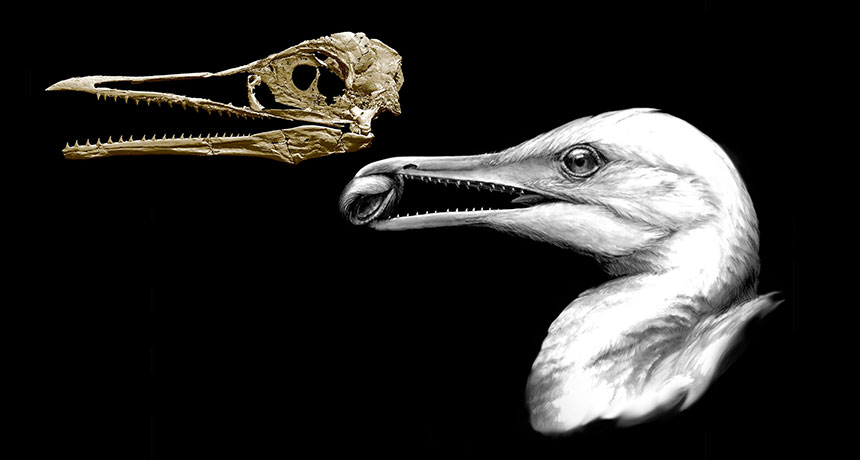
Scientists used fossils of an ancient toothed bird (illustrated at right) to make a 3-D reconstruction of its skull (left). They discovered the animal had a small beak at the tip of its snout.  MICHAEL HANSON AND B.-A. BHULLAR

Reconstructing the bird's skull offers new clues to bird evolution.

A bird that lived alongside dinosaurs may have used its beak to preen its feathers, as modern birds do. But it also had a full mouth of teeth. These let it chew like a dino. The finding provides new clues to how birds evolved from dinosaurs.

Scientists made a new 3-D reconstruction of the skull of Ichthyornis (Ick-thee-OR-nis) dispar. This bird lived during the Late Cretaceous, some 87 million to 82 million years ago. The new reconstruction shows this creature had a small, primitive beak. Its upper jaw would have moved around easily. Such traits would have let the bird use its beak to precisely groom itself and grab things, much as modern birds do. But I. dispar also kept some features from its dino ancestors. These included teeth and strong jaw muscles.

This ancient bird shows up often in textbooks. Paleontologist Othniel C. Marsh first described the animal some 150 years ago. It was a water bird, similar to a tern. Much like a duck, its wings spanned about 60 centimeters (24 inches). The shape of those wings and its breastbone suggested this bird could fly.

Another famous fossil flyer is Archaeopteryx (Ar-kee-OP-tur-ix). This extinct reptile lived about 70 million years before I. dispar. Archaeopteryx had a more reptilian skull, notes Bhart-Anjan Bhullar. He’s a vertebrate paleontologist at Yale University in New Haven, Conn. With a beak and fairly large head, the skull of I. dispar much better resembles those in modern birds, he says.

Several skulls of I. dispar existed at various museums. Still, there was much science didn’t know about these birds, Bhullar says. One reason: Fossils dug up in the 19th century had been smashed flat in places. This made it hard to see a lot of important details. Then, in 2014, researchers unearthed a new I. dispar fossil. It contained a nearly perfect skull.

The researchers combined that fossil with three partial skulls from museum collections. They also took a closer look at the skull found 150 years ago. Bhullar’s team input details from all of these skulls into a computer. It helped to recreate a 3-D image of what the ancient bird would have looked like. Those researchers published it May 3 in Nature.

An in-between head

The reconstruction showed these birds could raise their upper jaw separately from the lower jaw, as modern birds can. This range of motion would have let I. dispar use its tiny beak like tweezers to peck or preen or grasp objects. Large holes in the sides of its skull show where jaw muscles attached. The size of those holes suggests those muscles would have been strong. Says Bhullar, this suggests that “it was pecking like a bird and biting down like a dino.”

His team also made detailed measurements of the inside of the skull. This showed them the brain’s shape. And again, in many ways it looked like those of modern birds.

For example, the forebrain is an area in the front related to thinking. In I. dispar it was large. This brain also had big optic lobes — regions that process images sent from the eyes. “This [creature] was thinking like a bird, and had sensitive vision and motor coordination,” Bhullar concludes. It might have needed these traits to handle the intense physical challenges of flying.

The new study offers the first in-depth look at the skull of this ancient species, says Lawrence Witmer, who was not part of the new study. This vertebrate paleontologist at Ohio University in Athens says the study gives important new details on how dino jaws morphed into today’s bird beaks. Dinosaur jaws were toothy and covered in skin. A modern bird’s beak lacks teeth and is covered in keratin, the same stuff from which human hair is made.

Luis Chiappe praises the careful way researchers studied this important historical fossil. Chiappe, too, is a vertebrate paleontologist. He works at the Natural History Museum in Los Angeles, Calif. Still, he is not convinced that the size of the brain and other traits are related to the bird’s flying ability. He’s also not sure that I. dispar’s in-between features offer general clues to the way all birds would have evolved from dinosaurs.

“We have big questions about what was happening with birds in the Late Cretaceous,” he says. Scientists don’t know much about these animals’ skulls. “It could be that what we see in Ichthyornis might not be representative of an evolutionary trend,” he says.

Source: www.sciencenewsforstudents.org

Paleontologists in China, Ancient People Lived More Than 2 Million Years Ago

Friday, July 13, 2018

File photo

The findings of archaeologists lifted the veil of secrecy in the history of mankind.

Paleontologists after extensive studies conducted in China, said that in Asia, ancient people lived more than two million years ago. Thanks to the excavations, in which were found various tools, scientists were able to establish that the ancestors of upright humans left Africa, considered a kind of “cradle of humanity”, much earlier than 1.85 million years ago, as previously thought. Carbon Dating found in China tools showed that the age of the tools that helped the ancestors of modern man survive in the wild, more than 2.12 million years.

Scientists were amazed to find that among such ancient tools were not only simple scrapers and axes, and various household items, chisels, arrowheads and all sorts of hammers. Researchers are currently trying to determine how ancient people managed to occupy the territory of modern China before Georgia.

Source: https://sivtelegram.media

Oldest Rare Whale Fossil Identified 6 Decades After Found on Aussie Beach

Thursday, July 12, 2018

The ancient pygmy right whale ear bone is about the size of an apricot. Photo: ABC

A seemingly unremarkable fossil first collected on a Melbourne beach more than 60 years ago has turned out to be the oldest known evidence of the rare pygmy right whale.

The ancient bone was found in the bayside suburb of Beaumaris by Museums Victoria honorary palaeontologist George Baxter Pritchard in the first half of last century, and placed in one of the museum’s collections.

But only recently did palaeontologist Erich Fitzgerald decide to take a closer look at the object.

The pygmy right whale (Caperea marginata). Credit: Wikipedia.

He discovered the fossil was a six-million-year-old ear bone from a pygmy right whale.

It is the oldest known evidence of the species, which is still found in the Southern Ocean.

The find was made even more significant by the fact there are only six pigmy right whale fossils in the world, Dr Fitzgerald said.

“It’s a startling thing about museums that we can make big discoveries without having to take one step outside of the museum building,” he said.

Little is known about pygmy right whales – the smallest whales in the baleen family.

Dr Erich Fitzgerald looks into a microscope at a Museums Victoria laboratory.

Dr Erich Fitzgerald rediscovered the fossil. Photo: ABC

They have a dorsal fin but only spend a few minutes on the surface, making them hard to spot.

The fossil is about the size of an apricot.

Dr Fitzgerald said Mr Baxter, who found the bone all those years ago, was a pioneer of palaeontology in Australia.

“He undertook some of the pioneering studies in the geology and prehistory of Victoria and elsewhere in Australia,” he said.

“Now more than 60 years after his discovery at Beaumaris we can unlock the secrets of his finds and share them with the world.”

Source: ABC

2.1-Million-Year-Old Stone Tools Unearthed in China

Friday, July 13, 2018

The 2.12-million-year-old stone artifact at the Shangchen site, China. Image credit: Zhaoyu Zhu.

Archaeologists working in the southern Chinese Loess Plateau have unearthed stone tools crafted at least 2.1 million years ago by early humans. The discovery, reported in the journal Nature, implies that early humans left Africa earlier than indicated by evidence from Dmanisi, Georgia.

The stone tools were discovered at a Paleolithic locality called Shangchen in the Loess Plateau, near Gongwangling in Lantian county, by Professor Zhaoyu Zhu from the Chinese Academy of Sciences and colleagues.

The oldest artifacts are about 2.12 million years old — 270,000 years older than the skeletal remains and stone tools from Dmanisi, which were previously the earliest evidence of humanity outside Africa.

“The artifacts include a notch, scrapers, cobble, hammer stones and pointed pieces; all show signs of use,” Professor Zhu and co-authors said.

“Most were made of quartzite and quartz that probably came from the foothills of the Qinling Mountains 3 to 6 miles (5-10 km) to the south of the Shangchen site, and the streams flowing from them.”

At the site, the researchers also unearthed 2.12-million-year-old fragments of animal bones.

“The Loess Plateau, also known as the Huangtu Plateau, covers about 104,000 sq.miles (270,000 km2), and during the past 2.6 million years between 330 and 984 feet (100-300 m) of wind-blown dust — known as loess — has been deposited in the area,” they said.

“The 80 stone tools were found predominantly in eleven different layers of fossil soils which developed in a warm and wet climate.”

“A further 16 items were found in six layers of loess that developed under colder and drier conditions.”

“These 17 different layers of loess and fossil soils were formed during a period spanning almost a million years.”

“This shows that early humans occupied the Loess Plateau under different climatic conditions between 1.2 and 2.12 million years ago.”

_____

Zhaoyu Zhu et al. Hominin occupation of the Chinese Loess Plateau since about 2.1 million years ago. Nature, published online July 11, 2018; doi: 10.1038/s41586-018-0299-4

Source: www.sci-news.com

The Virginia Living Museum is Bringing Dinosaurs Back to Life

Tuesday, July 10, 2018

Destination: Dinosaur runs until Sept. 3. (HNNDaily photo/Courtesy of City of Newport News.)

Attractions include animatronic dinosaurs, a life-sized T. rex, a photo booth with a pachyrhinosaurus and more.

Locals can roam with dinosaurs at the Virginia Living Museum in Newport News.

For the 29th straight year, the museum is bringing animatronic dinosaurs to its exhibits. From now until Sept. 3, patrons can see seven dinosaur-themed features throughout the museum, according to a news release from the city.

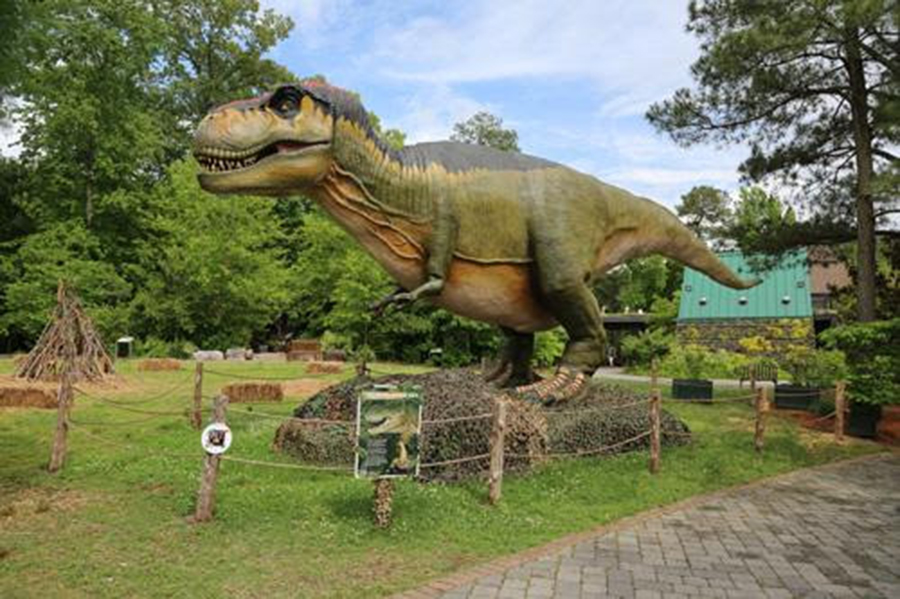
The attractions, entitled Destination: Dinosaur, include a life-sized animatronic T. rex, a photo booth with a pachyrhinosaurus, a water-spitting dilophosaurus, three dinosaur-themed shows and the Dinosaur Discovery Trail.

Destination: Dinosaur is included in museum admission, which is $20 for adults and $15 for children ages 3-12.

For information on the exhibit, visit here.

Source: https://wydaily.com

As It Was: Fossil Lake Preserves Footprints of Giant Mammoths

Saturday, July 7, 2018

Fossilized mammoth trackway at Fossil Lake, July 20, 2017. Photo from Greg Shine, Bureau of Land Management, Oregon.

Southeast Oregon’s Fossil Lake has attracted amateur fossil collectors and paleontologists since the l880s, but a recent discovery astounded University of Oregon scientists.

They already knew that giant Columbian mammoths once foraged along an ancient lake that covered the basin and present-day Fossil Lake.  Newly discovered in 2017 were more than 100 preserved mammoth tracks dating back more than 43,000 years.  One trail of tracks appears to have been made by a limping, injured female mammoth attended by juvenile mammoths in a manner resembling present-day elephant behavior.  University paleontologist Gregory J. Retallack told the Klamath Falls Herald and News that “tracks sometimes tell more about ancient creatures than their bones, particularly when it comes to their behavior.”

Fossil Lake is some 74 miles northwest of Lakeview, the Lake County seat of government.  Over the years, the lake has yielded more Holocene Epoch fossils from 8,000 to 50,000 years old than any other location in the world except for the La Brea Tar Pits in California.  Other fossils date back 2 million years.

Mammal fossils include ground sloths, giant beavers, pre-historic bison, extinct bears, and several species of camels and horses.

Source: www.ijpr.org

Sources: Liedtke, Kurt. "Mammoth steps found at Fossil Lake." Herald and News, 2 May 2018 [Klamath Falls, Ore.], https://www.heraldandnews.com/news/local_news/mammoth-steps-found-at-fos.... Accessed 14 May 2018; Retallack, Gregory J. "Late Pleistocene mammoth trackway from Fossil Lake, Oregon." Palaeogeography, Palaeoclimatology, Palaeoecology, 1 May 2018, https://www.sciencedirect.com/science/article/pii/S0031018217312154?via%...! Accessed 14 May 2018

How Tech Has Evolved Since Jurassic Park

Friday, July 6, 2018

Self ddriving car

Back in 1993, Jurassic Park wowed audiences with its futuristic machines and screens. Now, those high-tech gadgets have become reality. Here's a look at the evolution of tech from the original movie over the past 25 years:

SELF-DRIVING CARS

Then: John Hammond takes great pleasure in introducing his guests, Dr. Grant, Ellie and his grandchildren, Tim and Lex, to one of the park's technological marvels: the electric driver-less cars that will take them through Jurassic Park. For many audiences, the vehicles served as an introduction to the concept of a car without a driver.

Now: Driver-less cars are no longer a foreign concept. Many companies have developed functioning cars that can be driven by artificial intelligence (AI), sensors and cameras — not on contained tropical islands, but on busy city streets.

TOUCH SCREENS

Then: The SUVs guiding Jurassic Park's characters through the park impressed the characters in the film and audiences alike with touch screen monitors mounted in their front consoles.

Now: There's probably a good chance you're using a touch screen in your hand right now to scroll through this article. Smart phones, tablets, laptops and, of course, touch screen audio systems in our cars are now everywhere.

NIGHT VISION GOGGLES

Then: Another gadget that thrills Tim and Lex are the bulky and cumbersome night vision goggles they find in the driver-less cars.

Now: Since 1993, these gadgets have become so common that they're used for skiing and recreational sports and so sophisticated that Navy SEALs deploy a version of them to aid with night vision.

GIFS

Then: You know the scene: Arnold tries to access Nedry's computer code and is greeted by an animated image that taunts him with, "Ah, ah, ah, you didn't say the magic word." Arnold angrily dismisses it as "hacker crap," but we now know what it is: a GIF.

Now: GIFs like Dennis Nedry's are used far and wide. On social media, a GIF has practically become an official second language. Appropriately enough, even Dennis Nedry's GIF is now a GIF used online.

COMPUTERS

Then: It's a given that any computers you spy in Jurassic Park are going to look outdated — at the time, they would have needed to generate enough power to run the park's complex operations.

Now: A basic laptop is both lighter — and more powerful — than the ones in Jurassic Park.

CODE

Then: Dennis Nedry at one point complains about how everything in the park goes through him and his ability to “debug 2 million lines of code" that help keep the park functioning on its own. “You think that kind of automation is easy?" he snipes at Hammond.

Now: Since 1993, automation has gotten to the point where Dennis Nedry could simply deploy AI to control all sorts of functions, from factory production to customer service inquiries, to yes, even theme park operations.

THE SCIENCE TO RESURRECT DINOSAURS

Then: And now for the greatest question inspired by Jurassic Park: Could science actually bring back dinosaurs?

Now: Although scientists have resurrected preserved mammoth DNA, they have yet to figure out how to welcome dinosaurs back to earth.

A lot has changed since 1993, but one thing has remained the same. We still haven’t cracked the genetic code on bringing dinosaurs back to life.

Source: www.jurassicworld.com

How Jurassic Park Predicted The Future

Tuesday, July 10, 2018

Do you recall sitting in a movie theater in 1993, watching Drs Grant and Sattler driving across the grasslands of Isla Nublar, when a white-suited John Hammond suddenly stands, mouth agape, a look of childlike joy on his face? The camera cuts away and there, real as life, was a dinosaur—a massive Brachiosaurus picking leaves off a tree.

It was as though every dino-dream we had as kids was finally confirmed through the magic of film. Jurassic Park inspired many of us, so we wanted to take a look at some of the best tech predictions from the greatest dino-movie ever made.

Touchscreen computers. Perhaps one of the “greatest” hacking scenes in film comes when Lex looks at Jurassic Park’s computer, locked by the traitor Dennis Nedry (anagram: Nerdy Sinned). “This is Unix,” she says. “I know this.” (LOL).

Lex flies through a clunky GUI to begin resetting the park’s systems: and she does it with a touchscreen. This was a decade before the first touchscreen phones that didn’t require a stylus, and two decades before touchscreen tablets revolutionized how our children will understand interaction. For bonus points, notice the IR-based “hood” around the screen—a grid-based precursor to the technology behind the original Surface table.

Awesome CGI monsters. Go back and watch Jurassic Park again and marvel at how damn good those dinosaurs look. Some of them are puppets, but many are full-screen CGI renders. Jurassic Park was one of the first films to use CGI effects, and the dinosaurs still look better than monsters created two decades later. It was a groundbreaking achievement for Industrial Light and Magic and literally created the bar for how computer effects are still measured today.

Smart Cars. Jurassic Park’s tour begins inside special Ford Explorers, equipped with their own TV screens, CD-ROMs (!), that drive themselves along a track using GPS. Two of those three science-fiction elements have now come to pass—it’s hard to cruise down the highway and not see a minivan or SUV without a kid glued to a DVD player installed into the back of the driver’s seat—and self-driving cars on a massive scale may only be a few years away. That bodes well for the adoption of the bubble cars and trained packs of raptors teased in the Jurassic World trailer.

Chaos (Complexity) Theory. Raise your hand if you actually understood what Ian Malcolm was talking about with chaos theory. If you didn’t, here’s the skinny: using computers, you can model a big complex system if you have enough data, and attempt to predict how a small, seemingly insignificant variable might affect the entire system.

Originally called chaos theory at the time when Michael Crichton wrote the novel, this concept eventually morphed into complexity theory: tiny, seemingly inconsequential changes could actually produce drastically different outcomes with different long-term iterative models. These effects could only be studied with computers, and what once required massive supercomputers to attempt to model can now be done with the same cloud computing systems and data gathering techniques that companies use for resource and customer planning.

It’s too bad that we can’t get someone as awesome as Ian Malcolm to run the data division though.

Source: www.managedsolution.com

Pages