Blogs

Long-Forgotten ‘Dinosaur’ Bone Turns Out to Actually be From an Ancient Hippo-Like Herbivore: Paleoparadoxia

Thursday, July 26, 2018

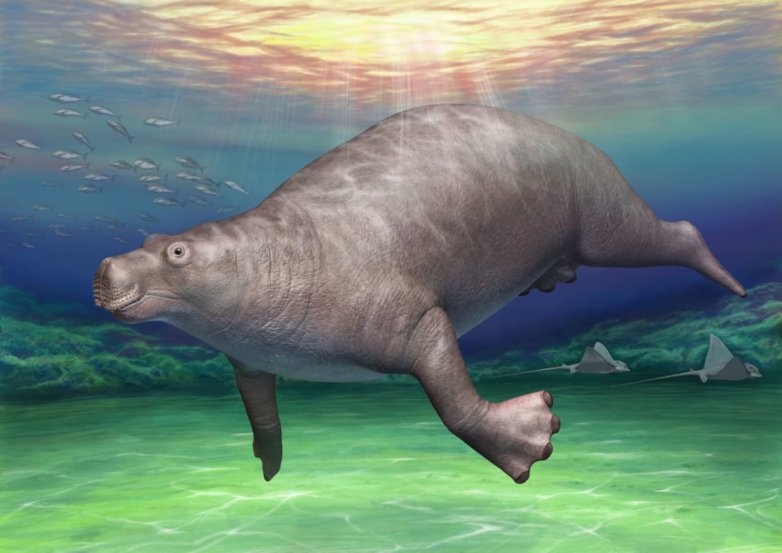
Paleoparadoxia. Image Source: Royal Society Open Science

Finding an fossilized bone on accident might be a pleasant surprise for scientists, or even a kid, but when dam workers in Japan stumbled across a large bone back in the 1950s they didn’t really know what to do with it. The unidentified bone was presumed to be from a dinosaur, and while it was certainly an interesting artifact, the locals didn’t pay much mind to it. Now, after finally landing in the hands of paleontologists, it’s been properly studied. As it turns out, it wasn’t from a dinosaur at all.

The bone is actually the thigh bone of a long-extinct aquatic herbivore belonging to the genus Paleoparadoxia. The hippo-like creature isn’t nearly as old as the dinosaurs, but it might be just as interesting.

The story of how the bone was misplaced is a wild one. After its initial discovery many decades ago it was placed on display in a small village hall. Several years later, a fire decimated part of the town and the bone ended up in the back of a museum along with an original note from its discoverers who described it as a dinosaur femur. Last year, the bone was uncovered in a wooden box and that’s when scientists got their first look at it.

By comparing the bone to others from the same group of animals, the researchers were able to conclusively determine that the fossil was indeed a leftover from an ancient herbivore. Paleoparadoxia lived a long time ago, but not quite as far back as the dinosaurs. In a paper published in Royal Society Open Science, researchers estimate the bone to be approximately 15.9 million years old.

It is assumed that the ancient beast would have lived much like modern aquatic herbivores, eating sea vegetation to pack pounds onto its stocky frame. They would have been capable of walking along the the bottom of rivers and seas, only surfacing to grab another breath of fresh air and get a glimpse of its surroundings.

Source: https://bgr.com

To Understand Fossils, These Paleontologists Are Making Faux-ssils

Thursday, July 26, 2018

A lizard foot after it endured compaction in clay and extreme pressure-cooking, to mimic fossilization. (Credit: Evan Saitta, Tom Kaye)

To learn more from fossils they find in nature, paleontologists are trying to create their own.

For decades, paleontologists have been experimenting with heat, pressure, and other factors to mimic nature’s ability to preserve the bodies of living things as fossils. Trying to copy fossilization in a laboratory would allow paleontologists to better understand the process and learn more about the history of life on our planet from the fossils they find.

In a study published in the journal Palaeontology on Wednesday, one team presented a method for simulating the fossilization process that has made some of the most realistic-looking artificial fossils yet. The researchers packed feathers and lizard parts into clay tablets before subjecting them to the traditional high-temperature, high-pressure method for simulating the fossilization process.

A Pressure Cooker on Steroids

The project began when paleontologist Evan Saitta decided that he wanted to try the traditional heat- and pressure-based fossilization experiments but embed would-be fossils in some kind of sediment, like the sand and clay found in rivers where dead animals can get buried and fossilized. Sediment is porous and acts as a filter that lets some molecules escape from a carcass while others stay behind.

Using sediment in an experimental fossilization setup, Saitta thought, might mimic this natural process and make more realistic artificial fossils. In past fossilization experiments, specimens were often either placed in sealed containers or wrapped in foil, Saitta says.

Saitta teamed up with Tom Kaye, an independent researcher, to try this out. In his lab, Kaye has a lab oven he calls a “pressure cooker on steroids,” which can reach the high temperatures and pressures needed for these fossilization experiments. The two experimented by packing feathers or the feet and heads of lizards into sand or clay tablets less than an inch wide before pressure-cooking them in the lab oven for up to 24 hours at temperatures as high as 480 degrees Fahrenheit and pressures as high as 300 times atmospheric pressure at sea level. 

They didn’t have much luck with sand, but the clay tablets were a different story.

Your Fossil is Served

“We were stunned, stunned at how well they came out,” Kaye says. One of the first trials they did was of a lizard foot in a clay tablet. “We cracked it open and we go, ‘Look at that, there’s skin impressions, the bones are brown!’ We couldn’t have asked for a better result.”

The artificial fossils looked pretty good by eye, but Saitta wanted to see how they held up under a scanning electron microscope. He found that the artificial fossils had melanosomes, tiny cellular organs that contain the pigment melanin. Melanosomes are often preserved in fossils, and paleontologists have recently been able to study fossils’ melanosomes and reconstruct the colors of ancient creatures, like dinosaurs.

Because the artificial fossils still had melanosomes but lost the surrounding fatty tissues, like real fossils do, the experiment seemed to be a success at the microscopic level too. One of the next steps, Saitta says, would be to look for similarities between their artificial fossils and real fossils beyond the microscopic level, by doing chemical analyses.

“We have high hopes that our method will probably lead to improved chemical similarities than previous methods, but we need to actually test if that’s the case or not,” says Saitta.

Making Fossils to Order

Paleobiologist Maria McNamara, who was not involved in the study, says using sediments like clay for fossilization experiments is possible with existing methods, but this method seems to allow for larger specimens and tissue samples, which is useful. Though this study’s artificial fossils are under an inch in diameter, they’re large enough to show details in skins and feathers.  

McNamara hopes that using sediments in fossilization experiments and making artificial fossils that look more similar to real ones will reassure some paleontologists who are wary of fossilization experiments.

“There are some palaeontologists who say that controlled experimentation is not an appropriate analog, because it doesn’t replicate the natural environment,” McNamara says. But McNamara says that’s why controlled experiments are so crucial.

“We cannot replicate the natural environment. We can never know all of the variables that were at stake. So the only way we can investigate fossilization is by using controlled experiments,” McNamara says. “I think this study is a nice attempt to bridge that gap.”

Source: http://blogs.discovermagazine.com

Fossilized Animals May have Looked Different as New Source of Melanin was Discovered

Wednesday, July 25, 2018

Fossilized-Animals-May-have-Looked-Different-as-New-Source-of-Melanin-was-Discovered

A combined team of paleontologists which included members from the University of Bristol and the University College Cork has made a breakthrough discovery regarding new sources of melanin. The theory will lead to a radical shift in how scientists reconstruct the color of fossilized animals such as birds, reptiles and dinosaurs.

Most studies affirmed that melanosomes, the fossilized granules of melanin, came from the skin. New evidence has shown however that different tissues, like the spleen, liver and lungs also contain melanosomes rendering the belief that melanosomes determined the color of the skin to be wrong.

Published in the journal Nature Communications, the study is led by the University College Cork professor Dr. Maria McNamara along with her PhD student Valentina Rossi and a team composed of paleontologists from the University of Dublin, Japan and UK. Powerful microscopes were employed in order to observe highly abundant internal melanosomes under chemical stimulation.

According to the study, several animals may have been incorrectly reconstructed, by assuming the skin color was provided by the number of melanosomes contained in the skin. As such many of the reconstructed animals may need a change when the fossils on which they are based will be analyzed by using the brand new method. While not a radical change, this will certainly impact future studies, allowing for a more accurate study of how extinct species really looked like. It will also allow the construction of reproduction that is more loyal to the original.

It was also found out that melanosomes may leak from the inside to the outside of the body during the fossilization process. Analysis of decay experiments also proved this process to be valid but there is, however, a very important detail: skin melanosomes can be distinguished from others based on comparisons between shapes and sizes.

Source: https://greatlakesledger.com

New Sauropod Dinosaur Unveiled: Lingwulong shenqi

Friday, July 27, 2018

An artist’s impression of Lingwulong shenqi. Image credit: Zhang Zongda.

Lingwulong shenqi, which lived approximately 174 million years ago (Middle Jurassic period), is the earliest known example of a type of sauropod dinosaur called a neosauropod.

Sauropod dinosaurs originated around 200 million years ago, but they only started to dominate terrestrial ecosystems by developing gigantic body size and new adaptations for obtaining and processing plant food.

These giant neosauropod descendants were thought to originate around 160 million years ago, rapidly diversifying and spreading across the world during a time window perhaps as short as just 5 million years.

“We were surprised to find a close relative of Diplodocus in East Asia 174 million years ago,” said Professor Paul Upchurch, from the Department of Earth Sciences at University College London, UK.

“It’s commonly thought that sauropods did not disperse there until 200 million years ago and many of their giant descendants, reached this region much later, if at all.”

“Our discovery of Lingwulong shenqi demonstrates that several different types of advanced sauropod must have existed at least 15 million years earlier and spread across the world while the supercontinent Pangaea was still a coherent landmass. This forces a complete re-evaluation of the origins and evolution of these animals.”

For the study, Professor Upchurch and colleagues analyzed the fossilized skeletons of 7-10 individual dinosaurs that were found together in rocks in 2005.

“We organized four excavations at a new dinosaur site in the lower Middle Jurassic Yanan Formation at Ciyaopu, Lingwu, Ningxia Hui Autonomous Region, which resulted in the discovery of fossil material comprising 7-10 partial skeletons (including portions of two skulls), ranging from juveniles to adults,” they said.

Skeletal reconstruction and exemplar skeletal remains of Lingwulong shenqi. Silhouette showing preserved elements (a); middle cervical vertebra in left lateral (b) and anterior (c) views; anterior dorsal vertebra in left lateral (d) and anterior (e) views; posterior dorsal vertebra in lateral view (f); sacrum and ilium in left lateral view (g); anterior caudal vertebra in left lateral (h) and anterior (i) views; right scapulocoracoid in lateral view (j); right humerus in anterior view (k); left pubis in lateral view (l); right ischium in lateral (m) views; right femur in posterior view (n); and right tibia in lateral view (o). Abbreviations: ap – ambiens process, ar – acromial ridge, ip – iliac peduncle, naf – notch anterior to glenoid, np – neural spine, podl – postzygodiapophyseal lamina, ppr – prezygapophyseal process ridge, prp – prezygapophysis, pvf – posteroventral fossa, slf – shallow lateral fossa, spol – spinopostzygapophyseal lamina, sprl – spinoprezygapophyseal lamina, wls – wing-like structure. Scale bars – 100 cm for (a) and 5 cm for (b-o). Image credit: Xu et al, doi: 10.1038/s41467-018-05128-1.

The new evidence also reinforces the growing realization that the Early Jurassic (200-175 million years ago), was a key time in dinosaur evolution, witnessing the origins and diversification of many groups that went on to dominate the later Jurassic and Cretaceous.

Diplodocus-like neosauropods were thought to have never made it to East Asia because this region was cut-off from the rest of the world by Jurassic seaways, so that China evolved its own distinctive and separate dinosaur fauna,” said Dr. Xing Xu, from the Institute of Vertebrate Paleontology & Paleoanthropology, Chinese Academy of Sciences.

“However, Lingwulong shenqi shows that these Diplodocus-like sauropods were present after all, and implies that the isolation of East Asia was less profound and short-lived than we realized.”

The research is published in the journal Nature Communications.

_____

Xing Xu et al. 2018. A new Middle Jurassic diplodocoid suggests an earlier dispersal and diversification of sauropod dinosaurs. Nature Communications 9, article number: 2700; doi: 10.1038/s41467-018-05128-1

Source: www.sci-news.com

Giant Dinosaur Foot Proclaimed Largest Ever Discovered

Wednesday, July 25, 2018

This illustration shows a Brachiosaurus eating from an Araucaria tree. These dinosaurs had enormous necks and relatively short tails. The animal to which the foot belongs was nearly 4 m high at its hip. Image credit: Davide Bonadonna.

A fossilized dinosaur foot believed to be the largest in the world has been unearthed in Weston County, Wyoming, the United States.

The 39-inch-wide (1 m) foot was excavated from the Upper Jurassic Morrison Formation by University of Kansas paleontologists in 1998.

Now, after detailed preparation and study, Rocky Mountain Dinosaur Resource Center researcher Anthony Maltese and co-authors identified it as belonging to a dinosaur species very closely related to the long-necked, long-tailed sauropod Brachiosaurus.

“It was immediately apparent that the foot was from an extremely large animal, so the specimen was nicknamed ‘Bigfoot’,” said Dr. Maltese, who was part of the original University of Kansas team in 1998.

The scientists used 3D scanning and detailed measurements to compare the specimen to feet from numerous dinosaur species.

The study confirms that this brachiosaur foot is the largest dinosaur foot discovered to date.

Photograph from the excavations in 1998, with 150-million-year-old brachiosaur foot bones below a tail of a Camarasaurus. Image credit: University of Kansas.

“There are tracks and other incomplete skeletons from Australia and Argentina that seem to be from even bigger animals, but those gigantic skeletons were found without the feet,” said Dr. Emanuel Tschopp, a paleontologist at the American Museum of Natural History, the Universidade Nova de Lisboa and the Museu da Lourinhã.

“This beast was clearly one of the biggest that ever walked in North America.”

The study also shows that brachiosaurs inhabited a huge area from eastern Utah to northwestern Wyoming.

“This is surprising. Many other sauropod dinosaurs seem to have inhabited smaller areas during that time,” Dr. Tschopp said.

The brachiosaur foot is described in a paper published in the journal PeerJ.

_____

A. Maltese et al. 2018. The real Bigfoot: a pes from Wyoming, USA is the largest sauropod pes ever reported and the northern-most occurrence of brachiosaurids in the Upper Jurassic Morrison Formation. PeerJ 6: e5250; doi: 10.7717/peerj.5250

Source: www.sci-news.com

Jurassic World: Fallen Kingdom Coming to DVD and Blu-Ray in November

Wednesday, July 25, 2018

Universal Pictures UK

Jurassic World: Fallen Kingdom is heading to 4K Ultra HD, 3D Blu-ray, Blu-ray, DVD and On Demand on 5th November 2018.

The film will be available on Digital from 19th October and it will feature more than an hour of bonus content. Jurassic World: Fallen Kingdom has been a huge hit across the world and topped the international box office for four straight weeks.

It’s so far earned over $1 billion in global ticket sales, taking the Jurassic franchise to over $4.7 billion at the box office.


Jurassic World: Fallen Kingdom sees Chris Pratt and Bryce Dallas Howard reprising their roles as Owen Grady and Claire Dearing respectively. It also marks the return of Jeff Goldblum (Jurassic Park) and BD Wong (Jurassic World).

Owen (Pratt) and Claire (Howard) return to Isla Nublar three years after the destruction of the Jurassic World theme park to rescue any remaining dinosaurs on the island from a catastrophic volcano that threatens to leave dinosaurs extinct once again. Owen is driven to save his lead raptor, Blue, while Claire makes it her mission to preserve the creatures that she has grown to deeply respect. When the lava begins to rain down, they soon discover terrifying new breeds of ferocious dinosaurs along with a conspiracy that could threaten the entire world.

Jurassic World: Fallen Kingdom is directed by J.A. Bayona (The Impossible) and executive-produced by Steven Spielberg and Colin Trevorrow. The cast also includes James Cromwell (The Green Mile), Justice Smith (The Get Down) and Daniella Pineda (The Detour).

Bonus features exclusive to 4K Ultra HD and Blu-ray include

  • Return to Hawaii – Cast and crew discuss shooting the film in Hawaii.

  • Aboard the Arcadia – Cast and crew discuss working with the animatronic dinosaurs.

  • Fallen Kingdom: The Conversation – Filmmakers and cast sit down for a candid and casual conversation about Jurassic World: Fallen Kingdom.

  • Song for the Kingdom – Justice Smith sings for the cast and crew of Jurassic World: Fallen Kingdom.


Click the icon below to preorder this movie.

Pre-order now. Ships from and sold by Amazon.com. Gift-wrap available.
 

Bonus features on DVD, 4K Ultra HD and Blu-ray include

  • The Kingdom Evolves – Filmmakers discuss how the second chapter in the Jurassic World trilogy pushes the franchise in a new direction.

  • Island Action – A behind-the-scenes look at the bunker scene and runaway gyrosphere sequence.

  • Start the Bidding! – A behind-the-scenes look at the auction scene.

  • On Set with Chris & Bryce – Go behind the scenes with Chris Pratt and Bryce Dallas Howard.

  • Birth of the Indoraptor – An inside look at the genetically designed monstrosity known as the Indoraptor.

  • Death by Dino – Go behind the scenes as the Indoraptor faces off with a key character.

  • Monster in a Mansion – Director J.A. Bayona discusses how Jurassic Park and Dracula (1979) influenced his approach to directing the monster in a mansion scene.

  • Rooftop Showdown – A look at the terrifying showdown on the rooftop of the Lockwood Mansion.

  • Malcolm’s Return – Behind the scenes with the one & only Jeff Goldblum.

  • VFX Evolved – The team at ILM discuss their cutting-edge approach to creating dinosaurs.

  • Chris Pratt’s Jurassic Journals

    • Vivian Baker, Makeup Artist

    • Mary Mastro, Hair Stylist

    • Chris Murphy, 1st Assistant Sound

    • Dean Bailey, Stunt Edge Car Driver

    • Peter Harcourt, Diver

    • Daniella Pineda and Justice Smith, Actors

    • Jody Wiltshire, Set PA

    • Kelly Krieg, Assistant Script Supervisor

    • J.A. Bayona, Director

    • James Cox, Stunt Performer

    • Rachelle Beinart, Stunt Double

    • Bryce Dallas Howard interviews Chris Pratt, Actor


Click the icon below to pre-order this movie.

Pre-order now. Ships from and sold by Amazon.com. Gift-wrap available.


Source: www.entertainment-focus.com

Review: Jurassic World: Fallen Kingdom is Fast Paced but Has a Preposterous Plot and is Ultimately Forgettable

Tuesday, July 24, 2018

Jurassic World Fallen Kingdom

This Fifth instalment in the Jurassic Park franchise follows on from 2015’s Jurassic World, and sees Chris Pratt teaming with Bryce Dallas Howard to take on prehistoric beasts once again.

After the destruction of the Jurassic World theme park two years ago, the island of Isla Nublar has been inhabited only by the remaining dinosaurs, but when a volcano threatens to wipe them out once and for all, Claire (Dallas Howard) and Owen (Pratt) are recruited to head up a rescue mission. This setup adds an interesting dynamic to early proceedings as our heroes battle to save the dinosaurs from extinction.

Again scripted by Colin Trevorrow, the American this time hands directing duties over to J A Bayona, director of last year’s excellent A Monster Calls.

The film doesn’t waste any time getting into the action, but the Spanish director manages to show some nice moments of directorial flair amongst the rapid pace.

A spectacular sequence involving lava raining down on the rescue team is one of many well directed set pieces.

The problem with the film comes after that when the location switches to the mainland and more specifically the millionaire mansion of James Cromwell’s Benjamin Lockwood.

It’s clear the filmmakers are attempting to try something different with the franchise as they inject a spooky horror vibe into proceedings, however the plot makes little sense at this stage and things becomes more and more preposterous.

The chemistry between Pratt and Dallas Howard is clear to see and the interplay between their characters is enjoyable to watch, but they are overshadowed by the dinosaurs, again brilliantly realised by a mixture of physical and computer generated effects.

Brits Rafe Spall and Toby Jones take on the roles of the cliched villains, and Jones particularly appears to relish the chance to be bad, sporting a wonderfully ridiculous combover and sparkling teeth arrangement.

Jeff Goldblum also makes a welcome return as Dr Ian Malcolm, but is criminally wasted in two very short cameos.

Jurassic World: Fallen Kingdom is a fast paced modern action movie which will no doubt spawn another sequel, enjoyable in the most part but ultimately rather forgettable.

Source: www.huntspost.co.uk

Malaysian Dinosaur Show to Debut in Iran

Wednesday, July 25, 2018

Royas (inset) standing next to a T. rex, one of the biggest creatures at the Ice Age Alive exhibition.

COMING from an entrepreneurial family has inspired Royas Jahangiri to start her own business.

The Iranian woman’s first venture will be to bring a Malaysian exhibition to the world stage.

The 30-year-old PhD student said being from a family that has been involved in the restaurant business meant that entrepreneurship was in her blood.

“I came to Malaysia nine years ago to further my studies. I completed my architecture degree in 2013 and went on to pursue an MBA.”

“I thought it must have been imported from Europe and was surprised to discover that it was designed and created by a Malaysian company, Creative Alliance Crew.

“People in my home country have never seen anything like this. The exhibits featuring life-size extinct animals in motion were very impressive. The animals looked real.

“I have always been on the lookout for new business opportunities and saw the potential to expand and export this exhibition overseas.

“I convinced my family to fly over to view this business opportunity and they agreed to invest as a partner in the company,” said the business development director.

Royas, who calls Malaysia home, said she plans to bring the exhibition to other parts of Malaysia as well as Iran and Indonesia.

“We are looking to expand to Langkawi in Kedah as well as Terengganu.

“The Tourism Ministry is supportive of this exhibition and I hope they would do the same for our future projects.

“It is a win-win situation for us and the ministry as we can drive tourists to the exhibition at no cost for the government.”

Royas said the exhibition would take on a different theme from time to time.

“It will feature new animals that have gone extinct as well as dinosaurs which are the main attraction.

“It will be an educational exhibition with brief explanations about the history and life forms that roamed our planet.

“The venture is also timely as there is a lot of interest in dinosaurs with the release of the Jurassic World 2 movie recently.

“The exhibition in Matic attracts a lot of tourists as it is just five minutes from KLCC and close to major tourist spots like Ampang and Bukit Bintang.”

Royas said she is working on securing land at the targeted venues and hopes to kick off other exhibitions next year.

Source: www.thestar.com.my

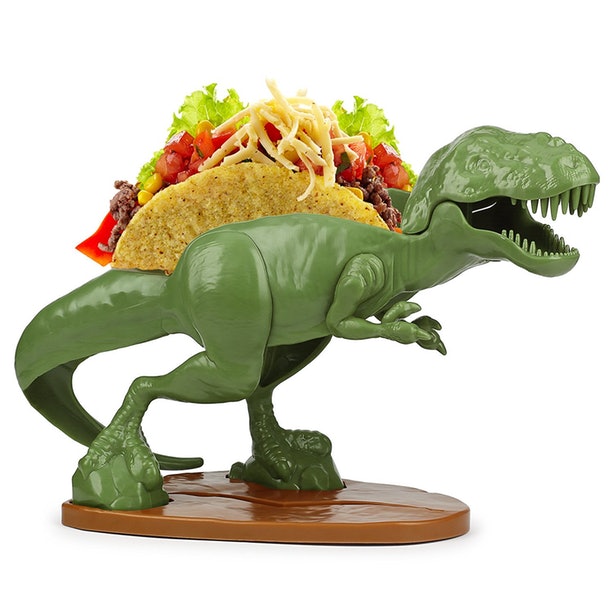
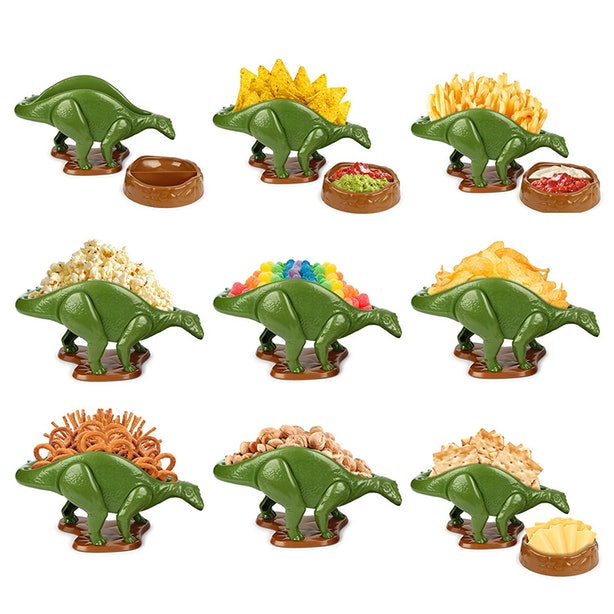
The Nachosaurus, A Dinosaur-Shaped Serving Dish For Nachos, Just Revolutionized Game Night Forever

Tuesday, July 24, 2018

Credit: Amazon

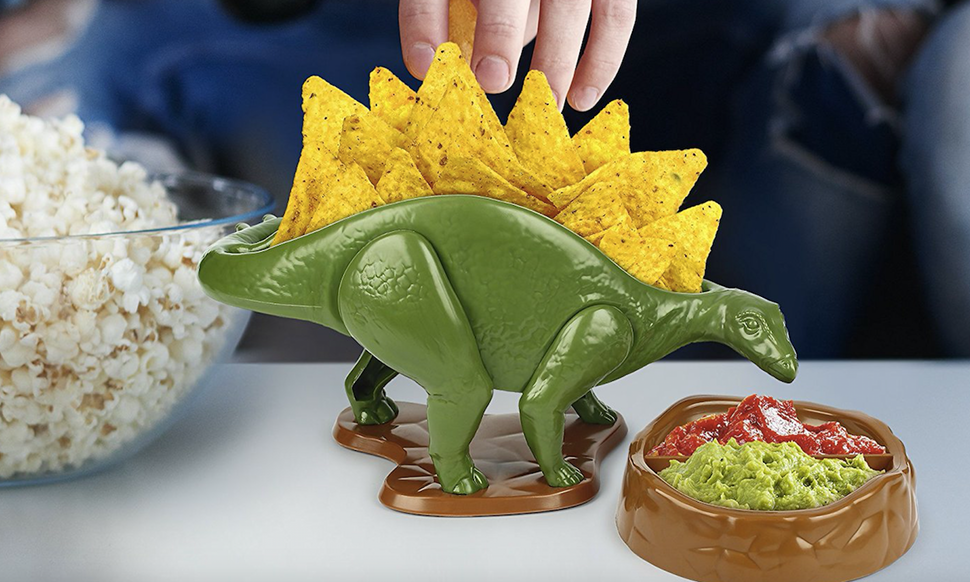
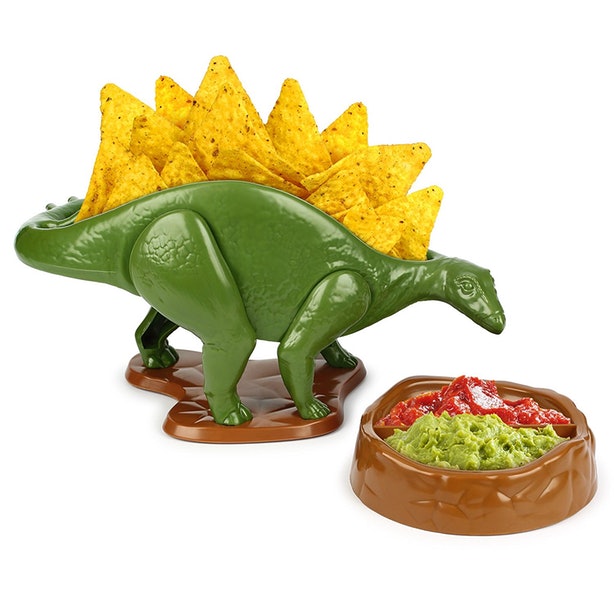
Adulthood has really taken its toll on the institution of chips. First of all, we have to pay for our own chips now. (And, like, our rent — but the chips somehow seem like an extra rub.) On top of that, guac is extra, and we are reminded of it at every turn. And to make it worse, I was recently told that calling Tostitos chips "toasty toes" was frowned upon in polite chip-eating society. With all of this in mind, never before has there been more dire a need of this Nachosaurus, a dinosaur chip-serving dish that says, "Hell yeah I'm grown enough to throw my own soirée, but I reserve the right to never emotionally mature past the age of 12, now please pass the salsa."


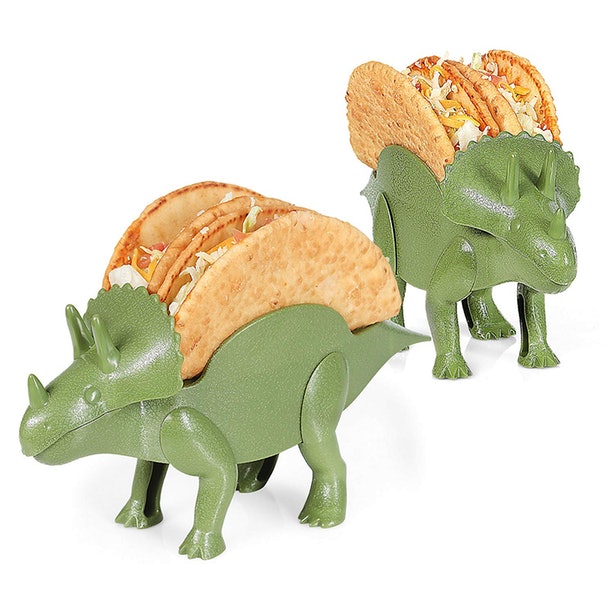
The Nachosaurus is currently being sold on Amazon for $14.99, which I reserve is an extremely small price to pay to make your childhood dreams come true. And it has two sisters! A Tricerataco, another dinosaur-shaped receptacle that holds tacos in it, as well as a Tacosaurus Rex, which is a thing I hope Chris Pratt personally owns and will purchase for him if he does not.

The TL;DR: your trips to Chipotle just got even more lit than the comet that rendered these dinos extinct (too soon?). Here are the Nachosaurus, Tricerataco, and Tacosaurus Rex in all of their prehistoric glory. Click all the images below to make your childhood dreams come true.

Nachosaurus

Tricerotaco

Tacosaurus Rex

If the concept alone isn't enough to get you on board, perhaps the glowing reviews will — take this one, written by Amadeus Platypus II, titled "According to my daughter (who loves dinosaurs), this is 'better than a $1000 in the bank':"

Pros: Holds my 16 year old daughters' cell phone at the perfect angle to watch YouTube. In theory it also holds two tacos. Or one cell phone and one taco. You get the idea.

Cons: Its too awesome to actually put tacos on it. Not enough to deduct a star, though.

Final thoughts: We named ours Tyrone.

Or this one, by JP, entitled "Tacorrific!!!!!"

Its a miracle!! My tacos taste amazing and its all because of the TriceraTACO. I could say I bought this for my child but that would be a lie. I bought this bad boy for me! Taco Tuesday's? We're talking Monday, Tuesday, Wednesday, Thursday.... Everyday is Taco Tuesday.

The thing that really seals the deal, though, is that the power of the Nachosaurus is truly infinite — it transcends chips and salsa, becoming the perfect receptacle for whatever it is your '90s baby heart desires.

Amazon

What I'm trying to say is that I already purchased this on Amazon Prime, and screw Taco Tuesday and literally all the other forms of dish ware that I own, because this is how I plan on serving my adult self through the rest of 2018. If anybody needs me, catch me taking some Nachosaurus and guac to the face while marathoning Jurassic Park and The Land Before Time (Cera remains an icon and we should all aspire to be her, thank you for coming to my Ted Talk).

Source: www.bustle.com

Beloved Dinosaur Sculpture 'Trixie' Stolen From Clairemont Home

Monday, July 23, 2018

Victoria Ngo Border

SAN DIEGO (KGTV) - A beloved dinosaur sculpture has been stolen from its home in Clairemont.

It is a metal triceratops dinosaur sculpture named "Trixie." The owner, Victoria, says she was purchased from Ricardo Breceda, the same artist who made sculptures in Anza Borrego and along CA-76.

Trixie has been a staple in the community for three years. She is usually dressed up for holidays and hands out goodies to kids in the neighborhood. She also has an Instagram page with almost 1,000 followers.

The owner believes she was stolen Saturday night or early Sunday morning. A police report has been filed, but nothing has come of it yet. Victoria says she has also gone door-to-door and posted on social media sites. 

If you have any information about Trixie's disappearance, please call police.

Source: www.10news.com

Pages