Blogs

After Surviving 420 Million Years, South Africa’s Dinosaur-Era Fish Could be in Danger Because of Oil Exploration

Tuesday, August 21, 2018

Photo by Dominic Lipinski/Getty Images

  • Italian energy company Eni plans to start six deep-water oil wells in a 400km long exploration block known as Block ER236.

  • Conservationists believe this threatens a colony of some 30 coelacanths, found off the Sodwana coast in 2000.

  • The fish had been believed extinct until 1938, and are considered living fossils, having amazingly survived, unchanged, for hundreds of millions of years.

South Africa’s last known colony of coelacanth, fish that have survived for more than 420 million years, could be under threat from oil exploration, conservationists warn.

Italian energy group Eni plans to start six deep-water oil wells in a 400km long exploration block known as Block ER236, near the iSimangaliso wetland park in South Africa.

A report from the Guardian says this may threaten the future of a colony of some 30 coelacanth found off the Sodwana coast in 2000, 40km from the northern boundary of the Eni exploration area, and nearly 200km north of the first drilling sites.

"The Deepwater Horizon oil spill in the Gulf of Mexico in 2010 decimated fish populations – so if we had an oil spill off iSimangaliso it is very likely it could wipe out these coelacanths," said Dr. Andrew Venter, the chief executive of the Wildlands Conservation Trust.

The trust is one of several conservation groups lobbying for a significant expansion of South Africa’s protected ocean areas.

The bright blue coelacanth, weighing as much as an average-sized man, were thought to be extinct until a living specimen was caught off East London in 1938. Further captures off the Comoros islands and Tanzania definitively proved they were not extinct.

According to coelacanth expert Prof. Mike Bruton, previous research shows that the remoteness of their habitat had not protected them from exposure to pollutants like PCB and DDT used on land.

Eni commissioned a mandatory environmental impact assessment (EIA) but, according to the conservationists, the report makes little mention of the protection of the Sodwana coelacanths. 

"Eni always applies the highest operational and environmental standards, which often exceed local compliance regulations," the energy group responded, and added that a study about accidental spillage modelling is being independently reviewed.

Source: www.businessinsider.co.za
'First' Dinosaur Footprints Recorded on Scottish Mainland

Tuesday, August 21, 2018

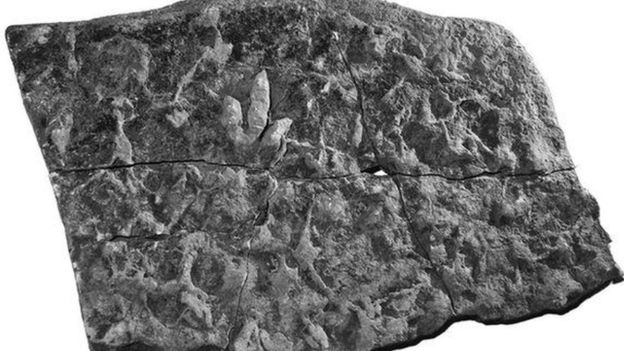
One of the footprints found near Inverness. DR NEIL CLARK

Dinosaur footprints have been found preserved in rocks on the Scottish mainland for the first time, a leading palaeontologist has said.

Dr Neil Clark, vice-president of the Geological Society of Glasgow, discovered the prints at a coastal location near Inverness.

Previously, dinosaur footprints have only been recorded in Skye.

The new fossils may have been left by different dinosaurs in the Middle Jurassic about 170 million years ago.

The location of the discovery has not been made public to allow for further research at the site.

Dr Clark, who is curator of of palaeontology at the Hunterian Museum in Glasgow, said: "I have frequently bemoaned the fact that dinosaurs have not been found elsewhere in Scotland.

"But I now have discovered some new dinosaur footprints in a completely different location."

He added: "They are from a completely new part of Scotland for dinosaurs and will add significantly to our understanding of dinosaurs of that age in Britain."

The site near Inverness contains fossilised impressions of footprints that are thought to be from several different types of dinosaur.

The size of the raised footprints suggests they were left by a member of the sauropod family of dinosaurs - huge, four-legged herbivores with long, slender necks that stood up to 18m (60ft) high.

Dr Clark has launched a crowdfunding campaign to raise the £5,000 needed to search for and map dinosaur footprints across Scotland. The money will be used to buy a drone.

Researchers from the University of Edinburgh are to take part in the research project.

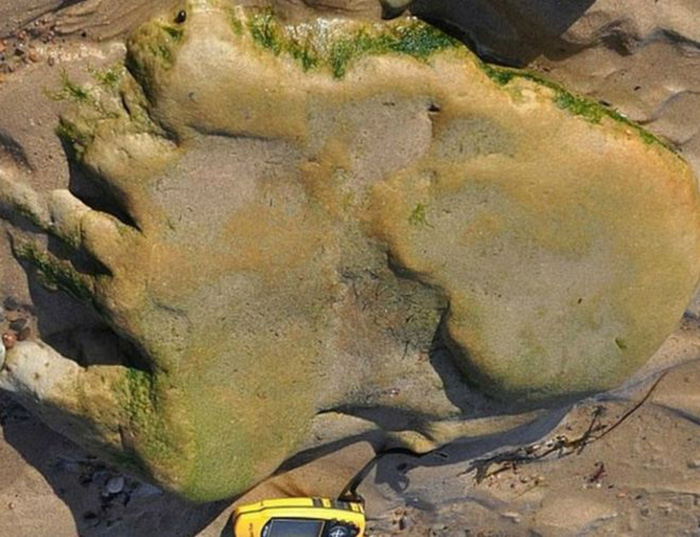
Some of the dinosaur footprints found in Skye. DR NEIL CLARK

Dr Clark made his find after attending a conference in Inverness in March.

He decided to walk along the coast and noticed dinosaur footprints on the shoreline.

He said: "I was pretty excited. I knew the significance of the find straight away."

About 170 million years ago, shortly after the supercontinent Pangaea began to break up, the land that is now the Isle of Skye was part of a smaller subtropical island.

Until the new discovery, Skye was the only place in Scotland where evidence of dinosaurs had been found.

It has more than 10% of the world's Middle Jurassic dinosaur species and more than 15% of the Middle Jurassic dinosaur sites.

The fossils found in Skye include more than 100 marks left by a lizard called Isochirotherium - also known as the hand-beast - 270 million years ago.

Source: www.bbc.co.uk

Jurassic World: Fallen Kingdom Release Date And Pre-Order Guide For 4K Blu-Ray / DVD / Digital

Tuesday, August 21, 2018

Jurassic World: Fallen Kingdom Release Date And Pre-Order Guide For 4K Blu-Ray / DVD / Digital

Dr. Ian Malcolm predicted all of this.

The dinosaurs are back once again, along with Bryce Dallas Howard, Chris Pratt, and company. Jurassic World: Fallen Kingdom is the sequel to 2015's Jurassic World, a resurrection of the series that examines everything that would definitely go wrong if we brought back dinosaurs and used science to make them even better at hunting prey (including humans).

This blockbuster sequel is set to release on digital platforms September 4 and on 4K Ultra HD, Blu-ray, and DVD on September 18. And when you're ready to secure your copy, you'll probably want to know what your options are. Let's break down what comes with the home versions of the movie, where you can pre-order it, and how much it costs. Read on for the details.

Jurassic World: Fallen Kingdom Digital Edition

If you want to grab the movie as early as possible, you'll have to go with the digital version. Here's where you can pre-order it now and how much it costs.

Amazon -- $20

Jurassic World: Fallen Kingdom 4K Ultra HD

The 4K Ultra HD Blu-ray version also includes a standard Blu-ray copy, as well as a digital version.


Amazon -- $28

Jurassic World: Fallen Kingdom Blu-Ray

If you buy the movie on Blu-ray, you'll also get a DVD and digital copy for free.

Amazon -- $25

Jurassic World: Fallen Kingdom 3D Blu-Ray

If you have a 3D television, you'll probably want to make full use of it by getting the movie in 3D. This version also comes with a standard non-3D Blu-ray as well as a digital copy.

Amazon -- $30

Jurassic World: Fallen Kingdom DVD

Aside from the digital version on certain sites, the DVD version is the most affordable way to bring home this blockbuster.

Amazon -- $18

Jurassic World 5-Movie Collection

Maybe the new movie isn't enough to satisfy your Jurassic needs. If you want a full collection of Jurassic Park/World films, you can pre-order this set. It comes with the original Jurassic Park trilogy as well as the two movies from the current series.

Amazon

4K Ultra HD -- $103

Blu-ray -- $67

DVD -- $60

Bonus Features

What's a home version of a movie without bonus features? Some of the bonus features included with home copies of the movie are exclusive to the 4K Ultra HD, Blu-Ray, and digital copies. Here they are:

  • The Kingdom Evolves--Filmmakers discuss how the second chapter in the Jurassic World trilogy pushes the franchise in a new direction.

  • Return to Hawaii--Cast and crew discuss shooting the film in Hawaii.

  • Island Action--A behind-the-scenes look at the bunker scene and runaway gyrosphere sequence.

  • Aboard the Arcadia--Cast and crew discuss working with the animatronic dinosaurs.

  • Start the Bidding!--A behind-the-scenes look at the auction scene.

And here are the bonus features you'll find on the DVD, 4K Ultra HD, Blu-Ray, and digital copies of the film:

  • On Set with Chris & Bryce--Go behind the scenes with Chris Pratt and Bryce Dallas Howard.

  • Birth of the Indoraptor--An inside look at the genetically designed monstrosity known as the Indoraptor.

  • Death by Dino--Go behind the scenes as the Indoraptor faces off with a key character.

  • Monster in a Mansion--Director J.A. Bayona discusses how Jurassic Park and Dracula (1979) influenced his approach to directing the monster in a mansion scene.

  • Rooftop Showdown--A look at the terrifying showdown on the rooftop of the Lockwood Mansion.

  • Malcolm's Return--Behind the scenes with the one & only Jeff Goldblum.

  • VFX Evolved--The team at ILM discuss their cutting-edge approach to creating dinosaurs.

  • Fallen Kingdom: The Conversation--Filmmakers and cast sit down for a candid and casual conversation about Jurassic World: Fallen Kingdom.

  • A Song for the Kingdom--Justice Smith sings for the cast and crew of Jurassic World: Fallen Kingdom.

  • Chris Pratt's Jurassic Journals

    • Vivian Baker, Makeup Artist

    • Mary Mastro, Hair Stylist

    • Chris Murphy, 1st Assistant Sound

    • Dean Bailey, Stunt Edge Car Driver

    • Peter Harcourt, Diver

    • Daniella Pineda and Justice Smith, Actors

    • Jody Wiltshire, Set PA

    • Kelly Krieg, Assistant Script Supervisor

    • J.A. Bayona, Director

    • James Cox, Stunt Performer

    • Rachelle Beinart, Stunt Double

    • Bryce Dallas Howard interviews Chris Pratt, Actor

  • Jurassic Then and Now--Presented by Barbasol – Key moments from the Jurassic saga that tie into Jurassic World: Fallen Kingdom.

What Kind Of Noises Did Dinosaurs Make?

Sunday, August 19, 2018

What Did Dinosaurs Really Sound Like?

In the movies, we often hear dinosaurs let out big, scary sounds. If you've ever played with toy dinosaurs, maybe you've also made your little Tyrannosaurus rex roar.

While dinosaurs have a reputation for roaring, I wasn't entirely certain whether or not they actually did so in real life. I asked my friend, Washington State University professor Cynthia Faux.

"It's impossible to say for sure," Faux said, "but we can speculate."

Faux is really curious about dinosaurs, especially those descendants of two-legged dinosaurs that soar through the sky today: birds.

Examining an animal's voice box might give us clues about what kind of sound it made. There are lots of birds on our planet and they all have different tweets, caws and chirps. Of course, a dinosaur's voice box would have been much bigger than a bird's voice box.

Sometimes, when we want to learn about life in the past, we examine fossils. Fossils are preserved traces of plants and animals. Some scientists even study poop fossils to find out what animals ate. But not all parts of an animal can be traced through fossils. Some voice boxes are made up of soft tissue.

This soft tissue breaks down over time, which makes it hard to figure out exactly what kind of voice box a dinosaur used to make their sounds.

Scientists who conducted some of the most recent research into dinosaur sounds have found the creatures actually might have cooed or boomed. In fact, that sound may been similar to the kinds of noises today's emus or ostriches make, Faux said.

Roaring is also more of a mammal thing, Faux added. Lions, tigers and bears are all predators that roar - but they aren't roaring all the time. When they do roar, it's often to show their dominance or to scare away another animal.

After all, making a lot of sound when you approach your prey isn't the brightest idea. It works much better to quietly sneak up on your prey, so they don't know what's coming.

There may have been some other ways dinosaurs communicated, too. Some dinosaurs may have displayed their feathers. Yes, some dinosaurs had feathers. They may have used them as a way to send messages to those around them-perhaps as a defense or to attract a mate.

Sauropods - plant-eating, four-legged dinosaurs that usually had long necks - were as big as houses and made a lot of noise just by walking around. Perhaps their stomping sent a message to those around them.

Some dinosaurs may have communicated in a way similar to alligators. By creating vibrations in the water, they could let creatures around them know they are frightened and might strike.

Alligators, birds and all kinds of animals make interesting sounds on our planet these days. Can you hear any animal sounds in your neighborhood? Can you guess what animal is making the sounds you hear? 

Source: http://dnews.com

Bones Of Two Fossils Reptiles Who Lived 260 Mln Years Ago Found In Russia

Friday, August 17, 2018

© Maria Shevchenko/TASS

Paleontologists have discovered fossils of two Pareiasaurs, reptiles who roamed the Earth some 260 million years ago.

Paleontologists in the Kirov Region, some 900 kilometers to the northeast of Moscow, have discovered fossils of two Pareiasaurs, reptiles who roamed the Earth some 260 million years ago.

The discovery was made at the Kotelnich fossil site on the right bank of the Vyatka river.

"The second skeleton is not as well preserved as the first one found during this season," said Leonid Kavardakov of the Vyatka paleontological museum. "Both discoveries were brought to the museum’s laboratory."

The first two skeletons of the ancient reptiles were unearthed at the fossil site in 1933 by a local hydrogeologist who was drilling for water wells. Excavation work has never stopped on the Vyatka river since the 1990s. The work is carried out here from May to October when the water level declines.

Therocephalians, cynodonts, gorgonopsians, anomodonts, dicynodonts, a Mastodonsaurus, Tarbosaurus and Ankylosaurus - all of these fossils were discovered at the Kotelnich site.

Pareiasaurs were large and awkward herbivores who measured to 2.5 meters in length, who most likely lived in damp lowlands. Sometimes they got trapped in mud and slowly died.

The Vyatka paleontological museum founded in 1994 houses some 3,000 items. The team of local paleontologists discovered over 20 new species of fossil animals in 25 years.

Source: http://tass.com

Chinese Paleontologists Discover Ancient Beetle To Pollinate Plants With Naked Seeds

Saturday, August 18, 2018

Cycad pollen grains associated with C. cycadophilus. (Xinhua/CREDIT: NIGPAS)

Chinese researchers have found a pollinator of early gymnosperms prior to the rise of flowering plants, lending clues to complex biology of those plants with naked seeds.

A study published in the journal Current Biology described a new mid-Cretaceous (99-million-year-old) boganiid beetle with specialized pollen feeding adaptations.

The findings suggested an ancient origin for beetle pollination of cycads long before the rise of flowering plants, according to Cai Chenyang with the Nanjing Institute of Geology and Palaeontology of the Chinese Academy of Sciences.

Plant-insect interactions, one of the critical bedrocks for modern ecosystems, are largely dominated by insect-angiosperm relationships owing to the hegemony enjoyed by flowering plants since the Late Cretaceous. Gymnosperm-insect interactions, on the other hand, are far less well understood, particularly in terms of pollination modes.

Unlike modern wind-pollinated conifers and Ginkgo, cycads are unusual in that they are an ancient group of gymnosperms pollinated by insects, such as beetles and rarely thrips.

The researchers discovered a new genus and species of boganiid beetle, preserved with many tiny cycad pollen grains and possessing specialized mandibular patches for the transport of cycad pollen.

The fossil represented the earliest definitive fossil evidence for cycad-insect interactions, and illuminated the ancient history of the establishment of complex entomophily in cycads. Entomophily is the form of pollination whereby pollen or spores are distributed by insects.

It also indicated a probable ancient origin of beetle pollination of cycads at least in the early stage of the Jurassic, some 176 million years ago, long before flowering-plant dominance and the radiation of their pollinators such as bees and butterflies later.

Source: www.xinhuanet.com

Jurassic World: Fallen Kingdom Available to Purchase on Amazon Video Next Month

Saturday, August 18, 2018

Amazon.com: Jurassic World: Fallen Kingdom

The fall is almost here and that means some of the summer blockbusters are coming to Amazon Video. First up is Jurassic World: Fallen Kingdom.

If you love streaming movies through Amazon Video, you’ll adore September. As the fall rolls in, the summer blockbusters are finally making their way to the service. Sure, you’ll have to pay to watch, but it’s totally worth it to get a good copy. Jurassic World: Fallen Kingdom is the first to make its way as a digital release next month.

Amazon Adviser already shared that the movie is now available for pre-order if you want the DVD or Blu-Ray. You can also now pre-order the digital version if that’s something you want. It costs $14.99 for the HD version.

Jurassic World: Fallen Kindgom will be released on digital on Sept. 4, 2018. This is 14 days before the DVD and Blu-Ray version of the movie is released.

If you do wait for the Blu-Ray, you’ll get access to the digital copy as well. So you can watch it anywhere you want in HD.

Watch 1000s of TV shows and movies with Amazon Prime

Jurassic World: Fallen Kingdom is the sequel to the Jurassic Worldmovie with Chris Pratt in the lead role. Owen and Claire want to rescue the remaining dinosaurs from the ruined Jurassic World theme park after the threat of a volcanic eruption, but things are never as easy as they seem. While it is a PG-13 rated movie, parents are strongly cautioned due to language and some of the action on the screen.

Reviews for the movie are spectacular. Even though I’m not a Jurassic Park/Worldfan (I know, I know), the reviews make me need to see this iinstallment so that’s saying a lot!

Will you get your hands on the Jurassic World: Fallen Kingdom digital copy? Are you waiting for the release on Blu-Ray? Share your thoughts.

Jurassic World: Fallen Kingdom is out on digital release on Amazon Video on Sept. 4, 2018.

Source: https://amazonadviser.com

'Jurassic Park' Roars Back into Theaters this September

Friday, August 17, 2018

Jurassic World: Fallen Kingdom blew up the box office just two months ago—and yet Universal is already inviting moviegoers back into its prehistoric pandemonium.

This September,  in honor of its 25th anniversary, Steven Spielberg's original Jurassic Park will retake big screens across the country. With over 500 participating theaters, ticket availability should be high. Jurassic fanatics will have a much better shot at getting seats here than at one of August's super in demand Dark Knight IMAX showings.

In addition to watching the original on the big screen, audience members will be treated to a 17-minute fan remake of classic Jurassic Park scenes.

Various showings will be scheduled for September 16th, 18th, and 19th. You can grab your tickets in advance through Fathom Events or directly from your theater's box office. (No word yet on whether the teetering-on-extinction MoviePass will support the event.)

These screenings will be a pleasant blast from the past—in more ways than one. Plus, it'll help to at least slightly close the gap between now and Jurassic World 3's release date. 2021 feels so, so far away. 

Source: https://mashable.com

New Perot Museum Exhibit Gets Up Close and Personal with Dinosaur Bones

Friday, August 17, 2018

See how scientists prep this dino discovery for its big display. Photo courtesy of Perot Museum

The scientists who prep dinosaur discoveries for display at the Perot Museum of Nature and Science are now putting themselves on display. The museum's new Paleo Lab, opening Labor Day weekend, will allow guests to view paleontologists as they prepare and process fossils fresh from the field.

The glass-encased permanent exhibit will have cameras in the lab projecting close-up shots of live fossil preparation, while museum "Brainiacs" explain and demonstrate things like tools, techniques, and how the paleontologists' work connects to the specimens displayed in the exhibit hall. There's science behind those skeletons, kids!

"Guests just might witness the unearthing of a new prehistoric species," the museum says in a release. 

They note that the museum’s paleo researchers have already made several big discoveries, including Nanuqsaurus hoglundi, the polar tyrannosaur that will welcome guests from atop the Paleo Lab. "A pint-sized cousin of the T. rexNanuqsaurus was discovered and named by the Perot Museum’s renowned paleontologists, Dr. Tony Fiorillo and Dr. Ron Tykoski, in 2014," the museum says. "The new skeletal reconstruction of Nanuqsaurus for the Paleo Lab is the first ever on display."

The lab will sit on Level 4 in the T. Boone Pickens Life Then and Now Hall.

It will open with a roar at a big event called Dino Fest, September 1-2. The dinosaur extravaganza will include hands-on fossil digs, live music, and a beer garden on the plaza, live bird (aka modern-day dinosaur) interactions, T. rex sports challenges, trivia games, “paleo talk” lectures, take-home pterosaur gliders, and more. Young guests will be able to act as junior paleontologists and learn about Arctic dinosaurs, while the young at heart can engage with paleontologists Dr. Fiorillo and Dr. Tykoski.

Dino Fest hours will be Saturday, 10 am-6 pm (members get in at 9 am); Sunday, 11 am-4 pm (members get in at 10 am). General admission museum tickets are required.

The museum's "Ultimate Dinosaurs" exhibition, which spotlights 17 rarely seen, exotic species from the southern hemisphere, remains open through January 6, 2019. 

Source: http://dallas.culturemap.com

Royal Tyrrell Research Blows Swimming Dinosaur Theory out of the Water

Friday, August 17, 2018

A model of a Spinosaurus is displayed outside the entrance at the National Geographic Society in Washington. PABLO MARTINEZ MONSIVAIS / AP

New research published by the Royal Tyrrell Museum has sunk previous claims that a swimming dinosaur once paddled the rivers of the Earth.

The paper, published in scientific journal PeerJ, uses computer modelling to conclude the Spinosaurus was not adapted to swim as previously thought.

Research published in 2014 by Nizar Ibrahim and others in the journal Science proposed the dinosaur was partly aquatic, meaning it could both swim and walk on land, a first for any dinosaur.

But using different techniques that relied on physics-based testing methods, the Royal Tyrrell Museum’s curator of dinosaurs, Donald Henderson, found that the 95-million-year-old species would not have been able to survive living in water.

Henderson created three-dimensional, digital models of Spinosaurus and other predatory dinosaurs in order to test their centres of mass buoyancy and equilibrium when immersed in water. He also tested the software using models of semi-aquatic animals such as an alligator and emperor penguin, for comparison.

Henderson’s models showed that Spinosaurus could float with its head above water. However, models of other dinosaurs demonstrated similar results. COURTESY ROYAL TYRRELL MUSEUM

His models showed the Spinosaurus would have been able to float with its head above water and breath freely, just like other dinosaurs analyzed in the study.

But unlike semi-aquatic animals like alligators, which can easily self-right themselves when tipped to the side in water, the Spinosaurus rolled over onto its side when tipped slightly. The finding implied that the dinosaur species would have easily tipped over in water, forcing it to rely on its limbs to constantly maintain an upright position.

Its centre of mass was also found to be close to its hips, between its hind legs, as opposed to the centre of the torso, which had been proposed by Ibrahim’s 2014 research.

A digital model of the centre of mass of Spinosaurus (illustrated by the black plus symbol located at the hind legs), which is similar to that of other theropods, such as Tyrannosaurus rex. COURTESY ROYAL TYRRELL MUSEUM

Henderson’s model found the Spinosaurus to be unsinkable underwater, something that would have severely limited its ability to hunt aquatic prey. This differentiates it from traits commonly demonstrated by living aquatic birds, reptiles and mammals, which can submerse themselves to pursue prey underwater.

“The combination of mass close to the hips, an inability to sink underwater, and a tendency to roll onto its side unless constantly resisted by limb use, suggest that Spinosaurus was not specialized for a semi-aquatic mode of life,” the researchers stated.

“Spinosaurus may have been specialized for a shoreline or shallow water mode of life, but it would have still have been a competent terrestrial animal,” added Henderson.


Source: https://calgaryherald.com

Pages