Blogs

New Jersey Fossils Shed Light on Theropod Dinosaurs of Eastern United States

Friday, August 31, 2018

North American dinosaurs. Image credit: Davide Bonadonna.

On the east coast of North America, dinosaur fossils are rare finds. Owing to several factors, such as the mass-urbanization of the eastern seaboard, fossils from these incredible creatures are few and far between. Even the most complete skeletons are incomplete, making nearly any stray chunk of bone from the area of scientific interest.

Discovered in the early 80s, the Ellisdale fossil site of New Jersey has become well-known for preserving an unusually complete record of terrestrial animals from the eastern coast of North America from 75 million years ago, when the continent was divided as two landmasses by a large interior sea. Yet, the dinosaur fossils of the site have never been formally described.

Since 2014, researcher Chase Brownstein of the Stamford Museum and Nature Center has been tracking down elusive eastern North American dinosaurs.

Recently, Brownstein has been working on describing the ample assemblage of bones from one group of dinosaurs, the theropods, from Ellisdale.

This group of dinosaurs, which includes giant carnivores like Tyrannosaurus, smaller predators like Velociraptor, herbivorous species like the long-necked, massive claw-bearing Therizinosaurus, is the lineage to which birds belong.

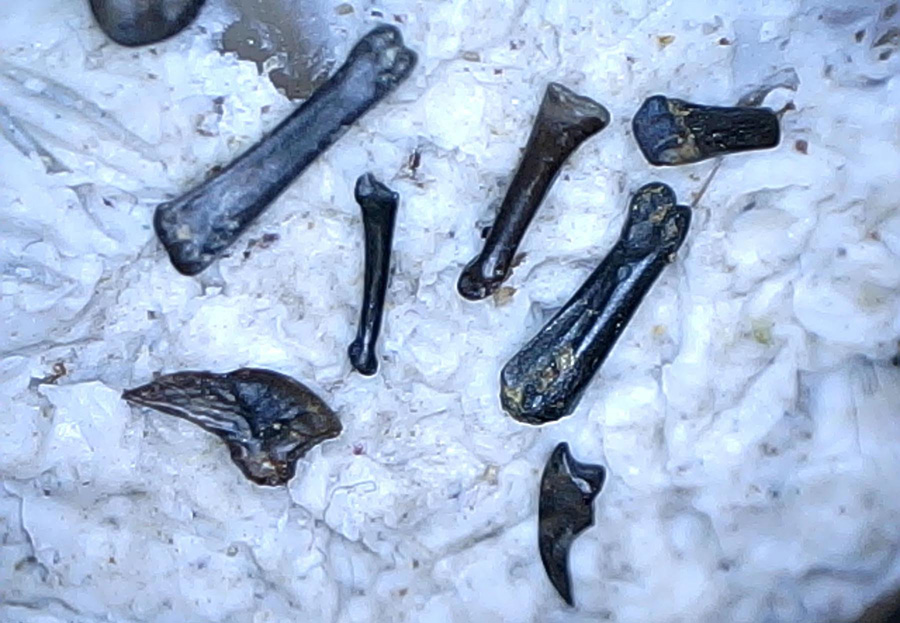
Ellisdale fossils: (A) foot bone of a tyrannosaur; (B) giant dromaeosaurid (raptor dinosaur) teeth; (C), tyrannosaur teeth; (D) limb bone of a theropod dinosaur; (E) partial tooth of a small dromaeosaurid (raptor dinosaur); (F) foot bone of an ornithomimosaur (ostrich dinosaur). Image credit: Chase D. Brownstein.

At Ellisdale, the diversity of this dinosaur group is evinced by the fossils. After viewing the theropod bones and teeth from Ellisdale stored at the New Jersey State Museum, Brownstein concluded that perhaps four different species are represented at the site, one of the most diverse faunas of these dinosaurs known from east of the Mississippi River.

Tyrannosaurs distantly related to T. rex are known from teeth and a single foot bone. The teeth recovered may indicate the presence of two types of these large carnivores in the ecosystem.

Another type of dinosaur that resembled an ostrich known as an ornithomimosaur is represented by a single foot bone.

One particularly interesting finding is that several teeth previously recognized as those of tyrannosaurs are in fact those of giant dromaeosaurid, or ‘raptor,’ dinosaurs potentially more than 13 feet (4 m) long.

Some of these teeth, although incomplete, are as large or larger than teeth from other giant raptor dinosaurs already known from western North America.

Finally, some teeth from smaller raptor dinosaurs are also known from Ellisdale. As small dinosaurs are very poorly known from eastern North America, these fossils are an important addition to the record of smaller dinosaur bones.

“These bones and teeth may not be more than a few isolated, fragmentary pieces,” said Brownstein, “but they can greatly help us in better grasping aspects of dinosaur biology like their global diversity, distribution, and evolution.”

“For one, the Ellisdale assemblage of theropod dinosaurs is the only one known from the northeast that overlaps in age with sites from both the southeastern U.S. and western North America, allowing us to better compare dinosaur faunas from across the entire continent.”

“Sites like Ellisdale, although they do not produce anything along the lines of the complete skeletons known from Asia and western North America, should not be overlooked. They are a great asset to the study of paleontology because of their ability to produce fossils at all in fossil-poor regions, allowing for glimpses at the places whose deep past has been so greatly obscured.”

The research was published in the Journal of Paleontology.

_____

Chase D. Brownstein. The distinctive theropod assemblage of the Ellisdale site of New Jersey and its implications for North American dinosaur ecology and evolution during the Cretaceous. Journal of Paleontology, published online August 20, 2018; doi: 10.1017/jpa.2018.42

Source: www.sci-news.com

Researchers Find Ancient Parasitic Wasps in Fossil Fly Pupae

Thursday, August 30, 2018

Illustration of a female Xenomorphia resurrecta ovipositing into a puparium. Image credit: van de Kamp et al, doi: 10.1038/s41467-018-05654-y.

A research team led by Karlsruhe Institute of Technology scientist Thomas van de Kamp has found ancient parasitoid wasps lurking inside 55 mineralized fly pupae from the Paleogene period (66-23 million years ago).

“Parasitic lifestyles are extremely successful among animals and evolved independently, perhaps hundreds of times,” Dr. van de Kamp and co-authors said.

“With an estimated 50% of species, parasites comprise a huge proportion of animal life on Earth, and the arms races between parasites and their hosts are considered major driving forces for evolution.”

“In insects, parasitism is especially diverse in the order Hymenoptera, where many wasp species develop as parasitoids on or within an arthropod host.”

“The fossil record of parasitoid wasps is nearly exclusively restricted to isolated adults, with few examples of unidentified larvae trapped in amber next to their hosts.”

Using synchrotron-based X-ray microtomography, the team examined 1,510 phosphatized fly pupae from the Paleogene period of France.

Host fly puparium and a parasitoid wasp inside host. Scale bar – 1 mm. Image credit: van de Kamp et al, doi: 10.1038/s41467-018-05654-y.

“The fossils we studied belong to the collections of the Natural History Museum of Basel and the Swedish Museum of Natural History,” the researchers said.

“They were collected in the phosphorite mines of the Paleogene fissure fillings of the Quercy region in south-central France in the late 19th century, but the exact locality, collection date and the original collector are unknown.”

“In 1944, Swiss entomologist Eduard Handschin described these fossils in detail and emphasized the value of the externally inconspicuous pieces of merely 3 mm in length. Still, they have fallen into oblivion for more than 70 years. At that time, Handschin had suspected the contours of a parasitic wasp in a thin section of a probably 34 to 40-million-year-old fly pupa, but could not prove it.”

In total, the scientists identified 55 parasitation events by four previously unknown ancient species of parasitoid wasps: Xenomorphia resurrectaXenomorphia handschiniCoptera anka and Palaeortona quercyensis.

“These wasps belong to the single family Diapriidae,” they said.

“The most common species was Xenomorphia resurrecta, of which we found 18 females and 24 males, followed by Xenomorphia handschini with one female, four males and one pupa and Coptera anka with three females and one male. Palaeortona quercyensis was represented by one female only.”

“Each of the four parasitic wasp species had its own strategy for adaptation to the host.”

The findings are published in the journal Nature Communications.

_____

Thomas van de Kamp et al. 2018. Parasitoid biology preserved in mineralized fossils.Nature Communications 9, article number: 3325; doi: 10.1038/s41467-018-05654-y

Source: www.sci-news.com

Original Jurassic World Script Featured a Raptor Pack Helicopter Jump

Wednesday, August 29, 2018

The original script for Jurassic World opened with the hero and a raptor pack jumping from a helicopter to raid a drug dealer’s compound. While Jurassic Park III proved to be another hit for the series back in 2001, it’s fair to say responses from fans and critics were mixed. The movie had a paper thin story, forced humor and a lack of the awe and suspense of the original, and it felt like the franchise had already run out of ideas.

This is partly why it took almost 15 years for Jurassic World to arrive. A number of concepts were thrown around during this period, including Alan Grant and Ian Malcolm teaming up to stop the spread of dinosaurs on a new island. The most famous abandoned idea from writer John Sayles featured a mercenary being hired to train a team of dinosaur/human hybrids for a villain named Baron Von Drax. Despite producer Steven Spielberg initially being onboard with this far out concept, the idea was ultimately dropped after a couple of drafts.

Jurassic World was co-written and directed by Colin Trevorrow, but there was already a script by writers Rick Jaffa and Amanda Silver before he came onboard. Trevorrow greatly reworked the screenplay before filming, but the director recalled the original opening sequence from that draft in a new interview with BDH Network Magazine.

I only read Rick and Amanda's script once, so I don't remember all the details of it. The lead character was a guy called Vance, who ultimately became Owen in our story. The film opened with Vance jumping out of a helicopter with a pack of raptors on a military raid of a drug dealer's compound in Colombia. It was a different approach.

While Jurassic World’s Owen Grady does train a pack of raptors to obey this commands and even leads them into battle against the Indominus Rex, the movie doesn’t turn them into military weapons. This is a notion InGen wants Grady to consider, but only the possibility is raised. While a raptor drug raid certainly would have been a unique way to open the movie, the scene also ran the risk of being incredibly silly. In the end, Trevorrow put the focus back on the park and the fight against the new hybrid dinosaur.

Maybe the notion of dinosaurs being used as soldiers will come up again in future Jurassic World sequels, however. Trevorrow will return to the director’s chair for Jurassic World 3, which he has stated will be a ‘science thriller’ like Jurassic Park. There are also rumors characters from the original trilogy like Ian Malcolm and Ellie Sattler will make a return, and that the movie will build on the implications of one of Jurassic World: Fallen Kingdom’s most controversial twists.

Source: https://screenrant.com

Drumheller 'World's Largest Dinosaur' Structure Marks Two Million Visitors

Wednesday, August 29, 2018

The "World's Largest Dinosaur" structure in Drumheller. PHOTO COURTESY THE DRUMHELLER & DISTRICT CHAMBER OF COMMERCE

A Drumheller structure billed as the World’s Largest Dinosaur is celebrating a milestone after reaching two million visitors this week.

Heather Bitz, executive director of the Drumheller and District Chamber of Commerce, said a visitor from Israel was the two millionth person to climb the 106 stairs to the mouth of the dinosaur and take in the view of the surrounding landscape.

The attraction, which is owned and operated by the Drumheller and District Chamber of Commerce, was built almost 18 years ago, in October 2000. It is more than 26 metres tall, or four times as large as an actual Tyrannosaurus rex would have been.

“Our attraction was a big undertaking for our organization,” Bitz said.

“It was a brain child of a group of Drumheller business owners and took many volunteer hours and funding from a variety of sources to get the project complete. Back in the day, it cost just over $1 million to build, and we’ve been operating it since.”

The “World’s Largest Dinosaur” structure in Drumheller. Photo courtesy the Drumheller & District Chamber of Commerce.

Fifteen per cent of the proceeds from admission fees and sales in the gift shop are returned into the community through the chamber’s legacy fund, Bitz said.

“To date … we’ve reinvested over $600,000 back into the community,” she said.

The two-millionth visitor, who climbed the stairs of the dinosaur on Monday afternoon, was rewarded with a package that included family passes to the Royal Tyrrell Museum and other local attractions, two nights of accommodation at a Drumheller hotel, and World’s Largest Dinosaur merchandise.

Source: https://calgaryherald.com

Three Previously Unknown Ancient Primates Identified

Wednesday, August 29, 2018

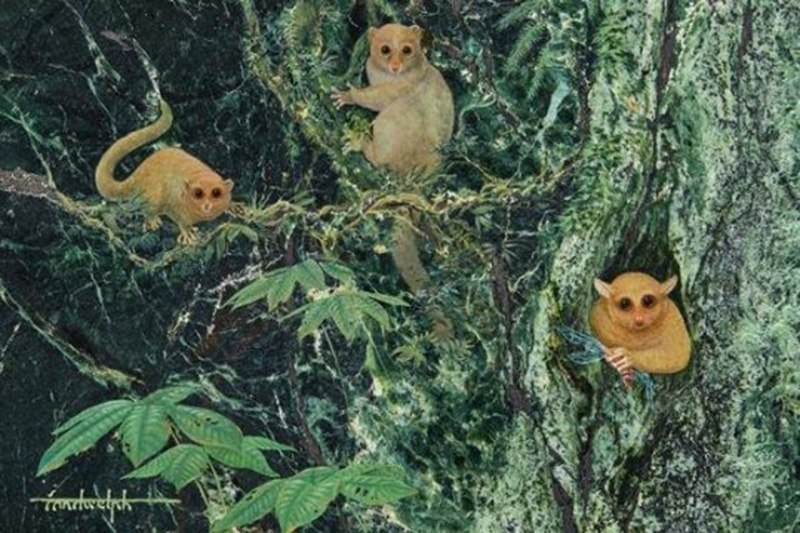
Kirk's father and Austin-based artist Randy Kirk produced his own rendering of what the species might have looked like. Credit: Painting on marble by Randwulph.

Biological anthropologists from The University of Texas at Austin have described three new species of fossil primates that were previously unknown to science. All of the new primates were residents of San Diego County at a time when southern California was filled with lush tropical forests.

Since the 1930s, numerous primate fossils have been uncovered in the sandstones and claystones that make up the Friars Formation in San Diego County. Paleontologist Stephen Walsh and fieldworkers from the San Diego Museum of Natural History (SDNHM) built up a large collection of fossil primates from the San Diego area, but Walsh was unable to describe these specimens before his death in 2007.

A decade later, UT Austin graduate student Amy Atwater and anthropology professor Chris Kirk took up the challenge, describing and naming three previously unknown omomyoid primates that lived 42 million to 46 million years ago. The researchers named these new species Ekwiiyemakius walshiGunnelltarsius randalli and Brontomomys cerutti.

These findings double the number of known primate genera represented in the Friars Formation and increase the total number of known omomyine primates of that period from 15 to 18.

Atwater and Kirk's descriptions were published in the Journal of Human Evolution.

"The addition of these primates provides for a better understanding of primate richness in the middle Eocene," said Atwater, who is now the paleontology collection manager at the Museum of the Rockies in Bozeman, Montana. "Previous research in the Rocky Mountain basins suggested the primate richness declined during this time period, but we argue that primate richness increased concurrently in other locations."

Studying the teeth, researchers concluded the three new genera, which represent the bulk of the undescribed Friars Formation omomyoid sample at SDNHM, range in size from 113 to 796 grams and are most likely related to a group of extinct species comprising the primate subfamily Omomyinae.

"Teeth can tell us a lot about evolutionary history and give us a good handle on the size and diet of an extinct primate," Kirk said. "Enamel is the hardest tissue in the body. And as a result, teeth are more likely to be preserved in the fossil record."

Ekwiiyemakius walshi, the smallest of the three new species, was estimated to weigh between 113 and 125 grams -- comparable in size to some modern bushbabies. It was named for Walsh, who collected and prepared many of the specimens, and also derives from the Native American Kumeyaay tribe's place name, Ekwiiyemak -- meaning "behind the clouds" -- for the location of the headwaters of the San Diego and Sweetwater Rivers.

Gunnelltarsius randalli was named for Gregg Gunnell, the researchers' late colleague and expert on Eocene mammals, and for SDNHM fossil collections manager Kesler Randall. It was estimated to weigh between 275 and 303 grams, about the size of today's fat-tailed dwarf lemur.

Brontomomys cerutti was large compared with most other omomyoids and was estimated to weigh between 719 and 796 grams -- about the size of a living sportive lemur. Due to its large size, its name derives from the Greek word bront?, or "thunder," as well as for Richard Cerutti, the retired SDNHM paleontologist responsible for collecting many of the Brontomomys specimens.

Source: www.sciencedaily.com

Now You Can Watch Paleontologists Work on Real Dinosaur Fossils at HMNS

Wednesday, August 29, 2018

Photo: Elizabeth Conley/Staff Photographer

A new feature at the paleontologist lab at the Houston Museum of Natural Science will allow patrons to see the ongoing work being done to preserve prehistoric dinosaur fossils.

Opening to the public on Sept. 1, the Morian Hall of Paleontology's Fossil Preparation Laboratory will give dinosaur enthusiasts of all ages a glimpse into the daily work of the museum's team of volunteer paleontologists as they clean and sort fossils.

There will also be an intercom system for patrons to chat with the scientists or ask questions. Patrons can't actually get up close and personal with the fragile work being done so this is the next best thing.

David Temple, associate curator of paleontology at the museum, said the new window allows patrons to see the work that goes into the preparation of the exhibits. He says it's a little like a TV studio inside the museum.

"The public can see every bit of a paleontologists' daily work," Temple said. "We do all kinds of prep work from gently chipping away rock from fossils to even the mounting of fossils."

Fossils are also being scanned in the lab, using 3-D printing and scanning technology which will allow other institutions to download the file and print them in their own labs, "sharing" fossils with other paleontologists from long distances.

With the proliferation of 3-D scanning even regular people can print out dinosaur fossils for their own research.

"Virtually everything we are doing in here will help other paleontologists," Temple added. "We are creating teaching opportunities within the paleontology community and for prospective paleontologists."

Temple said that along with giving patrons a look at the fossils in the inventory at HMNS, they will also see the hard work that goes into being a paleontologist. In many ways paleontology is the first taste that many people get of tangible science.

"Paleontology is a passion but it's hard to get a job and you don't always make a lot of money," Temple said. "What people will see here is people truly motivated by science and curiosity."

Volunteers can sign up through HMNS' volunteer program and specify that they want to work in the paleontology department. There are currently 75 volunteers of varying experience on staff working with fossils.

The window at the paleontology lab will be open every day at 10 a.m. until around 5 p.m.

The $85 million Morian Hall of Paleontology, opened in 2012, features a two-stories-tall Tyrannosaurus rex, along with other eye-popping displays that have made the hall a must-see for locals and tourists alike. It also makes one heck of a party space after hours.

Source: www.chron.com

New Clues Unearthed About Mammals' Rapid Evolution After Dinosaur Extinction

Tuesday, August 28, 2018

Fossilised finger and toe bones from the Royal Tyrrell Museum of Paleontology in Canada have helped determine the lifestyle of early mammals. Credit: Prof. Christine Janis

It was a life-altering event. Around 66 million years ago, at the end of the Cretaceous period, an asteroid struck the Earth, triggering a mass extinction that killed off the dinosaurs and some 75% of all species. Somehow mammals survived, thrived, and became dominant across the planet. Now we have new clues about how that happened.

Dr. Steve Brusatte, a palaeontologist at the University of Edinburgh, UK, who previously studied the dinosaurs' extinction, sought to understand exactly how this event affected mammals and their evolution.

'I wanted to find out where mammals were living, what were their habits … and how this exciting period of evolution set the stage for the great diversity of mammals that exists today,' he said.

His work revealed that while many mammals were wiped out with the dinosaurs, there was also an increase in the diversity and abundance of those that did survive.

As part of the four-year BRUS project which ended in March, Dr. Brusatte and his team collected new fossils dating back to the first million years after the extinction, which is thought to have lasted about 60,000 years, and put together a family tree of early mammals.

They hunted for fossils in New Mexico, US, which is known to have the best record of vertebrate specimens from this period. They collected several new fossils, including the previously unknown Kimbetopsalis simmonsae, a beaver-like species that lived during the first few hundred thousand years after the extinction.

The beaver-like Kimbetopsalis simmonsae is one mammal species that lived during the first few hundred thousand years after the dinosaurs died out. Credit: Sarah Shelley

The team also visited museums to explore fossil collections, which allowed them to describe the features of several important mammal species in detail, such as a type of Periptychus, one of the first mammals to prosper after the asteroid struck.

The specimens that they analysed are also providing an insight into how mammals living right after the extinction are linked to modern ones.

'Some of today's familiar mammals, like the groups that later evolved into horses or bats, got their start soon after the extinction and probably as a direct result of it,' Dr. Brusatte said.

Wiped out

The work supports a growing body of research showing that when the dinosaurs were wiped out, it wasn't simply a case of one group of animals dying off and another taking over as was previously thought.

Smaller mammals seemed to be better equipped to survive since they could hide more easily, for example, and those with a diverse diet were able to adapt more quickly, Dr. Brusatte said.

'There isn't one magic reason why some of them lived and others died,' he said. 'There was probably chance and randomness involved because things changed so quickly after the asteroid hit.'

The team was surprised to learn how quickly mammals evolved after the extinction. Although the first mammals originated at the same time as the early dinosaurs – more than 200 million years ago – they remained small, about the size of badgers, when they co-existed.

A few hundred thousand years after dinosaurs disappeared, there were much larger, cow-sized species. 'Mammals just took advantage of the opportunity and started to evolve really fast,' Dr. Brusatte said.

How they dealt with changes in climate remains a mystery. After the asteroid hit, there were a few years of immediate cooling followed by a few thousand years of global warming where temperatures spiked by 5°C. Then, over the next 10 million years, temperatures dropped, although the baseline temperature was still much hotter than it is today.

In the future, Dr. Brusatte and his team want to find out how temperature variations affected mammals—whether they changed in size, expanded or retracted their range, and whether some species became extinct, for example.

'We want to know these things to understand climate change in our world today,' Dr. Brusatte said. 'We just have to collect more fossils.'

But it wasn't just dinosaur extinction that influenced the evolution and rise of mammals—other environmental factors could also have played an important role.

A shift in vegetation took place in the last 10 million years or so of the Cretaceous period when flowering plants, such as deciduous trees, started to become more commonplace than the previously widespread conifers and ferns. The animals' habitat would have become more complex since deciduous trees have an elaborate canopy and understory.

'Even if  hadn't become extinct, mammals would have prospered anyway because of the change in forest environments,' said palaeontologist Professor Christine Janis from the University of Bristol in the UK.

The extinction of the dinosaurs paved the way for today's mammalian diversity. Credit: Petr Kratochvil/ Public Domain Pictures

Movement

Prof. Janis and her colleagues decided to investigate whether the change in plant life affected the habitat preferences of small mammals. As part of the MDKPAD project, which ran from 2015 until the end of 2017, they looked at mammal bones to deduce whether they lived in the ground or in trees as limb bones reflect locomotor behaviour.

Previous work had typically examined mammal teeth, which are prevalent in the fossil records, to gain insight into diets from that time. Studies looking at changes in mammals' limbs were limited to a few complete skeletons so the team set out to see if scraps of skeletons could provide similar information.

Whole fossils of small mammals from that era are rare. So Prof. Janis used around 500 bone fragments that she found in museums in North America, where the best collections from the late Cretaceous are found.

But before she could start her analysis, she first had to understand existing mammals to figure out how the shape of different parts of their bones, mainly the articulation of their joints, relate to arboreal or terrestrial lifestyles.

'You've got to have a comparative database,' said Prof. Janis, who set out to create one. 'That's not something that existed.'

Prof. Janis has now collected details of the bones of about 100 small living mammals and catalogued them. She found that pieces of joints, which also happen to be preserved more often since they are more dense, can reveal a small animal's mode of locomotion with a good degree of confidence.

Certain joints, like the elbow and knee, showed similar anatomical correlations to those of small living animals, so these could be used to identify the locomotive behaviour linked to a fossil.

Surprisingly, mammal bones from the last 10 million years of the Cretaceous period showed that most were generalised but a few very arboreal, with limbs similar to those of modern primates. 'I was expecting all of the animals to be more like squirrels and not quite as specialised,' Prof. Janis said.

The bones of extinct mammals suggest they became more terrestrial in the early Paleogene, the period after the Cretaceous. Prof. Janis thinks it's because of an increase in understory vegetation. 'Bushes and shrubs beneath the tree canopy were now a more suitable habitat for these small mammals,' she said.

Although Prof. Janis does not plan to further the project, she will make her bone database available to other researchers. This database could help scientists determine the behaviour of individual species, locomotive changes in communities over time, and allow for local and global environmental changes to be tracked.

'The powerful thing about this data is that you don't need to have pristine skeletons (to do comparisons),' she said. 'You can have scrappy data and still get results from it.'

Source: https://phys.org

Two New Alvarezsaurian Dinosaurs Unearthed in China

Tuesday, August 28, 2018

Xu et al report two new Early Cretaceous alvarezsaurian theropods representing transitional stages in alvarezsaurian evolution. The analyses indicate that the evolutionary transition from a typical theropod forelimb configuration to a highly specialized one was slow and occurred in a mosaic fashion during the Cretaceous period. Image credit: Xu et al, doi: 10.1016/j.cub.2018.07.057.

Paleontologists in China have found fossil fragments from two new dinosaur species — named Xiyunykus pengi and Bannykus wulatensis — that walked the Earth approximately 120 million years ago (Cretaceous period).

Xiyunykus pengi and Bannykus wulatensis are both alvarezsaurs, an enigmatic group of dinosaurs that share many characteristics with birds.

Their bodies are slender, with a bird-like skull and many small teeth instead of the usual large, sharp cutting teeth of their meat-eating relatives.

“Alvarezsaurs are weird animals. With their strong, clawed hands and weak jaws, they appear to be the dinosaurian analogue to today’s aardvarks and anteaters,” said Professor Jonah Choiniere, from the University of the Witwatersrand.

Xiyunykus pengi was discovered in 2005 in Xinjiang, north-western China.

Bannykus wulatensis was discovered a few years later, in 2009, in Inner Mongolia, north-central China.

Skeletal anatomy of Xiyunykus pengi: (A) skeletal silhouette showing preserved bones (in gray); (B) histological thin-section of the fibula; arrows denote growth lines used to age the specimen; (C) left frontal in dorsal view; (D-F) partial braincase in left lateral (D), ventral (E), and posterior (F) views; (G and H) right dentary (G) and right surangular (H) in lateral view; (I) left articular in dorsal view; (J) vertebrae in left lateral view, including a middle cervical (left), a middle dorsal (middle left), the last sacral (middle right), and a posterior caudal (right); (K) left scapula and coracoid in lateral view; (L) left humerus in anterior view; (M) right ulna in anterior view; (N) partial left metatarsal III in ventral view. Scale bars – 100 mm for (A) and 500 μm for (B). Abbreviations: absf – anterior border of supratemporal fossa; bo – basioccipital; bt – basal tuber; bsr – basisphenoid recess; cg – curved groove; cp – cultriform process; ct – coracoid tubercle; dlf – dorsolateral flange; dpt – dorsomedially projecting tab; ec – exoccipital; if – infracondylar fossa; it – internal tuberosity; ld – lateral depression; oc – occipital condyle; op – olecranon process; pf – pneumatic fossa; rc – radial condyle; sor – subotic recess; uc – ulnar condyle; vk – ventral keel; vr – ventral ridge. Image credit: Xu et al, doi: 10.1016/j.cub.2018.07.057.

“When we described the first well-known alvarezsaur, Mononykus, in 1993, we were amazed at the contrast between its mole-like arms and its roadrunner-like body, but there were few fossils connecting it back to other theropod groups,” said Professor James Clark, a paleontologist at the George Washington University.

“However, alvarezsaurs did not always look this way. Early members of the group had relatively long arms with strong-clawed hands and typical meat-eating teeth.”

“Over time, the alvarezsaurs evolved into dinosaurs with mole-like arms and a single claw.”

“This transition plays out in an incremental fashion over more than 50 million years. It could one day potentially serve as a classic example of macroevolution akin to the ‘horse series’ of North America,” said Dr. Xing Xu, a researcher at the Institute of Vertebrate Palaeontology and Palaeoanthropology, Chinese Academy of Sciences.

Skeletal anatomy of Bannykus wulatensis: (A) skeletal silhouette showing preserved bones (in gray); (B) histological thin-section of the fibula; (C) left frontal in dorsal view; (D) basioccipital in ventral view; (E) left surangular in lateral view; (F-H) vertebrae in left lateral view, including a middle cervical (F), a middle dorsal (G), and a middle caudal (H); (I) left scapula and coracoid in lateral view; (J and K) left humerus (J) and left ulna (K) in anterior view; (L) left manus in anterior view; (M) left ilium in lateral view; (N) right femur in posterior view; (O) right metatarsals in posterior view. Scale bars – 100 mm for (A) and 500 μm for (B). Abbreviations: absf – anterior border of supratemporal fossa; bt – basal tuber; ct – coracoid tubercle; ecc – ectepicondyle; enc – entepicondyle; fmcIII – facet for metacarpal III; lpp – laterally protruding parapophysis; mc II-III – metacarpals II-III; mdc – medial distal condyle; mt II-V – metatarsals II-V; pof – popliteal fossa; oc – occipital condyle; op – olecranon process; pf – pneumatic fossa; rc – radial condyle; uc – ulnar condyle; sc – surangular crest; sf – surangular foramen. Image credit: Xu et al, doi: 10.1016/j.cub.2018.07.057.

The discovery of Xiyunykus pengi and Bannykus wulatensis allowed the team to uncover an important shift in how the specialized features of the alvarezsaurs evolved.

“It can be hard to pin down the relationships of highly specialized animals,” Professor Choiniere said.

“But fossil species with transitional features, like Xiyunykus pengi and Bannykus wulatensis, are tremendously helpful because they link bizarre anatomical features to more typical ones.”

“The new fossils have long arms, and so show that alvarezsaurs evolved short arms only later in their evolutionary history, in species with small body sizes,” said Oxford University’s Professor Roger Benson.

“This is quite different to what happens in the classic example of tyrannosaurs, which have short arms and giant size.”

The findings appear in the journal Current Biology.

_____

Xing Xu et al. Two Early Cretaceous Fossils Document Transitional Stages in Alvarezsaurian Dinosaur Evolution. Current Biology, published online August 23, 2018; doi: 10.1016/j.cub.2018.07.057

Source: www.sci-news.com
Siberian Permafrost Melts to Reveal 40,000-YEAR-OLD Perfectly-Preserved Ice Age Creature

Monday, August 27, 2018

The Ice Age animal was found after some of the Siberian permafrost melted. MICHIL YAKOVLEV/SIBERIAN TIMES

The body of the young horse that died between 30,000 and 40,000 years ago still has hair and its hooves in an incredible discovery.

Paleontologists found the mummified foal around 100 metres inside the Batagaika crater in eastern Siberia earlier this month.

According to Grigory Savvinov, the deputy head of the North-Eastern Federal University in Yakutsk, Russia, the animal was only two months old when it died.

Its cause of death is likely that it drowned after getting caught in some kind of naturally occurring trap.

Mr Savvinov told the Siberian Times: “Experts that took part in the expedition came up with a version that the foal could have drowned after getting into some kind of a natural trap. 

“We’ll study the content of its bowel to understand the foal’s diet.

“The autopsy will be carried later.”

The team is set to carry out more tests on the animal. MICHIL YAKOVLEV/SIBERIAN TIMES

Siberia’s melting permafrost has revealed other stunning preserved animals in the past.

Last year, scientists raised the prospect of cloning woolly mammoth DNA that had been found.

It is thought that the extinct creatures could once again roam the Earth after they died out thousands of years ago.

Source: www.dailystar.co.uk

Scientists May Have Uncovered What Dinosaur DNA Looked Like

Monday, August 27, 2018

Wouldn't want this to fall into the hands of an eccentric Scottish venture capitalist, would we?

The Earth has preserved dinosaur bones for millions of years, but DNA breaks down much faster. Fortunately, scientists have worked out a way to predict what dinosaur DNA may have looked like.

Using DNA from modern-day turtles and birds -- long-lost relatives of our ancient "terrible lizard" friends -- researchers at the University of Kent, in the UK, were able to piece together a history of DNA that dates back some 255 million years. 

We know there were dinosaurs with spiky tails, dinosaurs with extremely long necks and dinosaurs that crushed the bones of prey in their teeth. We don't see these traits in birds often (though that would be cool), so one might expect that the way their DNA is arranged would be wildly different.

Not the case.

Despite the variation, the research team at Kent believe that dinosaur DNA has been highly stable throughout history. Their results, published in Nature Communications, suggests that the birds you see today have very similar DNA to their ancient relatives, the dinosaurs.

The team also speculate that the way in which DNA was organised may have "provided a blueprint for evolutionary success" because it is able to generate variation and thus facilitate natural selection -- which keeps animals alive. It may also be why we see so much variation in modern-day birds.

The research team is led by professor Darren Griffin, whose research focuses on reconstructing the way DNA assembles into chromosomes in birds. 

"These "chromosome level assemblies' are the ultimate aim of a genome sequencing effort as they allow us to ask a series of biological questions that we couldn't do otherwise," he says.

In what will likely come as bad news to many, Griffin can't see the research leading to any theropod-based theme parks.

"We are not going to have Jurassic Park anytime soon," Griffin told the BBC, explaining that you can't just put the DNA of a dinosaur into a distant relative's egg and hope you get a dinosaur out the other end.

think we can trust you, Professor Griffin, but there's something in the back of my mind telling me that life, uh... finds a way.

(Sorry.)

Source: www.cnet.com

Pages