Blogs

Paleontologists Have Traced the Origin of Kangaroo

Tuesday, October 9, 2018

The appearance of the ancestors of modern kangaroos associated with global climate change and the spread of grassland three million years ago.

Today kangaroos are the most numerous and diverse group of herbivorous marsupial mammals. Their appearance is connected with changes in Australian climate and the spread of the continent’s dry grassy plains, which lasted between 12 and five million years ago. It is believed that this process was slow and gradual and only one-two million years ago in Australia there was a real kangaroo, specializing on feeding on hard grass. This is significantly later than the grass-eaters of other continents, which appeared a few million years earlier. However, the authors of a new article published in the journal Science, casts doubt on this hypothesis. Based on their data, the appearance of a kangaroo happened much earlier and faster than previously thought.

Professor of paleontology from Australian Flinders University Gavin Prideaux (Gavin Prideaux) investigated the anatomy of the dental system in modern kangaroos and their relatives — both living and extinct, is dated up to 25 million years. The structure of the teeth allows you to specify the usual diet of herbivorous animal and find out what is its main source of food is a relatively soft foliage or tougher grass. And indeed, the work showed that the ancestors of today’s kangaroos moved on to eating grass rather quickly — about three million years ago.

During this period, the Earth went through another cycle of global warming and reduce forest cover. Presumably, it is during the Pliocene epoch stimulated our ancestors to master open spaces of the Savannah. Affected by the changes, and kangaroo, among which appeared and began to spread quickly species adapted to eating grasses and became the ancestors of modern Australian animals. In contrast, other groups kangaroo faithful to the deciduous diet, over time, turned out to be at a disadvantage and become extinct.

Source: https://koztimes.com

This Photographer Makes Amazing Pictures of Children Living Out Their Dinosaur Dreams

Saturday, October 6, 2018

Lorna comes up with the story ideas and Jason takes the photographs and creates the images using 3D software

The award-winning company creates storybooks using 3D imagery.

Do you know someone who would love to be photographed riding on the back of a tyrannosaurus rex?

How about taking flight with a pterodactyl?

Well a photographer can (almost) make their dreams come true.

The pictures form a story as the 'hero' searches for a missing T-Rex egg

Jason Banbury, who was Welsh Portrait Photographer of the Year for four years in a row, offers the special "Jurassic" service for dinosaur fans.

His triceratops portrait won the UK Post Production Image of the Year from the Master Photographer’s Association.

The finished portraits weave together to form a story of your child’s very own Jurassic Adventure and their quest to find a stolen T-Rex egg; making the personalised Jurassic Storybook, one of the company’s most popular items to purchase.

The sitting, which costs £35, is for children aged four plus and they provide the costumes.

This Autumn Jason and Lorna will be popping across south Wales and take bookings for shoots via their Facebook page .

The pair started the business to bring together Jason's IT background and love of photography with Lorna's 20 year career running her own design company.

Jason's triceatops portrait won the UK Post Production Image of the Year from the Master Photographer’s Association.

"We decided that corporate life and the weekly commutes to Cardiff, London, and beyond were no longer for us," said Lorna.

"We wanted to work together in an environment where we could be creative and also have fun.

"Our families thought we were ‘losing our marbles’ when we announced that we were leaving the rat race to embrace a world of fairies, wizards & warriors, but in truth we have never looked back.

"We have a studio base in St Clears, Carmarthenshire and travel with our themed work, along with our two fabulous assistants, Heather and Lorraine."

Jason Banbury uses 3D digital software to create the images

The Jurassic theme was started earlier this year and next year they are looking to add a unicorn package and a dragon theme.

Source: www.walesonline.co.uk

Texas Family Sports Dinosaur Costumes for Pregnancy Announcement Goes Viral

Sunday, October 7, 2018

In the hilarious pregnancy announcement, Nicole and Daniel Berkley of Aubrey dressed up along with their kids - Myleigh, 10, Montana, 6, Lane, 5 and Hannah, 4 – in matching oversized, prehistoric reptile outfits for a memorable photoshoot. (Susan Garrett Photography)

One Texas mom with a funny bone was thrilled to tell the world she was expecting her fifth child — by dressing up her family in inflatable, orange T. rex costumes.

In the hilarious pregnancy announcement, Nicole and Daniel Berkley of Aubrey dressed up along with their kids – Myleigh, 10, Montana, 6, Lane, 5 and Hannah, 4 – in matching oversized, prehistoric reptile outfits for a memorable photo shoot, Good Morning America reported.

Posing in the verdant woods, the couple happily hold a sonogram and a wooden egg inscribed “Hatching in April." (Susan Garrett Photography)

Posing in the verdant woods, the couple happily held a sonogram and a wooden egg inscribed “Hatching in April,” in the images taken by Susan Garrett Photography.


Breaking tradition with the popular social media trend of announcing a pregnancy through what the busy mom described as “cutesy” images, the fresh, funny photo shoot was a hit on Facebook.

"We wanted something that was going to be really cute and really funny and fits our personalities, so this was perfect,” Nicole said of the “Jurassic Park”-inspired shoot. (Susan Garrett Photography)

Winning over 620 likes and sparking over 950 shares, users declared the Berkley family’s portrait session honoring their “baby-rex” on the way as “super cute” and “adorable.”

"It's our fifth baby, so I think we're past the cutesy photos. We wanted something that was going to be really cute and really funny and fits our personalities, so this was perfect,” Nicole told GMA of the “Jurassic Park”-inspired shoot.

The family plans to throw a dinosaur-centric gender reveal party for the baby soon, too. (Susan Garrett Photography)

The bun in the oven marks an extra-special “rainbow” pregnancy for the Berkley family, as Nicole suffered a miscarriage in February.

"I was so nervous... because it's hard to get excited, especially after a miscarriage," she told the outlet. "Once I went to the doctor, saw the first ultrasound, heard the heartbeat, we were thrilled. Everything's going great."

The fresh, funny photo shoot was a hit on Facebook. (Susan Garrett Photography)

The family plans to throw a dinosaur-centric gender reveal party for the baby soon, too.

“Can't wait for the little egg to hatch!” their photographer wrote on social media.

Source: www.foxnews.com

Universal Hopes to Make Jurassic World a 365-Day Franchise

Thursday, October 4, 2018

“Jurassic World” is transforming into a 365-day franchise.

Not long after the home release of their fifth installment in the Jurassic World franchise, “Jurassic World: Fallen Kingdom,” Universal has announced a slate of new content, immersive experiences, and new products to turn the prehistoric epic into an everlasting, yearlong franchise.

In live entertainment and gaming experiences, the franchise gives fans a chance to immerse and involve themselves in the story.

Jurassic World: The Exhibition made its debut in Paris this year and is headed to Madrid in the fall. Meanwhile, Jurassic World In Concert is touring around the world, giving fans the opportunity to experience the film accompanied by a live orchestra.

Universal Games & Digital Platforms have launched a new title called “Jurassic World Alive,” a location-based, augmented reality (AR) mobile game, as well as “Jurassic World Evolution,” a dinosaur theme park management game for PC and consoles.

For the rest of 2018 and beyond, Universal Brand Development is prepping for the release of two 22-minute animated “Lego Jurassic World” shorts to keep the franchise going through Christmas.

“This momentum, plus much more, is key to the lead up of the third ‘Jurassic World’ film slated for 2021,” said Hannah Mungo, country director for UK and Ireland for Universal Brand Development. “We know that there is a strong appetite for this enduring entertainment brand and we are committed to adding breadth and depth to the franchise, which continues to propel ‘Jurassic World’ as an always-on franchise.”

Source: https://attractionsmagazine.com

‘The Dinosaur Artist’ Digs into the World of Fossils

Thursday, October 4, 2018

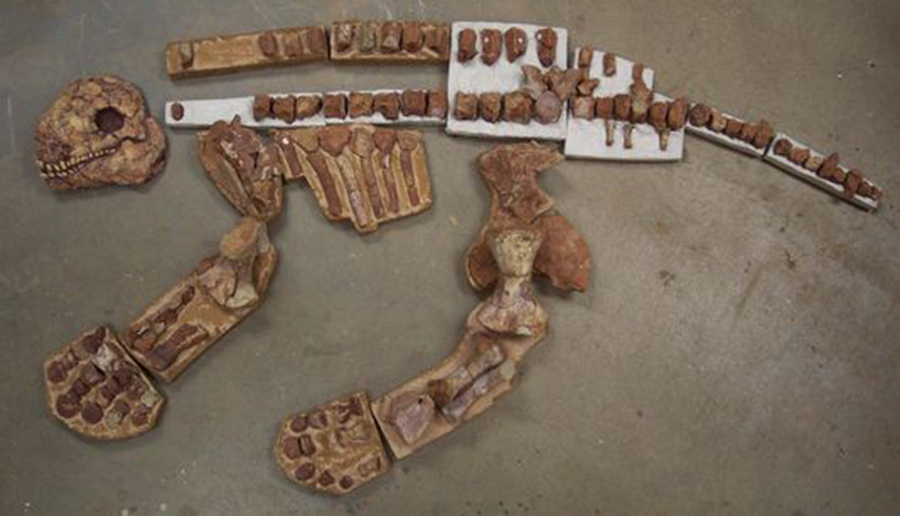
Tarbosaurus fossil skeleton

Paige Williams's new book and 'Poached' by Rachel Love Nuwer are compelling works of nonfiction about the underworld of obsessive and morally ambiguous collectors.

Humans have a special place in their hearts for megafauna, alive or extinct. Zoogoers line up for elephant and tiger exhibits, and millions flock to the latest Jurassic Park installments. Sometimes, though, people get a little too obsessed with these creatures and find themselves on the wrong side of the law. That’s when there’s a story to tell.

Enter New Yorker staff writer Paige Williams and her compelling new book about fossil collectors, The Dinosaur Artist: Obsession, Betrayal, and the Quest for Earth’s Ultimate Trophy ($15; Hachette). Williams focuses her narrative on one fossil fanatic, Eric Prokopi, an entrepreneur who makes a living finding, prepping, and selling fossils to collectors and museums. To increase his cash flow, Prokopi procures the bones of a Tarbosaurus bataar (basically, Asia’s T. rex) from the Gobi Desert and auctions them in the United States. A knotty legal battle ensues, involving, as Williams writes, “collectors, smuggling, marriage, democracy, poverty, artistry, museums, mining, Hollywood, Russia, China, criminal justice, presidential politics, explorers, Mongolian culture, the auction industry, and the history of science.”

It’s easy to be skeptical of dustcover comparisons to The Orchid Thief by Susan Orlean. While Williams’s book doesn’t quite belong in that category of classic nonfiction, it’s an absorbing dive into a community just as insular and fascinating as rare-flower collectors. The Dinosaur Artist begins with an introduction to Prokopi, its obsessive main character. As a boy, he learned to dive in the town of Land O’ Lakes, Florida, returning to shore with treasure from another age. His parents’ house was soon filled with prehistoric souvenirs from the area’s rivers and fields. Before graduating from college, Prokopi started trading shark teeth and other specimens, naming his business Florida Fossils. At one point, he imagines what he would tell his future children about how he constructed these pieces of natural history. “To him, self-referential talk sounded like showing off,” Williams writes. “But, if asked, he would explain how he had prepared the bones before reassembling and mounting them like a 3D puzzle, standing the creature on its feet again for the first time since it last breathed.”

Williams wastes no time plunging the reader into Prokopi’s bizarre world. She makes Tucson mineral shows and Mongolian history—dating back to Genghis Khan—shimmer with intrigue. If she goes on tangents, they are filled with charming details and absorbing trivia. We meet a pipe insulator who is also a Smithsonian-recognized fossil hunter, a supplier with a garage full of dinosaurs, and a Mongolian paleontologist named Bolortsetseg Minjin who is intent on protecting the Gobi Desert from poachers. Turns out, Bolortsetseg’s concern is warranted. High-end auction houses have illegally taken Mongolian fossils since the 1990s, attracting wealthy customers looking for a striking living-room piece. In fact, none other than Nicolas Cage and Leonardo DiCaprio waged a bidding war for one of Prokopi’s T. bataar skulls. (Cage won, paying $276,000 for the 67 million-year-old specimen.)

Things get really messy when Prokopi unwittingly incites an international conflict by ordering T. bataar bones from a supplier in Mongolia to sell to this fossil market. Williams deftly describes the politics surrounding fossil removal there and the country’s complicated relationship with the United States. It’s not only a legal issue, we learn: Prokopi has gotten caught up in something of a proxy for asserting the country’s independence by claiming Mongolia’s property.

As the story crescendoed with these new details, I felt conflicting sympathies. At times, Prokopi seemed like an oblivious casualty of a political debacle. Fossil sellers have ignored laws surrounding the international transportation of specimens before to no consequence—this was the first time the government of Mongolia claimed dinosaur bones from an auction house. On the other hand, Prokopi wasn’t in the dinosaur-selling game purely because of his love of natural history. Selling the T. bataar bones would have provided a much-needed windfall to his family as they stacked up thousands of dollars in credit card debt and mortgage loans.

Despite all the moral ambiguity and conflict, one thing is clear: Dinosaurs capture people’s hearts. Prokopi’s livelihood blossomed out of a childhood love of the creatures. Bolortsetseg, the paleontologist, viewed the Gobi Desert’s specimens as a source of national pride. One aside describes a South Dakota town that erupted in protest in 1992 when the government impounded a T. rex skeleton nicknamed tyrannosaurus Sue. More than anything else, Williams effectively tells the story of people living out their passions, for better or worse.

Another book released in September, Rachel Love Nuwer’s Poached: Inside the Dark World of Wildlife Trafficking ($28, De Capo), also deals with unsavory aspects of international trade. The difference: The animals aren’t extinct—yet.

Poached gives readers an up-front look at the vulnerability of endangered animals that are worth more dead than alive. Nuwer commands attention as she relays accounts pangolin scales being sold on the black market, Kenyan officials burning millions of dollars of ivory and rhino horn in attempt to discourage their trade, and a cobra’s heart being ripped out for consumption. But these anecdotes aren’t just for shock value. Nuwer also documents the political, cultural, and economic factors driving wildlife trafficking. Ivory has deep cultural significance and status in China, for example, and many in East Asia believe consuming pangolin scales has health benefits (even though supporting scientific evidence is lacking). Sometimes Nuwer gets into a little too much detail, but her takeaway is abundantly clear: This business has major consequences.

Toward the end of the book, Nuwer finds herself in a bar talking with her husband and a friend about the illegal wildlife trade. Her friend comments on the cruelty humans inflict on animals. “It sounds like you’re coming at this from an animal welfare perspective, though,” she tells him. “For me, the even more important concern here is biodiversity—of the possibility of losing species forever, just because of this trade.”

Both Nuwer and Williams show how obsession, especially when profit is involved, can be a dark force. Hopefully, by appreciating how threatened some of our favorite animals really are, we will act to protect them before elephants and pangolins join the ranks of the T. bataar.

Source: www.outsideonline.com

Siberian Paleontologists Discovered the Oldest Macro-Skeleton Remains

Tuesday, October 2, 2018

These are agglutinated walls in Palaeopascichnus linearis from the khatyspyt formation under the scanning electron microscope. (B, C) are magnified images showing the wall, the internal filling and the surrounding rock. White arrowheads mark the outer limit of the rim. CREDIT: Anton Kolesnikov

The oldest skeleton remains known to fossil chronicle of the Earth belonged to the microorganisms that lived 700-650 million years ago. International research team proved that a larger organisms of the same period, such as Palaeopascichnus linearis up to 20 centimeters long, also had a skeleton. The research is published in Precambrian Research.

Palaeopascichnus resembles a series of spheres or ellipsoids, which are placed one by one and called chambers. They have been known for a long time and can be found all across the world since for that time period they were one of the most widespread living organisms. Palaeopascichnus was considered as fossil traces of life activity for a while: someone described them as traces on the surface of a substrate or sediment left by animal migration in search of food, someone - as petrified chains of feces, someone - as the algae remains.

Researchers from Institute of Petroleum Geology and Geophysics SB RAS and Novosibirsk State University together with their colleagues from Great Britain and France for the first time managed to prove that in fact Palaeopascichnus was a skeletal organism. The scientists found out that Palaeopascichnus has much in common with modern giant protozoa: deep-sea single-cell xenophyphores. For example, Palaeopascichnus agglutinated exoskeleton by staying motionless at the bottom and gluing around itself particles of rocks and sediment from the surrounding space. As a modern example of the agglutination caddisflies can be named, even though they are moving.

"The material was collected in the Arctic at the Olenek uplift of the northeast of the Siberian platform, where a very large accumulation of organisms was found," says one of the researchers Anton Kolesnikov, member of Institute of Petroleum Geology and Geophysics SB RAS and Doctor of the University of Lille. "When we made a thin cut through the Palaeopascichnus across the chamber, we saw that there is a certain wall composed of a material that is more coarse in comparison to the host rocks."

A set of diverse methods was used in this research: the scientists made thin saw cuts, or slides, studied them under microscope, conducted tomography studies, used scanning electron microscope and so for. Afterwards the researchers started to look at additional materials from the White Sea, Ukraine, Australia, Canada, and all these samples confirmed the existence of a skeleton.

Through statistical calculations of rock grains size in the Palaeopascichnus wall and the surrounding space, the scientists also found that these organisms preferred to collect large particles to construct the skeleton rather than everything around them.

Palaeopascichnus turned out to be more lucky than other creatures of that time, such as Ediacaran biota, which almost disappeared approximately ten million years before the CambrianPalaeopascichnus lived up to the beginning of the Cambrian, and theoretically modern xenophyphores might be their distant descendants.

Apart from Palaeopascichnus' potential descendants, the paleontologists discovered their ancient relatives. "The thing is that there are plenty organisms like Palaeopascichnus," Anton Kolesnikov notes. "For instance, genus Orbesiana, which was discovered in the well drilled near Moscow by a famous scientist, founder of the Ediacaran biota study, Boris Sokolov. He described the fossils that he found as the ancient macroscopic algae, and after that this material got lost for a while. Recently, the family of Boris Sokolov offered us his archives and we found the original material with detailed explanatory note."

The researchers managed to use the most advanced equipment, and with the help of British and French colleagues they showed that Orbesiana was far from being an algae. More likely, they were close to Palaeopascichnus and might be placed in one group of the oldest macro-skeletal organisms. "Palaeopascichnus preferred to build their skeleton of single row chambers, while Orbesiana used multiple raw building as they either created spirals and foam-like clusters of irregular shape or simply were two- and multi-row," explains Anton Kolesnilov.

For the next step of the research the paleontologists plan to further examine organisms, that could be attributed to this group. In other words, the researchers have to deeply understand the taxonomy of these first macro-skeletal creatures of the Ediacaran biota.

###

Reference: https://www.sciencedirect.com/science/article/pii/S0301926817307052?via%3Dihub#!

Source: www.eurekalert.org

Dinosaurs on Display as Museum of Surrey Reopens With New Expansion

Sunday, September 30, 2018

The Museum of Surrey reopened on Saturday with a pre-historic display that proved a big hit with the younger crowd. Global News

It’s been years in the making, but a major expansion of Surrey’s main civic museum is now complete.

The Museum of Surrey held its grand re-opening on Saturday, celebrating a nearly $16-million upgrade that includes additions to the museum’s main building, a tripling in size of the Kids Explore Zone and a new Indigenous Hall.

“It feels amazing. We’ve been working non-stop day and night for weeks on end,” said museum manager Lynn Saffery.

“The museum isn’t completely done; we still have lots of work to do, but we are ready for the people of Surrey and the people who are visiting Surrey, too.”

Originally opened in 2005 as the Surrey Museum, officials quickly found it it wasn’t large enough for the city’s rapidly growing young population.

The newly expanded facility reopened to lineups Saturday morning, and one exhibit in particular was a major hit with the younger crowd: dinosaurs.

“Dinosaurs Unearthed,” which runs until March 31, includes animatronic dinosaur displays — some feathered — skeletons and hands-on fossils.

Located at 17710 56A Ave., the facility shares a neighbourhood with several other museums and civic assets, including the Fraser Valley Heritage Railway, a vintage truck museum, the Surrey Archives and the Cloverdale Library.

“Our idea is this becomes a cultural campus that is a focal point for people in the are and that people will visit from around the world,” said Saffery.

The City of Surrey contributed nearly $11 million of the total costs for the expansion, with the federal government contributing about $5 million.

Source: https://globalnews.ca

'A Bit Gruesome': Australian Museum Autopsy Gets to the Heart of a T. rex

Sunday, September 30, 2018

Australian Museum CEO Kim McKay with a T-Rex autopsy installation as part of the Dinosaur Festival ahead of the school holidays.  Photo: Wolter Peeters

Australian Museum CEO and director Kim McKay has a theory on why so many children are absolutely obsessed with dinosaurs. "It's because they're almost mythical creatures in a way," says McKay. "Some children look at them and say have you got a dragon dinosaur? So they're somewhat mythical, but they know they existed."

The museum's popular Dinosaur Festival is back for its third year to keep school holidays boredom at bay while also teaching visitors a thing or two. Youngsters can build their own dioramas inspired by real fossils, make prehistoric creatures out of Lego bricks or watch the documentary Monsters in the Outback to discover more about Australian dinosaurs.

The Dinosaur Gallery has reopened this month after being closed for six months of refreshments to reflect the latest research in palaeontology.

There is one special display that McKay is particularly excited about. "Our big star attraction is the life-size, anatomically correct T. rex model, which cost over $600,000 to build and was donated to the museum by National Geographic," she says. "It is the most extraordinary sight to see literally what a T. rex looked like."

Every day visitors will get a chance to view an "autopsy" on the 13-metre beast, who goes by the name of Lizardbeth, and glimpse her enormous heart, lungs, stomach and even ovaries. "It may sound a bit gruesome, but the kids love it."

Dinosaur Festival, 9.30am-5pm, Australian Museum, 1 William Street, city, $15/free, australianmuseum.net.au

Source: www.smh.com.au

Permian Fossils Finds in Taylor County Plentiful

Sunday, September 30, 2018

A diadectid, a Permian herbivore found in Taylor County, in preparation to be presented in the "Dinosaurs of Texas" at the Grace Museum in 2003-2004. The Permian period, and the animals that lived in it, actually vanished long before dinosaurs emerged, being around 290 million years ago. (Photo: Jo Helen Cox)

Millions of years ago, Taylor County was a far different place, one recorded in its fossil record.

Now, some of that once-forgotten history is documented in a recent paper published in the Journal of Paleontology.

The area is rife with finds from the Permian, a geological era that began roughly 290 million years ago, long before even the dinosaurs, and lasted for roughly 47 million years.

The recent paper, titled “Faunal overview of the Mud Hill locality from the early Permian Vale Formation of Taylor County, Texas,” details a “previously undescribed" area near Abilene, "the first vertebrate-bearing locality from the (Vale) formation to be described in detail in several decades."

The paper was written by Bryan M. Gee, Diane Scott, and Robert R. Reisz of the Department Biology with the University of Toronto Mississauga, along with Steven J. Rosscoe of the Department of Geology of Hardin-Simmons University, and Abilene fossil-finder Judie Ostlien. It notes that the site features “juvenile diplocaulids, captorhinids, abundant material of rare taxa such as varanops and diadectids,” and a first report of a “recumbirostran ‘microsaur’ from the formation" among its finds.

Red bed revolution

During the Permian era, Abilene would have been very near the equator and on the interior of the massive supercontinent called Pangaea, said HSU's Rosscoe.

"The climate was extremely dry and very warm — warmer even than we can imagine in the hottest of our summers in recent years."

Early amphibians and reptiles inhabited small scattered shallow bodies of water on a vast gently sloping land surface.

"Most of the time that surface was bone-dry, but in rare rains water would flood over the surface moving bigger particles and depositing them in thin layers over the pre-existing surface," he said.

The earliest reported collection of significant material from what is known as the “Vale Formation” was from 1939-40 on the land of C.O. Patterson near Lawn, under the direction of a Works Projects Administration excavation led by the University of Texas.

A paper published in 1953 by John Andrew Wilson of the University of Texas says "several specimens of well-preserved paleoniscoid fishes and a large quantity of plant material were discovered," as well as well-known fossils of Permian-age creatures including Diplocaulus, Seymouria, and the famous, fin-backed Dimetrodon.

The distinctive Permian ecosystem described by the most recent paper, made up of fossils located near Buffalo Gap, was first uncovered by Judie Ostlien, Jo Helen Cox, and Robert Burt, a number of years ago.

Some of their initial finds were featured in the Grace Museum's "Dinosaurs of Texas" exhibit in 2003-04, and certain of those first fossils have gone on to a wide degree of fame.

For example, a well-articulated fossil of a varanops, a pelycosaur that – at its largest – was about the size of modern monitor lizards, became the subject of a 2006 paper published in the Journal of Vertebrate Paleontology, “An Articulated Skeleton of Varanops with Bite Marks: The Oldest Known Evidence of Scavenging among Terrestrial Vertebrates.”

The latest paper on Taylor County's fossil record, using fossils primarily collected by Ostlien and her father, Dale Ostlien, describes what is believed to be a pond deposit, which organisms were believed to have been preserved "in situ," essentially the place where they died.

"Most of what we know from the Permian of Texas comes from floodplain deposits that were formed in relatively high-energy settings (e.g., rivers) that led to skeletons being transported for some distance and becoming entirely disarticulated," wrote Bryan Gee, the paper's primary author, in an email.

The most common animals found in such deposits are large, aquatic to semi-aquatic amphibians, freshwater sharks, and "carnivorous synapsids,” reptilian precursors to mammals, Gee said.

"What we see at the Mud Hill locality is the preservation of a very different setting," he said.

Analysis of the rocks in which the fossils were preserved also tells us that the animals were preserved in a "low-energy setting, with very little transport, and were exposed to the surface for a long time," he said.

The only aquatic animals are very small, juvenile forms of the aquatic amphibians, Gee said.

“There are abundant remains of a large herbivorous almost-reptile (diadectids), and some of the skeletons are still neatly articulated,” he said. “What all of this tells us is that this was likely a pond that could have been conducive for newly hatched amphibians to develop in and for vegetation to grow that could have sustained the herbivores.”

Documenting localities like this helps capture environments that are known to have existed in the Permian, but are rarely encountered, he said.

And that is a “crucial part of building a more holistic picture of the environment and fauna at that time in North America,” he said.

Hidden secrets

Rosscoe said "it almost seems like a hidden secret of Taylor County" that there are some "amazing fossil deposits" here.

The recently-published Journal article focuses on vertebrate fossils, he said, the sort of thing one usually visualizes when thinking about dinosaurs.

But "while we don’t have any of those, our vertebrate fossils are really important additions to the overall Permian fossil record," Rosscoe said.

The specimens from this paper show that the fossil assemblage here in Taylor County is unique compared to others of similar age.

"This brings new information to our greater understanding of Permian paleontology," he said.

While not the focus of the paper, the Permian rocks in Taylor County also have a nice fossil assemblage of plants near the Buffalo Gap area.

"And we even have some nice amphibian footprints and other trace evidence of the life that lived here during that time," he said. "With every new study a more complete understanding of the overall Permian develops."

Of particular interest to Rosscoe is that the more recent finds were made by dedicated amateur paleontologists.

"Seeing folks so interested in science and geology brings real joy to my heart," he said.

And there's always room for more, he said.

"Hopefully, if they are really interested, I’ll even get a chance to see them in my classroom and maybe they’ll even become the next discoverer of something fantastic about geology in Abilene and Taylor County," Rosscoe said.

Source: www.reporternews.com

11 Dinosaur Secrets From the Making of Jurassic World: Fallen Kingdom

Sunday, September 30, 2018

Jurassic World: Fallen Kingdom is more than just a CGI franchise film, it's a game-changer when it comes to animatronics and director J.A. Bayona has Neal Scanlon to thank for that. The British-born creature designer brought his expertise from the rebooted Star Wars franchise to the Jurassic World dinosaurs, and one only has to look each film to see how brilliant his work is.

Scanlon doesn't do it alone, though; he worked with the VFX team at Industrial Light & Magic to ensure symmetry between the animatronics used in real life with actors Chris Pratt and Bryce Dallas Howard and the computer animations added on in post-production.

SYFY caught up with Scanlon as well as ILM's VFX supervisors David Vickery and Alex Wuttke and animation supervisor Jance Rubinchik to discuss the magic involved behind the scenes in bringing these monstrous creatures to life on screen.
 

1 - Every department is involved in the creation of the dinosaurs

The biggest hurdle for a movie like this is bringing the dinosaurs to life, so it has to be a cross-department effort. “There is a very deliberate collaboration with Neal's creatures effects team and my visual effects team to try and come up with the best suite of tools,” Vickery explained.

2 - There are several forms of dinosaurs used in the movie

Some of the dinosaurs you see in Fallen Kingdom are just computer-animated, while others are ridiculously detailed animatronics. There were even a few inflatable versions floating around during the shoot.

“It gave us a fighting chance to sort of make sure that [for] the digital dinosaurs, you believed their performances because there was a real performance as the basis for those characters,” Vickery said.

Having “real” dinosaurs on set better-informed performances of Chris Pratt, Bryce Dallas Howard and the other actors who had to perform opposite them.

“A lot of people haven't worked with a practical effect before, it's been a while, dare I say, but that's been encouraged,” Neal says. “I refer to the first film and they must have walked onto that set, saw that T-Rex and [be] asked to perform in front of it - that must have been an incredible thing for them to do that because there was this real world T-Rex, with a car, and it was raining.”

“When the actresses and actors walked onto the set, they could fully be engaged in that way that we couldn't have done if we didn't have some form of practical effect or practical reference for them to work with,” Neal adds.

3 - The animators and VFX team spend A LOT of time on set

The team was involved from pre-production to planning through to the actual shoot and they have more of a partnership with Bayona, the DP and production designer in order to reflect the real world variables when they’re designing the visual effects and CG dinosaurs.

“You spend so much time sitting in front of a computer working on this stuff and then to see it for real is super exciting,” Rubinchik said, while Wuttke added that one of the best moments was seeing the T-Rex in action.

“This franchise is unique in the sense that you have the ability to see these kinds of things for real and that’s a real honor to see Neal and his creature team working,” Alex adds. “and to see a full-scale T-Rex thrashing about for real inside a shipping container, it’s quite a sight.”

4 - The actors were petrified by the dinosaurs

“Neal's creatures terrified our actors on a number of occasions,” Vickery said. “They made them jump, made them cry and made them laugh and that brought such a great energy to the process.”

“You see them in the original film, I think [the actors] were genuinely terrified,” Scanlon added. “At some points, they were scared stiff that the T-Rex would suddenly bite their heads off and you can see it in the sequences.”

5 - The design team ignores new aesthetic discoveries about dinosaurs

The design team doesn’t incorporate new finds about the way dinosaurs look because they need to remain aesthetically in-sync with the original movie. That’s why we don’t see raptors or the T-Rex with feathers, despite paleontologists saying so. The films get away with this thanks to the way these man-made dinosaurs were created.

“The conceit in the original film is that they’re not creating a completely accurate idea of what a dinosaur is by modern standards, they are creating what they think a dinosaur should be using bits of DNA that they’ve recovered and mixed with other DNA,” Wuttke explained. “So I think in some respect the technology that appears in the original Jurassic Park films is advanced but there’s still a bit of guesswork involved.”

6 - The puppeteers are acting as hard as the actors

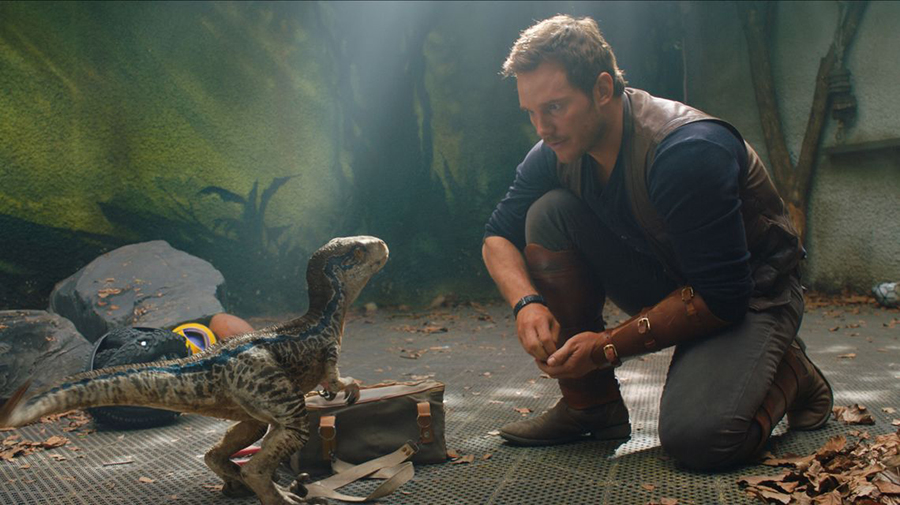
It takes a village to bring these animatronics to life, and SYFY saw firsthand how many it took to get Blue the velociraptor moving, but the performance starts from the beginning for both the animators and director.

“At the beginning where Owen is talking to little Blue we just made very simple toys that ran around on wheels, really more for sight line for Chris to play to and one of our puppeteers had a rod on the head of one of them which enabled them to puppeteer,” Scanlon said. “It was JA observing that, Chris's reaction to that little model which was a really good first indication of the strength being able to participate on or off camera.

“He totally engaged and he was amazing. Chris was almost talking to this other puppet as he was talking to Robin who was performing it and suddenly two actors are working together.”

7 - There aren’t dozens of versions of each dinosaur

There isn't a production line of each dinosaur made; rather, one gets built to be used as a practical effect. However, it doesn’t negate the importance of having them on set.

“I think we have a higher responsibility to look and say as a team of people what are we really trying to achieve here because really is there any reason for me to be here? Probably not,” Scanlon said. “Not from a visual effects perspective but on a filmmaking perspective, suddenly that blend becomes so much more important.

“What you are really doing is trying to enhance and service the director's aspirations, the actors' interactions, the DOP, everybody becomes engaged in the moment when you walk on with a practical effect so its validity starts right there and then."

8 - No one gets to keep them

If you’re wondering if Chris Pratt has a life-sized Blue at home, he does not. No one gets to take any of the animatronics home because they get used again for future installments.

“We need them back because if we do another one we're going to use them again,” Vickery said (though sometimes they do get out and end up on eBay).

“They are acetated at the end of the film, which means they are wrapped up and stored, so sometimes they are lost forever and that's why these things sometimes end up on the, should I say, black market?” Scanlon added.

9 - Nosferatu inspired the Indoraptor

Bayona had a very specific idea for how he wanted the indoraptor to look, and he urged the ILM design team to look at some German cinema for inspiration.

“JA had some specific design ideas for the indoraptor,” Wuttke told us. “This idea that it’s an unfinished product, it’s almost a beta version of this militarised dinosaur.

“He also had a lot of influences that he wanted to bring to bear, a lot of Gothic influences, he would talk about classic German impressionist films like Nosferatu which gave us the ability to give [the indoraptor] these long gangly limbs that were really sinister and creepy.”

10 - Scanlon would love to do a Jurassic World exhibition though

Scanlon told us that he would love to get together his animatronics from his past films like Star Wars, Babe and Jurassic World, and put them on display for fans to see in person.

“Are they just there to be seen on screen or should they be taken somewhere for the public to appreciate?” he asked. “I would certainly say I've been to the Harry Potter museum several times now and have been utterly enthralled by it.

“It's been an incredibly successful display of how much cinema-going audiences want to see not only creatures but all the other things that go into the filmmaking processes. It's a beloved art, isn't it? I'd be immensely delighted.”

11 - They already have ideas for the next film

According to Wuttke, the design team “have an amalgamation of ideas” ready to explore in the next installment. “I have lots I’d like to do,” he added, “[but] we’re not allowed to say. We’d love to say more!”

Jurassic World: Fallen Kingdom is available on DVD, Blu-Ray and Digital download now in the US.

Source: www.syfy.com

Pages