Blogs

Pachycephalosaurus May Have Actually Eaten Meat, Skull Suggests
Thursday, October 25, 2018

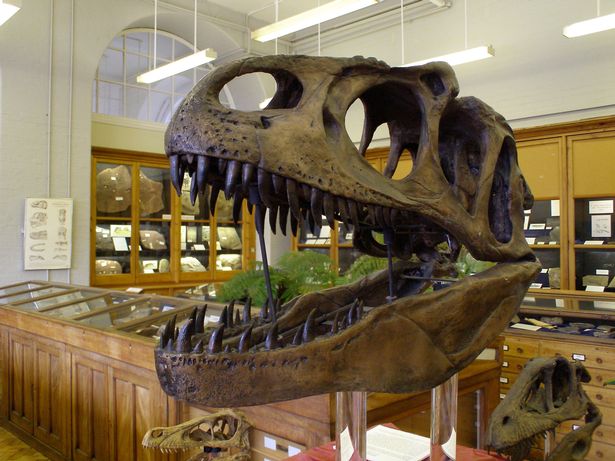
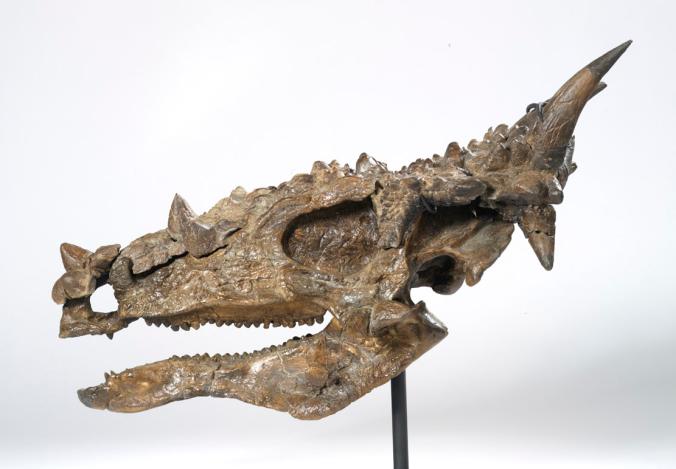
A reconstruction of the fossil skull of the Pachycephalosaurus that has theropod-like teeth. PHOTOGRAPH BY BRIAN BOYLE, ROYAL ONTARIO MUSEUM

Steak knife-like teeth in the most complete Pachycephalosaurus jaw ever found look suspiciously like those of a carnivore.

Pachycephalosaurus, the delicately built, 15-foot-long, dome-headed dinosaur that lived alongside Tyrannosaurus and Triceratops, is a staple of children’s books and popular culture—one usually depicted as a benign plant eater. But the discovery of a new skull with the most complete jaw and set of teeth yet found for the species dumfounded scientists when it was revealed at the Society of Vertebrate Paleontology meeting in Albuquerque, New Mexico, earlier this week.

This juvenile Pachycephalosaurus, like all known specimens of its kind, had broad, leaf-shaped teeth toward the back of its jaw, suited to shredding rough plant matter, fruits, and seeds.

But in the front portion of its jaw—a part of the species never found fossilized before—this specimen bared sharp, triangular, blade-like teeth that look more like those seen in carnivores such as Tyrannosaurus and Velociraptor. It is unclear if the species had these teeth temporarily during its youth, or if they were a permanent fixture for the dinosaur.

The fact that Pachycephalosaurus had these teeth during at least some stage of its development is fascinating, comments Steve Brusatte, a paleontologist at the University of Edinburgh in the U.K., who attended the talk in Albuquerque.

“I’ve studied [carnivorous] theropods for 15 years, and I’m pretty sure if you handed me a tooth like that, I would say that’s a theropod tooth,” he says. “It had the combination of a beak with these very sharp, steak knife-like serrated teeth … They must have been eating some kind of meat. Why else would you have steak knives at the front of your mouth?”

Dinosaur development

The discovery was presented by Mark Goodwin of the University of California Museum of Paleontology in Berkeley, who, alongside David Evans of the Royal Ontario Museum in Toronto, Canada, has unearthed and studied many new Pachycephalosaurus specimens in recent years.

Goodwin’s work last caused controversy in 2009 when he presented evidence—now widely accepted—that two species of dinosaur found in the Hell Creek Formation of the western U.S. were not, in fact, species in their own right, but actually juvenile forms of Pachycephalosaurus. These creatures, previously named Stygimoloch and Dracorex, appeared markedly different from adults. They were covered with bumps and horns as part of their complex head ornamentation, but did not yet possess the large domes of a full-grown Pachycephalosaurus, hence the previous confusion.

The remarkably complete new skull of a Dracorex-like juvenile was discovered in eastern Montana and donated to the Royal Ontario Museum. It dates back 66 to 68 million years ago, in the late Cretaceous, shortly before the asteroid impact that ultimately exterminated the non-avian dinosaurs. It is one of 71 mostly fragmentary fossils that Goodwin and Evans are studying to better understand how Pachycephalosaurus developed as it grew from youth to adulthood.

At the paleontology meeting in Albuquerque, Goodwin also revealed another finding from the pair’s research: that the style and complexity of the head ornamentation of Pachycephalosaurus appears not only to have changed during an individual’s maturation, but also during the two million years of evolution recorded in the rocks of the Hell Creek Formation. This adds further complexity to the picture first put forward in 2009.

Diet du jour

Finding teeth that “look, to all intents and purposes, like theropod teeth” in the new skull was a great surprise, Goodwin says. He speculates that these animals may have been opportunistic eaters and at least partly carnivorous, perhaps changing their diet seasonally as many bears do today.

Confirming the dinosaur’s dietary preferences will require more concrete evidence of exactly what it ate, and there are several ways the scientists might go about finding that out. One way would be to do an analysis of the ratio of carbon isotopes in this pachycephalosaur’s tooth enamel. This chemical signature can provide information about the composition of an animal’s diet—as can a study of the minute pits and scratches on the surface of the teeth. Another method would be to look at bite marks on other fossil bones from the Hell Creek Formation, to see if any of them match the shape and size of the newly found teeth.

This research could have broader implications as well. Philip Currie, a paleontologist at the University of Alberta in Canada, says he is keen to reexamine numerous puzzling ‘theropod’ teeth found isolated in rocks of the same age over many years. In light of the new discovery, he wonders if these mystery teeth may in fact belong to Pachycephalosaurus.

Evans agrees: “If these teeth were found isolated from a jaw—and doubtless many have been—they could easily be mistaken for the teeth of small carnivorous dinosaurs.”

“It is especially crazy that these teeth at the front of the jaw may also have been reinforced at least partially by a beak,” Currie says. “We have always been somewhat mystified by what these animals were eating, but I think the teeth at the back of the jaws clearly show it’s an herbivore. The question is why it would need carnivore-like teeth at the front?”

Most scientists like to place dinosaurs into neat categories, says Danny Anduza of the University of California Museum of Paleontology, who has himself helped excavate several Pachycephalosaurus fossils. “What makes this study so exciting is that the authors use new evidence to challenge some of those assumptions.”

He says the work also highlights the importance of continued fieldwork. “Even after all these years of collecting, the discovery of just one new specimen can change the way we look at a dinosaur group,” Anduza says. “I think that's pretty inspiring. It's a reminder to get out into the field as often as possible, and to always look over the next hill.”

Source: www.nationalgeographic.com

Dinosaur Fossil May be a Whole New Species of the First Birds

Friday, October 26, 2018

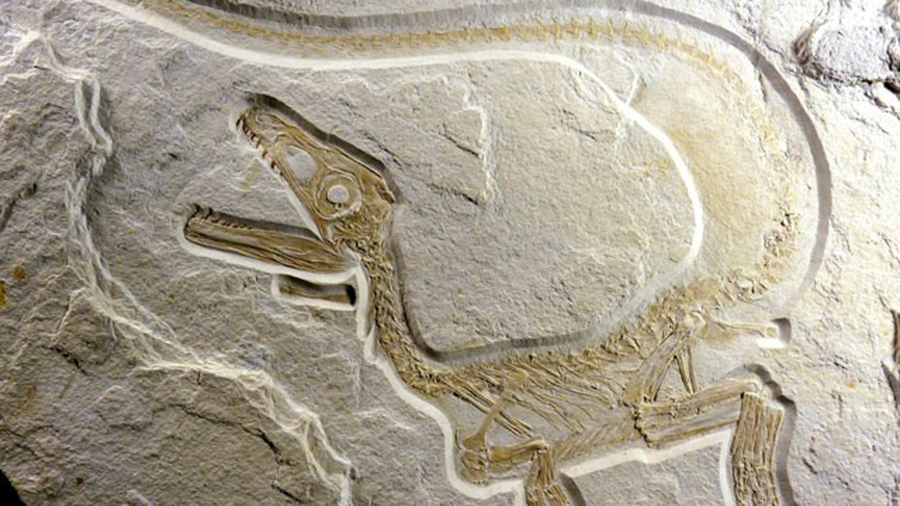
The Munich specimen of Archaeopteryx – distinct from the Daiting specimen? ESRF / Pascal Goetgheluck

A new species of Archaeopteryx, the famous “first bird”, has been identified. The discovery supports the idea that Archaeopteryx really is a transitional species between dinosaurs and their bird descendants, and not an evolutionary dead end as has been suggested.

Archaeopteryx was first recognised as a species in the 1860s. It was immediately seized on as evidence for Darwin’s theory of evolution, because it appeared to be a bird with dinosaur-like traits. It had wings and feathers, but teeth instead of a beak. The obvious implication was that Archaeopteryx was a transitional fossil, showing how birds evolved from dinosaur ancestors.

It was about the size of a raven and may have had black feathers. It’s been suggested that it only flew in short bursts like a pheasant, and hunted at night.


However, over the last decade its position in the evolutionary tree of birds has been called into question, following the discovery of similar dino-birds in China. A 2011 study built a family tree and concluded that Archaeopteryx was a dinosaur, not a bird.

Martin Kundrát at the University of Pavol Jozef Šafárik in Slovakia and his colleagues have now studied a hitherto-unexamined Archaeopteryx fossil.

Phantom fossil

It was found in the early 1990s, apparently in a quarry near Daiting, Germany, and ended up with a private collector. For years it remained unknown and was nicknamed “the Phantom”, until in 2009 palaeontologist Raimund Albersdörfer bought it. It is now on long-term loan to the Bavarian State Collection of Paleontology and Geology in Munich.


The fossil contains most of the skull, plus parts of the shoulders and left wing. It is encased in rock and has been squashed, but Kundrát scanned it using high-powered X-rays. “We can see every preserved bone,” says Kundrát. “Not only that, we can see these bones from inside.”

The team found subtle differences in the bones and teeth not seen in the other known fossils of Archaeopteryx. Kundraat’s team has put the specimen in a new species, Archaeopteryx albersdoerferi.

Some of the bones are hollow, which makes them lighter. Modern birds have similar bones to help them fly, implying the species could fly.

Early bird

When the team built a new family tree of birds and related dinosaurs, it placed the new species of Archaeopteryx at the base of the bird (or avian) line. “It’s in an important position to tell us about the early evolution of avian dinosaurs,” says Kundrát.

“It looks more and more likely that Archaeopteryx really is somewhere on the lineage towards recent birds,” says Oliver Rauhut of the Bavarian State Collection of Paleontology and Geology in Germany. “It’s very unlikely that it is an ancestor to later birds,” he says, because the odds are against a direct ancestor being fossilised, but “it gives us a good idea what a very early bird might have looked like”.

Flight arose “probably three times” and maybe more among bird-like dinosaurs, says Rauhut. He points to Microraptor, a dinosaur with flight feathers on its legs as well as its wings that probably glided. “It had nothing to do with the origin of birds.” Another dinosaur, Yi qi, had membranous wings like those of a bat.

Journal reference: Historical BiologyDOI: 10.1080/08912963.2018.1518443

Source: www.newscientist.com

48-Million-Year-Old Fossil Owl Is Almost Perfectly Preserved

Wednesday, October 24, 2018

The rocky chunk holding the fragile fossilized bones of the ancient owl, next to a quarter for size comparison. Credit John Alexander

About 48 million years ago, an owl swooped down to catch its prey, not by the light of the moon but in broad daylight.

How do paleontologists know this fowl wasn't a night owl? They found the exquisitely preserved remains of an owl, and its skull shares a telltale characteristic with modern-day hawks, which also hunt by day, the researchers said.

The finding is extraordinary, largely because it's rare to find fossilized owls, especially one that has so many preserved bones, said project co-researcher Elizabeth Freedman Fowler, an assistant professor at Dickinson State University in North Dakota, who dubbed the specimen "the finest fossil owl."

"There is no fossil owl with a skull like this," Freedman Fowler told Live Science. "Bird skulls are incredibly thin and fragile, so to have one preserved still in three dimensions, even if slightly crushed, it's amazing. It even has the hyoids at the bottom, the bones that attach to the tongue muscles."

The skull is in such good shape that the researchers noticed that the supraorbital processes (the regions above the eye sockets) have a bony overhang, making it look as if the owl had a mini baseball cap on top of each eye, according to the research, which was presented here at the 78th annual meeting of the Society of Vertebrate Paleontology on Oct. 19. The study has yet to be published in a peer-reviewed journal.

This overhang "gives you shade so you don't get dazzled [by the sun]," said project lead research Denver Fowler, a curator of paleontology at the Badlands Dinosaur Museum in North Dakota. This feature is weak or absent in nocturnal owls, but it's common in modern hawks and daytime owls, he noted.

The finding isn't completely out of the blue. Birds are diurnal — or daytime — creatures, and at some evolutionary point, the owl changed course and became nocturnal, he said. What's more, there are diurnal owls alive today, including the northern hawk owl (Surnia ulula) and the northern pygmy owl (Glaucidium gnoma), Marc Devokaitis, a public information specialist at the Cornell Lab of Ornithology in Ithaca, New York, previously told Live Science.

What's unclear is whether this mysterious specimen was an early form of owl that hunted during the day, before most owls became nocturnal, or whether it was an owl outlier that hunted during the daytime while other owl species stalked prey by night, Fowler told Live Science.

Fowl find

In all, the researchers have about 45 percent of the owl's skeleton, including the skull and bones from the legs, feet, wings and lower jaw. That's way more material than what has been found with other discoveries of fossilized owls — some of which are given scientific names based on a single fragment of a bone, Freedman Fowler said.

The owl was discovered by project co-researcher John Alexander, a research associate at the Burke Museum of Natural History and Culture at the University of Washington, while he was digging for fossils of ancient lemur-like animals known as Notharctus and Smilodectes in the Bridger Formation of southwestern Wyoming in 2007. Given that he was looking for mammals, he said he was surprised to find a bird of prey.

"This is the first predatory bird skeleton found in that formation, and people have been looking in there for 150 years," Alexander told Live Science.

However, it wasn't until recently, after showing the specimen to Fowler, that Alexander realized the specimen was an owl — one a little larger than a modern barn owl (Tyto alba).

It's not yet clear whether the owl is a newfound species, or whether it's already known in the scientific literature, but only from a fragment, Freedman Fowler said. But they expect to find out soon, as well as learn as much as they can about the ancient hunter.

"We just CT [computed tomography] scanned this, so we'll get the results back from that soon," Freedman Fowler said. "We can look at things like neck mobility — we have the cervical vertebrae, so we can see how far it could move its neck."

In addition, the braincase (the inner part of the skull that held the owl's brain) is well-preserved, "so we'll be looking at the different parts of the brain to see what its senses were like, [including] how well it could hear and how well it could see," she said.

This wasn't the only owl finding presented at the conference. Peter Houde, a professor of biology at New Mexico State University, found bones from two different owl species in the Clarkforkian-Wasatchian beds of north-central Wyoming, one dating to about 56 million and the other to about 55 million years ago. That's a bit younger than Ogygoptynx, the oldest owl on record, which lived in what is now Colorado about 61 million years ago, just a few million years after the nonavian dinosaurs went extinct about 65 million years ago, Houde told Live Science.

Originally published on Live Science.

Dozens of Baby Skulls of Weird Jurassic Hybrid Creature Discovered Next to Their Mom

Wednesday, October 24, 2018

Kayentatherium wellesi

Scientists have uncovered the skulls of 38 babies hidden in the ancient fossilized remains of an extinct mammal precursor—the only such fossils ever discovered.

The team think their research, presented recently at the 78th annual Society of Vertebrate Paleontology meeting, may help explain how mammals swapped hordes of offspring for bigger brains over the course of million years of evolution.

The research was also published earlier this year in the journal Nature. A member of the Kayentatherium wellesi species—dog-sized herbivores that lived 185 million years ago—have an awful lot in common with mammals. They may even have hair.

But they differ in some crucial ways. Most importantly, the fossilized family reveals the ancient animal bred more like a reptile. It produced large clutches of eggs with lots of babies, rather than birthing just a few.

Mammals just a few million years later “unquestionably had big brains, and they unquestionably had a small litter size,” University of Texas researcher Timothy Rowe said in a statement.

Both brains and broods use oodles of energy. Kayentatherium’s little brain and massive clutch of children, the researchers wrote, suggest mammals tended toward larger brain size later in their evolutionary journey.

A figure representing the 38 Kayentatherium babies found with an adult specimen. EVA HOFFMAN/THE UNIVERSITY OF TEXAS AT AUSTIN

Researchers spotted the baby skulls by accident, years after the remains were uncovered in Arizona. Then-graduate student Sebastian Egberts spied a glint of unexplained enamel about 9 years ago.

“It didn’t look like a pointy fish tooth or a small tooth from a primitive reptile,” said Egberts, who teaches anatomy at the Philadelphia College of Osteopathic Medicine. “It looked more like a molariform tooth (molar-like tooth)—and that got me very excited.”

Advances in imaging technology finally revealed the babies, which are a “really important point in the evolutionary tree,” according to Eva Hoffman, who led the research while attending the University of Texas as a graduate student. The scientists expect advancing technology will continue to shed light on the intricacies of evolution.

In other fossil news, scientists recently discovered an ancient flesh-eating fish that lived about 150 million years ago. The piranha-like critter chomped down on other creatures with its razor-sharp teeth.

Researchers have also found the smallest diplodocus skull ever discovered. The “exceedingly rare” find, they said, is a great window into the gentle giants’ youth.

A dinosaur species—Ledumahadi mafube—was also recently named after many years of study. Known as Giant Thunder Clap at Dawn, this enormous sauropod cousin lived around 200 million years ago.  

Source: www.newsweek.com

The Best Places to See Dinosaurs in Nottingham and Beyond

Wednesday, October 24, 2018

(Image: Rachel Gorman)

Hatching dinosaur eggs, a smoking 8ft volcano and a crash-landed plane are just some of the obstacles players can negotiate at the £500,000 Jurassic-themed adventure golf course.

Lost World Adventure Golf, in Riverside Family Golf Centre, Lenton Lane, takes inspiration from famous courses from around the world, including St Andrew's 18th hole (complete with mini Swilken Bridge, where you can grab a commemorative snap).

The 2,500 square metre site is littered with Lost World-themed obstacles ideal for anyone who has dino obsessed kids or indeed grew up themselves on a diet of Richard Attenborough, Sam Neil, Jeff Goldblum and some ground-breaking special effects... for the early '90s at least.

Adults tickets are £8 a pop and there are also £21 family tickets which admits two kids and two adults.

Land of the Living Dinosaurs at West Midlands Safari Park, Bewdley

The UK's largest animatronic Dinosaur attraction at West Midland Safari Park

In March 2015, the safari park opened a new Land of the Living Dinosaurs attraction - the UK's largest collection of animatronic dinosaurs.

You can see prehistoric creatures from many different eras - not just the Jurassic - in the form of life-sized models brought to life with movement and sound effects.

Admission prices vary - if you are visiting on a fixed date and book online in advance at wmsp.co.uk, it costs £15.99 for an adult, £11.99 for a child aged three to 15 and free for children under free. Groups of six of more paying members can get in at a reduced price.

Dinosaur Trail at Drayton Manor Theme Park, Tamworth

Dino Trail at Drayton Manor

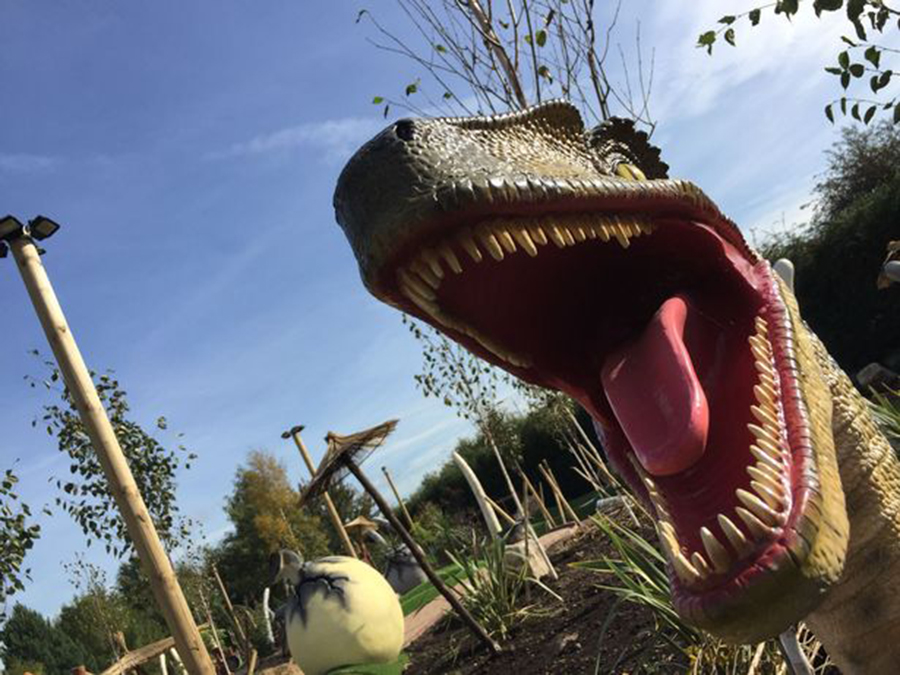
Among the attractions at Drayton Manor is a Dino Trail, which includes a whole host of life-sized prehistoric creatures great and small such as a Stegosaurus, Iguanodon and two dome-headed Pachycephalosaurus charging at each other for a head-butting battle.

Some are grazing peacefully, others are wading in water, and there are prowling predators lurking and looking for their next meal.

Tickets between £7 and £24.

Charnwood Museum, Loughborough

Permanent exhibitions at the museum include The Natural World of Charnwood - and there you can discover how a schoolboy made Charnwood famous when he found one of the world's oldest fossils. Watch out for the Barrow Kipper, a Jurassic marine reptile that scientists know as Rhomaleosaurus megacephalus.

Admission to the museum is free.

Lapworth Museum of Geology, Birmingham

A model at the The University of Birmingham’s Lapworth Museum of Geology

The museum reopened in June 2016 following a £2.7m investment including cash from the Heritage Lottery Fund.

On arrival families will be greeted by an Allosaurus called Roary, who died young but still looks pretty ferocious.

On the ground floor are displays of fossils - most of them were found in the Midlands and offer an incredible insight into the region's landscape, flora and fauna in pre-historic times.

Visitors can also check out the creepy Coseley Spider, Dudley Bug trilobites, a sabre-tooth tiger with fearsome fangs, giant ammonites,Velociraptors and many other creatures.

Entry is free of charge and it is open Monday-Friday, 10am-5pm, Saturday and Sunday, noon-5pm.

New Walk Museum, New Walk, Leicester

The New Walk Museum

Galleries include Ancient Egypt, Dinosaurs, Wild Space, The Den gallery for the under 5s, the Victorian art gallery, Arts & Crafts gallery and a modern and contemporary art gallery.

Kids can learn all about Rutland, the on-site dinosaur, with fun and creative activity sheets.

Entry is free and it is open Monday-Friday, 11am-4.30pm, Saturday and Sunday, noon-5pm.

Jurassic Kingdom

The touring pre-historic zoo has 35 life-size animatronic dinosaurs hidden amongst the trees, foliage and orangerie behind Nottingham's own Wayne Manor and when approached the beasts start swinging tails, clawing the air, blinking, breathing and roaring.

Jurassic Kingdom is at Wollaton Hall and Deer Park until November 4.

Tickets cost between £10.83 and £14.61 (including booking fee).

Source: www.nottinghampost.com

Bird-Like Lungs May Have Helped Dinosaurs Rule The World

Thursday, October 25, 2018

Breathe like a dinosaur Nature Picture Library / Alamy Stock Photo

Many dinosaurs were swift and active animals, which is puzzling given that Earth’s atmosphere contained less oxygen than it does today when dinosaurs ruled. They may have thrived in the challenging conditions due to their efficient bird-like lungs, according to a new study.

“Birds and mammals are highly active and evolved a way of living that requires a lot of oxygen, so their lungs are complicated,” says Robert Brocklehurst at the University of Manchester, UK. “Lizards and snakes have simpler lungs – they don’t need to get a lot of oxygen out of the air because they’re not doing anything with it.”

He and his colleagues compared dinosaur lungs both to those of living crocodilians – which shared a common ancestor with dinosaurs – and to those of birds, which are modern-day descendants of dinosaurs. They removed the lungs of an alligator and an ostrich, and found that the skeletal support structures surrounding the lungs were dramatically different.


Smooth or furrowed

The alligator’s lung cavity is smooth, which Brocklehurst says may allow the lungs and some other internal organs to glide as they move to pump air in and out while the animal swims.

The ostrich lung cavity, in contrast, is furrowed. Rows of vertebrae and ribs jut into it, leaving deep grooves in the surface of the lungs. “The ribs are very much embedded in the lung tissue and that gives it a lot of structural support,” says Brocklehurst.

With that much physical support, the walls of the lungs don’t have to be as thick, he says, which means the soft tissue of the blood-gas barrier can be thinner. As a result, birds can extract more oxygen from the air they breathe and transfer it into their blood.

When Brocklehurst and his colleagues used CT scans to compare the structure of the lung cavities of 4 modern crocodilians and 29 modern birds with those of 16 dinosaurs from across the dinosaur family tree, they found that all of the dinosaurs had vertebrae more similar in shape to those of birds than those of reptiles. This suggests the dinosaur vertebrae jutted into the lung cavity as they do in living birds.

“We thought maybe some of the dinosaurs would have lungs more like birds, and some would be less similar. But basically everything just looked like the birds,” says Brocklehurst. “I was a bit surprised at quite how similar to birds some of the early dinosaurs were.”

If even the very first dinosaurs to evolve had bird-like lungs, this may help explain why dinosaurs became so successful. The other animal groups who shared their world may not have had lungs as well suited to extracting oxygen from the air. “That difference may have let dinosaurs rise and become dominant,” says Brocklehurst.

Journal reference: Royal Society Open ScienceDOI: 10.1098/rsos.180983

Source: www.newscientist.com

A Climate Catastrophe Paved the Way for the Dinosaurs’ Reign

Tuesday, October 23, 2018

Dinosaurs evolved after dramatic global climate changes killed competitors

“The need to understand strange events like the Carnian Pluvial Episode has taken on new urgency."

In Italy, the dawn of the greatest empire in the history of the world is marked, not by broken marble pediments strewn across the seven hills of Rome, but modest three-toed footprints pressed into rocks far to the north, high in the Italian Alps. They were left by coastal dinosaurs patrolling the tidal flats of a tropical lagoon over 230 million years ago, and they’re among the earliest in Earth’s history. Perhaps more remarkable, though, than this sudden appearance of dinosaurs in ancient Europe, are the strange rocks which host them. The legendary reptile trackways appear just above crumbling bands of red clay that cut through the cream-colored peaks of the Dolomites—a striking dash in the strata that marks one of the most bizarre climate events ever.

Almost a quarter-billion years ago, rains soaked the arid wastes of the supercontinent Pangaea for more than a million years. When the floodwaters retreated, a new world was born.

I joined up with paleontologist Massimo Bernardi in Trento, Italy hoping to learn more about this primeval washout, known as the Carnian Pluvial Episode. It was one of the oddest climate events, and most severe biotic crises, in the history of life. We hopped into the museum truck of his Museo Delle Scienze and, before long, were winding through apple orchards that sloped off sun-splashed towers of ivory and rose-tinted dolomite. Here in northern Italy’s Adige Valley you’re as likely to be served strudel as gelato, and traveling from one mountain village to another represents a linguistic island-hop between Italian, German, and even Ladin, an ancient relic of Roman occupation. But among the jagged peaks that carve up this cultural collage, Bernardi was more interested in literal island-hopping between 230-million-year-old tropical atolls that had been thrust toward the stars and draped in snow.

Here in the mountains, the bottom of a prehistoric ocean meets the top of the sky, and gondolas hoist skiers up these ancient reef walls like alpine ammonites. In fact, the entire Dolomite region is a playground of exhumed lagoons, shallow seas, and tidal flats, part of a swath of Triassic rocks that extends all the way to Slovenia—lifted into the air ages later by Africa’s languid drift northward.

“Of course, they’re just rocks for most people,” said Bernardi about his hometown limestone, which piled up almost 2 miles thick in places, “But I kind of like trying to be the voice of those rocks.”

Bernardi is part of an international group of Carnian Pluvial Episode researchers, trying to reconstruct how this obscure spasm of extreme climate change tucked into the middle of the Triassic period rerouted the trajectory of life on Earth, and—if he’s right—launched the near-eternal age of the dinosaurs.

The crisis started with a familiar culprit. Two hundred and thirty-four million years ago, gigantic pulses of carbon dioxide erupted into the atmosphere from volcanoes at the bottom of the ocean—volcanoes whose frozen magma today can be found on the other side of the planet, grafted onto the side of British Columbia. This earthly belch of CO2 drove intense bouts of global warming, ocean acidification, mass extinction, and, most notably, a barrage of extreme rainfall and mountain-flattening mega-monsoons still visible in rocks around the world.

In Italy, the episode appears in places as a muddy red mess, many meters thick, that laterally slices through the white ocean rock of the Dolomites. Above and below this incongruous red-clay layer, in the kilometers of classic dolomite that sandwich it, one can find seashells living in what were the former white sands and reefs of a prehistoric Bora Bora–like platform almost 50 miles offshore. But among the surprising red layers of the Carnian Pluvial Episode itself one suddenly finds coals from forests, and lake sediments. The onshore world had somehow overrun the offshore one.

The global warming pulse had fueled violent storms and lashing rains that attacked Pangaea, leveled the topography—eroding away whatever interesting terrain existed on the mainland—and dumped it all into the ocean. In the Dolomites the tropical island paradise was suddenly smothered by this red mud and swallowed up by a bloating supercontinental shoreline.

Similar signals of extreme rainfall and humidity are found in rocks all over the earth, from Japan to Argentina, as lakes and rivers briefly soaked a parched Pangaea. The extreme climate change apparently stressed trees so much that—from Hungary to Arizona—they exploded in resin (a defense mechanism seen in modern conifers under duress), leaving behind the first widespread deposits of amber in the fossil record, as documented by University of Göttingen botanist Leyla Seyfullah.

Like other similar heat waves deep in Earth’s past, the crisis was accompanied by sweeping extinctions. A menagerie of lumbering beasts (many of them unfairly consigned to the C-list of natural-history museums), like rhynchosaurs and dicynodonts, was all but exterminated; while in the ocean the disaster is marked by a massacre of reefs, sea lilies, shelled octopus relatives, and a sinuous group of marine reptiles called thalattosaurs.

Oxygen isotopes from the fossil teeth of tiny sea creatures reveal that the entire episode was kicked off by warming of only about 4–7 degrees Celsius—roughly the same magnitude predicted for our own world under a business-as-usual carbon-emissions scenario.

“We don’t need an experiment in a laboratory to tell us what happens when CO2 rises quickly, because it’s there in the rocks,” Bernardi told me about this ancient natural experiment that the planet ran all on its own. “It is written.”

But perhaps the most extraordinary aspect of the Carnian Pluvial Episode was not the crisis itself, but the world that came after. Until then, dinosaurs had been a puny and obscure lineage confined to the furthest southern reaches of Pangaea. But by the time the crisis was over, they had spread all over the world—perhaps using the oddly humid pulse to hopscotch across the previously arid wastelands of Pangaea—and rapidly diversified, using the extinction of their competitors to experiment with new lifestyles. The planet would never be the same.

Bernardi pulled the museum truck up next to a typical tree-frosted colossus of beige rock that loomed over the valley floor. Halfway up, the cliff face was improbably interrupted by a crumbling medieval castle that had somehow been built into it more than 800 years ago. The castle apparently belonged to an older woman who waylaid us from her car window to complain to Bernardi in Italian about some teen trespassers, before driving away. Bernardi strapped on a helmet.

“You should not go up there, it’s not the safest place,” he said, pausing to size up the cliff before us. “It can be done.”

With that, we began climbing.

The rocks before us, some studded with seashells, were from sometime in the middle of the Triassic—an endlessly fascinating period that lasted from 252 to 201 million years ago. The Triassic was one of the most unstable periods in the history of life. It kicked off in the wretched and scorching aftermath of Armageddon, as the planet struggled to recover from the greatest mass extinction it would ever endure, the dread End-Permian mass extinction. (Earth’s cruelty to its own creatures knew no bounds in this terrible age, as a mere 3 million years after the apocalypse another minor mass extinction, the “Smithian-Spathian,” would punish the survivors for their courage.) And the Triassic concluded 50 million years later with a terrifying runner-up to doomsday: the End-Triassic mass extinction (like the Carnian Pluvial Episode, both the End-Permian and End-Triassic mass extinctions were carbon dioxide–driven global-warming disasters). But sometime between these bookending nightmares came the impressive rise of the dinosaurs, mammals, and crocodilians, as well as modern conifers, corals, and even plankton. The Carnian Pluvial Episode has long been seen as something of a stratigraphic curio buried in the middle of this stack of time, dismissed by some geologists as a local or unimportant event. But amazingly, as the fossil record has come into finer resolution in recent years, not only has an overlooked mass extinction been uncovered in the Episode, but the closer the dramatic origin of all these creatures has edged toward the immediate aftermath of the mysterious event as well. It marked just as much a planetary birth as death.

“We have been stuck with a definition of extinction that is very easy to understand but is very misleading,” said Bernardi, as I struggled to keep up on our hike. “Extinction is more or less thought of as death, as the end, as something that does not go forward. That’s obviously true but it’s just half of the history. And some of the events are more easily described by what is happening after than before.”

When we finally reached the castle in the cliff—what was left of it, at least—Bernardi informed me that we were, in fact, standing in the Carnian Pluvial Episode itself. And it was no coincidence that this medieval redoubt had been built into the exact line in the rocks that marked the ancient cataclysm. In the mountain of hard, island-paradise rock beneath us, before the event, there were no dinosaurs anywhere in Europe. Where we were standing though, in the castle ruins, was a cavity, a natural cave. Eroded out of the cliff face were the strange Pangaean red clays—the very same that had been dumped into the ocean by the unexpected megamonsoons of the Carnian Pluvial Episode, and that marked the fever of global warming. This disaster layer was softer than the otherwise hard ocean rock, and had thus been worn away. As a result, the ancient disaster had left a gap in the strata—and the perfect place to build a castle.

And, above us, more than a million years later, in the natural ceiling of the castle when the hard dolomite rock of an offshore Bahamas returned, and the Triassic world recovered, Bernardi pointed to the arrival of the dinosaurs: those unmistakable birdlike footprints of the planet’s most legendary inhabitants, pressed into this former tidal flat, now a ceiling in the mountains. I asked Bernardi whose footprints he thinks will be found in the rock layers above our own chemistry experiment with the planet.

"I think we don’t actually know how the grand scheme works and that is the scariest thing,” he said. “Because we might be just very close to changing something that then creates cascades of effects that we don’t know. We don’t know how it all works.”

Today we find ourselves at another very strange moment in the planet’s history. In the coming decades our climate may return to a state that has analogues only deep in geological time. The global water cycle could intensify by 24 percent by 2100. Who knows what this will mean for a civilization already struggling to accommodate unprecedented rainfall events like Hurricanes Harvey and Florence, and Japanese floods that, in recent months, forced the evacuation of almost 2 million people and an intensification of storms worldwide. In these liminal moments before our planet truly leaps backward into geological history, the need to understand strange events like the Carnian Pluvial Episode has taken on new urgency. We know that when you kick the climate system hard enough, truly crazy things happen to the planet. And we know that we’re kicking it about as hard as possible. But the lesson for posterity is that, however temporary these climate paroxysms, the world that comes after is never the same as the world that came before.

Later in the day, after a vertiginous gondola ride, we met Bernardi’s colleague Piero Gianolla on top of the snow-capped peak of Sass Pordoi, an alpine perch that provided jaw-dropping views of the Dolomites’ jagged kingdom. Gianolla traced for me, across the immense, wintry landscape, how the narrow band of Carnian Pluvial Episode geology—more than a million years of stormy chaos—slipped secretly across the countryside. The eroding red line shaped not only caves in the sides of cliffs, but the entire vista of mountains before us: Here, the ubiquitous red-clay layer had broken some of the peaks in half and, there, produced vast flat plateaus of red rock spattered with the footsteps of early dinosaurs.

Though they are often thought of as the mascots for mass extinction, dinosaurs benefited tremendously from the specter of indiscriminate destruction and climate chaos over their entire history—from this, the Carnian Pluvial Episode, to the mass extinction at the end of the Triassic which took out their crocodilian competitors and ensured the dinosaurs’ reign for over 100 million years. But mass extinction is an untameable fire and, in the end, brings about the fall of even the most storied empires.

Two hundred and thirty-four million years ago a path was cleared by climate change for the dinosaurs’ eventual dominance—propelling a previously unimpressive tribe toward greatness, like a band of ragged but resourceful Romans overthrowing the Etruscans. If our species is in the late stages of empire, for whom are we clearing a path?

Source: www.theatlantic.com

How Fossil Fuel Use Is Making Carbon Dating Less Accurate

Tuesday, October 23, 2018

How Do Scientists Date Ancient Things?

The scientific process of carbon dating has been used to determine the age of Ötzi the Iceman, seeds found in King Tutankhamun’s tomb, and many other archaeological finds under 60,000 years old. However, as SciShow points out in a recent episode, the excessive use of fossil fuels is making that method less reliable.

Carbon dating, also called radiocarbon or C-14 dating, involves analyzing the ratio of two isotopes of carbon: C-14 (a radioactive form of carbon that decays over time) and C-12 (a more stable form). By analyzing that ratio in a given object compared to a living organism, archaeologists, paleontologists, and other scientists can get a pretty clear idea of how old that first object is. However, as more and more fossil fuels are burned, more carbon dioxide is released into the environment. In turn, this releases more of another isotope, called C-12, which changes the ratio of carbon isotopes in the atmosphere and skews the carbon dating analysis. This phenomenon is called the Suess effect, and it’s been well-documented since the ‘70s. SciShow notes that the atmospheric carbon ratio has changed in the past, but it wasn’t anything drastic.

A recent study published in Nature Communications demonstrates the concept. Writing in The Conversation, the study authors suggest that volcanoes “can lie about their age." Ancient volcanic eruptions can be dated by comparing the “wiggly trace” of C-14 found in trees killed in the eruption to the reference "wiggle" of C-14 in the atmosphere. (This process is actually called wiggle-match dating.) But this method “is not valid if carbon dioxide gas from the volcano is affecting a tree’s version of the wiggle,” researchers write.

According to another paper cited by SciShow, we're adding so much C-12 to the atmosphere at the current rate of fossil fuel usage that by 2050 brand-new materials will seem like they're 1000 years old. Some scientists have suggested that levels of C-13 (a more stable isotope) be taken into account while doing carbon dating, but that’s only a stopgap measure. The real challenge will be to reduce our dependence on fossil fuels.

Source: http://mentalfloss.com

Paleontologists Are Still Digging Into the Origins of the ‘Chinese Pompeii’

Tuesday, October 23, 2018

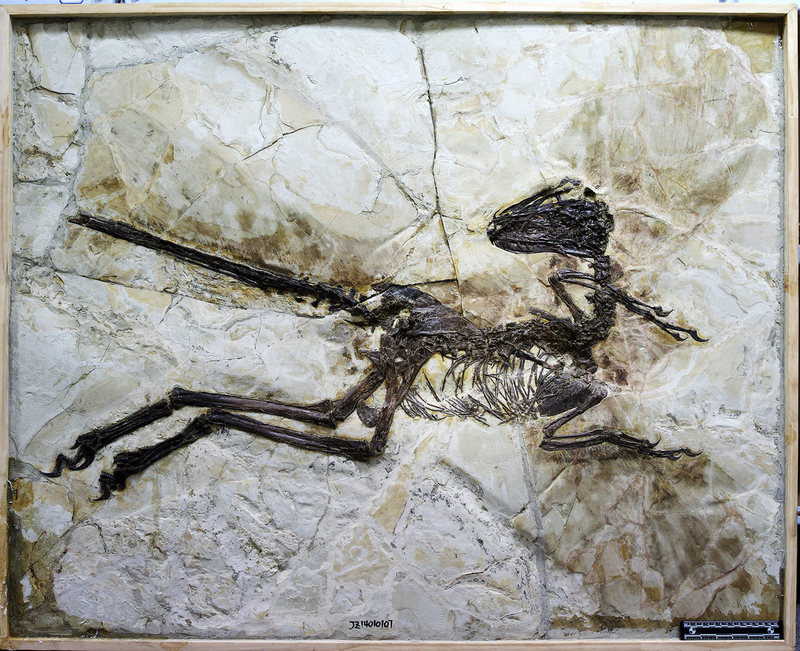
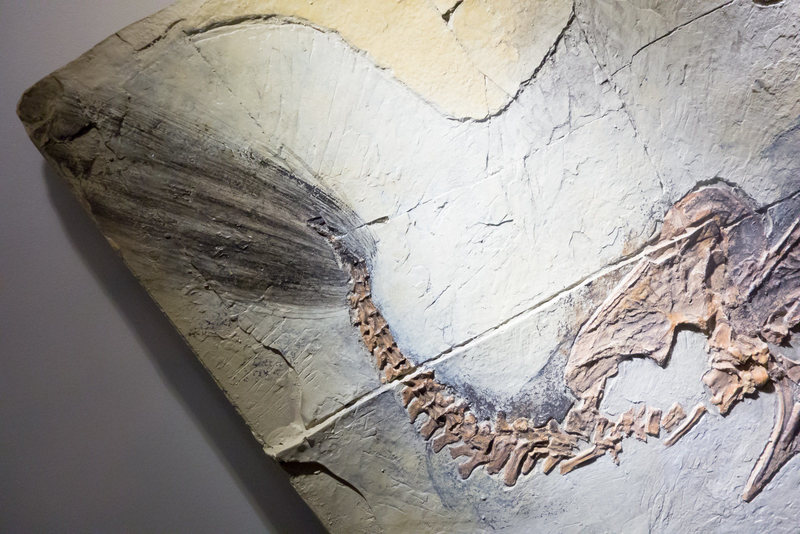
A raptor, genus Zhenyuanlong. STEVE BRUSATTE AND JUNCHANG LU.

What we know (and what we don’t) about the Jehol Biota.

WHEN SOMETHING DIES, NATURE ENSURES that its remains won’t stay intact. Microbes eat away at the soft tissue, and wind, rain, rivers, oceans, and scavengers shuffle around the hard segments of the corpse. As eons pass by, these skeletal segments may become fossilized, but they remain broken jigsaw pieces of a puzzle that often cannot be entirely pieced back together.

But around 130 to 120 million years ago, in what is now northeastern China, nature behaved rather differently. It was then, during the early Cretaceous, that a series of cataclysmic events took place, ensuring that a vast collection of plants and animals, including plenty of dinosaurs, were left in much the same state they were in when they were alive.

These often fully or at least partly joined-up fossilized skeletons looked like they had been frozen in time. Many of them still retained soft tissues, from muscles to skin. The remarkable state of preservation at this location, officially known as the Jehol Biota, led to some researchers and journalists to dub the site the “Chinese Pompeii.”

However, the true story behind this fossiliferous trove, which spans 10 million years, is more complex than this striking moniker would lead you to believe. Even today, experts still aren’t completely sure what produced one of the most important paleontological sites on Earth.

How in the world were these fossils so well preserved?

Historical records are vague about the date when these important fossil beds were first discovered. But we do know that during the late 19th and early 20th centuries, they caught the attention of a few fossil collectors.

It was, however, a series of major papers, including several published in Nature and Science in the 1990s, that garnered the site wider attention from the scientific world. The papers carefully described the contents of the rock layers, and revealed a number of amazing fossils. The layers have since been found to contain thousands of individual species, including fishes, frogs, turtles, birds, non-avian dinosaurs, pterosaurs, salamanders, plants, mammals, insects, and more.

Thanks to geological clues left within the fossil beds, it was established that these organisms lived in a lush, temperate, jungle-like or heavily forested area by a series of lakes. This extremely biodiverse environment may have disappeared into the annals of geological history, but these rock layers offer paleontologists a glimpse of what used to be.

This collection of life revolutionized paleontology. Dinosaur hunters, in particular, were thrilled: The plethora of feathers and bone structures clearly supported the building consensus that birds evolved from older dinosaurs. Not only that, but preserved melanosomes—organelles that produce pigments—allowed scientists to work out what color dinosaurian feathers were for the very first time.

“The feathered dinosaurs are, hands down, the most important dinosaur fossils found during my lifetime,” says Steve Brusatte, a vertebrate paleontologist and evolutionary biologist at the University of Edinburgh. “And that’s all because of the exquisite preservation—having not only bones, but feathers, and gorgeously detailed feathers at that.”

He describes Zhenyuanlong suni, a new raptor that he helped identify in 2015, as his “all-time favorite,” the most beautiful fossil he has ever had the privilege to study. Its chocolate-brown bones prominently stand out from the surrounding rock, as do the halo of feathers found across the body, including the quill feathers on the wing-like arms. “When you look at this dinosaur, you see a bird,” he says.

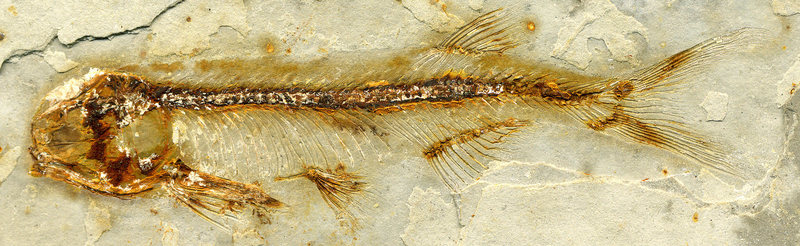
Lycoptera davidi fossil fish (Jehol Lagerstatte, Yixian Formation, Lower Cretaceous; western Liaoning Province, China). JAMES ST. JOHN/CC BY 2.0

For those fascinated by the Jehol Biota, the question, of course, is how in the world were these fossils so well preserved? Preservation largely comes down to the environment in which the animals or plants died, and that information can be teased out of the sediments in which the fossils are encased.

It was discovered that much of the Yixian and Jiufotang Formations—two of the three rock formations containing the Jehol Biota—were lakebed deposits. Clearly, many of the animals were entombed at the bottom of prehistoric lakes.

Strangely, there were plenty of terrestrial animals found within these lakebeds, suggesting that powerful forces brought these outsiders to their final resting places. As it happens, these lakebed layers are interspersed with volcanic deposits, indicating that volcanic activity was a prominent feature of the region.

Some researchers suspected lahars could be the killers. These are volcanic mudflows: When pre-deposited volcanic ash and debris are rained on, they can move considerable distances as rapid, cold, concrete-like slurries that pick up everything else they run into, including dinosaurs. Others pointed to the coiled-up poses of some creatures, and suggested that toxic volcanic gases, perhaps released from the lakes, suffocated the animals. They were then buried at a later date by fine ash.

Then, in 2014, a blockbuster paper turned up in Nature Communications with a bold idea: What if pyroclastic flows were to blame? These mixtures of ash, lava chunks, and gas, generated by varying types of explosive volcanic activity, can be 700°C (1,300°F) and move at speeds of 80 kilometers (50 miles) per hour.

A dinosaur imprint from the Yixian Formation. KENNETH LU/CC BY 2.0

A team led by Baoyu Jiang, a professor of paleontology and stratigraphy at Nanjing University, looked at 14 fossils taken from the ancient lakebed rock layers of the Jehol beds. The researchers found that plenty of the sediments containing fossils were rich in volcanic components, likely representing the animals’ burial in volcanic ash.

They also noted that there appeared to be black streaks on the bones of these animals, as well as intricate cracks. To them, this indicated that the animals had been charred. In fact, they write that this damage was “comparable to features from victims at Pompeii and nearby archaeological sites caught in PDCs from the 79 AD eruption of Mt. Vesuvius.”

PDCs (pyroclastic density currents) take several forms, but the most common type is pyroclastic flows. Pyroclastic surges, also common, are slightly cooler, gassier versions of flows.

The effects of encountering both are usually the same. Anyone hit by these will experience extreme heat shock, leading to rapid organ failure. Their muscles will suddenly contract, putting them in curled up positions known as pugilistic poses. Water in the body will rapidly boil, including in the brain, which can cause the skull to explode. Those not impacted by the heat would asphyxiate due to the cocktail of unleashed toxic gases and clouds of ash. Death is often quick, but gruesome.

Jiang’s team suspects that these lethal flows killed the animals. At the same time, the researchers suggest that the fine-grained volcanic ash formed molds around their remains, encapsulating them and shielding them from scavengers and normal processes of decay. This theory seeks to explain the deaths and preservation quality, but how did so many different types of animals—from birds to salamanders, pterosaurs to dinosaurs—all end up in the lakes? The answer, they suggest, is that the pyroclastic flows were widespread enough to sweep up not just life living alongside the lake, but life far from its edges.

Their theory, which they tentatively apply to much of the terrestrial Jehol Biota, seemed to elegantly solve several mysteries. A separate team, however, suspected this was a little too good to be true. Writing a year later in Palaeogeography, Palaeoclimatology, Palaeoecology, a different group of researchers, including Mike Benton, professor of vertebrate paleontology at the University of Bristol, took a closer look at one section of the Yixian Formation and came to a very different conclusion.

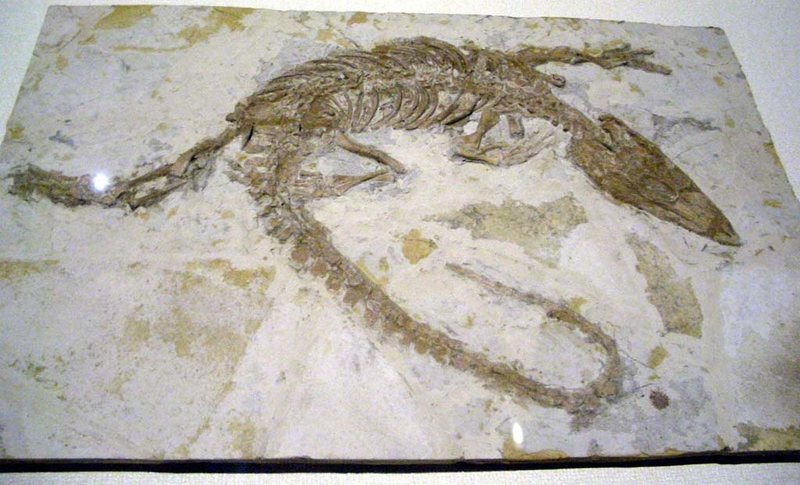
Monjurosuchus splendens fossil from the Yixian Formation. LAIKAYIU/CC BY-SA 3.0

Named after the closest village, the Lujiatun Unit features particularly exceptional fossil preservation. Volcanic material dominates the unit, not lake-borne sediments. This team’s field and laboratory assessment indicated that the unit was in fact the upper part of a floodplain. The sediments here were certainly provided by volcanic eruption features—including lahars, pyroclastic flows, and ash fallout—but intense rainfall generated flooding that moved them around after they were initially deposited.

These multiple, colossal, gloopy, sheet-like floods were able to transport and preserve—and possibly kill—the creatures found trapped and fossilized inside the unit. There isn’t necessarily any evidence that volcanic eruptions, or pyroclastic flows, were directly involved here in the fossilization process here.

Sure, it’s likely that a handful of deaths in the area back then would be linked to volcanic events, from PDCs to lahars. Lujiatun is also just one unit, and so cannot be directly compared to the other fossil-rich lakebed units looked at by Jiang’s team in the 2014 paper. Indeed, Jiang says that he stands by his study’s conclusions: He doesn’t doubt that the Lujiatun Unit represents volcanic debris flows, but that’s quite different from the lakebed deposits that they focused on.

In any case, the 2015 study underscores the importance of very carefully examining the sediment record at each site throughout the Jehol rock layers—a necessity before any sweeping statements about ancient Pompeii-style apocalypses can be made.

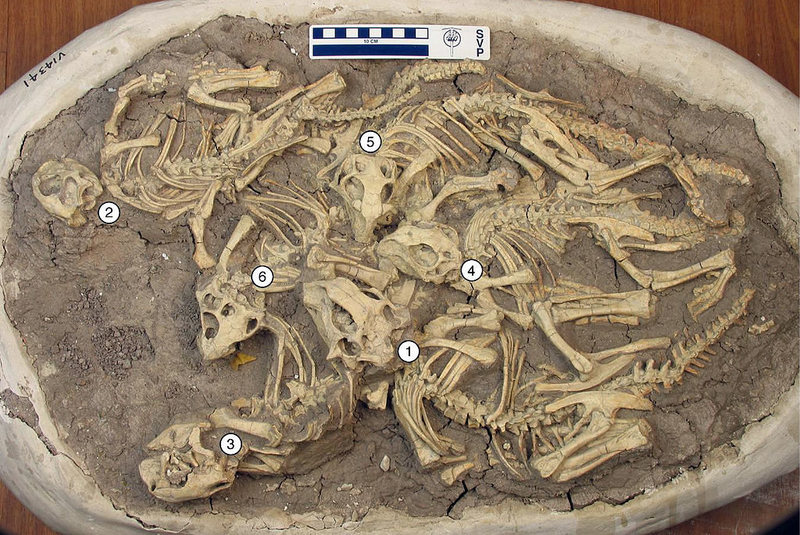
Cluster of six juvenile Psittacosaurus from the Early Cretaceous of Lujiatun, Liaoning Province, China. QI ZHAO, MICHAEL J. BENTON, XING XU, AND MARTIN J. SANDER/CC BY 2.0

“I don’t think the Pompeii-like model is rejected, but we would certainly argue it is unlikely for a couple of reasons,” Benton says. He notes that there’s no convincing evidence in his team’s paper or any other that shows the specimens in any of the layers were scorched by hot ash. If they were, it’s hard to explain why so much organic material of even delicate creatures, such as insects, remained intact. At the same time, the victims of the real Pompeii were indeed buried and preserved, but they weren’t transported.

Pierre-Olivier Antoine, a paleontologist at the University of Montpellier, says both papers can’t be generalized to fit the entire site. Lujiatun can’t be said to represent what always happened throughout the 10 million year time period, and neither can the lakebed deposits.

He is nevertheless “more comfortable” with the 2015 study, which implicates a “wider array of volcano-related events” rather than a solitary type of killer. Asphyxiation through volcanic gas, charring from hot ash, transport from pyroclastic density currents, and flood-driven sediment flows could all be involved.

As of 2018, the question of preservation remains open for debate. The specifics remain uncertain, but as Brusatte notes, “it all seems to be down to the volcanoes.” These creatures, going about their everyday business, were quickly killed and preserved in much the way the humans of that ancient Roman metropolis were, he says.

“It wasn’t exactly a Pompeii-style scenario,” he says, “but it wasn’t too far off.”

Source: www.atlasobscura.com

Found and Lost: An Indian Fossil Hunter’s Chase for Dinosaur Relics

Monday, October 22, 2018

Did you know that India was home to fierce reptiles & fantastic dinosaurs?

Unlike countries like the US or even China, India doesn’t have a national repository to store fossil finds. Only this year, there has been some talk of a natural history museum in Delhi – but the damage of this lethargy is evident all over the country.

The fossil of the cidaris looked like a self-embroidered Christmas ornament. It was the relic of a slate-pencil sea urchin, or cidaris, a punk-styled marine critter. Alive, it looks like a golf ball with spikes, or a comic-book version of an exploding firecracker.

Vishal Verma, a 48-year-old fossil-hunter and conservationist, was rummaging through an overcrowded closet, sifting through a wobbly pile of electrical-fan cartons. They were now stuffed with fossils of ancient life, some wrapped in plastic, others in old newspapers.

Entombed in one of these boxes was the million-year-old, petrified fossil of the cidaris. It was blonde from the limestone that had meticulously ripped through every cell of its existence.

Verma had found numerous breathtaking fossils like this one. But one particular kind eluded him: That of the poster children of these relics, the dinosaurs.

§

Manavar is a sleepy town in central India, surrounded by rolling hills of pale limestone and dark volcanic basalt. Dinosaurs once walked these lands.

On the geological timescale, it was the Cretaceous period, 146 to 65 million years ago. It was overall warm on earth with high sea levels.

India had broken free from Africa and Madagascar. It was an island continent in the southern hemisphere. A seaway cut through its centre and a vast ocean spread out to its north, separating it from Asia. The Himalayas weren’t born yet.

Dinosaurs ruled this period – until, of course, apocalypse struck.

§

A widely accepted theory is that dinosaurs were killed by a meteor or an asteroid crash. But other palaeontologists believe that a series of colossal volcanic eruptions in a part of western India decimated these megafauna 65 million years ago.

Sediments deposited during what is called the Deccan volcanic activity are a treasure-trove of dinosaur nests and eggs. The fossil-rich rocks along the banks of the Narmada river in Central India were formed during this geological event.

In fact, the first dinosaurian bones in Asia were reported in 1828 from Jabalpur, close to the eastern end of the Narmada river. The bones were of the Titanosaurus indicus, a gentle and giant herbivore of the Cretaceous period.

Since then, a vast collection of dinosaur bones, nerves, teeth, claw, eggs and even dung have been found in the country.

Some of these facts come from a book called ‘Dinosaurs of India’, a 100-pager authored by veteran fossil researcher Ashok Sahni. He is the leading figure in Indian palaeontology, best known for unearthing dinosaur nesting sites in central India.

“It is a thrill that cannot be explained,” Sahni said over the phone from Lucknow. “The joy of finding something is like the joy of creation.”

His amazement at fossil digs in India is understandable. The country’s landscape is a lavish buffet of animal relics.

Its diverse fossil wealth is partly thanks to a 100-million-year odyssey. This Noah’s Ark-like trip kicked off when India chipped away from Gondwanaland, the mother continent. As India waltzed up latitudes, it underwent climatic changes. This isolation also led to a spike in animal and plant species, even a variety of dinosaurs, found only in the floating landmass.

Jabalpur has numerous deposits of dinosaur eggs and nests. The city is located along the banks of the Narmada river. It was amid the barren hillocks of this region that the British soldier William Sleeman found dinosaur bones in 1828.

More than 150 years later, Sahni stumbled upon dinosaur nests around the same spot.

“I saw these rounded bodies and they didn’t look like eggs because they were silicified. They had been covered with silica,” Sahni said. “We started searching for more and found more. One of my MPhil students was with me. He got so excited that he went back with a torch”  Sahni had spent many years on that site and hadn’t come across any dinosaur egg fossils until that day. “A lot is luck,” Sahni added. “A lot of it is perseverance.”

§

Vishal Verma is aware of the patience it takes to find animal relics. In 2000, the fossil hunter started scanning the neighbouring town of Bagh in Madhya Pradesh.

He spent weekends cruising over 40 km of asphalt to Bagh on his motorbike. There, he did his version of a superhero flip. He shed his high-school physics-teacher garb and fastened his amateur palaeontologist cape.

Verma started looking for petrified bones, eggs, even a shard of a dinosaur-egg fossil in this prehistoric graveyard. He was keenly aware of what he should look for, as he had spent hours studying attributes of these elusive fossils.

“To identify an egg, its shell is key,” he said en route to Bagh, speaking in Hindi. “The details on the egg shell tell us whether it is a carnivore or a herbivore dinosaur. The breathing pores, its textures, its shape. If it is spherical, it is a herbivore, and if it is elongated, it is a carnivore.”

He had all these little details tucked in his head but his detective skills proved futile in finding clues in this ancient crime scene.

“He had done a lot of work and had a large collection of fossils and knew where to find them,” said Rajesh Chauhan, also in Hindi. “But there was one thing that he yearned for. He didn’t have any dinosaur fossils.”

Chauhan is a former student of Verma. He is now a forest ranger guarding Bagh’s natural history and wildlife.

A decade ago, when he was a graduate student of zoology, he got in touch with Verma for some assistance on a research paper. Chauhan was really interested in studying fossils.

It was Verma’s sixth year of dinosaur-fossil hunting in Bagh and he decided to persevere. Now, it was with Chauhan in tow.

§

The morning drive from Manavar to Bagh is stunning. You wheel past lush rolling hills and small fields with saplings of various crops.

“You have corn here and cotton,” Verma said. “The basalt that buried the dinosaurs now is a fertile ground for these crops.”

The Bagh Fossils Park is a 100-hectare conservatory. It was an overcast day and Verma walked down a mud-path that wound around lush mounds to sight a small pond.

Back in 2006, on a cool November morning, Chauhan and Verma chose this very spot for their fossil hunt.

“On the first day itself. We parked our bikes and came here close to the pond,” said Chauhan pointing to a waterbody at the park. “And we kept doing the rounds and I was a bit unsure because I didn’t know to identify a dinosaur egg or its shell. Then Vishal called out, ‘Come here, come here.’ It was the shell of a dinosaur egg.”

A while later, there was another shriek. This time it wasn’t just another shard of the puzzle. It was the actual whole: a coconut-sized dinosaur-egg fossil.

But even that wasn’t what left them clicking their heels. Over the next couple of days, they collected about a hundred petrified dinosaur eggs. It was one of India’s biggest finds.

“At that time, we didn’t have any words. Everyone’s happiness was of different degrees,” said Chauhan. “I was excited that we found dinosaur eggs. And we truly had a windfall. We were taking the eggs in sack-loads. And since we couldn’t take them on our bikes, we got a friend to bring along a van and spent a few days ferrying the dinosaur eggs to Manavar.”

It was a monumental find. A few months later, they handed the eggs over to the Madhya Pradesh government. Some of these egg fossils were deposited at a fossil museum in Mandav, a tourist town located 100 km from Bagh on a scenic plateau in the Vindhya mountain range.

But that wasn’t exactly the best decision.

§

When Sahni and his students discovered a whale fossil in Kutch in the 1970s, it was tough to find a place to keep it safe. The seasoned fossil finder literally lugged the meter-long, brittle skull along with him wherever he went. There was always a fear of the fossil being broken, misplaced or stolen if he didn’t keep it within arm’s reach.

“Whale fossils cannot be put in your pocket,” Sahni said. “So when I shifted to another university, I had a problem, you know. How do you transport? And how do you convince your wife and family that I am going to carry these there because they are very important?”

Unlike countries like the US or even China, India doesn’t have a national repository to store fossil finds. Only this year, there has been some talk of a natural history museum in Delhi.

The damage of this lethargy is evident all over the country. Like Bagh, Raiyoli in neighbouring Gujarat was another major dinosaur nesting site. It is close to the western bank of the Narmada. But today, Raiyoli has very few fossils.

“So much of it has been destroyed and is constantly being destroyed. That’s the biggest tragedy happening around,” said Sanjay Kumar, a Delhi-based journalist working with Sahni and others to push the government to establish a natural history museum. “This spot in Raiyoli was a global hotspot, which was to be declared a UNESCO site. Nothing was done and the whole site was destroyed. It’s almost clean now.”

Verma’s find faced a similar disaster. In 2013, some of the dinosaur-egg fossils at the Mandav museum were stolen.

§

Mandav is located 50 km from Manavar, a good two-hour drive.

Enroute to the Mandav museum, Verma tried to sound optimistic and spoke of the beauty of this tourist hotspot.

“You’ll see when we go to Mandu, there will be waterfalls,” said Verma. “It will be beautiful with a light fog hovering over it.”

But he actually seemed a bit like the frugal urban van he was seated in. The vehicle groaned as it inched up the gentle slopes and grumbled through the mist.

After what seemed like a rickety roller-coaster ride, the museum came into view. It was a stunning site. The building was perched on a volcanic basalt cliff with a view of the cascading waterfalls.

A family with kids arrived as Verma walked through the gate.

They were disappointed to learn that the building containing the dinosaur eggs, a tacky egg-shaped, igloo-like structure, wasn’t open for the public. It had been locked for five years now, since the day some of the egg fossils were stolen.

Verma reveres Sahni. And now, he has started mimicking his efforts in more ways than one.

For starters, he isn’t parting with his finds – whether the beautiful cidaris he possesses or the dinosaur-egg fossils placed just opposite his closet on the floor of his home.

The curios form a part of a traveling museum that Verma pedals to educate locals and children about the region’s fossil riches. At all other times, they remain wedged in pizza-box shaped, electrical-fan cartons, safely tucked in his crummy closet.

“Some people look at fossils with amazement as a clue to the origins of life,” said Verma. “And then there are those who cannot understand why we are investing so much in a piece of stone.”

Source: https://thewire.in

Pages