Blogs

The Teeth of Changchunsaurus: Rare Insight Into Ornithopod Dinosaur Tooth Evolution

Thursday, November 8, 2018

Changchunsaurus by cisiopurple

Unexpected features in this dinosaur's teeth appear to represent early adaptations for herbivory.

The teeth of Changchunsaurus parvus, a small herbivorous dinosaur from the Cretaceous of China, represent an important and poorly-known stage in the evolution of ornithopod dentition, according to a study released November 7, 2018 in the open-access journal PLOS ONE by Jun Chen of Jilin University in China and colleagues.

The skull of the holotype specimen of C. parvus (JLUM L0304-j-Zn2). Credit: Chen et al., 2018 CC-BY

Ornithischian ("bird-hipped") dinosaurs developed an incredible diversity of teeth, including the famously complex dental batteries of derived ornithopods, but little is known about how these intricate arrangements arose from the simple tooth arrangements of early dinosaurs. Changchunsaurus parvus belongs to an early branch at or near the origins of the ornithopods, and thus may provideinsight into the ancestral state of ornithopod tooth development. In this study, Chen and colleagues took thin sections from five jaw bones of Changchunsaurus to investigate tooth composition as well as how the teeth are maintained throughout the life of the animal using histological techniques.

Among the notable features of Changchunsaurus dentition is a unique method of tooth replacement that allowed it to recycle teeth without disrupting the continuous shearing surface formed by its tooth rows. The authors also found that the teeth feature wavy enamel, a tissue type formerly thought to have evolved only in more derived ornithopods. The authors suspect these features may have arisen early on as this group of dinosaurs became specialized for herbivory.

Features of the jaws and teeth are often used to assess dinosaur phylogeny. In addition to investigating the evolution of ornithopod dentition, this study also identifies new dental traits that might help sort out ornithischian relationships in future analyses. But the authors note that this is only the first in-depth study at a dinosaur near the base of the ornithopod family tree, and that more studies on more dinosaurs will be needed to fill in the full picture of this group's evolution.

Professor Chen Jun summarizes: "These tissue-level details of the teeth of Changchunsaurus tell us that their teeth were well-adapted to their abrasive, plant-based diets. Most surprisingly, the wavy enamel described here, presumably to make it more resistant to wear, was previously thought to be exclusive to their giant descendants, the duckbilled dinosaurs."


Story Source:

Materials provided by PLOSNote: Content may be edited for style and length.


Journal Reference:

  1. Jun Chen, Aaron R. H. LeBlanc, Liyong Jin, Timothy Huang, Robert R. Reisz. Tooth development, histology, and enamel microstructure in Changchunsaurus parvus: Implications for dental evolution in ornithopod dinosaursPLOS ONE, 2018; 13 (11): e0205206 DOI: 10.1371/journal.pone.0205206

Source: www.sciencedaily.com

Jurassic World Director Reveals Why Lesbian Scene Was Cut

Wednesday, November 7, 2018

Daniella Pineda as Dr. Zia Rodriguez in Jurassic World: Fallen Kingdom (Universal Studios)

The director of Jurassic World: Fallen Kingdom has said that a lesbian scene did not make the final cut because it was too long.

In an interview with Yahoo Movies UK, director JA Bayona also said that a clip from Jurassic World: Fallen Kingdom, which revealed the sexuality of paleo-veterinarian Zia Rodriguez (Daniella Pineda), was cut out because it disrupted the flow of the movie. 

“The whole thing came as a surprise to us. We always thought of Zia as lesbian,” he told the entertainment website.

“And then the scene where she was actually talking about it…it was a very long scene and it broke the pace of the whole movie so we decided to cut it.”

Jurassic World’s lesbian scene was early in movie

Pineda had previously said that producers felt the scene showing her character’s sexuality wasn’t “relevant to the story, but it was a little glimmer into who she is.”

She told Yahoo: “Originally the cut was two hours and 40 minutes, and they were like, ‘This is too long.’”

Source: www.pinknews.co.uk

T. Rex Turned Like a Ballerina from a Slow-Motion Nightmare

Wednesday, November 7, 2018

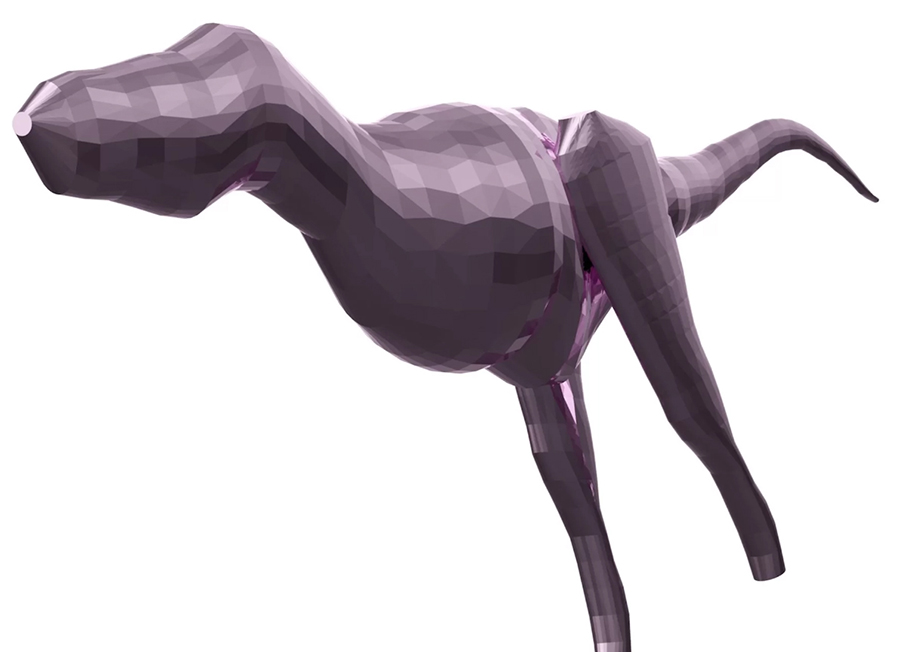
A very pink, digital model of the tyrannosaur Gorgosaurus that, like Tyrannosaurus rex likely turned around more quickly than other theropod dinosaurs could. Credit: Andre Rowe; Eric Snively

Most people don't think of the mighty Tyrannosaurus rex as having the grace of a pirouetting ballerina or the poise of a spinning figure skater, but new research indicates that the dinosaur king was quite good at turning to pounce on prey.

In fact, T. rex and its tyrannosaur relatives were master twirlers — sporting between two and three times the agility of other theropod dinosaurs, a group of bipedal, mostly meat-eating beasts, new research finds.

"An adult T. rex could turn like a slow-motion 10-tonne [9 tons] figure skater from hell," study co-researcher Eric Snively, an associate professor of biology at the University of Wisconsin-La Crosse, told Live Science in an email. "Juvenile tyrannosaurs were much scarier. Their turning ability suggests that tyrannosaurs could successfully attack smaller, younger and/or more dangerous prey than other carnivorous dinosaurs would bother to tackle."

The research, which has yet to be published in a peer-reviewed journal, was presented at the 78th annual Society of Vertebrate Paleontology meeting on Oct. 20 2018 in Albuquerque, New Mexico.

Tyrannosaurs were humongous — those that lived at the end of the Cretaceous period, which lasted from about 145 million to 65 million years ago, weighed at least 880 lbs. (400 kilograms). But despite these dinosaurs' massive size, research showed that tyrannosaurs were shorter, from nose to tail, and had larger ilia (the upper part of the hip bone) — which allowed more space for large muscle attachment than other, similarly sized theropods did, Snively and study co-researcher Donald Henderson, the curator of dinosaurs at the Royal Tyrrell Museum of Palaeontology in Alberta, Canada, told Live Science. The combination of short body length and large ilia indicated that tyrannosaurs might have had lower rotational inertia (resistance of an object to turning) and leg muscles that could exert greater torque (turning force) to turn their bodies, the researchers said.

These forces are the same ones used in figure skating. "A figure skater can turn more quickly if she pulls her arms in than if she keeps her arms stretched out," Snively said. But while a figure skater with a tight turn might get more points, this dinosaur research has entirely different goals: "The answer might reveal how [tyrannosaurs] hunted and attacked prey," Snively said.

Turning a corner

To investigate, the researchers figured out every detail possible about the Mesozoic monsters' mass and bodies. "Our reconstructions included the latest knowledge about muscles and other soft tissues in dinosaurs, including the neck, legs and tail, and lungs and air sacs in their bodies," Snively said.

Then, they estimated how muscle force and leverage affected the creatures' torque and rotational inertia. The results gave each theropod a unique "turning acceleration index," which allowed the scientists to compare the turning ability between different dinosaurs. Next, the research team tested two scenarios: in the first, both of the dinosaur's feet were firmly planted on the ground (which the beast might do if it was exceptionally close to prey) and, in the second, the dinosaur was pivoting on one foot (which it would do while turning to chase its fleeing dinner).

Finally, it was time to compare all of the dinosaurs' turning abilities. Study co-researcher Haley O'Brien, an assistant professor of neuroscience at Oklahoma State University's Center for Health Sciences, plotted these turning indices against the body mass for tyrannosaurs and non-tyrannosaur theropods.

The results showed that tyrannosaurs came out on top.

"No matter what their body size, tyrannosaurs always seemed able to turn their bodies twice as quickly as other blade-toothed carnivorous dinosaurs of the same mass," such as CeratosaurusAllosaurus and Dilophosaurus (best known as the dinosaur in "Jurassic Park" that attacks Dennis Nedry, played by Wayne Knight),  Snively said. Tyrannosaurs could even turn as quickly as theropods half their body size, indicating they were gold medalists not only for their banana-size, serrated teeth and powerful bite force, but also for their agility, the researchers found.

If humans somehow came face-to-face with a T. rex (time-machine inventors, we're looking at you), it would still be smart to run behind it as fast as our little legs could carry us. "In absolute terms, long heavy objects will turn slowly," Snively said. "My colleague John Hutchinson calculated that you could yawn and check your watch before an adult T. rex turned around to catch you."

But T. rex's prey wasn't as lucky. "A big duck-billed Edmontosaurus or a Triceratops would have a harder time scooting behind an adult T. rex," Snively said. "And if a human- or even horse-sized juvenile tyrannosaur was chasing you, you'd probably be toast. Tasty, bloody toast."

Originally published on Live Science.

‘Jurassic Park’ Door-Lock Confusing Moment Finally Explained By Joe Mazzello

Monday, November 5, 2018

UNIVERSAL PICTURES VIA GETTY IMAGES

Twenty-five years after “Jurassic Park,” life’s finally found a way to address one of the movie’s most head-scratching moments.

Let’s set the scene: Dr. Alan Grant (Sam Neill) and paleobotanist Ellie Sattler (Laura Dern) are struggling to hold a door closed, as pursuing raptors paw at the other side. Ellie desperately tries to wrangle a gun lying nearby on the floor, but it’s just out of her reach. Acting fast, child hacker Lex (Ariana Richards) tries to activate the door locks on the Unix system. Her brother Tim ... just stands there.

Well, at one point Tim does jump up and down. But, for the most part, he just stands behind his sister while Alan and Ellie struggle. Over the years, the odd moment has inspired some frustrated parodies. But none answered the question: Why, Tim? Why?

“Mistakes were made, OK? Mistakes were made” Joe Mazzello, the actor who played Tim, recently told me.

“It was a high-pressure situation,” he noted. “Maybe Dr. Grant didn’t want an 8-year-old boy handling a gun. That’s one theory, but all I have to say is... I wasn’t a complete bozo in the movie. Tim at least understood, ’Hey, don’t shine the light in the T. rex’s face.′ So I’ll give myself credit for that one.”

“Maybe the gun thing was a mistake,” he added, “but all’s well that ends well.”

And it has ended up pretty well for Mazzello. Since his “Jurassic Park” days, the actor has appeared in high-profile projects like “The Social Network” and “The Pacific.” In his latest role, he’s a dead ringer for Queen bassist John Deacon in the Freddie Mercury/Queen biopic “Bohemian Rhapsody.” 

Source: www.huffingtonpost.com

What Was The Biggest Dinosaur? How Scientists Determine Giant Prehistoric Record-Breakers

Tuesday, November 6, 2018

Argentinosaurus in prehistoric landscape

Dinosaurs were among our planet’s most diverse land animals. They ranged from the chicken-sized Microraptor zhaoianus – at 39 cm (15.3 in) in length, the Smallest dinosaur – to the titanic sauropods (aka titanosaurs) that could weigh the same as an entire herd of African elephants, the Largest land animals today…

Ever since these prehistoric beasts came to light – the First scientific description of a dinosaur dates to 1824 – palaeontologists have faced the very difficult challenge of estimating their size. It’s fine when the remains are more or less complete: the Most complete Tyrannosaurus rex, incidentally, is “Sue”, who was unearthed in 1990 in South Dakota, USA, and was around 90% intact.

But “Sue” is a rare exception. The vast majority of dinosaurs – particularly larger specimens – have to be identified and filled out from minimal fragments. Over 2,000 species of non-avian dinosaur have so far been recognized and named, but many are known from just a single bone. In cases such as these, the dinosaurs’ proportions can only be calculated by comparing their bones with those from the same family with more extensive skeletal remains. 

Although advanced 3D-modelling software is making this job easier than it used to be, this process often still relies upon past finds and educated guesswork. As you can imagine, this results in a lot of debate when it comes to definitively declaring superlative dinos.

Despite their fearsome reputation, the T. rex (pictured) wasn't the biggest meat-eating dinosaur – that title goes to the Spinosaurus, which lived some 10 million years before the T. rex and was around 4 m (13 ft) longer

Like most records that deal with size, you first have to establish your parameters for “bigness”. Length, height and weight are all key characteristics that need to be taken into account. 

Argentinosaurus – long-heralded the Heaviest dinosaur – is known from only a small number of bones found in Argentina in the early 1990s. One vertebra (neck bone) was 1.59 m (5 ft 3 in) long, indicative of a giant sauropod, so to estimate its full size, palaeontologists compared it with vertebrae in the skeletons of more complete members of the sauropod clade, namely Saltasaurus and Rapetosaurus

From this, the final weight of Argentinosaurus was estimated at 100 tonnes (220,462 lb). Nowadays, most scientists favour a more conservative range of 60–90 tonnes (132,277–198,417 lb) – though that still makes these truly massive beasts!

While there have been several other contenders for the title, Argentinosaurus is still widely considered the heaviest dinosaur. Based on its mid-range estimate, it weighed the same as about nine T. rexes or 13 African elephants!

Argentinosaurus isn't without its rivals for the heavyweight title. A fellow titanosaur, since named Patagotitan mayorum – only found in 2012, also in Argentina – could have tipped the scales at 69 tonnes (152,118 lb). So at the lower end of the range for Argentinosaurus, that would make Patagotitan the biggest animal ever to walk the Earth. Others argue, however, that a more conserative body mass range for Patagotitan is 50–55 tonnes (110,231–121,254 lb). 

The debate, like the footsteps of these prehistoric giants, will inevitably rumble on for a long time… 

The most likely Tallest dinosaur, meanwhile, is another sauropod – the lofty Sauroposeidon proteles (below), which lived in the Early Cretaceous period. Owing to an extraordinarily elongated neck, it could have towered as tall as 18 m (59 ft) off the ground – about the same as four double-decker buses in a stack! 

It has to be acknowledged that this figure is based on a very small sample of bones and extrapolated from the more extensive remains of a similar prehistoric giant, Giraffatitan brancai – which itself was yet another former contender for the title of “largest dinosaur”.

Sauroposeidon is believed to have had the longest dinosaur neck – a key contributor to its superlative stature

As you could probably guess by now, the Longest dinosaur was yet another sauropod. Which species, again, is a matter of conjecture. Amphicoelias has to be a prime contender, though, given its estimated head-to-tail length of up to 60 m (197 ft) – more than twice that of a full-grown blue whale. 

The ever-popular Diplodocus also deserves a mention here just for its prodigious tail – the 14-m (46-ft) appendage is the Longest tail of any animal that has ever lived. 

Estimates based on limited remains aren’t only a headache for determining the overall biggest dinosaurs, either. Mongolia’s Therizinosaurus, for instance, was found with claws measuring up to 91 cm (3 ft) along their outer edge. Estimates of its total body size using only its claw dimensions would suggest an enormous creature. However, partial skeletal remains revealed that its claws were disproportionately long – indeed, the Longest dinosaur claws (see artist’s impression below).

Longest claws: Therizinosaurus

It's worth mentioning that sauropods shared the planet with many other giants that weren't dinosaurs. For instance, the oceans were ruled over by massive marine reptiles, like Mosasaurus – the Largest lizard ever, reaching up to 18 m (59 ft) long. 

While the king of the flying reptiles was Quetzalcoatlus (below). These supersized pterosaurs were the Largest flying creatures ever, standing as tall as a giraffe on the ground and spanning as wide as an F-16 fighter jet with wings outstretched!

The largest pterosaurs had beaks that measured the same length as an adult human. It's thought that they may have been scavengers, a bit like modern-day vultures

So: which was the largest dinosaur of them all? The answer is probably not as simple as you’d like it to be. What we can say, without doubt, is that the mighty sauropods stood taller, stretched longer and outweighed all other dinosaurs, and indeed any other terrestrial animal ever to walk our planet since. Any more specific than that and you have to be prepared to enter a prehistoric minefield of best estimates… 

Until time travel becomes possible (or at least until some lucky paleontologist unearths a much more complete skeleton), we'll have to reconcile ourselves to the fact that we can’t be 100% certain.

Budding dino hunters: be sure to check out Guinness World Records: Wild Things, which has a special chapter dedicated to record-breaking dinosaurs, plus an interview with world-famous palaeontologist Phil Currie!

Source: www.guinnessworldrecords.com

UO Scientists Uncover a Rare Oregon Dinosaur Fossil

Tuesday, November 6, 2018

Tenontosaurus. shutterstock

Paleontologists at the Museum of Natural and Cultural History have reported the discovery of a land-dwelling dinosaur’s fossilized bone in Eastern Oregon — an exceedingly rare find in a state that was underwater throughout most of the dinosaur age.

The toe bone belonged to a plant-eating, bipedal dinosaur known as an ornithopod and is estimated to date back 103 million years to the Cretaceous, a geological period that also gave rise to Tyrannosaurus rex.  

Uncovered by UO earth sciences professor Greg Retallack during a 2015 field excursion near Mitchell, the find was published online in the Journal of Vertebrate Paleontology and is the first Oregon dinosaur fossil ever reported in a peer-reviewed scientific journal.

“Oregon landscapes are rich with Cretaceous rocks, but they rarely contain the kinds of dinosaur remains we see elsewhere in the U.S.,” said Retallack, the museum’s director of fossil collections and the report’s lead author. “The rocks here are the right age but are mostly from under the sea where dinosaurs did not live or from swamps where dinosaur bones are seldom preserved.” 

During the 2015 trip to Mitchell, part of a University of Oregon course on fossil plants, Retallack and his students surveyed a shale slope on Bureau of Land Management property. There he spotted the toe bone amid an array of mollusk fossils preserved in the marine rocks.

Views of the fossil from several angles. It was found on a field excursion near the Eastern Oregon town of Mitchell.

Edward Davis, a co-author on the report and the museum’s fossil collections manager, said the land-dweller’s bone likely ended up there after a posthumous stint in the ocean.   

“It’s a phenomenon we sometimes call ‘bloat and float,’” he said. “That is, the animal died on shore in its terrestrial habitat, then washed out to sea, where it floated while bloated with decomposition gasses. Eventually it burst, and only this toe bone was entombed and became a fossil.”

Based on comparisons with other ornithopods, the co-authors estimate that the Mitchell dinosaur was more than 20 feet long and weighed nearly a ton. 

“With such a small piece of the ornithopod, it’s hard to say much about its ecology,” said report co-author Samantha Hopkins, the museum’s curator of paleontology and an associate professor of earth sciences at the Clark Honors College. “However, just finding it in Oregon is exciting, because we rarely see evidence here of the dinosaurs we know must have been nearby.” 

The report was also co-authored by the University of Calgary’s Jessica Theodor and UO doctoral student Paul Barrett.

Retallack said he doesn’t expect to find more dinosaur bones in Oregon marine rocks anytime soon.

“But we are now looking more carefully,” he said. 

—By Kristin Strommer, Museum of Natural and Cultural History

Source: https://around.uoregon.edu

Humans Caused The Largest Loss Of Biodiversity Since The Dinosaurs Were Wiped Out

Monday, November 5, 2018

© Getty Images

The most significant event of the last half-century is arguably “the Great Acceleration,” the explosive growth of our global population and economy in the wake of World War II.

 In many ways, the Great Acceleration is a positive story. It’s the story of lifting billions of people out of extreme poverty, and the spread of basic freedoms across the globe. But with that came an exponential increase in the demand for food, water and energy.

Our rapidly growing footprint on this world comes at a cost: in less than a single person’s lifetime, global wildlife populations have declined by 60 percent.That’s the finding of WWF’s recent “Living Planet Report,” which tracked thousands of populations of mammals, fish, birds, amphibians and reptiles between 1970 and 2014.

We’re witnessing the largest loss of Earth’s biodiversity — the vast, varied and delicate web of all living things and the ecosystems that sustain them — since a cataclysmic event wiped out the dinosaurs 66 million years ago. Today, humans are the main culprit for biodiversity loss, primarily through unsustainable fishing, hunting and conversion of land for agriculture. But we are also the only species capable of bringing it to an end. 

Why should we care about biodiversity loss? Simply put, our planet’s natural bounty helped write the Great Acceleration’s inspiring story of human progress. From the food we eat to many of the medications introduced in the last 25 years, the value that biodiversity provides is essential to our survival as a species.

It’s not too late to course correct. Life is resilient. Life bounces back — when given half a chance. We’ve seen it right here in the U.S. By the 19th century, logging, the fur trade and other economic activities had reduced forest cover in New England to roughly 30 to 40 percent and driven species like moose, deer and beaver to the brink. 

Today, thanks to a mix of conservation efforts and societal changes that shifted the region’s economy away from land-intensive activities, forest covers 80 percent of the region. It’s the single greatest restoration of forest in the Americas in more than a millennium.

History also tells us that government action can help stop biodiversity loss on a national scale. The Endangered Species Act (ESA), enacted in 1973, is one of the cornerstones of American conservation and a model that has inspired conservation laws worldwide. Some 99 percent of the species protected under the ESA have avoided extinction, and iconic species like the bald eagle have enjoyed remarkable comebacks.

How do we recreate these success stories on a global scale? Just as the climate threat called for the global pact agreed to in Paris in 2015, we ultimately need a global deal to save nature. Indeed, our efforts to protect biodiversity and slow climate change go hand in hand, for the same ecosystems that keep carbon out of the atmosphere also provide shelter, sustenance and other essential resources for countless species — including us.

This is our shared challenge, and our shared responsibility. Another 50 years from now, what will be the next global headline for humanity? Will it be that we sat on our hands and let our world deteriorate unchecked? Or will it be that we acted in time to save nature — and ourselves?

Nik Sekhran is chief conservation officer at World Wildlife Fund (WWF). Previously, he worked at the United Nations Development Programme (UNDP), where he served most recently as the director for Sustainable Development, leading a team of over 200 staff dedicated to advancing the UN sustainable development goals.

Source: https://thehill.com

Your Child Can Pat A Dinosaur In The Blue Mountains, Yes Really

Tuesday, November 6, 2018

This is a must-visit for any dino mad kids and it's something the whole family will love.

There is something about dinosaurs that are so magical to children. Every kid goes through at least one big dino obsession in their lives, and it's easy to see why, they're big, they're different, they're all-round cool. 

Now, Scenic World in the Blue Mountains is offering up a family excursion that will have your little dinosaur fan jumping for joy. 

Dinosaur Valley

Dinosaur Valley at Scenic World in Katoomba is bringing the ancient rainforest to life with prehistoric dinosaurs, daily events and family fun from November 1 – January 28.

I was lucky enough to check it out on opening day and I was blown away by the level of detail and effort that went into it. We rode down to the valley on the Scenic Railway while the Jurassic Park theme song played. Once we reached the bottom a Dinosaur ranger took us on a fun and educational tour, telling us a bit about all of the dinosaurs we passed.

The dinosaurs themselves were amazing, animatronic robots that look spookily realistic and certainly fooled my four-year-old who looked at them wide-eyed. 

As well as seeing the dinosaurs from the walkway, three times a day visitors have the opportunity to do a 'meet and roar' where you get up close with Ringo the Raptor and an adorable baby triceratops named Barbara. The kids have the chance to pat them and get photos and it is awesome (all included in the ticket price). 

When we'd completed our tour we took the newly refurbished Skyway cable car back up out of the valley. It was the perfect day out for the whole family, highly recommended. 

Make a weekend of it

Scenic World has teamed up with local accommodation to provide some great package deals, so why not get out of the city for the weekend and explore the mountains. We stayed at the Fairmont Resort and I can honestly say I have never seen such a child-friendly hotel. My four-year-old thought it was a paradise and basically refused to leave when it was time to go. 

They have not one but two fully decked out kids' playrooms, an arcade and a mirror maze as well as train rides and pony rides on selected days. 

Dinosaur Valley details:

This highly recommended activity will be running at Scenic World from the 1st of November to the 28th of January, so don't miss out. 

Tickets: 

Discovery Pass - SAVER: Dinosaur Valley

The ultimate Scenic World experience. Includes access to all rides for one day of adventure, plus entry to Dinosaur Valley.

    • Child Pass: aged 4-13 years

    • Children under 4 years are free!

    • Family Pass includes 1 or 2 adults and up to 5 children under 14 years old.

Adult + Dinosaur Valley $39.00

Child + Dinosaur Valley $21.00

Concession + Dinosaur Valley $35.00

Family + Dinosaur Valley $99.00

The meet and roar happens every day at 10:30am, 12:30pm & 2:30pm - free with entry.

Source: www.kidspot.com.au

New Dinosaur Species Discovered In ‘Unusual’ Argentine Location

Sunday, November 4, 2018

© AFP / Agencia CTYS

The newfound species is a sauropod and was found in an area that wouldn't normally accommodate the megaherbivores.

Paleontologists have stumbled upon the fossils of a new dinosaur species in one of the unlikeliest places. The puzzling discovery was made in the Neuquen province of Argentina, in an “unusual” location where no one would think to go looking for dinosaur bones.

According to AFP, the newfound dinosaur species belongs to the sauropod group — gigantic herbivores that stood up to 108 feet tall and weighed as much as 120 tons.

As the Inquisitr previously reported, sauropods were the largest creatures to ever walk the Earth. These megaherbivores lived throughout the entire Mesozoic Era, spanning from 251 million to 65 million years ago.

The new sauropod species discovered in Argentina was named Lavocatisaurus agrioensis and was identified as a rebbachisaurus — a genus of sauropod from the Diplodocoidea family, which also included some of the iconic sauropod giants, such as Supersaurus, Diplodocus, and Apatosaurus.

The new species was described from fossils belonging to three individuals — one adult and two juveniles. Judging by the size of the bones, the adult Lavocatisaurus agrioensis was about 39 feet long, whereas the two juveniles had only grown to about 20 feet in length.

The first remarkable thing about this discovery is that the fossils were unearthed in an area which wouldn’t have normally accommodated the gentle giants.

Lavocatisaurus agrioensis roamed the planet 110 million years ago, during the Late Cretaceous — a time when the Neuquen site would have been a desolate desert region with very few water sources. As AFP points out, finding these fossils here was “unusual” and “a huge surprise” for paleontologists.

“While one can imagine that this group of sauropods could have adapted to move in more arid environments, with little vegetation, little humidity and little water,” said Jose Luis Carballido, a researcher at the Egidio Feruglio museum.

Carballido is also the co-author of a recent study detailing the discovery of the new sauropod species. The paper was published at the end of October in the journal Acta Palaeontologica Polonica.

While none of the three Lavocatisaurus agrioensis skeletons were found intact, this is one of the most impressive rebbachisaurus finds that paleontologists have come across in a long time.

The dig at Neuquen yielded an almost complete skull — a rarity among rebbachisaurus fossils — along with parts of the dinosaur’s neck, tail, and back. Taken together, the dinosaur remains feature almost all the bones of a Lavocatisaurus agrioensis, the authors wrote in the study.

“We found most of the cranial bones: the snout, the jaws, a lot of teeth, also the bones that define the eye sockets — for example — and, in that way, we were able to create an almost complete reconstruction,” said Carballido.

“Not only is this the discovery of a new species in an area where you wouldn’t expect to find fossils, but the skull is almost complete.”

Equally notable is the fact that the three Lavocatisaurus agrioensis skeletons were found together — the first time ever that paleontologists uncovered rebbachisaurus fossils from multiple individuals.

“This discovery of an adult and two juveniles also signifies the first record of a group displacement among the rebbachisaurus dinosaurs,” said Jose Ignacio Canudo of Zaragoza University, the lead author of the study announcing the new sauropod species.

Source: www.inquisitr.com

Mary Anning: How a Poor, Victorian Woman Became One of the World’s Greatest Palaeontologists

Saturday, November 3, 2018

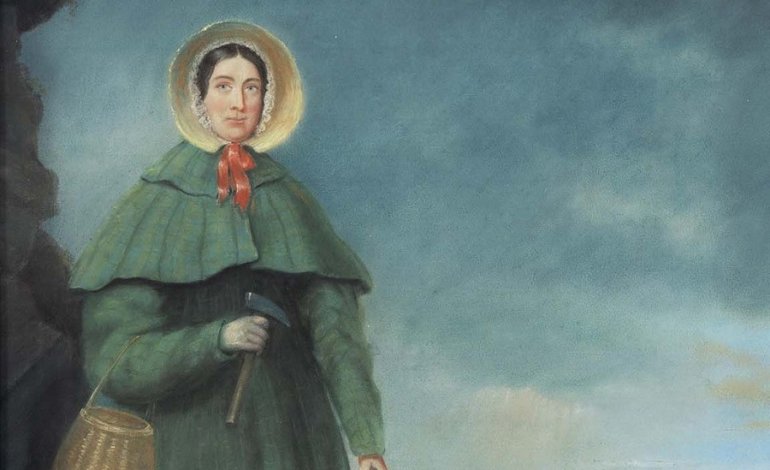
Mary Anning

Lyme Regis is an almost obnoxiously gorgeous town in Dorset in the west of England, perched atop the cliffs of the world-heritage listed Jurassic Coast. Thanks to a campaign set off by a local 10-year-old girl and her mother, the people of this town is raising funds to erect a statue to their famous citizen Mary Anning. As an expert on paleontology, I think this is a brilliant idea.

Mary Anning was born in 1799. Her family was poor – and somewhat tragic. She was named after an older sister who had died in a fire. Her father died when she was barely a teenager, leaving her family dependent on selling Lyme Regis’ abundant ammonitesbelamnites and other fossils to tourists. Fossils became the family business – and Mary was the sharpest fossil spotter.

The work was often dangerous: the Jurassic coast’s cliffs are treacherous (Mary’s dog was killed in a mudslide while prospecting). Still in her early 20s, Anning became a legendary fossil hunter. She found the first complete plesiosaur fossil, the first British pterosaur and figured out that coprolites were fossilised dung. In Lyme Regis, she and her family opened “Anning’s fossil depot”, where her fossils were purchased for collections in the United States and Europe.

Many of the great geological luminaries of the day bought her fossils and went fossil hunting with her. Her knowledge of fossil anatomy was obvious to those “in the know” and she became something of a local celebrity. Lady Harriet Silvester marvelled that “this poor, ignorant girl” could have “arrived to that degree of knowledge as to be in the habit of writing and talking with professors and other clever men on the subject, and they all acknowledge that she understands more of the science than anyone else in this kingdom”.

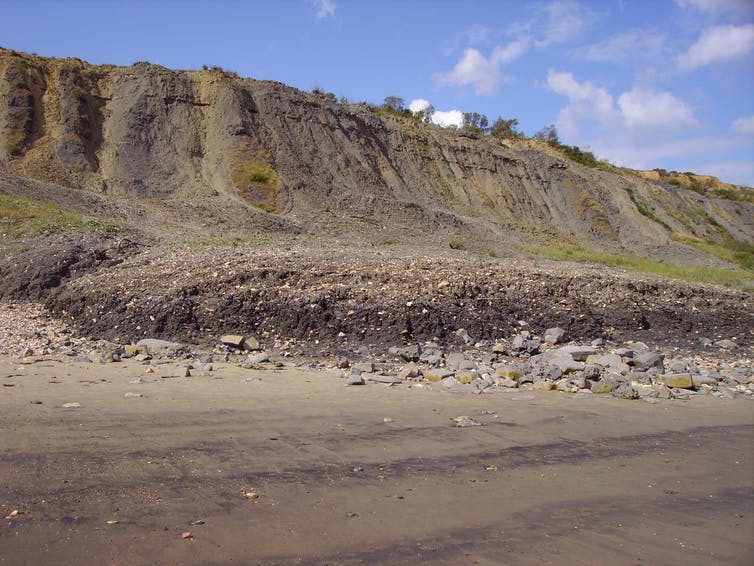
Landslip near Lyme Regis. Ballista/wikipedia, CC BY-SA

The picture we get of Anning’s personality is of someone who knows what they’re talking about and doesn’t mind letting you know. As the Scottish mineralogist Thomas Allen noted: “Mary Anning’s knowledge of the subject is quite surprising – she is perfectly acquainted with the anatomy of her subjects, and her account of her disputes with Buckland, whose anatomical science she holds in great contempt, was quite amusing”.

The Reverend Buckland was an Oxfordian giant of geology and he and Anning often worked closely together, particularly on coprolites. Gideon Mantell, the discoverer of the Iguanadon described Anning (in rather misogynistic terms) as a “geological lioness … in a little dirty shop, with hundreds of specimens piled around her in the greatest disorder. She, the presiding Deity, [proved] a prim, pedantic vinegar looking, thin female; shrewd, and rather satirical in her conversation.”

Anning, then, was a major contributor to the sciences of geology and paleontology, just as they were gathering steam – becoming established in museums and gaining worldwide interest. Historian Hugh Torrens, in his 1995 presidential address about Anning for the British Society for the History of Science, chose the epithet the “greatest fossilist the world has known” for the title of his talk. So why is Anning only now getting a statue? Why did she not have a more prominent place in the history of science? There are a number of explanations.

Sexism and classism

The most obvious answer is Anning’s gender. In Anning’s time, science was very much a male domain. Even today only 35% of those enrolled in STEM disciplines and only 28% of the world’s researchers are women. Most contemporary descriptions of Anning expressed surprised that a woman could be so knowledgeable, often with the implication that such knowledge in the “fairer sex” is threatening.

Another factor was class. Science wasn’t simply the domain of men, but gentlemen. As the artist and geologist Henry De la Beche wrote in Anning’s death notice, she was “not placed among even the easier classes of society, but who had to earn her daily bread by her labour”. Anning’s research was intimately tied to how she made a living. To the Victorian mind, such reliance was rather distasteful and sullied the pure search for knowledge.

The fact that Anning – despite the fact that she made her living from finding and classifying fossils – was classed as an amateur is a third explanation (she lacked education). Her class and gender denied membership (or even attendance) to the Geological Society. One of the myths about Anning throughout the 19th and 20th centuries was the idea that she was barely literate: a kind of lower-class fossil prodigy who had little real input into the science of paleontology.

Anning was rarely thanked in academic publications – or even credited for her discoveries. Careful work by historians tracking down the many letters between Anning and prominent geologists revealed not only Anning’s knowledge of fossils, but also of the debates around the long-lost worlds those fossils revealed. Considering the prominent role of amateurs as “citizen scientists” in paleontology today, Anning’s example is telling.

Big scientific ideas

Another reason that Anning had little impact during her lifetime and beyond is a bias for grand scientific theories. Scientists who are considered great and heroic – think Charles Darwin or Isaac Newton – all built systematic theories about how the universe worked. Anning, by contrast, collected fossils and prepared them for display (although we now know she influenced the debate as well).

Cast of Plesiosaurus macrocephalus found by Mary Anning in 1830. Muséum national d'histoire naturelle, Paris/wikipedia, CC BY-SA

However, Darwin similarly depended on careful breeding experiments and natural observations, while Newton relied on an enormous network of traders, explorers and astronomers to collect the experimental data underlying his work. Anning was a remarkably skilled, knowledgeable field worker and fossil preparator. The science of field work, fossil preparation and so forth – often invisible – is necessary and important in itself.

Anning died of breast cancer in 1847 after a rough decade. In the late 1830s, fossil hunting became more difficult and her last sale to the British Museum is recorded in 1840. She was not forgotten by the geological community who had so benefited from her discoveries though. They helped grant her a £25 annuity in 1838.

The philosopher Derek Turner has mused about how the history of palaeontology might have been different if Anning was given the recognition and support she deserved: “What theoretical contributions might she have made? And how might our popular images of the fossil hunter have developed differently? Would we think differently about commercial fossil collecting? Would women be better represented and more visible in palaeontology today?”

A statue to Mary Anning doesn’t simply commemorate her remarkable achievements – achievements made despite considerable bias – but what she could have achieved had she lived in a world without that bias.

Source: http://theconversation.com

Pages