Blogs

How Are Dinosaurs Named?

Saturday, November 17, 2018

Dinosaurs around the world.

New species get identified and named every year, even though you've probably never heard of them.

From Tyrannosaurus rex to Stegosaurus, some dinosaurs are household names. But have you ever heard of Lingwulong shenqi or Caihong juji? If not, it’s probably because these two dinosaurs were discovered in recent years, and their names are in Mandarin.

Dinosaurs are named by the person who discovers the creature, says Mark Norell, a paleontologist who studies fossils at the American Museum of Natural History. The New York museum is home of the world’s largest collection of dinosaur remains.

“The first person to describe a new dinosaur or any animal, plant, fungi species gets to name it anything they want,” Norell says.

Though dinosaurs—a group of reptiles that once lived on and dominated Earth starting around 245 million years ago—mostly went extinct about 66 million years ago, scientists have learned a lot about these creatures through fossils. Fossils are imprints left behind on rocks.

And as scientists find these fossils, they give them names so that they can be identified across all future research. Dinosaur names must abide by the International Code of Zoological Nomenclature, a general set of rules that governs scientific names for all organisms, but there are no major rules as to what their names have to be.

Dinosaurs are often named for their appearance or characteristics, but sometimes also after the scientist who discovered the dinosaur, a place, or a mythical animal.

In the 19th century, the early days of dinosaur discovery, dinosaurs were named by Americans and Europeans using Greek or Latin roots to describe them vividly, Norell says.

In 1841, Sir Richard Owen, an English biologist and paleontologist, came up with the name “dinosaur” to describe the extinct reptile fossils. The name comes from the Greek words “deinos,” meaning terrible, and “sauros,” meaning lizard.

Micropachycephalosaurus, which has a dome-shaped head, means "little thick-headed lizard." And the best known of them all, Tyrannosaurus rex, was discovered in South Dakota in 1892. The name means tyrant lizard king. Maiasaura, on the other hand, means "good mother.” It got its name when the researcher who found it, Jack Horner, found evidence that the dinosaur would chew up plants to feed its newly hatched babies who couldn’t leave their nest.

But nowadays dinosaur names are much more multicultural since excavations happen all around the world. Now, names are often in local dialects to represent the place where they’re found, Norell says.

For example, in 2004, Norell excavated a small dinosaur in northern China. The dinosaur fossil was discovered in a birdlike sleeping pose, and this gave way to the name Mei Long, a Mandarin name that translates to “soundly sleeping dragon.”

What’s interesting, Norell says, is that new species are being found all the time. About 1,200 extinct dinosaurs have been discovered and named throughout history, and about 50 new dinosaurs are named each year.

Source: www.popsci.com

The Engineering Work of Ants Can Influence Paleoclimatic Studies

Saturday, November 17, 2018

Ant architects: How do ants construct their nests?


The paleontological site of Somosaguas (Madrid) hosts a large colony of ants of the species Messor barbarus. A study  has now revealed that the daily activity of these insects modifies soil composition and therefore influences the results obtained in paleoclimatic studies. The researchers also found that the ants transport fossils.

Ants of the species Messor barbarus modify the grain size and mineralogical composition of the soils they inhabit, influencing the results obtained in palaeoclimatic and palaeoenvironmental studies, according to research conducted by the Complutense University of Madrid (UCM), the National Museum of Natural Sciences (MNCN), the Institute of Geosciences (CSIC, UCM) and the Doñana Biological Station (CSIC).

"Innumerable studies over the past decades have shown that ants and other arthropods that act on the soil are authentic engineers and constantly modify their environment. In our study, we found that intensive action in a given area could affect petrological studies aimed at inferring palaeoclimates," explained Omid Fesharaki, a researcher in the Department of Geodynamics, Stratigraphy and Palaeontology at the Complutense University of Madrid and one of the authors of the study, published in Catena.

Studies of past climatic conditions on Earth may be based on analyses of mineral typologies and proportions in sediments of a given age, because mineral associations largely depend on the stability of these, and therefore, on climatic characteristics such as temperature or the rate of precipitation.

Preferential selection by ants can alter these mineral associations and therefore distort the data obtained in palaeoclimatic studies. Consequently, when performing this type of climatic inference, it is important to take into account the bioturbatory action of ants or other insects.

The study, carried out at the palaeontological site of Somosaguas (Madrid), shows for the first time that these insects also transport fossil remains, paving the way for the use of this activity as a palaeontological prospecting technique to define fossiliferous sites.

"It's a relatively cheap and easy technique which consists of studying ant nests under a magnifying glass or sifting them to find fossils in microvertebrate deposits or with slivers of macrovertebrate remains," Fesharaki continued.

How ants select grains of soil

Another of the findings concerns the grains of soil transported. Previous studies have reported that ants select the sizes that most interest them for their constructions, but in the present study, the researchers also describe how they do this.

They found that this species of ant selects medium-sized rather than smaller or larger grains of soil, and prefers quartz over feldspar, probably in response to the criteria of mechanical stability and ease of transport.

"This may be because in their engineering work, they are capable of identifying which soil grain sizes and mineral compositions will endow greater stability to the structures they build, and therefore they discard the rest and remove it from the nest," speculated Fesharaki.

The techniques employed in this study included petrographic counts under a microscope to compare the mineralogical composition of modified sediments in ant nests with that of sediments that had not been modified by these insects, sifting or observation under a magnifying glass of fossil remains and analyses of soil grain size in nests for comparison with previous data.


Story Source:

Materials provided by Universidad Complutense de MadridNote: Content may be edited for style and length.


Journal Reference:

  1. David Martín-Perea, Omid Fesharaki, M. Soledad Domingo, Sara Gamboa, Manuel Hernández Fernández. Messor barbarus ants as soil bioturbators: Implications for granulometry, mineralogical composition and fossil remains extraction in Somosaguas site (Madrid basin, Spain)CATENA, 2019; 172: 664 DOI: 10.1016/j.catena.2018.09.018

Source: www.sciencedaily.com

A Historic Find: UO Scientists Discover First Oregon Dinosaur Fossil

Saturday, November 17, 2018

A reconstruction of what the ornithopod, whose fossilized toe bone was discovered by a University of Oregon earth sciences professor, may have looked like during the Cretaceous era more than 100 million years ago. [Courtesy of the University of Oregon Museum of National and Cultural History]

Greg Retallack’s four-decade paleontology career has turned up fossilized plants and ancient soils from North America to Africa and Australia to Antarctica.

But it was a 2015 trip to the tiny town of Mitchell, near Eastern Oregon’s Painted Hills, that turned up perhaps his most interesting find of all: the fossilized toe bone of a dinosaur.

Museums across the country are full of fossilized bones and reconstructed dinosaur skeletons. But the title of a research paper Retallack and other University of Oregon researchers co-authored about the find, published last week in the Journal of Vertebrate Paleontology, highlights its significance: “First dinosaur (Ornithopoda) from early Cretaceous (Albian) of Oregon, U.S.A.”

In other words, no one had found a confirmed fossilized dinosaur bone in Oregon before the discovery by Retallack, a UO earth sciences professor, plant and soil researcher and expert on evolutionary transitions.

It is believed to belong to an ornithopod, a plant-eating dinosaur thought to have lived about 103 million years ago during the Cretaceous Period, the same period in which the Tyrannosaurus rex lived. It is believed to have weighed about a ton and spanned more than 20 feet in length.

“This bone was sitting out there with all the rocks. It was pretty surprising,” Retallack said this week. “No excavation was needed. It was just sitting among the ammonites and coil fossils.”

Just an inch long and less than two inches wide, the earth-toned fossil isn’t much to look at. But Retallack sensed almost instantly that he had found something significant on that summer 2015 dig in Eastern Oregon.

When he found the toe bone, he was on U.S. Bureau of Land Management property below a series of fossil-rich cliffs known as the Hudspeth Formation, an area known for turning up fossils of reptile and dolphin ancestors.

“It was in a marine rock. That is not where you would expect to find dinosaurs,” Retallack said. “We have seen from these same rocks pterosaur bones and a plesiosaur (flying and marine reptiles, respectively). That’s been known for some time. But dinosaurs have been missing until now.”

Still, confirming the discovery required three years of follow-up research and writing by Retallack and fellow UO researchers, including Edward Davis, Paleontological Collection manager at the UO Museum of National and Cultural History; Samantha Hopkins, the museum’s curator of paleontology; and UO doctoral student Paul Barrett, as well as Jessica Theodor, a biological sciences professor at the University of Calgary who was working at the UO on a research sabbatical at the time.

Retallack’s expertise is in plants and soil. So it was his fellow researchers who almost instantly confirmed Retallack’s suspicion when he returned from the dig.

“We looked at it and said, ‘Oh yeah. This is an ornithopod toe bone,’” Hopkins said. “Given the time period when it came from and the morphology, that’s the only thing it could have been.”

Retallack and Davis returned to the site the following spring to more thoroughly document the find, along with a BLM official.

Then Retallack started visiting museums from Montana to Alaska and Canada, examining fossilized dinosaur collections to weigh their characteristics against his find.

“That was really great, I could get a really good idea about what (the bone) was and what it wasn’t,” he said.

Meanwhile, Retallack and the other researchers began writing up the discovery into a research paper for submission to an academic journal. The work was completed in October 2017, and underwent a yearlong peer review process.

Finally, last month, the Journal of Vertebrate Paleontology published the report, declaring that the fossil toe bone was “the first diagnostic nonavian dinosaur fossil from Oregon, a state whose Mesozoic rocks are mostly marine. This discovery is novel evidence of Cretaceous terrestrial environments and faunas in Oregon.”

The discovery has thrown into doubt the long-held thought that dinosaur fossils wouldn’t be found in Oregon, since much of the land that makes up the state today was submerged under water during the Cretaceous era.

“It was a long process,” Davis said. “We hadn’t had a case like this before.” The most likely scenario, he said, is that the ornithopod died on the shore, washed out to sea and burst after filling up with decomposition gasses. The toe bone fossilized over millions of years.

The bone is expected to be placed in the UO Museum of National and Cultural History’s new acquisitions case in the next month, Davis said. And it’s likely to play a role in an upcoming “Explore Oregon” exhibit early next year about, ironically, the lack of dinosaur fossils in Oregon, Davis said.

Retallack said he’s not sure if the discovery will lead to any more dinosaur fossils in Eastern Oregon. But he said he’s already made another discovery that has caught his attention, though he wouldn’t provide any details.

“Things come out of the woodwork when you make a discovery like this,” Retallack said. “That’s what we do, and what’s great about science.”

Source: www.registerguard.com

Preserved Eggs Reveal How Dinosaurs Raised Their Juveniles

Friday, November 16, 2018

Image Credit: Marco Foto/Shutterstock

“And therefore think him as a serpent’s egg,

Which, hatch’d, would as his kind grow mischievous,

And kill him in the shell.”

-Brutus, in Julius Caesar by William Shakespeare

Lucky for us, mischievous or not, plenty of dinosaurs were, like the titular emperor of Shakespeare’s play, killed in the shell. Natural disasters such as floods and landslides have preserved dinosaur eggs, including entire nests, on every continent but Australia and Antarctica. China in particular, followed by France, India, Argentina, and Montana in the United States, have proven to be particularly rich sites of discovery. The crushed shells of these ancient eggs have given us what we know about dinosaur reproduction and how—or if—they reared their young.

It is often misstated that the first dinosaur eggs were discovered in 1923 during an expedition by the American Museum of Natural History to the evocatively named Flaming Cliffs in the Gobi Desert of southern Mongolia. This expedition, funded by titans of industry including J.P. Morgan and John D. Rockefeller, did indeed unearth some remarkable dinosaur eggs, now attributed to the theropod Oviraptor. But, in fact, eggs had been discovered as early as 1859 in the French Pyrenees, though they were not identified as belonging to dinosaurs at the time. And other eggs had been discovered near Marseilles, France in 1900, and in Montana in 1913.

Intriguingly, the 1923 discovery included an array of Neolithic jewelry made of dinosaur egg shell fragments, indicating that our primitive ancestors had stumbled upon these ancient ova as well. Since that time, more than 200 hundred sites have been identified worldwide, most of them from the Late Cretaceous, near the end of the age of the dinosaurs. In a disappointing turn for Michael Crichton fans, only an armful of Jurassic-era eggs have yet been discovered.

Nonetheless, we have been able to extrapolate huge amounts of data from the late-era dinosaur nests that have been found. We have some idea of which dinosaurs exhibited parental care, for one. Ornithischian and sauropod dinosaurs appear to have nested in a style more similar to that of modern crocodilians than to that of birds, our living dinosaurs. Large numbers of eggs were deposited in depressions in the ground and buried. Their buried state can be discerned through shell analysis. More porous eggs are more likely to have been buried because they require humidity, as in a covered nest.

The quantities of eggs found in many such nests, and their disorganized arrangement, suggests that these dinosaurs, possessed paired oviducts as crocodilians do. This meant that they produced the entire clutch before it was laid all at once. The egg shell structure of these dinosaurs is also more similar to that of crocodilian eggs than those of birds. It can be inferred, then, that like crocodilians, ornithischians and sauropods exhibited minimal brooding behavior and may have had little or nothing to do with raising the young. Some hadrosaur eggs, though, have been found in dish-like structures and the unossified bones of the hatchlings found to resemble those of altricial birds, which require parental care. In many other species, the size of adults compared to that of the hatchlings might have made such care prohibitive. Imagine a 65-ton titanosaur bending down to feed a chick the size of a goose.

Image Credit: Marco Foto/Shutterstock

So, too, the time it took the eggs to hatch supports a theory of limited parenting. One study demonstrated that two ornithischians, Protoceratops and Hypacrosaurus, may have take six months or more to hatch, meaning that their parents would have needed to remain sedentary for half the year or more, thought to be unlikely due to seasonal migrations. Another study found that a large titanosaur from Argentina buried its eggs near hydrothermal vents in order to take advantage of their heat, obviating the need for incubation by the parent. Leaving your eggs in the care of the elements had its risks, though—some sauropod nests in India have been discovered with fossilized snakes coiled atop them.

Unlike their cousins, theropod dinosaurs, from which birds are descended, do appear to have exhibited parental care in many cases. Theropod fossils represent both extremes in the size of known dinosaur eggs, with some from Thailand as small as those of a modern-day goldfinch and others from China topping out at two feet long. These eggs, which possess smaller pores, appear to have only been partially buried in soil, suggesting that they were actively incubated.

Tantalizingly, it appears to be this transition to greater exposure that led to the evolution of colored eggs, a trait that persists in many birds today. Greater exposure meant the need for camouflage. Buried eggs, both in dinosaurs and modern reptiles, are always white. The arrangement of the eggs, too, is an indication that the nest was managed by a parent. While some primitive theropod nests exhibit the scattered egg formation more typical of ornithischians, others, notably oviraptorids and troodontids, produced nests in which the eggs are arranged in a circular patterns, a sign that an adult sat in the middle and kept them warm. In fact, several fossils have been found that preserve the parent in situ, likely after it was buried in a flood or landslide. This is the origin of the name “oviraptor” which means “egg thief” in Latin; when first discovered, the adult on the nest was believed to be a predator rather than a parent.

Because these parents did not move in time to avoid whatever catastrophe buried them, it has been hypothesized that, like the modern day emu, the father brooded the eggs in a lethargic state, eating and drinking little until his charges emerged. The paternal care theory is further supported by the large clutch sizes in such nests, which may have been the result of a polygamous mating system in which multiple females laid their eggs in the same nest.

A fossil of another theropod species, Sinosauropteryxwas found with two eggs inside of it, demonstrating that some theropods retained two oviducts, as compared to the one in the birds of today. This fact, in conjunction with the asymmetrical shape of the egg, shows that they produced two eggs at a time, rather than in rapid succession, like crocodiles and likely more-primitive dinosaurs. Thus, an entire clutch might take a week or more to lay, as is the case for modern avians who produce large clutches.

And so the continuum between our modern dinosaurs and their fossilized ancestors is reinforced, an ever-denser mosaic of bones, feathers, and eggshells.

By Earth.com

Dinosaurs the Size of Sparrows Once Roamed South Korea

Saturday, November 17, 2018

Dromaeosaur iformipes rarus. Photo credit: University of Queensland

Dinosaur tracks uncovered in South Korea have been identified as belonging to sparrow-sized dinosaur raptors, marking the smallest prints of their kind, according to latest Australian-linked research.

"These 110-million-year-old footprints and trackways were made by carnivorous dinosaurs commonly known as raptors," University of Queensland researcher Dr Anthony Romilio, who was part of an international team of paleontologists behind the discovery, said in a statement on Friday.

"These new tracks are just one centimeter in length, which means the dinosaur that made them was an animal you could have easily held in your hand. They are the world's smallest dinosaur tracks." Anthony said.

According to the statement, to estimate the size of the dinosaur, Anthony's team measured the length of the fossil footprints and multiplied the value by 4.5 to get an approximate hip height. The team's findings were published in online scientific journal Scientific Reports.

The tracks were first spotted by Professor Kyung Soo Kim from South Korea's Chinju National University of Education.

The Cretaceous lake deposits at the discovery site created ideal conditions that allowed for the preservation of tiny footprints rarely found elsewhere, the professor said.

"In addition to tiny dinosaur tracks, we have footprints made by birds, pterosaurs, lizards, turtles, mammals and even frogs," he said.

"We have named these small tracks Dromaeosaur iformipes rarus, which means rare footprints made by a member of the raptor family known as dromaeosaurs," he added.

Source: www.xinhuanet.com

Inside the Illegal and Unethical World of Owning Dinosaur Bones

Thursday, November 15, 2018

Stock footage of a large carnivorous dinosaur skeleton (Getty)

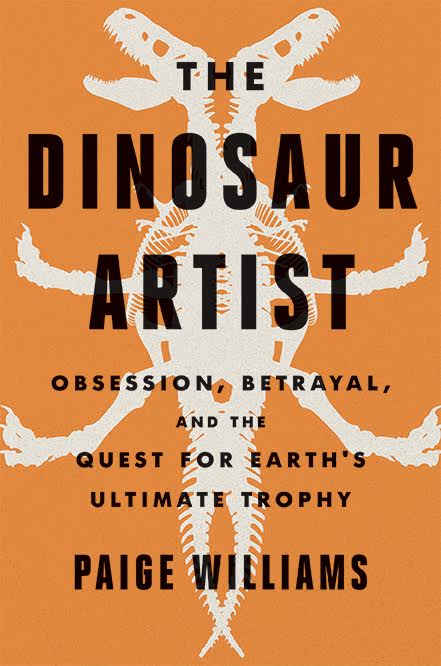
Q&A with Paige Williams, reporter and author of the new book, “The Dinosaur Artist.”

Dinosaurs are one of the great human connectors—this much is clear in Paige Williams’ recently published book, The Dinosaur ArtistFrom the time we are children, we marvel over dinosaur skeletons and teeth, imagining an Earth dominated by lizards as tall and as long as skyscrapers. Our planet’s oceans hold secrets too, of gargantuan prehistoric sharks and crocodiles that could decimate an apartment complex in a few bites. But perhaps most fascinating is that, for all of their mass and might, these titanic reptiles were wiped out 66 million years ago after an asteroid slammed into Earth, setting off a chain reaction of catastrophes that wiped out their population across the globe.

If they couldn’t stand a chance, how can we? And do their secrets have anything to tell us, so that we may avoid a similar fate should another asteroid come for us?

The Dinosaur Artist peers into the human curiosity that hangs on that question—as well as the lengths and laws we’re willing to travel and break in our journey. Specifically, it looks at what is perhaps one of the strangest court cases in history: United States v. One Tyrannosaurus Bataar Skeleton. The case centered on said Tyrannosaurus skeleton, which was illegally imported to the United States from Mongolia. According to Mongolian Constitution, all dinosaur fossils by law belong to the country’s people—but that didn’t matter to fossil hunter Eric Prokopi, who attempted to sell the skeleton for more than $1 million. Prokopi, who had curated private collections for the likes of actors Nicolas Cage and Leonardo DiCaprio, was ultimately jailed for 3 months and gave up all claims to this skeleton, as well as others he was charged for illegally possessing.

RealClearLife recently caught up with Williams for a Q&A to talk about this bizarre case as well as who should be allowed to own fossils, why it’s important, and what secrets they may hold for humanity at large.

The Dinosaur Artist (Courtesy of Paige Williams)

RealClearLife: Do you think the public deserves more of a say in how fossils are excavated, and where they end up (e.g., scientists v. fossil hunters, private collections v. museums)?

Paige Williams: There’s a strong argument for leaving science in the hands of scientists, and for developing a system that better safeguards the only remaining evidence of the planet’s history. There’s also an argument for enlisting non-science professionals, many of whom are field experts, in the careful cultivation of paleontological resources. The latter would say that part of what motivates them is the notion that careful hunters should gather available fossils instead of letting them weather out, at which point they’re no good to anyone—there simply aren’t enough paleontologists to pick up or excavate everything that’s out there. The public has always played a vital role in paleontology (unlike in other scientific disciplines) because without the casual hunter, or the hobbyist, or the commercial hunter, the science might not exist. Natural history museums certainly would not exist. Any good paleontologist would acknowledge that the science needs eyes out there, all over the world, looking for the fossil remains of life on Earth.

RCL: What’s your favorite dinosaur?

PW: I mean obviously Tarbosaurus bataar, followed closely by its North American cousin, T. rex. How clichéd is that? Despite the theories about scavenging, it would be hard to convince me that rex—or any animal with foot-long teeth—wasn’t an apex predator.

RCL: If private fossils hunters were eliminated, what do you think the impact would be on new discoveries made?

PW: More eyes on the ground means more finds. Without a global community of fossil hunters, the fossil record would without question contain far fewer species. It was “amateurs” who made some of the greatest and most pivotal finds. Without the non-scientist hunter, we’d know far less about the planet’s history than we do, including when and where certain creatures lived, and how they behaved, and when and why they went extinct. Before the word science ever existed, natural philosophers were walking around, picking up strange objects, and wondering what forces of the universe had created them. If fossil lovers weren’t allowed to be curious, and to contribute to the fossil record, we as a society would be far the poorer in our understanding of everything from geology to evolution to climate change.

RCL: What are the dangers of allowing private fossil hunting to continue?

PW: Paleontologists worry most that potentially important scientific specimens, the ones that might unlock theories about, say, prehistoric environments or animal growth patterns, will be destroyed by careless hunters or disappear into private collections, never to be studied. A great many private or commercial fossil hunters care deeply about the specimens they collect—the best of them collect data in the same way that paleontologists do. It’s the poachers—the venal, destructive lawbreakers—that worry the scientists and the honorable commercial hunters alike.

RCL: Why are people paying so much money for fossils?

PW: Because they can?

RCL: In your research, did you find that it’s more of a Western thing that we believe that we’re entitled to fossils (the finders-keepers mentality, as well as the collecting of fossils)?

PW: The finders-keepers idea plays out uniquely in the United States. No other country allows hunters to keep whatever dinosaur bones and teeth (or other fossils) they find on their own property, or on land where they have permission to collect. Public lands are off limits—it’s illegal to collect most fossils on federal property, such as the national parks. The concept of finders keepers seems to have appeal around the world, though.

Commercial hunters like to argue that the Earth belongs to everyone, and therefore that they should be allowed to hunt fossils without restriction, whether dinosaurs or dragonflies. It’s a convenient and faulty construct, as is one particular legal notion that surfaced during the federal T. bataar case involving the subject of my book: that countries cannot legislate natural resources that predate borders and laws. As one of the sources in my book puts it, “That’s like saying the Saudis aren’t entitled to their oil.”

RCL: Can it be quantified what is lost when fossil hunters excavate without using a scientific method (i.e., contextual data that could help understand a changing climate)?

PW: Hunters who yank fossils out of the ground do a grave disservice to science because they destroy information that provides clues to the history of life on Earth. Rogue excavations have been compared to removing a homicide victim from a crime scene without logging the kind of data that might help an investigator solve the case.

In the case of fossil dinosaurs those questions would include: Where and when and under what circumstances were the bones found? How deep? Which bones were present? In what pattern? If there’s a skeleton, was it intact? Was other fossil evidence present, like other animals? How about plants? Were there bite marks? Evidence of bone breaks? Hints about offspring? Hints about weather? The data surrounding a fossil are numerous and altogether vital to understanding life and its place—and, in turn, our place—in the planet’s history. And the window of opportunity is finite: Once a fossil is out of the ground, there’s no going back and recreating that all-important opportunity to capture the facts as they existed at the time of discovery. When the work isn’t done right, the loss is unquantifiable.

RCL: Can you talk a little bit about the positives and negatives of Jurassic Park as this iconic cultural touchstone. Has it inspired people? Has it encouraged more collecting? How has it affected prices of dinosaur fossils?

PW: It isn’t a stretch to say that Jurassic Park stoked people’s interest in these fascinating animals. It’s been said that the film did for dinosaurs what Jaws did for sharks. To what extent that global interest benefits science: good question. What we do know is that dinosaurs are what Kirk Johnson, the paleobotanist who leads the Smithsonian’s National Museum of Natural History, calls a gateway. He once told me, “Dinosaurs are the gateway to science, which is the gateway to technology, which is the gateway to the future. I can make a case that paleontology is as significant as anything in this world because of its ability to get kids into science.”

RCL: What do you think is the major takeaway for affluent collectors who want to ethically acquire fossils? Is that even possible to do?

PW: The paleontologists who most despise the commercial fossil-hunting world and who truly believe the trade endangers science would say that it’s straight up unethical to collect fossil vertebrates like dinosaurs. They can abide the collection and sale of, say, ubiquitous materials like shark teeth; but it horrifies them to see the trafficking of bones. A collector can avoid feeding the black market in particular in a couple of ways: one, do the homework; two, don’t buy dubious fossils. Any paleontologist or legitimate dealer would be happy to explain how to self-educate, and how to collect with integrity.

RCL: Anything you think a prospective reader should know before delving into your book?

PW: It’s a story with multiple threads: science, history, the history of science, craftsmanship, class warfare, post-Civil War industrialization, black markets borne of major shifts in global politics. Oddly enough, all those threads came together in the story of this one Gobi Desert dinosaur—a story that likely never would’ve come to light if the skeleton hadn’t sold at auction, in New York, for over $1 million. Dinosaurs always appeared to be time capsules; I had no idea.

Find The Dinosaur Artist at Amazon.

Source: www.realclearlife.com

New Research Offers Detail and Insight Into Deep-Time Evolution of Animal Life on Islands

Thursday, November 15, 2018

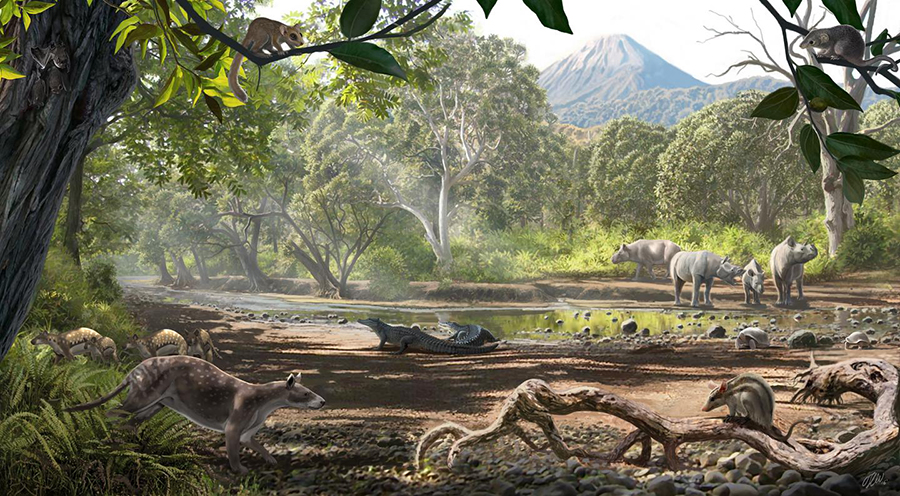
A reconstruction of the Eocene of Turkey, where the small marsupial was found. Besides the marsupials, the fauna includes embrithopods (the rhino-like animals of the background, more related to elephants and sea cows), pleuraspidotheriids (primitive ungulates with a deer/dog look), a group of primates called omomyids, bats, tortoises and crocodiles. CREDIT: OSCAR SANISIDRO | UNIVERSITY OF KANSAS

Islands have been vital laboratories for advancing evolutionary theory since the pioneering work of Charles Darwin and Alfred Russel Wallace in the 19th century.

Now, a new paper appearing in PLOS ONE from an international team of investigators describes two new fossil relatives of marsupials that shed light on how a unique island ecosystem evolved some 43 million years ago during the Eocene.

"Evolution in many ways is easier to study in an island context than on a large continent like North America because it's a simpler ecosystem," said coauthor K. Christopher Beard, Distinguished Foundation Professor of Ecology and Evolutionary Biology at the University of Kansas and senior curator with KU's Biodiversity Institute and Natural History Museum. "Evolutionary biologists have been focusing on islands ever since Darwin and Wallace independently formulated their ideas about evolution based on their observations of plants and animals living on the Galapagos and the Malay archipelago, which is modern Indonesia."

However, Beard said a poor fossil record for animals living on islands through "deep time," or across a multimillion-year time frame, has hampered our understanding of exactly how island ecosystems are assembled. The new paper describes two new fossil species, identified from their teeth, that inhabited the Pontide region of modern-day north-central Turkey.

During the Eocene the Pontide region was an island in a larger version of the modern Mediterranean Sea called Tethys. At that time, Africa and Eurasia were not connected as they are today in the Middle East, but Africa was drifting northward due to plate tectonics and would eventually collide with Eurasia millions of years later. The Pontide region was sandwiched between these converging continents. This geological setting makes the Pontide region similar to the island of Sulawesi in the Indonesian archipelago, which is similarly sandwiched between the converging continents of Asia and Australia.

"No other ecosystem on the face of the planet from any time period matches what we're finding in the Eocene of Turkey -- it's a completely unique mammalian ecosystem much like Madagascar is today," he said. "But how did this island biota develop over time? You need fossils and time depth to see that. We're able here to study in great detail how this ancient island evolved -- where the different animals came from, how they got there and when they got there. Once they got there, some of these mammals, including one of the new marsupial lineages we've discovered, were able to diversify on the island. Most of the Eocene mammals on the Pontide island seem to have gotten there by swimming or rafting across parts of the Tethys Sea, instead of getting stranded on the island when it got separated from adjacent parts of Eurasia."

Beard's collaborators in the research were Grégoire Métais of the Museum national d'Histoire naturelle in Paris, John R. Kappelman of the University of Texas, Alexis Licht of the University of Washington, Faruk Ocakog?lu of Eskis?ehir Osmangazi University in Turkey, and KU's Pauline M.C. Coster and Michael H. Taylor.

In the Pontide marsupial fossils -- which have no living descendants -- the team found evidence that distinctive forms of life that develop on islands are ill-fated in general, given enough time.

"One thing we know for sure is that the incredibly interesting and unique Eocene biota that occurred on this island in what is now Turkey at some point was totally eradicated," Beard said. "It was eradicated when the island was reconnected to mainland Eurasia and more cosmopolitan animals were able to access it for the first time, driving the weird island biota to extinction. The message for conservation biology today is that island ecosystems are inherently ephemeral on the grand scale of macroevolutionary time. Today, conservation biologists are concerned about many endangered taxa on islands. The ugly truth that paleontology provides is that, given enough time, most island faunas are doomed to extinction. They're cul-de-sacs of evolution -- even though they're wonderful places to study processes of evolution."

Beard said the two newly described fossil marsupials -- Galatiadelphys minor and Orhaniyeia nauta -- lived near the top of the food chain on the Pontide of the Eocene, because mammalian carnivores were unable to reach the small island.

"One of weirdest things about the island fauna from the Pontides is that there are no true mammalian carnivores," he stated. "There was nothing related to cats, dogs, bears or weasels -- no modern mammalian predators. They couldn't get to the Pontide terrain because it was a little island. So, these marsupials ecologically are taking their place at the top of the food chain."

According to the KU researcher, the newly discovered fossils demonstrate geological context has a huge influence on how ecosystems are assembled on any given island.

"Current ideas about island evolution are based on some fairly simplistic, yet fairly effective, models," Beard stated. "These models propose that organisms colonize islands based on two main factors -- how big is the island and how far away is it from nearby continental landmasses? A bigger island makes a bigger target and hosts a greater diversity of habitats, making it easier for organisms to colonize the island and once they get there they have a better chance of surviving and maybe even diversifying."

Based on his team's findings from the Pontide region, Beard said that geological context was at least as important as an island's size or distance from colonizing animals' source territory.

"All men may have been created equal, but all islands were not. The geological context of the island -- here it's in a region of active tectonic convergence -- we think is swamping these other factors, size and distance to mainland," he said. "The oddest thing about the Pontide mammal fauna is that it contains a unique mixture of animals coming from Europe, Africa and Asia. Even our two new marsupials show different evolutionary roots in the north and the south. This makes sense because the Pontide island was being sandwiched between Eurasia and Africa, and animals were arriving there from multiple directions. We can make an interesting analogy with the modern island of Sulawesi in Indonesia, which like the Pontide terrain has a mixed fauna. It mainly hosts animals like tarsiers, pigs and shrews that are clearly related to Asian species, but you also have on Sulawesi species that are obviously related to mammals from New Guinea. If you look at plate tectonics today, Sulawesi is getting sandwiched between Australia and Asia in much the same way the Pontide was being sandwiched between Africa and Asia in the Eocene."

###

Beard recently returned from Turkey where he and his team conducted more fieldwork. This research was funded by multiple sources including a major grant from the US National Science Foundation.

Source: https://eurekalert.org

The Softer Side of Dinosaur Fossils

Wednesday, November 14, 2018

Usually, when a plant or animal becomes a part of the fossil record, it is a hard part of the organism that preserves. Dinosaur bones, petrified wood, fossil shells – these are all common fossils that represent the hardest parts of those animals and plants. Very little else is usually preserved.

However, in exceptional circumstances, exceptional fossilization can occur. One of the places that palaeontologists have been finding many exceptionally preserved fossils recently has been from the Jiufotang Formation of Liaoning Province, China.

Recently, researchers from China, including friend of the Philip J. Currie Dinosaur Museum Dr. Jingmai O’Connor, have described a fossil bird from 120 million years ago with fossilized lung tissue preserved in the specimen. The find was published in the scientific journal Proceedings of the National Academy of Sciences of the United States of America.

The bird is called Archaeorhynchus (meaning “ancient beak”), and it is one of the oldest fossil birds known with a toothless beak. Not only does this specimen preserve the remains of lung tissue, which look remarkably similar to modern bird lungs, but it also contains roughly 100 small stones that would have occupied a muscular gizzard. The soft tissue evidence in this specimen has brought to light many similarities to features in modern birds that would be unknown without the incredible preservation of the fossil. The lungs themselves were preserved as a whitish mineral of uncertain origin, but the preservation was so good that the microscopic tissue structure was preserved.

There are a lot of uncertainties around exactly how these soft tissues were preserved. But we are learning more and more about dinosaurs from exceptionally preserved fossils, in addition to what we have been able to determine solely from fossil bones. Every new fossil find reveals an exciting new mystery.

Source: www.dailyheraldtribune.com

Meet the New Dinosaur Bone Hunter at the Science Museum of Minnesota

Wednesday, November 14, 2018

The Science Museum of Minnesota has a new boneman. Alex Hastings is recently started work as the museum’s Fitzpatrick Chair of Paleontology. Here, Hastings talked about a Haplocanthosaurus skeletal fossil in the museum’s bone lab Tuesday. DAVID JOLES • STAR TRIBUNE

The Science Museum's new paleontologist really digs crocodiles and "Jurassic Park."

Alex Hastings studies beasts that sound like they come from monster movies: a crocodile agile enough to hunt horses, a snake as long as a school bus.

Happily, those creatures are long extinct, but Hastings can tell you all about them as the new expert on dinosaurs and fossils for the Science Museum of Minnesota.

Hastings, 35, is the St. Paul museum’s new Fitzpatrick Chair of Paleontology, taking over from Bruce Erickson, who recently retired after 58 years on the job.


Formerly the assistant curator of paleontology at the Virginia Museum of Natural History, the Vermont native moved to Minnesota with his wife, newborn son, three cats, two dogs, two lizards and a snake (the ball python, named Nagini, is much smaller than a school bus, but is still a substantial 3 ½ feet long).

A Ph.D. who likes comic books, Hastings is a specialist in prehistoric crocodiles and a fan of a certain movie about dinosaurs brought back to life through cloning.


Q: How long have you been interested in dinosaurs?

A: I’ve been on this path as long as I have memory, basically. It’s definitely my life’s passion. I was very much the little kid that was just enthralled by dinosaurs. And, basically, I just didn’t grow up. As long as I can remember, knowing that it was a possibility to pursue this as a career, I’ve been pursuing that.

Q: A lot of kids like dinosaurs. Any particular thing that kept you at it?

A: To be honest, the movie release of “Jurassic Park” in 1993. I was definitely very much geeked out on dinosaurs. I was pretty much on this career path anyway, but if I was ever going to waver, that movie just derailed any other possible notion of doing anything else.

Q: How did you get interested in prehistoric crocodiles?

A: They’re really amazing, fascinating animals. I can stare at them for hours and hours and hours. They are one of nature’s longest surviving groups. They have a record that goes over 240 million years.

When you go into that massive record, you find some really bizarre ones where they really branched out from this typical ambush predator in the water. I did my post-doc on a land hunting crocodile in Germany about 48 million years ago that was likely hunting down horses, which is just something we don’t have alive today.

Q: What was the biggest find you’ve been involved in as a paleontologist?

A: As a grad student, I was lucky enough to be one of the people who can claim at least partial discovery of Titanoboa, which is the largest snake that ever lived. It was about 42 feet long and weighed 1¼ tons and lived 60 million years ago in South America. It is a relative of the anacondas. It’s the biggest by far in terms of both length and mass.

Q: Did discovering the Titanoboa lead to other insights?

A: We worked out that the minimum temperature needed to keep a snake of that size alive — you’re looking at a temperature in the tropics that’s significantly higher than today. It’s very important for climate prediction and future models to understand how climate change will impact tropical environments.

At the time there had been a few ideas that the tropics would be relatively buffered from temperature increases globally, that it would affect temperate and polar regions dramatically, but not so dramatically in the tropics. This countered that entirely. You can absolutely turn up the thermostat in the tropics, and there’s absolutely every potential to do that in the future.

Q: So if it gets hotter, we’ll get bigger snakes in the tropics. Anything else?

A: Interestingly, heat affects where you can have big snakes. And there’s already records of the invasive Burmese pythons in Florida getting further and further north as time goes by. It’s not necessarily saying we will immediately get these massive snakes, but it lifts the bar on what’s possible.

Q: How many times have you been asked if “Jurassic Park” could really happen?”

A: I do get asked that a lot. Short answer is no. Fantastic movie. I absolutely loved it. Great science fiction.

The whole premise is being able to get dinosaur DNA from mosquitoes preserved in amber. Big problem with that is the second that dinosaur blood gets into the mosquito’s stomach, the digestive acids break up the DNA completely.

DNA degrades after about 50,000 years, and dinosaurs are millions and millions of years old. So the odds of getting any genetic information by any means are astonishingly low. In terms of cloning dinosaurs, I don’t see how that’s ever going to be possible. But it would be cool.

Q: So we’ll never see a velociraptor brought back to life?

A: What you do have, though, is DNA from the last ice age. If you wanted to start cloning ancient creatures, things like mammoths and saber tooth cats are much more in the realm of possibility. There are still all kinds of complications that go into that, but it’s something that — certainly not anytime soon, but maybe sometime long in the future — might actually be possible.

Q: What do you think of the de-extinction projects, being worked on by some scientists, which would use genetic engineering to devise creatures that would look and act like a passenger pigeon or a woolly mammoth or a dodo?

A: Basically you’re mutating something that exists into your perception of another thing. So what you’re creating is never going to be the same. You’re putting your own biases into it. You’re not really making a discovery in that sense.

When you’re cloning something, if it turns out it has feathers and you didn’t realize that, then that’s new information. If you’re trying to mutate a chicken into a T. rex or something, you’re going to be mutating it based on the things that you’ve seen in the bones, but you’re not creating a T. rex. You’re just creating a highly mutated chicken, basically. Which could still be cool and interesting to look at, but it’s not giving you a new discovery.

Q: Do you think it’s a good idea for someone to say, “Here’s passenger pigeon 2.0, a new version of this creature we killed off 100 years ago?”

A: Once you remove something from the ecosystem, it tends to find a new norm. More or less, you end up being unable to reset the clock. Once it’s done, it’s kind of done. If you want to make these new changes by bringing something back, realize you’re not going to get back to where you were before.

Source: www.startribune.com

Rare Fossil Bird Deepens Mystery of Avian Extinctions

Wednesday, November 14, 2018

Illustration depicting Mirace eatoni perched on a Utahceratops gettyi Illustration: Brian Engh

During the late Cretaceous period, more than 65 million years ago, birds belonging to hundreds of different species flitted around the dinosaurs and through the forests as abundantly as they flit about our woods and fields today.

But after the cataclysm that wiped out most of the dinosaurs, only one group of  remained: the ancestors of the birds we see today. Why did only one family survive the mass extinction?

A newly described fossil from one of those extinct bird groups, cousins of today's birds, deepens that mystery.

The 75-million-year-old fossil, from a bird about the size of a turkey vulture, is the most complete skeleton discovered in North America of what are called enantiornithines (pronounced en-an-tea-or'-neth-eens), or opposite birds. Discovered in the Grand Staircase-Escalante area of Utah in 1992 by University of California, Berkeley, paleontologist Howard Hutchison, the fossil lay relatively untouched in University of California Museum of Paleontology at Berkeley until doctoral student Jessie Atterholt learned about it in 2009 and asked to study it.

Atterholt and Hutchison collaborated with Jingmai O'Conner, the leading expert on enantiornithines, to perform a detailed analysis of the fossil. Based on their study, enantiornithines in the late Cretaceous were the aerodynamic equals of the ancestors of today's birds, able to fly strongly and agilely.

"We know that birds in the early Cretaceous, about 115 to 130 million years ago, were capable of flight but probably not as well adapted for it as ," said Atterholt, who is now an assistant professor and human anatomy instructor at the Western University of Health Sciences in Pomona, California. "What this new fossil shows is that enantiornithines, though totally separate from modern birds, evolved some of the same adaptations for highly refined, advanced flight styles."

The fossil's breast bone or sternum, where flight muscles attach, is more deeply keeled than other enantiornithines, implying a larger muscle and stronger flight more similar to modern birds. The wishbone is more V-shaped, like the wishbone of modern birds and unlike the U-shaped wishbone of earlier avians and their dinosaur ancestors. The wishbone or furcula is flexible and stores energy released during the wing stroke.

If enantiornithines in the late Cretaceous were just as advanced as modern birds, however, why did they die out with the dinosaurs while the ancestors of modern birds did not?

"This particular bird is about 75 million years old, about 10 million years before the die-off," Atterholt said. "One of the really interesting and mysterious things about enantiornithines is that we find them throughout the Cretaceous, for roughly 100 million years of existence, and they were very successful. We find their fossils on every continent, all over the world, and their fossils are very, very common, in a lot of areas more common than the group that led to modern birds. And yet modern birds survived the extinction while enantiornithines go extinct."

One recently proposed hypothesis argues that the enantiornithines were primarily forest dwellers, so that when forests went up in smoke after the asteroid strike that signaled the end of the Cretaceous—and the end of non-avian dinosaurs—the enantiornithines disappeared as well. Many enantiornithines have strong recurved claws ideal for perching and perhaps climbing, she said.

"I think it is a really interesting hypothesis and the best explanation I have heard so far," Atterholt said. "But we need to do really rigorous studies of enantiornithines' ecology, because right now that part of the puzzle is a little hand-wavey."

Atterholt, Hutchison and O'Connor, who is at the Institute of Vertebrate Paleontology and Paleoanthropology in Beijing, China, published an analysis of the fossil today in the open-access journal PeerJ.

Theropod dinosaurs evolved into birds

All birds evolved from feathered theropods—the two-legged dinosaurs like T. rex—beginning about 150 million years ago, and developed into many lineages in the Cretaceous, between 146 and 65 million years ago.

Skeletal reconstruction of Mirarce eatoni, an extinct bird that lived in Utah about 75 million years ago. Mirarce was a very large, strong flier. Credit: Scott Hartman (skeletaldrawing.com)

Hutchison said that he came across the fossil eroding out of the ground in the rugged badlands of the Kaiparowits formation in the Grand Staircase-Escalante National Monument in Garfield County, Utah, just inside the boundary of the recently reduced monument. Having found bird fossils before, he recognized it as a late Cretaceous enantiornithine, and a rare one at that. Most birds from the Americas are from the late Cretaceous (100-66 million years ago) and known only from a single foot bone, often the metatarsus. This fossil was almost complete, missing only its head.

"In 1992, I was looking primarily for turtles," Hutchison said. "But I pick up everything because I am interested in the total fauna. The other animals they occur with tells me more about the habitat."

According to Hutchison, the area where the fossil was found dates from between 77 and 75 million years ago and was probably a major delta, like the Mississippi River delta, tropical and forested with lots of dinosaurs but also crocodiles, alligators, turtles and fish.

Unlike most bird fossils found outside America, in particular those from China, the fossil was not smashed flat. The classic early Cretaceous bird, Archaeopteryx, was flattened in sandstone, which preserved a beautiful panoply of feathers and the skeletal layout. Chinese enantiornithines, mostly from the early Cretaceous, are equally beautiful and smashed flatter than a pancake.

"On one hand, it's great—you get the full skeleton most of the time, you get soft tissue preservation, including feathers. But it also means everything is crushed and deformed," she said. "Not that our fossils have zero deformation, but overall most of the bones have really beautiful three-dimensional preservation, and just really, really great detail. We see places where muscles and tendons were attaching, all kinds of interesting stuff to anatomists."

Once Hutchison prepared the fossils and placed them in the UC Museum of Paleontology collection, they drew the attention of a few budding and established paleontologists, but no one completed an analysis.

"The stuff is legendary. People in the vertebrate paleontology community have known about this thing forever and ever, and it just happened that everyone who was supposedly working on it got too busy and it fell by the wayside and just never happened," Atterholt said. "I was honored and incredibly excited when Howard said that I could take on the project. I was over the moon."

Her analysis showed that by the late Cretaceous, enantiornithines had evolved advanced adaptations for flying independent of today's birds. In fact, they looked quite similar to modern birds: they were fully feathered and flew by flapping their wings like modern birds. The fossilized bird probably had teeth in the front of its beak and claws on its wings as well as feet. Some enantiornithines had prominent tail feathers that may have differed between male and female and been used for sexual display.

"It is quite likely that, if you saw one in real life and just glanced at it, you wouldn't be able to distinguish it from a modern bird," Atterholt said.

This fossil bird is also among the largest North American birds from the Cretaceous; most were the size of chickadees or crows.

"What is most exciting, however, are large patches on the forearm bones. These rough patches are quill knobs, and in modern birds they anchor the wing feathers to the skeleton to help strengthen them for active flight. This is the first discovery of quill knobs in any enantiornithine bird, which tells us that it was a very strong flier."

Atterholt and her colleagues named the species Mirarce eatoni (meer-ark'-ee ee-tow'-nee). Mirarce combines the Latin word for wonderful, which pays homage to "the incredible, detailed, three-dimensional preservation of the fossil," she said, with the mythical Greek character Arce, the winged messenger of the Titans. The species name honors Jeffrey Eaton, a paleontologist who for decades has worked on fossils from the Kaiparowits Formation. Eaton first enticed Hutchison to the area in search of turtles, and they were the first to report fossils from the area some 30 years ago.

Thousands of such fossils from the rocks of the Kaiparowits Formation, many of them dinosaurs, contributed to the establishment of the Grand Staircase-Escalante National Monument in 1996.

"This area contains one of the best Cretaceous fossil records in the entire world, underscoring the critical importance of protecting and preserving these parts of our natural heritage," Atterholt said. "Reducing the size of the protected area puts some of our nation's most valuable natural and scientific resources at risk."

More information: Atterholt et al. (2018), The most complete enantiornithine from North America and a phylogenetic analysis of the Avisauridae. PeerJ 6:e5910; DOI: 10.7717/peerj.5910 , peerj.com/articles/5910

Journal reference: PeerJ

Source: https://phys.org

Pages