Blogs

Spiclypeus

Friday, May 20, 2016

An artist’s rendering of Spiclypeus shipporum. Image credit: Mike Skrepnick.

A new species of ceratopsid (horned) dinosaur has been identified from bones discovered a decade ago in the Judith River Formation in Montana.

The species, named Spiclypeus shipporum by Dr. Jordan Mallon from the Canadian Museum of Nature and co-authors who documented it, lived in North America about 76 million years back.

Spiclypeus is a combination of two Latin words meaning ‘spiked shield,’ referring to the impressive head frill and triangular spikes that adorn its margins,” the scientists explained.

“The name shipporum honors the Shipp family, on whose land the fossil was found near Winifred, Montana.”

Spiclypeus_Vienna_Natural_History_Museum

Spiclypeus shipporum belonged to a group of dinosaurs called ceratopsids (Ceratopsidae), which were herbivorous dinosaurs with horns and huge neck frills.

“Ceratopsidae is a clade of megaherbivorous dinosaurs that arose during the Late Cretaceous and rapidly diversified in Asia and North America to become one of the most speciose dinosaur groups of their time,” Dr. Mallon and co-authors said.

“Ceratopsids are most easily distinguished by their horned crania and expansive parietosquamosal frills, which were typically ornamented for display.”

About half of Spiclypeus shipporum’s skull, as well as parts of the dinosaur’s legs, hips and backbone had been preserved in the silty hillside that once formed part of an ancient floodplain.

What sets this species apart from other ceratopsids such as Triceratops is the orientation of the horns over the eyes, which stick out sideways from the skull.

There is also a unique arrangement to the bony ‘spikes’ that emanate from the margin of the frill — some of the spikes curl forward while others project outward.

“This dinosaur is special because of the shape of its horns and frill. The sideways projection of the brow horns is uncommon, and the arrangement of the frill spikes is unique: near the midline they curl forward, while the others radiate outward,” the paleontologists said.

Spiclypeus shipporum is transitional between more primitive forms in which all the spikes at the back of the frill radiate outward, and those such as Kosmoceratops in which they all curl forward,” Dr. Mallon said.

Skull reconstruction of Spiclypeus shipporum: the darker color indicates the portions of the skull that preserved and were collected. The skull is 2.54 m long x 1.22 m wide x 1.16 m high. Image credit: Mallon J.C. et al.

The remains also tell us much about this individual’s life history, which was rife with suffering — an upper arm bone shows significant deformities from arthritis and osteomyelitis (bone infection).

“If you look near the elbow, you can see great openings that developed to drain an infection,” Dr. Mallon said.

“We don’t know how the bone became infected, but we can be sure that it caused the animal great pain for years and probably made its left forelimb useless for walking.”

Despite this trauma, analysis of the annual growth rings inside the dinosaur’s bones by the team suggests it lived to maturity. The dinosaur would have been at least 10 years old when it died.

“There are now nine well-known dinosaur species — including Spiclypeus shipporum — from Montana’s Judith River Formation,” the scientists said.

“Some are also found in Alberta, which has a much richer fossil record, but others such as Spiclypeus shipporum are unique to Montana.”

“None of the species are shared with more southerly states, suggesting that dinosaur faunas in western North America were highly localized about 76 million years ago.”

The results were published online May 18, 2016 in the journal PLoS ONE.

_____

Mallon J.C. et al. 2016. Spiclypeus shipporum gen. et sp. nov., a Boldly Audacious New Chasmosaurine Ceratopsid (Dinosauria: Ornithischia) from the Judith River Formation (Upper Cretaceous: Campanian) of Montana, USA. PLoS ONE 11 (5): e0154218; doi: 10.1371/journal.pone.0154218

Source: www.sci-news.com

Utahceratops

Sunday, December 9, 2018

Utahceratops by NTamura

Utahceratops is a genus of ceratopsian dinosaur that lived approximately 76.4~75.5 million years ago during the Late Cretaceous period in what is now UtahUtahceratops was a large-sized, robustly-built, ground-dwelling, quadrupedal herbivore, that could grow up to an estimated 7 m (23 ft) long.

Utahceratops has been classified as a basal chasmosaurine ceratopsian. It has been found to be in a clade of basal chasmosaurines with Pentaceratops.

Utahceratops gettyi by Teratophoneus

The holotype specimen UMNH VP 16784, consists of only a partial skull. This genus is known from six specimens, including two partial skulls, which when taken together preserve about 96% of the skull and 70% of the postcranial skeleton. Utahceratops are estimated to have measured on average 2 metres (6.6 feet) in height, 6 to 7 meters (19.7 to 23 feet) in length, and between three and four metric tons in weight.

According to Sampson et al. (2010), Utahceratops can be distinguished based on the following characteristics: the nasal horncore is caudally positioned, almost entirely behind external naris; the supraorbital horncores are short, robust, dorsolaterally directed, and oblate in shape with a blunt tip; the episquamosals on the mid-portion of the lateral frill margin are low and extremely elongate (some >10 cm long); and the median portion of transverse bar of the parietal bone is rostrally curved.

Reconstructed skeleton, Natural History Museum of Utah

The genus name Utahceratops, means "horned face from Utah", and is derived from the state of Utah and Greek words "keras" (κέρας) meaning "horn" and "ops" (ὤψ) referring to the "face". The specific name gettyi, is derived from the name of Mike Getty, who discovered the holotype and has played a pivotal role in the recovery of fossils from the Grand Staircase-Escalante National Monument (GSENM). It was first named by Scott D. Sampson, Mark A. Loewen, Andrew A. Farke, Eric M. Roberts, Catherine A. Forster, Joshua A. Smith and Alan L. Titus in 2010, and the type species is Utahceratops gettyi.

Reconstructed skeleton of Utahceratops with known elements in yellow

The only known specimen of Utahceratops was recovered at the Kaiparowits Formation, in Utah. Argon-argon radiometric dating indicates that the Kaiparowits Formation was deposited between 76.6 and 74.5 million years ago, during the Campanian stage of the Late Cretaceous period. During the Late Cretaceous period, the site of the Kaiparowits Formation was located near the western shore of the Western Interior Seaway, a large inland sea that split North America into two landmasses, Laramidia to the west and Appalachia to the east. The plateau where dinosaurs lived was an ancient floodplain dominated by large channels and abundant wetland peat swamps, ponds and lakes, and was bordered by highlands. The climate was wet and humid, and supported an abundant and diverse range of organisms. This formation contains one of the best and most continuous records of Late Cretaceous terrestrial life in the world.

Chasmosaurine distribution

Utahceratops shared its paleoenvironment with other dinosaurs, such as dromaeosaurid theropods , the troodontid Talos sampsonityrannosaurids like Teratophoneusarmored ankylosaurids, the duckbilled hadrosaurs Parasaurolophus cyrtocristatus and Gryposaurus monumentensis, the ceratopsians Nasutoceratops titusi and Kosmoceratops richardsoni and the oviraptorosaurian Hagryphus giganteus. Some fossil evidence suggests the presence of the tyrannosaurid Albertosaurus and the ornithomimid Ornithomimus velox, but the existing assessment of the material is not conclusive. Paleofauna present in the Kaiparowits Formation included chondrichthyans (sharks and rays), frogs, salamanders, turtles, lizards and crocodilians. A variety of early mammals were present including multituberculates, marsupials, and insectivorans.

Source: https://en.wikipedia.org

Can You Find Dinosaurs in Ireland?

Thursday, December 6, 2018

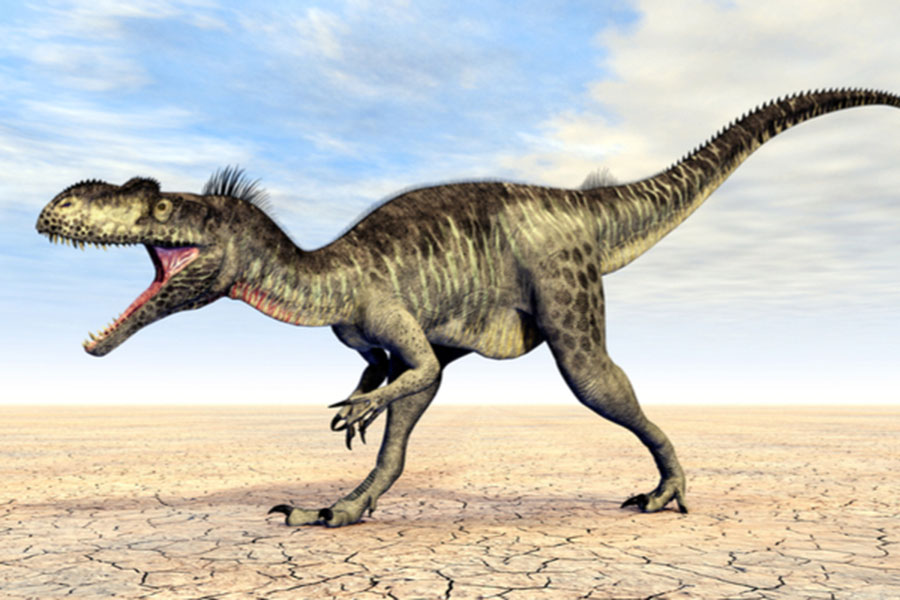
The Megalosaurus was the first dinosaur to be officially named, following its discovery in Oxfordshire in 1824 (Image: Shutterstock)

Only two dinosaur bones have been discovered in Ireland. What is it about the island's geology that makes dinosaurs such a rare find in this part of the world?

Dinosaurs were massively successful land animals that existed for more than 170 million years and lived across all continents. So you might expect to find fossil evidence of them everywhere you look.

But palaeontologists are at the mercy of time, chance and geology when they go searching for suitable rocks to find dinosaur fossils in.

Dr Mike Simms, Senior Curator of Natural History at National Museums Northern Ireland, explains why so few dinosaur fossils have been unearthed in Ireland. Read on to explore the reasons in more detail.

Summary of Irish geological history

  • Most of the rocks that make up Ireland are from earlier than the time of the dinosaurs, so they hold no dinosaur fossils to be discovered.
  • Only in northeast Ireland are there significant deposits of rocks of the right age to find dinosaur fossils in. But even within this time interval there is a gap of 100 million years in which is no rock at all has been preserved and so no dinosaur fossils either.
  • Ireland was underwater for significant portions of time during the age of the dinosaurs, so there is less chance of land animals such as dinosaurs being preserved in the rocks that are of a suitable age.

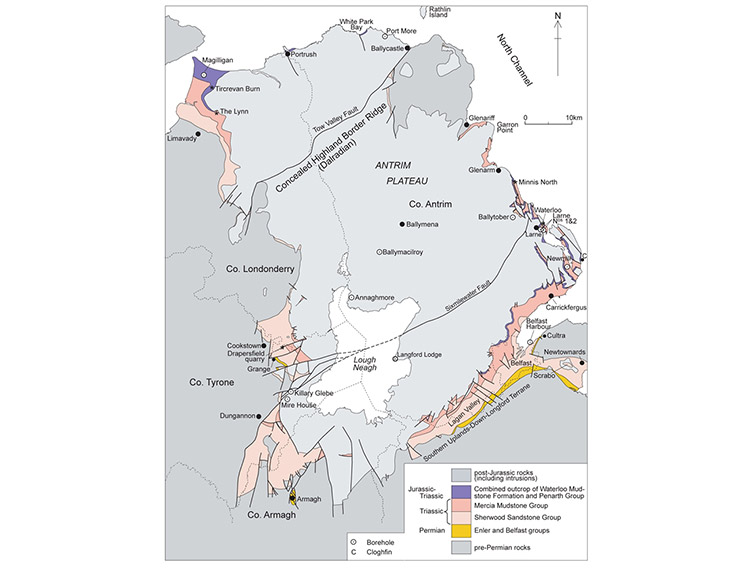
Northern Ireland geo-map

Most rocks from the time of the dinosaurs can be found in northeast Ireland, where they have been preserved under later basalt rocks. The map shows Triassic and Jurassic rocks in pink and purple, where they are exposed around the edge of the basalt, shown in light grey. (Cat Ref: P947841)

Ireland during the time of the dinosaurs

Dinosaurs existed for a vast amount of time, from 245 to 66 million years ago. During this time, called the Mesozoic Era, the area of the Earth's crust that we now call Ireland underwent many changes.

It started out as part of a supercontinent called Pangea, at a latitude similar to modern-day Egypt, but as it drifted slowly north it broke up. Over this time the environment across this precursor of Ireland would have changed from desert conditions to periods of partial and total immersion under water.

Where are all the rocks?

Precious little of this history is recorded in the rocks that make up most of Ireland, since most of them are more than 250 million years old. Only about 1% of Ireland's rocks date from the time of the dinosaurs.

Rocks from the correct period may once have existed but since been eroded away, or perhaps the conditions across most of Ireland weren't right for them to form in the first place.

What little Mesozoic rock we do have is found in the northeast of Ireland, but much of it is buried beneath younger rocks. After the end of the age of the dinosaurs, intense volcanic activity caused lava to flow over the surface, forming hard basalt layers that preserved the rock underneath from erosion.

You can find Triassic and Jurassic rocks at Waterloo Bay, near Larne.

Burials at sea

Most of Ireland's Mesozoic rocks were deposited beneath the sea - these include chalks, limestones and mudstones.

Dinosaurs are land animals, so to have been preserved in these types of rocks they would have had to be washed into the sea. While large marine reptile fossils such as ichthyosaurs and plesiosaurs have been found here, dinosaur fossils are much rarer.

Dinosaur discoveries

Only two dinosaur fossil bones have been found in Ireland, both from the same location on the Country Antrim coast. The bones are from the hind legs of two animals that lived around 200 million years ago: a herbivore called Scelidosaurus and a carnivorous Megalosaurus.

The fossils can be seen in Ulster Museum, Belfast, where they are currently on display with Dippy.

Source: www.nhm.ac.uk

Scelidosaurus

Saturday, December 8, 2018

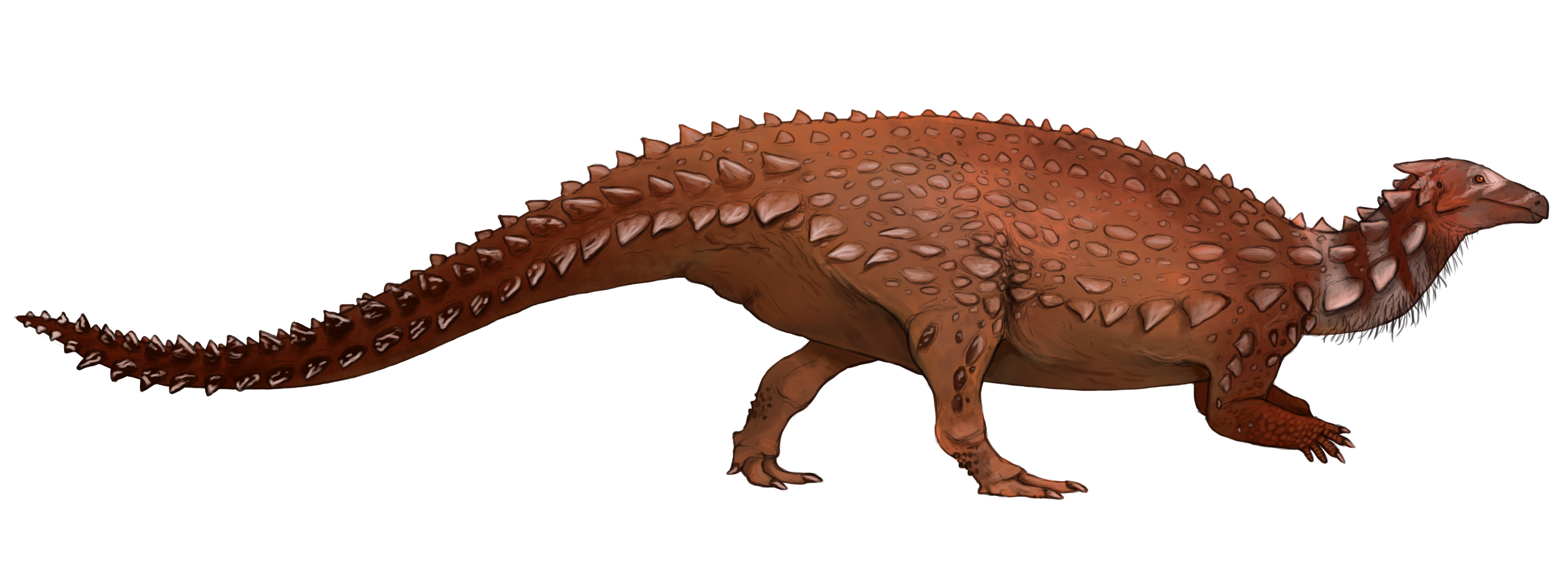
Restoration showing bipedal posture, as indicated by a fossil trackway

Scelidosaurus is a genus of herbivorous armoured ornithischian dinosaur from the Jurassic of England.

Scelidosaurus lived during the Early Jurassic Period, during the Sinemurian to Pliensbachian stages around 191 million years ago. This genus and related genera at the time lived on the supercontinent Laurasia. Its fossils have been found near Charmouth in Dorset, England, and are known for their excellent preservation. Scelidosaurus has been called the earliest complete dinosaur. It is the most completely known dinosaur of the British IslesScelidosaurus is currently the only classified dinosaur found in Ireland. Despite this, a modern description is still lacking. After initial finds in the 1850s, comparative anatomist Richard Owen named and described Scelidosaurus in 1859. Only one species, Scelidosaurus harrisonii named by Owen in 1861, is considered valid today, although one other species was proposed in 1996.

Scelidosaurus was about 4 metres (13 ft) long. It was a largely quadrupedal animal, feeding on low scrubby plants, the parts of which were bitten off by the small, elongated head to be processed in the large gut. Scelidosaurus was lightly armoured, protected by long horizontal rows of keeled oval scutes that stretched along the neck, back and tail.

One of the oldest known and most "primitive" of the thyreophorans, the exact placement of Scelidosaurus within this group has been the subject of debate for nearly 150 years. This was not helped by the limited additional knowledge about the early evolution of armoured dinosaurs. Today most evidence indicates that Scelidosaurus is the sister taxon to the two main clades of Thyreophora, the Stegosauria and Ankylosauria.

Scelidosaurus Size Comparison by PaleoGeek

A full-grown Scelidosaurus was rather small compared to most later non-avian dinosaurs, but it was a medium-sized species in the Early Jurassic. Some scientists have estimated a length of 4 metres (13 ft). In 2010, Gregory S. Paul gave a body length of 3.8 metres (12.5 ft) and a weight of 270 kilogrammes. Scelidosaurus was quadrupedal, with the hindlimbs longer than the forelimbs. It may have reared up on its hind legs to browse on foliage from trees, but its arms were relatively long, indicating a mostly quadrupedal posture. A trackway from the Holy Cross Mountains of Poland shows a scelidosaur like animal walking in a bipedal manner, hinting that Scelidosaurus may have been more proficient at bipedalism than previously thought.

The most obvious feature of Scelidosaurus is its armour, consisting of bony scutes embedded in the skin. These osteoderms were arranged in horizontal parallel rows down the animal's body. Osteoderms are today found in the skin of crocodilesarmadillos and some lizards. The osteoderms of Scelidosaurus ranged in both size and shape. Most were smaller or larger oval plates with a high keel on the outside, the highest point of the keel positioned more to the rear. Some scutes were small, flat and hollowed-out at the inside. The larger keeled scutes were aligned in regular horizontal rows. There were three rows of these along each side of the torso. The scutes of the lowest, lateral, row were more conical, rather than the blade-like osteoderms of Scutellosaurus.

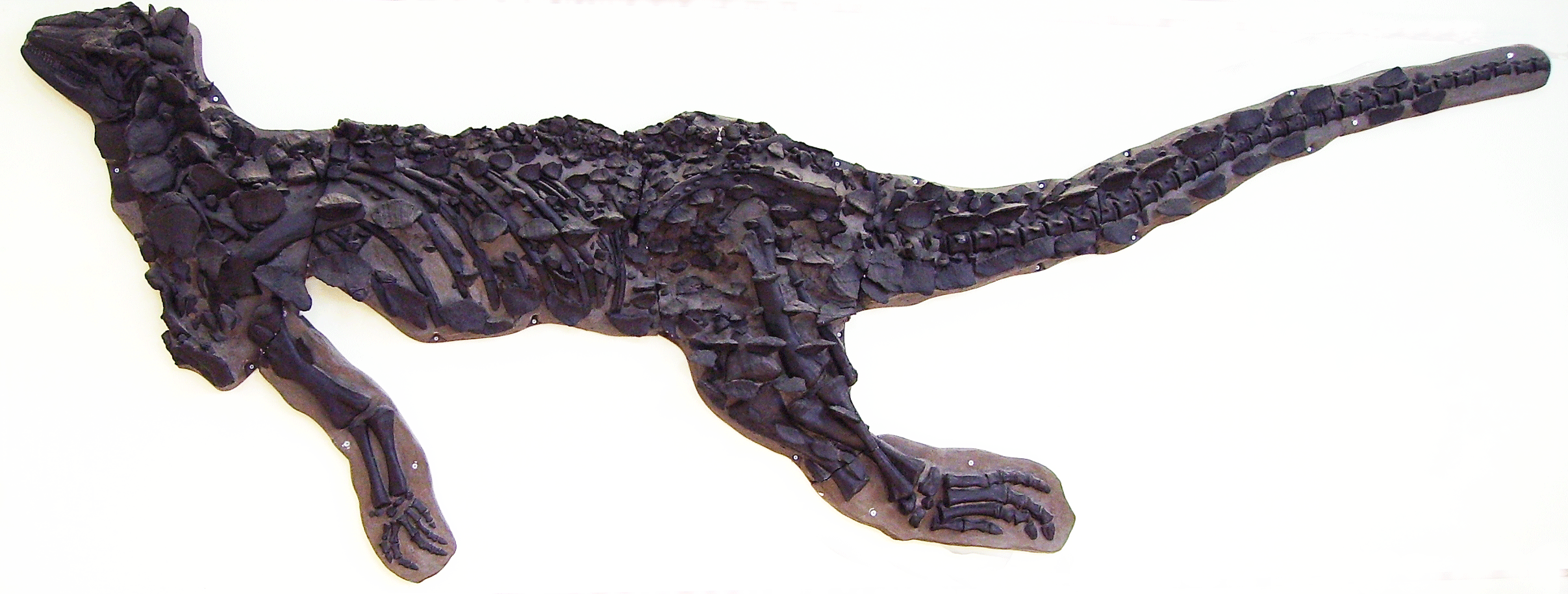
Scelidosaurus skeleton

Scelidosaurus harrisonii, named and described by Owen, is currently the only recognized species, based on several nearly complete skeletons. A potential second species from the Sinemurian-age Lower Lufeng Formation, Scelidosaurus oehleri, was described by David Jay Simmons in 1965 under its own genus, Tatisaurus. In 1996 Spencer G. Lucas moved it to Scelidosaurus. Although the fossils are fragmentary, this reassessment has not been accepted, and S. oehleri is today once again recognized as Tatisaurus.

Scelidosaurus was an ornithischian. It was the oldest ornithischian known until the description of Geranosaurus in 1911. During the twentieth century, it has been classified at different times as an ankylosaur or stegosaur. Alfred von Zittel (1902), William Elgin Swinton (1934), and Robert Appleby et al. (1967) identified the genus as a stegosaurian, though this concept then encompassed all armoured forms. In a 1968 paper, Romer argued it was an ankylosaur. In 1977, Richard Thulborn of the University of Queensland attempted to reclassify Scelidosaurus as an ornithopod similar to Tenontosaurus or Iguanodon. Thulborn argued Scelidosaurus was a lightly built bipedal dinosaur adapted for running. Thulborn's 1977 theories on the genus have since been rejected.

This debate is still ongoing; at this time, Scelidosaurus is considered to be either more closely related to ankylosaurids than to stegosaurids and, by extension, a true ankylosaur, or basal to the ankylosaur-stegosaur split. The stegosaur classification has fallen out of favor, but is seen in older dinosaur books. Cladistic analyses have invariably recovered a basal position for Scelidosaurus, outside of the Eurypoda.

Skeletonof a young specimen, Bristol City Museum and Art Gallery

Like most other thyreophoransScelidosaurus is known to be herbivorous. However, while some later ornithischian groups possessed teeth capable of grinding plant material, Scelidosaurus had smaller, less complex leaf-shaped teeth suitable for cropping vegetation and jaws capable of only vertical movement, due to a short jaw joint. Paul Barrett concluded that Scelidosaurus fed with a puncture-crush system of tooth-on-tooth action, with a precise but simple up-and-down jaw movement, in which the food was mashed between the inner side of the upper teeth and the outer side of the lower teeth, without the teeth actually touching each other as shown by very long vertical wear facets on the lower teeth alone. In this aspect, it resembled the stegosaurids, which also bore primitive teeth and simple jaws. Its diet would have consisted of ferns or conifers, as grasses did not evolve until late into the Cretaceous Period, after Scelidosaurus was long extinct.

Source: https://en.wikipedia.org

Hunting for Dinosaur Bones in the Digital Age

Thursday, December 6, 2018

Researchers at the Mongolia Institute of Paleontology examining a fossil from the Gobi. KESHIA NAURANA BADALGE

I’d never seen large animals look so small, or move with such a cinematic stillness, as I did in the Gobi. A dozen of us arrived at Gurvan Saikan airport, in the south of the Gobi Desert in Mongolia, just in time for the break of dawn. As we left the airport and traveled the hour-long drive through the great Mongolian steppe to our campsite, specs of motion in the distance slowly transformed into a caravan of camels or a flock of sheep following each other towards a knoll.

I have traveled here with members of the Explorer’s Club and researchers from the Mongolian Institute of Paleontology and Geology on a mission: to look for evidence of some of the largest animals to roam the Earth. I couldn’t help but think that maybe, in the Gobi, even dinosaurs wouldn’t seem so big.

The Gobi in fact encompasses both desert and steppe, both barren sand and lush greenlands. It’s the world’s largest unfenced rangeland, bounded only by natural features like the Altai mountains in the north, and the Tibetan plateau to the south. Here, native two-humped Bactrian camels, wearing throws of shaggy hair, share space with scorpions, hawks, snow leopards, and Gobi bears. It’s also littered with the remains of prehistoric creatures that, millions of years ago, swarmed the land.

Bones found by drones.

Our path to the south of the Gobi retraced the route of Roy Chapman Andrews, an unorthodox American explorer who led a series of expeditions here nearly a century ago. With a team of scientists, he took a fleet of open-topped Dodges—the first automobiles seen in the region—and scoured sand and rock in search of fossilized bounty in the 1920s. They called him a fool at that time, for the only proven way to get around the Gobi was on light-footed camels—and the Dodges’ feeble totter did not cut an impressive image compared to the humped animals’ elegance. Andrews was not exactly known for his scientific finesse either: while his paleontological counterparts dusted bones off with feathers, he could be found hacking away at the same earth with rock, hammer, and gusto.

It didn’t matter, in the end, whether Andrews looked like a paleontologist or not. In 1922, here in the Gobi, he came upon the richest dinosaur boneyards in the world. His landmark discovery of a nest of fossilized dinosaur eggs in the Flaming Cliffs here changed paleontology forever by proving dinosaurs were reptilian, and opened up Mongolia for future investigations as well as in our collective imagination. Andrews later became the director of the American Museum of Natural History in New York, and many speculate Indiana Jones was modelled after him.

In our search for fossils this summer, we were aided by a breakthrough technology modern to our times: satellites and drones. Prior to our departure, satellite imagery narrowed our search by scanning large swathes of land for sandstone, mudstone, and shale deposited during the Cretaceous period, between 145 and 65 million years ago, when dinosaurs are believed to have existed here.

A Mongolian researcher leads the group down the Flaming Cliffs, the same region where Roy Chapman Andrews first found a nest of dinosaur eggs. KESHIA NAURANA BADALGE

After these hotspots were identified, Scott Nowicki, the lead scientist at Florida-based geospatial data firm Quantum Spatial, led the second step of the search using modified DJI Phantom quadcopter drones. Nowicki had previously worked with NASA to use similar drones to study rock surfaces on several explorations to Mars. Here in the Gobi, Nowicki flew drones with thermal and spectral cameras over hundreds of square miles to create high-resolution, three-dimensional maps accurate down to the inch. The process identified 250 likely new locations to find fossils.

Leading the expedition was Badamkhatan Zorigt—or “Badmaa” for short—a cherubic paleontologist from Mongolia. Badmaa received his doctorate at the University of Montana under the training of Jack Horner (the technical advisor for all the Jurassic park films), and now heads the division of vertebrate paleontology at the Mongolian Institute of Paleontology and Geology. He told us how difficult it would have been to execute effective fossil excavations without those high-res maps. “We just wouldn’t have the resources to go out to look,” he said, “It is very time-consuming, as you will see.”

Scouting by Eye in the Flaming Cliffs

After a sleepless night of travel and a quick breakfast of tsuivan (a traditional stew of stir-fried noodles and meat and suutei tsai (milk tea), I took the wheel of an Infiniti SUV. Other members of the team piled into what was certainly an upgrade from Andrews’ 1920s Dodge.

Our destination: the Flaming Cliffs, a sprawling basin of pink sand and bleached rock that earned its name from how its rocks glow like fire in the setting sun. “Fossils are everywhere here,” Badmaa assured us, “you just have to learn how to look.”

The author holding a bone found in the Ömnögovi province. KESHIA NAURANA BADALGE

Drones equipped with advanced imaging equipment can find a fossil beneath the earth, but they can’t do the painstaking work of picking out bone from the rock. The ravines and gorges which were, in Andrews’ words, “studded with bones,” are now peppered by red herrings: wind-strewn rock of similar size and color, and the bones of modern species such as cows, camel, and sheep. The best places to look for fossils, I learned from Badmaa, were at the sides of rock outcrops, where erosion would have uncovered fossils and then left them exposed.

On the surface of rocky slope awash with pebbles, Badmaa found the skull of a Protoceratops—an Upper Cretaceous-period herbivore, which as a mature adult reached about six feet (1.8 meters) long and 400 lbs (180 kg)—skull awkwardly jutting out. Badmaa predicted that the dinosaur’s body sits somewhere inside the slope. It would take a long time to fully excavate the slope and uncover the body, so the team from Mongolia will have to return again later in the year.

In just 20 days, the team of paleontologists, geologists, and Explorer Club members was able to survey the same amount of land it took Andrews multiple years to cover. Among the hundreds of fossils found were the hind leg of an ostrich-type dinosaur from 65 million years ago, a 70-million-year old intact turtle, and the first Velociraptor ancestor uncovered in the Öösh mountain range. The search also yielded a primitive horned dinosaur never before seen in the Ömnögovi province of the Gobi, a rare Theropod dinosaur egg, and a velociraptor rib cage.

Then there were the discoveries of the vertebrae, ribs, skull, and tail fragments of a Tarbosaurusthe Mongolian cousin of the T. rexas well as the longest mature Tarbosaurus tooth ever found. Chinzorig Tsogtbaatar, a researcher with the Institute of Paleontology and Geology in Mongolia, said that the tooth might have belonged to “possibly the largest carnivorous dinosaur found in the southern region of Mongolia.”

Base camp in the Gobi desert. KESHIA NAURANA BADALGE

The Future of Dinosaur Fossil Hunting

In 2011, on NPR’s program Talk of The Nation, three members of the National Geographic Society grappled with this question: “What do explorers do in the 21st century?”

At a time when Google Maps can call up a picture of a remote village, and satellites can zoom in on contours of the seafloor 12,000 ft (3,650 meters) under the ocean’s surface, exploration has lost some of its allure.

Robert Ballard, explorer-in-residence at the National Geographic Society and a guest on the NPR program, argued that digital exploration tools are a cause for celebration, not dismay. Explorers in the past had the propensity to leave a trail of damage in their wake. More “remote” exploration, through drones and satellites, provide a less intrusive alternative. This certainly applies to paleontological exploration in Mongolia. The land here is fragile; one wrong step or chisel hack could cause a million-year-old fossil to crumble to dust. The satellite and drone maps are able to delineate areas that are safe for walking, as well as areas that require an extra-cautious approach.

We may soon even be able to advance paleontology from our bedrooms. After the data from the three-dimensional maps is processed, the Mongolia team plans to open them up to the public for “virtual scouring.” Because the maps are so detailed, the researchers think that people anywhere in the world could virtually walk through the land and look for fossils on their screens. Horner says he already searches for fossils on his computer via drone photos. The combination of thermal and spectral cameras could add a new dimension of specificity. This would open up a new era for citizen science and allow for more people, who do not have the means or access to fossil hotspots, to contribute to paleontology. Call this the new era of virtual paleontology.

Source: https://qz.com

Copper Dinosaur Appears in Aberdeen Shopping Centre

Wednesday, December 5, 2018

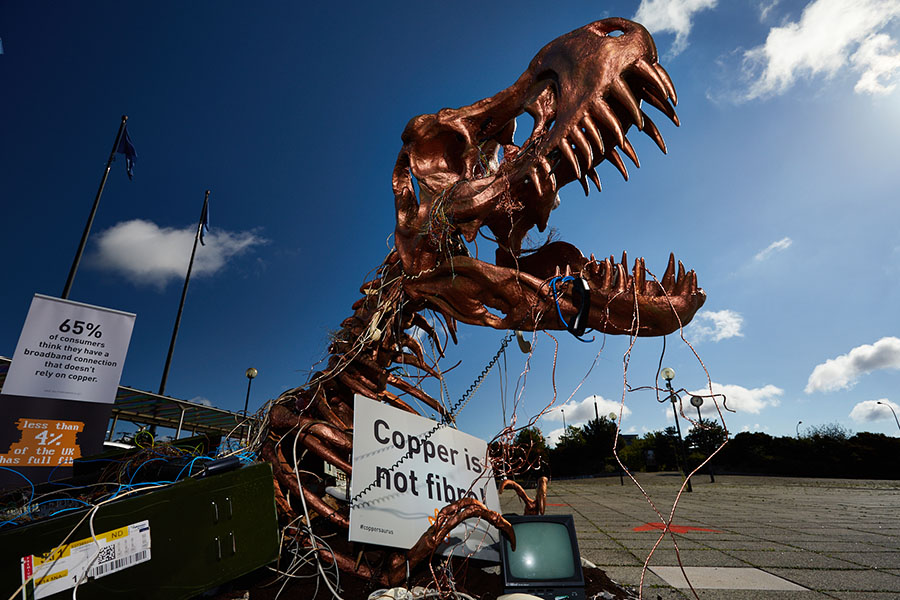
Welcome to Jurassic nark: Coppersaurus “unearthed” as UK grows frustrated with prehistoric broadband

A copper dinosaur has been unveiled at Aberdeen’s Union Square shopping centre as part of a national broadband campaign.

The Coppersaurus is touring the UK as part of the CityFibre’s national campaign to make “misleading broadband adverts extinct”.

It will be making its way to the Bon Accord Centre tomorrow.

Will Brayne, director of marketing and communications at CityFibre, said: “The Coppersaurus represents the UK’s neglected digital infrastructure and its equally redundant advertising rules. Copper is masquerading as fibre across the UK, leaving us stuck with a relic from the past rather than focusing on the digital connectivity of the future.”

The Coppersaurus at Union Square in Aberdeen

At present, the UK’s advertising rules – enforced by the Advertising Standards Authority (ASA) – do not require advertisers to distinguish between full and part fibre services.

The city has been selected as the first location in Scotland to benefit from a complete full fibre transformation as part of CityFibre’s strategic partnership with Vodafone, which aims to deliver full fibre to five million homes and businesses by 2025.

Source: www.pressandjournal.co.uk

New Dinosaur Species Discovered in Australia: Weewarrasaurus pobeni

Friday, December 7, 2018

An artist’s impression of Weewarrasaurus pobeni. Image credit: James Kuether.

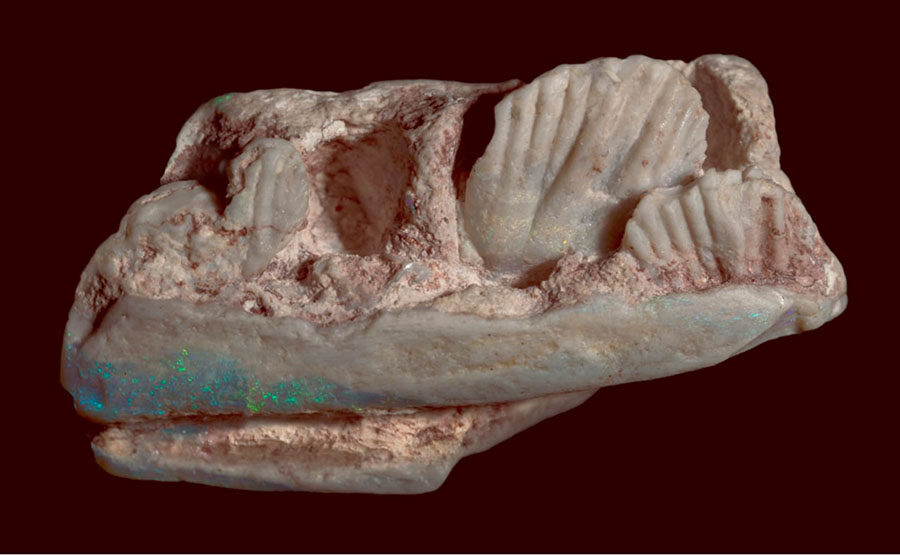
Paleontologists in Australia have found a fossil fragment from a new species of ornithopod dinosaur that walked the Earth approximately 100 million years ago (Cretaceous period).

The new Australian dinosaur, named Weewarrasaurus pobeni, was about the size of a large dog.

The ancient creature was an ornithopod dinosaur, part of a group of small plant-eating species that moved around on two legs and that were particularly abundant on the Cretaceous floodplains of eastern Australia.

A fragment of the jawbone of Weewarrasaurus pobeni was found deep in an underground mine at the Wee Warra locality close to the Grawin/Glengarry opal fields, approximately 25 miles (40 km) southwest of Lightning Ridge, central-northern New South Wales.

The fossil was analyzed by a team of paleontologists from the Australian Opal Centre and the Universities of New England and Queensland.

“Like all fossils from the Lightning Ridge opal mines, the lower jaw of Weewarrasaurus pobeni is preserved in opal,” said University of New England’s Dr. Phil Bell and co-authors.

“Lightning Ridge is the only place in the world where dinosaur bones routinely turn to opal.”

The lower jaw of Weewarrasaurus pobeni. Image credit: Bell et al, doi: 10.7717/peerj.6008.

Lightning Ridge is a world-class fossil resource because it preserves a unique suite of Cretaceous fauna.

“If these fossils were in surface rock, like those found in China and Mongolia, it would be an absolute treasure-trove,” Dr. Bell said.

“Unfortunately, the fossil remnants we see are almost always part of mining spoil, because they sit in rock strata that lie up to 100 feet (30 m) underground.”

“The mining process breaks the fossils into fragments — but on the other hand, we would never get to see even those fragments if it wasn’t for mining.”

“The jawbone of Weewarrasaurus pobeni is a supremely rare and unlikely discovery,” said Dr. Jenni Brammall, manager of the Australian Opal Centre.

“This incredible little object is both the 100 million-year-old jaw of a new dinosaur species and a precious gemstone.”

The discovery is reported in the journal PeerJ.

_____

P.R. Bell et al. 2018. Ornithopod diversity in the Griman Creek Formation (Cenomanian), New South Wales, Australia. PeerJ 6: e6008; doi: 10.7717/peerj.6008

Source: www.sci-news.com

Strangers Replace Boy's Toy Dinosaurs Burnt in California Fire

Tuesday, December 4, 2018

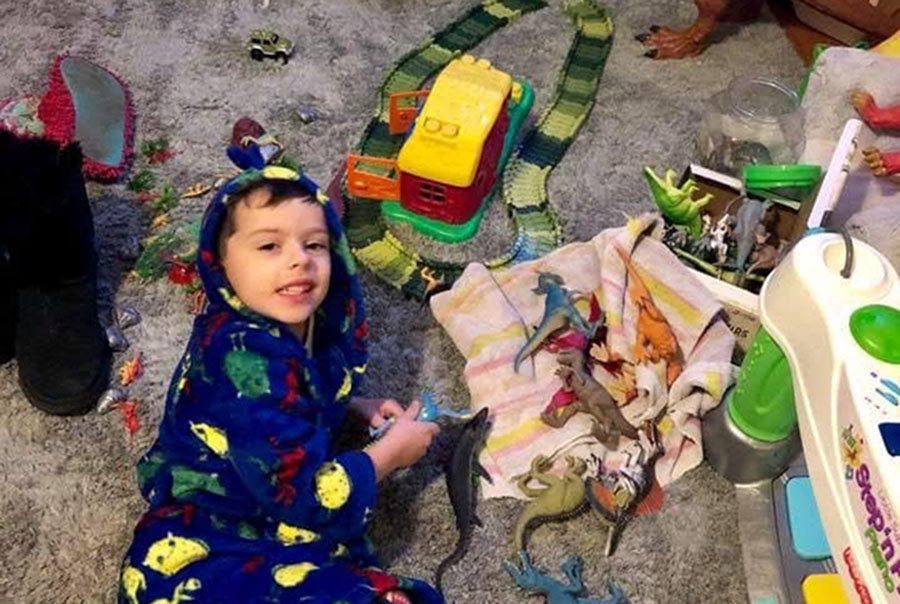
Riley Wooten, 4, with some of the dinosaurs strangers sent him after his collection burned with his Paradise, Calif., home in the deadly Camp Fire. (Tanya Renfro)

Four-year-old Riley Wooten literally ran from his house in Paradise, Calif., with his grandmother and his dog as their home suddenly erupted in flames.

He grabbed his favorite toy, a dinosaur named Chompy, but left behind everything else, including his prized collection of other dinos.

He and his family made it safely out of town that day last month to relatives’ homes, dodging fire raining around them in the Camp Fire blaze that killed almost 90 people and scorched about 14,000 homes. In the aftermath, friends and family kept asking Riley’s family: What can we do to help?

In response, Riley’s great aunt, Tanya Renfro, posted on Facebook that maybe someone could send Riley a toy dinosaur, as he sorely missed his collection. She added a photo of Riley on Halloween dressed as a Triceratops. Within days, boxes and boxes of dinosaurs, dino-themed blankets, pillowcases, movies, books and lamps started appearing at their doorstep.

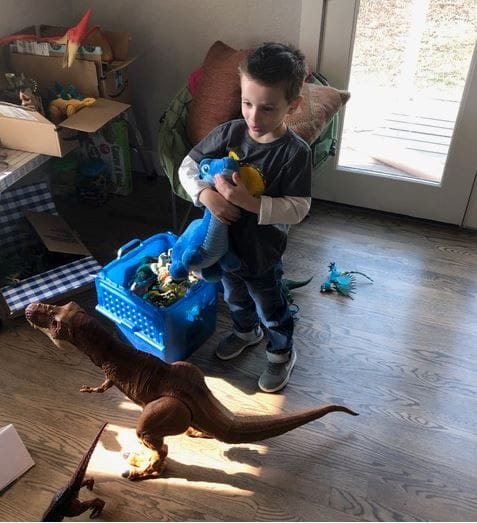
Riley Wooten, 4, with some of the dinosaurs strangers sent him after his home in Paradise, Calif., burned and he lost his collection. (Tanya Renfro)

There were walking Velociraptors, talking Pteradons, light-up Triceratops and a roaring T-Rex.

“All my friends shared my Facebook post and people were like, ‘Oh my gosh, give me that baby’s address,’ ” Renfro said. “Some days, we’d get five packages.”

Riley’s collection has been replenished to about 100 different dinosaur toys. But the boxes keep coming — and about half of the packages are from complete strangers.

“The outpouring has been amazing,” Renfro said. “I can’t even describe how much the community has come together to help. Everybody lost everything, nobody had time to get their things.”

Riley’s family is grateful for the many dinosaur toys people have sent, which are helping Riley as he deals with the trauma of watching his home and all his belongings go up in flames.

“My old school burned down,” Riley said in an interview with The Washington Post, and he also described how he left his favorite blue helmet in his old house, and now it’s gone.

“Sometimes he’ll cry and say ‘I want to go home,’ ” Renfro said.

But he excitedly talks about his new toys.

Riley has been raised by his grandmother, Teri Shesson, 58, with the help of other family members since he was just a few weeks old, when his parents couldn’t care for him and they wanted Riley to be raised in a stable, loving home.  “He’s the sweetest boy and he’s very smart,” Renfro said.  He and his grandmother are now living with Riley’s aunt, Jenny Benson, 34, in the town of Gridley, which is about 30 miles from Paradise. Riley and Shesson are sleeping in a room with Benson’s son, who is roughly the same age as Riley.  It has been a bit of a challenge at times, but Benson said they all feel extraordinarily fortunate because they are aware that many people were not able to escape the fire, or if they did, have nowhere to go.  [This family fled the Camp Fire. Then they learned their garage became a makeshift hospital.]  Benson gets excited with Riley every time a package arrives. She has also been helping him set aside some of his new dinosaur toys for other kids in need.  “He’s bagged up some to give to kids who really don’t have anything,” Benson said, adding there is a local shelter in town where she can bring them. “It’s a good lesson for him to pay it forward.”

“I got dinosaur blankets, I got a pillowcase with my name on it and a dinosaur that poops other dinosaurs out,” he said in the phone interview.

Riley has been raised by his grandmother, Teri Shesson, 58, with the help of other family members since he was just a few weeks old, when his parents couldn’t care for him and they wanted Riley to be raised in a stable, loving home.

“He’s the sweetest boy and he’s very smart,” Renfro said.

He and his grandmother are now living with Riley’s aunt, Jenny Benson, 34, in the town of Gridley, which is about 30 miles from Paradise. Riley and Shesson are sleeping in a room with Benson’s son, who is roughly the same age as Riley.

It has been a bit of a challenge at times, but Benson said they all feel extraordinarily fortunate because they are aware that many people were not able to escape the fire, or if they did, have nowhere to go.

Benson gets excited with Riley every time a package arrives. She has also been helping him set aside some of his new dinosaur toys for other kids in need.

“He’s bagged up some to give to kids who really don’t have anything,” Benson said, adding there is a local shelter in town where she can bring them. “It’s a good lesson for him to pay it forward.”

Source: www.washingtonpost.com

Rare Dinosaur Fossil Discovered on Internet After Disappearing for Decades

Tuesday, December 4, 2018

The Kakuru kujani is the only dinosaur to have left fossils in SA.  Supplied: South Australian Museum

A rare fossil believed to be from South Australia's only known dinosaur is shedding new light on the turkey-sized creature, with the opalised toe bone resurfacing on the internet after disappearing for almost five decades.

The fossil is one of only three dinosaur bones known to have been found in South Australia, all of which are from a species called Kakuru kujani.

The fossilised bones were originally found in South Australia's outback in sediments from the early Cretaceous Period, about 110 million years ago.

A fossil expert at the South Australian Museum said the Kakuru appeared to have been a small carnivorous dinosaur.

"These are the only bones of this dinosaur known anywhere in the world," said Ben McHenry, the museum's senior collections manager for earth sciences.

The fossil will officially be unveiled at the museum later today.

"It's a toe bone, it's about five centimetres long," Mr McHenry said.

"Australia is the only place in the world where you find opalised fossils… the bones of a dinosaur have been replaced by precious opal."

PHOTO: The fossil specimen is barely five centimetres in length. (Supplied: Ashleigh Glynn)

Rediscovered after 45 years

The history behind the state's only known dinosaur dates back to a discovery almost half a century ago in the centre of Adelaide.

An opalised toe bone of the dinosaur was dug up in Andamooka in the early 1970s and was spotted by Neville Pledge — the museum's then-curator of fossils.

He noticed the toe bone in 1973 in an opal shop in Hindley Street in the Adelaide CBD.

Mr Pledge is now an honorary researcher at the South Australian Museum and said he was fortunate to be able to take photos, measurements and make a few plaster casts of the toe bone — but from there, the fossil went missing.

The Kakuru kujani is believed to have been little more than a metre in length.  Supplied: South Australian Museum

But in an intriguing twist, the bone was spotted for sale on the internet by Coober Pedy resident Joy Kloester in April this year.

Ms Kloester immediately purchased the toe bone and offered it to the museum.

Mr McHenry said he acted quickly to acquire the rare specimen and said the find was so special because dinosaur bones were "incredibly rare" in the state.

"The reason why we don't have dinosaur bones is because when the dinosaurs were stomping around on the land, most of South Australia was under water," he said.

"The rocks which now form the Great Artesian Basin were once an inland sea.

"These are the rock formations that host the opal at Andamooka and at Coober Pedy… 110 million years ago we were actually still joined to Antarctica as part of the supercontinent Gondwana and we were right down near the South Pole."

The fossil toe bone will be on display in the South Australian Museum's opal fossil gallery.

Source: www.abc.net.au

Maiabalaena nesbittae: Oligocene-Epoch Whale Had Neither Teeth Nor Hair-Like Baleen

Tuesday, December 4, 2018

An artistic reconstruction of a mother and calf of Maiabalaena nesbittae nursing offshore of Oregon during the Oligocene, about 33 million years ago. Image credit: Alex Boersma, www.alexboersma.com.

Maiabalaena nesbittae represents a surprising intermediate stage between modern filter-feeding whales and their toothed ancestors. Instead, the 15-foot (4.6 m) long ancient whale was a suction feeder,” said team leader Dr. Carlos Mauricio Peredo, a paleontologist at George Mason University and the National Museum of Natural History.

“The findings suggest that early whales lost their teeth before the evolutionary origin of comb-like baleen.”

“Baleen works much like a sieve, allowing modern baleen whales to filter huge volumes of small prey from seawater in quantities sufficient to support their massive bodies.”

“Filter feeding in baleen whales represents an innovation without precedent among any other mammals, and its origin has been a long-standing question since Darwin.”

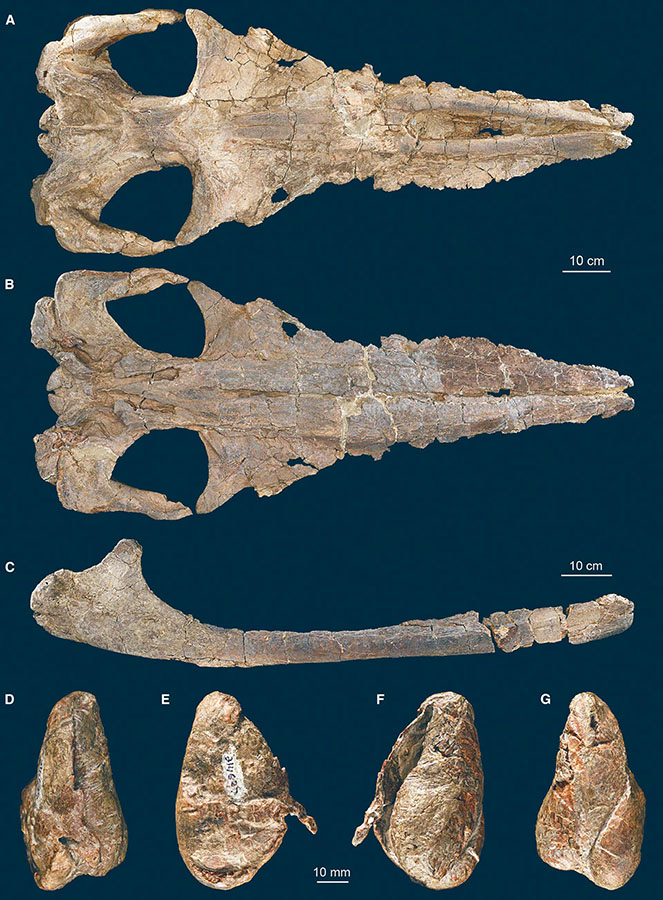
Cranial elements of the holotype of Maiabalaena nesbittae: (A-G) dorsal (A) and ventral (B) views of the holotype skull; lateral (C) view of the right mandible; dorsal (D), lateral (E), medial (F), and ventral (G) views of left tympanic bulla. Image credit: Peredo et al, doi: 10.1016/j.cub.2018.10.047.

At 33 million years oldMaiabalaena nesbittae dates back to a period of massive geological change.

The age and geographic location of Maiabalaena nesbittae suggested to the scientists that it would shed new light on whale evolutionary history.

Their first surprise was the discovery that the species lacked teeth, making it the oldest toothless whale known to science.

But, the real surprise came when they realized that the fossilized specimen showed no evidence for baleen either.

“A living baleen whale has a big, broad roof in its mouth, and it’s also thickened to create attachment sites for the baleen,” Dr. Peredo said.

Maiabalaena nesbittae does not. We can pretty conclusively tell you this fossil species didn’t have teeth, and it is more likely than not that it didn’t have baleen either.”

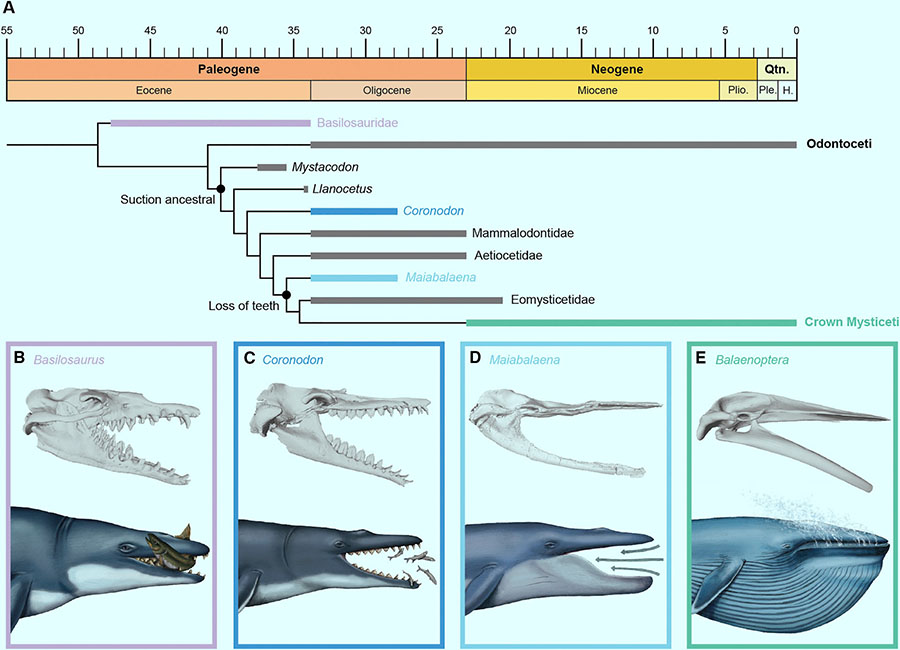
Based on Maiabalaena nesbittae’s relationship to other whales, the findings suggest that whales lost teeth first. Baleen only came later.

The results also help to shape paleontologists’ understanding of the evolutionary origin of baleen, which remains one of the most enigmatic and unique structures in mammals.

Phylogenetic relationships of stem mysticetes illustrating the evolutionary loss of teeth and subsequent origin of baleen: (A) time calibrated simplified phylogeny, with collapsed clade resolution for Mammalodontidae, Aetiocetidae and Eomysticetidae, and crown Mysticeti; (B-E) colored bars indicate groups figured; gray bars indicate groups not figured; panels represent 3D models of select specimens in lateral view with artistic reconstructions of their feeding modes: (B) Basilosaurus isis, (C) Coronodon havensteini, (D) Maiabalaena nesbittae, and (E) Balaenoptera musculus; these panels illustrate the loss of a functional dentition, the intermediate phase with neither teeth nor baleen, and the subsequent origin of baleen. Image credit: Alex Boersma, www.alexboersma.com / Peredo et al, doi: 10.1016/j.cub.2018.10.047.

“While Maiabalaena nesbittae would not have been able to chew or to filter feed, muscle attachments on the bones of its throat indicate it likely had strong cheeks and a retractable tongue. These traits would have enabled it to suck water into its mouth, taking up fish and small squid in the process,” the researchers said.

“The ability to suction feed would have rendered teeth, whose development requires a lot of energy to grow, unnecessary.”

“The loss of teeth, then, appears to have set the evolutionary stage for the baleen, which we estimate arose about 5 to 7 million years later.”

The research is published in the journal Current Biology.

_____

Carlos Mauricio Peredo et al. Tooth Loss Precedes the Origin of Baleen in Whales.Current Biology, published online November 29, 2018; doi: 10.1016/j.cub.2018.10.047

Source: www.sci-news.com

Pages