Blogs

Long-Necked Dinosaurs Rotated Their Forefeet To The Side
Wednesday, January 30, 2019

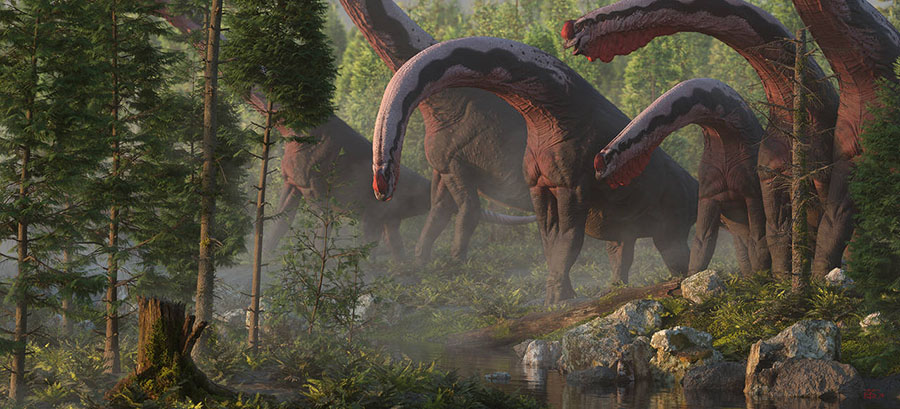
Family Gathering by Gorgonzola

Long-necked dinosaurs (sauropods) could orient their forefeet both forward and sideways. The orientation of their feet depended on the speed and centre of mass of the animals. An international team of researchers investigated numerous dinosaur footprints in Morocco at the foot of the Atlas Mountains using state-of-the-art methods. By comparing them with other sauropods tracks, the scientists determined how the long-necked animals moved forward. The results have now been published in the Journal of Vertebrate Paleontology.

"Long-necked dinosaurs" (sauropods) were among the most successful herbivores of the Mesozoic Era -- the age of the dinosaurs. Characteristic for this group were a barrel-shaped body on columnar legs as well as an extremely long neck, which ended in a relatively small head. Long-necked dinosaurs existed from about 210 to 66 million years ago -- they thus had been able to assert themselves on earth for a very long period. Also their gigantism, with which they far surpassed other dinosaurs, points at their success.

Sauropods included the largest land animals in Earth history, some over 30 metres long and up to 70 tonnes in weight. "However, it is still unclear how exactly these giants moved," says Jens Lallensack, paleontologist at the Institute of Geosciences and Meteorology at the University of Bonn in Germany. The limb joints were partly cartilaginous and therefore not fossilised, allowing only limited conclusions about the range of movement.

Detective work with 3D computer analyses

The missing pieces of the puzzle, however, can be reconstructed with the help of fossil footprints of the giants. An international team of researchers from Japan, Morocco and Germany, led by the University of Bonn, has now investigated an unique track site in Morocco at the foot of the Atlas Mountains. The site consists of a surface of 54 x 6 metres which was vertically positioned during mountain formation and shows hundreds of individual footprints, some of which overlap. A part of these footprints could be assigned to a total of nine trackways (sequences of individual footprints). "Working out individual tracks from this jumbled mess of footprints was detective work and only possible through the analysis of high-resolution 3D models on the computer," says Dr. Oliver Wings of the Zentralmagazin Naturwissenschaftlicher Sammlungen der Martin-Luther-Universität Halle-Wittenberg in Germany.

The researchers were amazed by the results: the trackways are extremely narrow -- the right and left footprints are almost in line. Also, the forefoot impressions are not directed forwards, as is typical for sauropod tracks, but point to the side, and sometimes even obliquely backwards. Even more: The animals were able to switch between both orientations as needed. "People are able to turn their palms downwards by crossing the ulna and radius," says Dr. Michael Buchwitz of the Museum für Naturkunde Magdeburg. However, this complicated movement is limited to mammals and chameleons in today's terrestrial vertebrates. It was not possible in other animals, including dinosaurs. Sauropods must therefore have found another way of turning the forefoot forwards.

How can the rotation of the forefoot be explained?

How can the rotation of the forefoot in the sauropod tracks be explained? The key probably lies in the mighty cartilage layers, which allowed great flexibility in the joints, especially in the shoulder. But why were the hands rotated outwards at all? "Outwardly facing hands with opposing palms were the original condition in the bipedal ancestors of the sauropods," explains Shinobu Ishigaki of the Okayama University of Science, Japan. The question should therefore be why most sauropods turned their forefeet forwards -- an anatomically difficult movement to implement.

A statistical analysis of sauropod tracks from all over the world could provide important clues: Apparently the animals tended to have outwardly directed forefeet when the foreleg was not used for active locomotion but only for carrying body weight. Thus the forefeet were often rotated further outwards when the animal moved slowly and the centre of mass of the body was far back. Only if the hands were also used for the forward drive, a forefoot directed to the front was advantageous. The analysis furthermore showed that the outer rotation of the forefeet was limited to smaller individuals, whereas in larger animals they were mostly directed forward. The large animals apparently could no longer rotate their forefeet sideways. "This loss of mobility was probably a direct result of their gigantism," says Lallensack.


Story Source:

Materials provided by University of BonnNote: Content may be edited for style and length.


Journal Reference:

  1. Jens N. Lallensack, Shinobu Ishigaki, Abdelouahed Lagnaoui, Michael Buchwitz, Oliver Wings. Forelimb Orientation and Locomotion of Sauropod Dinosaurs: Insights from the ?Middle Jurassic Tafaytour Tracksites (Argana Basin, Morocco)Journal of Vertebrate Paleontology, 2019; 1 DOI: 10.1080/02724634.2018.1512501

Source: www.sciencedaily.com
Fossil Feathers of Anchiornis Give Clues to How and When Dinosaurs Took Flight

Tuesday, January 29, 2019

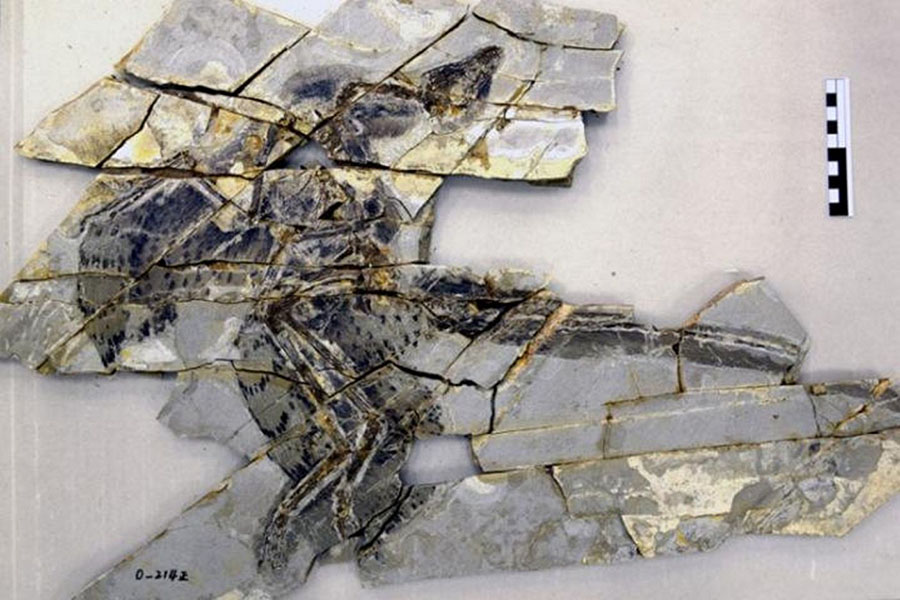
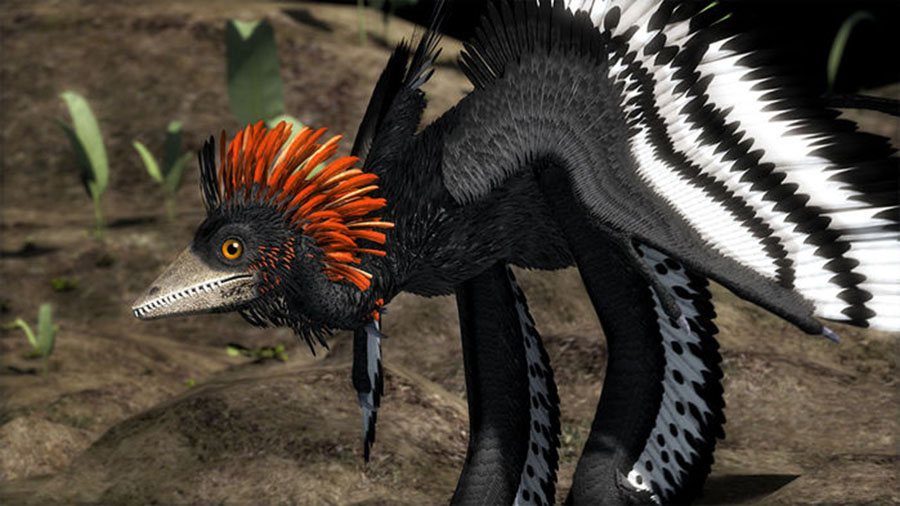
Anchiornis dinosaur feathers were likely an evolutionary intermediate on the way to flight. ROBERT CLARK/NATIONAL GEOGRAPHIC

It isn't clear how and when feathered dinosaurs, the ancestors of present day birds, started to fly. Analysis of the fossilized remains of a winged dinosaur that lived in China 160 million years ago, however, offered clues on the evolution of flight.

The crow-sized dinosaur called Anchiornis lived 10 million years before the Archaeopteryx, the first recognized bird.

Keratin

Modern vertebrates that walk on land have the protein called keratin. Alpha-keratins (α-keratins) are in the 10 nanometer-wide filaments of the hair, skin, and nails of humans and other mammals.

In reptiles and birds, beta-keratins (β-keratins) form the narrower but more rigid filaments that make up the beaks, claws, and feathers.

Study researcher Mary Schweitzer, from North Carolina State University in Raleigh, explained that modern bird feathers are primarily composed of β-keratin. Feathers, however, differ from other beta-keratin tissues because the feather protein is modified in a way that made it more flexible and more conducive to flight.

"At some point during the evolution of feathers, one of the β-keratin genes underwent a deletion event, making the resultant protein slightly smaller. This deletion changed the biophysics of the feather to something more flexible — a requirement for flight," Schweitzer said.

The researchers said that knowing when and in what organisms the deletion event occurred can provide researchers a better understanding of how flight evolved when dinosaurs transitioned to birds.

The Anchiornis specimen studied at the Chinese Academy of Science. Credit: WANG Xiaoli

Anchiornis Feathers Have Both Alpha-keratins And Beta-keratins

Using high-resolution electron microscopy, as well as chemical and immunological techniques, researchers took a closer look at the fossilized feathers of the Anchiornis and compared these to those of younger fossil birds and modern birds at the molecular level.

The researchers found that the feathers of the Anchiornis is composed of both β-keratins and α-keratins, which is surprising since α-keratin is present in only small amounts in modern feathers. The Anchiornis feathers has also already undergone the deletion event that made feathers different from other tissues.

The findings suggest that during the transition to flight, the β-keratin gene was duplicated many times in the genomes of some dinosaurs. As these animals evolved, some of the extra copies mutated into the truncated form that made flight possible.

This allowed the feathered dinosaurs such as the Archaeopteryx to take flight around 150 million years ago and gave rise to modern-day birds.

Researchers said that the Anchiornis feathers were not likely suitable for flight, but represents an intermediate stage in the evolution toward flight feathers.

The findings were published in the Proceedings of the National Academy of Sciences.

Source: www.techtimes.com

Paleontologists in Cambridgeshire Have Discovered the Skull of an Extinct Buffalo that Lived 150,000 Years Ago

Sunday, January 20, 2019

YAKOV OSKANOV / SHUTTERSTOCK

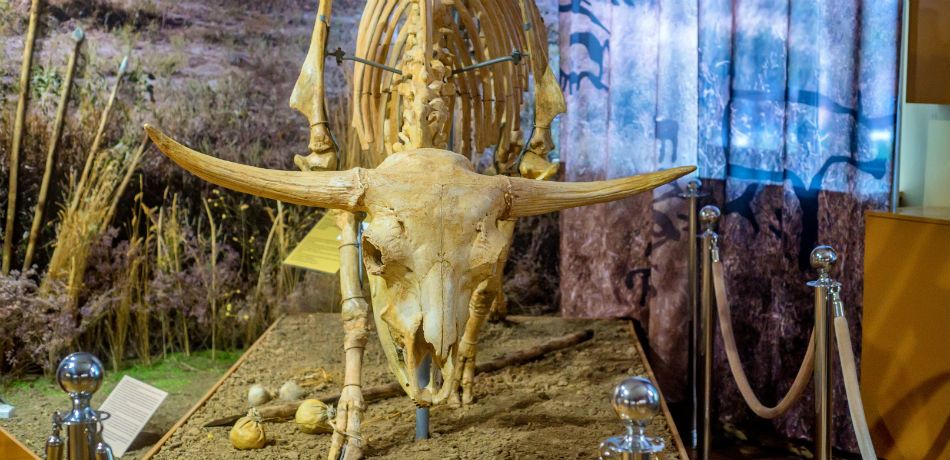
Paleontologists have stumbled upon the 150,000-year-old skull of an extinct bison priscus, and this discovery marks the first time that a complete skull has been discovered at this particular Cambridgeshire quarry site.

Paleontologists in Cambridgeshire, England have recently discovered the skull of a prehistoric and extinct buffalo that roamed the Earth 150,000 years ago after unearthing the animal’s skull in a quarry.

As the Daily Mail reports, the surprising discovery was made by a fossil enthusiast who is a frequent visitor to the quarry, and despite finding hundreds of buffalo bones at this location, this fossilized skull is the first time that a complete skull has been discovered here.

It has been determined that the extinct bison priscus was 6.5 feet tall and weighed an enormous 2,000 pounds. Jamie Jordan, the man responsible for this unique discovery, runs Fossils Galore museum in Cambridgeshire, and has described the moment when he first stumbled upon the 150,000-year-old buffalo skull.

“As we were going through the quarry we saw some splintered pieces of bone on top of the surface, and I thought to myself, that’s a bit strange. I have mainly come across maybe one half of a skull at a time so it is very unusual to find everything together. I had a closer look and it turned out to be a horn cone from a buffalo and removed the loose horn core and there was still a large bone underneath.”

After further excavation, paleontologists discovered the other pieces of the buffalo’s skull and, as Jordan noted, despite having been thoroughly crushed, the Ice Age animal’s skull was nevertheless complete, even down to its massive jaws.

Once washed and weighed, the skull of this extinct buffalo was determined to be between 45 and 55 pounds, and Jordan now believes that other bones that were found at the Cambridgeshire quarry may have come from this same animal, and he intends to conduct further investigation to see if he can find other missing pieces of the bison priscon.

It is being reported that Jordan and his team were also the individuals who were responsible for the astonishing discovery of an Iguanodon skeleton that was found in a quarry in Surrey in 2017, and which had been buried at the site for around 132 million years.

The complete skull of the 150,000-year-old buffalo that was found in the Cambridgeshire quarry will be worked on over the next two months so that it will be perfectly preserved and will then be shown to the public, along with many of the other amazing finds of Jamie Jordan.

Source: www.inquisitr.com

Could Evolution Ever Bring Back the Dinosaurs?

Sunday, January 27, 2019

Credit: shutterstock

Did you watch the 1993 movie blockbuster "Jurassic Park" and wonder, "Could this happen for real? Could the dinosaurs ever come back?" The idea that these mighty creatures could wander our Earth again some day is for most humans both fascinating and terrifying in equal measure.

Even real-life scientists are intrigued as to whether the evolutionary process could bring us back to the time of the Tyrannosaurs. But Susie Maidment, a vertebrate paleontologist at London's Natural History Museum, quickly dismissed the notion that a DNA-filled mosquito preserved in amber for millions of years — as in "Jurassic Park" — could ever help recreate an extinct dinosaur.

"We do have mosquitos and biting flies from the time of the dinosaurs, and they do preserve in amber," Maidment said in a statement. "But when amber preserves things, it tends to preserve the husk, not the soft tissues. So, you don't get blood preserved inside mosquitos in amber."

Researchers have found blood vessels and collagen in dinosaur fossils, but these components don't have actual dinosaur DNA in them. Unlike collagen or other robust proteins, DNA is very fragile, and sensitive to the effects of sunlight and water. The oldest DNA in the fossil record is around 1 million years old, and the dinosaurs died out about 66 million years ago.

Maidment added: "Although we have what appears to be blood from mosquitos up to 50 million years old, we haven't found DNA, and in order to reconstruct something, we need DNA."

Jamal Nasir, a geneticist at the University of Northampton in the United Kingdom, said he wouldn't rule out the idea of dinosaurs evolving back from the dead. In his opinion, evolution isn't fixed or planned. In other words, anything could happen. "Evolution is largely stochastic [randomly determined], and evolution doesn't necessarily have to go in a forward direction; it could have multiple directions. I would argue that going back to dinosaurs is more likely to happen in reverse, because the building blocks are already there."

Of course, Nasir pointed out, the right conditions would have to exist for dinosaurs to reappear. "Clearly, one could imagine viral pandemics that might disrupt our genomes, our physiology and behavior beyond our control," he told Live Science. This, in turn, could create the right conditions for evolution to take a path toward reinventing the ancient reptiles.

However, while evolution might not be directional in any particular sense, something we do know is that we don't see the same animal evolving again, Maidment countered. "We can see an animal that is closely related occupying a similar ecological niche — for example, ichthyosaurs were marine reptiles with long pointy snouts and dolphin-like body shapes and tails," she told Live Science. "Today we see the dolphin, and they probably occupy a similar ecological niche. But we wouldn't describe a dolphin as an ichthyosaur because they don't possess the anatomical characteristics that allow them to be ichthyosaurs."

Besides, dinosaurs never quite died out in the first place, Maidment said. Birds evolved from meat-eating dinosaurs, and thus in strict biological definition, everything that evolved from this common ancestor is a dinosaur, sharing the same anatomical characteristics, she said.

"Dinosaurs are still with us," Maidment said. "They say dinosaurs went extinct, but only the non-avian dinosaurs went extinct. Birds are dinosaurs, and birds are still evolving, so we will certainly see new species of birds evolving — and those will be new species of dinosaur."

Some scientists are even dabbling with the evolution process by trying to reverse engineer a chicken into a dinosaur, dubbed the "chickenosaurus." However, this beast, if it ever comes to fruition, would not be a replica of a dinosaur, but rather a modified chicken, Jack Horner, a research associate at the Burke Museum at the University of Washington, previously told Live Science.

Things have changed drastically over 66 million years, and if one day a dinosaur evolved back onto Earth, it would be to a very different world.

"An animal that died out naturally, perhaps 150 million years ago, is not going to recognize anything in this world if you bring it back," Maidment noted "What is it going to eat when grass hadn't [yet] evolved back then? What is its function, where do we put it, does anyone own it?"

That said, it may be best to let sleeping dinosaurs lie, she said.

Originally published on Live Science.

Jurassic Park Recipe? Ancient Insect Found Preserved Inside Opal

Friday, January 25, 2019

Photo: Brian Berger

An opal, purchased a year ago, produced a most unusual discovery, as it contained an ancient insect embedded within it.

In his post for Entomology Today, gemologist Brian Berger shared pictures of an opal he bought during a trip to the Indonesian island of Java. Inside the crystal was an insect frozen in a dramatic pose. The specimen was examined by the Gemological Institute of America, a nonprofit research institute, which authenticated it as a real opal with a fossil inclusion.

The fact that the insect was stuck within the crystal means that the opal itself isn’t just an opal, but opalized amber. Some trees exude a sticky sap that can immobilize bugs, leaves, seeds, and other ancient life forms. After being buried in the right sedimentary conditions, the sap transforms into a soft material called copal, and then, over the course of millions of years of underground pressure and heat it hardens into amber – a bright-yellow or orange stone, with an ancient lifeform inside.

However, it is unusual for amber to become opal, as most of the Indonesian opals found are of volcanic origin. Opalization occurs when dissolved silicates are swept into cracks and cavities by water or other ground liquids, where they harden into opals, but amber located in the presence of hot siliceous fluids is extremely rare.

The opalization of the amber is only one of the theories, he noted, and he is hoping that in collaboration with other experts, including an expert on insect fossils, they would be able to investigate the insect inclusion further.

Source: https://sputniknews.com

This 'Jurassic Park' Kit Has Everything a Visitor Needs

Thursday, January 24, 2019

Fans of Jurassic Park and Jurassic World can now order Visitor Center kits that are loaded with fun goodies. It's like visiting the park gift shop without having to deal with those pesky rampaging dinosaurs!

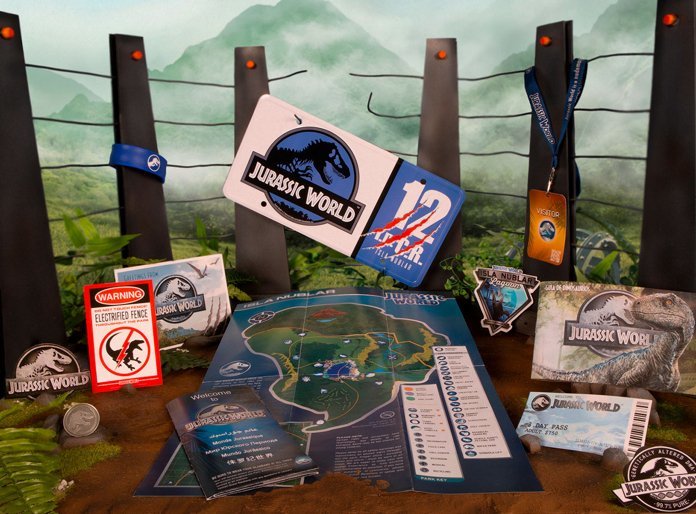
First up we have the Jurassic Park Visitor Center Legacy Kit which includes box art from John Bell (art director on Jurassic Park), a metal stamped license plate, individually numbered entrance ticket, "When Dinosaurs Ruled the Earth" banner, a Jurassic Park brochure map, 18 trading cards, night vision goggles safety instructions, Jurassic Park logo pin, Mr. DNA pin, VIP vistor pass with lanyard, Isla Nublar postcard, T-Rex Kingdom postcard, and three stickers. You can pre-order a kit here for $57.99 with free shipping slated for June. Only 1993 of these kits will be produced, so reserve one while you can.

The Jurassic World Deluxe Welcome Kit includes a metal stamped license plate, entrance ticket, Jurassic World brochure map, dinosaur guide, bracelet scanband, Jurassic World lanyard, VIP visitor pass, exclusive coin, Isla Nublar postcard, and four stickers. It's available to pre-order here for $39.99 with free shipping slated for March.

Pre-order quantities on both of these kits are limited, but you'll definitely want to go for the Jurassic Park kit right away since it's a limited edition. If you own a Jeep it would be worth getting for the license plate alone.

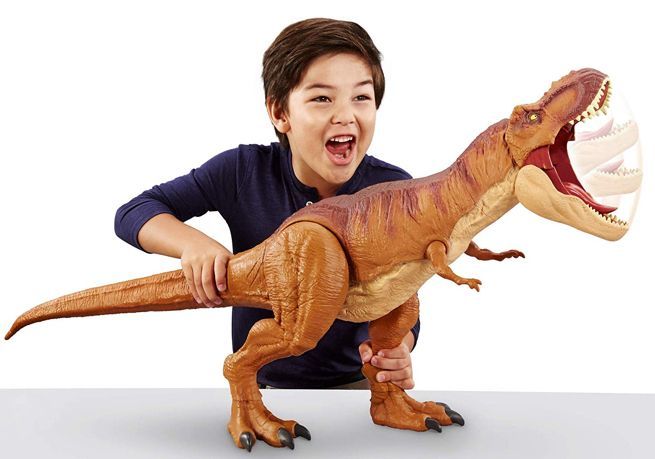
On a related note, the Jurassic World: Fallen Kingdom Super Colossal T-Rex is a whopping 3-feet long and can be ordered on Amazon for $52.98. However, A battle damaged version that roars is available via Walmart for $49 with free 2-day shipping. The official description for the standard T-Rex reads:

From the Jurassic World: Fallen Kingdom movie comes this Super Colossal Tyrannosaurus Rex! Watch out! This Super Colossal T-Rex is on a rampage! Approximately 3-feet long when fully assembled, this massive menace is based on the iconic T-Rex. The T-Rex features an articulated jaw, arms, and legs. Swoop down and pick up smaller, helpless dinosaurs with its articulated jaw to swallow smaller prey whole! This amazing T-Rex functions as a neat carrying unit as well. Open T-Rex's belly compartment to remove any eaten figures.

Source: https://comicbook.com

Galagadon nordquistae: New Cretaceous Shark Species Discovered in South Dakota

Wednesday, January 23, 2019

An illustration showing what Galagadon nordquistae would have looked like in life, swimming along the river floor. Image credit: Velizar Simeonovski, Field Museum.

A new species of freshwater shark that lived about 67 million years ago (Cretaceous period) has been identified from fossilized teeth found in South Dakota.

Named Galagadon nordquistae, the newly-discovered shark species once swam in the Cretaceous rivers of what is now South Dakota.

It was a small freshwater shark (12 to 18 inches, or 30.5-45.7 cm, long), related to modern-day carpet sharks such as the ‘whiskered’ wobbegong shark.

Its tiny teeth — each one measuring less than a millimeter across — were discovered in the sediment left behind when paleontologists uncovered the bones of ‘Sue,’ currently the most complete T. rex specimen ever described.

“The more we discover about the Cretaceous period just before the non-bird dinosaurs went extinct, the more fantastic that world becomes,” said Dr. Terry Gates, lecturer at North Carolina State University and research affiliate with the North Carolina Museum of Natural Sciences.

“It may seem odd today, but about 67 million years ago, what is now South Dakota was covered in forests, swamps and winding rivers.”

“This shark lived at the same time as Sue the T. rex, it was part of the same world,” said Dr. Pete Makovicky, curator of dinosaurs at the Field Museum.

“Most of its body wasn’t preserved, because sharks’ skeletons are made of cartilage, but we were able to find its tiny fossilized teeth.”

Galagadon nordquistae was not swooping in to prey on T. rexTriceratops, or any other dinosaurs that happened into its streams. This shark had teeth that were good for catching small fish or crushing snails and crawdads,” Dr. Gates added.

“It amazes me that we can find microscopic shark teeth sitting right beside the bones of the largest predators of all time. These teeth are the size of a sand grain. Without a microscope you’d just throw them away.”

The study also reflects the importance of learning about fossils beyond big, flashy dinosaurs.

“Every species in an ecosystem plays a supporting role, keeping the whole network together,” Dr. Gates said.

“There is no way for us to understand what changed in the ecosystem during the time of the mass extinction at the end of the Cretaceous without knowing all the wonderful species that existed before.”

“Most people, when they think of fossils, think of big huge dinosaur bones, but in the dirt, there are the bones of tiny animals,” said Field Museum volunteer Karen Nordquist.

“When you get those bones and identify them, you get an idea of the whole environment — everything that lived with the big dinosaurs. You learn so much from microsorting.”

The discovery is described in the Journal of Paleontology.

_____

Terry A. Gates et al. New sharks and other chondrichthyans from the latest Maastrichtian (Late Cretaceous) of North America. Journal of Paleontology, published online January 21, 2019; doi: 10.1017/jpa.2018.92

Source: www.sci-news.com

Saltriovenator zanellai: Meet the Oldest Large Predatory Dinosaur Ever Found

Wednesday, January 23, 2019

Saltriovenator zanellai by Lucas Attwell on DeviantART

Everyone knows or thinks they know of T. rex and Velociraptor sp. from popular portrayals in movies and books like Jurassic Park.  We’re accustomed to these examples of dangerous predatory dinosaurs but those of us seriously interested in dinosaurs know they’re just the tip of the iceberg. 

Large raptors like Utahraptor and other Tyrannosaurids like Albertosaurus of Canada or Teratophoneus of the Grand Staircase-Escalante barely start to fill out a history of almost 200 million years occupied by the likes of Allosaurus and even giant birds (technically dinosaurs) like Moas.  It’s a history that spans the whole globe as well. Predatory Tarbosaurus lived in Mongolia with Velociraptor, theropod (two legged predator) dinosaurs have been found in South America and Africa.  A few theropod fossils have been found in Australia and even Antarctica as well. But now, a new chapter in the history of predator dinosaurs has been discovered.

As we reported last month, researchers working in the Italian Alps have discovered what so far is the oldest example of a ceratosaurian.  Ceratosaurians are the oldest clade of theropod dinosaurs, perhaps best known by the horned Ceratosaurus as well as the Dilophosaurus that played an important role in Jurassic Park.  Both of these examples have strange head gear, the crest on top of the Dilophosaurus (sorry but the neck frill was pure Hollywood invention) and a horn on the nose of the Ceratosaurus

As the oldest of theropods, it’s possible that these dinosaurs were the ancestors of all theropod dinosaurs but it’s impossible to say for sure at this point.  According to the University of California Museum of Paleontology, Ceratosaurians were very bird-like that scientists believe first evolved during the Triassic, a period that started about 225 million years ago.  Despite this, no examples of Ceratosaurians have been found earlier than the Jurassic.

The new dinosaur discovered in Italian Alps is still a Jurassic dinosaur of about 198 million years ago but it’s the oldest of its type found so far.  Other theropod dinosaurs close to the same age are rare and often incomplete. Other old theropod dinosaurs from Europe include incomplete discoveries like a pelvis, vertebrae and femur found in England and a 40% complete Dracoraptor skeleton from Wales.

The new dinosaur has been named Saltriovenator zanellai and is not only older than any other Ceratosaurians found so far, it also seems to represent the largest predator dinosaur that old known to science. The dinosaur is about 25 million years older than previously known large theropod dinosaurs.  This is also the first Jurassic dinosaur fossil found in Italy. The find was just recently published but the fossil was found by an amateur fossil hunter at a quarry back in 1996.

It seems from bite marks left by invertebrates on the bones that the dinosaur died and was nibbled at in the ocean, it likely drifted into before eventually being covered in sediment and fossilized in an area that slowly became part of the Italian Alps. 

The dinosaur is estimated to have weighed 1 ton, measuring 7.5 meters in length when alive and was armed with sharp serrated teeth similar in form and function to other theropod dinosaur teeth as well as living Komodo dragons.  Uniquely S. zanellai has three fingers rather than four as would be expected and seems to have some features common to later dinosaurs mixed with those of earlier dinosaurs. 

The new dinosaur is important in showing the state of dinosaur evolution at that time.  Despite the probability of Ceratosaurians in the Triassic, we know very little about these early theropod dinosaurs.  The end of the Triassic represented a major extinction much less famous than the one that killed off dinosaurs. So the beginning of the Jurassic represent a time when new forms were evolving and filling niches left open by the earlier extinction event.

It seems that Saltriovenator zanellai is just one example of an explosion in the diversity of Ceratosaurians spreading across the world. Examples of other dinosaurs from Morrocco, South Africa, Massachusetts, Antarctica and elsewhere seem to reflect this interpretation of dinosaur evolution.  In their paper, the scientists, Cristiano Dal Sasso​, Simone Maganuco and Andrea Cau describe the importance of the find to dinosaur paleontology,

“…In this context, the discovery of a new specimen from the Sinemurian of Italy is extremely relevant as it is among the oldest Jurassic theropods, it is larger than all other pre-Aalenian theropods (see Skeletal reconstruction and body size section, below) and it improves our knowledge on some of the macroevolutionary patterns that would have characterized the evolution of Theropoda during the Jurassic. It also represents the first dinosaur skeleton from the Italian Alps, the first of Jurassic age, and the second theropod skeleton found in Italy…”

In the evolution of birds more generally, this find also represents a new piece of information on the formation of bird hands (and eventually wings). The fossil shows that long before evolving into wings, the arrangement of bones in dinosaurs were for grasping and struggling with prey. Today, we’re more accustomed to thinking of living dinosaurs (birds) as having no real hands at all but wings, flippers or nearly useless vestiges.  While munching on hot wings or watching birds sitting on a wire, it’s interesting to reflect on the amazing power of evolution over mind boggling lengths of time.

It’s likely that older Ceratosaurian dinosaurs are still hidden somewhere waiting to be found.  Paleontology itself is a speculative science relying on necessarily incomplete physical evidence and hypotheses based on the best of this evidence.  This discovery if anything verifies what scientists have thought about the origins of theropod dinosaurs, showing that they were evolved into something similar to what we expect later in geologic history by the Jurassic.  Scientists speculate that they may have existed even earlier than that. This discovery also shows that Europe played an important role in the evolution of theropod dinosaurs and opens up new possibilities of where to look for them.

Source: www.earth.com

Fossilized Slime of 100-Million-Year-Old Hagfish Shakes up Vertebrate Family Tree

Tuesday, January 22, 2019

Tethymyxine tapirostrum, is a 100-million-year-old, 12-inch long fish embedded in a slab of Cretaceous period limestone from Lebanon, believed to be the first detailed fossil of a hagfish. Credit: Tetsuto Miyashita, University of Chicago

Paleontologists at the University of Chicago have discovered the first detailed fossil of a hagfish, the slimy, eel-like carrion feeders of the ocean. The 100-million-year-old fossil helps answer questions about when these ancient, jawless fish branched off the evolutionary tree from the lineage that gave rise to modern-day jawed vertebrates, including bony fish and humans.

The fossil, named Tethymyxine tapirostrum,is a 12-inch long fish embedded in a slab of Cretaceous period limestone from Lebanon. It fills a 100-million-year gap in the fossil record and shows that hagfish are more closely related to the blood-sucking lamprey than to other fishes. This means that both hagfish and lampreys evolved their eel-like body shape and strange feeding systems after they branched off from the rest of the vertebrate line of ancestry about 500 million years ago.

"This is a major reorganization of the family tree of all fish and their descendants. This allows us to put an evolutionary date on unique traits that set hagfish apart from all other animals," said Tetsuto Miyashita, PhD, a Chicago Fellow in the Department of Organismal Biology and Anatomy at UChicago who led the research. The findings are published this week in the Proceedings of the National Academy of Sciences.

The slimy dead giveaway

Modern-day hagfish are known for their bizarre, nightmarish appearance and unique defense mechanism. They don't have eyes, or jaws or teeth to bite with, but instead use a spiky tongue-like apparatus to rasp flesh off dead fish and whales at the bottom of the ocean. When harassed, they can instantly turn the water around them into a cloud of slime, clogging the gills of would-be predators.

This ability to produce slime is what gave away the Tethymyxine fossil. Miyashita used an imaging technology called synchrotron scanning at Stanford University to identify chemical traces of soft tissue that were left behind in the limestone when the hagfish fossilized. These soft tissues are rarely preserved, which is why there are so few examples of ancient hagfish relatives to study.

The scanning picked up a signal for keratin, the same material that makes up fingernails in humans. Keratin, as it turns out, is a crucial part of what makes the hagfish slime defense so effective. Hagfish have a series of glands along their bodies that produce tiny packets of tightly-coiled keratin fibers, lubricated by mucus-y goo. When these packets hit seawater, the fibers explode and trap the water within, turning everything into shark-choking slop. The fibers are so strong that when dried out they resemble silk threads; they're even being studied as possible biosynthetic fibers to make clothes and other materials.

Miyashita and his colleagues found more than a hundred concentrations of keratin along the body of the fossil, meaning that the ancient hagfish probably evolved its slime defense when the seas included fearsome predators such as plesiosaurs and ichthyosaurs that we no longer see today.

"We now have a fossil that can push back the origin of the hagfish-like body plan by hundreds of millions of years," Miyashita said. "Now, the next question is how this changes our view of the relationships between all these early fish lineages."

Shaking up the vertebrate family tree

Features of the new fossil help place hagfish and their relatives on the vertebrate family tree. In the past, scientists have disagreed about where they belonged, depending on how they tackled the question. Those who rely on fossil evidence alone tend to conclude that hagfish are so primitive that they are not even vertebrates. This implies that all fishes and their vertebrate descendants had a common ancestor that -- more or less -- looked like a hagfish.

But those who work with genetic data argue that hagfish and lampreys are more closely related to each other. This suggests that modern hagfish and lampreys are the odd ones out in the family tree of vertebrates. In that case, the primitive appearance of hagfish and lampreys is deceptive, and the common ancestor of all vertebrates was probably something more conventionally fish-like.

Miyashita's work reconciles these two approaches, using physical evidence of the animal's anatomy from the fossil to come to the same conclusion as the geneticists: that the hagfish and lampreys should be grouped separately from the rest of fishes.

"In a sense, this resets the agenda of how we understand these animals," said Michael Coates, PhD, professor of organismal biology and anatomy at UChicago and a co-author of the new study. "Now we have this important corroboration that they are a group apart. Although they're still part of vertebrate biodiversity, we now have to look at hagfish and lampreys more carefully, and recognize their apparent primitiveness as a specialized condition.

Paleontologists have increasingly used sophisticated imaging techniques in the past few years, but Miyashita's research is one of a handful so far to use synchrotron scanning to identify chemical elements in a fossil. While it was crucial to detect anatomical structures in the hagfish fossil, he believes it can also be a useful tool to help scientists detect paint or glue used to embellish a fossil or even outright forge a specimen. Any attempt to spice up a fossil specimen leaves chemical fingerprints that light up like holiday decorations in a synchrotron scan.

"I'm impressed with what Tetsuto has marshaled here," Coates said. "He's maxed out all the different techniques and approaches that can be applied to this fossil to extract information from it, to understand it and to check it thoroughly."

The study, “A Hagfish from the Cretaceous Tethys Sea and a Reconciliation of the Morphological-Molecular Conflict in Early Vertebrate Phylogeny,” was supported by the National Science Foundation and the National Science and Engineering Research Council (Canada). Additional authors include Robert Farrar and Peter Larson from the Black Hills Institute of Geological Research; Phillip Manning and Roy Wogelius from the University of Manchester; Nicholas Edwards and Uwe Bergmann from the SLAC National Accelerator Laboratory; Jennifer Anné from the Children’s Museum of Indianapolis; and Richard Palmer and Philip Currie from the University of Alberta.


Story Source:

Materials provided by University of Chicago Medical Center. Original written by Matt Wood. Note: Content may be edited for style and length.

Source: www.sciencedaily.com

A T. Rex and a Shark as Neighbors? Yes, Eons Ago in South Dakota

Tuesday, January 22, 2019

The Tyrannosaurus rex named Sue is shown on display at the Field Museum in Chicago, Illinois, U.S., in this undated photo provided January 1

Scientists conducting a recent painstaking examination of the two tons of rock left over after the fossilized bones of the celebrated Tyrannosaurus rex named Sue were extricated in the 1990s came across a surprise: shark teeth.

The huge meat-eating dinosaur did not meet its demise in a shark attack in some sort of "Jaws" meets "Jurassic Park" monster mash. But, scientists said on Monday, when the 40-1/2-foot-long (12.3-meter) Sue died some 67 million years ago, the beast fell into a South Dakota river teeming with sharks - albeit small ones - thriving in the freshwater environment.

The skeleton of Sue, the largest, most complete and best-preserved T. rex ever unearthed, is displayed at the Field Museum in Chicago, which kept the leftover rock for years in underground storage. That rock has now yielded fossils from other creatures that were Sue's neighbors including a shark species called Galagadon nordquistae.

Galagadon, related to a group called carpet sharks found in Indo-Pacific seas today, measured 1-2 feet (0.3-0.6 meters) long, with teeth the size of a sand grain, about four-hundredths of an inch (1 millimeter). Tyrannosaurus teeth were up to a foot long (30 centimeters).

If Galagadon ever interacted with Sue, it may have been when the thirsty dinosaur came to the river for a gulp of water.

"It would not surprise me at all if a T. rex individual scared a little Galagadon as it lowered its head to drink," said North Carolina State University paleontologist Terry "Bucky" Gates, lead author of the research published in the Journal of Paleontology.

If Galagadon resembled its existing relatives, it was a blunt-faced bottom-dweller with barbels by its mouth like a catfish and camouflage patterning.

"The teeth have an unusual shape with three unequal points and a wide apron at the root. Some of the teeth bear an uncanny resemblance to the spaceship in the 1980s arcade game 'Galaga,' which inspired the genus name," said co-author Pete Makovicky, a paleontologist and Field Museum dinosaur curator.

Scientists also are studying fossils of at least two other shark species from Sue's river. Virtually all sharks live in the sea, though two freshwater species today reside permanently in rivers and lakes, and some other species venture into freshwater.

"I doubt Galagadon spent its whole life in freshwater habitats," Makovicky said, suggesting its river may have been connected to an inland sea 100 miles (160 km) away that at the time split North America in half.

Source: https://kfgo.com

Pages