Blogs

Tiny Tyrannosaur Fossil Discovery Changes The Dinosaur Timeline

Friday, February 22, 2019

Tyrannosaurus Rex. Dean Mouhtaropoulos/Getty Images

Dinosaur fossil found in Utah.

Tyrannosaurus rex wasn't always the king of the dinosaurs. Before they became towering predators, tyrannosaurs started out much smaller, and a newly discovered fossil is helping fill the gap between those two extremes.

The fossil findings are detailed in a study published in Communications Biology.

The dinosaur fossil was found in Utah, where it lived 96 million years ago in a lush delta during the Cretaceous period. It's been named Moros intrepidus, which means "harbinger of doom." The dinosaur lived at the end of the allosaurs' reign at the top of the food chain and before Tyrannosaurus rex arrived.

It's now the oldest tyrannosaur from the Cretaceous period found in North America.

Medium-size tyrannosaur fossils have been found from the Jurassic period, about 150 million years ago. And then, about 81 million years ago during the Cretaceous, tyrannosaurs grew into giant predators and replaced allosaurs as the top of the food chain.

So what happened in between? Moros is helping researchers fill that 70 million-year gap, as well as provide a portrait of tyrannosaur lineage in North America. Moros links the earliest, smaller tyrannosaurs to Tyrannosaurus rex.

"With a lethal combination of bone-crunching bite forces, stereoscopic vision, rapid growth rates, and colossal size, tyrant dinosaurs reigned uncontested for 15 million years leading up to the end-Cretaceous extinction -- but it wasn't always that way," said Lindsay Zanno, lead study author and paleontologist at North Carolina State University, in a statement. "When and how quickly tyrannosaurs went from wallflower to prom king has been vexing paleontologists for a long time. The only way to attack this problem was to get out there and find more data on these rare animals."

Zanno and her team spent a decade searching for fossils from the Late Cretaceous period. They recovered teeth and a hind limb consisting of a femur, a tibia and parts of a foot belonging to Moros in the same area where Zanno found the fossil of a giant carnivorous carcharodontosaur.

But Moros stood between 3 and 4 feet tall. The dinosaur they found was 7 years old when it died, a nearly full-grown adult that would have weighed around 172 pounds. The elongated leg and foot bones indicated that it would be a great runner.

"Moros was lightweight and exceptionally fast," Zanno said. "These adaptations, together with advanced sensory capabilities, are the mark of a formidable predator. It could easily have run down prey, while avoiding confrontation with the top predators of the day."

This allowed Moros to be a survivor as the environment shifted and changed. For 15 million years, tyrannosaurs were restricted to this smaller size before evolving into giants (about 12 feet tall and 11,000 to 15,500 pounds) over a 16 million-year period.

"Although the earliest Cretaceous tyrannosaurs were small, their predatory specializations meant that they were primed to take advantage of new opportunities when warming temperatures, rising sea-level and shrinking ranges restructured ecosystems at the beginning of the Late Cretaceous," Zanno said. "We now know it took them less than 15 million years to rise to power."

Moros is most closely related to tyrannosaurs from Asia, which helped the researchers trace the dinosaurs' lineage. This means Moros crossed the Alaskan land bridge during the Early Cretaceous to reach North America.

"T. rex and its famous contemporaries such as Triceratops may be among our most beloved cultural icons, but we owe their existence to their intrepid ancestors who migrated here from Asia at least 30 million years prior," Zanno said. "Moros signals the establishment of the iconic Late Cretaceous ecosystems of North America."

Follow us: @paleontologyworld on Instagram | Paleontology World on Facebook

Source: www.keyt.com

10 Terrific Dinosaur Books For Adults

Sunday, February 24, 2019

Artwork by Román García Mora

The continued success of the Jurassic Park franchise just goes to show that most of us never got over our childhood fascinations with our prehistoric pals the dinosaurs. The difference between now and then is that we can appreciate more of the mystery and the science than we could back then.  The books on this list will allow you to do a deep dive into the secret lives of dinosaurs, both factual and fictional. Here are 10 of the best dinosaur books for adults.

NOTE:  With the noteworthy exception of Paige Williams and The Dinosaur Artist, this list is made up of primarily white male authors. That seems to be most of what is available out there in terms of dinosaur books for adults. If you have any recommendations for books written by a more diverse group of writers, we’d love to hear them!


NON-FICTION DINOSAUR BOOKS FOR ADULTS

THE DINOSAUR ARTIST BY PAIGE WILLIAMS

This is not your typical dinosaur book. It’s not written by a paleontologist. It’s a work of investigative journalism about the world of fossils and the lengths to which people will go in their quest to hold such a prominent piece of the past. This is the story of Erik Prokopi, a “super Tyrannosaurus” specimen (actually a T. Bataar), and the fierce custody battle that springs up when he tries to sell it at auction.

THE RISE AND FALL OF THE DINOSAURS: A NEW HISTORY OF A LOST WORLD BY STEVE BRUSATTE

Called the “Best Dinosaur Biography” by Scientific American and rated one of the best Science books of 2018, The Rise and Fall of the Dinosaurs is the most up-to-date account of the age of dinosaurs out there. The book charts not only the history of dinosaurs on this planet, but also the work of Steve Brusatte, a young American paleontologist at the University of Edinburgh. It is an interesting, engaging, and highly educational read.

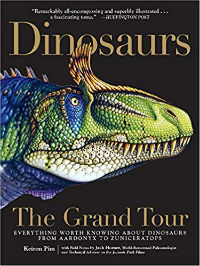
DINOSAURS―THE GRAND TOUR: EVERYTHING WORTH KNOWING ABOUT DINOSAURS FROM AARDONYX TO ZUNICERATOPS BY KEIRON PIM 

This book is an A to Z record of everything you have ever wanted to know about more than 300 dinosaur varieties. The information is pulled from many, many different sources – not just the annals of paleontology. Pim includes information on anatomy, astronomy, evolution, and mythology to complete the record.

WEIRD DINOSAURS: THE STRANGE NEW FOSSILS CHALLENGING EVERYTHING WE THOUGHT WE KNEW BY JOHN PICKRELL

John Pickrell, science writer and dinosaur enthusiast, traveled the world to find out about the newest, most interesting finds, including an aquatic crocodile-looking creature that was larger than a T-Rex found in North Africa and a creature with bat-like wings found in China. Readers will also find out about some of the new technologies used to make these discoveries.

KING OF THE DINOSAUR HUNTERS: THE LIFE OF JOHN BELL HATCHER AND THE DISCOVERIES THAT SHAPED PALEONTOLOGY BY LOWELL DINGUS

John Bell Hatcher is responsible for finding a number of the most famous dinosaur skeletons out there, with many of his finds housed at Yale, Princeton, The Peabody Museum, and the Carnegie Museum. His discoveries, many made in Wyoming during the 1890s, are only part of what made this man a legend. Dingus explores the life of this “real life Indiana Jones” in this thoroughly engaging biography.

BIG BONE LICK: THE CRADLE OF AMERICAN PALEONTOLOGY BY STANLEY HEDEEN

This story traces the history of the fossil site known as Big Bone Lick from the Shawnee legends that tell of a herd of giant bison and a great salt lick to the “discovery” of the fossil site by European settlers in 1739. This discovery captured the imagination of many in what would eventually be known as America, including George Washington and Benjamin Franklin. It opened their eyes to a new way of thinking about the world and gave rise to the study of fossils for scientific purposes. Think of it as paleontology’s (well, American paleontology’s) origin story.


FICTION DINOSAUR BOOKS FOR ADULTS

DRAGON TEETH BY MICHAEL CRICHTON

It turns out that Jurassic Park wasn’t Michael Crichton’s only novel to involve dinosaurs. This recently discovered work is set in the American West in 1876 and tells the story of two paleontologists who are ruthless in the pursuit of the most impressive fossil finds. Their rivalry, the “Bone Wars,” serves as the backdrop for a bet between Yale student William Johnson and his arch-rival. He just has to survive the summer in the west. Doing so while working for (first one then the other) the famous paleontologists Cope and Marsh proves to be more difficult than he could have ever imagined.

THE DINOSAUR HUNTER BY HOMER HICKAM

Mike Wire is a retired homicide detective, now working as the foreman on a Ranch in Montana. When fossils are discovered on the ranch, paleontologist Norman Pickford works out a deal to handle the dig. It soon becomes clear that these fossils are far more important than anyone realized. Someone is even willing to kill over them. Mike realizes that murder can happen anywhere.  The novel is an interesting mix of science and mystery. It builds slowly, but the payoff is worth it.

THE DINOSAUR LORDS (SERIES) BY VICTOR MILAN

George R.R. Martin describes The Dinosaur Lords as “a cross between Jurassic Park and Game of Thrones,” and as one of those is his own creation, it’s probably a safe bet to believe him. This series take places in a world not unlike our own 14th century Europe – except for the presence of dinosaurs. They’ve been domesticated, used for beasts of burden, war machines, and any number of things in between. It’s a really interesting concept that will appeal to those who can’t help but wonder what it would have been like to live during the time that the dinosaurs walked the Earth.


A FUN DINOSAUR BOOK FOR ADULTS

ENCYCLOPEDIA PREHISTORICA DINOSAURS: THE DEFINITIVE POP-UP BY ROBERT SABURDA AND MATTHEW REINHART

This is the perfect  coffee table book for any dinosaur enthusiast. Don’t let the simple cover fool you. Inside you’ll find gorgeous pop-up illustrations, fun facts, and anecdotes about the history of paleontology, like the Bone Wars (mentioned in the Crichton novel above) or the Victorian New Year’s Dinner held inside the belly of a dinosaur skeleton.

Know a kid who is into dinosaurs? Check out this list of 6 Seriously Science-y Dinosaur Books for Future Paleontologists.

Follow us: @paleontologyworld on Instagram | Paleontology World on Facebook

Source: https://bookriot.com

Meet This Tiny Ancestor of the Fearsome T. Rex

Friday, February 22, 2019

JORGE GONZALEZ

Moros intrepidus is a distant relative that lived millions of years before the first T. rex was born, and tells scientists how Tyrannosaurs evolved.

Tyrannosaurus rex has become one of the most notorious predators that ever walked the earth, thanks to in part to movies like Jurassic Park. The T. rex you know and fear was a monster with teeth as long as a person’s forearm. But Tyrannosaurs haven’t always been so gigantic. According to a new fossil discovery, early Tyrannosaurs were much smaller.

WHEN AND HOW QUICKLY TYRANNOSAURS WENT FROM WALLFLOWER TO PROM KING HAS BEEN VEXING PALEONTOLOGISTS.

Archaeologists working in Utah recently uncovered a fossilized member of a new Tyrannosaur species, called Moros intrepidus. It lived in the area around 100 million years ago, about 15 million years before the first giant Tyrannosaurs appeared.

Uniquely, Moros is significantly smaller than most of the well-known Tyrannosaurs, like the infamous Rex. While T. rex stood nearly 12 feet high, Moros would only come up to an adult human’s waist. It wouldn’t have been much bigger than a large dog.

Interestingly, scientists have found fossils of other Tyrannosaurs that are much older—about 150 million years old, to be exact—that are around the same size as Moros. According to these fossils, the vast majority of Tyrannosaurs were very small, and only started getting big toward the end of their history.

This discovery is a big deal because it fills what has been a blank spot in Tyrannosaurs' history. Prior to the discovery of Moros, we knew about Tyrannosaurs from 150 million years ago, and we knew about Tyrannosaurs from 80 million years ago, but we knew nothing about any of the Tyrannosaurs in between. That was a 70-million-year gap in the fossil record.

"When and how quickly tyrannosaurs went from wallflower to prom king has been vexing paleontologists for a long time,” said lead study author Lindsay Zanno in a press release. “The only way to attack this problem was to get out there and find more data on these rare animals."

Now, thanks to Moros, we have a clearer picture of how Tyrannosaurs evolved. We know that they spent most of their history not as gigantic fearsome predators, but as small and nimble hunters. Arguably, a smaller Tyrannosaur might be even scarier since it can fit through doorways.

Follow us: @paleontologyworld on Instagram | Paleontology World on Facebook

Source: www.popularmechanics.com

Raptor Noises in ‘Jurassic Park’ Were Made From the Sounds of Tortoises Mating

Saturday, February 23, 2019

Did You Know the Raptor Sounds in 'Jurassic Park' Were Made from Turtle Sex?

If you’re a dinosaur enthusiast, for sure you have already heard  about this secret (that is not so secret!) from Steven Spielberg’s 1993 classic film “Jurassic Park.” The sound effects used for the velociraptors in the movie were not recordings of enraged animals, but actually, two tortoises having sex.

In an interview with Vulture, Gary Rydstrom, the sound designer of the film, said that “If people knew where the sounds in Jurassic Park came from, it’d be rated R!”

Rydstrom was asked to create a bunch of different dinosaur sounds from square one since not even a single living person in this world knows what these humongous creatures would have sounded like. His game plan was to spend months recording animal sounds then modifying the noise to make it sound more real and natural.

So, how did he record these two tortoises mating? The story of how he got the recording is very simple and casual, nothing too funny or upsetting.

“It’s somewhat embarrassing, but when the raptors bark at each other to communicate, it’s a tortoise having sex,” Rydstrom said.

“It’s a mating tortoise! I recorded that at Marine World…the people there said, ‘Would you like to record these two tortoises that are mating?’ It sounded like a joke because tortoises mating can take a long time. You’ve got to have plenty of time to sit around and watch and record them.'”

But tortoises having an “intimate time” together wasn’t the only animal component used to produce raptor noises. Rydstrom also used horse noises, not just for raptors, but also for three to four individual dinosaurs. Hissing sounds that the Raptors made in the film were actually goose noises.

“Birds make pretty raspy sounds, but geese are famous for being the nastiest. You’ve got to get a goose mad and then they hiss at you, and it doesn’t take much to get a goose mad because they seem to get mad at everything,” explained the brilliant sound designer.

Follow us: @paleontologyworld on Instagram | Paleontology World on Facebook

Source: https://pop.inquirer.net

How Sex Killed Tyrannosaurus rex

Sunday, February 10, 2019

AP Photo/Michel Euler

Tyrannosaurus rex, king of the tyrant lizards, may have been the most fearsome land predator to ever exist on planet Earth. Yet despite its lofty position and regal name, T. rex did not live a pampered, kingly lifestyle. True, no other dinosaur species directly predated upon T. rex after it reached the age of two, when an individual would have grown large enough to dissuade any would be attacker, but that doesn't mean that tyrannosaurs cruised through life, succumbing only to death from old age. In reality, life at the top was not a walk in the (Cretaceous) park.

The most obvious source of peril was prey. Tyrannosaurs would try to pick off juvenile, smaller, or sickly dinosaurs, but would still have to reckon with an angry Ankylosaur, Triceratops, or Edmontosaur in the process. A swipe from a clubbed tail could shatter bones, rendering a T. rex unable to hunt and susceptible to starvation. A stab from a horn could result in infection and eventual death. Herbivores may have had to contend with being hunted, but at least they didn't have to do battle every time they wanted a meal.

Infant T. rex suffered the highest mortality, endangered by predators and disease, but upon becoming a juvenile around age two, life was fairly safe, with nearly three-quarters of individuals surviving to their 13th birthday. Here was where things started to get hairy, however

The pre-teens heralded sexual maturity. Combat for mates and nesting sites would turn T. rex against T. rex. Females would also likely experience extreme stress from laying lots of eggs. Between the ages of 13 and 18, mortality for T. rex might have spiked to as high as 23 percent a year. According to Florida State paleontologist Gregory M. Ericksonover half of the known T. rex specimens seem to have died within six years of reaching sexual maturity.

As T. rex battled each other, they might also have been spreading parasites. In 2009, a group of paleontologists theorized that the dinosaurs commonly suffered from Trichomonas gallinae infections, which afflicts modern birds to this day. The parasite eats away at the back of the throat, inflaming nearby tissues and even leaving telltale holes in the back of the lower jaw, which are conspicuously present in many notable T. rex fossils.

Tyrannosaurus rex confirms that life at the top of the food chain is not the easiest, quite the opposite in fact. As few as one in fifty Tyrannosaurs may have reached their maximum attainable body sizes, achieved after living for more than twenty years. Firmly outliving the mighty T. rex were the massive, herbivorous Apatosaurus, Brachiosaurus, and Supersaurus, which could live as long as a century, almost four times longer than the lifespan of Sue, the oldest-known T. rex.

Source: www.realclearscience.com

Moros intrepidus: New Deer-Sized Species of Tyrannosaur Discovered

Saturday, February 23, 2019

Moros intrepidus. Image credit: Jorge Gonzalez.

Paleontologists have unveiled a remarkable new species of tyrannosauroid dinosaur from the Cretaceous period: a small relative of Tyrannosaurus rex. The discovery is described in the journal Communications Biology.

Medium-sized, primitive tyrannosaurs have been found in North America dating from the Jurassic period (around 150 million years ago).

By the Cretaceous period (81 million years ago) North American tyrannosaurs had become the enormous, iconic apex predators we know and love.

The fossil record between these time periods has been a blank slate, preventing paleontologists from piecing together the story behind the ascent of tyrannosaurs in North America.

“When and how quickly tyrannosaurs went from wallflower to prom king has been vexing paleontologists for a long time,” said Dr. Lindsay Zanno, a paleontologist at North Carolina State University and head of paleontology at the North Carolina Museum of Sciences.

“The only way to attack this problem was to get out there and find more data on these rare animals.”

The newly-discovered tyrannosaur, named Moros intrepidus, lived about 96 million years ago in the lush, deltaic environment of what is now Utah.

It is the oldest Cretaceous tyrannosaur species yet discovered in North America, narrowing a 70-million-year gap in the fossil record of tyrannosauroid dinosaurs on the continent.

“With a lethal combination of bone-crunching bite forces, stereoscopic vision, rapid growth rates, and colossal size, tyrant dinosaurs reigned uncontested for 15 million years leading up to the end-Cretaceous extinction — but it wasn’t always that way,” Dr. Zanno said.

“Early in their evolution, tyrannosaurs hunted in the shadows of archaic lineages such as allosaurs that were already established at the top of the food chain.”

With a 3.9-foot (1.2 m) length and 78-kg mass, Moros intrepidus ranks among the smallest Cretaceous tyrannosauroids.

Dr. Zanno and colleagues estimate that the individual was over seven years old when it died, and that it was nearly full-grown.

Moros intrepidus was lightweight and exceptionally fast,” Dr. Zanno said.

“These adaptations, together with advanced sensory capabilities, are the mark of a formidable predator.”

“It could easily have run down prey, while avoiding confrontation with the top predators of the day.”

The bones of the new tyrannosaur also revealed the origin of T. rex’s lineage on the North American continent.

When the scientists placed Moros intrepidus within the family tree of tyrannosaurs they discovered that its closest relatives were from Asia.

T. rex and its famous contemporaries such as Triceratops may be among our most beloved cultural icons, but we owe their existence to their intrepid ancestors who migrated here from Asia at least 30 million years prior,” Dr. Zanno said.

Moros intrepidus signals the establishment of the iconic Late Cretaceous ecosystems of North America.”

_____

Lindsay E. Zanno et al. 2019. Diminutive fleet-footed tyrannosauroid narrows the 70-million-year gap in the North American fossil record. Communications Biology 2, article number: 64; doi: 10.1038/s42003-019-0308-7

Source: www.sci-news.com

Dimetrodon Footprints Found on P.E.I. Bring Island to 'World Stage' of Paleontology

Friday, February 22, 2019

Skeleton of D. incisivum, Staatliches Museum für Naturkunde Karlsruhe

'Prince Edward Island holds Canada’s only fossil record of life on land in the Permian period'

A series of footprints found in May in P.E.I. National Park near Cavendish have been confirmed as those of the sail-backed Bathygnathus borealis, more commonly known as Dimetrodon.

Laura MacNeil, who has a background in geology, discovered the footprints while searching for fossils in the area. 

"It was about the size of my hand and it almost looked like a human hand, but if the thumb were replaced with another digit," she said.

"I looked at it for about a half an hour trying to convince myself that this wasn't a fossil because when you're in science, you try to be skeptical because … you don't want to just jump to conclusions."

'The footprints are of creatures that were living'

MacNeil said she ran back to her car to call the the province who then called Parks Canada and Dr. John Calder, a geologist at Saint Mary's University, to confirm what the discovery was. 

"My jaw was open for quite a long time. I couldn't believe it, honestly," she said.

Calder said the footprints belonged to a dimetrodon, a reptile-like mammal that lived 100 million years before the dinosaurs.

"It's the first example from P.E.I. of this type of footprint," he said.

This isn't the first time a dimetrodon fossil has been found on P.E.I.

'The fossil record on P.E.I. is truly world class'

In 1845, the upper jaw bone of a dimetrodon was discovered by a farmer during a well excavation in French River, near the Island's North Shore.

Calder said the discovery of the footprint is especially significant. 

"The bones are of dead creatures, the footprints are of creatures that were living," he said.

"When you see a fossil footprint, it's a living fossil and it shows this animal actually walked here, this is how it stepped, this is where it walked."

Dimetrodons are huge, ancient reptiles related to modern mammals that had giant spiny "sails" on their backs.

They ate giant salamanders in the steamy, swampy forests of the early Permian period, around 290 million years ago. 

Rich prehistoric history

Although fossils are scattered in various places across the Island, these particular footprints are important as they indicate that P.E.I. holds some of Canada's richest evidence of terrestrial fossils of the Permian period.

Their fossils have previously been found in Germany and the United States.

"The fossil record on P.E.I. is truly world class and yet most people don't even know about it," said Calder. ​

MacNeil said the fossil will be studied by scientists and hopefully put on display at P.E.I's national park this summer. 

Source: www.cbc.ca

How Fossilized Poo Changed Our View on Dinosaurs

Friday, February 22, 2019

Source: Mike Beauregard // Flickr

Were you aware that some of the most beautiful (and informative) fossils out there are actually made of poop?

Yeah, it turns out that dino dung not only makes some gorgeous jewelry, it’s also full of information that scientists can use to learn about the environment and behaviors of some long-extinct creatures! Oh, and to make it even cooler, these pieces of fossilized poo have played a giant role in the history of women in science. Who knew such wonders could come in such strange forms? Just check out the inside of this one!

Unlike fossil finds of bone, fossilized poop, called coprolites, are able to give us insights into an animal’s diet, environment, and even hint at some of their unexpected behaviors! But even though dino dung would have been prevalent in its day, coprolites are far less common than their boney brethren.

For Paleontologists like Dr. Karen Chin, who studies ancient ecosystems, sometimes coprolites are the best evidence left behind. Hidden in these gems—really though they can be quite beautiful—lay clues to which species were available for the animals to eat and even the creatures that then made the poo their home!

Alright so let’s get into this! Here’s a great piece from the fantastic YouTube channel SciFri. If you haven’t yet subscribed to them jump over and give them a follow. They are a great source of all things science!

So there you go! Dinosaur poop can unlock a few mysteries and help us see into the ancient past with more clarity than ever.

But why does ancient dino dung matter to any of us today?

Let’s start with three words, women in science. Alright, friends, I won’t lie I really wasn’t sure where to go next with this article. I wanted to give you all more, in-depth media featuring coprolite factoids. Most of the videos featuring coprolites tend to focus on the “Oh cool, poop!” angle and less on the “Woah! Science!” angle. I was stumped, really really stumped.

But then, I found the podcast Tumble! If you haven’t heard of them yet, allow me to change your life.

Or, more accurately, the life of any kid you know. It’s a science podcast for kids and it’s PHENOMENAL! They cover all kinds of scientific topics from approachable angles that kids and adults can enjoy. And, they run about 15-20 minutes long so they stay at a pace that keeps kids (and distractable adults) engaged. Honestly, I’m subscribing as a curious adult without kids in her life.

So, back to why this all matters to us? They have two episodes on coprolites. The first features an interview with Dr. Chin, the paleontologist from the video we featured today. The second shines a light on the fascinating history of coprolites. As it turns out, dinosaur poop plays a critical role in the history of women in science! It even involves one of my personal science heroes, Mary Anning. Yes, if you or I or anybody else knows or is a woman of science, we can thank coprolites for playing a part in helping women break into the field!

No matter your age, there’s something there for you.

Oh, and here are the links to a couple of the great things they mentioned in the episode. Here is the link to Kidosaurus. And if you want to dig into the history of women in archaeology, geology and paleontology go check out TrowelBlazers!

Source: https://everwideningcircles.com

Extraordinary Diversity on Land Is Not a Recent Phenomenon, Says New Study

Thursday, February 21, 2019

Reconstructions of land vertebrate communities through the Phanerozoic. Image credit: University of Birmingham.

According to new research published in the journal Nature Ecology & Evolution, land animal diversity has been similar for at least the last 60 million years, since soon after the extinction of the dinosaurs.

“Our work provides an example of the combined power of the fossil record and modern statistical approaches to answer major questions about the origins of modern biodiversity,” said University of Birmingham’s Professor Richard Butler, senior author of the study.

“By understanding how biodiversity has changed in the past, we may be able to better understand the likely long-term impact of the current biodiversity crisis.”

Previously, many scientists have argued that diversity increased steadily through geological time, which would mean that biodiversity today is much greater than it was tens of millions of years ago.

But building an accurate picture of how land diversity was assembled is challenging because the fossil record generally becomes less complete further back in time.

Professor Butler and colleagues examined how the diversity of land vertebrate species living in local ecosystems (also known as ecological communities) changed over the last 375 million years.

The researchers analyzed nearly 30,000 fossil sites that have produced fossils of tetrapods, land vertebrate animals, such as mammals, birds, reptiles (including dinosaurs) and amphibians.

They found that the average number of species within ecological communities of land vertebrates have not increased for tens of millions of years.

Their results suggest that interactions between species, including competition for food and space, will limit the overall number of species that can co-exist.

“Scientists often think that species diversity has been increasing unchecked over millions of years, and that diversity is much greater today than it was in the distant past,” said study lead author Dr. Roger Close, also from the University of Birmingham.

“Our research shows that numbers of species within terrestrial communities are limited over long timescales, which contradicts the results of many experiments in modern ecological communities — now we need to understand why.”

One reason why diversity within ecological communities does not increase unchecked on long timescales could be because resources used by species, such as food and space, are finite.

Competition for these resources may prevent new species invading ecosystems and lead to a balance between rates of speciation and extinction.

After the origins of major groups of animals, or large-scale ecological disruptions like mass extinctions, though, increases in diversity may happen abruptly — on geological, if not human timescales — and are again followed by long periods where no increases occur.

“Contrary to what you might expect, the largest increase in diversity within land vertebrate communities came after the mass extinction that wiped out the dinosaurs, 66 million years ago, at the end of the Cretaceous period,” Dr. Close said.

“Within just a few million years, local diversity had increased to two or three times that of pre-extinction levels — driven primarily by the spectacular success of modern mammals.”

_____

Roger A. Close et al. Diversity dynamics of Phanerozoic terrestrial tetrapods at the local-community scale. Nature Ecology & Evolution, published online February 18, 2019; doi: 10.1038/s41559-019-0811-8

Source: www.sci-news.com

Unnuakomys hutchisoni: Paleontologists Discover Northernmost Marsupial Known to Science

Friday, February 22, 2019

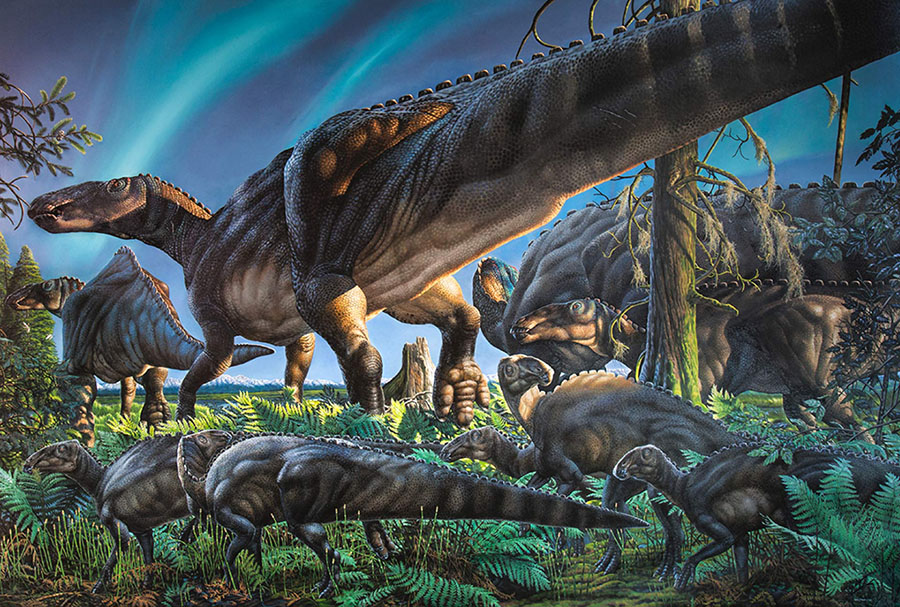
Small creatures like Unnuakomys hutchisoni scurried at the feet of duck-billed dinosaurs and other larger animals in Alaska’s polar forests 69 million years ago. Image credit: James Havens.

Paleontologists have uncovered a new species of marsupial that lived during the Cretaceous period above the Arctic Circle, the farthest north marsupials have ever been found.

The new marsupial, named Unnuakomys hutchisoni, is a member of Metatheria, a group within mammals that includes modern-day marsupials and their fossil relatives.

The opossum-like critter roamed the Earth approximately 69 million years ago. It rubbed elbows with dinosaurs on a land mass that was, at the time, located far above the Arctic Circle.

The ancient creature was about the size of a house mouse, probably munched on insects, and may have lived underground.

“Despite an estimated weight of less than an ounce, this itty-bitty animal was probably pretty hardy,” said Dr. Jaelyn Eberle, curator of fossil vertebrates at the University of Colorado Museum of Natural History.

“It would have needed to survive 120 days of darkness in the winter and temperatures that averaged just 42 degrees Fahrenheit (about 6 degrees Celsius).”

“These guys must have been adapted to darkness because they spent a lot of time in it.”

Unnuakomys hutchisoni. Image credit: James Havens.

Over 60 specimens of Unnuakomys hutchisoni teeth and jaws were collected from the Cretaceous deposits of the Prince Creek Formation cropping out along the Colville River on the North Slope of Alaska.

“The discovery paints a more detailed picture of the flora and fauna that once thrived in what is now the North Slope of Alaska — a region that, in the age of dinosaurs like Tyrannosaurus rex, was home to species not seen anywhere else on Earth,” Dr. Eberle said.

“This new marsupial is an exciting addition to the growing list of new species of dinosaurs and other animals that we are describing from northern Alaska as part of a bigger project to reveal ancient Arctic ecosystems,” said Dr. Patrick Druckenmiller, a researcher at the University of Alaska Fairbanks.

The discovery is reported in a paper in the Journal of Systematic Palaeontology.

_____

Jaelyn J. Eberle et al. Northernmost record of the Metatheria: a new Late Cretaceous pediomyid from the North Slope of Alaska. Journal of Systematic Palaeontology, published online February 14, 2019; doi: 10.1080/14772019.2018.1560369

Source: www.sci-news.com

Pages