Blogs

Jurassic Park Danger! NEW Exciting Strategy Board Game

Friday, April 19, 2019

Select to control the dinosaurs or the humans and let battle commence in this Jurassic Park light strategy game. You must work together to activate locations, complete tasks and make it to the helicopter and out of there alive before it’s too late.

Jurassic Park Danger! is the perfect board game for fans of the film series, dino lovers and families to enjoy on a rainy day.

Be the first to review this product

Dinosaur Fossils Found in Antarctica

Friday, April 19, 2019

In an Antarctic expedition, researchers have discovered a fossilized dinosaur footprint approximately 200 million years old.

In an Antarctic expedition, researchers have discovered a fossilized dinosaur footprint approximately 200 million years old. 

It is about the hand-sized trace of an animal from the group of archosaurs, said the Federal Institute for Geosciences and Natural Resources (BGR) in Hanover.

According to the German news agency, the researchers found the trail finder in January 2016 in the Helliwell Hills in northern Victoria Land, but their findings were recently published in the journal "Polar Research".

BGR expedition leader Andreas Läufer revealed that dinosaur bones were already discovered in the southern Viktorialand, in the north, however, not even a tooth.

"That was something we had not expected at all," he said.

In addition, scientists found fossilized remnants of forests around 1700 kilometers from the South Pole.

"This is an indication that Antarctica was not the icy continent, as we know it today, about 200 million years ago," said Räufer.

Source: https://aawsat.com

Scientists Unearth 220 Million-Year-Old Dinosaur Fossils in Argentina

Friday, April 19, 2019

220-million-year-old-fossil

A site containing the 220-million-year-old fossilized remains of nearly a dozen dinosaurs has been discovered in western Argentina.

“There are almost ten different individuals, it’s a mass of bones, there’s practically no sediment,” said Argentinian paleontologist Ricardo Martinez.

“It’s very impressive.”

According to Martinez of the University of San Juan, the fossils are approximately 220 million years old, belonging to “an era of which we know little.”

“This discovery is doubly important because there are at least seven or eight individuals of dicynodonts, the ancestors of mammals, the size of an ox,” he said.

He said there were also remains of archosaurs, reptiles that could be the ancestors of great crocodiles “that we do not know about yet.”

The find was discovered in September last year in San Juan province, about 1,100 kilometres (680 miles) west of Buenos Aires.

The site is between one and two metres (yards) in diameter and about the same depth, leading scientists to speculate it was a former drinking hole at a time of great drought, and the creatures died of weakness at the spot.

Argentina has been a rich source of fossils from the Triassic, Jurassic and Cretaceous periods over the years — most, of creatures not found in the northern hemisphere.

Source: https://egyptindependent.com

Simbakubwa kutokaafrika: Carnivorous Mammal Larger than Polar Bear Once Roamed Kenya

Saturday, April 20, 2019

Simbakubwa kutokaafrika, a hyaenodont that was larger than a polar bear. Image credit: Mauricio Anton.

A gigantic meat-eating mammal has been discovered — after its jaw, portions of its skull, and parts of its skeleton spent several decades sitting in a museum.

Dubbed Simbakubwa kutokaafrika (means ‘Big lion from Africa’ in Swahili), the gigantic carnivore lived about 22 million years ago (Early Miocene Epoch) in what is now Kenya.

The ancient creature was the size of a small rhinoceros and had a body mass of up to 1,500 kg.

© Nancy Stevens / Ohio University

Its fossilized remains have been owned by the National Museums of Kenya since the 1980s, but sat in its archives until a closer look revealed they held information about the previosuly unknown mammal.

“Opening a museum drawer, we saw a row of gigantic meat-eating teeth, clearly belonging to a species new to science,” said Dr. Matthew Borths, a paleontologist at Ohio University.

Simbakubwa kutokaafrika was not closely related to big cats or any other mammalian carnivore alive today. Instead, the animal belonged to Hyaenodonta (hyaenodonts), an extinct group of predatory mammals.

For about 45 million years after the extinction of the non-avian dinosaurs, hyaenodonts were the apex predators in Africa.

© BORTHS AND STEVENS—EARLY MIOCENE KENYAN HYAINAILOURIN/ Information for Journal of Vertebrate Paleonto

Then, after millions of years of near-isolation, tectonic movements of the Earth’s plates connected Africa with the northern continents, allowing floral and faunal exchange between landmasses.

Around the time of Simbakubwa kutokaafrika, the relatives of cats, hyenas, and dogs began to arrive in Africa from Eurasia. As the relatives of cats and dogs were going south, the relatives of Simbakubwa kutokaafrika were going north.

“It’s a fascinating time in biological history. Lineages that had never encountered each other begin to appear together in the fossil record,” Dr. Borths said.

Simbakubwa kutokaafrika is the oldest of the gigantic hyaenodonts, suggesting this lineage of giant carnivores likely originated on the African continent and moved northward to flourish for millions of years.

Ultimately, hyaenodonts worldwide went extinct. Global ecosystems were changing between 18 and 15 million years ago as grasslands replaced forests and new mammalian lineages diversified.

“We don’t know exactly what drove hyaenodonts to extinction, but ecosystems were changing quickly as the global climate became drier. The gigantic relatives of Simbakubwa kutokaafrika were among the last hyaenodonts on the planet,” Dr. Borths said.

© BORTHS AND STEVENS—EARLY MIOCENE KENYAN HYAINAILOURIN/ Information for Journal of Vertebrate Paleonto

“This is a pivotal fossil, demonstrating the significance of museum collections for understanding evolutionary history,” added Professor Nancy Stevens, also from Ohio University.

Simbakubwa kutokaafrika is a window into a bygone era. As ecosystems shifted, a key predator disappeared, heralding Cenozoic faunal transitions that eventually led to the evolution of the modern African fauna.”

The discovery is reported in the Journal of Vertebrate Paleontology.

_____

Matthew R. Borths & Nancy J. Stevens. Simbakubwa kutokaafrika, gen. et sp. nov. (Hyainailourinae, Hyaenodonta, ‘Creodonta,’ Mammalia), a gigantic carnivore from the earliest Miocene of Kenya. Journal of Vertebrate Paleontology, published online April 17, 2019; doi: 10.1080/02724634.2019.1570222

Source: www.sci-news.com

FAU Professors' Research Gives Snapshot of World Millions of Years Ago

Thursday, April 18, 2019

Fossil Discovery in South Florida

Robert DePalma and Dr. Anton Oleinik teach paleontology at Florida Atlantic University in Boca Raton. In their spare time, they're making earth-shattering discoveries in North Dakota about the day 66 million years ago when an asteroid shattered the Earth, slamming into what is now the Yucatan Peninsula of Mexico.

"You had this stable system, the dinosaurs, that had been there for millions and millions and millions of years, all brought to their knees by this," said DePalma, who is a doctoral student at the University of Kansas.

"The giant impact set up a scene for mass extinction," Oleinik explained. "The aftermath effects put the Earth first into darkness and then the plants die, it essentially took some time.

DePalma has spent seven years working at the site in the badlands of North Dakota called Tanis. He is the lead author of a recently published, peer-reviewed paper which claims the Tanis site shows the actual day when the global apocalypse started, the very hours after the impact which wiped out 75% of life on the planet.

"In geology, you basically see time represented in hundreds of thousands to millions of years in a single rock layer, you're not going to see a moment in time very often, at this site you have a moment in time recorded," DePalma said.

The asteroid was the size of Mount Everest. Its impact, DePalma says, "rang the planet like a dinner bell" and sent shock waves everywhere.

The North Dakota site is thousands of miles from the impact zone, yet it features remarkably preserved fish, plants, and other wildlife, including some dinosaur bones, tossed together like a salad by the seismic surge.

"We know that this is related to the actual Chicxulub impact that brought about the extinction because it has the geochemical fingerprint of that impact event," DePalma said, explaining one of several ways the 11 authors of the paper came to the conclusion that the layer of fossils they found was connected to the asteroid impact.

Another tell-tale clue is the overwhelming presence of tiny glass balls called ejecta spheriles, or tektites.

The asteroid melted upon impact, spewing molten glass into the atmosphere which rained down as tektites. DePalma's team found them embedded in the gills of fossil fish from the site, which means the fish breathed them in before they died.

They also found the tektites embedded in amber from trees that were knocked down in the seismic waves.

DePalma says being part of this discovery has had a profound impact on his view of history.

"We basically, as mammals, got our beginnings as a result of the dinosaurs being cleared off the playing field so this asteroid making that vacancy in the ecology was what enabled mammals to rise and diversify and become what we are today," DePalma said.

There is much more work to do. Now that their initial paper has been published, other teams of scientists are working at the site, and all their findings can be compared and data shared with paleontologists around the globe.

The team's work shines a light on what happened one extremely significant day 66 million years ago, and reminds everyone how fragile life on Earth can be.

Source: www.nbcmiami.com

Volcanic Eruptions Caused End-Permian Extinction, New Evidence Confirms

Thursday, April 18, 2019

The discovery of a spike of mercury in 252-million-year-old rock at locations around the world gives evidence for the prevailing theory that volcanic eruptions caused the end-Permian extinction. Image credit: Margaret Weiner / University of Cincinnati Creative Services.

An international team of paleontologists from China and the United States has found high levels of mercury in the end-Permian marine sediments at nearly a dozen sites around the world, which provides persuasive evidence that volcanic eruptions were to blame for the mass extinction at the end of the Permian period, about 252 million years ago.

The end-Permian extinction, also known as the Permian-Triassic extinction event and the Great Dying, is the largest mass extinction event in Earth’s history.

The catastrophe killed off nearly 96% of all marine species on the planet over the course of thousands of years.

The main cause of the extinction is generally thought to be linked to severe environmental perturbations caused by eruptions in a volcanic system called the Siberian Traps.

Many of the eruptions occurred not in cone-shaped volcanoes but through gaping fissures in the ground.

The eruptions ignited vast deposits of coal, releasing mercury vapor high into the atmosphere. Eventually, it rained down into the marine sediment around the planet, creating an elemental signature of a catastrophe that would herald the age of dinosaurs.

“Volcanic activities, including emissions of volcanic gases and combustion of organic matter, released abundant mercury to the surface of the Earth,” said study lead author Dr. Jun Shen, a researcher at the China University of Geosciences.

“Typically, when you have large, explosive volcanic eruptions, a lot of mercury is released into the atmosphere,” added University of Cincinnati’s Professor Thomas Algeo, co-author of the study.

“Mercury is a relatively new indicator for researchers. It has become a hot topic for investigating volcanic influences on major events in Earth’s history.”

The researchers used the sharp fossilized teeth of lamprey-like creatures called conodonts to date the rock in which the mercury was deposited. Like most other creatures on the planet, conodonts were decimated by the catastrophe.

The eruptions propelled as much as 3 million km3 of ash high into the air over this extended period.

“In fact, the Siberian Traps eruptions spewed so much material in the air, particularly greenhouse gases, that it warmed the planet by an average of about 10 degrees centigrade,” Professor Algeo said.

“The warming climate likely would have been one of the biggest culprits in the mass extinction. But acid rain would have spoiled many bodies of water and raised the acidity of the global oceans. And the warmer water would have had more dead zones from a lack of dissolved oxygen.”

“We’re often left scratching our heads about what exactly was most harmful. Creatures adapted to colder environments would have been out of luck. So my guess is temperature change would be the No. 1 killer. Effects would exacerbated by acidification and other toxins in the environment.”

Stretching over an extended period, eruption after eruption prevented the Earth’s food chain from recovering.

“It’s not necessarily the intensity but the duration that matters. The longer this went on, the more pressure was placed on the environment,” Professor Algeo said.

“Likewise, the Earth was slow to recover from the disaster because the ongoing disturbances continued to wipe out biodiversity.”

“The mercury signature provides convincing evidence that the Siberian Traps eruptions were responsible for the catastrophe,” Dr. Shen said.

The study appears in the journal Nature Communications.

_____

Jun Shen et al. 2019. Evidence for a prolonged Permian-Triassic extinction interval from global marine mercury records. Nature Communications 10, article number: 1563; doi: 10.1038/s41467-019-09620-0

Source: www.sci-news.com

Gobihadros mongoliensis: New Dinosaur Species Uncovered in Mongolia

Friday, April 19, 2019

Skull and mandible of Gobihadros mongoliensis in left lateral (A), dorsal (B), ventral (C), and posterior (D) views. Abbreviations: an – angular, ar – articular, at – atlas, atr – atlantal rib, ax – axis, boc – basioccipital, bsp – basisphenoid, cop – coronoid process, c3 – 3rd cervical vertebra, d – dentary, exo – exoccipital, f – frontal, gl – glenoid for the lateral quadrate condyle, hy – hyoid, j – jugal, l – lacrimal, mx – maxilla, n – nasal, p – parietal, pa – palpebral, pat – proatlas, pd – predentary, pf – prefrontal, pl – palatine, pm – premaxilla, po – postorbital, poc – paroccipital process, pt – pterygoid, q – quadrate, qj – quadratojugal, rap – retroarticular process, s – surangular, scl – sclerotic ring, soc – supraoccipital, sq – squamosal, v – vomer. Image credit: Tsogtbaatar et al, doi: 10.1371/journal.pone.0208480.

Paleontologists in Mongolia have discovered a new species of hadrosauroid dinosaur that roamed what is now the Gobi Desert approximately 90 million years ago.

Members of the dinosaur family Hadrosauridae, also known as duck-billed dinosaurs, were widespread and ecologically important large herbivores during the Late Cretaceous Period, but little is known about their early evolution.

In recent years, many new hadrosaurid species have been filling in this picture, but few complete remains are known from the early part of the Late Cretaceous, which is when the group originated.

Dr. Khishigjav Tsogtbataaar from the Mongolian Academy of Science and colleagues found a new species closely related to Hadrosauridae, Gobihadros mongoliensis.

An almost complete and undeformed skull and skeleton of this dinosaur, as well as extensive referred material, were unearthed in the Bayshin Tsav region of the Gobi Desert.

An anatomical analysis revealed that Gobihadros mongoliensis doesn’t quite fit into Hadrosauridae, but is a very close cousin, making it the first such dinosaur known from complete remains from the Late Cretaceous of central Asia.

Skull of Gobihadros mongoliensis in left lateral (A), anterior (B), dorsal (C), and posterior (D) views. Schematic reconstruction of the skeleton of Gobihadros mongoliensis (E) in lateral view. Abbreviations: an – angular, boc – basioccipital, bsp – basisphenoid, d – dentary, exo – exoccipital, f – frontal, fm – foramen magnum, hy – hyoid, j – jugal, l – lacrimal, mx – maxilla, n – nasal, p – parietal, pa – palpebral, pd – predentary, pf – prefrontal, pm – premaxilla, po – postorbital, pt – pterygoid, q – quadrate, qj – quadratojugal, s – surangular, soc – supraoccipital, sq – squamosal. Image credit: Tsogtbaatar et al, doi: 10.1371/journal.pone.0208480.

Gobihadros mongoliensis did not directly give rise to later Asian hadrosaurs,” the paleontologists said.

“Instead, those Asian hadrosaurs appear to have migrated over from North America during the Late Cretaceous.”

“The new species and its close Asian relatives seem to disappear as these new hadrosaurs enter Asia, suggesting that the invaders might have ultimately outcompeted species like Gobihadros mongoliensis.”

The discovery of Gobihadros mongoliensis is reported in the journal PLoS ONE.

_____

K. Tsogtbaatar et al. 2019. A new hadrosauroid (Dinosauria: Ornithopoda) from the Late Cretaceous Baynshire Formation of the Gobi Desert (Mongolia). PLoS ONE 14 (4): e0208480; doi: 10.1371/journal.pone.0208480

Source: /www.sci-news.com

Rhinos, Gomphotheres, Camels, Horses, Antelopes and Alligators Lived in Ancient ‘Texas Serengeti’

Thursday, April 18, 2019

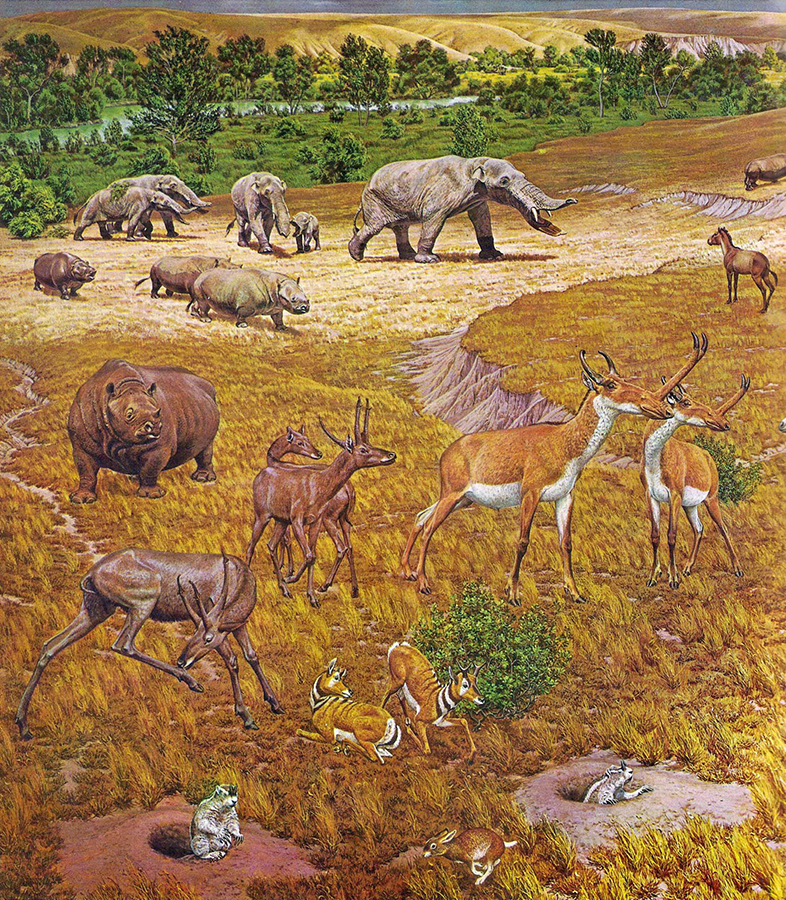
An artist’s interpretation of ancient North American fauna. The new study revealed that elephant-like gomphotheres, rhinos, horses and antelopes with slingshot-shaped horns were among the species recovered near Beeville, Texas, by Great Depression-era fossil hunters. Image credit: Jay Matternes / Smithsonian Institution.

Dr. Steven May, a paleontology research associate at the University of Texas at Austin, has studied and identified an extensive collection of fossils from dig sites near Beeville, Texas. The results appear in the journal Palaeontologia Electronica.

Dr. May analyzed a collection of specimens unearthed by fossil hunters in Texas in the 1930s-1940s.

He found that the fauna make up a veritable ‘Texas Serengeti’ — with specimens including elephant-like gomphotheres, rhinos, alligators, antelopes, camels, 12 types of horses and several species of carnivores.

In total, the fossil trove contains nearly 4,000 specimens representing 50 animal species, all of which roamed the Texas Gulf Coast between 11 and 12 million years ago (Clarendonian age of the Miocene Epoch).

“It’s the most representative collection of life from this time period of Earth history along the Texas Coastal Plain,” Dr. May said.

“In addition to shedding light on the inhabitants of an ancient Texas ecosystem, the collection is also valuable because of its fossil firsts.”

“They include a new genus of gomphothere (an extinct relative of elephants), named Blancotherium; the oldest fossils of the American alligator; and an extinct relative of modern dogs.”

“This extensive collection of fossils is helping to fill in gaps about the state’s ancient environment,” said Dr. Matthew Brown, Director of the Vertebrate Paleontology Collections at the Jackson School Museum of Earth History.

_____

Steven R. May. 2019. The Lapara Creek Fauna: Early Clarendonian of south Texas, USA.Palaeontologia Electronica 22.1.15A: 1-129; doi: 10.26879/929

Source: www.sci-news.com

Life-Size Skeletal Replica of Japan's Largest Dinosaur Restored

Wednesday, April 17, 2019

The plant-eating Hadrosaurid, dubbed “Mukawaryu”

What is believed to be Japan’s largest fossilized dinosaur skeleton has been restored as a life-size replica, researchers and officials from the town of Mukawa, in Hokkaido, where the original discovery was made.

The replica of the 8-meter-long and 4-meter-tall plant-eating Hadrosaurid, dubbed “Mukawaryu,” was created with duplicates of the actual fossils unearthed from a 72 million-year-old geological layer. The replica and the fossils will be displayed at the National Museum of Nature and Science in Tokyo for three months from July 13.

“A standing Mukawaryu has been resurrected after 72 million years. I hope it will help liven up our town,” Mukawa Mayor Yoshiyuki Takenaka said.

The excavation involving Hokkaido University members began in 2013 after local fossil collector Yoshiyuki Horita found a fossilized tail bone in 2003 in the Hobetsu district of Mukawa. More than 1,000 fossil bones were eventually unearthed, making it the largest complete dinosaur skeleton ever found in the country.

Complete skeletons are generally defined as containing more than 50 percent of the bones, but for the Mukawaryu, over 80 percent were unearthed as fossils.

The work to create the replica of the duck-billed dinosaur began in July 2017 and was completed last month. The replica, unveiled to the media, has a color close to the actual fossils and is positioned as if the reptile is looking into the far distance.

“I hope people will immerse themselves in the fascination of ancient history by imagining Mukawaryu strolling over the vast ground of Hobetsu,” said Horita, 69.

Hadrosaurids were common herbivore dinosaurs during the late Cretaceous Period and thrived on the Eurasian and North and South American continents in addition to Antarctica, according to Hokkaido University.

Source: www.japantimes.co.jp

Unique in Palaeontology: Liquid Blood Found Inside a Prehistoric 42,000 Year Old Foal

Wednesday, April 17, 2019

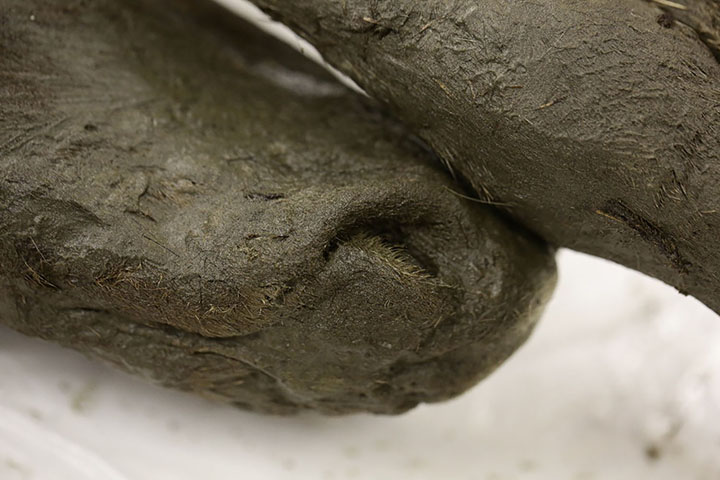
Liquid blood in Ice Age foal. Picture: North-Eastern Federal University

Permafrost preserved the ‘oldest blood in the world’ boosting hopes of bringing extinct species back to life.

Semyon Grigoryev, head of the Mammoth Museum in Yakutsk, said today: ‘The autopsy shows beautifully preserved internal organs. 

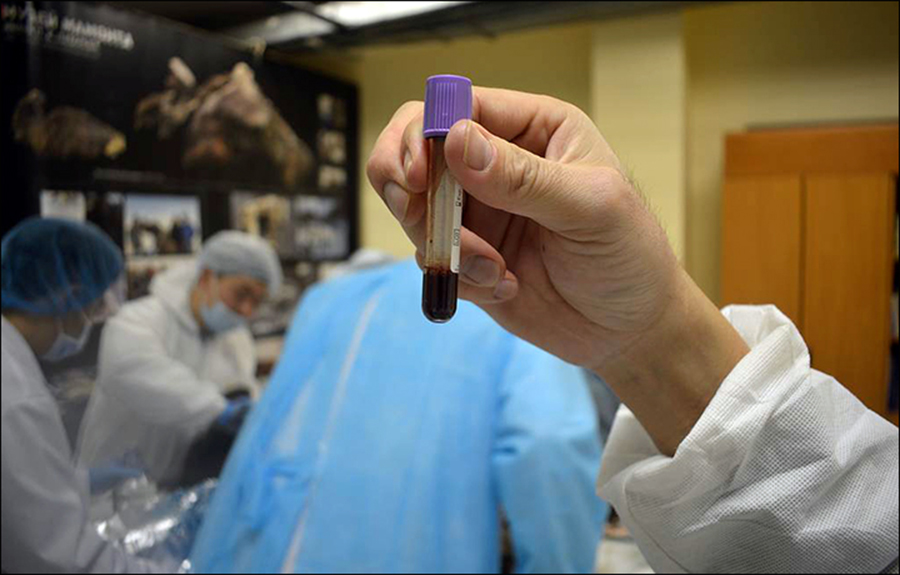
‘Samples of liquid blood were taken from heart vessels - it was preserved in the liquid state for 42,000 years thanks to favourable burial conditions and permafrost. 

‘The muscle tissues preserved their natural reddish colour. 

‘We can now claim that this is the best preserved Ice Age animal ever found in the world.’ 

Dr Grigoryev revealed in an interview with TASS that the foal is in an exceptional condition without any visible damage. 

‘This is extremely rare for paleontological finds, because some of them are either incomplete, fragmented, with serious body deformations or strongly mummified,’ said the expert. 

‘The foal’s hair is intact on its head, legs and part of its body. 

‘Its tail and mane are black, the rest of the foal’s body is bay. 

‘Having preserved hair is another scientific sensation as all previous ancient horses were found without hair.’

The 42,000 years old foal. Pictures: North-Eastern Federal University

______________________________________________________________________________________________________________________

This is the second month of intense joint work of the Yakutian university team and scientists from South Korean Sooam Biotech Research Foundation.

‘Our studies showed that at the moment of death the foal was from one to two weeks old, so he was just recently born,’ said the scientist. 

‘As in previous cases of really well-preserved remains of prehistoric animals, the cause of death was drowning in mud which froze and turned into permafrost. 

‘A lot of mud and silt which the foal gulped during the last seconds of its life were found inside its gastrointestinal tract.’

Scientists have already indicated  that they are 'confident of success’ in extracting cells from this foal in order to clone its species - the extinct Lenskaya breed - back to life, as previously reported by The Siberian Times.

Work is so advanced that the team is reportedly choosing a mother for the historic role of giving birth to the comeback species. 

Michil Yakovlev, editor of the university’s corporate media, said: “Hopefully, the world will soon meet the clone of the ancient foal who lived 42,000 years ago.”

The foal was found in the Batagai depression in Yakutia.

An attempt to restore the species to life is seen as paving the way for a similar effort to restore to life the giant woolly mammoth.  

The same scientists are working on both projects.

The international team of scientists working in the laboratory of North-Eastern Federal University, the foal held by Semyon Grigoryev after it was found, the Batagai depression. Pictures: NEFU, The Siberian Times

_____________________________________________________________________________________________________________________________________

The unique foal will become one of the key exhibits of one year long The Mammoth exhibition in Japan, starting in June this year. 

‘More than 30 exhibits from Yakutia will travel to the exhibition,’ said Dr Grigoryev. 

‘For the first time we’ll show the world’s only frozen woolly mammoth trunk, as well as the carcass of the Yukagir bison, an ancient partridge and the Batagai horse.’

Blood of Maloyakhovky mammoth found in 2013. Malolyakhovskiy mammoth ready for the trasportation. Modern-day Yakut horses. Pictures: NEFU, The Siberian Times

_____________________________________________________________________________________________________________________________________

Source: http://siberiantimes.com

Pages