Blogs

Fossils of the First Winged Mammals Dating Back 160M Years, Discovered
Friday, May 3, 2019

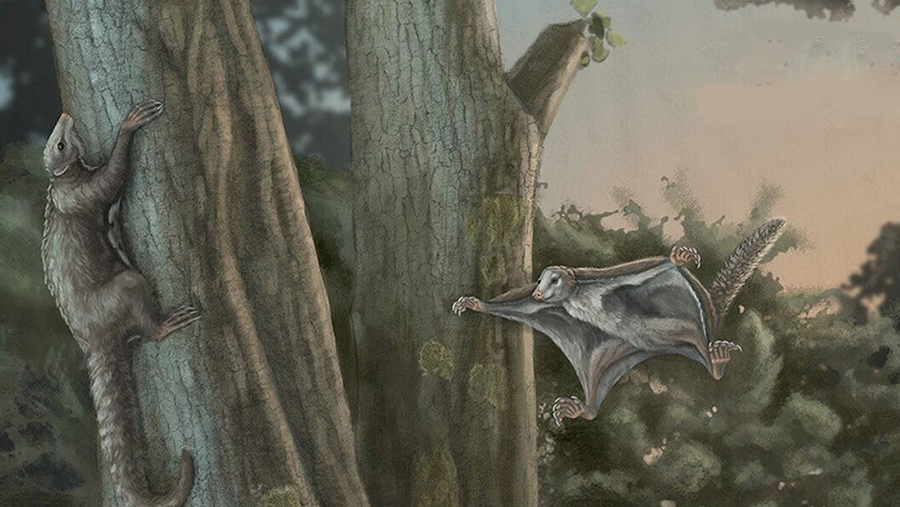
This is a Maiopatagium in Jurassic forest in crepuscular (dawn and dusk) light: A mother with a baby in suspending roosting posture, climbing on tree trunk, and in gliding. (Credit: SWNS)

Fossils of the first winged mammals dating back 160 million years to the age of the dinosaurs have been discovered.

The remains, from the Jurassic period, suggest a new way of life - gliding - for the forerunners of mammals.

Two 160 million-year-old mammal fossils discovered in China show that the forerunners of mammals in the Jurassic Period evolved to glide and live in trees.

With long limbs, long hands and foot fingers, and wing-like membranes for tree-to-tree gliding, Maiopatagium furculiferum and Vilevolodon diplomylos are the oldest known gliders in the history of early mammals.

The new discoveries suggest that the volant, or flying, way of life evolved among mammalian ancestors 100 million years earlier than the first modern mammal fliers.

The fossils are described in two papers, published in the journal Nature, by an international team of scientists from the University of Chicago and Beijing Museum of Natural History.

Professor Zhe-Xi Luo, of the University of Chicago, said: "These Jurassic mammals are truly 'the first in glide.'

"In a way, they got the first wings among all mammals.

"With every new mammal fossil from the Age of Dinosaurs, we continue to be surprised by how diverse mammalian forerunners were in both feeding and locomotor adaptations.

"The groundwork for mammals' successful diversification today appears to have been laid long ago."

The ability to glide in the air is one of the many remarkable adaptations in mammals.

Most mammals live on land, but volant mammals, including flying squirrels and bats that flap bird-like wings, made an important transition between land and aerial habitats.

Prof Luo said the ability to glide between trees allowed the ancient animals to find food that was inaccessible to other land animals.

That evolutionary advantage can still be seen among today's mammals such as flying squirrels in North America and Asia, scaly-tailed gliders of Africa, marsupial sugar gliders of Australia and colugos of South East Asia.
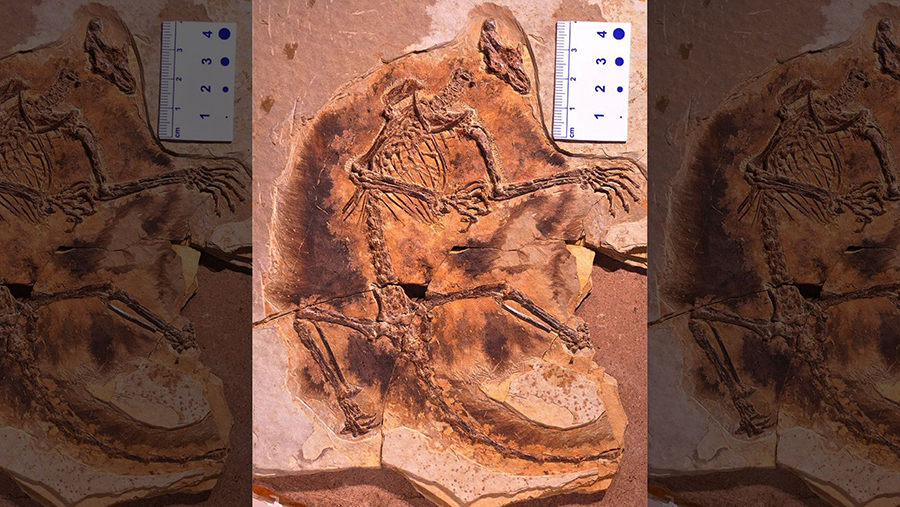
 Two 160 million-year-old mammal fossils discovered in China show that the forerunners of mammals in the Jurassic Period evolved to glide and live in trees. With long limbs, long hand and foot fingers, and wing-like membranes for tree-to-tree gliding, Maiopatagium furculiferum and Vilevolodon diplomylos are the oldest known gliders in the history of early mammals. (Credit: SWNS)

The Jurassic Maiopatagium and Vilevolodon are long-extinct relatives of living mammals.

Prof. Luo said they are haramiyidans, an entirely extinct branch on the mammalian evolutionary tree, but are considered to be among forerunners to modern mammals.

Both fossils show the exquisitely fossilized, wing-like skin membranes between their front and back limbs.

They also show many skeletal features in their shoulder joints and forelimbs that gave the ancient animals the agility to be capable gliders.

Evolutionarily, the two fossils, discovered in the Tiaojishan Formation, northeast of Beijing, represent the earliest examples of gliding among extinct mammal ancestors.

Prof. Luo said the two newly discovered creatures also share similar ecology with modern gliders, with some significant differences.

Today, the hallmark of most mammal gliders is their herbivorous diet that typically consists of seeds, fruits and other soft parts of flowering plants.

But Maiopatagium and Vilevolodon lived in a Jurassic world where the plant life was dominated by ferns and gymnosperm plants like cycads, gingkoes and conifers - long before flowering plants came to dominate in the Cretaceous Period, and their way of life was also associated with feeding on these entirely different plants.

The distinct diet and lifestyle evolved again some 100 million years later among modern mammals.

Study co-author David Grossnickle, a graduate student at the University of Chicago, said: "It's amazing that the aerial adaptions occurred so early in the history of mammals,

"Not only did these fossils show exquisite fossilization of gliding membranes, their limb, hand and foot proportion also suggests a new gliding locomotion and behavior."

Early mammals were once thought to have differences in anatomy from each other, with limited opportunities to inhabit different environments.

But the new glider fossils from the dinosaur-dominated Jurassic Period, along with numerous other fossils described by Prof Luo and his colleagues in the last 10 years, provide "strong evidence" that ancestral mammals adapted to their wide-ranging environments despite competition from dinosaurs.

Prof. Luo added: "Mammals are more diverse in lifestyles than other modern land vertebrates, but we wanted to find out whether early forerunners to mammals had diversified in the same way.

"These new fossil gliders are the first winged mammals, and they demonstrate that early mammals did indeed have a wide range of ecological diversity, which means dinosaurs likely did not dominate the Mesozoic landscape as much as previously thought."

Source: www.foxnews.com

This Jurassic Park Birth Announcement Video Is Brilliantly Stupid

Thursday, May 2, 2019

Ryan Porter/YouTube

We can't stop watching.

There are Jurassic Park fans—and then there are Jurassic Parkfans who record their pregnancy announcement as one of the scenes from the 1993 blockbuster. Which is what one couple attempted to do, resulting in a video that’s nothing if not hilarious.

“This September, Life Finds a Way…” reads the caption of the video, titled “Jurassic Baby Porter.” In the clip, dad-to-be Ryan Porter simply superimposed the heads of him and his expecting wife on the movie’s characters. And instead of discovering a dinosaur, the pair discovers a sonogram showing their future little one, with newborn crying noises in the background.

“It’s a baby,” Porter says at the end of the video, as the couple gets out of their Jeep to get closer to the floating sonogram. The cheesy clip then closes with Jeff Goldblum’s iconic line, “You did it. You crazy son of a bitch, you did it.”

And the Porters aren’t the first ones to announce their pregnancy a la Steven Spielberg’s flick. When one Texas couple found out that they were going to have a fifth child, they decided to tell their friends and family with a Jurassic Park-themed photoshoot. Mom and Dad, plus the four kids, dressed up in inflatable T-rex costumes and held a tiny blow-up dinosaur in their arms.

“Since we are big Jurassic World fans and a really quirky and down-to-earth kind of family, it seemed SO fitting!” mom Nicole Berkley told POPSUGAR, adding that both her kids and everyone who received the announcement thought it was hysterical.

Source: www.fatherly.com

99-Million-Year-Old, Unknown Millipede Found Trapped in Burmese Amber

Friday, May 3, 2019

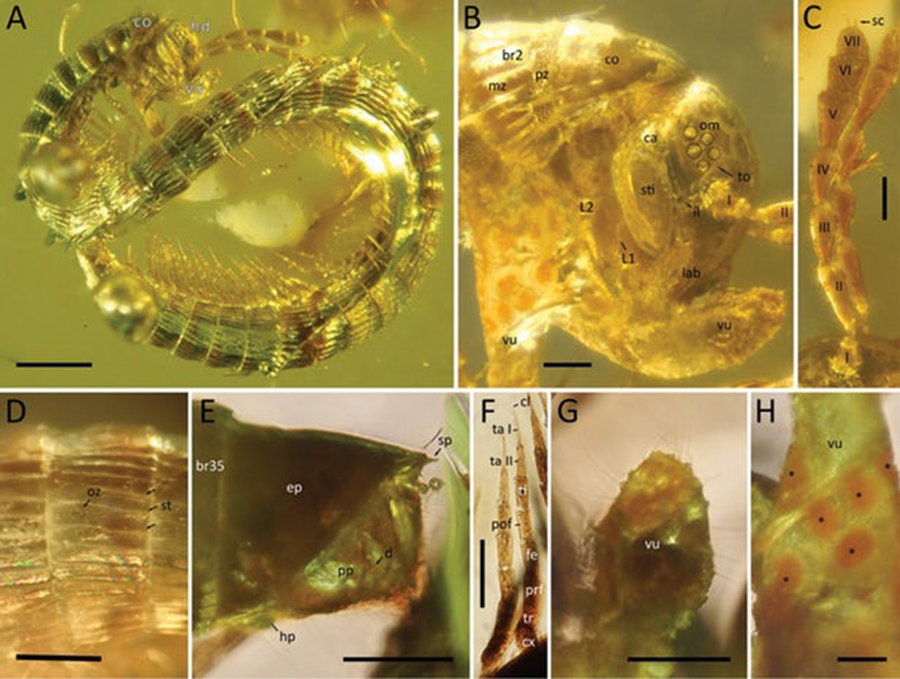
The newly described millipede, Burmanopetalum inexpectatum, preserved in amber(Credit: Leif Moritz (CC-BY 4.0))

Picking up where the Jurassic period left off, the Cretaceous is best known as the last hoorah for the dinosaurs. As far as insects are concerned, it gave us ants, termites, aphids and the explosion of pollinators that coincided with the development of flowering plants. But, ironically, the prehistoric-looking millipedes of the order Callipodida, are thought to have come later. Until now.

Scientist now have to rearrange what they know – or thought they knew – about the evolution of millipedes due to a tiny, 8.2-mm member of the order Callipodida who got its many feet stuck in some tree resin, which turned up in Myanmar 99 million years later as a golden lump of amber.

This places this tiny critter well into the Cretaceous period, making it the oldest millipede of its order yet discovered. In fact, it's morphology – which included compound eyes composed of five ommatidia while most Callipodidan eyes have at least 30 – was so unique it warranted its own suborder as it didn't quite fit within the current classifications for the species.

Prof. Pavel Stoev of the National Museum of Natural History (Bulgaria) and Dr. Thomas Wesener and Leif Moritz of the Zoological Research Museum Alexander Koenig (Germany) chose the name Burmanopetalum inexpectatum, where "inexpectatum" translates as "unexpected" from Latin.

"It came as a great surprise to us that this animal cannot be placed in the current millipede classification," says Professor Stoev.

"The entire Mesozoic Era – a span of 185 million years – has until now only been sampled for a dozen species of millipedes, but new findings from Burmese amber are rapidly changing the picture," says Dr. Greg Edgecombe, a leader in the study of fossil arthropods from the Natural History Museum who wasn't involved in the research. "In the past few years, nearly all of the 16 living orders of millipedes have been identified in this 99-million-year-old amber. The beautiful anatomical data presented by Stoev et al. show that Callipodida now join the club."

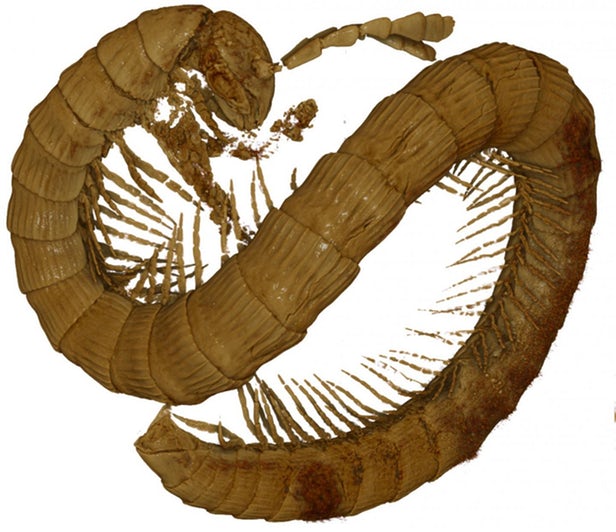
3D X-ray microscopy was used to get a better look at the find, including its internal structure. This was made possible due to its amber tomb that helped it retain fine details not usually preserved in fossils. This particular piece of amber that trapped Burmanopetalum inexpectatum is part of a private collection – the largest of its kind in Europe – belonging to Patrick Müller, which comprises 400 amber stones, all of which have been made available to the scientists.

Millipedes belong to the class Diplopoda, Latin for "double foot." The name refers to the two pairs of legs on on each body segments, in contrast to centipedes (class Chilopoda) which have just one pair per segment.

The study describing Burmanopetalum inexpectatum is published in the open access journal ZooKeys.

Source: Pensoft (CC-BY 4.0) https://newatlas.com

Museo Paleontológico Tocuila (Paleontological Museum of Tocuila)

Tuesday, April 30, 2019

Paleontological Museum in Tocuila, Texcoco, México State

Get a close look at the gigantic remains of long-extinct mammoths.

In 1996 in Tocuila, a small town just outside Mexico City, called Tocuila, a team of workmen building a cistern system made a mammoth discovery. They had dug just shy of 10 feet into the ground when gargantuan bones began to protrude from the dirt.

Shocked by this unexpected find, the workers contacted local authorities, who in turn got in touch with archeologists and paleontologists from Mexico’s National Institute of Anthropology and History. The scientists excavated the site and determined the bones belonged to seven Columbian mammoths that had lived approximately 10,000 to 12,000 years ago.

The site was one of the Americas’ richest deposits of late Pleistocene fauna ever found. After the excavations finished, the INAH bought the land and converted it into a modest museum where the general public could come admire the remains of these long-extinct creatures.

This Columbian mammoth was one of the largest species of the elephant family to have ever existed. The animals could be two or three times larger than modern African elephants, weighed up to 11 tons, and typically had tusks that could reach lengths of 16 feet.

The mammals roamed much of North America, grazing in its open plains and steppes. Like modern elephants, paleontologists believe the creatures were highly social animals that lived in herds led by a matriarch. Like today’s elephants, mammoths, too, were also threatened by humans.

The mammoths found in Tocuila were killed by natural causes, rather than a human hand. The hypothesis that currently has the most supporting fossil evidence is that the animals were killed when a gigantic lahar, or mudflow, was triggered by a volcanic eruption.

Know Before You Go

The museum is open from Tuesday to Saturday from 10 a.m. to 7 p.m. Entrance is free.

Source: www.atlasobscura.com

Jurassic Museum of Asturias

Tuesday, April 30, 2019

 The exhibit of the horny Tyrannosaurs. Mario Modesto /cc by-sa 3.0

A wonderful collection of fossilized dinosaurs and other creatures that roamed the landscape millions of years ago.

The hills and coastlines of Asturias are not only rich in prehistoric human history but also contain the fossilized remains of a much older and more primeval past, of the saurians that once dominated the landscape of Spain and the world at large.

The skeletons of many of these extinct creatures can be seen at the superb Jurassic Museum of Asturias (El Museo del Jurásico de Asturias). The museum itself is housed within a bizarrely shaped copper-roofed building designed by the architect Rafael Urribelarrea (and unmistakenly resembling a giant pair of breasts). Inside, it holds one of the largest and most complete collections of dinosaur remains in the world. 

Within the museum, you’ll find an immense display of fossils collected locally, including many dinosaur bones and footprints. There are also many assembled skeletons of dinosaur species on exhibit, such as the long-necked Camarasaurus. But it is perhaps the pair of horny T. rex skeletons that take the cake as the collection’s most amusing and uniquely bawdy dino display. 

Outside, on the spacious grounds of the museum, stand a number of gigantic lifesize and (presumably) lifelike sculptures of predatory and herbivorous dinosaurs, which make the lawns resemble an Iberian Jurassic park.

Know Before You Go

The museum is open Wednesday through Friday from 10 a.m. to 2:30 p.m. and 3:30 pm to 6 p.m. and weekends from 10:30 a.m. to 2:30 p.m. and 4 p.m. to 7 p.m. The entrance fee is 7.21 euro.

Source: www.atlasobscura.com

Jurassic World 3: Laura Dern Addresses Possibility of Cameo

Monday, April 29, 2019

After last appearing in Joe Johnston's Jurassic Park III, Laura Dern's Ellie Sattler has remained absent from the franchise. However, the actor has now discussed the possibility of her return in Jurassic World 3.

Speaking to ET, Dern addressed the possibility of Sattler's long-awaited return, saying, "I don't know. I have no idea. I mean, I love Dr. Ellie Sattler, so I could never say no to that on any level. But I really don't know. I don't even know what they're cooking up yet."

Dern did reveal she met with Chris Pratt, who is currently one of the series' leads, in a restaurant, saying, "We didn't even know each other. It was really funny. We ran into each other's arms and hugged each other like we were family because we were both in the same movie [franchise] and he just seemed fantastic and is hilarious. But yeah, I don't know any more."

If Dern does return, she wouldn't be the first cast member from the original film to do so. Jeff Goldblum had a memorable — but brief cameo — as Dr Ian Malcolm in Jurassic World: Fallen Kingdom. It's unclear if Sam Neill would reprise his role as Alan Grant, as the actor has actively downplayed the possibility, saying the character has either retired or is dead by now.

Still, Fallen Kingdom director J.A. Bayona welcomed the idea of Dern and Neill returning for Jurassic World 3. Whether Trevorrow has some surprise cameos remains to be seen, but it definitely sounds like Dern is up for stepping back into the role of Dr Ellie Sattler.

There are few details available for Jurassic World 3, which is slated for a 2021 release. The movie will see the return of Chris Pratt as Owen Grady and Bryce Dallas Howard as Claire Dearing.

Source: www.cbr.com

John Hammond: What Happened to the Jurassic Park Founder

Monday, April 29, 2019

Of all the fan-favorite characters to appear in the Jurassic Park franchise, none are more crucial than John Hammond. The founder of the dinosaur-populated theme park, the entire premise is brought about by Hammond's vision to take the fiction genetics corporation InGen into the world of entertainment by resurrecting the prehistoric creatures through advances in science and technology.

Despite his prominence and memorable performance by the late Sir Richard Attenborough, the cinematic incarnation of Hammond is significantly different from Michael Crichton's original novel. Now, CBR is breaking down the differences and similarities between the literary and cinematic versions of the visionary businessman and the deadly theme park he created.

HOW JOHN HAMMOND BUILT JURASSIC PARK

A flashy venture capitalist who had always dreamed of entertaining the masses including running a flea circus decades ago in his native United Kingdom, John Hammond founded the genetics startup company International Genetic Technologies, Inc. (InGen). Hammond had attracted investors with his vision of cloning dinosaurs through genetic material found in fossils, opening a theme park on a private island off the coast of Costa Rica while a separate island would serve as the actual breeding ground for the theme park's dinosaurs.

Hammond had at least one daughter who had two children of her own and decided to bring both his grandchildren to test out Jurassic Park. With the board of investors worried about the park's safety and viability, those two kids joined with a lawyer, chaos scientist Ian Malcolm, and paleontologists Alan Grant and Ellie Sattler after the accidental death of a worker on site prompts a massive lawsuit against the company.

JOHN HAMMOND THE NOVEL

The original, literary version of Hammond, as created by author Michael Crichton, is a much more opportunistic character than his eventual cinematic counterpart. He's more interested in profit margins than the actual scientific miracles of cloning creatures extinct for millions of years and alienated employees with a hair-trigger temper and vocal mood swings. With that in mind, the literary Hammond planned to make access to the park excessively expensive with expansion plans for Europe and Japan should the initial Costa Rican site prove successful.

As the park descends into chaos following a massive thunderstorm engulfing the island, Hammond confused the stock sound of a Tyrannosaurus rex on the park's PA system for an actual one pursuing him. While panicking, Hammond falls down a hill and breaks his ankle leading to him being eaten by a pack of Procompsognathus; his movement and senses impeded by his injuries and the small dinosaurs' venomous bites.

JOHN HAMMOND IN THE MOVIE

The cinematic Hammond, portrayed by Attenborough in the first two films in the franchise, is considerably more sympathetic than the original source material. Insisting to keep prices affordable and the park as accessible to the general public as possible, this version of Hammond takes the time to personally be present at the hatching of every single dinosaur so they can imprint on him. Realizing the folly of his dreams, Hammond later tasks Malcolm to keep Site B's dinosaurs free from InGen's influence after being ousted from the company by his nephew who plots to open a theme park in San Diego during The Lost World: Jurassic Park.

After the existence of dinosaurs on Site B becomes public, Hammond publicly urges the creatures to be left to survive, free of human influence. By the time of Jurassic World, Hammond has been dead for some time with a bust of the entrepreneur visible in the lobby of one of the new park's facilities. Whether an altruistic visionary or an exploitative businessman, the entire premise of Jurassic Park springs from Hammond's dreams. Ultimately, the British tycoon founded InGen and used advanced genetic technology to bring dinosaurs into the modern era. As such, his legacy looms over the entire franchise.

Source: www.cbr.com

Trending: China's "Roaring" Animatronic Dinosaur Industry

Sunday, April 28, 2019

Animatronic dinosaur replicas in all forms and sizes on display outside Gengu Dinosaurs' factory in Zigong City. /CGTN Photo

Many people love dinosaurs, but perhaps not as much as the group of Chinese designers and craftsmen dedicated to making the perfect life-size dinosaur toys.

The city of Zigong, in southwest China, is home to a Jurassic period site Dashanpu, where workers building a parking lot unearthed a large number of dinosaur fossils in 1979.

The city's prehistoric ties with dinosaurs have nurtured the success of the animatronics production industry. Zigong has 19 companies making animatronic dinosaurs for theme parks and safaris in more than 60 countries and regions. Its annual export totaled 62 million yuan (9.25 million U.S. dollars) in 2018.

Deng Peilin, a local in Zigong, knows a lot about the animal species that ruled the world long before humans did. As the owner of Zigong Dinosaur Landscape and Art Co., Ltd, Deng has become a successful businessman. His company makes over 1,000 life-size dinosaurs for clients both domestically and overseas each year.

He is a frequent visitor of the Zigong Dinosaur Museum, built on top of the fossil site and home to the remains of almost all the dinosaur species who lived between 205 million to 135 million years ago.

"Zigong was once a haven for dinosaurs. I've learned a lot from the fossils. The paleontologists teach me about dinosaurs so I can make them look as real as possible," Deng said.

At Deng's factory, workers brush finishing paint on a gigantic Tyrannosaurus to be exported to Jordan.

Knowledge about dinosaurs helps Deng and his workers meet varied demands from customers. "For example, carnivorous dinosaurs have brightly colored skin, while a herbivore's skin looks less shiny and similar with the environment it lived in," he said.

Deng has memorized the specifications of a lot of dinosaurs. "For example, the Omeisaurus lived in the middle Jurassic period of what is now China. An Omeisaurus tianfuensis was 22 meters long, while a Tyrannosaurus was usually 12 meters long," he said.

"Sometimes customers ask us to inflate the size of animatronic dinosaurs," he said.

The company's largest product was a Diplodocus, 23 meters tall with a 66-meter-long spine, doubling the size of a real Diplodocus. It was sold to a buyer in Ankara, Turkey.

Zigong's animatronic industry started in the 1990s when a businessman from Taiwan invested in a production line to make props for theme parks. Deng was an art designer for the company.

"Simulated animals were a huge success. I remember people got up at six o'clock in the morning to wait in line to buy a ticket to see an animatronic dinosaur. I made up my mind to open my own factory," he said.

Over the years, materials and techniques used for making the dinosaurs have upgraded. Now they use aluminum alloy and stainless steel for bones, and high-quality silica gel and sponges for the skin.

In Zigong, animatronic dinosaurs are still made by hand, and it takes as many as 26 steps to make them. To produce a single dinosaur, 10 to 20 people have to work for as many as 40 days.

Besides dinosaurs, Deng and his colleagues make other animals. A gorilla and a mammoth will be shipped to Orlando in the United States, and several brown bears are ready to be sent to Guatemala.

Manager Jiang Qiaoyu wants to get creative about the three-story-tall Tyrannosaurus. "I'm thinking of stuffing a used car into its mouth, which I think will make it look more stunning," he said.

Source: www.xinhuanet.com

Dinosaur National Monument Named Dark Sky Park, Ideal For Stargazers

Friday, April 26, 2019

Dinosaur National Monument and the International Dark Sky Association announced the designation of Dinosaur as an International Dark Sky Park. Courtesy photo

Moffat County’s Dinosaur National Monument has been given a designation that could attract planet-watchers and stargazers from around the world.

The National Park Service announced that Dinosaur National Monument is an International Dark Sky Park, a designation that recognizes the skies above Dinosaur to have low light pollution ideal for sky watching.

“We are proud of this accomplishment,” Dinosaur Superintendent Paul Scolari was quoted as saying in a news release. “And we’re committed to continuing to work with surrounding communities to uphold the high standard set by the IDA in order to protect the magnificence of the night sky in our region moving forward.”

Dinosaur is now the fifth internationally recognized Dark Sky Park in Colorado, and its location between Denver and Salt Lake City puts it within a day’s drive of millions of people who can no longer see the Milky Way from their backyards because of increased light pollution, according to the release.

“Visitors from around the world are finding that star-filled skies at Dinosaur are often as novel and awe-inspiring as fossil-filled rocks,” Park Ranger Sonya Popelka said.

“Our goal is to invite everyone to learn about and enjoy the benefits of nights without too much artificial light,” she said. “And with a few simple tips for adopting night-sky friendly lighting in their own communities, they can bring that starry view home with them.” 

The monument will have plenty of sky-watching opportunities this year:

  • May 4: Tour of the sky from 9 to 10 p.m. outside the Quarry Exhibit Hall. Participate in dark sky measurements as citizen scientists and evaluate outdoor lighting options.
  • June 8: Stargazing program at the Gates of Lodore
  • June 17: Full-moon hike in Echo Park to commemorate the 150th anniversary of the John Wesley Powell expedition
  • Find more events at nps.gov/dino.

“Our ranger staff is developing a terrific program lineup,” Scolari said. “So, when the sun starts to scorch, come out to Dinosaur on a cool night and check out the marvels the sky has to offer.”

This story is from CraigDailyPress.com.

Dinosaur Fossils Re-Branded The Loch Ness Monster’s Image

Friday, April 26, 2019

Reports that a creature was living in Scotland’s Loch Ness go back to the sixth century. The 19th and 20th centuries, in particular, saw an increase in interest, especially after the infamous “surgeon’s photograph” in 1934.

Now, a new study suggests that the legend of the Loch Ness monster and other long-necked “sea monsters” may have been influenced by something very real and even more terrifying — dinosaurs.

Published in the scientific journal Earth Sciences History, the study theorizes that the sea serpent reports of the early 19th century were heavily influenced by early dinosaur fossil discovery.

“Over the last 200 years, there is indeed evidence of a decline in serpentiform sea serpent reports and an increase in the proportion of reports with necks but there is no evidence for an increase in the proportion of mosasaur-like reports,” the study’s abstract reads. “However, witnesses only began to unequivocally compare sea serpents to prehistoric reptiles in the late nineteenth century, some fifty years after the suggestion was first made by naturalists.”

British fossil hunter William Buckland was the first to discover dinosaur fossils in 1819.

Researcher Charles Paxton of the University of St Andrews and paleontologist Darren Naish of the University of Southampton looked at several hypotheses and more than 1,500 alleged cases of “monster” sightings (excluding hoaxes) going back to 1801. From 1801 to the early 1930s, around the time of the “surgeon’s photograph,” reported sightings of long-necked creatures, such as plesiosaurs (or reports that mentioned plesiosaurs) increased from 10 percent of all sightings to approximately 50 percent.

Paxton and Naish added that the presence of mosasaur-like sightings did not change, likely due to dinosaur fossils starting to be displayed for the first time in museums.

Science fiction writer L. Sprague De Camp was the first to suggest this hypothesis in 1968, writing: “After Mesozoic reptiles became well-known, reports of sea serpents, which until then had tended towards the serpentine, began to describe the monster as more and more resembling a Mesozoic marine reptile like a plesiosaur or a mosasaur.”

“The discovery of long-necked marine reptile fossils in the 19th century does appear to have had an influence on what people believe they have spotted in the water,” Paxton said in an interview with The Telegraph.

The legend of the Loch Ness monster has commonly been attributed to a plesiosaur that somehow managed to survive the mass extinction event that killed off the dinosaurs.

Supposedly taken by Robert Kenneth Wilson, a London gynecologist, the “surgeon’s photograph” was first published in 1934 and appears to show the neck and head of the creature. It was eventually proven to be a hoax years later.

In May 2018, researchers said they would investigate the waters of Loch Ness in Scotland and use environmental DNA sampling of the waters to try and identify everything that swims in it.

Source: https://nypost.com

Pages