Blogs

99-Million-Year-Old Ammonite Found in Burmese Amber

Wednesday, May 15, 2019

The 99-million-year-old piece of amber from northern Myanmar. Image credit: Nanjing Institute of Geology and Palaeontology.

An international team of paleontologists has found a piece of amber containing the beautifully preserved ammonite, several marine and land organisms that lived 99 million years ago (Cretaceous period).

The ammonite-bearing piece of amber was obtained from a mine located near Noije Bum Village, Tanaing Town, northern Myanmar. It is 33 mm long, 9.5 mm wide, and 29 mm high, and its mass is about 6 g.

The specimen was analyzed by Professor Bo Wang from the Nanjing Institute of Geology and Palaeontology and his colleagues from China, France, the United Kingdom and the United States.

The researchers used X-ray micro-computed tomography to obtain high-resolution 3D images of the ammonite, including its sutures, which are diagnostically important for ammonites.

They found that the ammonite belongs to Puzosia, an ammonite genus that first appeared in the Upper Albian age of the Cretaceous period (between 113 and 100 million years ago) and ranged through the Cenomanian age (between 100 and 94 million years ago).

“The ammonite is a juvenile, has a maximum preserved diameter of 12 mm, and appears to retain the original aragonitic shell, on the basis of its appearance in reflected light,” they said.

“Its presence in the amber supports a late Albian-early Cenomanian age for the amber deposit. This discovery represents a rare example of dating using amber inclusions.”

The ammonite Puzosia sp.: (A) lateral view under light microscopy; (B) flattened sutures reconstructed by microtomography; (C) microtomographic reconstruction, apparent view; (D) microtomographic reconstruction, surface rendering; (E) microtomographic reconstruction, virtual section. Scale bars – 2 mm. Image credit: Yu et al, doi: 10.1073/pnas.1821292116.

The team also found at least 40 individuals of arthropods in the amber sample from both land and marine habitats, including crustaceans, mites, spiders and millipedes, and several individuals of insects, including cockroaches, beetles, true flies and wasps.

“But how did the ammonite, an extinct sea-dwelling relative of squid, and other marine creatures get preserved in a piece of amber that also contains land-based animals? The ammonite and sea snail shells offer possible clues,” the paleontologists said.

“The shells are all empty with no soft-tissue, so the organisms were long dead by the time they were engulfed by resin. The outer shell of the ammonite is broken away and the entrance of the shell is full of sand. The amber also contains additional sand.”

“The most likely explanation is that a sandy beach covered with shells was located close to resin-producing trees. The flying insects were trapped in the resin while it was still on the tree.”

“As the resin flowed down the tree trunk, it trapped organisms that lived near the foot of the tree. Reaching the beach, it entombed shells and trapped the slaters living there.”

The discovery is reported in a paper in the Proceedings of the National Academy of Sciences.

_____

Tingting Yu et al. An ammonite trapped in Burmese amber. PNAS, published online May 13, 2019; doi: 10.1073/pnas.1821292116

Source: www.sci-news.com

Mesa Museum Adds a New Dinosaur to its Herd

Thursday, May 16, 2019

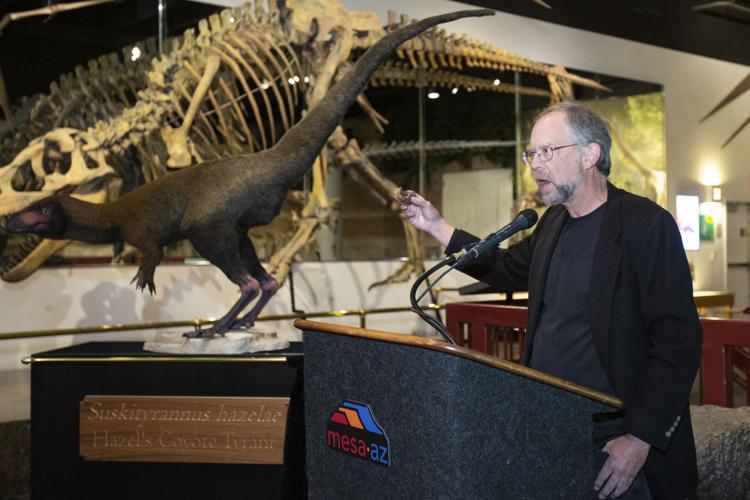
Douglas Wolfe, who co-discovered the bones of the latest dinosaur addition at the museum, talks about the creature’s likely diet and other features.  Kimberly Carrillo/Tribune Staff Photographer

The Arizona Museum of Natural History unveiled the name of a new prehistoric creature to add to its collection – a relative of the well-known Tyrannosaurus rex.

The museum, in partnership with Virginia Polytechnic Institute and State University, announced last week the Suskityrannus hazelae – a newly discovered tyrannosauroid dinosaur that stands at roughly 3 feet tall and 9 feet long.

More than 50 people filed into the museum’s Dinosaur Hall to listen to Douglas Wolfe, co-discoverer and CEO of Zuni Dinosaur Institute of Geo Sciences, talk about his team’s findings.

Wolfe, along with paleontologist Sterling Nesbitt of Virginia Tech, found two partial skeletons of the species in the Moreno Hill formation in the Zuni Basin of western New Mexico in the late 1990s – marking a 20-year journey to determine what they found.

The fossils date back 92 million years ago and are key pieces in understanding the tyrannosaur evolution, explained Wolfe.  

“This animal is an intermediate form between the very early Theropod dinosaurs – carnivores of the earlier protections,” he said. “And the bone-crunching giants roaming the landscape just before their extinction.”

Though the Suskityrannus is related to the massive “bone-crunching” T. rex, its body is only slightly longer than the skull of its full-grown cousin. With slender skulls and feet, it is believed to have weighed between 45 and 90 pounds.

The dinosaur’s diet most likely consisted of hunting small animals, said Wolfe, which can be concluded from features in its skull.

“There are teeth on both sides on the upper and lower jaws with little serrations on it, like a steak knife,” he said. “That’s one of the things that really make it clear it’s one of the advanced meat-eating dinosaurs.”

Another unique quirk is its feathery-like coat.

The first Suskityrannus skeleton was found in 1997 by Robert Denton, now a senior geologist with Terracon Consultants, and others during an expedition organized by Wolfe.

The second, which is more complete, was found in 1998 by Nesbitt, then a high school junior with a burgeoning interest in paleontology, and Wolfe.

While the two specimens were found within about 50 meters of each other, the researchers – whose findings have now been published in the latest online issue of Nature Ecology & Evolution – initially thought they discovered the remains of a dromaeosaur, such as a Velociraptor.

There were no known relatives of the T. rex at the time.

“We all have things in the closet we’d like to get done – this is a big thing,” said Wolfe. “This is the candles on the birthday cake for us. This is great.”

The name Suskityrannus hazelae is derived from “Suski,” the Zuni Native American tribe word for “coyote,” and the Latin word “tyrannus,” meaning king.

Wolfe said the Zuni Tribal Council granted the researchers permission to use “Suski” in the name.

‘Hazelae’ is for Hazel Wolfe, Douglas Wolfe’s wife, who made the fossil expeditions to the basin possible, he said.

At the museum, Paleo-artist Benjamin Paysnoe created a full-scale, fleshed out version of the dinosaur to be put on display, as well as a reproduction of its skeleton. The museum will also permanently house the Suskityrannus fossils.

Source: http://www.eastvalleytribune.com

Is Godzilla a Dinosaur?

Wednesday, May 15, 2019

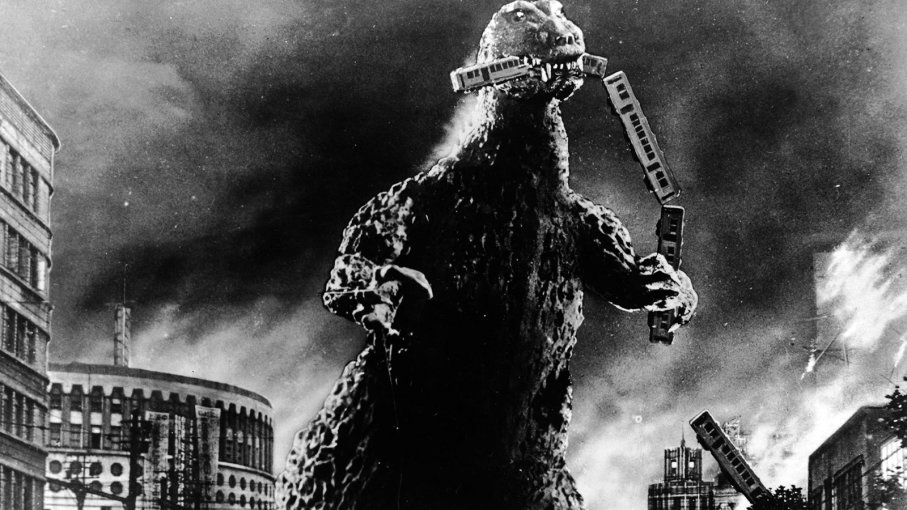
The first Godzilla movie, titled "Godzilla" was produced and distributed by Toho in Japan in 1954. PUBLIC DOMAIN

Godzilla has remarkable staying power. Movies about giant monsters were a dime a dozen back in the 1950s. Yet while Atomic Age classics like "The Giant Claw" or "The Beast From 20,000 Fathoms" never garnered any sequels, Godzilla forged on. The kaiju made his cinematic debut in 1954.

Since then, he's starred in more than 30 films spanning six-and-a-half decades. His newest movie, "Godzilla: King of the Monsters" debuts May 31. The character's origin story keeps getting re-written: He's usually said to be an irradiated beast of prehistoric origins, but the specifics vary from movie to movie. One thing that's remained consistent, however, is Godzilla's physical toughness. On-screen, the nuclear behemoth is practically invincible. But have you ever wondered how — or "if" — a beast with Godzilla's dimensions would function in real life? And what kind of animal is Godzilla, anyway?"

Godzilla as a Dinosaur
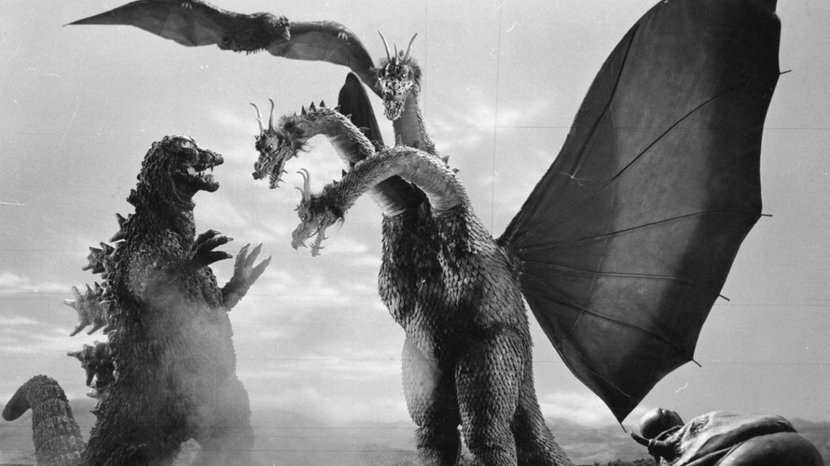
Here Godzilla is battling his arch nemesis, King Ghidorah, a golden dragon with three heads, no arms, and giant wings, in 1964's "Ghidorah, the Three-Headed Monster." PUBLIC DOMAIN

Kenneth Carpenter, a paleontologist at Utah State University, took a stab at that second question in a 1998 essay he wrote for The Official Godzilla Compendium. Traditionally, the monster has been identified as a theropod dinosaur. All known carnivorous dinos (like T. rex) are classified as theropods. So are birds.

Now, Godzilla's skull looks short and blunt for a theropod. He also tends to be depicted with four fingers per hand, and the beast's got multiple rows of bony, vertically oriented plates running down his back and tail.

Using these features, Carpenter tentatively assigned Godzilla to the ceratosauria, a primitive theropod subgroup. Like our radioactive pal, a few ceratosaurians had backsides that were littered with osteoderms: bony deposits embedded in the skin. Certain species, such as the bull-horned Carnotaurus sastrei, had shortened skulls to boot.

And there was another key feature that helped the ceratosaurians stand out. In an email, Carpenter told us that while some theropods had three, two or even one-fingered forelimbs, the more primitive varieties — like the ceratosaurians — "have four or more digits" per hand.

Maybe He's a Croc?

OK, so Godzilla must be a ceratosaurian theropod, right? Not necessarily, says Victoria Arbour. An armored dinosaur expert, Arbour is the Curator of Paleontology at the Royal British Columbia Museum. In a 2014 blog post, Arbour made the case that the King of the Monsters might not be a dinosaur at all. Maybe he's got more in common with crocodiles.

Crocs, alligators and their prehistoric kin form a reptilian clade called the pseudosuchia. As Arbour notes, osteoderms and four-fingered hands are more commonly seen in pseudosuchians than they are in theropods. So perhaps Godzilla belongs to the former group.

Speaking of digits, let's check out Godzilla's feet. In most of the original Japanese movies, the big guy has a plantigrade stance. That means he walks flat on his feet like humans. Conversely, digitigrade animals — such as dogs — walk on their toes while keeping their heels off the ground.

"Living crocodylomorphs are plantigrade, but the jury is still out on whether or not all pseudosuchians were plantigrade, especially those that were bipedal," Arbour said via email. No known dinosaur, theropod or otherwise, was similarly flat-footed.

Do His Feet Hold the Answer?

However, for the 2014 American-made movie, Godzilla's feet underwent a dramatic re-design."I think you could ... make the argument that Godzilla 2014 has tortoise-like feet, and many tortoises are also digitigrade in a manner similar to elephants, with a large heel pad supporting upright toes," Arbour said. She also points out that while "almost all bipedal dinosaurs" only had three weight-bearing digits per foot, this version of Godzilla keeps "at least four toes on the ground."

Truly huge land animals such as the long-necked dinosaurs have column-shaped, digitigrade feet. Those limbs are really efficient at supporting massive body weights. So if Godzilla were a real creature we'd probably expect him to have digitigrade hindlimbs — even though a 2017 study claimed plantigrade animals can swing their arms more forcefully in combat. (And Godzilla sure loves combat.)

But of course, it's doubtful that Godzilla could physically walk on dry land, no matter what his feet looked like. "[Getting] Godzilla to stand upright and still would be a complete non-starter," paleontologist Donald Henderson said in an email. "Its bones would not be able to support its body weight, and its heart would be unable to pump blood to the head."

This is mostly due to the square-cube law: When you scale up an object, its mass increases more sharply than its surface area. Double the height, weight and length of a wooden cube and you'll have also made the thing eighttimes heavier than it was before.

Godzilla as a Marine Animal
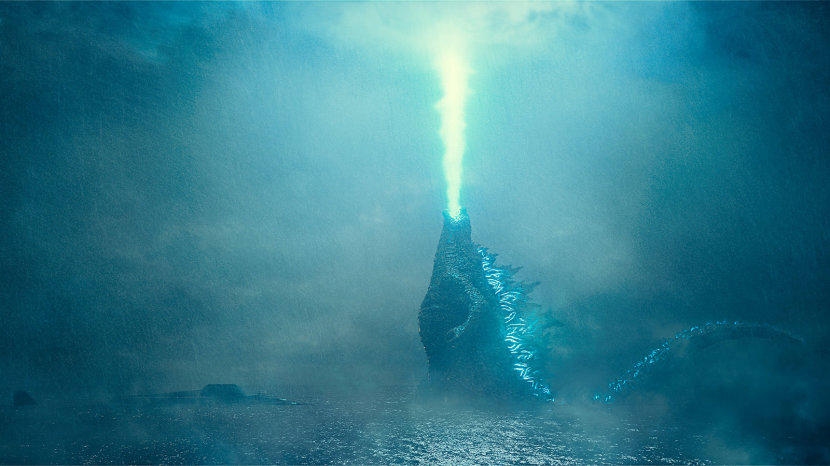
Godzilla rises from the depths and unleashes his atomic breath to claim his crown in the 2019 release, "Godzilla: King of the Monsters." COURTESY OF WARNER BROS.

So how would Godzilla fare underwater? Henderson works at Canada's Royal Tyrell Museum and tackles physics-related questions about extinct animals. In 2018, he used computer modeling to test the hypothesis that Spinosaurus— a theropod with a large sail on its back — was built for swimming. He found that the deep overall body shape of this fin-backed animal would have made the dinosaur prone to tipping over as it swam.

Would Godzilla's osteoderms put him at the same risk? Henderson doesn't think so. By his calculations, the back plates on Stegosaurus — a Jurassic herbivore who influenced Godzilla's design — only represented 17 percent of that dinosaur's overall body mass.

Meanwhile, Godzilla's plates appear to make up an even smaller fraction of the kaiju's total mass. He'd need to build a new digital model to prove it, but for now Henderson suspects that "the plates of Godzilla would not cause it to tip" during swim sessions.

Still, as a marine animal, Godzilla would face plenty of other problems. Seagoing creatures tend to be streamlined. With his jagged osteoderms and chunky legs, Godzilla is anything but. Therefore, he'd need to expend lots of extra energy in order to propel himself through the water.

"The best option for Godzilla to swim would be to undulate its body and tail to produce waves that travel down the body," Henderson explained. "Think of how crocodiles and salamanders swim when they want to move quickly. They fold their arms and legs close to the body, and use sideways motions ... to push back against the water and get a forward thrust."

By the way, semiaquatic behavior was — and still is — widespread among the pseudosuchians. On the other hand, there's no proof that any non-bird theropod was habitually amphibious. Yet some of them did take the occasional dip. In Utah, there's a series of 190-million-year-old dino tracks made by theropods whose toes barely scraped the ground as they paddled along.

For his part, Carpenter disagrees with the pseudosuchian identity argument. Since theropods could clearly swim, he thinks Godzilla's seagoing ways don't preclude the monster from being a bona fide dinosaur. Furthermore, as we've seen, the kaiju does share a lot of traits with the ceratosaurians. If he's not a member of that group, then his ancestors probably evolved all of those features independently. This scenario is certainly plausible (it's a phenomenon called "convergent evolution"). But Carpenter thinks the similarities between Godzilla and theropod dinos are probably too numerous to be coincidental.

"We already know that Dr. Yamane [a character from the 1954 movie] declared the original Godzilla a dinosaur," Carpenter says, "and since he was on site, I'll take his word."

Source: https://entertainment.howstuffworks.com

New Species of Dinosaur Found in Sa Kaeo, Thailand

Wednesday, May 15, 2019

Bangkok – The Department of Mineral Resources says dinosaur fossils have been discovered at Phra Prong water reservoir in Tambon Chong Kum in Wattana Nakhon district of Sa Kaeo province.

Titannosaurid fossils have been discovered and are believed to date back to the early Cretaceous period. Fossils of pelvises of large-sized carnivorous dinosaurs have been found as well as those of other creatures in the same period such as two kinds of crocodile’s teeth, three kinds of turtle, two kinds of fish scales and three kinds of shark’s teeth. Since 2002, a total of 62 bones of dinosaurs have been discovered in the compound of Pang Sida national park and found to have belonged to long-necked, long-tailed sauropod dinosaurs which might have been a new species of dinosaur. The department has planned to manage the area where the fossils have been found as a learning center and tourist attraction for Sa Kaeo province.

Source: www.pattayamail.com

13 Things That Could Happen If Dinosaurs Were Still Alive

Sunday, May 12, 2019

What if Dinosaurs Were Alive TODAY?

How different would our world be if “terrible lizards” were still among us?

Well, for starters, they are

natmac stock/Shutterstock

That’s right, dinosaurs do still exist, and they are everywhere—in the form of birds. That adorable little sparrow on your windowsill? Dinosaur. The noisy blue jay disturbing your morning coffee? Dinosaur. Pigeons, geese, hawks, you name it—they’re all descendants of large, two-legged, non-avian dinosaurs called theropods. Theropods, “whose members include the towering Tyrannosaurus rex and the smaller velociraptors,” according to Scientific American, adapted certain existing dino features (like feathers) into the birds we see today. Dinosaur extinction is just one myth scientists wish people would unlearn.

We wouldn’t have recognized them

frantic00/Shutterstock

Say that species-extinction asteroid hadn’t hit Mexico 66 million years ago and life on Earth had continued apace. Well-known dinosaurs like the Triceratops “would be totally different than anything we know from the fossil record,” science writer Brian Switek wrote in The Guardian. Why? They, too, would have continued to adapt. “There might even be new groups of dinosaurs that didn’t exist during the Mesozoic era. The present Earth wouldn’t be a hodgepodge of old favorites, but an entirely different mix of unknown dinosaurs,” wrote Switek. But even extinct dinosaurs looked nothing like what most people believed when they were kids.

In fact, we might never have seen them at all

aSuruwataRi/Shutterstock

Why? It’s likely that, with a preponderance of dinosaurs remaining on our planet, humans and many other mammals would not have had the chance to evolve into existence. “Even though mammals thrived in the shadow of the dinosaurs, they did so at small size,” writes Switek. “And even though the very first primates had evolved by the end of the dinosaurian reign, they had more in common with a tree shrew than with you or me…[dinosaurs] would have undoubtedly continued to influence mammalian evolution.”

It would not look like Jurassic Park

Amblin/Universal/Kobal/Shutterstock

The movie took a lot of liberties with the possible, wrote biologist Ben Waggoner in Forbes. “Dilophosaurusthe critter that spit poison in Wayne Knight’s face, lived about 120 million years and 6000 miles away from Velociraptor, the critters that ate Bob Peck. So if all the extinct dinosaurs suddenly started roaming the Earth together at the same time … well, you’d have utter ecological chaos, as the Velociraptors discovered that their tactics for hunting Protoceratops were ineffective against unfamiliar Ankylosaurus, and Triceratops found out that it had no idea how to dodge Allosaurus.”

Part of the chaos? Dead herbivores

Reimar/Shutterstock

Plant eaters like Edmontosaurus, snacking on the rich diversity of flowering plants that exist today on and in our plains, prairies, and forests, would likely have gotten sick and perhaps even died from this diet. At the very least, wrote Waggoner, they might have just spent their whole lives hallucinating. The chemical makeup of modern plants isn’t anything like what dinosaur biology was meant to handle. Other, more palatable plants might have been completely decimated by the hungry (and huge) critters.

Happy times for carnivores!

Ton Bangkeaw/Shutterstock

All those dead and dying herbivores lying around—poisoned by flowering grasses and other plants their systems couldn’t handle—would have presented a total feeding bonanza for Tyrannosaurus rexfor example, and other at-least-partial scavengers, according to Forbes. Easy pickings! You’ll be glad these 12 terrifying prehistoric monsters are extinct.

But that bounty would have been short-lived

releon8211/Shutterstock

That’s because the dead animals would run out eventually. And when that happened, what would T. rex and friends eat then? “There were mammals alive at the same time and place as T. rex, but none very big—and for all we know, modern mammal flesh might be unpalatable,” wrote Waggoner. Also likely: “A T. rex that was lucky enough to find a turkey farm would probably eat the birds like so much popcorn.”

Climate change would have mixed things up

merrymuuu/Shutterstock

“An event known as the Paleocene-Eocene Thermal Maximum, 55 million years ago, saw average global temperatures reach 8 [degrees] C hotter than today, and rainforests spanning much of the planet,” according to BBC Future. “In this hothouse world with abundant vegetation, perhaps many long-necked sauropods might have grown more rapidly, breeding at a younger age and shrinking in size; several ‘dwarf’ sauropods (some little bigger than a cow) were already known from European islands in the late Cretaceous.”

So would fruit

Peter Kniez/Shutterstock

Many modern birds have adapted to eating fruit and drinking the nectar of our numerous flowering plants—in fact, these things co-evolved so that birds would disperse the plants’ seeds. Some non-bird vegetarian dinosaurs could have developed this ability as well. Some or all may have grown into gradually smaller animals thanks to the relative ease of digestion of fruits and flowering plants compared to the gymnosperms of the Cretaceous, paleontologist Matt Bonnan told BBC Future. Dinosaurs aren’t the only thing to have gone extinct—here are 16 animals that have gone the way of the dodo in the past 200 years.

Adapting to grasslands

Brian C. Weed/Shutterstock

In the absence of dinosaurs, mammals evolved—slowly—to have the ability to eat grassland plants. Vertebrate paleontologist Darren Naish speculated that surviving dinosaurs would have evolved much quicker thanks to evolutionary advantages they’d already developed, like the “batteries” of up to 1,000 teeth that hadrosaurs had in their jaws, which would have been extremely well-suited to grinding grass.

Physical changes…

Pavlina Trauskeova/Shutterstock

…to the heads and bodies of these grass munchers would eventually have evolved. As BBC Future pointed out, “Horses and cows have flattened muzzles useful for cropping tough, low-lying vegetation.” Grass-eating, duck-billed dinosaurs might have developed squared-off snouts, and “sauropod necks might have shortened to aid grazing at their feet.”

Dinos that burrow?

pittaya/Shutterstock

“It’s odd that dinosaurs didn’t really [burrow], as it’s a common way of life among lizards and snakes,” paleontologist Paul Barrett told BBC Future. “Given more time, some dinosaurs might have become subterranean specialists—the scaly or feathery equivalent of mammalian moles,” the article notes.

Furry…but probably still not cuddly

MrPhotoMania/Shutterstock

Some dinosaurs before the asteroid hit were living up above the Arctic Circle, in conditions that were considerably warmer than what was to come with various ice ages over the millennia. Naish wonders if some of them would have developed “thick and elaborate pelts, covered in fuzz and feathers all the way down to the tips of their toes and tails.” A woolly T. rex?

Source: www.rd.com

Students Using Drone to Map Dinosaur Tracks in New Mexico

Sunday, May 12, 2019

Students Using Drone To Map Dinosaur Tracks In New Mexico

ALBUQUERQUE – New Mexico college students are using drones to help map the location of dinosaur tracks at a state park, the latest project to use drone technology to gather data from historical sites in the American West.

New Mexico State Parks recently announced it is teaming up with Central New Mexico Community College students and the New Mexico Museum of Natural History and Science to map out the footprints at Clayton Lake State Park, the Albuquerque Journal reports.

The park located in the northeastern part of the state contained track sites that give can give scientists key information about the ancient reptiles.

Central New Mexico Community College instructor Rick Watson says students will fly the drones from different heights to record a variety of details.

Once the project is complete, students will place the photographs, 3D models, maps and other findings on a website.

“The public will be able to access the website,” he said. “It’s designed to help people explore the track site from anywhere in the world.”

Spencer Lucas, a curator of paleontology at the museum, said the hundreds of tracks found at Clayton Lake, which is about 4½ hours from Albuquerque, are from four different species of dinosaurs and were all made within a year.

“The Clayton Lake site is a treasure,” he said. “The track sites are about 100 million years old and along an ancient sea coast.”

Clayton Lake was created when officials dammed Seneca Creek north of Clayton in the 1960s. Construction of the dam’s spillway unveiled the tracks, which were embedded in sandstone.

Rick Leonhardt, a semi-retired psychotherapist, is one of the students working on the projects. His first career, he said, was as a geologist and now practices it as a hobby.

“This will help us digitally preserve these tracks,” he said. “We are putting procedures in place to collect the data so others can duplicate the process in the future.”

The dinosaur track drone project comes as researchers from the University of Denver are using images gathered from a drone to create a 3D reconstruction of a World War II-era Japanese internment camp in southern Colorado.

Researchers last month dispatched the drone from the Switzerland-based company senseFly as part of a mapping project to help future restoration work at Camp Amache in Granada, Colorado.

Stay in touch!

If you’d like to stay up to date with all the latest drone news, scoops, rumors and reviews, then follow us on FacebookYouTubeInstagram.

If you are a drone geek, buy your next drone through retailers like Amazon. By using our links, we will make a small commission, but it will not cost you anything extra.

Source: https://durangoherald.com

Ambopteryx longibrachium: Tiny Jurassic Dinosaur Had Membranous Wings

Friday, May 10, 2019

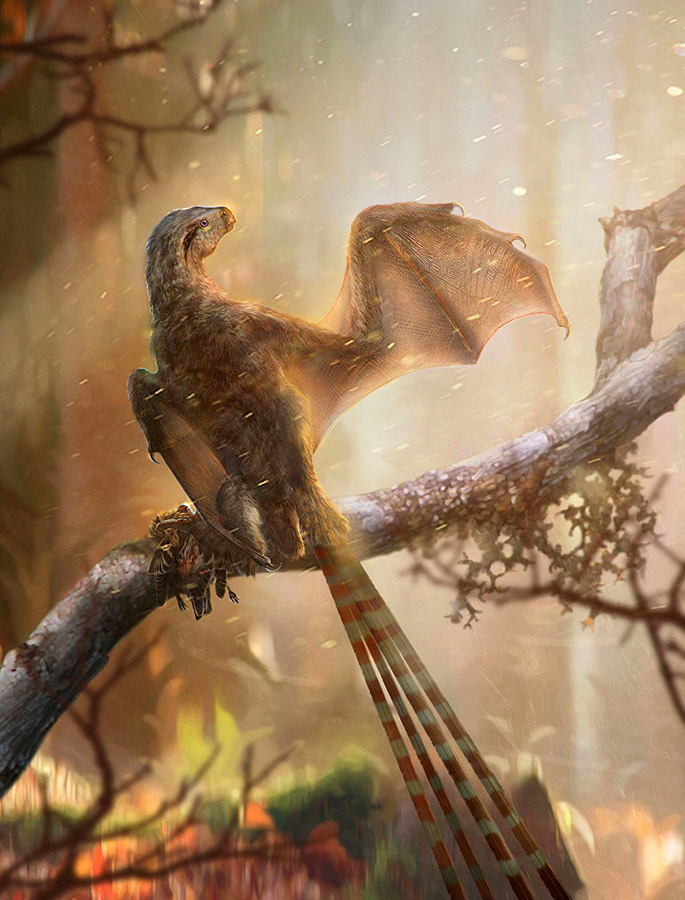
Ambopteryx longibrachium. Image credit: Chung-Tat Cheung & Min Wang / Institute of Vertebrate Paleontology and Paleoanthropology, Chinese Academy of Sciences.

A previously unknown species of bird-like dinosaur with pterosaur-like wings has been discovered by a team of paleontologists working with the Institute of Vertebrate Paleontology and Paleoanthropology and the Center for Excellence in Life and Paleoenvironment at the Chinese Academy of Science. The discovery, reported in the May 9 issue of the journal Nature, sheds some new light on the origins of avian flight.

Named Ambopteryx longibrachium, the new dinosaur lived approximately 163 million years ago (Jurassic period) in what is now China.

The prehistoric creature had a body length of about 12.6 inches (32 cm) and an estimated body mass of 300 g.

It belongs to Scansoriopterygidae, an extinct family of climbing and gliding non-avian theropod dinosaurs.

“Scansoriopterygids differ from other theropods in their body proportions, particularly in the proportions of the forelimb, which supports a bizarre wing structure first recognized in Yi qi, a close relative of Ambopteryx longibrachium,” said team leader Dr. Min Wang and colleagues.

“Unlike other flying dinosaurs, namely birds, these two species have membranous wings supported by a rod-like wrist bone that is not found in any other dinosaur, but is present in pterosaurs and flying squirrels.”

A nearly complete skeleton of Ambopteryx longibrachium was unearthed near Wubaiding Village in China’s Liaoning Province.

“Due to incomplete preservation in the only known specimen of Yi qi, the veracity of the unique wing structures and their exact function remained hotly debated,” the paleontologists said.

“As the most completely preserved specimen to date, Ambopteryx longibrachium preserves membranous wings and the rod-like wrist, supporting their widespread existence in Scansoriopterygidae.”

“These wing structures represent a short-lived and unsuccessful attempt to fly,” they added.

“In contrast, feathered wings, first documented in Late Jurassic non-avian dinosaurs, were further refined through the evolution of numerous skeletal and soft tissue modifications, giving rise to at least two additional independent origins of dinosaur flight and ultimately leading to the current success of modern birds.”

_____

Min Wang et al. 2019. A new Jurassic scansoriopterygid and the loss of membranous wings in theropod dinosaurs. Nature 569: 256-259; doi: 10.1038/s41586-019-1137-z

Source: www.sci-news.com

Statistical Study Finds it Unlikely South African Fossil Species is Ancestral to Humans

Thursday, May 9, 2019

Fossil casts of Australopithecus afarensis (left), Homo habilis (center), and Australopithecus sediba (right).  CREDIT: Matt Wood, UChicago

Statistical analysis of fossil data shows that it is unlikely that Australopithecus sediba, a nearly two-million-year-old, apelike fossil from South Africa, is the direct ancestor of Homo, the genus to which modern-day humans belong.

The research by paleontologists from the University of Chicago, published this week in Science Advances, concludes by suggesting that Australopithecus afarensis, of the famous "Lucy" skeleton, is still the most likely ancestor to the genus Homo.

The first A. sediba fossils were unearthed near Johannesburg in 2008. Hundreds of fragments of the species have since been discovered, all dating to roughly two million years ago. The oldest known Homo fossil, the jawbone of an as yet unnamed species found in Ethiopia, is 2.8 million years old, predating A. sediba by 800,000 years.

Despite this timeline, the researchers who discovered A. sediba have claimed that it is an ancestral species to Homo. While it is possible that A. sediba (the hypothesized ancestor) could have postdated earliest Homo (the hypothesized descendant) by 800,000 years, the new analysis indicates that the probability of finding this chronological pattern is highly unlikely.

"It is definitely possible for an ancestor's fossil to postdate a descendant's by a large amount of time," said the study's lead author Andrew Du, PhD, who will join the faculty at Colorado State University after concluding his postdoctoral research in the lab of Zeray Alemseged, PhD, the Donald M. Pritzker Professor of Organismal and Biology and Anatomy at UChicago.

"We thought we would take it one step further to ask how likely it is to happen, and our models show that the probability is next to zero," Du said.

Du and Alemseged also reviewed the scientific literature for other hypothesized ancestor-descendant relationships between two hominin species. Of the 28 instances they found, only one first-discovered fossil of a descendant was older than its proposed ancestor, a pair of Homo species separated by 100,000 years, far less than the 800,000 years separating A. sediba and earliest Homo. For context, the average lifespan of any hominin species is about one million years.

"Again, we see that it's possible for an ancestor's fossil to postdate its descendant's," Du said. "But 800,000 years is quite a long time."

Alemseged and Du maintain that Australopithecus afarensisis a better candidate for the direct ancestor of Homofor a number of reasons. A. afarensis fossils have been dated up to three million years old, nearing the age of the first Homo jaw. Lucy and her counterparts, including Selam, the fossil of an A. afarensis child that Alemseged discovered in 2000, were found in Ethiopia, just miles from where the Homo jaw was discovered. The jaw's features also resemble those of A. afarensis closely enough that one could make the case it was a direct descendant.

"Given the timing, geography and morphology, these three pieces of evidence make us think afarensisis a better candidate than sediba," Alemseged said. "One can disagree about morphology and the different features of a fossil, but the level of confidence we can put in the mathematical and statistical analyses of the chronological data in this paper makes our argument a very strong one."

Source: https://eurekalert.org

Dinosaurs Get Their Close-Ups In These Stunning Photos

Wednesday, May 8, 2019

German photographer Christian Voigt shot this Tyrannosaurus rex fossil at Berlin's Museum für Naturkunde. Credit: Christian Voigt

THE LAST OF the dinosaurs died off 65 million years ago, but they come roaring back to life in German photographer Christian Voigt's remarkable new series. A couple years ago, Voigt, best known for his sumptuous interior photography, was shooting inside London's Natural History Museum before visiting hours when a few of the dinosaur skeletons in the paleontology hall caught his eye.

"Like all photographers, I always face this problem of how to capture images that no one's ever seen," Voigt says. "If you shoot the Eiffel Tower, for instance, probably 50,000 tourists have taken the same shot that day." But Voigt came up with a novel way of photographing the dinosaur exhibitions that are the star attraction of every natural history museum. "In most exhibition halls they put 10 or 12 dinosaurs in one room," he observes. "To bring out their individuality and beauty, I needed to make them stand alone, to take them out of the crowd."

Easier said than done. Moving the skeletons into a studio was out of the question—no museum would allow it—so Voigt had to photograph the skeletons in situ. Because of additional museum restrictions, he could only use the existing gallery lighting. And, of course, he couldn't pose the skeletons. (In addition to London, he shot at natural history museums in Berlin, Frankfurt, Paris, and Denkendorf, Germany.) Voigt solved the problem by rigging a black cloth backdrop around the skeletons, then digitally removing the rest of the background in postproduction.

Voigt's idea was to isolate each skeleton, like he did with this Tyrannosaurus rex he photographed at the Dinosaurier-Park Altmühltal, in Denkendorf, Germany. Christian Voigt

Skeletons such as this Tyrannosaurus rex in Frankfurt's Senckenberg Naturmuseum are typically part of larger displays. Voigt wanted to focus on one dinosaur at a time. Christian Voigt

This photograph of a triceratops on display at Frankfurt's Senckenberg Naturmuseum is one of Voigt's favorites from the series, because of its realism. Christian Voigt

Voigt chose skeletons consisting almost entirely of original fossils, like this triceratops on display at Frankfurt's Senckenberg Naturmuseum. Christian Voigt

The key, he says, was choosing the right camera and settings with which to capture each dinosaur. As usual, Voigt worked with a Swiss-made ALPA medium-format analog camera, bracketing his exposures with different f-stops to give him a full range of lighting options in postproduction. That allowed him to create extraordinarily lifelike images that turn fossil assemblages into individuated animals with distinct personalities.

It helps that Voigt purposely chose skeletons consisting mostly of original fossils rather than plaster replicas. Millions of years in the ground have aged the fossils to beautifully mottled shades of brown, red, and yellow. One of Voigt's favorite images from the series is a triceratops he shot at Frankfurt's Senckenberg Naturmuseum. "It just looks so alive," he says. "The head is lowered, and it's looking to the right, as if it just caught a scent."

Spending so much time around dinosaur fossils prompted Voigt to think about mankind's own future. Thanks to global warming, the idea of another mass extinction like the one that carried off the dinosaurs no longer seems beyond the realm of possibility. "We will all be skeletons ourselves someday," he says. "Nothing lasts."

Source: www.wired.com

Oxygen Linked With The Boom And Bust Of Early Animal Evolution

Tuesday, May 7, 2019

This is a fossilized trilobite Aldonaia from the Cambrian Period. CREDIT: Andrey Zhuravlev, Lomonosov Moscow State University

Extreme fluctuations in atmospheric oxygen levels corresponded with evolutionary surges and extinctions in animal biodiversity during the Cambrian explosion, finds new study led by UCL and the University of Leeds.

The Cambrian explosion was a crucial period of rapid evolution in complex animals that began roughly 540 million years ago. The trigger for this fundamental phase in the early history of animal life is a subject of ongoing biological debate.

The study, published today in Nature Geoscience by scientists from the UK, China and Russia, gives strong support to the theory that oxygen content in the atmosphere was a major controlling factor in animal evolution.

The study is the first to show that during the Cambrian explosion there was significant correlation between surges in oxygen levels and bursts in animal evolution and biodiversity, as well as extinction events during periods of low oxygen.

Dr Tianchen He, study lead author and postdoctoral researcher at the University of Leeds, began this research while at UCL. He said: "The complex creatures that came about during the Cambrian explosion were the precursors to many of the modern animals we see today. But because there is no direct record of atmospheric oxygen during this time period it has been difficult to determine what factors might have kick started this crucial point in evolution.

"By analysing the carbon and sulphur isotopes found in ancient rocks, we are able to trace oxygen variations in Earth's atmosphere and shallow oceans during the Cambrian Explosion. When compared to fossilised animals from the same time we can clearly see that evolutionary radiations follow a pattern of 'boom and bust' in tandem with the oxygen levels.

"This strongly suggests oxygen played a vital role in the emergence of early animal life."

Study co-author Professor Graham Shields from UCL Earth Sciences, said: "This is the first study to show clearly that our earliest animal ancestors experienced a series of evolutionary radiations and bottlenecks caused by extreme changes in atmospheric oxygen levels.

"The result was a veritable explosion of new animal forms during more than 13 million years of the Cambrian Period. In that time, Earth went from being populated by simple, single-celled and immobile organisms to hosting the wonderful variety of intricate, energetic life forms we see today."

The team analysed the carbon and sulphur isotopes from marine carbonate samples collected from sections along the Aldan and Lena rivers in Siberia. During the time of the Cambrian explosion this area would have been a shallow sea and the home for the majority of animal life on Earth.

The lower Cambrian strata in Siberia are composed of continuous limestone with rich fossil records and reliable age constraints, providing suitable samples for the geochemical analyses. The isotope signatures in the rocks relate to the global production of oxygen, allowing the team to determine oxygen levels present in the shallow ocean and atmosphere during the Cambrian Period.

Study co-author Dr Benjamin Mills, from the School of Earth and Environment at Leeds, said: "The Siberian Platform gives us a unique window into early marine ecosystems. This area contains over half of all currently known fossilised diversity from the Cambrian explosion.

"Combining our isotope measurements with a mathematical model lets us track the pulses of carbon and sulphur entering the sediments in this critical evolutionary cradle. Our model uses this information to estimate the global balance of oxygen production and destruction, giving us new insight into how oxygen shaped the life we have on the planet today."

Study co-author Maoyan Zhu from Nanjing Institute of Geology and Palaeontology, Chinese Academy of Sciences, said: "Understanding what triggered the Cambrian explosion requires multidisciplinary study. That's why with Graham Shields we organized together such a multidisciplinary team funded by NERC and NSFC in past years. I am so excited about the results through this collaborative project."

"On the other hand, it took a long time to get this result. We already got samples from Siberia in 2008. The sections in Siberia are difficult to access. It took time for us to organize the expedition and collect the samples there. Without support from Russian colleagues, we could not do the project."

Study co-author Andrey Yu Zhuravlev from Lomonosov Moscow State University said: "This has been an incredibly successful and exciting joint study. The question of the Cambrian Explosion trigger has puzzled scientists for years. Now, the results give us convincing evidence to link the rapid appearance of animals as well as mass extinction during the early Cambrian with oxygen."

###

Further information

The paper Possible links between extreme oxygen perturbations and the Cambrian radiation of animals is published in Nature Geoscience 06 May 2019. (DOI: 10.1038/s41561-019-0357-z)

Full list of authors: Tianchen He, Maoyan Zhu, Benjamin J. W. Mills, Peter M. Wynn, Andrey Yu. Zhuravlev, Rosalie Tostevin, Philip A. E. Pogge von Strandmann, Aihua Yang, Simon W. Poulton and Graham A. Shields

This work was facilitated and supported by a joint Sino-UK-Russia research collaboration.

UK institutes: UCL; University of Leeds; Lancaster University; University of Oxford

Chinese institutes: Nanjing Institute of Geology and Palaeontology, CAS; University of Chinese Academy of Sciences; Nanjing University

Russian institute: Lomonosov Moscow State University


Source: www.eurekalert.org

Pages