Blogs

Cluster of 66 Million-Year-Old Dinosaur Eggs Found During Rural Walk

Sunday, May 19, 2019

The tyrannosaurus rex, the feathered velociraptor and the three-horned triceratops all lived during the period (Image: Newsflare)

The men reported their rare find to a local museum where it was confirmed that the fossilised remains dated to the Cretaceous Period.

Four college students found rare dinosaur egg fossils while on a walk through a rural area of southern China.

Footage shows how the young men encountered the "strange stones" covered in red mud in Pingxiang City in Jiangxi Province on May 11. 

They decided to report their find to a local museum for further examination which later called in experts from the Chinese Academy of Science.

The "strange stones" were confirmed as dinosaur egg fossils, dating back to the late Cretaceous Period which began 145 million years ago and ended 66 million years ago.

The petrified remains are now being held in local museum.

Experts confirmed that the fossils dated back to the Cretaceous Period (Image: Newsflare)

Jiangxi Province has seen the discovery of a number of fossil in recent years and has been dubbed China’s ‘hometown of dinosaurs’

Dinosaurs alive during the Cretaceous Period include the Tyrannosaurus rex, the feathered Velociraptor and the three-horned Triceratops.

On April 15, 2010, a dinosaur egg fossil with an eggshell was found on a building site.

In September 2008, Pingxiang cultural relics found several dinosaur skeleton fossils from the rest of the building.

The young Chinese students uncovered cluster of 66 million year old dinosaur eggs (Image: Newsflare)

In 2017, a cluster of perfectly preserved dinosaur eggs were discovered by construction workers digging the foundations for a new school .

Up to 30 eggs were uncovered are believed to be a staggering 130 million years old.

The fossilised eggs were lucky to survive intact as the builders detonated an explosive to break up a large boulder.

The city and surrounding area is “one of the most productive oviraptorosaurian regions of the world” according to an article published in nature.com with seven oviraptorosaurian (feathered and bird-like) dinosaurs named after the region.

The seventh, the Corythoraptor jacobsi, was only discovered this year and is said to closely resemble the flightless cassowary, which lives in Australia, Papua New Guinea and Indonesia.

Source: www.mirror.co.uk

Taphophoyx hodgei: Museum Volunteers Discover New Species of Extinct Heron at North Florida Fossil Site

Saturday, May 18, 2019

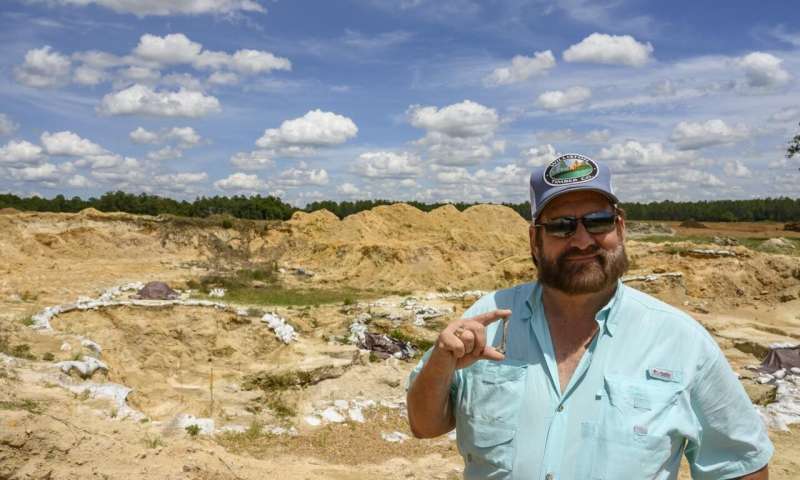
Eddie Hodge holds the coracoid bone from Taphophoyx hodgei, a new species of extinct heron found at the site and named in his honor. Credit: Florida Museum photo by Kristen Grace

When the bones of an ancient heron were unearthed at a North Florida fossil site, the find wasn't made by researchers but by two Florida Museum of Natural History volunteers.

A previously unknown genus and species, the heron has been named Taphophoyx hodgei (TAFF'-oh-foy-ks HAHJ'-ee-eye) in honor of landowner Eddie Hodge, who has allowed Florida Museum researchers and volunteers to excavate the site on his property near Williston since his granddaughter first discovered fossils there in 2015.

Nearly 700 volunteers have worked at the Montbrook fossil site, collectively digging more than 12,000 hours.

"You couldn't have a better group of people," Hodge said. "There's a lot of negativity when we get home and turn on the television, but it does you good to be out here seeing volunteers get excited and be positive about something."

The bones used to identify the new heron were found by volunteers Toni-Ann Benjamin and Sharon Shears.

Taphophoyx hodgei - whose genus name means "buried heron" in Greek and Latin—is the first new species to be described from Montbrook. Many other new species from the fossil-rich site await publication.

"It's invigorated the local fossil community," said David Steadman, Florida Museum curator of ornithology and lead author of the description of T. hodgei. "One of the greatest values of Montbrook is that it's been such a collaborative learning tool."

Because Montbrook is such an intensively worked fossil site, processing the finds takes the teamwork of scientists and amateurs. Hodge oversees much of the land management that Montbrook requires, including moving dirt and managing drainage. In addition to working outdoors at the site, volunteers prepare and catalog specimens in the Florida Museum's vertebrate paleontology lab.

A good day of digging requires between 10 and 20 days to process in the lab, said Jonathan Bloch, Florida Museum curator of vertebrate paleontology and a coordinator of the fossil dig.

"We simply couldn't do all this work without help from the public," Bloch said. "Volunteers are not only the backbone of the dig, they're actively contributing to scientific discoveries."

Taphophoyx hodgei, a newly described species of extinct heron. Credit: Florida Museum photo by Kristen Grace

Steadman and then-master's student Oona Takano used the characteristics of the bird's scapula and coracoid, two bones that intersect to support the bird's shoulder, to determine the relationship between this ancient heron and modern lineages.

They believe T. hodgei is most closely related to today's tiger-herons, which live in Mexico and Central and South America. They have given the new species the common name "Hodge's tiger-heron."

"This heron adds to this big suite of aquatic birds we're finding at Montbrook," Steadman said. "We're seeing the same families of birds you'd see around wetlands today, but they're all extinct species. The fun challenge is finding out how closely related any given species at Montbrook is to the birds that we see flying and swimming around Florida today. Even after three and a half years, we're nowhere near diminishing returns."

Takano, now a University of New Mexico Ph.D. student, said that bird fossils are prized finds, particularly at a site like Montbrook where the majority of fossils belong to young gomphotheres, extinct elephant-like mammals.

"In general, bird bones don't fossilize well because they're hollow," she said. "It's relatively rare to find well-preserved bird bones at all and even rarer to find articulated bones," referring to bones that would have locked together in the bird's body.

Most Florida fossil sites are limestone sinkholes or pitfall traps created by ancient predators to capture their prey. At Montbrook, researchers have been able to glimpse a different type of ancient environment: the riverine ecosystem. Five million years ago, T. hodgei would have lived alongside saber-toothed cats, rhinoceroses and horses that frequented a river that likely weaved through a grassland, Steadman said.

Researchers believe the ancient river's current scattered decomposing animal remains, making this find of two intersecting bones even more significant. Steadman said naming the species after Hodge was a natural choice.

"Through the kindness of his heart and being interested—just wanting to know what's in the ground on his land—Eddie let us in and one thing led to another." Steadman said. "Naming this heron after Eddie is a minor part of treating him right because he's been treating us right."

"He's genuinely interested in the fossils we're finding," Takano added.

The Florida Museum recruits volunteers for the Montbrook dig in fall and spring and regularly encourages volunteers and students to become involved, often resulting in meaningful fossil discoveries. Finds are shared on the Florida Museum Montbrook Fossil Dig Blog.

"Volunteers are fascinated by this stuff—it's really their passion," Hodge said. "There's a satisfaction in being able to provide something like this for people interested in higher learning, and you don't get the chance to do that very often. You never know what you can find. Just the next little spoonful of dirt, brush it back and there it is."


More information: David W. Steadman and Oona M. Takano. A New Genus And Species Of Heron (Aves: Ardeidae) From The Late Miocene Of Florida. Bulletin of the Florida Museum of Natural History.Published On-line: April 6, 2019. www.floridamuseum.ufl.edu/file … vol55no9archival.pdf

Source: https://phys.org

World's Largest Tyrannosaurus Rex, 'Scotty,' Unveiled in Saskatchewan

Saturday, May 18, 2019

“Scotty” is the largest dinosaur skeleton ever found in Canada. (Tourism Saskatchewan)

More than 25 years after it was discovered, the largest Tyrannosaurus rex in the world is on display in Regina, Sask., thanks to the efforts of a dedicated team of paleontologists who freed the 67 million-year-old skeleton from the rock encasing it.

Scotty – named after the celebratory bottle of scotch used to toast the discovery – was a T. rex that had a skeleton about 13 meters long and weighed more than 8,800 kilograms.

Scotty is now on display at the Royal Saskatchewan Museum and has had a warm reception thus far.

“I think this is fabulous for the city of Regina, for the province of Saskatchewan and our nation” said Saskatchewan Premier Scott Moe. “It really is a world class exhibit.”

First discovered in the early 1990s, Scotty was encased in sandstone that took years of work to remove.

“This was incredibly unforgiving ground,” said Tim Tokaryk, curator of vertebrate paleontology and professor of geology at the University of Regina. “We blew jack hammers and air hammers on the rock. It was just so hard. I had a guy use a pickaxe and actually bent the pick axe [on the rock].”

Scotty represents an unusual portrayal of life some 67 million years ago, as paleontologists believe the dinosaur died at 30 years old, which is quite advanced by T. rex standards.

Scotty’s skeleton also offers clues about the harsh reality that even apex predators had to deal with during that time period, showcasing bite marks, broken ribs, an infected jaw and other injuries that would have been from other T. rex dinosaurs.

For now, Scotty puts Saskatchewan on the scientific map – something paleontologists are happy to share.

“We’ve known there are fossils in Saskatchewan for a hundred plus years,” said Tokaryk. “But now we can show we are at the high table of paleontology as well.”

Source: www.ctvnews.ca

Teen Finds Prehistoric Mastodon Jaw in Southern Iowa

Saturday, May 18, 2019

In this May 14, 2019 photo, a juvenile mastodon's jaw bone is displayed temporarily while unwrapped from its plastic covering, at the University of Iowa Paleontology Repository on the University of Iowa campus in Iowa City, Iowa. A teen searching for arrowheads in southern Iowa found the prehistoric jawbone of a mastodon. The Iowa City Press-Citizen reports that the 30-inch bone belonged to a juvenile mastodon, an elephant-like animal believed to have roamed Iowa some 34,000 years ago. Officials with the University of Iowa Paleontology Repository, which now has possession of the bone found last week, say the mastodon might have stood around 7-feet tall. Joseph Cress

A teen searching for arrowheads in southern Iowa found something much bigger: the prehistoric jawbone of a mastodon.

The Iowa City Press-Citizen reports that the 30-inch bone belonged to a juvenile mastodon, an elephant-like animal believed to have roamed Iowa some 34,000 years ago.

Officials with the University of Iowa Paleontology Repository, which now has possession of the bone, say the mastodon might have stood around 7-feet tall.

The farmers who donated the jaw and related bones to the repository did so anonymously, saying they didn't want to encourage people to trespass on their property looking for fossils.

There likely are more fossils on the land, as the owners found other mastodon remains there decades ago.

Source: https://pilotonline.com

A Surprising New Species of Rhino Found at Gray Fossil Site

Saturday, May 18, 2019

A new species of rhino was recently found at Gray Fossil Site.

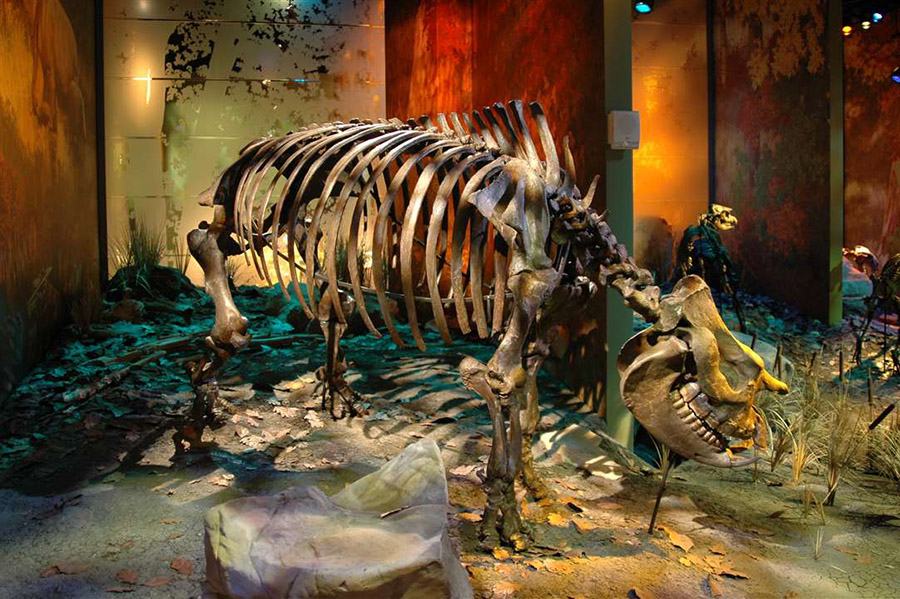
The Gray Fossil Site in East Tennessee, which preserves the remains of a diverse ecosystem dating to the late Miocene to early Pliocene Epoch, is home to tapirs, alligators, mastodons, red pandas and more. Now, a study published in the Bulletin of the Florida Museum of Natural History unveils the latest new species from the site, a rhinoceros named Teleoceras aepysoma. At an estimated 4.5-4.9 million years old, these were among the very last rhinos in North America.

The new species is a member of a group called the barrel-chested rhinos, which were once widespread across the plains of North America. They were typically grass-eaters, and they looked sort of like hippos, with short legs, round bodies and a nose adorned with only a very small horn or no horn at all. But the Gray Fossil Site rhino discovered by East Tennessee State University paleontologists is very different.

“If you put it in a group of other Teleoceras species, it would be like the NBA player. It would be noticeably taller and larger,” says Rachel Short, lead author of the new paper and a 2013 graduate of the ETSU master’s degree program in paleontology. One of the major distinguishing features of the new species is its long front limbs, which gave it a height boost not seen in its cousins. In fact, the name aepysoma means “high-bodied.”

This “high-bodied” rhino was also living an unexpected lifestyle compared to its relatives. The ancient habitat of the Gray Fossil Site was not a grassy plain, but a dense forest, and previous chemical analysis of this rhino’s teeth has shown that it was browsing on leaves, not grazing on grass.

Short, currently a Ph.D. candidate at Texas A&M University, suspects it is no coincidence that this unusually shaped rhino was living in an unusual place. The extra height of T. aepysoma may have been a helpful adaptation while it competed for leafy greens with smaller herbivores like tapirs.

The detailed description of this new species was possible thanks to the quality of preservation at the Gray Fossil Site. While most extinct species are known only from fragmentary remains, T. aepysoma is represented by two practically complete skeletons, affectionately named Little Guy and Big Boy, as well as partial remains of at least four others. Little Guy, who is identified in this paper as the reference specimen or holotype for the species, has every single bone in the body except for one missing toe bone.

This fossil bounty allowed the researchers to present what they describe in their study as “a detailed, thorough, bone-by-bone description” of the rhino.

“I feel like this is practically going to be a rhinoceros reference manual,” says Laura Emmert, study coauthor and field and lab technician at the Gray Fossil Site. Like Short, Emmert also graduated from ETSU in 2013 with a master’s degree paleontology.

Partial rhino remains were first found at the Gray Fossil Site in 2000, and from 2004 to 2006, paleontologists discovered and excavated the full skeletons of Little Guy and Big Boy.

“It was almost immediately that we started noticing these weird differences, especially in the legs,” says Dr. Steven Wallace, study co-author and professor of paleontology in the ETSU Department of Geosciences. “Once we got the skull together, we noticed the skull was weird, too.”

But it wasn’t until Short started her master’s research in 2011 that the rhinos finally got the academic attention they were waiting for. Then it was a matter of meticulously examining all the bones individually and comparing them to those of rhinos around the country. The researchers suspected all along that this was a new species, and with the publication of this paper, it is official.

“I’ve been working on these rhinos for almost eight years,” says Short. “To have it done now is very satisfying and I’m excited to contribute to our understanding of North American rhinos.”

Source: www.johnsoncitypress.com

Bedbugs Arose 115 Million Years Ago, Roamed Earth alongside Dinosaurs

Saturday, May 18, 2019

This digitally-colorized scanning electron micrograph revealed some of the ultrastructural morphology displayed on the ventral surface of Cimex lectularius; from this view you can see the insect’s skin piercing mouthparts it uses to obtain its blood meal, as well as a number of its six jointed legs. Image credit: Janice Harney Carr, CDC.

Bedbugs are blood-sucking parasites in the family Cimicidae. A multinational research team led by University of Sheffield, the University Museum Bergen and Dresden University has compared the DNA of dozens of bedbug species and discovered that bedbugs are 50 million years older than bats — a mammal that scientists had previously believed to be their first host 50-65 million years ago.

“To think that the pests that live in our beds today evolved more than 100 million years ago (Cretaceous period) and were walking the Earth side by side with dinosaurs, was a revelation,” said University of Sheffield’s Professor Mike Siva-Jothy, co-author of the study.

“It shows that the evolutionary history of bed bugs is far more complex than we previously thought.”

Professor Siva-Jothy and colleagues spent 15 years collecting samples from wild sites and museums around the world, dodging bats and buffaloes in African caves infected with Ebola and climbing cliffs to collect from bird nests in South East Asia.

“The first big surprise we found was that bedbugs are much older than bats, which everyone assumed to be their first host,” said co-lead author Dr. Steffen Roth, a researcher at the University Museum Bergen.

“It was also unexpected to see that evolutionary older bedbugs were already specialized on a single host type, even though we don’t know what the host was at the time when T. rex walked the Earth.”

The scientists found that a new species of bedbug conquers humans about every half a million years: moreover that when bedbugs changed hosts, they didn’t always become specialized on that new host and maintained the ability to jump back to their original host.

This demonstrates that while some bedbugs become specialized, some remain generalists, jumping from host to host.

“These species are the ones we can reasonably expect to be the next ones drinking our blood, and it may not even take half a million years, given that many more humans, livestock and pets that live on earth now provide lots more opportunities,” said co-lead author Professor Klaus Reinhardt, a bedbug researcher at Dresden University.

The team also found that the two major bedbug pests of humans — the common bedbug (Cimex lectularius) and the tropical bedbug (Cimex hemipterus) — diverged approximately 47 million years ago and are much older than humans.

This finding clearly rejects so-called Ashford’s hypothesis, which predicts a divergence that coincides with the split between Homo sapiens and Homo erectus lineages around 1.6 million years ago.

“The findings will help us better understand how bedbugs evolved the traits that make them effective pests — that will also help us find new ways of controlling them,” Professor Siva-Jothy said.

The results were published online in the journal Current Biology.

_____

Steffen Roth et al. Bedbugs evolved before their bat hosts and did not co-speciate with ancient humans. Current Biology, published online May 16, 2019; doi: 10.1016/j.cub.2019.04.048

Source: www.sci-news.com

6 Best Lego Jurassic World Sets

Friday, May 17, 2019

LEGO Jurassic World #75931 Dilophosaurus Outpost Attack Pack Set

The Jurassic World films explore what happens when man messes with nature. Or a highly fictionalized version thereof. To the surprise of no one, things go to sh*t, and fast. And naturally, the folks at Lego are in on the action with a slew of Jurassic World-themed Lego sets that are crammed with heroes, vehicles, disasters, buildings, labs, and, of course, dinosaurs. Lots and lots of dinosaurs.

One thing we particularly love about the Lego Jurassic World sets is that there’s one for just about every age. The creatures are incredibly detailed. Plus, unlike other Lego sets, which are very gender-specific, these are geared for all kids. And if your kids loves the Tyrannosaurus (and really, who doesn’t), these Lego sets are the best ones to buy.

LEGO Jurassic World Indoraptor Rampage

Experienced builders can join Owen and Claire to create the Indoraptor Rampage at Lockwood Estate. They can build the museum and laboratory from the film, with removable windows, collapsing roof function and dinosaur toys.

Buy Now

Kids ages five and up can work together to build the Indoraptor Rampage at Lockwood Estate. You get the Owen, Claire, Maisie, Mills, Wheatley and Eversol, plus Indoraptor and Velociraptor figures. If your kids love dinosaurs, they’ll go berserk for this Jurassic World set.

LEGO Jurassic World Blue’s Helicopter Pursuit

You build an actual helicopter with moving parts, featuring rotating blades, a six-stud shooter and dual searchlights, plus a quad bike.

Buy Now $31.99

Kids can use the Lego chopper to locate Blue, the last surviving Velociraptor. This set is great for kids seven and older, and of course, works with all other Jurassic World sets.

LEGO Jurassic World T. rex Transport

Once kids get past two guards, they can save the escaped T-Rex and perform a dinosaur blood transfusion with the help of Jurassic World's Zia.

Buy Now $55.99

Kids build a truck with a trailer, and they use the mobile medical unit and monitoring system to catch the escaped T-Rex. It’s idea for kids ages seven and up. As for the dinosaur, it has posable limbs, head and snapping jaws.

LEGO Jurassic World Stygimoloch Breakout

Yes, you can have a chicken coop. But isn't a dinosaur enclosure that much cooler? With the Lego set, kids build the laboratory with observation deck and a dinosaur figure enclosure pen.

Buy Now $23.99

It’s a dinosaur emergency, as the Stygimoloch has broken outThis Lego Jurassic World laboratory has an observation deck and a tilting workbench with breaking window function.

LEGO Jurassic World Pteranodon Chase

Here's your chance to build the Jurassic World high-speed off-roader with a net shooter and a tranquilizer gun and chase the Pteranodon pterosaur.

Buy Now $15.99

A fairly straightforward Jurassic World set to build, this one is ideal for kids six and up. Kids are part of a lightning-fast pursuit to help Owen and the tracker save the Pteranodon.

LEGO Juniors Jurassic World T. rex Breakout

Younger builders can get in on the dinosaur action with this Tyrannosaurus rex dinosaur toy with scary but fun opening jaws.

Buy Now $32.91

With only 150 pieces, this Lego Jurassic World set is great for builders ages four and up. It includes a truck with an opening back, a science station and a tall gate, plus a baby dinosaur figure.

If you click a link on our site and buy something, we may earn an affiliate commission.

Source: www.yahoo.com

Rhoetosaurus brownei: A 'High-Heeled' Dinosaur that Walked on its Tiptoes

Saturday, May 18, 2019

Rhoetosaurus brownei by Gogosardina

A 24-tonne dinosaur may have walked in a 'high-heeled' fashion, according to University of Queensland research.

UQ Ph.D. candidate Andréas Jannel and colleagues from UQ's Dinosaur Lab analysed fossils of Australia's only named Jurassic sauropodRhoetosaurus brownei, to better understand how such an enormous creature could support its own body weight.

"Looking at the bones of the foot, it was clear that Rhoetosaurus walked with an elevated heel, raising the question: how was its foot able to support the immense mass of this animal, up to 40 tonnes?" Mr Jannel said.

"Our research suggests that even though Rhoetosaurus stood on its tiptoes, the heel was cushioned by fleshy pad."

"We see a similar thing in elephant feet, but this dinosaur was at least five times as heavy as an elephant, so the forces involved are much greater."

Mr Jannel and his colleagues arrived at this conclusion by creating a replica of the fossil, and then physically manipulating it in an attempt to understand the movement between bones.

"We also used 3-D modeling techniques to assess the different foot postures that would have allowed Rhoetosaurus to support its weight," he said.

Right hind foot of the fossil specimen of Rhoetosaurus brownei (QM F1659), in dorsal view. The hind foot preserves the first four digits in completion, but is missing the fifth one. Credit: Jay P. Nair & Andréas Jannel.

"Finally, we looked at a range of sauropod footprints from around the world, many of which indicated the presence of a fleshy heel pad behind the toes, supporting what the bones were telling us.

"The addition of a cushioning pad that supports the raised heel appears to be a key innovation during the evolution of sauropods, and probably appeared in early members of the group some time during the Early to Middle Jurassic Periods.

"The advantages of a soft tissue pad may have helped facilitate the trend towards the enormous body sizes we see in these dinosaurs."

The fossils of the specimen R. brownei were found near Roma in southwest Queensland and are dated to 160–170 million years ago, when Australia was part of the supercontinent of Gondwana.

Mr Jannel is now using computer techniques to simulate how different foot postures and the presence of a soft tissue pad affect stress distributions within the bones.

A cross-section of an elephant’s foot alongside a human foot x-ray, revealing a striking skeletal likeness. Credit: University of Queensland

"In a nutshell, I'm using engineering tools to apply theoretical forces on the bones, assessing how stress is distributed within the feet of these giant dinosaurs, with the aim to provide mechanical evidence for the presence of such a soft tissue pad.

"It can be a tedious and time-consuming process, but I've always been fascinated by palaeontology, particularly the link between form and function in extinct animals," he said.

"There's so much more to know, but it's amazing to discover that becoming 'high-heeled' might have been an important step in the evolution of sauropod dinosaurs."

Source: https://phys.org
Fossil Trackway Discovered At Grand Canyon Traced To Early Reptiles

Friday, May 17, 2019

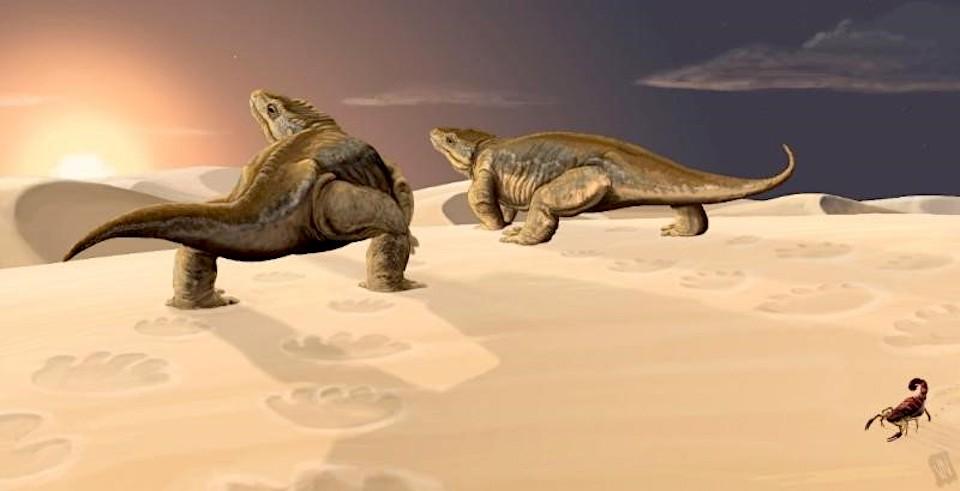
Artwork depicting the Coconino desert environment and two primitive tetrapods, based on the occurrence of Ichniotherium from Grand Canyon National Park/Voltaire Paes Neto illustrator

Nearly 300 million years ago, in a sandy desert now preserved as Coconino Sandstone at Grand Canyon National Park, some creatures walked across an area left moist very likely by an oasis. Those tracks, revealed today in a remote area of the national park, likely point to the transition of amphibians to reptiles and reflect another of the wonders held within the National Park System.

The discovery of the trackway, which was found a couple years ago, dates back 280 million years, just about to the arrival of the Permian Period and before dinosaurs walked the Earth.

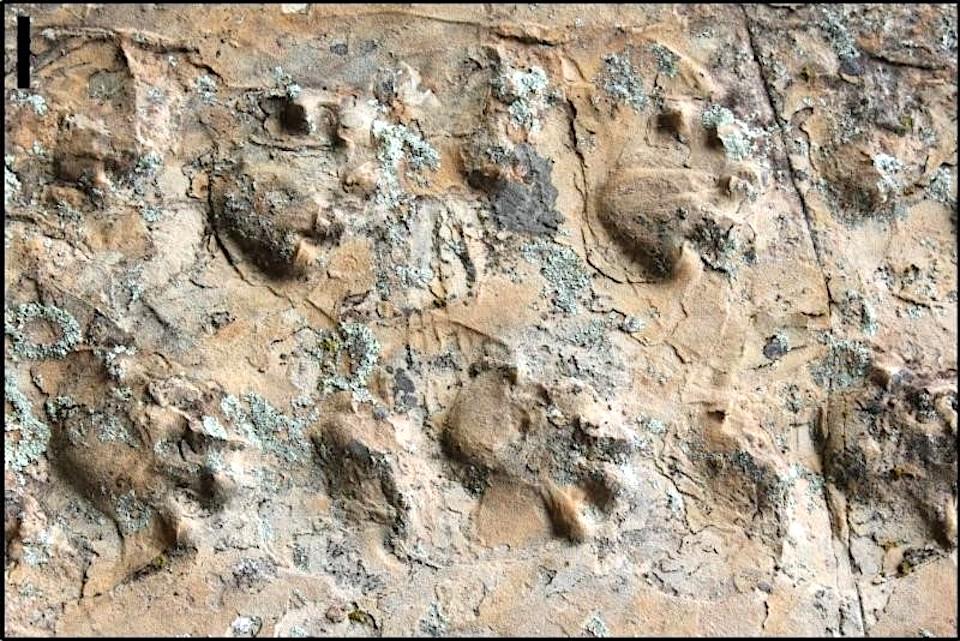
"It's a pretty spectacular trackway," said Vince Santucci, the National Park Service's senior paleontologist. "It's called an 'ichnogenus.' The term ichno refers to trace fossil. This ichnogenus is really well represented on this track block. It is known from Permian age rocks in Europe and South America, and so it's only recently been confirmed and this block contributes to the occurrence of that Permian age ichno form in North America at Grand Canyon National Park.

"There have been some similar finds in northern Arizona, but this particular block is the most well-preserved long trackway, several long trackways," he added during a phone call from his Washington, D.C., office.

Map of Arizona (southwestern USA), indicating the main localities mentioned in the text. The Grand Canyon National Park area is shaded dark brown (left). Stratigraphic section of the Pennsylvanian and Permian rocks exposed in the Grand Canyon area (right). Credit: Modified from Blakey and Knepp 1989.

Brazilian paleontologist Dr. Heitor Francischini, from the Laboratory of Vertebrate Paleontology, Federal University of Rio Grande do Sul, and Dr. Spencer Lucas, curator of paleontology at the New Mexico Museum of Natural History & Science in Albuquerque, New Mexico, first visited the Grand Canyon fossil track site in 2017. The paleontologists recognized the tracks as having been produced by a long-extinct relative of very early reptiles, a release from the museum said. 

"This new discovery at Grand Canyon is the first occurrence of Ichniotherium from the Coconino Sandstone and from a desert environment," the release added. "In addition, these tracks represent the geologically youngest record of this fossil track type from anywhere in the world."

Santucci said the creatures that left the tracks likely were reptiles due to the surrounding desertscape environment. Though they were not far removed from amphibians, he added.

"It's an enigmatic invertebrate, a tetrapod, four-legged animal, that was somewhere between amphibian and reptiles," the paleontologist said. "It's probably closer to the reptilian stock, but when you're only looking at the tracks, they don't know for absolutely sure. There's a group called the diadectids that are this enigmatic group that are transitional between amphibians and reptiles. A lot of people tend to think that they're probably more reptilian because of their occurrence within these arid paleo environments. Biologically, in particular we know this from modern amphibians, modern amphibians don't have the same protective skin and the egg casing that allows them to survive successfully in arid environments. They need moisture. They lay their eggs in water. Their reproductive cycle is dependent upon it."

"Although the actual track maker for the Grand Canyon footprints may never be known for certain," the museum's press release said, "the Grand Canyon trackways preserve the travel of a very early terrestrial vertebrate. The measurable characteristics of the tracks and trackways indicate a primitive animal with short legs and a massive body. The creature walked on all four legs and each foot possessed five clawless digits."

Closeup view of ichniotherium trackway/NPS

The Park Service paleontologist said the discovery will further "debate and discussion among paleontologists who are trying to figure out what this transitional diadectid animal was all about. ... It tends to lean the support towards a more reptilian stock as opposed to an amphibian."

The trackway is about 10 feet in length, and tilted from having slipped down, said Santucci. It's located below the park's South Rim, well off established hiking trails. It was found by a researcher who headed off trail to relieve herself.

The paleontologist said the tracks likely lend little additional knowledge to what is known about the environment that laid down the Coconino Sandstone, as it is well known. 

"Closer to the (Grand Canyon's) rim you get into the Coconino Sandstone fairly easily, and it's this very distinquishable, identifiable crossbedded sandstone, and those crossbeds represent dune-set facies of giant sand dunes," he said. "It was that time period where we had this really strange diversification of these early tetrapods that went all sorts of directions. Most of them were very short-lived, most of them were deadends. They didn't give rise to anything that survived into the recent, and so it's a really enigmatic group. There's enough evidence that has generated a lot of curiosity about them, but it's still a big debate as to whether these tetrapods, these four-legged creatures, were amphibian or reptile. What's important about this trackway is because it's found in clearly a dry, arid desert type of paleo environment, that it lends itself more with this particular group of organisms being more reptilian in character."

Source: www.nationalparkstraveler.org

Alcmonavis poeschli: Scientists Unearth 'Most Bird-Like' Dinosaur Ever Found

Wednesday, May 15, 2019

The picture shows the wing of Alcmonavis poeschli as it was found in the limestone slab. Alcmonavis poeschli is the second known specimen of a volant bird from the Jurassic period. Credit:  Ludwig Maximilian University of Munich

Researchers in Germany have unearthed a new species of flying dinosaur that flapped its wings like a raven and could hold vital clues as to how modern-day birds evolved from their reptilian ancestors.

For more than a century and a half since its discovery in 1861, Archaeopteryx—a small feathered dinosaur around the size of a crow that lived in marshland around 150 million years ago—was widely considered to be the oldest flying bird.

Palaeontologists from Ludwig-Maximilians University (LMU) in Munich and the University of Fribourg examined rock formations in the German region of Bavaria, home to nearly all known Archaeopteryx specimens.

They came across a petrified wing, which the team initially assumed to be the same species. They soon found several differences, however.

"There are similarities, but after detailed comparisons with Archaeopteryx and other, geologically younger birds, its fossil remains suggested that we were dealing with a somewhat more derived bird," said lead study author Oliver Rauhut from LMU's Department of Earth and Environmental Sciences.

Manual phalanges of Alcmonavis poeschli. (A) and (B) Distal ends of metacarpals II and III and proximal phalanges of digits II and III in normal (A) and ultraviolet (B) light. (C) First phalanx of first digit in medial view. (D) Ungual phalanx of digit I in medial view under ultraviolet light. (E) Ungual phalanx of digit II in medial view under ultraviolet light. (F) Ungual phalanx of digit III in lateral view under ultraviolet light. Abbreviations as in Figure 2, and: ft, flexor tubercle; gr, groove; ks, keratinous sheath; lpf, lateropalmar flange; pl, proximal lip. Scale bars are 1 cm. DOI: https://doi.org/10.7554/eLife.43789.012

They called the new bird-like dinosaur Alcmonavis poeschli—from the old Celtic word for a nearby river and the scientist who discovered the fossil, excavation leader Roland Poeschl.

The study, published in the journal eLife sciences, said Alcmonavis poeschli was "the most bird-like bird discovered from the Jurassic".

As well as being significantly larger than Archaeopteryx, the new specimen had more notches in its wing bones that pointed to muscles which would have allowed it to actively flap its wings.

Significantly, this "flapping" trait found in Alcmonavis poeschli is present in more recent birds, but not in Archaeopteryx.

"This suggests that the diversity of birds in the late Jurassic era was greater than previously thought," Rauhut said.

The discovery is likely to fuel debate among dinosaur experts over whether birds and dinosaurs developed the ability to flap their wings from earlier gliding species.

"Its adaptation shows that the evolution of flight must have progressed relatively quickly," said Christian Foth, from the University of Fribourg, and a co-author of the research.

Source: https://phys.org

Pages