Blogs

Dinosaurs Return to Smithsonian Fossil Hall After 5-Year Renovation

Thursday, June 6, 2019

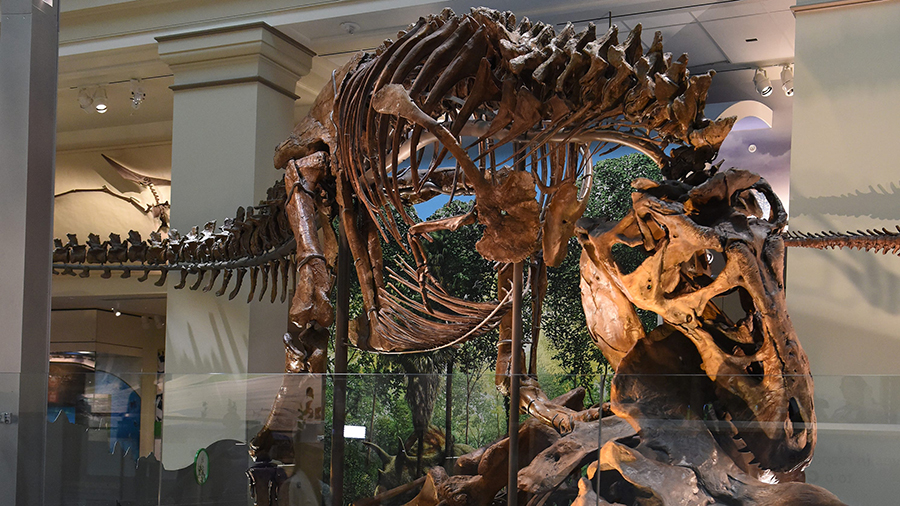
After five fossil-less years, T. rex is roaring back to the Smithsonian.

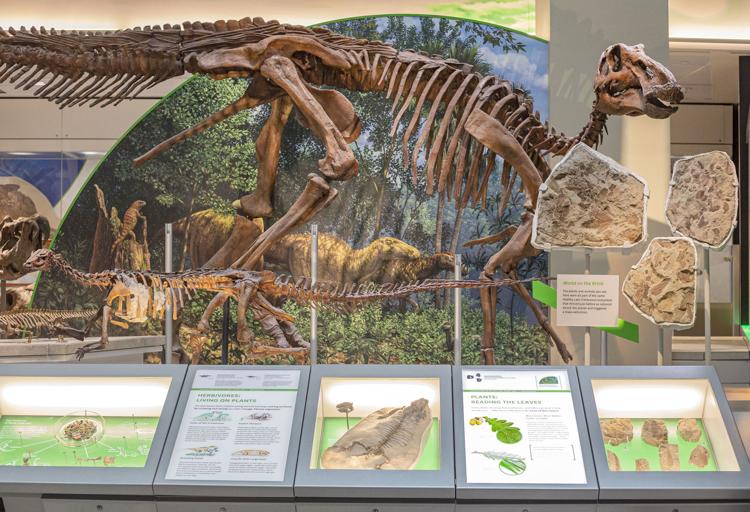
The David H. Koch Hall of Fossils -- Deep Time at the Smithsonian National Museum of Natural History in Washington, DC, reopened June 8, after being closed for the past five years.

The exhibit features over 700 fossils ranging from giants like Tyrannosaurus rex to fossilized animals and even plants and bugs. CNN got a preview of the 31,000-square-foot exhibit.

"The exhibition tells the story of 3.7 billion years of life on Earth, highlighting the connections among ecosystems, climate, geological forces and evolution and encouraging visitors to understand that the choices they make today will have an impact on the future," according to the museum.

The hall aims to "chronicle of the entire history of life" by illustrating the origins, evolution and changing surroundings of different species, according to a museum press release. The exhibit's themes include "All Life is Connected," "Evolution," "Ecosystems Change," "Earth Processes," "Extinction," and "Age of Humans and Global Change."

Visitors can learn "about the myriad ways in which humans are causing rapid, unprecedented change to the planet" in the Warner Age of Humans Gallery, which was made in conjunction with the Anthropocene Advisory Committee, a panel of climate change scholars and educators. Museum guests can also watch scientists prepare fossils in the FossiLab, per the release.

Kirk Johnson, Sant Director of the National Museum of Natural History, said that while the interactive exhibit provides an experience steeped in the past, it also addresses questions about Earth's current and future challenges.

"Visitors to the new hall will go on a voyage like no other—a journey that begins in the past and ends in the future," Johnson said in a statement. "Along the way, they will experience the history of life on Earth—a story told through extraordinary fossils and engaging interactive exhibits."

"Visitors will also be called upon to consider the very real challenges our planet faces and their role in shaping a desirable future," he added.

The hall's construction cost $110 million, of which $70 million was federal appropriations for the renovations and $40 million was privately raised, according to the museum press release.

A celebratory ceremony at 10:15 a.m. on the exhibition's opening day is open to the first 300 visitors to the museum's Madison Drive entrance, featuring remarks by Smithsonian Secretary David Skorton and Johnson.

Source: https://edition.cnn.com

How the First Snakes Looked Like?

Monday, May 20, 2019

Artist's rendering of an ancient snake, with tiny hind limbs. Credit: Julius T. Csotonyi

The original snake ancestor was a nocturnal, stealth-hunting predator that had tiny hindlimbs with ankles and toes, according to research published in the open access journal BMC Evolutionary Biology.

The study, led by Yale University, USA, analyzed fossils, genes, and anatomy from 73 snake and lizard species, and suggests that snakes first evolved on land, not in the sea, which contributes to a longstanding debate. They most likely originated in the warm, forested ecosystems of the Southern Hemisphere around 128 million years ago.

Snakes show incredible diversity, with over 3,400 living species found in a wide range of habitats, such as land, water and in trees. But little is known about where and when they evolved, and how their original ancestor looked and behaved.

Lead author Allison Hsiang said: "While snake origins have been debated for a long time, this is the first time these hypotheses have been tested thoroughly using cutting-edge methods. By analyzing the genes, fossils and anatomy of 73 different snake and lizard species, both living and extinct, we've managed to generate the first comprehensive reconstruction of what the ancestral snake was like."

By identifying similarities and differences between species, the team constructed a large family tree and illustrated the major characteristics that have played out throughout snake evolutionary history.

Their results suggest that snakes originated on land, rather than in water, during the middle Early Cretaceous period (around 128.5 million years ago), and most likely came from the ancient supercontinent of Laurasia. This period coincides with the rapid appearance of many species of mammals and birds on Earth.

The ancestral snake likely possessed a pair of tiny hindlimbs, and targeted soft-bodied vertebrate and invertebrate prey that were relatively large in size compared to prey targeted by lizards at the time. While the snake was not limited to eating very small animals, it had not yet developed the ability to manipulate prey much larger than itself by using constriction as a form of attack, as seen in modern Boa constrictors.

While many ancestral reptiles were most active during the daytime (diurnal), the ancestral snake is thought to have been nocturnal. Diurnal habits later returned around 50-45 million years ago with the appearance of Colubroidea -- the family of snakes that now make up over 85% of living snake species. As colder night time temperatures may have limited nocturnal activity, the researchers say that the success of Colubroidea may have been facilitated by the return of these diurnal habits.

The results suggest that the success of snakes in occupying a range of habitats over their evolutionary history is partly due to their skills as 'dispersers'. Snakes are estimated to be able to travel ranges up to 110,000 square kilometres, around 4.5 times larger than lizards. They are also able to inhabit environments that traditionally hinder the dispersal of terrestrial animals, having invaded aquatic habitats multiple times in their evolutionary history.


Story Source:

Materials provided by BioMed CentralNote: Content may be edited for style and length.


Journal Reference:

  1. Allison Y Hsiang, Daniel J Field, Timothy H Webster, Adam DB Behlke, Matthew B Davis, Rachel A Racicot, Jacques A Gauthier. The origin of snakes: revealing the ecology, behavior, and evolutionary history of early snakes using genomics, phenomics, and the fossil recordBMC Evolutionary Biology, 2015; 15 (1) DOI: 10.1186/s12862-015-0358-5

Source: www.sciencedaily.com

How Do Scientists Know What Dinosaurs Looked Like?

Friday, February 1, 2019

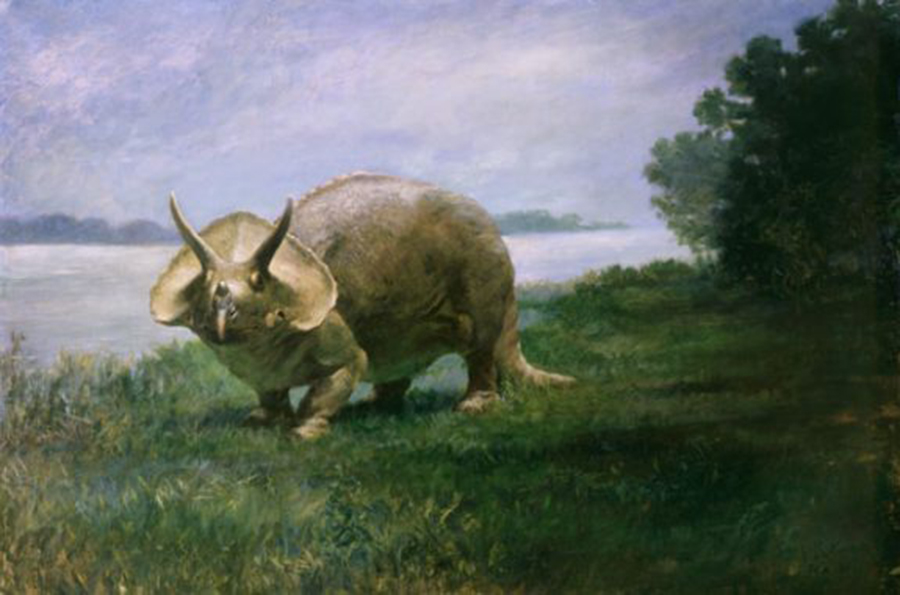
Triceratops painting by Charles Knight

Picture this. You’re out in sun-drenched territory in Morrison, Colorado. As you stop to close your eyes and take a deep breath in the searing heat and wipe another steady stream of sweat from your face, you notice a rock that seems a bit different. It’s hard to see it at first, but the color, texture, and placement seem a bit off in its surrounding. You clamber over the terrain separating you from this object of intrigue, keeping your gaze locked on the exact spot you noticed when you first opened your eyes from that deep breath.  Now that you’re at the spot, you believe that your suspicions are correct. This rock seems to be more than just a rock. With your field gear, you begin to excavate carefully around the rock, slowly revealing what can be clearly identified as a fossilized jaw of some prehistoric creature. Excited that your amateur paleontological journey has paid off, you ask yourself while staring wide-eyed at your discovery, “What was this and what in the world did it look like?”

While we all may not be in that position in our lives, if you’re a fan of dinosaurs and other amazing prehistoric creatures, you may have imagined yourself in this situation. You could make the find of the century somewhere! You’re more likely to have this daydream after watching a documentary or Jurassic Park movie where these amazing creatures are brought back to life on the screen.

The question remains: How do those fossils go from that exhilarating moment of discovery to become a classified, named, and fully imagined drawing or computer model of a dinosaur? Between discovery and depiction, there is a lot of scientific sleuthing and artistic licensing that comes into play. Over the course of the past several decades, our understanding of dinosaurs has changed dramatically and so has their depictions. From bipedal, lumbering, tail-draggers to intelligent, complex, and sometimes feathered beasts, a lot has changed in our understanding of dinosaurs. How we depict dinosaurs has also changed to reflect these new understandings.

A depiction of a Tyrannosaurus by Charles Knight. Credit: Public domain/Wikimedia Commons

Illustration of Tyrannosaurus rex. Credit: Wikimedia Commons

While it’s impossible for any scientists or artist to say that their understanding or recreation of a dinosaur is 100% accurate, science gets closer to this goal as new discoveries are made. Let’s take some time to dive in and see how the process brings these creatures back to life, from paleontologist to paleoartist.

Paleontologist

Paleontologists are scientists who study fossils of organisms. The study of these fossils ultimately helps us study the history of life on Earth. Not all paleontologists study dinosaurs. There is a myriad of different fields of expertise in paleontology, like micropaleontology, paleobotany, and invertebrate paleontology. Paleontologists study some of the largest creatures to ever exist on Earth like dinosaurs, all the way to the smallest microscopic plants and animals. This work takes place in a variety of places, from the lab to the field. Paleontologists use a variety of tools, whether they are extracting fossils from the Earth or using computer models to simulate the movement or vocalization of creatures. This work is incredibly important, not only because it tells us about life on Earth in the past, but because it also tells us an incredible amount about the creatures that exist today, how the world as we know it came to be, how Earth’s processes have changed the planet, how the climate has changed over time, and how these processes may impact humanity in the future. Even though not all paleontologists will agree about other things, they’ll all tell you that studying dinosaurs does in fact matter.

Going back to our fossil dream, how do these fossils go from being in the ground to places in our books or movie screens?

The Paleontologist’s Process:

Here is the process paleontologist would follow when a fossil is discovered in the field.

1 - Know your geographic location to know your geologic time location.

Paleontologists want to know the geographic location so that they will be able to determine their geologic time location. North America, and the United States, in particular, is well-mapped in terms of what rock layers are exposed across the country. This information is readily available by the US Geological Survey. Knowing the rock layer and geographic location of your fossil can allow you to narrow down your search in terms of which organisms were alive during that time and how their environment may have looked. 

2 - An eye for clues.

Careful observation of your fossil can lead you to a lot of very useful information. For example, the teeth in a fossilized jawbone can tell you the diet of your organism. This information can lead you to the part of the phylogenetic, or “family tree” where the dinosaur belonged. Phylogenetic trees are a way of visualizing evolutionary relationships between a group of organisms that share a common ancestor. A phylogenetic tree branches out as new species or groups of species are formed with their own unique traits. This can be incredibly helpful as members of similar branches of the tree will have similar traits. The phylogenetic tree on page 7 of your Dinosaur ID Guide shows which dinosaurs were alive and during what time. The names and numbers on the left side of the sheet indicate what era and how many million years ago they lived. You’ll notice that not all of the dinosaurs you’ve heard of are on the diagram. Some you’ve heard of before were alive during the entire age of dinosaurs. For example, Ceratopsia, the group where the Triceratops belonged, appeared first in the late Triassic at the earliest.

3 - Environment.

Based on the location of the fossil and the relative age of the rock, you can learn about that location’s environment during the time that dinosaur was alive. The world has changed in an incredible amount of ways over time. Using Howard Hughes Medical Institute’s Earth Viewer, move back in time to see a location and details about that location back when your dinosaur was alive. For example, the location of Los Angeles during this time period is no longer coastal area, but in a mountainous area. That type of environment could therefore be a potentially colder and rockier environment than exists there now. 

4 - Look deeper.

When there is very little fossil evidence, paleontologists take a much deeper look. Microscopic details in the structures of the bones can lead them in the right direction to identifying their dinosaurs. Minute details can mean big things to paleontologists, whether it be places for feathers to connect or channels for air sacs. Paleontologists also know the value of collaboration and what it means to support each as they make new discoveries.


Paleoartist

Paleoart is the artistic representation of prehistoric creatures that lived long ago. In the realm of paleoart, artists, in many cases, work to blend and compare the anatomy of existing animals, examples of creatures that are more well known, and anatomical structure from fossils that are as realistic as possible based on the information that’s available at the time. One such artist, Gabriel Ugueto, has taken his passion for the natural world and art and translated it into a career recreating dinosaurs and other extinct species for the public to see.

Gabriel has taken his passion as a herpetologist, someone who studies amphibians and reptiles, into the artistic realm. Using his knowledge, he’s developed his own method to recreate the fantastic organisms from long ago. Gabriel first looks at the bone structure to determine the shape of the organism. From there, Gabriel works outward to create the skin, scales, feathers, and color based on the time period and where the animal lived. Using all this information in concert, Gabriel creates his own interpretation of how the organism may have looked.

Source: www.sciencefriday.com

First Teaser Trailer for Animated 'Jurassic World: Camp Cretaceous' Series on Netflix

Friday, June 7, 2019

Netflix has ordered the animated series “Jurassic World: Camp Cretaceous,” inspired by the multi-billion dollar “Jurassic Park” film franchise.

The series is set within the timeline of the 2015 film “Jurassic World” and hails from DreamWorks Animation. It follows a group of six teenagers chosen for a once-in-a-lifetime experience at a new adventure camp on the opposite side of Isla Nublar. But when dinosaurs wreak havoc across the island, the campers are stranded. Unable to reach the outside world, they’ll need to go from strangers to friends to family if they’re going to survive.

Scott Kreamer and Lane Lueras will serve as showrunners and executive producers. Steven Spielberg, Frank Marshall, and Colin Trevorrow will executive produce. Zack Stentz serves as consulting producer. The series is expected to launch on Netflix in 2020.

Produced by Universal Pictures and Amblin Entertainment, the first two “Jurassic World” films have grossed have grossed nearly $3 billion. The third installment debuts in theaters on June 11, 2021. Those films were preceded by the blockbusters “Jurassic Park,” “The Lost World: Jurassic Park,” and “Jurassic Park III.”

“Camp Cretaceous” is the latest in a long line of DreamWorks Animation projects to debut on Netflix. DreamWorks Animation and Netflix signed an expansive first look deal for animated series based on Universal Pictures properties, as well as original and acquired IP, following the acqusition of DreamWorks by NBCUniversal. Among the shows the studio has debuted on Netflix are “She-Ra and the Princesses of Power,” the “Tales of Arcadia” trilogy, and “The Boss Baby: Back in Business.” Upcoming projects include an animated “Fast & Furious” series.

Source: https://variety.com

What Came First, The Feather or The Bird? Prehistoric Mystery SOLVED

Wednesday, June 5, 2019

Dinosaur discovery: Feathers predate birds by many millions of years (Image: GETTY)

DINOSAURS were covered in feathers at least 100 million years before the first birds took flight, archaeologists at Bristol University has spectacularly announced.

The genealogy of feathered dinosaurs promises to forever shakeup how paleontologists approach dinosaurs, birds and flying reptiles or pterosaurs. A study led by the University of Bristol, UK, has found the evolution of feathers significantly predates the evolution of birds. The first major clue came earlier this year when archaeologists discovered feathers on pterosaurs – winged monsters from the late Triassic and Cretaceous period. Pterosaurs like the Pterodactyl, are some of the earliest known vertebrates to have developed the power of flight.

But if these fascinating creatures were covered in feathers, researchers assume feathers made an appearance in the evolutionary timeline even earlier.

The oldest known ancestor of the modern bird is the small dinosaur Archaeopteryx.

These winged and fanged beasts lived approximately 150 million years ago, in the late Jurassic.

Professor Mike Benton, from the University of Bristol’s School of Earth Sciences, said: “The oldest bird is still Archaeopteryx first found in the Late Jurassic of southern Germany in 1861, although some species from China are a little older.

“Those fossils all show a diversity of feathers – down feathers over the body and long, vaned feathers on the wings.

“But, since 1994, palaeontologists have been contending with the perturbing discovery, based on hundreds of amazing specimens from China, that many dinosaurs also had feathers.”

Another clue came when scientists had the opportunity to work on the fossilised remains of Kulindadromeus – a dinosaur only discovered in the last 10 years.

The small bipedal creature is believed to have been covered in a type of proto-feathers or feather-like fuzz.

Dinosaur feathers: Feathers likely developed as insulation against changing climate (Image: Yuan Zhang

According to Dr Maria McNamara, the study’s co-author from the University College Cork, the dinosaur specimen had an incredibly well-preserved skin.

The skin showed signs of scales on the legs and tails and “strange whiskery feathers” all over the rest of the body.

Dr McNamara said: “What supposed people was that this dinosaur was as far from birds in the evolutionary tree as could be imagined. Perhaps feathers were present in the very first dinosaurs.”

The findings suggest, according to Baoyu Jiang from the University of Nanjing, the origin of feathers could be pushed back as far as 200 million years into the past.

The researcher, who co-authored the dinosaur study, said: “At first, the dinosaurs with feathers were close to the origin of birds in the evolutionary tree.

Dinosaurs, pterosaurs and their ancestors had feathers too.

Professor Mike Benton, University of Bristol

“This was not so hard to believe. So, the origin of feathers was pushed back at least to the origin of those bird-like dinosaurs, maybe 200 million years ago.”

Even modern-day chickens have an interesting link to the terrifying monsters of the past.

The harmless birds have scales on their necks and legs, which through the process of reversal started off as feathers.

In 2015, scientists reverse-engineered developing chicken embryos to alter their bone structure.

By inhibiting certain genes in the development process, the baby chicks developed snouts resembling Velociraptor bone structures, rather than bird beaks.

All of these findings combined give credibility to the idea feathers evolved long before birds, as a form of insulation and not a flight-aid.

Professor Benton said: “So, the dinosaurs, pterosaurs and their ancestors had feathers too.

“Feathers then probably arose to aid this speeding up of physiology and ecology, purely for insulation.

“The other functions of feathers, for display and of course for flight, came much later.”

Overall, this pushes the development of feathers back by some 250 million years “at least”.

The study was published in the journal Trends in Ecology & Evolution.

Source: www.express.co.uk

Fostoria dhimbangunmal: 'Spectacular' Opal-Laced Fossils Reveal Previously Unknown Australian Dinosaur

Tuesday, June 4, 2019

Artist’s impression of Fostoria dhimbangunmal. Illustration: James Kuether

Paleontologists in Australia have identified a previously unknown plant-eating dinosaur from the mid-Cretaceous. Remarkably, the fossilized bones of these creatures, which glisten in hues of blue and green, are preserved in opal.

New research published in the Journal of Vertebrate Paleontology describes Fostoria dhimbangunmal, a dinosaur species that’s closely related to Iguanodon and Muttaburrasaurus. Fossils of four specimens were found in Lightning Ridge, a small town in the Australian Outback. As reported in The Australian, paleontologists recovered the opal-encrusted fossils in 1984 after being alerted to their presence by an opal miner, Robert Foster, who was working 10 meters (33 feet) below a field known as the “Sheepyard.”

After the excavation, these fossils went on display at the Australian Museum in Sydney, where they remained for decades. The Foster family recently donated the fossils to the Australian Opal Centre, where researchers recognized the opalized items as deserving of further investigation. The analysis, led by Phil Bell from the University of New England in Armidale, Australia, revealed the fossils belonged to a new species. The researchers named the dinosaur in honor of Foster and the field above the deposit where the bones were found; the name dhimbangunmal (pronounced dim-baan goon-mal) translates to sheep yard in Yawaalaraay, the local indigenous language.

Lightning Ridge is famous for its opal gemstones, which form underground over long timescales from a solution of silicon dioxide and water (more about the process here). It’s not uncommon to find the odd bone or tooth that has undergone opalization, but the discovery of around 60 opal-encrusted bones (including the braincase) from a single individual—an adult Fostoria—is without precedent.

The opalized fossils of another three individuals, all juveniles, were also identified in the new study. The remains were all found jumbled together in the opal mine, leading Bell to speculate that the individuals were once part of a herd or a family, as reported in National Geographic. The researchers used a CT scanner to analyze the fossils without having to damage them.

Opalized toe fossil of Fostoria dhimbangunmal. Image: Australian Opal Centre

Fostoria is now the earliest known iguanodontian dinosaur ever found in Australia. Dating back to the mid-Cretaceous some 100 million years ago, these flat-toothed, herbivorous creatures foraged as they stood on their hind limbs. Today, this region of New South Wales is barren and dusty, but during the mid-Cretaceous it contained rivers, lagoons, and vast tracts of vegetation. Importantly, Fostoria was “an early member of a group that would elsewhere evolve into the duckbilled hadrosaurs, which were common in North America and Asia toward the end of the time of the dinosaurs,” James Kuether wrote for National Geographic.

“It’s exciting enough to have a bonebed of new dinosaurs from Australia,” Liz Freedman Fowler, an assistant professor of biology at Dickinson State University, said in an email to Gizmodo. “To also have them preserved in beautiful opal is a spectacular bonus. Kudos to the original discoverers for recognizing the importance of their find so the bones could be excavated safely and scientifically,” said Fowler, who wasn’t involved with the new research.

Australia has a long history of producing “bizarre and amazing creatures,” according to paleontologist Terry Gates from the Department of Biological Sciences at North Carolina State University, also not involved with the new study. Gates attributed this to the continent’s isolated geographic position. The Fostoria discovery “fills in a glaring gap in our understanding of duck-billed dinosaur evolution in a spectacular way,” explained Gates in an email to Gizmodo.

To which he added: “It’s hard to imagine a more perfect shape for gemstones than a new species of dinosaur.”

Source: https://gizmodo.com

How Deinonychus Changed Our Understanding of Dinosaurs

Tuesday, June 4, 2019

Deinonychus antirrhopus by tuomaskoivurinne

Academics used to tease paleontologists, saying that while dinosaurs appeal to children, they won’t answer the important evolutionary questions.

Yale’s John Ostrom (1928-2005) proved them wrong.

Fifty years ago, in Feb. 1969, Ostrom, then an assistant professor of geology and geophysics at Yale, published a paper describing a previously unknown dinosaur he dubbed Deinonychus, meaning “terrible claw” in Greek. The paper reignited public interest in dinosaurs and upended common assumptions in the field. It also helped answer the question: Where do birds come from?

As an undergraduate student at Union College Ostrom was captivated by the works of George Gaylord Simpson, a paleontologist-turned-evolutionary biologist. Ostrom decided against entering medicine as his father had hoped, and instead pursued a Ph.D. at Columbia University to study with Simpson. In 1961, Ostrom joined Yale’s Department of Geology and Geophysics, and he remained there until his retirement in 1993, though he remained active in research and writing as an emeritus professor at Yale until 2001.

The name Deinonychus may not be familiar to non-scientists, but millions of people have seen one on the big screen. In the 1993 film “Jurassic Park” the murderous Velociraptors were, in fact, based on Deinonychus. (Real velociraptors were considerably smaller than the creatures in the film, about the same size as a turkey.)

Michael Crichton, the writer of the “Jurassic Park” novel on which the movie was based had been swept up in the “Dinosaur Renaissance” sparked by Ostrom’s discovery and the work of one of his students, Robert Bakker ’67, and the paleoartist Greg Paul in the 1970s and 1980s.

The quarry where Yale paleontologist John Ostram discovered Deinonychus.

“I was in my office when the telephone rang one morning. ‘Professor Ostrom, this is Michael Crichton,’” the Yale professor recalled in 1997 while speaking to The New York Times. “And we had a very interesting conversation.”

While Crichton used the physical attributes and hypothesized behaviors described to him by Ostrom to describe the creatures in his novel, he opted for the more dramatic name “velociraptor.” “Jurassic Park” went on to become a pop culture juggernaut, inspiring a whole new generation to be captivated by dinosaurs and eager to study them.

Ostrom’s work didn’t just change how dinosaurs were perceived by the public, he also shifted the conventional wisdom in academia. According to Ostrom’s last graduate student and current Peabody Museum paleontologist, Daniel Brinkman ’94 M.Phil., “prior to Ostrom, dinosaurs were thought of as large, lumbering, cold-blooded, and slow-witted evolutionary failures.”

“The discovery of Deinonychus not only reshaped our understanding of dinosaurs, it recalibrated how we understand evolution. Darwin’s notion of steady, gradual change had led scientists to believe that dinosaurs must have been quite primitive in their behavior and cognitive ability. Deinonychus called this presumption into serious question. Half a century later, the way we conceive of prehistoric life is completely transformed,” explains David Skelly, director of the Yale Peabody Museum and the Frank R. Oastler Professor of Ecology.

Ostrom deduced that Deinonychus had an upright posture by analyzing the shape and function of its limbs. As Ostrom was studying Deinonychus, he came across the work of J.E Heath, who had proposed that an upright posture benefits warm-blooded animals because it allows the muscles to retain and generate heat.

The two observations led Ostrom to suggest that dinosaurs could have been warm-blooded. The paleontological community rallied to investigate the question.

A drawing of Deinonychus by Robert Bakker ’67, which appeared in Ostram’s original paper describing the dinosaur.

Bakker, who had been a student of Ostrom and went on to be a renowned paleontologist in his own right, became one of the biggest proponents of this hypothesis and led the scientific debate for decades. Today, most scientists accept that dinosaurs were more metabolically active than present day reptiles, but caution against a simplistic view of warm or cold bloodedness.

Discovering Deinonychus also ressurrected the hypothesis that birds descended from dinosaurs. Back in the 1860s renowned biologist Thomas Henry Huxley had championed this idea. While describing the anatomy of fossilized bird remains he once remarked: “[If] found in the fossil state, I know not by what test they could be distinguished from the bones of a Dinosaurian.”

The similarities between the remains of both birds and dinosaurs also struck Ostrom in 1970 while he was visiting the Teylers Museum in the Netherlands.

As he was inspecting what was believed to be a pterodactyl, he had a startling realization. Through his intimate knowledge of Deinonychus and his keen eye, Ostrum recognized that the specimen was in fact a feathered bird. At that time he hypothesized that the specimen was of Archaeopteryx, a prehistoric bird. The incident sparked Ostrom’s curiosity and his focus shifted to the question of the evolutionary ancestry of birds.

Over the next decade, Ostrom published a series of papers that investigated the possible relationship between Deinonychus and Archaeopteryx. Out of that, he postulated that birds were direct descendants of the dinosaurs, rather than simply sharing a common ancestry. Further, he claimed that flight evolved when feathered dinosaurs flapped their arms in pursuit of prey. The scientific community was rocked by these hypotheses and a vigorous debate occurred in the succeeding decades.

Today almost all scientists accept Ostrom’s findings.

By persevering in the face of difficult questions, Ostrom upended multiple core assumptions in paleontology, sparked a Jurassic renaissance, and inspired multiple generations to look at dinosaurs with wonder.

In one of Ostrom’s final papers, “How Bird Flight Might Have Come About,” he gives a “last word,” saying, “The missing, unknowable fossil record can never be allowed to stifle our curiosity.”

It certainly didn’t stifle his.

Source: https://scitechdaily.com

Original Jurassic Park cast set to return for Jurassic World 3!

Monday, June 3, 2019

Original Jurassic Park cast set to return for Jurassic World 3!

Jurassic World star Bryce Dallas Howard, who plays Claire Dearling, hinted at the original Jurassic Park returning for the new movie.

In an interview with MTV News, Bryce Dallas Howard talked about the possibility of the original cast of Jurassic Park starring in the new film. She could barely contain her excitement when asked about it. Bryce Dallas Howard said “I’ll blink if it’s happening,” and immediately blinked right after, hinting that Jeff Goldblum, who plays Ian Malcolm, Sam Neill, who plays Alan Grant, and Laura Dern, who plays Ellie Sattler, will indeed be featured in the movie. Bryce Dallas Howard has played Claire Dearing in the franchise since the debut of the Jurassic World in 2015. She returned for that role in the sequel Jurassic World: Fallen Kingdom and will be in the upcoming untitled Jurassic World 3.

You can check out the full video below.

https://twitter.com/MTVNEWS/status/1134935401163104257

Jurassic Park star Jeff Goldblum made a cameo appearance in Jurassic World: Fallen Kingdom as Ian Malcolm, but this will be Laura Dern and Sam Neill’s first appearances since Jurassic Park III should they return.

Aside from being in Jurassic World 3, Bryce Dallas Howard just appeared in Rocketman. She will also be directing an episode of the upcoming Disney+ Star Wars series The Mandalorian from Jon Favreau.

Would you be excited to see the Jurassic Park cast return to Jurassic World? Are you a fan of the new movies? Would you like to see the Jurassic World cast star alongside the original Jurassic Park cast? Let us know your thoughts in the comments below! As always Heroic Hollywood will keep you updated on Jurassic World 3 as more news comes in.

Here is the synopsis for Jurassic World: Fallen Kingdom: 

Three years after the destruction of the Jurassic World theme park, Owen Grady and Claire Dearing return to the island of Isla Nublar to save the remaining dinosaurs from a volcano that’s about to erupt. They soon encounter terrifying new breeds of gigantic dinosaurs, while uncovering a conspiracy that threatens the entire planet.

Directed by J.A. Bayona, the film stars Chris Pratt, Bryce Dallas Howard, Rafe Spall, Justice Smith, Daniella Pineda, James Cromwell, Toby Jones, Ted Levine, B.D. Wong, Isabella Sermon, Geraldine Chaplin and Jeff Goldblum.

Jurassic World: Fallen Kingdom is available to own on 4K Ultra HD Blu-ray, Blu-ray, DVD and Digital HD.

Source: https://heroichollywood.com

The Sexy Theory Behind T. Rex’s Tiny Arms

Sunday, June 2, 2019

A Tyrannosaurus rex fossil at the National Museum of Natural History in Paris. NurPhoto via Getty Images

Paleontologists have discovered a remarkable amount of new information about dinosaurs over the past few decades. Michael J. Benton, a professor of vertebrate paleontology at the University of Bristol in England, was part of the team that in 2008 confirmed the presence of melanosomes — the parts of an animal’s coat that gives it color — in dinosaur feathers.

For the first time, they were able to reveal that the Sinosauropteryx dinosaur was a redhead.

“Ball-shaped melanosomes in our samples showed that Sinosauropteryx was ginger,” writes Benton in the book “Dinosaurs Rediscovered: The Scientific Revolution in Paleontology” (Thames & Hudson), out now. “It had a neat ginger and white striped tail.”

Around the same time, a team at Yale, whose work had initially inspired Benton, found that the Anchiornis, from China, “sported black and white stripes on its wings and tail and a lovely ginger crest on top of its head, as well as specklings of black and ginger feathers on its cheeks.”

Meanwhile, scientists are still trying to figure out exactly what the ferocious T. rex was able to do with its legendarily tiny arms, which were just 20 percent the length of its legs. (For humans, that number is around 70 percent.)

“Suggestions [include] that the arms were used to push the animal off the ground after it had been asleep, [or] to hold down prey while the death bite was being delivered,” writes Benton, who notes that the arms might have had a more flirty function as well.

“Their function remains a mystery, one of those puzzles in dinosaur science that will keep future researchers happily engaged.”

Here are more fun dino-facts from Benton’s book. . .

How did dinosaurs eat?

Using a 3D model of an Allosaurus skull, paleontologist Emily Rayfield found that dinosaurs “had a bite force of 35,000 ‘newtons’ (the unit scientists use to measure bite force), much greater than any living predator.” By comparison, humans’ bite force ranges between 200-700 newtons; great white sharks measure 18,000.
Rayfield found differences in how various dinosaurs eat.

“T. rex used a puncture-pull means of killing and feeding, snapping with the front of its jaws to kill its prey and then pulling back to tear the flesh from the carcass held down by its great foot,” Benton writes.

The Allosaurus and Coelophysis, two other meat-eating dinosaurs, “were capable of a more powerful bite along a greater stretch of the jaws and so were perhaps juggling the prey in their mouths and chomping it into bits before swallowing.”

How fast could dinosaurs run?

Having uncovered many dinosaur footprints and tracks in fossils over the years, scientists calculated that dinosaurs walked or ran around 2-8 miles per hour, with T. rex managing only 2-5 miles per hour — not much faster than a brisk walk for a human being.

How did dinosaurs get so big?

Dinosaurs like the 85-foot-long Brachiosaurus, the largest dinosaur ever, achieved these sizes thanks in large part to “bird-like lungs.”

“One-way respiration [where air isn’t inhaled and exhaled through the same location] increased their ability to acquire oxygen and so to power a high metabolic rate with less energy than we have to use,” Benton writes.

Did dinosaurs flirt?

Scientists theorized that certain visually stimulating aspects of a dinosaur’s anatomy were used for “sexual signaling” — flirting, as it were.

“The striped tail of Sinosauropteryx and the barred wings and colored crest of Anchiornis could have had no other function than signaling,” Benton writes, noting that “we can now imagine male dinosaurs hopping about and showing off their wares to the females, just as so many birds do today.”

It has also been theorized that the functionally useless tiny arms of the Tyrannosaurus rex might have been used to “twirl a tuft of feathers [to] attract members of the opposite sex” or to “tickle members of the opposite sex to encourage them to mate.”

Dinosaurs Rediscovered: The Scientific Revolution in Paleontology - 1st Edition

Source: https://nypost.com

Drawing on Science to Illustrate Dinosaurs

Friday, June 7, 2019

One of Julius Csotonyi’s murals can be seen in the new “Deep Time” exhibit at the National Museum of Natural History in Washington, D.C.

Most people know what a Tyrannosaurus rex looked like. Its snarling teeth, slashing tail and tiny arms make it one of the most recognizable dinosaurs that roamed the planet. Yet if it weren’t for paleoartists, the T. rex would be just another fossilized skeleton in museums.

Paleoartists specialize in using scientific data to make images or models of long-extinct animals. In the process, they take the prehistoric world out of the abstract and bring it to life for the rest of us.

Julius Csotonyi’s paleoart has been used in scientific papers, coins, postage stamps and murals — including many at the Smithsonian’s soon-to-reopen Fossil Hall. In addition to his artistic skills, he has a doctorate in microbiology and a master’s degree in ecology. He considers his scientific background crucial to his job.

It “helps me understand how animals in their environment interact and how to accurately restore prehistoric ecosystems,” says Csotonyi.

Paleoart usually starts with a fossil. If the actual dinosaur fossil is unavailable, artists can use a 3-D rotatable digital model or photographs. Paleoartists then work with the scientists to learn details about the dinosaur’s diet, behaviors and environment. From there, the artists build the image in stages. First they might settle on the overall shape of the animal, then work outward from the skeleton, adding muscles, soft tissue and finally distinctive features such as skin, horns or crests.

Of course, dinosaurs are still mysterious and largely unknown. Paleoartists’ challenge is to fill in the missing pieces as realistically as possible. To do this, they use a combination of direct evidence — what’s known for sure — and indirect evidence from known environments.

Jennifer Hall, whose work has been in Scientific American magazine and on the History Channel, looks for clues in similar living animals.

For example, birdlike dinosaurs might have had bright colors like modern-day birds. But if a dinosaur was frequently hunted, then “you probably want something that you would see in our modern prey animals,” she says. “Whether it’s mule deer, which are more sandy in color and blend into the dry landscape, or zebras, which have stripes to blend in with the vertical savanna.”

Today we’re learning more about dinosaurs than ever before. Previously unknown species are being discovered regularly. We’re also learning more about what they looked like. Fossilized feathers have been found in rock and amber. Electron microscopy is revealing patterns found on the dinosaur’s skin. In some cases, it’s even possible to know what colors they were.

The paleoartist’s job is to render these discoveries in a way that sparks the imagination. Sometimes that means using a bit of artistic flair — and even a dash of fun.

“I always think back to when I was visiting a particular aquarium, and there was a fish that was blue, and its lips were blue with pink polka-dots,” Csotonyi said. “It was real and it looked so ridiculous. It makes me feel okay to come up with an outlandish idea every once in a while, because these things do exist in nature.”

Source: www.news-journal.com

Pages