nandi's blog

Earliest ‘Baleen Whales’ Had Large Teeth and Gums

Saturday, May 12, 2018

A life-like reconstruction of Llanocetus denticrenatus. Image credit: Carl Buell.

The discovery of Llanocetus denticrenatus — an ancient whale species that swam in Antarctic waters 34 million years ago, during a period called the Eocene — has paved the way for new knowledge about the evolution of baleen whales (Mysticeti).

Baleen whales are the largest animals on Earth, thanks to their ability to filter huge volumes of small prey from seawater using comb-like baleen in their mouths.

But the new evidence, based on the analysis of a skull of Llanocetus denticrenatus (the second-oldest baleen whale known to date), suggests that early whales had well-developed gums, but no baleen.

Llanocetus denticrenatus is an ancient relative of our modern gentle giants, like humpback and blue whales. Unlike them, however, it had teeth, and probably was a formidable predator,” said Dr. Felix Marx, a paleontologist with the Royal Belgian Institute of Natural Sciences.

“Until recently, it was thought that filter feeding first emerged when whales still had teeth. Llanocetus denticrenatus shows that this was not the case,” added Dr. R. Ewan Fordyce, from the University of Otago, New Zealand.

Like modern whales, Llanocetus denticrenatus had distinctive grooves on the roof of its mouth, which usually contain blood vessels that supply the baleen.

In the ancient whale, however, those grooves cluster around tooth sockets, where baleen would have been useless and at risk of being crushed.

“Instead of a filter, it seems that Llanocetus denticrenatus simply had large gums and, judging from the way its teeth are worn, mainly fed by biting large prey. Even so, it was huge: at a total body length of around 8 m, it rivals some living whales in size,” Dr. Marx said.

The findings suggest that large gums in whales like Llanocetus denticrenatusgradually became more complex over evolutionary time and, ultimately, gave rise to baleen.

That transition probably happened only after the teeth had already been lost and whales had switched from biting to sucking in small prey — as many whales and dolphins now do.

The study authors suggest that baleen most likely arose as a way to keep such small prey inside the mouth more effectively.

“The giants of our modern ocean may be gentle, but their ancestors were anything but,” Dr. Marx said.

Llanocetus denticrenatus was both large and a ferocious predator and probably had little in common with how modern whales behave.”

The study was published online this week in the journal Current Biology.

_____

R. Ewan Fordyce & Felix G. Marx. Gigantism Precedes Filter Feeding in Baleen Whale Evolution. Current Biology, published online May 10, 2018; doi: 10.1016/j.cub.2018.04.027

Source: www.sci-news.com

Patagotitan mayorum: Mega-Dinosaur at Field Museum is Named Maximo, Unveiled June 1

Saturday, May 12, 2018

A Field Museum rendering of what its new titanosaur skeleton will look like in Stanley Field Hall. (Field Museum)

The new titanosaur skeleton cast replacing Sue in the Field Museum’s central Stanley Field Hall now has a name and a debut date, the Chicago natural history museum announced Friday.

The Patagotitan mayorum skeleton replica will be called “Maximo,” Spanish for “maximum” or “most,” a nod to the Argentinian soil in which the original skeleton was unearthed.

And it will officially open June 1, although it will be hard for museum visitors to avoid witnessing the installation of the 122-foot-long skeleton, scheduled for May 23 to 25.

As part of a makeover of the central hall in the museum’s 125th anniversary year, the two-story tall titanosaur will be surrounded by flying reptile models such as pteranodons, and a new hanging garden will occupy nearby airspace.

Patagotitan mayorum is the largest dinosaur yet found, a plant eater first uncovered in Argentina in 2014. The American Museum of Natural History in New York already has a Patagotitan cast on display, but the Field is counting on its more open space to show it to better advantage.

The creature will be roughly in the spot long occupied by Sue the T. rex specimen, which has already been dismantled and moved into a new room upstairs as an exhibit is designed around it. Sue’s debut in its new digs should come in the first part of next year.

Source: www.chicagotribune.com

Proof Dinosaurs Could Heal From Injuries

Thursday, May 21, 2015

Researchers bombarded a toe bone from a giant carnivorous dinosaur, Allosaurus fragilis (shown here), finding that the beast apparently had an amazing power to heal its broken bones. Credit: Phillip Manning.

A giant carnivorous dinosaur apparently possessed an enormous power to heal its broken bones, thanks to new findings revealed by powerful X-rays, researchers say.

The new findings suggest this ancient predator could shrug off massive trauma, revealing the dinosaur healed well like reptiles do than more poorly like birds do, which dinosaurs are more closely related to, scientists added.

Dinosaur bones sometimes include evidence they cracked and mended while the reptiles lived. Such findings can yield insights into how much violence dinosaurs experienced, and whether they healed differently than other animals.

Analyzing fossils for signs of healed fractures often involves slicing through them, damaging these rarities. Now scientists have used intense X-rays with beams brighter than 10 billion suns to illuminate breaks hidden within the bones of a 150-million-year-old predatory dinosaur.

The researchers examined a toe bone from a giant carnivorous dinosaur, Allosaurus fragilis, excavated from Utah. They bombarded the fossil with X-rays from the Diamond Light Source in England and the Stanford Synchrotron Radiation Lightsource in California. Both light sources are synchrotrons, or particle accelerators that can generate powerful beams of light, which the investigators used to analyze the chemical nature of samples down to a resolution of 2 microns, or 1/50th the average diameter of a human hair.

There are subtle chemical differences between normal and healed bone tissue. The scientists discovered they could detect the "chemical ghosts" of ancient breaks.

"This is beyond recognizing a healed injury — this is mapping the biological processes that enable that healing," said study author Phillip Manning, a paleontologist and director of the Interdisciplinary Center for Ancient Life at the University of Manchester in England. "The ability to map the biological processes of healing allows great insight to the physiology and metabolism of animals. To extend this into the fossil record might provide new insight on many groups of vertebrates, not just dinosaurs."

The researchers found this dinosaur could apparently shake off massive trauma, healing from injuries that would prove fatal to humans if not treated. Curiously, this fact suggests dinosaurs healed more effectively like reptiles such as crocodilians than less effectively like close dinosaur relatives such as birds, Manning told Live Science. One might speculate these differences are due in part to how birds typically possess hollow bones to lighten them for flight.

"This is the starting point in a new line of research that has a long way to go when comparing the chemistry of bone between species, both modern and extinct," Manning said. "We are already looking at new techniques that might further expand our understanding of the growth, trauma and healing of bones in vertebrates."

Manning and his colleagues detailed their findings online today (May 7) in the Journal of the Royal Society Interface.

Original article on Live Science / 2014

Dinosaur Tracks and Wind Caves at Thompson Springs Trail

Friday, May 11, 2018

Crescent Junction on I-70 east of Green River is the place to turn south to Moab. Just three miles east is the sleepy little town of Thompson Springs — a place to stage a great ATV adventure.

Gathering at the Ballard RV Park, the NUATV club lined up and headed south under the freeway. Our parade of 28 machines carried more people than the population of the town.

That number dropped to 27 when one caught fire and had to be left behind. It seems that an adjustment made before we started caused a partial application of the brakes. The friction caused the fire.

Traveling south on the Salt Valley Gorge Road, we were enjoying perfect riding weather. The sun was bright and a light jacket was all we needed on this late April ride.

We were riding on a low ridge east of Thompson Wash. This is rugged country with a wild feel to it. The trail was not difficult, but vegetation was sparse. Our track took us along the northeast border of Arches National Park.

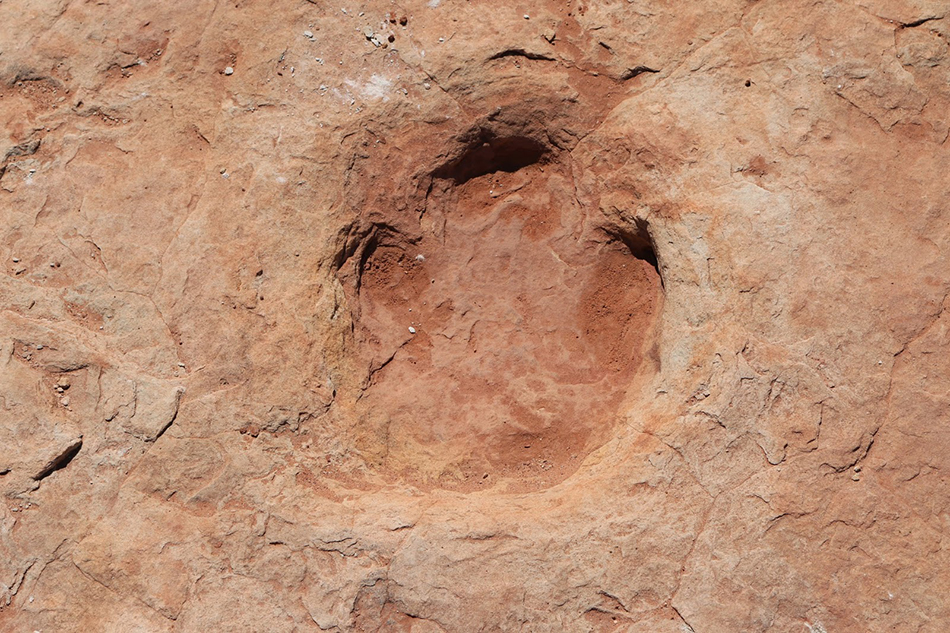
Stopping at Yellow Cat Wash, we took a short hike southwest in the wash. Where the water had cleared the dirt away, we saw dinosaur tracks of many sizes permanently pressed into the rock. It was fun to look for them in the wash.

Some tracks were the size of hubcaps — oops, that dated me. They were more like the size of a laptop computer.

Crossing Yellow Cat Flat, we passed Dry Oak Spring and turned south. Mining played a part of the history of this area, as we passed several claims. I love the names of some of these old mines — Little Eva, Ringtail, Cactus Rat and Poison Strip.

Passing the Highlands, we came onto Owl Draw. Traveling east, we then looped back to the west and stopped for lunch at a place called the Wind Caves.

This was a fascinating place to stop. We were in a huge stone grotto. The walls featured caves — some connected and some didn’t.

I walked into one that I illuminated with the flash of my camera. The sandy floors were inviting and it would be a cool respite on a hot day. However, I am not sure I would like to seek refuge here and find that some wild critter had the same idea.

I am told that there is one of these caves with a small opening. If you can squeeze through, it expands into a large cavern some 20 feet high. I wasn’t ready to try that one. This place would be fun to come back and spend some time exploring.

We made one more stop at a place called “The Arch.” I guess I would expect an arch in this country, being close to the national park. I just would have expected a little more creativity in naming it.

Our last stop was at an overlook of the Colorado River. The view here was amazing. The river was some 1,600 feet below us and we could see Highway 128 that follows the river east from a junction in Moab.

This view was special because I could see trails that I have ridden before across the valley. The Onion Creek Trail snaked away east as it disappeared up the canyon. I could also see Fisher Towers below the end point of the Top of the World Trail. I couldn’t see Moab, but I knew it was behind the ridge that featured Castle Rock.

Heading back, we crossed Cottonwood Wash and passed by Yellow Cat Mesa. We came back to I-70 where we took an overpass and turned onto the Old Cisco Highway back to Thompson Springs.

Following the Denver and Rio Grande Railway, I noticed some white flowers between the road and the tracks. I realized that they were sego lilies. I remembered seeing them last year on the Tusher Canyon Trail about the same time of year. It is always a treat to find a sego lily because I rarely find them when and where I expect them.

When you go take plenty of water, keep the rubber side down and enjoy some wild country in Grand County.

Source: www.standard.net

Fossil of Flying Reptile With 29-Foot Wingspan Discovered

Thursday, May 10, 2018

The new species was found in the same region, and is related to, this pterosaur called "Dracula." ANDREAS GEBERT/GETTY IMAGES

Paleontologists have recently discovered the biggest pterosaur jawbone ever found, indicating the existence of a previously unknown flying reptile that lived in what is now Romania.

Romania is known for being the former home to a variety of enormous pterosaurs, some with huge heads and necks oddly disproportionate to their bodies. Pterosaurs, like the famous Pterodactyl, lived alongside the dinosaurs and are related to them, but pterosaurs aren’t dinosaurs.

The various species of these winged creatures could be as small as seagulls or as tall as giraffes. The newly-discovered creature’s jaw was incomplete, but paleontologists estimate that if reconstructed, it would have measured 3.6-4.2 feet, National Geographic reported. Paleontologists published a formal description of the creature in the journal Lethaia.


By comparing this jawbone to that of other pterosaurs, paleontologists estimate that the animal was imposing, with a wingspan of 26-29 feet. By comparison, the wandering albatross has the longest wingspan of any living animal at nearly 12 feet.

Surprisingly, that doesn’t mean that the new creature was the largest pterosaur ever found. A North American pterosaur called Quetzalcoatlus and a Transylvanian pterosaur called “Dracula” are among the largest, with wingspans nearing 40 feet.  

As paleontologists have only part of the jawbone of the unnamed new species, it’s hard to understand exactly what it was like in life. Having only a partial fossil means that they have to compare the bone with those of other pterosaurs and modern animals. Paleontologists believe it may have been a heavy, wide omnivore, National Geographic reported.

The new creature, as well as two other giant pterosaurs found in this region of Romania, had lived on islands when they were alive. There were no known large, carnivorous dinosaurs that could access the island, so it’s likely that pterosaurs were the top predators of their ecosystem.

Source: www.newsweek.com

Antarctica Fossils on Display at The Burke Museum

Thursday, May 10, 2018

Antarctica fossils

Burke Museum and University of Washington paleontologists discovered more than 100 fossils on an 11-week expedition to Antarctica, according to a Burke Museum news release.

Some of those fossils will be on display in the Burke Museum's "Testing, Testing 1-2-3: Work in Progress" exhibit through June 10. The fossils will then be prepared for research.

The release states that the multi-institution research team found fossil bones, trace fossils and plant impressions that show what life was like about 250 million years ago.

"In the past, we've known which families of amphibians have been there but not which species," Christian Sidor, Burke Museum curator of vertebrate paleontology and UW professor said in the release. "Because we found so many (amphibian fossils) and they're so well-preserved, we'll be able to tackle that question and know what species of amphibians lived in Antarctica after the mass extinction."

According to the release, the Antarctic fossil record is one of the least understood in the world, partially because of factors like extreme conditions. 

During the expedition, the team's only way of accessing the mountainsides where they worked was by helicopter.

"We're working on the mountainsides -- the tips of mountain sticking through the glacier," Sidor said in the release. "We use our knowledge of the geology and sedimentology to understand where fossils are likely to be found."

One of the areas the team focused on was a rock formation that is about 230 to 250 million years old.

Antarctic fossils from past expeditions will also be on display at the new Burke Museum when it opens in fall 2019.

Cretaceous Battlefield: T. rex vs Triceratops

Sunday, May 15, 2016

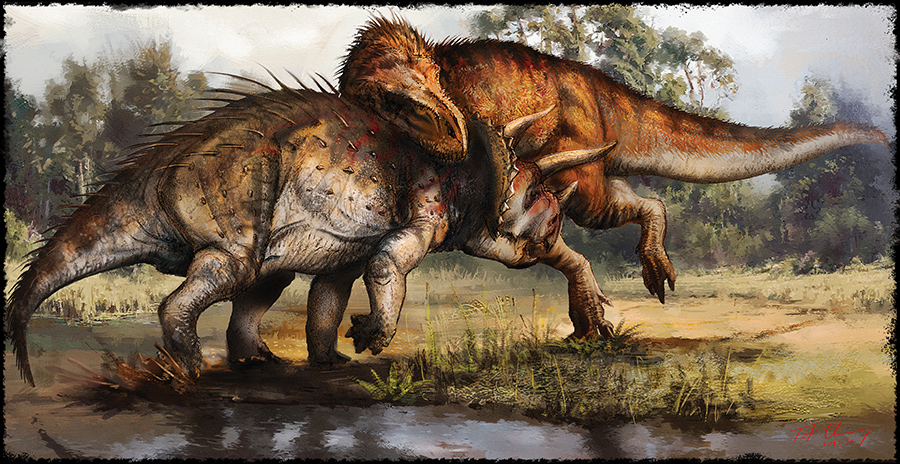
Tyrannosaurus vs Triceratops by cheungchungtat

There is arguably no dinosaur on dinosaur conflict that is more depicted and sensationalized then Tyrannosaurus vs Triceratops.

T. rex vs Triceratops is the one that is always popping up. Why is that? Well, probably the biggest reason that the general public may not even consider is that a fight between a T. rex and a Triceratops could have happened. They both lived in the same place at the same time (Western North America, about 66 Million Years Ago), and are both generally considered tough dinosaurs. A fight between two dinosaur powerhouses that actually lived together is just to alluring of an image to pass up.

Triceratops is often depicted as a power house of a dinosaur, like a modern day rhino but three times as big. It is often depicted using it’s horns offensively, goring into the sides of large predators. However, some scientists have considered an alternate theory.

It is theorized instead by some that the head of the Triceratops was brightly colored and used for display, and the horns merely aided that function. It has been inferred through several specimens of different age groups that the size and shape of the horns changed as they grew, so it may have also been a sign of sexual maturity or dominance. Some who propose this theory disregard the popular image of the horns being used as weapons, saying the horns were too delicate for offensive purposes and would break in battle.

However, nature is frugal, and will often adopt multiple uses for any given asset. Let’s take a look at a modern example. Deer use their antlers for display purposes and as a sign of sexual maturity, but they also use them to fight amongst themselves…

Source: www.natgeo.com

Tsintaosaurus, Unicorn No More

Friday, June 19, 2015

 Photo by KoS, distributed under the Creative Commons Attribution-Share Alike 3.0 Unported, 2.5 Generic, 2.0 Generic and 1.0 Generic license. A reconstructed skeleton of the hadrosaur Tsintaosaurus.

Tsintaosaurus has always been an oddball hadrosaur. That’s part of what made the shovel-beaked herbivore a favorite in dinosaur books and model collections. Instead of the domes or tubes seen in other crested hadrosaurs, such as the well-known Corythosaurus and Parasaurolophus, the weird Tsintaosaurus seemed to have nothing but a spike with a little fork at the end. This was a duckfaced unicorn. And since some artists thought such cranial decoration was a little subdued, they often added round, inflatable sacs at the spike’s base. But that’s bollocks. In PLoS One, paleontologists Albert Prieto-Márquez and Jonathan Wagner have given Tsintaosaurus a more dignified look with an expanded crest.

The mystery of what Tsintaosaurus actually looked like goes back to fossils from the Late Cretaceous of China that paleontologist Yang Zhongjian (also known as C.C. Young) described in 1958. In his reconstruction, Yang figured a tubular spike made of the nasal bones jutting from the dinosaur’s skull. But this ornament was so unlike that of other crested hadrosaurs that other researchers questioned whether the spike was a real feature. Paleontologist Philippe Taquet, for one, suggested that the Tsintaosaurus spike might simply be a nasal bone that was wrested out of place by distortion after the hadrosaur’s death.

 An old style restoration of Tsintaosaurus by ДиБгд, with inflatable sacs at the base of the spike. Image from Wikimedia Commons.

But the skull that Yang described wasn’t the only one. Another partial skull, previously studied by Eric Buffetaut and Haiyan Tong, had skull bones in similar positions to support a crest, and the new study also attributes a forgotten pair of skull bones to Tsintaosaurus. The spiky nasal bone was a real feature and close to its actual placement. And with this material in hand, Prieto-Márquez and Wagner make the case that this hadrosaur had a hollow, domed crest that was more like those of the dinosaur’s later relatives.

Rather than pointing forward, as it does in many artistic depictions, Prieto-Márquez and Wagner hypothesize that the spiky nasal bone was connected to the prefrontal bone above the eye socket and angled backward, making up part of the crest’s rear margin. The main body of the crest itself, which is still missing, would have been made of premaxillary bones that connected the front of the snout to the rear-pointing nasal. The skull of Tsintaosaurus was probably more shoehorn than unicorn.

The crest of Tsintaosaurus wasn’t only for show, though. Like other crested hadrosaurs, which fall into a group called lambeosaurines, Tsintaosaurus would have had nasal passages that looped through those expanded premaxillary bones. This circuitous route would have allowed Tsintaosaurus to make unique, low-frequency calls, similar to those reconstructed on the basis of the crests and inner ears of better-known hadrosaurs. Dinosaurs like Tsintaosaurus were probably among the most vocally adept of all the non-avian forms.

 A new reconstruction of the Tsintaosaurus skull. From Prieto-Márquez and Wagner, 2013.

For now, though, the route the dinosaur’s nasal passage would have taken is speculative. The relevant bones haven’t been uncovered, and, despite its name, the nasal bone itself had little to do with the internal plumbing of the hadrosaur’s skull. Future finds will fill out what’s missing. The test of the hypothesis lies with undiscovered bones. This will give artists a little leeway as they imagine what Tsintaosaurus looked like, but, happily for the dinosaur’s legacy, the hadrosaur will no longer wear a suggestive spike.

References:

Prieto-Márquez, A., Wagner, J. 2013. The ‘unicorn’ dinosaur that wasn’t: A new reconstruction of the crest of Tsintaosaurus and the early evolution of the Lambeosaurine crest and rostrum. PLoS One. 8, 11: e82268.

Source: http://phenomena.nationalgeographic.com

"Expedition Dinosaur" Returns to Milwaukee County Zoo

Wednesday, May 9, 2018

Plateosaurus

"Expedition Dinosaur" returns to the Milwaukee County Zoo this summer for a prehistoric exhibit.

The exhibit, which is sponsored by Sendik's Food Markets, will feature more than 20 life-size dinosaur replicas from May 26 until September 3.

The robotic creatures will move and rumble in their outdoor habitats. The habitats are re-created to resemble prehistoric scenery.

The exhibit will feature classic dinosaurs including Tyrannosaurus rexDilophosaurus with its semi-circular plates on its head, and the Brachiosaurus, one of the tallest and largest dinos. 

New dinos include the Amargasaurus and its baby, an Iguanodon and its nest, a Pachyrhinosaurus, a Quetzalcoatlus, a Sarcosuchus and a Utahraptor.

The exhibit will be open daily from 9 a.m. until 5 p.m. In addition to the zoo's admission, entry into the exhibit costs $3 per person.

Source: www.tmj4.com

The Remarkable Backstory of a 475-Million-Year-Old Fossil

Monday, May 7, 2018

The 475-million-year-old fossil

The discovery of a 475-million-year-old trilobite exoskeleton in Tennessee recently is a glimpse into an ancient past.

An 11-year-old girl in Tennessee made an extraordinary find recently, discovering a 475-million-year-old fossil of an empty cast exoskeleton from an ancient creature known as a trilobite, as we reported recently. And it reveals the stunning reality of what our planet looked like long before the existence of mankind, when creatures such as the trilobite thrived in the seas.

The intact trilobite exoskeleton, an extraordinarily rare find since such exoskeletons typically shatter into many pieces, was found on the shore of Douglas Lake in East Tennessee by Ryleigh Taylor. This marine arthropod has long since gone extinct, but hundreds of millions of years ago it lived right here in the United States, albeit when it was covered in water.

The trilobite is an extraordinary creature, first appearing in the early Cambrian period some 521 million years ago. There are an estimated 17,000 known species, and the study of these creatures have led to breakthroughs in everything from evolutionary biology to plate tectonics.

Trilobites are typically quite small, but not always. The largest one ever found was Isotelus rex in Manitoba, which measured 28 inches in length and 16 inches and width.

Today, you can find trilobite fossils all around the world, owing to the tremendous amount of species that have lived in the history of the Earth (although the discovery of an intact exoskeleton is quite rare).

Long before humans, these creatures populated the Earth, making it a very different place than we know of today. It is a chilling reminder of just how short of a time we have spent on this Earth as a species, and how different our planet looked eons ago.

Trilobites are a fossil group of extinct marine arachnomorph arthropods that form the class Trilobita,” reads a Wikipedia excerpt. “Trilobites form one of the earliest known groups of arthropods. The first appearance of trilobites in the fossil record defines the base of the Atdabanian stage of the Early Cambrian period (521 million years ago), and they flourished throughout the lower Paleozoic era before beginning a drawn-out decline to extinction when, during the Devonian, all trilobite orders except the Proetids died out. Trilobites disappeared in the mass extinction at the end of the Permian about 252 million years ago. The trilobites were among the most successful of all early animals, roaming the oceans for over 270 million years.”

Source: www.morningticker.com

Pages