nandi's blog

Scientists Take to Twitter to Share What They Sacrificed in the Name of Science

Wednesday, May 23, 2018

Early Career Scientists

Scientists reflect on what they sacrificed in their pursuit of science.

Choosing a profession in the sciences is one of the most exciting, yet challenging choices a person can make. Most choose it in the pursuit of knowledge - unable to live without the answers, so they go out and find them. It is a difficult, rather unglorified job. Scientists sacrifice countless hours and dollars to further their understanding of basically, everything. But it is far from the only sacrifice scientists are willing to make in the name of science.

Dean Lormax, a paleontologist passionate about science, understands some of those struggles. At the age of 18, Lormax new his passion was with paleontology - the science of fossilized animals and plants. However, participating in his first dig meant selling his prized collection of Star Wars memorabilia.

Lormax, now a well-respected paleontologist in the science community, reflected on his sacrifice for science a decade later.

“As a paleontologist, I get to work on some incredible projects, but it’s taken so much to get to that stage,” Lormax explained. He added that in his pursuit of science he has sacrificed his health, sanity, social life, and finances have all suffered.

However, Lormax is far from the only one to make such sacrifices in the name of science. In a tweet he made late April, Lormax shared his story on Twitter and asked his followers what they too have sacrificed to pursue a career in science.

Hey, #scientists I'm intrigued.

I sold my childhood #StarWars collection to fund my first professional dig - a decade ago. #geek #scientists I want to know what sort of things you've had to sacrifice in order to pursue a career in science? #SacrificeScientists

— Dean R. Lomax (@Dean_R_Lomax) April 24, 2018

Since the tweet went live, many scientists have come out to share their struggles as well.

As most will experience, money is likely the first thing most will have to sacrifice to begin their journey to becoming a scientist. ReBecca, a Twitter user who responded to the post, described the crippling debt she entered to be able to make enough money and pay for school.

Massive student loan debt till I’m in my 60s. Missed most of my daughter being 3 to drive 200 mi/day to my new job. Husband gave up his job/work stability to move so I could have a “real job.” Self funding all meetings. All “vacations” revolve around fossils/paleo meetings

— ReBecca HF (@paleochick) April 26, 2018

The time commitment of becoming a scientist is another thing scientists must be willing to give. While other quickly move along with their degrees, scientists often stay in academia much longer. Elsa Panciroli shared her story on what she sacrificed for science.

Everything! Started again from scratch in late 20s., but also watching my friends buying homes, rising to top job positions, settling with families... , but I'm still *just* a student.
Worth it to pursue something I love though.

— Elsa Panciroli (@gsciencelady) April 25, 2018

Diva Amon, another one of the scientists to share her story described the hardship she experienced spending so much time away from the things she loved.

Years and years of time with family and friends, not to mention a handful of boyfriends. Being an international student & then moving countries twice for postdocs is enough of a sacrifice but then there are the hours, the money, some of the skin off my foot.... the list goes on!

— Diva Amon (@DivaAmon) April 24, 2018

Getting results is tough, especially in the tight timelines demanded by companies. Deadlines come quickly, and good data does not. Keeping investors interesting is notoriously difficult; results must come quick enough and must be good enough for further funding to be released. Even more troubling is ensuring investors stay interested long enough to see the results. Dr. Lisa Buckley explained how pursing science left her with the constant fear of stability.

How timely! Security and stability were sacrificed in the name of "hoping" our funding situation would improve "next year." It has been a decade of "hoping for next year" now. There's enough data to demonstrate that "hoping" isn't working.

— Lisa Buckley, Ph.D. (@Lisavipes) April 24, 2018

Others, like Jade, shared their more sorrowing stories. Also a victim of science, Jade made the difficult decision to leave the country in the pursuit of furthering her education. As a result, she never made it home to say goodbye to her grandparents.

When one of the most important people in my life was dying, I was in the process of applying for a visa for my first postdoc. Getting on an international flight to say goodbye would disqualify the visa application and bar me from that country for 10 years.

I chose the job.

— Jade (@vertigopostdoc) April 27, 2018

While some give up their last moments with family, others put starting a family on hold for many years until they are stable again. Anna shared her story of how she put off having a family until she finished her degree. 

For my PhD I moved 10,000 km from home, far from my family and friends. But what I feel is my biggest sacrifice now: I would have become a mother many years ago if I had a normal job back home. With all the uncertainty I don't know if I'll ever be able to have children at all.

— Anna SdTC (@annasdtc) April 25, 2018

Becoming a scientist is no easy gig. There are countless hours spent figuring out how data fits together, and countless more trying to figure out what to do next. Things often go wrong and things must be sacrificed in order to make deadlines. It sounds quite horrible, and it can be - sometimes. 

But sometimes a little blood, sweat, and tears is what it takes to ensure humanity is always progressing. It is up to scientists to make tomorrow better so everyone else can have a better today. It is the kind of forward thinking which drives humanity forward together.

It is not without struggle, and it is far from glorious. It is often ugly, dirty, and requires many, many sacrifices. But in the end, being a scientist is one of the most gratifying jobs in the universe - and most would do it again, and again, and again.

Humanities constant desire for something better will always be filled by scientists - as long as they are willing to make the sacrifice.

Via: Nature Index

Source: https://interestingengineering.com

Maximo, The Largest Dinosaur Ever Uncovered, Moving Into Field Museum

Thursday, May 24, 2018

Maximo, a 122-foot-long titanosaur skeleton cast, is being installed in the Field Museum, in the spot once occupied by SUE the T-Rex. (Credit: Field Museum)

The Field Museum is getting a huge new house guest, who will be moving into SUE the T. rex’s old room.

Wednesday morning, crews began installing the new titanosaur skeleton cast of “Maximo,” the largest dinosaur ever unearthed.

The two-story tall Patagotitan mayorum was uncovered in Argentina in 2014. The 70-ton skeleton cast being installed at the Field Museum is the result of a $16.5 million gift from billionaire Ken Griffin, to help the Field Museum celebrate its 125th anniversary.

Crews used forklifts and pallet jacks to unload parts of the skeleton cast earlier this week. Wednesday morning used a crane to lift a 15-foot vertebrae piece to the front door. From there, they rolled it inside.

The piece weighs 2,000 pounds, and was too big for the museum’s freight elevator.

Crane operator Dan O’Gean was responsible for swinging the massive bone from the sidewalk to the south entrance at the top of the stairs. He said only one thing was going through his mind as he lifted the bone.

“Just to keep it under control, and pay attention to who is signaling me and telling me what to do,” he said.

Field Museum exhibitions production director Dan Breems coordinated the move.

“Using a crane to get stuff up that entrance, we do it maybe every two-three years,” he said.

Crews will begin building Maximo from the feet up. He’ll be ready for visitors on June 1, and museum guests will be able to stand under and touch the massive skeleton cast.

The two Dans didn’t break a sweat or a bone. The 15-foot cast touched down safely on the museum’s front steps in less than four minutes.

“We’ve brought up a viking ship, a whale skull,” Breems said.

“I picked up a piece of Titanic at the Museum of Science and Industry. I’ve also picked up a rhinoceros,” O’Gean said.

Staffers unloaded the rest of the massive skeleton from containers shipped from South America.

“It’s multiple sea containers coming all the way from Argentina, through the Harbor of New York, and arriving here,” said Field Museum director of exhibitions Jaap Hoogstratem.

The last part of Maximo’s journey hit a snag, needing some help rolling over the rugs at the entrance, but a bit of simple elbow grease did the trick.

A 122-foot- long plant eater, Maximo was the size of two articulated CTA buses.

“It’s unimaginable that this animal walked around, and found enough food to eat,” Hoogstratem said.

While no more crane work will be needed to finish delivering the bones, crews said the front doors at the museum will be taken off next week to move in a set of 35-foot pterosaurs that will be part of the same exhibit.

The whole exhibit officially opens June 1, but visitors can watch Maximo grow over the next few weeks.

Maximo will stand in Stanley Field Hall, where the museum’s most famous dinosaur, SUE the T-Rex, used to stand. 

In addition to the skeleton cast, the display will include some real titanosaur bones, including an 8-foot thigh bone.

SUE might pale in size compared to Maximo, but she won’t be forgotten. SUE is getting a new permanent exhibit – The Griffin Halls of Evolving Planet.

“There’s going to be a better moment of encounter, I think, for visitors to come face-to-face with SUE, and see them in a space that they’re going to be a rock star, and the star of that space,” Field Museum exhibition registration assistant Lisa Geiger said.

In her new exhibit, SUE will have a new pose, and bones the public hasn’t seen before. The museum will be adding her gastralia to the fossil. The bones appear to be extra ribs across SUE’s belly, and weren’t originally part of the display, because scientists weren’t sure how to position them when the skeleton was first mounted in 2000. Since then, research has determined their function and placement.

SUE’s new display will be unveiled next year.

Source: http://chicago.cbslocal.com

Debunking Dinosaur Myths and Movie Misconceptions

Thursday, May 24, 2018

Numerous movie misconceptions have helped make these Tyrannosaurus famous.

Misconceptions about dinosaurs are frequently fuelled by their inaccurate (though entertaining) representations in films.

Not everything you've been led to believe about dinosaurs is true.

The extinct reptiles that dominated our planet over 66 million years ago have long captured our imaginations.

As more is understood about dinosaurs, for the most part, our perceptions of them have changed.  But some myths have endured thanks to depictions that made certain dinosaurs household names.

We're looking at you, Velociraptor.

Museum dinosaur experts Dr Susie Maidment and Prof Paul Barrett reveal some of the common mistakes made about the ancient reptiles that once dominated Earth.

The undersized frill-necked lizard

If you are familiar with Dilophosaurus, a large, venom-spitting, frill-necked lizard may come to mind - at least that's what Steven Spielberg's 1993 film, Jurassic Park, would have you believe.

Unlike many of the reptiles that feature in the famous park, Dilophosaurus did live during the Jurassic. But despite a colourful portrayal, the dinosaur's starring turn was almost certainly all artistic license.

For a start, it probably wasn't venomous. In many living venomous animals, there are distinct pits in the jaw bone that indicate how an animal can deliver a toxic surprise.

Susie says, 'We don't have any evidence that Dilophosaurus or in fact any dinosaurs were able to produce venom. It also had this frill in the film and we don't have any evidence for that either.'

The film's version of the dinosaur was also undersized, which is unusual given movies' go-to approach of making beasts bigger for maximum effect. In reality, an adult Dilophosaurus would have reached around six metres in length - although, you could argue that the dinosaur in the film was a juvenile.

But what the film did get right was the presence of a head crest. This is a known feature of the genus, although it is almost impossible to define its purpose.

'It was possibly for attracting a mate,' Susie says. 'If we had lots of specimens then we could potentially look at if the crest was a sexual difference - did the males have crests and the females didn't, for example.

'But Dilophosaurus is a very old dinosaur from about 190 million years ago, and the rocks that it comes from are not prolific at producing fossils - so I expect that we don't have many of them.'

Naked Velociraptor

This mistake may be almost 25 years old, but large, featherless Velociraptors remain firmly lodged in many minds.

Velociraptor would actually have been around the size of a turkey - and the cinematic star was actually more like the related theropod Deinonychus. 

Susie points out that size wasn't the only thing they got wrong:

'The major thing that's wrong these days is that they were naked. Back in 1993 that's how we thought Velociraptor and Deinonychus would have looked. But starting in the mid-1990s there has been a vast number of discoveries of feathered dinosaurs.

'It's absolutely certain that they would have been covered in feathers and they may well have had long, display-type feathers on their forearms. 

'The feathers may have evolved for thermoregulation, so to keep them warm, because these animals may have been warm-blooded.'

T. rex versus V. rex

Peter Jackson's 2005 King Kong remake features a fictional Tyrannosaurus rex descendant called Vastatosaurus rex. The star, a 7.6-metre-tall gorilla, takes down the mighty meat-eater with apparent ease. The reality (that is, if a giant gorilla were to exist) would likely have been very different.

Paul explains, 'Tyrannosaurus's bite force was about three times stronger than that of an African lion - it had the strongest bite of any animal that has been measured. If T. rex had wrapped its jaws around King Kong's arm, he wouldn't have an arm left - it was a bone-crushing bite.'

Although it is suggested to have experienced 65 million years of isolated evolution on Skull Island, V. rex falls foul of more than one misconception when compared to its ancestors.

Most theropods had three fingers on each hand, but there were several whose arms and hands were significantly reduced. Tyrannosaurus had two fingers per hand, as would its fictitious descendant.

Paul says, 'We don't know why the forelimbs were so reduced in T. rex. It could be that they weren't used much for prey capture and they were vestigial structures that were gradually being lost through evolution.'

Theropods are also often depicted with bunny hands.

'A lot of dinosaurs have this problem. You often see them looking like they're pianists. But when you actually look at the hands and how they work, their palms would actually be facing each other.

'They couldn't rotate their hands into that downward pose. No meat-eating dinosaur that we know of could do that - so they could clap, but they weren't pianists.'

A battle of titans

In 2001, Jurassic Park viewers watched as Tyrannosaurus took on Spinosaurus and lost.

But these giants actually missed each other by about 25 million years. Where T. rex lived in the Late Cretaceous, it was the only very large carnivore, so it would never have faced a size-matched adversary.

Spinosaurus was the largest meat-eater ever to live. Although it is a challenge to study this dinosaur due to the lack of fossils, scientists believe that it carved a niche for itself by primarily eating fish and spending most of its time in water. 

Susie says, 'In the UK we have Baryonyx, which is a relation of Spinosaurus. If you took the upper jaw off and looked down at the snout, it's kind of rosette-shaped. That is very characteristic of animals that eat fish, both now and in the past.'

Marine-dwelling ancient reptiles (such as ichthyosaurs and pliosaurs) and modern crocodiles also have this distinct jaw shape. Fossilised stomach contents of Baryonyx have also been found that contained fish scales.

'That supports the theory that it was a fish-eating dinosaur. It wasn't just eating fish though - they also found juvenile Iguanodon bones in its stomach.'

Baryonyx and its cousin Spinosaurus may have supplemented their diets with other dinosaurs, but not likely anything nearly as big as Tyrannosaurus.

You could probably outrun T. rex

T. rex wasn't the speed demon it's often made out to be.

'In the first Jurassic Park a Tyrannosaurus chases down an accelerating Jeep. People have looked at running speeds of dinosaurs and the most recent research suggests that T. rex could barely run faster than a human,' says Susie.

T. rex probably had a top speed of only around 16 kilometres per hour, but the dinosaurs it preyed on wouldn't have been moving much faster either. 

'Triceratops and hadrosaurs probably weren't very quick either. So if Tyrannosaurus was a pursuit predator, everything in the Mesozoic was happening a lot slower than on the Serengeti today.'

Tyrannosaurus was likely a proficient hunter, albeit a slow one. But theories of a strictly scavenging nature persist.

'It's really difficult to tell behaviour from the fossil record. But if you look at modern ecosystems you'll notice that if a lion sees a carcass, it isn't going to pass up the opportunity to eat.

'I think it's a false dichotomy that T. rex was only a hunter and not a scavenger, or only a scavenger and not a hunter. Things that hunt also scavenge. There are very few animals that solely scavenge.'

Did Stegosaurus have two brains?

The relationship between body mass and brain size in living animals is an indicator of intelligence.

Paul says, 'For almost anything we do with dinosaursw we use comparisons with living things as a baseline.

'To get a measure of intelligence of any extinct animal, we use the endocast - that's the shape left behind within the skull that would have been occupied but the brain. You compare the volume of the brain with the mass of the animal.

'Most dinosaurs fall in line with modern reptiles or birds - their brains are about the expected size for their body size. But there are exceptions such as Troodon, which had a brain much bigger than we'd anticipate for bodies of its size. It looks like this small dinosaur would have been quite smart.'

Stegosaurus was a moderately sized thyreophoran (armoured dinosaur), weighing about 2,000 kilogrammes as an adult. Its brain was particularly small, so when an enlarged section of the spinal column in the sacral (hip) region was noticed, it led to the theory that this had housed a second brain.

'The spinal column tends to be enlarged in lots of dinosaurs, but for some reason it was noticed early on in Stegosaurus, ' says Susie.

'There were theories that its front brain wasn't powerful enough to coordinate its entire body, so if it had a rear brain that might have helped. There may have been a collection of neurons there, but I don't think we'd describe it as a brain.'

But a high IQ isn't a vital factor for many animals' ability to survive.

Paul explains, 'Animals don't need to be all that smart. They need to eat, not get eaten or fall under a tree or in a river, and find a mate. So intelligence is rare in the sense of things that have much bigger brains than they need.'

After all, Stegosaurus may have had a small brain, but it still managed to thrive during the Late Jurassic. 

Source: www.nhm.ac.uk

'Jurassic Park' Turns 25: Behind-the-Scenes Moments You May not Have Known

Wednesday, May 23, 2018

Ariana Richards and Joseph Mazzello are trapped in a truck in a scene from the film 'Jurassic Park', 1993.

 The low, approaching rumble. The ripples in the water cup. The silence. Then a giant T-Rex emerges from the brush.

The cold rush of fear that washes over you during that iconic scene in “Jurassic Park” feels as real today as when the movie premiered 25 years ago.

Since the original “Jurassic Park,” the franchise has grown to include four more chapters, the latest being “Jurassic World: Fallen Kingdom,” which premiered this June.

Members of the cast and crew from the original 1993 film sat down with ABC News for the “20/20” special, “Lights, Camera, Summer,” to talk about funny and interesting behind-the-scenes moments from this summer classic. 

1. There are approximately 15 minutes of dinosaur footage in the entire movie

Out of the entire “Jurassic Park” film, which runs for two hours and seven minutes, the dinosaurs only appear for approximately 15 minutes combined, according to crewmembers John Rosengrant and Matt Winston.

The movie used both animatronic dinosaurs and puppets overseen by Matt Winston’s father, the late Stan Winston. They were all part of the Stan Winston Studio team that was responsible for operating and moving the dinosaurs. Matt Winston is the co-founder of the Stan Winston School of Character Arts, an online visual effects program, and Rosengrant is the co-founder of the special effects studio Legacy Effects.

“It's taking that great philosophy of when you see it, it's amazing and you pepper it throughout the whole film, so you think you're seeing dinosaurs 24/7 but you actually don't. But when you do see them, they're top-notch and excellent,” Rosengrant said.

This technique, Matt Winston said, harkens back to director Steven Spielberg’s gifts as a filmmaker. Stan Winston’s team worked with Spielberg on a number of blockbuster films, including the first three “Jurassic Park” movies and “A.I. Artificial Intelligence.”

A brontosaurus eats leaves in a scene from the film 'Jurassic Park', 1993.

“In ‘Jaws’ there are very few shots of that shark and yet you're aware of the shark's presence throughout the film through music and other techniques he used, and he did that as well in ‘Jurassic Park,’” Matt Winston said. “There's a lot more dinosaur footage than there was shark footage, but still he used that technique of, ‘It's over there, I can hear it breathing but I'm not necessarily seeing it.’”

Actress Laura Dern, who played Ellie in “Jurassic Park,” described to “20/20” what it was like to see the dinosaurs up-close.

“Thanks to Stan Winston, there was a triceratops right in front of me... it just was so real,” Dern said. “It's one of the most beautiful things I've ever seen. The raptor I wasn't as comfortable with. Because of the puppetry, you felt like you were right there -- in bliss or in terror.” 

2. The T-Rex was so large, the building it was housed in had to be altered

Matt Winston said Spielberg went to Stan Winston to build the dinosaurs after seeing the 14-foot-tall Alien Queen he had built for James Cameron’s 1986 film, “Aliens.” But developing the giant T-Rex for “Jurassic Park” proved to be a major challenge.

“Nothing had ever been done on this scale, specifically the T-Rex,” Winston said. “Although the other dinosaurs were incredibly impressive, to build a 40-foot long puppet had never been done before, and that's exactly the kind of job dad liked to take.”

But as Stan Winston's team started to build the T-Rex in their workshop, they realized they needed a bigger space.

“[Stan said] ‘We can raise the roof. We can also make the door bigger to get it out at the other end and... We're going to modify this building,” Rosengrant said. “You felt like you were really in the middle of something special... You're sculpting a dinosaur. Not many people in the world have done that.”

In the end, Rosengrant said the T-Rex ended up being 36-feet-long, 18-feet-tall and weighed around 12,000 pounds.

3. A team of people had to dry off the T-Rex with towels, hair dryers every day

For a movie where some of the most intense scenes are done in the rain, Winston and Rosengrant said the T-Rex was not waterproofed. There was a team of people who had to dry the dinosaur out every day after shooting.

“Lots of long nights with blow dryers and fans... drying it out, squeezing it out,” Winston said. “It was nuts ... after the shot was done, everyone would run to the T-Rex and just start mopping it off with towels.”

“It was all night,” Rosengrant added. “There was a night shift that would come in to continue the process of drying the T-Rex so he'd be ready for his next day.”

4. A devastating hurricane hit while shooting the film

About three to four weeks into shooting the original film in Hawaii, the cast and crew had to take shelter when Hurricane Iniki slammed into the island of Kauai on Sept. 11, 1992. It’s still one of the costliest and most powerful hurricanes to hit the Hawaiian Islands, according to the National Oceanic and Atmospheric Administration (NOAA).

“That experience changed everything,” Dern said. “You become a family instantly. We walked through a natural disaster together, and so we were so, so bonded. For the next several months when we were filming, we were like... ‘We went through everything' ... Given that there was a hurricane in the movie and everything was so radical on this island, it just changed the whole experience.” 

5. The T-Rex lost a tooth during the kids' car scene

Actress Arianna Richards, who played young girl Lex in the original film, said Spielberg changed her character in the movie to be different than what was in Michael Crichton’s book, “Jurassic Park,” for which the movie is based.

In the book, the girl is the younger sister, but in the movie, Spielberg made her the older sibling “with all the computer knowledge to be able to save the day,” Richards said, who was 12 years old during filming.

“It was really something to have that empowerment,” she said.

One of the most dramatic scenes in the movie is when Lex and her brother Tim, played by Joe Mazzello, were trapped in the Jurassic Park SUV as the T-Rex attacks. Richards said she never felt scared or unsafe during filming, but in that scene, the T-Rex suffered a minor “injury.”

“The T-Rex got really close to us when we were filming the scene where he was crashing down on the vehicle, and at one point, the T-Rex's tooth actually hit the glass and ended up breaking off,” she said. 

6. Joe Mazzello got the 'Jurassic Park' part after auditioning for 'Hook'

Mazzello got the part of Tim, the little boy in “Jurassic Park,” after he said Spielberg watched his audition for “Hook,” another beloved '90s film starring Robin Williams and Dustin Hoffman. He was 7 years old when he auditioned.

“I was a little too young for the [“Hook”] part, but Steven came up to me after that and said, ‘Don't worry, Joey, I'm going to get you in the movie this summer,’ and then he offered me ‘Jurassic Park,’” Mazzello said. “In fact, ‘Jurassic Park,’ he changed the ages of the children so that I could play Tim. Tim was originally in the book older.”

7. Spielberg had the crew sing 'happy birthday' to Mazzello after a run-in with raptor claw

While filming the heart-pounding raptor kitchen scene, Mazzello said there was one take where one of the raptors was being pushed on wheels and its metal claw hit him in the face. And it happened to be his birthday that day.

“I fall on the ground, I'm dizzy. Everybody comes over, running and Steven [Spielberg] comes over, ‘Joe, Joe, you OK? You OK?’ I'm a little like, ‘yeah, yeah. I think so,’” Mazzello said. “And he goes, ‘Well, I think this is as good of a time as any. Ready everyone? Happy Birthday to you,’ and the entire crew is singing ‘Happy Birthday’ to me while I'm on the floor, dizzy from getting hit by the claw of the raptor.”

8. Wayne Knight said he had a 'make-up problem' on 'Seinfeld' after spitting dinosaur scene

Knight had already taken on the part of Newman, the scheming mailman who was Jerry Seinfeld’s nemesis on his TV sitcom “Seinfeld,” when he landed the part of Dennis Nedry in “Jurassic Park.”

In one of the movie’s most memorable scenes, Nedry comes face-to-face with a Dilophosaurus, which extends its throat fan, screeches and spits purple slime on his face and shirt.

“One night, I went back to shoot a ‘Seinfeld’ [episode] and I came back while we were shooting ‘Jurassic [Park],' and I said, ‘You know when you did the thing with the spitter?’ They go, ‘Yeah.’ [I said] ‘It kind of dyed my face purple.’ He [dinosaur creator] goes, ‘Yeah, it'll do that,’” Knight said. “So there was a make-up problem going back to TV, we had to like cover the spot ... and they basically said, ‘Don't blink, because we'll do it again.’”

Source: https://abcnews.go.com

Genome Structure of Dinosaurs Discovered by Bird-Turtle Comparisons

Saturday, May 12, 2018

This is an Apalone spinifera spiny softshell turtle hatchling. Credit: Nicole Valenzuela

A discovery by scientists at the University of Kent has provided significant insight into the overall genome structure of dinosaurs.

By comparing the genomes of different species, chiefly birds and turtles, the Kent team were able to determine how the overall genome structure (i.e. the chromosomes) of many people's favourite dinosaur species -- like Velociraptor or Tyrannosaurus -- might have looked through a microscope.

The research was carried out in the laboratory of Professor Darren Griffin, of the University's School of Biosciences, and is now published in the journal Nature Communications. It involved extrapolating the likely genome structure of a shared common ancestor of birds and turtles that lived around 260 million years ago -- 20 million years before the dinosaurs first emerged.

Dr Becky O'Connor, senior postdoctoral researcher and co-author of the Nature Communications paper, then traced how chromosomes changed over evolutionary time from a reptile ancestor to the present day.

The team found that, although the individual chromosomes rearranged their genes internally, this did not occur much at all between the chromosomes -- what the scientists describe as 'a significant discovery'.

Birds (which are themselves living dinosaurs) have a lot of chromosomes compared to most other species and that is possibly one of the reasons why they are so diverse. This research suggests that the pattern of chromosomes (karyotype) seen in early emerging dinosaurs and later theropods is similar to that of most birds and, again, may help explain their great diversity.

The new discovery suggests that, had scientists had the opportunity to make a chromosome preparation from a theropod dinosaur, it might have looked very similar to that of a modern-day ostrich, duck or chicken.

One of the key pieces of biotechnology that made it possible was the development of a set of fluorescent probes derived from birds that worked well on the chromosomes of turtles.

The genetics laboratory run by Professor Darren Griffin in Kent's School of Biosciences carries out research into how genes organise into chromosomes and how that is different between species. The work is a collaboration with Dr Denis Larkin at the Royal Veterinary College in London, Iowa State University, the University of Cambridge, Oxford Genome Technologies and the Natural History Museum, London. The work is a collaboration with Dr Denis Larkin at the Royal Veterinary College in London, Iowa State University, the University of Cambridge, the Cambridge company Cytocell and the Natural History Museum, London.


Story Source:

Materials provided by University of Kent. Note: Content may be edited for style and length.


Journal Reference:

  1. Rebecca E. O’Connor, Michael N. Romanov, Lucas G. Kiazim, Paul M. Barrett, Marta Farré, Joana Damas, Malcolm Ferguson-Smith, Nicole Valenzuela, Denis M. Larkin, Darren K. Griffin. Reconstruction of the diapsid ancestral genome permits chromosome evolution tracing in avian and non-avian dinosaurs. Nature Communications, 2018; 9 (1) DOI: 10.1038/s41467-018-04267-9

Source: www.sciencedaily.com

Zak Designs Releases Jurassic World Drinkware

Saturday, May 26, 2018

Zak's Sculpted T-Rex Mug

To get fans across the country exited for the release of “Jurassic World: Fallen Kingdom,” Zak Designs is releasing a new line of licensed drinkware that feature the characters of the film.

The collection includes a new color-changing coffee mug that reveals hidden graphics when the mug is filled with hot beverages. The line also includes a bust-out mug that has a sculpted version of Blue the velociraptor jumping out of the side of the ceramic mug. The company is also releasing a sculpted T-Rex mug.

For slightly cooler thirsts, Zak is releasing a 15-ounce Funtastic tumbler with action graphics on the tumbler and a 3D sculpt of Blue on the lid. And when it comes to staying hydrated on-the-go, the 25-ounce Union bottle features a flip-up drinking spout, a special rubberized grip and a built-in carrying loop to clip onto sports bags or backpacks.

You can buy this mug here.

Source: www.homeworldbusiness.com

‘Jurassic Park’ Dinosaur Expert’s Next Big Thing: Holograms

Monday, May 21, 2018

FILE – In this May 21, 2016, file photo, Jack Horner sits under Montana’s T-Rex in the Museum of the Rockies in Bozeman, Mont. The Montana paleontologist, Horner, who consulted with director Steven Spielberg on the “Jurassic Park” movies is developing a three-dimensional hologram exhibit that will showcase the latest theories on what dinosaurs looked like. Horner and entertainment company Base Hologram are aiming to have multiple traveling exhibits ready to launch in spring 2018. (AP Photo/Matt Volz, File)

Forget the gray, green and brown dinosaurs in the “Jurassic Park” movies. Paleontologist Jack Horner wants to transport people back in time to see a feathered Tyrannosaurus rex colored bright red and a blue triceratops with red fringe similar to a rooster’s comb.

Horner, who consulted with director Steven Spielberg on the “Jurassic Park” films, is developing a three-dimensional hologram exhibit that will showcase the latest theories on what dinosaurs looked like. He is working with entertainment company Base Hologram to create an exhibit that will let people feel as though they’re on an archaeological dig, inside a laboratory and surrounded by dinosaurs in the wild.

“I’m always trying to figure out a good way to get the science of paleontology across to the general public,” Horner said in a recent interview with The Associated Press. “Like taking them into the field or taking them into my laboratory and then using the technology that we have to show people what dinosaurs were really like.”

That understanding of what dinosaurs looked like has changed a lot since the original “Jurassic Park” in 1993. For example, researchers now believe dinosaurs were much more bird-like than lizard-like, and scientists studying dinosaur skulls have found keratin, a substance that gives birds their bright colors.

Photo from: http://www.jurassicworld.com

“We can see at least areas that could be vividly colored, very much like birds, and there’s no reason to make them different from birds,” Horner said.

Horner and Base Hologram workers have been developing the exhibit’s story line for a couple of months, with plans to have multiple traveling exhibits ready to launch by spring 2019. The company wants to place them in museums, science centers and other institutions where they might spur debate among scientists who don’t share the theory that dinosaurs were colorful, feathered creatures.

“The controversy is OK because it makes people talk,” said Base Hologram executive vice president Michael Swinney.

Live performances using holograms have gained attention in recent years, notably through concerts that feature likenesses of dead performers such as Michael Jackson and Tupac Shakur.

Until now, Base Hologram, a subsidiary of the live entertainment company Base Entertainment, has used the technology to put on concerts by late singers Roy Orbison and Marie Callas. As the field becomes more competitive, the company is seeking new areas to apply the technology, such as science, CEO Brian Becker said.

Horner previously worked with Microsoft to create his dinosaur holograms that can be used with virtual and augmented reality technologies.

He noted the technology used in the exhibit can be applied even more broadly, including by paleontologists in their labs.

“What we do now is, when we want to envision something, we get an artist to paint it,” Horner said. “Now, we’re going to be able to create a 3-D immersive experience a lot better than a painting.”

Source: www.seattletimes.com

Big Discovery in a Tiny Mammal-Like Skull Found Under a Dinosaur’s Foot

Thursday, May 24, 2018

An artist’s rendering of Cifelliodon wahkarmoosuch. Its fossilized skull was found under a dinosaur’s foot by paleontologists in Utah.CreditJorge A. Gonzalez

In 2006 a team of paleontologists in Utah were examining the fossils of a large dinosaur when they discovered beneath its foot a tiny skull unlike anything they had seen in the area.

Now, scientists have found that the fossilized cranium belonged to an ancient relative of modern mammals that once scurried around North America some 130 million years ago. The new species, called Cifelliodon wahkarmoosuch, is a member of an extinct group of animals known as the haramiyids, which some researchers think bridged the transition between reptiles and mammals.

A reconstruction of a Cifelliodon skull made using computed tomography. Huttenlocker et al.

The finding, published Wednesday in the journal Nature, shows that haramiyids spread much farther across the globe and in a later time period than previously thought.

“When I first saw the specimen I was stunned,” said Simone Hoffmann a paleontologist from New York Institute of Technology who was not involved in the paper. Dr. Hoffmann, who wrote a perspective that accompanied the study, said she was surprised to see a haramiyid fossil among the thousands of dinosaur specimens found in North America from the Cretaceous period.

In the 1900s scientists had uncovered teeth and jawbones from haramiyids in parts of Eurasia that dated back to the Jurassic and Triassic periods, more than 145 million years ago. Then around 2014 and 2015, researchers found skeletons and soft tissue of haramiyids in China, sparking a debate about where the group belongs on the evolutionary tree. Some argue that its place is within the mammal family, while others have said that it exists just outside that classification.

“It’s a mystery group,” said Zhe-Xi Luo, a paleontologist at the University of Chicago and an author on the paper.

If haramiyids are mammals, then the group pushes back the birth of mammals to about 220 million years ago. But if they are not, mammals date to only about 185 million years ago. Dr. Luo said he and his colleagues place the haramiyids at the doorstep of mammals — close but just outside.

Scientists think haramiyids were diverse and possibly occupied similar ecological niches, eating insects, plants or meat. There is evidence that some of the creatures could glide like flying squirrels and others could swim. 

Adam Huttenlocker, a paleobiologist at the University of Southern California and lead author on the paper made the link that the fossil found in Utah belonged to a haramiyid. The team performed CT scanning of the skull, which showed that its brain was small, and it likely had a good sense of smell.

Though most furry creatures during the Mesozoic Era — which spanned the Triassic, Jurassic and Cretaceous periods — were about the size of a shrew or mouse, Cifelliodon was about as big as a rabbit or hare, and weighed about 2.5 pounds.

“For a Mesozoic proto-mammal it was pretty huge,” said James Kirkland, a paleontologist from the Utah Geological Survey who first found the skull. “It was like a godzilla proto-mammal.” 

The skull the team found only had one tooth, which they said was similar to a fruit-eating bat’s teeth. But that lonely tooth was important, said David Krause, a paleontologist from the Denver Museum of Nature and Science who co-wrote the accompanying perspective.

“That tooth is now largely responsible for extending the geographic range of the group to an entire new continent — North America — and to a significantly later time than is typical for haramiyidans,” said Dr. Krause.

Dr. Hoffmann added that despite the new finding, she is undecided on whether haramiyids belong inside or outside of the mammal group.

“We still need more fossils to tell that,” she said.

Source: www.nytimes.com

Study Casts Doubt on Traditional View of Pterosaur Flight

Wednesday, May 23, 2018

This is an image of a reliable reconstruction. Soft tissues like ligaments play a big role in determining a joint's range of motion. But soft tissues rarely fossilize, causing problems for paleontologists trying to reconstruct who extinct creatures may have lived. Now researchers have shown a new method for inferring the extent to which ligaments inhibit joint movement, which could be helpful in reconstructing ancient species. Credit: Armita Manafzadeh

A new study of how ligaments restrict joint movement suggests that pterosaurs and 'four-winged' dinosaurs couldn't have flown in the same way that bats do. 

Most renderings and reconstructions of pterodactyls and other extinct flying reptiles show a flight pose much like that of bats, which fly with their hind limbs splayed wide apart. But a new method for inferring how ancient animals might have moved their joints suggests that pterosaurs probably couldn't strike that pose.

"Most of the work that's being done right now to understand pterosaur flight relies on the assumption that their hips could get into a bat-like pose," said Armita Manafzadeh, a Ph.D. student at Brown University who led the research with Kevin Padian of the University of California, Berkeley. "We think future studies should take into account that this pose was likely impossible, which might change our perspective when we consider the evolution of flight in pterosaurs and dinosaurs."

The research, published in Proceedings of the Royal Society B, is an effort to help paleontologists infer the range of motion of joints in a way that takes into account the soft tissues -- particularly ligaments -- that play key roles in how joints work. Generally, soft tissues don't fossilize, leaving paleontologists to infer joint motion from bones alone. And there aren't many constraints on how that's done, Manafzadeh says. So she wanted to find a way to use present-day animals to test the extent to which ligaments limit joint motion.

It's an idea that started with grocery store chickens, Manafzadeh says.

"If you pick up a raw chicken at the grocery store and move its joints, you'll reach a point where you'll hear a pop," she said. "That's the ligaments snapping. But if I handed you a chicken skeleton without the ligaments, you might think that its joints could do all kinds of crazy things. So the question is, if you were to dig up a fossil chicken, how would you think its joints could move, and how wrong would you be?"

For this latest study, she used not a grocery store chicken, but dead quail. Birds are the closest living relative of extinct pterosaurs and four-winged dinosaurs. After carefully cutting away the muscles surrounding the birds' hip joints, she manipulated the joints while taking x-ray videos. That way, she could determine the exact 3-D positions of the bones in poses where the ligaments prevented further movement.

This technique enabled Manafzadeh to map out the range of motion of the quail hip with ligaments attached, which she could then compare to the range of motion that might have been inferred from bones alone. For the bones-only poses, Manafzadeh used traditional criteria that paleontologists often use -- stopping where the two bones hit each other and when the movement pulled the thigh bone out of its socket.

She found that over 95 percent of the joint positions that seemed plausible with bones alone were actually impossible when ligaments were attached.

The next step was to work out how the range of motion of present-day quail hips might compare to the range of motion for extinct pterosaurs and four-winged dinosaurs.

The assumption has long been that these creatures flew a lot like bats do. That's partly because the wings of pterosaurs were made of skin and supported by an elongated fourth finger, which is somewhat similar to the wings of bats. Bat wings are also connected to their hind limbs, which they splay out widely during flight. Many paleontologists, Manafzadeh says, assume pterosaurs and four-winged dinosaurs did the same. But her study suggests that wasn't possible.

In quail, a bat-like hip pose seemed possible based on bones alone, but outward motion of the thigh bone was inhibited by one particular ligament -- a ligament that's present in a wide variety of birds and other reptiles related to pterosaurs. No evidence, Manafzadeh says, suggests that extinct dinosaurs and pterosaurs wouldn't have had this ligament, too.

And with that ligament attached, this new study suggests that the bat-like pose would be impossible. According to Manafzadeh's work, this pose would require the ligament to stretch 63 percent more than the quail ligament can. That's quite a stretch, she says.

"That's a huge difference that would need to be accounted for before it can be argued that a pterosaur or 'four-winged' dinosaur's hip would be able to get into this bat-like pose," Manafzadeh said. And that, she says, may require a rethinking of the evolution of flight in these animals.

In addition to calling into question traditional ideas about flight in pterosaurs and early birds, the research also provides new ways of assessing joint mobility for any joint of any extinct species by looking at its living relatives.

"What we've done is to provide a reliable way to quantify in 3-D everything a joint can do," Manafzadeh said.

She hopes other researchers will use the method to study other joint systems and to better understand how other species may have moved their joints, walked and flown.


Story Source:

Materials provided by Brown University. Note: Content may be edited for style and length.


Journal Reference:

  1. Armita R. Manafzadeh, Kevin Padian. ROM mapping of ligamentous constraints on avian hip mobility: implications for extinct ornithodirans. Proceedings of the Royal Society B: Biological Sciences, 2018; 285 (1879): 20180727 DOI: 10.1098/rspb.2018.0727

Source: www.sciencedaily.com


How a Humble Chatham County Phytosaur Crawled into History Before the Mighty T. rex

Thursday, May 24, 2018

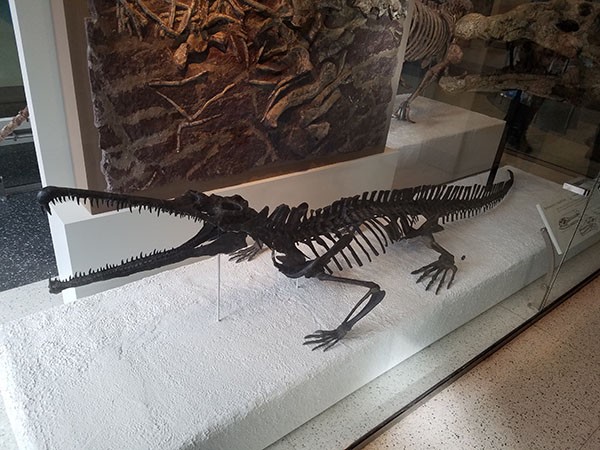
Chatham County native AMNH-FR-1 at the American Museum of Natural History. Photo by Ethan Fulwood

If you visit the Hall of Vertebrate Origins at the American Museum of Natural History, you'll find a mounted skeleton of Rutiodon carolinensis, a member of the superficially crocodile-like order Phytosauria. This long-lived and diverse group inhabited North America during the Triassic period, from around 250 million to 200 million years ago. If you look closely at the signage, you'll notice that this skeleton, specimen AMNH-FR-1, was the very first cataloged in the museum's fossil reptile collections.

The AMNH is famous for spectacular mounted skeletons of dinosaurs from the badlands of Mongolia and the American West, but this skeleton, you might also notice, is said to come from the verdant hills of Chatham County, North Carolina. So how did this humble Carolina crocodylomorph make its way to Central Park West before the first Tyrannosaurus or Triceratops?

The AMNH signaled its intention to build a major vertebrate paleontology program in 1891, when it hired Henry Fairfield Osborn. Osborn's interest in North Carolina appears to date from the 1880s, when he published a short paper on two jaws from mammal relatives called cynodonts. They had been found in Chatham County coal mines by Ebenezer Emmons, North Carolina's first state geologist. Emmons's visits to the mines in the 1850s also yielded fragmentary phytosaur fossils that he would give the name Rutiodon ("wrinkled tooth") carolinensis ("of Carolina"), a new species.

Over the summers of 1894 and 1895, Osborn dispatched his newest assistant curator, William Diller Matthew, to North Carolina, on a search for more early mammals. Matthew would eventually become a pioneer of modern American mammalian paleontology. A creative theorist and a careful researcher, he did much to bring order to the chaos created by the exuberance of some nineteenth-century paleontologists. His North Carolina expeditions were his first for the AMNH.

Matthew began work in the Egypt Coal Mine (now in the community of Cumnock), one of a string of mines along the Deep River from Gulf to Sanford that operated sporadically from the 1810s until the 1920s. The coal deposits of Chatham and Lee counties had formed in swamps in the rift basins created as the African plate pulled apart from North America beginning about 220 million years ago. Phytosaurs were important predators in these swamp ecosystems and were common enough fossils to be well-known to the miners. Matthew returned to New York in 1895, frustrated in his efforts to find additional fossil mammals but with a large quantity of phytosaur material.

The specimen cataloged as AMNH-FR-1 is a composite of a skull and a number of skeletal elements, likely from multiple creatures found in the Egypt mine in close proximity. The skeleton was mounted some time before 1906, when it first figured in a monograph, and again in the 1940s, using information acquired from additional Rutiodon discoveries. As such, Rutiodon carolinensis was among the first ancient reptiles to be represented by a museum-mounted skeleton.

Rutiodon wouldn't reign long as king of AMNH reptiles, though. Later in 1895, the museum acquired the thousands of fossils collected by famous and fractious Philadelphia paleontologist E.D. Cope over his long career. This included many important dinosaur specimens that would find their place in the fossil reptile collections inaugurated by Matthew's North Carolina phytosaurs. But fossils of phytosaurs, mammal relatives, and other contemporaneous animals have continued to emerge from rocks of the Triassic basins of central North Carolina, providing key insights into this period of the evolution of North America.

Source: www.indyweek.com

Pages