nandi's blog

Many Paleontologists Today Are Part Of The 'Jurassic Park' Generation

Wednesday, July 11, 2018

Many Paleontologists Today Are Part Of The 'Jurassic Park' Generation

Paleontology is experiencing a golden age, with a new dinosaur species discovered every 10 days on average. Those inspired by the film Jurassic Park as children are now exiting Ph.D. programs and injecting the field with new talent.

AILSA CHANG, HOST:

Right now, paleontology is booming. Lots of scientists are entering the field, competing for academic and research jobs. And a new dinosaur species is being discovered on average every 10 days.

ARI SHAPIRO, HOST:

Many people who work in paleontology think what's happening today is tied to a summer blockbuster that hit movie theaters 25 years ago.

(SOUNDBITE OF FILM, "JURASSIC PARK")

BOB PECK: (As Muldoon) Joffrey, raise the gate.

JOSEPH FREDERICKSON: I remember leaving my kindergarten class running to the car where my aunt and uncle were picking me up, and they took me to the movie theater and took me to go see this PG-13 rated movie called "Jurassic Park." And from the onset, when you see that first cage with the raptor in it... and.

(SOUNDBITE OF FILM, "JURASSIC PARK")

FREDERICKSON: ...I was standing on top of my chair.

SHAPIRO: That is paleontologist Joseph Frederickson. He's part of the "Jurassic Park" generation that's now helping to create a golden age of dinosaur discovery.

FREDERICKSON: Right off the bat, dino mania; I owned every dinosaur, "Jurassic Park" thing that I could get my hands on. And for at least four to five years, "Jurassic Park" was the biggest thing in my life. But going through adolescence, you know, you kind of forget about those things, and it wasn't really until I got into college and I kind of started to reflect on really what did I want to do with my life. And I ended up picking up "Jurassic Park" the novel again at that point, and I read it, and I found myself getting more and more interested in it again as I got through it. As soon as I put it down, I realized I needed to enroll in a paleontology class or a Earth science class to learn more.

(SOUNDBITE OF JOHN WILLIAMS AND BOSTON POP ORCHESTRA'S "THEME (FROM "JURASSIC PARK")")

FREDERICKSON: The "Jurassic" generation is 100 percent a thing. I have colleagues - so many colleagues - who are, you know, in their early 30s who were just children when "Jurassic Park" came out. And I have no doubt that it meant just as much to every one of them as it did to me and can really point to that moment as being one of these life-changing events that really made them want to get into paleontology.

(SOUNDBITE OF JOHN WILLIAMS AND BOSTON POP ORCHESTRA'S "THEME (FROM "JURASSIC PARK")")

FREDERICKSON: You know, we are finding more dinosaurs and more prehistoric animals than we ever have before at a rate that is just unprecedented. And it's not going to stop anytime soon because we have an army of paleontologists who are chomping at the bit to get out there who are all, in my situation, starting their careers right now.

CHANG: That's Joseph Frederickson, a newly minted professor at Southwestern Oklahoma State University. He's a member of the "Jurassic Park" generation - paleontologists who were first inspired by the Steven Spielberg film 25 years ago.

SHAPIRO: Frederickson will defend his Ph.D. dissertation at the end of this month. It addresses a question prompted by the original "Jurassic Park" - did velociraptors, in fact, hunt in packs?

(SOUNDBITE OF FILM, "JURASSIC PARK")

UNIDENTIFIED ACTOR: (As character, screaming).

SHAPIRO: His conclusion - the movie probably took some liberties.

(SOUNDBITE OF JOHN WILLIAMS AND BOSTON POP ORCHESTRA'S "THEME (FROM "JURASSIC PARK")")

Source: www.npr.org

New World’s First Dogs Came from Siberia: Study

Tuesday, July 10, 2018

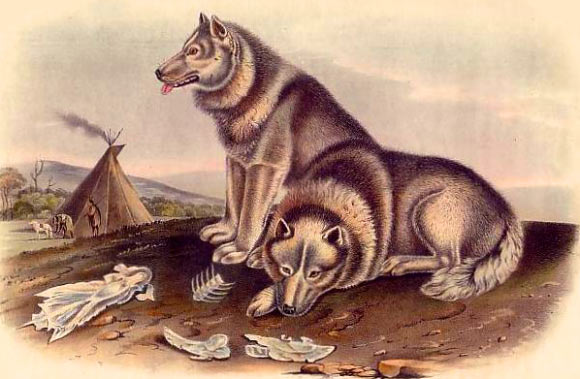
‘Pre-contact’ American dogs, which arrived alongside people over 10,000 years ago and dispersed throughout North and South America, possessed genetic signatures unlike dogs found anywhere else in the world. Illustration by John James Audubon and John Bachman (1845-1848).

According to a study published in the journal Science, the earliest New World dogs were not domesticated from North American wolves; instead, they form a lineage that likely originated in Eastern Siberia and dispersed into the Americas alongside people.

Domestic dogs first appear in the archaeological record of the Americas 9,900 years ago, nearly 6,000 years after the earliest evidence of human activity.

However, the precise timing of their arrival as well as their associated geographic origins are not well understood.

To investigate in unprecedented detail the origins of ‘pre-contact’ American dogs — domesticated dogs that populated the Americas prior to the 15th century arrival of Europeans, University of Oxford’s Professor Greger Larson and colleagues combined archaeology with genomic analysis.

The scientists sequenced 71 mitochondrial and seven nuclear genomes from ancient North American and Siberian dogs.

They found that pre-contact dogs stem from a genetically distinct lineage, most closely related to a 9,000-year-old ancient breed of sled dogs from Eastern Siberia.

These ancient dogs almost completely disappeared following the arrival of European settlers, leaving little or no trace in more modern American dogs.

“This study demonstrates that the history of humans is mirrored in our domestic animals,” Professor Larson said.

“People in Europe and the Americas were genetically distinct, and so were their dogs. And just as indigenous people in the Americas were displaced by European colonists, the same is true of their dogs.”

“When we compare our ancient dog DNA to all other known dog/wolf DNA, we find that the closest relatives are the Siberian dogs,” said co-author Dr. Anna Linderholm, of Texas A&M University.

“This mirrors what we know about humans at the time and sites in Siberia have records of people using dogs then.”

The team also found that a cancerous condition spread through the mating of dogs thousands of years ago is still present today and is the last remaining trace of these early dog populations that arrived in the Americas.

“It is fascinating that a population of dogs that inhabited many parts of the Americas for thousands of years, and that was an integral part of so many Native American cultures, could have disappeared so rapidly,” said co-lead author Dr. Laurent Frantz, of Queen Mary University.

“Their near-total disappearance is likely due to the combined effects of disease, cultural persecution and biological changes starting with the arrival of Europeans.”

“This suggests something catastrophic must have happened, but we do not have the evidence to explain this sudden disappearance yet. It is ironic that the only vestige of a population that was likely wiped out by a disease is the genome of a transmissible cancer,” the researchers said.

“The sudden disappearance of dogs in America was probably associated with European colonization, but we don’t know the details yet,” Dr. Linderholm said.

“This is further evidence of the strong bond between humans and dogs. Humans will bring their dogs to every new place they explore and colonize, regardless of time and space.”

_____

Máire Ní Leathlobhair et al. 2018. The evolutionary history of dogs in the Americas. Science 361 (6397): 81-85; doi: 10.1126/science.aao4776

Source: www.sci-news.com

Bright Pink is Oldest Color in Geological Record

Wednesday, July 11, 2018

Biogeochemist Dr. Janet Hope holds an ampoule with pink colored porphyrins. Image credit: Australian National University.

An international team of researchers from Australia, Japan, the United States and Belgium has successfully extracted bright pink biological pigments from 1.1-billion-year-old marine sedimentary rocks of the Taoudeni Basin in Mauritania, West Africa.


“The bright pink pigments called porphyrins are the molecular fossils of chlorophylls that were produced by ancient photosynthetic organisms inhabiting an ancient ocean that has long since vanished,” said Dr. Nur Gueneli, from the Research School of Earth Sciences at the Australian National University.

The molecular fossils range from blood red to deep purple in their concentrated form, and bright pink when diluted.

They are approximately 600 million years older than previous ancient pigment discoveries.

Dr. Gueneli and colleagues crushed the Taoudeni Basin rocks to powder, before extracting and analyzing molecules of ancient organisms from them.

“The precise analysis of the ancient pigments confirmed that tiny cyanobacteria dominated the base of the food chain in the oceans a billion years ago, which helps to explain why animals did not exist at the time,” Dr. Gueneli explained.

“The emergence of large, active organisms was likely to have been restrained by a limited supply of larger food particles, such as algae,” said Dr. Jochen Brocks, also from the Research School of Earth Sciences at the Australian National University.

“Algae, although still microscopic, are a thousand times larger in volume than cyanobacteria, and are a much richer food source.”

“The cyanobacterial oceans started to vanish about 650 million years ago, when algae began to rapidly spread to provide the burst of energy needed for the evolution of complex ecosystems, where large animals, including humans, could thrive on Earth,” he said.

The results appear online this week in the Proceedings of the National Academy of Sciences.

_____

N. Gueneli et al. 1.1-billion-year-old porphyrins establish a marine ecosystem dominated by bacterial primary producers. PNAS, published online July 9, 2018; doi: 10.1073/pnas.1803866115

Source: www.sci-news.com

These Long-Necked, Elephant-Sized Dinosaurs Arose Long Before Brachiosaurus

Wednesday, July 11, 2018

There’s more than one way to supersize a dinosaur. Scientists studying the ancient bones of sauropod relatives have found that they grew to multiton masses 30 million years before the appearance of their cousins, the titanosaurs. (Jorge A. González)

There’s more than one way to supersize a dinosaur. Scientists studying the ancient bones of sauropod relatives that walked the Earth more than 200 million years ago have found that they grew to multiton masses 30 million years before the appearance of their cousins, the titanosaurs.

The findings described in the journal Nature Ecology & Evolution could fill in a more complex portrait of the ecology of early dinosaurs and the evolution of sauropods and their relatives.

“This discovery helps shed light on how the different traits that we think led to the extreme gigantism in sauropods first evolved,” said Kristina Curry Rogers, a vertebrate paleontologist at Macalester College in St. Paul, Minn., who was not involved in the study. “The discovery is important because it helps connect some dots between earlier bipedal dinosaurs and the giants that ruled the Mesozoic later on.”

Think of a sauropod, and a species like Brachiosaurus may come to mind: Long-necked, long-tailed, straight-legged with giant bodies and small heads. They arose from the sauropodomorphs, whose members included “the largest animals recorded in the history of life,” the study authors wrote.

Brachiosaurus, which plodded across the terrain roughly 150 million years ago, could outweigh several elephants; some scientists estimate that the largest of the sauropod species could hit 70 tons or more. But the ancestors of these titans were very different: they were small, nimble and walked on two legs instead of four.

In order to grow into these massive eusauropoda, or “true sauropods,” these animals had to undergo some major modifications to their body plan, scientists say. Among the changes, they had to develop straighter, tree-trunk legs to support their weight; they also had to grow quickly and consistently. But there isn’t a whole lot of evidence to show what that transition looked like.

“It was long believed that acquisition of giant body size in this clade (over 10 tonnes) occurred during the Jurassic and was linked to numerous skeletal modifications present in Eusauropoda,” the study authors wrote. (A tonne is a metric ton, or roughly 1.1 U.S. tons.) “Although the origin of gigantism in sauropodomorphs was a pivotal stage in the history of dinosaurs, an incomplete fossil record obscures details of this crucial evolutionary change.”

Two strange-looking sauropodomorphs offer a surprising twist to the story of gigantism in these iconic dinosaurs. Cecilia Apaldetti of the National University of San Juan in Argentina and her colleagues examined a new species, Ingentia prima, as well as a previously known species called Lessemsaurus sauropoides.

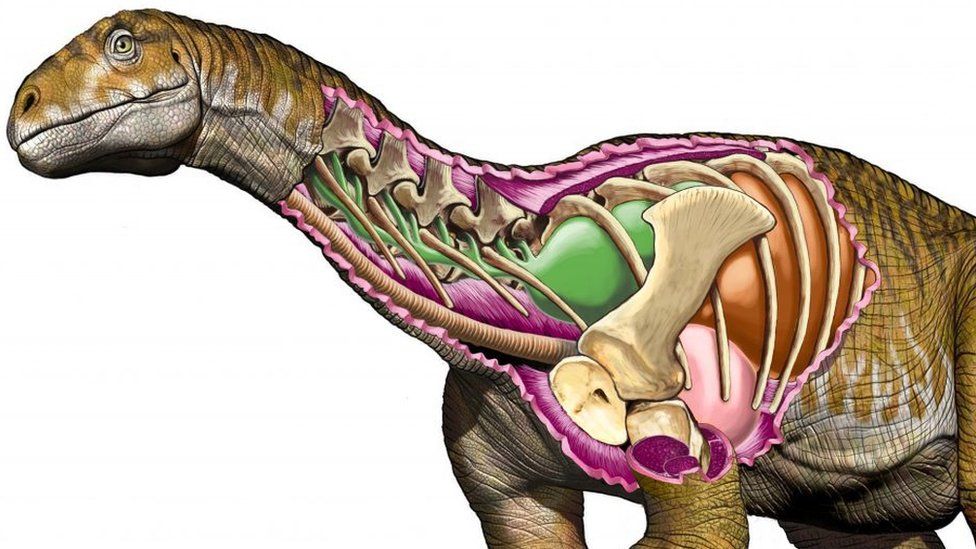
Ingentia prima had an improved, avian-like respiratory system with developed cervical air sacs, shown in green. Its lungs are shown in brown. (Jorge A. González)

These so-called lessemsaurids lived roughly 237 million to 201 million years ago in present-day Argentina, roughly 47 million years before Brachiosaurus did, and yet they had already managed to grow to gigantic sizes — that is, roughly 8 to 11 tons, about the size of a large elephant. They also had long necks and tails, though not as long as the true sauropods.

These animals didn’t just grow to massive sizes roughly 30 million years before true sauropods did — they also managed this feat with unexpected adaptations. Their legs were more bent rather than trunk-like, in spite of this great mass. Like their giant sauropod cousins, they had air sacs in their vertebrae, though not quite as many, Curry Rogers said; these may have helped lighten the animals’ mass. And instead of growing continuously, they grew in short, intense bursts until reaching their final size.

“That’s one freaky-looking animal,” said Matthew Lamanna, a dinosaur paleontologist at the Carnegie Museum of Natural History in Pittsburgh who was not involved in the study. “That’s what struck me, more than anything else.”

The idea that such large dinosaurs developed so soon after the emergence of dinosaurs as a group roughly 245 million years ago was something of a surprise, he added.

“That’s pretty exciting,” he said. “It shows that dinosaurs, even in their early evolutionary history, were more diverse than we give them credit for.”

Still, the new analysis offers a piece of the puzzle rather than a full picture of the sauropodomorph family tree, Curry Rogers said.

“I'd argue that we still have a lot to learn,” she said. “We actually don't yet have a great understanding of how this transition occurred, because the rocks that are the critical age are pretty rare, and dinosaurs in those rocks are even more hard to come by.”

The discovery does show that there are a lot more clues to be found in specimens like these that could help scientists fill in this stage of dinosaur evolution, she added, “especially in terms of how all these organisms are related to each other, and in terms the pattern of how their different characteristics evolved.”

Source: www.latimes.com

The Unexpected Techniques 'Jurassic World: Fallen Kingdom' Used to Create Super-Realistic FX

Tuesday, July 10, 2018

DIRECTOR J.A. BAYONA AND THE INDORAPTOR | UNIVERSAL PICTURES

There are some incredible animatronic and CGI dinosaurs in J.A. Bayona’s Jurassic World: Fallen Kingdom, made possible by the team of practical dinosaurs creators under the supervision of Neal Scanlan and the visual effects artists at Industrial Light & Magic (ILM) and several partner studios. But when you have things like CGI dinosaurs and other effects in your movie that need to be added later, you also often need ways for actors to perform with something on set. That’s where an ingenuous mix of methods came in handy to make the blockbuster film -- from the animatronics themselves, to more unconventional stand-ins like cat litter, inflatable dinosaurs, and even a roller coaster track.

In Fallen Kingdom’s first act, former park operator and now dinosaur freedom campaigner Claire Dearing (Bryce Dallas Howard) and her colleague Franklin (Justice Smith) find themselves catapulted inside a gyrosphere over the edge of a cliff on Isla Nublar -- its volcano erupting -- and into the sea. For a stunt like that, actors might normally be filmed against bluescreen and composited into the final scene. But Bayona wanted to see real emotion (read: fear) on the actors’ faces. That would only be possible by replicating a real leap off the cliff.

"J.A. said, 'Wouldn't it be cool if we just take them to a theme park and put them on one of those crazy rides where they fly through the air or drop 200 feet and we'll just film them?'" relates Fallen Kingdom visual effects supervisor David Vickery. Realizing that it'd be too difficult to actually go to and shoot inside a theme park, the filmmakers did the next best thing: They built a ride themselves. Special effects supervisor Paul Corbould constructed a downhill piece of track for the gyrosphere to slide down.

"I think it was around 40 feet tall," says Vickery. "We had this amazing special effects technician who also worked out the sort of G's that they should be pulling were they to go over a cliff. And then we pushed Claire and Franklin over this piece of track. You can see their terrified faces as they go over. It's beautiful and brilliant and you really believe they're doing it."

That roller coaster gyrosphere shot also included, of course, meticulous visual effects work to add in the environment, pieces of the gyrosphere and the surrounding dinosaurs. But having the real actors and something practical is always a great starting point for a final shot. This can be the case even when the effect does not seem that complicated.

An example is an earlier moment the characters find themselves confronting a Baryonyx in a bunker, while streams of lava begin falling from the roof. The lava would ultimately be crafted as a digital effect, but during filming, they needed a way to generate a stream of light that would interact with the set and the actors. Any kind of practical lights or LED panels in place of the streams of lava would be too intrusive. The solution? Setting cat litter on fire.

"We had this crack in the ceiling filled with cat litter that had been soaked in some sort of flammable liquid," describes Vickery. "There were 12 different nozzles that could drop this cat litter at different points, and that gave us these huge beautiful streams of liquid fire that dropped down from the ceiling. It also gave us this wonderful interactive lighting and a really interesting billowing smoky atmosphere."

Meanwhile, the dinosaur star of Fallen Kingdom is the new genetically-engineered Indoraptor, more menacing than any creature previously seen in the film franchise. One of the challenges of the dynamic Indoraptor moments was how to shoot scenes where a CGI dinosaur would later need to be inserted. On some occasions, Neal Scanlan’s team provided partial dinosaur animatronic elements, such as a claw or a head for the actors to act against. And then sometimes it involved an inflatable Indoraptor.

"That was Neal's idea," says Vickery. "He had two puppeteers hold an inflatable dinosaur and puppeteer that." One person puppeteered the tail, while another was operating the head. They stood roughly the right distance apart from each other in order to fit an 'invisible volume' that would be the CG Indoraptor. "It still sounds silly, but this gave us great eyeline reference," adds Vickery. We’d then insert our CG dinosaur afterwards."

The filmmakers even devised an ingenious way to film flashback scenes of Velociraptor trainer Owen Grady (Chris Pratt) working with the baby dinosaurs. In the final shots, the baby raptors are seen running around on the ground, but during filming, two-wheeled, remote-operated Jumping Sumo Parrot MiniDrone toys stood in for the creatures. 

"We bought four of them and used them for raptors running around Owen in the wider shots," says Vickery. "They actually have this spring in them that you use to make them jump, which we used just so that Chris Pratt could be randomly going, ‘What's that? What was that? What's that?' It was really helpful."

Source: www.thrillist.com

Ingentia prima: Fossil of 'First Giant' Dinosaur Discovered in Argentina

Wednesday, July 11, 2018

 Reconstruction with air sacs in green and lungs in brown. JORGE A. GONZÁLEZ

They are the biggest animals to have walked the Earth, with some weighing as much as a Space Shuttle.

However, it is unclear how dinosaurs grew to such massive proportions.

A new dinosaur discovery from Argentina gives fresh evidence on the rise of the giants.

The animal used a novel strategy to become super-sized, involving very fast growth spurts and efficient bird-like lungs, say palaeontologists.

The fossil was found in the northwest of Argentina during a field trip. The scientists found four skeletons in all, one of a new species and three of related dinosaurs.

"We could see that it was a new species that we named Ingentia prima," said Dr Cecilia Apaldetti of Universidad Nacional de San Juan in Argentina. "That in Latin means the 'first giant'."

The dinosaur dates back to the Triassic, about 30 million years before the iconic long-necked plant-eaters Diplodocus and Brachiosaurus appeared on the scene.

It wasn't as large, weighing about 10 tonnes. But its discovery is a surprise, coming so early in dinosaur evolution.

The new dinosaur species Ingentia prima and similar species are grouped together as "lessemsaurids".

The dinosaur was found in what is now Argentina, but once a huge supercontinent. CECILIA APALDETTI

Analysis: By Dr Steve Brusatte of the University of Edinburgh

Dinosaur fans need to learn a new name, the lessemsaurids, because these were the first dinosaurs to grow to giant sizes of around 10 tonnes, back in the Triassic Period some 215 million years ago. The remarkable discovery of four lessemsaurid skeletons forces us to rethink when, and how, dinosaurs got so huge.

We used to think that the first giant dinosaurs arose in the early part of the Jurassic Period, after supervolcanoes caused a global extinction at the end of the Triassic. But the lessemsaurids tell us that at least some dinosaurs were able to attain giant sizes during the latest part of the Triassic, before the extinction.

What is really unexpected is that the lessemsaurids achieved their huge bodies independently of the gigantic sauropods like Brontosaurus and Diplodocus, which did indeed evolve later during the Jurassic. The development of huge size wasn't just a one-off event for the sauropods, but rather different types of dinosaurs were able to become colossal, which speaks to just how incredible these animals were.

 Drilling out the bones. CECILIA APALDETTI

What was the new dinosaur like?

It is a member of a group called sauropodomorphs, meaning "lizard-foot form". These eventually evolved into the four-legged creatures that became the largest animals that ever walked the land.

The dinosaur had an elongated neck and tail, although not on the scale of Diplodocus. It was about 10m long.

The bones were found in the Marayes-El Carrizal Basin. CECILIA APALDETTI

How did it grow so big?

Like dinosaurs that lived later, it had bird-like air sacs, which may have been needed to keep large animals cool and supply large amounts of oxygen.

Growth rings seen in its bones show it grew very fast.

"We could observe in the bones [from the growth rings] that they had markedly high-growth periods," said Dr Apaldetti, who was among the team to find the dinosaur.

Her group's investigations show that there is more than one way to super-size a dinosaur.

Brachiosaurus came later, and was even bigger. Image copyright SPL

And they suggest that there may be even bigger and stranger dinosaurs out there, which are yet to be discovered.

"It is a new way to get body size in an early moment in evolutionary history," said Dr Apaldetti. "This strategy was not used again in the history of dinosaurs."

The findings are published in the journal Nature Ecology & Evolution.

Source: www.bbc.com

10 Cool Facts About Triceratops

Sunday, October 22, 2017

 Jura Park.

With its three horns and its giant frill, Triceratops is one of those outsized dinosaurs that can be spotted from a mile away, either in the wild or in a collection of figurines. But how much do you really know about this horned, frilled behemoth, other than that its plastic model looks cool posed next to your scale-model Stegosaurus and Tyrannosaurus rex?

1. Triceratops Had Two Horns, Not Three

Triceratops at National Museum of Natural History.

The name Triceratops is Greek for "three-horned face," but the fact is that this dinosaur had only two genuine horns; the third, much shorter "horn" on the end of its snout was actually made from a soft protein called keratin, the kind found in human fingernails, and wouldn't have been of much use in a tussle against a hungry raptor. (By the way, paleontologists have identified the remains of a two-horned dinosaur called Diceratops, but these may represent a juvenile growth stage of Triceratops; see slide #8.)

2. The Skull of Triceratops Was One-Third the Length of its Entire Body

The skull of Triceratops (Wikimedia Commons).

Part of what makes Triceratops such a recognizable dinosaur is the enormous size of its skull, which, with its backward-pointing frill, could easily attain a length of over seven feet. Unbelievably, the skulls of other ceratopsians, such as Centrosaurus and Styracosaurus, were even bigger and more elaborate, most likely as a result of sexual selection, as males with bigger heads were more attractive to females during mating season and passed down this trait to their offspring. Appropriately enough, the biggest skull of all horned, frilled dinosaurs belonged to the allusively named Titanoceratops.

3. Triceratops Was on the Lunch Menu of Tyrannosaurus Rex

Tyrannosaurus und Triceratops / © Alain Bénéteau

As any dinosaur fan knows, Triceratops and Tyrannosaurus rex occupied the same ecosystem (the marshes and forests of western North America) at the same time (about 65 million years ago, just before the K/T Extinction that wiped out the dinosaurs). Therefore, it's reasonable to assume that T. rex occasionally preyed on Triceratops, though only Hollywood special-effects wizards know how it managed to evade this plant-eater's sharp horns, assuming it was hungry enough to take the risk.

4. Triceratops Had a Hard, Parrot-Like Beak

The jaws and grinding teeth of Triceratops (Wikimedia Commons).

One of the lesser-known facts about horned, frilled dinosaurs like Triceratops is that they possessed bird-like beaks, which they used to clip off hundreds of pounds of tough vegetation (including cycads, ginkgoes and conifers) every day. Triceratops also had "batteries" of shearing teeth embedded in its jaws, of which a few hundred were in use at any given time. As one set of teeth wore down from constant chewing, they would be replaced by those from the adjacent battery, a process that continued throughout this dinosaur's lifetime.

5. The Ancestors of Triceratops Were the Size of House Cats

Gobiceratops, an early Asian ancestor of Triceratops (Wikimedia Commons).

By the time ceratopsian dinosaurs reached North America, during the late Cretaceous period, they had evolved to the size of cattle--but their distant progenitors were small, occasionally bipedal, and slightly comical-looking plant-eaters that roamed the expanse of central and eastern Asia. One of the earliest identified ceratopsians is the late Jurassic Chaoyangsaurus, which weighed 30 pounds soaking wet and had only the most rudimentary hint of a horn and frill; other early members of the horned, frilled dinosaur family may have been even smaller!

6. Triceratops Used its Frill to Signal Other Members of the Herd

Field Museum of Natural History.

Why did Triceratops have such a prominent frill? As with all such anatomical structures in the animal kingdom, this thin flap of skin scaffolded on solid bone likely served a dual (or even triple) purpose, but the most probable explanation is that it was used to signal other members of the herd. A brightly colored frill, flushed pink by the numerous blood vessels lying under its  surface, may have signaled sexual availability or warned about the approach of a hungry Tyrannosaurus rex; the frill may also have had some temperature-regulation function, assuming that Triceratops was cold-blooded.

7. Triceratops May Be the Same Dinosaur as Torosaurus

 Torosaurus, now considered a species of Triceratops (Carnegie Museum of Natural History).

In recent years, many dinosaur species have been reinterpreted as "growth stages" of already-named genera. This appears to be the case with the two-horned Torosaurus, which some paleontologists argue represents the remains of unusually long-lived Triceratops males whose frills continued to grow into old age. (Despite what you may have heard, though, it's not true that Triceratops will have to change its name to Torosaurus, the same way Brontosaurus suddenly became Apatosaurus when no one was looking.)

8. Triceratops Was Once Mistaken for a Giant Bison

A very early depiction of Triceratops (Charles R. Knight).

In 1887, the famous American paleontologist Othniel C. Marsh examined a partial Triceratops skull, complete with horns, discovered in the American west—and promptly and incorrectly assigned the remains to the grazing mammal Bison alticornis, which didn't evolve until tens of millions of years later, long after the dinosaurs had gone extinct. Fortunately for his reputation, Marsh quickly reversed this embarrassing blunder, though some of his other mistakes (pertaining to other dinosaurs) weren't so easily erased. (See more about the discovery and naming of Triceratops.)

9. Triceratops Fossils Are Prized Collector's Items

Natural History Museum of Los Angeles County.

Because the skull and horns of Triceratops are so large, so distinctive and so resistant to natural erosion—and because so many fossil specimens have been discovered in the American west—museums and individual collectors tend to dig deep to enrich their collections. The most famous recent example is Triceratops Cliff, purchased for $1 million in 2008 by a wealthy dinosaur fan and donated to the Boston Museum of Science. Unfortunately, the hunger for Triceratops bones has also resulted in a thriving grey market, as unscrupulous fossil-hunters try to poach and sell this dinosaur's remains.

10. Triceratops Lived Up to the Brink of the K/T Extinction

 Jura Park.

The fossil remains of Triceratops date to the very end of the Cretaceous period, only slightly before the meteor impact that killed the dinosaurs. By this time, paleontologists believe, the pace of dinosaur evolution had slowed to a crawl, and the resulting loss of diversity (combined with various other factors) virtually guaranteed their quick extinction. Along with its fellow plant-eaters, Triceratops was doomed by the loss of its accustomed vegetation, as clouds of dust circled the globe in the wake of the K/T catastrophe and blotted out the sun.

Source: www.thoughtco.com

The World's Best Trips For Dinosaur Lovers

Saturday, July 7, 2018

 Dinosaur fossils from Mongolia

A seasoned paleontologist reveals her favorite fossil-focused spots.

Paleontologist and National Geographic Explorer Bolortsetseg Minjin has spent a lifetime investigating Mongolia’s remote Gobi Desert, looking for signs of dinosaurs. Relying on her training and passion for ancient history, Minjin has developed a keen sense of where fossils might appear. Here are a few of her favorite fossil-focused spots, with Mongolia topping the list. “I would love to see more people come and enjoy my country,” she says.

GOBI DESERT, MONGOLIA

Roam places where the ferocious Velociraptor, star of Jurassic Park, hunted and raised young. If you’re patient (and lucky), you might come across bones of a two-ton Pinacosaurus or the remnants of eggs laid by a plant-eating Protoceratops. Take a group tour such as National Geographic’s “Discover Mongolia,” which features a day trip to the Flaming Cliffs paleontology site, a protected part of a park that Minjin helped create. Count on sunny, windy conditions, and keep an eye out for the occasional herd of Mongolian gazelle.

ALBERTA, CANADA

At Dinosaur Provincial Park, a UNESCO World Heritage site, book a guided trip to the bone beds, where you can learn how to identify dinosaur fossils. Plan ahead, Minjin says, because tours fill up fast. And stay in the area for three days, so you can canoe the Red Deer River and visit the Royal Tyrrell Museum of Palaeontology in Drumheller, a two-hour drive northwest. There you’ll meet the astonishingly well-preserved, 110 million-year-old nodosaur, an armored herbivore.

COLORADO AND UTAH, U.S.

Dinosaur National Monument is a quick trip back to the Jurassic period. Fossils include those of the spiky-tailed Stegosaurus, carnivorous Allosaurus, and long-necked Camarasaurus. Don’t miss the park’s Quarry Exhibit Hall, built “off the cliff where dinosaur bones are sticking out,” says Minjin. Spend the night at one of six campgrounds, and book a rafting trip on the Colorado River.

Source: www.nationalgeographic.com.au

Have You Ever Wondered Why the T. Rex Had Such Tiny Arms?

Wednesday, July 4, 2018

With Jurassic World: Fallen Kingdom now in theaters, a resurgence of interest in dinosaurs is once again sweeping the Internet. Luckily, PBS has a series that is perfect for dino-lovers of all ages and minimal attention spans. Eons, hosted by Hank Green, Kallie Moore, and Blake de Pastino, takes a look at the long evolution of ancient creatures every Tuesday on their YouTube channel. And one of the most recent episodes deals with a mystery that has plagued paleontologists and children for years: Just why does the Tyrannosaurus rex have such ridiculously tiny arms?

Click the Image

In the video above, first shared by Laughing Squid, Green covers the salient points with humor and speed. Take a few minutes out of your day to learn new trivia to impress your friends with over-grilled hot dogs and fireworks this weekend.

No time to watch? Here are the highlights:

– T. rex evolved from a Triassic Prosauropod called Riojasaurus, which walked on all fours. But as the millennia passed, the Riojasaurus gave rise to the likes of Plateosaurus and Jingshanosaurus, which walked on their hind limbs.

– By the time the genus Tyrannosauridae came into existence, the forelimbs had evolved into spiky death claws. Over time, the carnivores’ tails became used for balance while their skulls became larger and more powerful. As such, their forelimbs were no longer needed for hunting or balance and began to recede.

– However, T. rex arms still had musculature, so they weren’t vestigial. Theories as to their use include holding the dinosaur steady during mating, or holding prey still while eating. They could also have been on their way to evolving completely out of the species, but the mass extinction put a kibosh on that evolutionary plan.

Got any “alternative” theories on T. rex arms? Let us know!

Source: https://nerdist.com

What If ‘Jurassic World’ Was Real and Humans Lived With Dinosaurs?

Wednesday, July 4, 2018

UNIVERSAL PICTURES

LIFE, UH, FINDS A WAY

What would happen if we found ourselves sharing a planet with T. rex, velociraptors, and other creatures that had been extinct for tens of millions of years?

Without giving away too much of the plot, let’s just say that Jurassic World: Fallen Kingdom—the newest installment of the Jurassic Park franchise involves a whole lot of dinosaurs running amok, terrorizing humans.

It’s all good sci-fi fun, but it does raise a question that I get often as a paleontologist: What would happen if we brought dinosaurs back to life and had to live with them?


Thankfully, it’s not something that we have to prepare for. Dinosaur cloning remains an impossibility, as nobody has found even a tiny fragment of fossil dinosaur DNA, despite a quarter century of ceaseless effort. Even if it were somehow possible, many scientists (me included) would oppose dinosaur resurrection on ethical grounds. The dinosaurs had their time, then nature knocked them out with a six-mile-wide asteroid, so it would be foolish (or worse) to try to turn back history.

But let’s imagine for a moment that some mad scientists really did find a way to make Jurassic World a reality. Now, all of a sudden, we would find ourselves sharing a planet with T. rexVelociraptor, and other creatures that had been extinct for tens of millions of years. What would happen next?

At first, probably very little. Those first-born dinosaur clones would find themselves in an alien world. Take a T. rex hatchling, for example. Its genetic ancestors lived 66 million years ago, when the Earth was a different place. Back then, it was much hotter, there was more carbon dioxide in the atmosphere, there were few flowering plants and no grasslands, and mammals were rat-sized critters scurrying in the underbrush. Before they could even think about chasing down jeeps or eating lawyers, the T. rex clones would need to adapt to their new home.

“We would probably do to the dinosaurs what we have done to countless other animals during our 200,000 years of existence: drive some of them to extinction, and use others to our advantage.”

And adapt they would—probably very quickly. As I recount in my new book The Rise and Fall of the DinosaursT. rex and kin dominated the Earth for over 150 million years. They endured extreme temperature changes, rising and falling oceans, and super-volcano eruptions, and they diversified as their home—the supercontinent of Pangaea—literally broke apart. Dinosaurs were prehistory’s ultimate survivors, and the modern world of humans, skyscrapers, highways, and climate change is nothing they couldn’t handle.

Once they overcame the initial challenges of modern Earth, the dinosaurs would probably settle in. Some of the iconic Jurassic Park scenes might play out in real life, but it wouldn’t be all terror and bloodshed. It seems like every big-screen dinosaur is always on a rampage, but that’s not how most animals behave. Lions aren’t always roaring, baring their teeth, and chasing after prey. Much of the time, in fact, they just lounge around. The same would probably be true for a T. rex.

As a paleontologist, I suspect that some dinosaurs—like T. rex—would proliferate and become akin to invasive species, whereas others wouldn’t gain much of a foothold. It would all depend on the mammals. Recall that during the Age of Dinosaurs, mammals were anonymous vermin living in the shadows. Then, once the asteroid suddenly extinguished the dinosaurs, the few surviving mammals were freed from their shackles and began to grow larger and spread around the world.

Dinosaurs and mammals, in other words, can’t easily coexist as apex species. Big, fierce dinosaurs like T. rex could probably out muscle most modern mammals, but some of the smaller, plant-eating dinosaurs probably could not.

(click the image)

Over time, we would learn how to live with dinosaurs. Some species we would undoubtedly avoid, but many others we would interact with. This means that we would probably do to the dinosaurs what we have done to countless other animals during our 200,000 years of existence: drive some of them to extinction, and use others to our advantage.

Big, beefy mammals like woolly mammoths and giant ground sloths used to thunder across the Ice Age plains, but we hunted them to death. Maybe behemoth dinosaurs like brontosaurus and diplodocus would suffer the same fate. Other species, like wolves and horned-and-hoofed mammals called aurochs, were useful to us, and we domesticated them into pets, pack animals, and food.

So Chris Pratt’s pack of trained velociraptors in Jurassic World is not as absurd as it sounds. Maybe we could turn raptors into dinosaurian dogs, triceratops into a new type of cattle.

By this point, we could keep going deeper into the realm of Hollywood fantasy, but it’s a good time for a reality check. Although T. rex probably never will be resurrected, the truth is that humans have lived with dinosaurs, and continue to do so. I’m talking about birds.

Birds evolved from dinosaurs, which makes them dinosaurs. They were the only ones that survived the asteroid impact (more evidence that dinosaurs are supremely adaptable survivors!), and today there are more than 10,000 species living alongside us. Some are majestic soarers like eagles, others are pests like gulls or terrors that we avoid, like cassowaries. We’ve domesticated chickens and ducks to use for food, and keep others as pets. Many of us have bird feeders in our gardens and some of us enjoy bird watching, or even falconry, as hobbies.

Although daydreaming about T. rexes and velociraptors can be fun (or terrifying), we should also appreciate all of those dinosaurs around us—like the pigeons outside my window as I write this, which carry on the legacy and the genetics of their long-dead ancestors.

Dr. Steve Brusatte is on the faculty of the University of Edinburgh and author of the new book The Rise and Fall of the Dinosaurs (William Morrow), which tells the story of dinosaur evolution from origins to extinction and tales of the women and men around the world piecing together this story.

Source: www.thedailybeast.com

Pages