nandi's blog

Skeletons and Scares at Portugal's Dinosaur Park

Thursday, July 19, 2018

People visit the Dino Park, an outdoor museum with more than 120 models of dinosaurs, in Lourinha. Jose Manuel Ribeiro, AFP

Eyes popping in astonishment, his mouth hanging mutely open, seven-year-old Joel approaches the four-metre-high monster and stands nose-to-nose with one of the deadliest killing machines the world has ever known. 

The full-scale Tyrannosaurus rex is just one of the prehistoric highlights on display at Portugal's self-proclaimed "dinosaur capital," a new theme park in one of the most fossil-rich regions in Europe.

"We have 120 large-scale reproductions of 70 different species, spread over 10 hectares," Simao Mateus, Dino Park's scientific director told AFP. 

Although only recently opened, the park sits in a part of Portugal long famous among palaeontologists for its extraordinary array of fossilised remains. 

The nearby town of Lourinha, an hour's drive north of Lisbon, has been dinosaur-mad ever since the remains of a dozen of the creatures were discovered in the late 19th century. 

It already has a dinosaur museum and dinosaur statues in metal or resin can be seen on its roundabouts, while pavements are decorated with paintings of dinosaur footprints.

"Lourinha is quite particular about its dinosaurs, so we should all enjoy" the new facility, Mateus said. 

Visitors to the park are greeted by the rearing neck of a giant model Supersaurus -- one of the largest dinosaur genera -- announcing a collection as impressive as anything else to be found in Europe. 

Imported from Germany, the resin statues are dotted throughout a forest route guiding budding palaeontologists through the eons when dinosaurs stalked the Earth.

Pride of place goes to two models of dinosaurs actually discovered in the town. 

Lourinhasaurus was a sauropod -- an immense, four-legged herbivore similar to Brachiosaurus or Diplodocus -- that roamed the rainforests of western Laurasia around 150 million years ago. 

That gentle giant is not to be confused with Lourinhanosaurus, a sharp-fanged and crafty hunter the size of a crocodile that lived in roughly the same era as Lourinhasaurus.

'Creatures from their dreams'

Mateus says interest in the park has started strong, with 175,000 visitors through the gates in the six months since opening, despite a prolonged period of poor weather. 

On this visit, to the backdrop of the roars and squawks of dinosaurs of all shapes and sizes, a gaggle of young schoolchildren gape up in awe at the T. rex, its huge jaws capable of gobbling each one in a single gulp. 

Other little ones cluster around a model Iguanodon -- a Cretaceous period grazer -- though one boy keeps his distance from the reptile's giant spiky thumb. 

For park employee Filipa Pedro, who has been handing out stone blocks, hammers, chisels and other tools to this next generation of geologists, the experience offers children a glance of a long-lost part of the planet's past.

"Children love dinosaurs, they are like these mysterious creatures that come from their dreams," she says. 

"Thanks to lots of cartoons and films on the subject, their knowledge is impressive. So this park is bound to please them."

Source: Agence France-Presse

How 'The Rise and Fall of the Dinosaurs' Makes Academic Life Look Awesome

Tuesday, July 17, 2018

'The Rise and Fall of the Dinosaurs' covers millennia of dinosaur dominance

Why reading about paleontology will make you want to go to grad school.

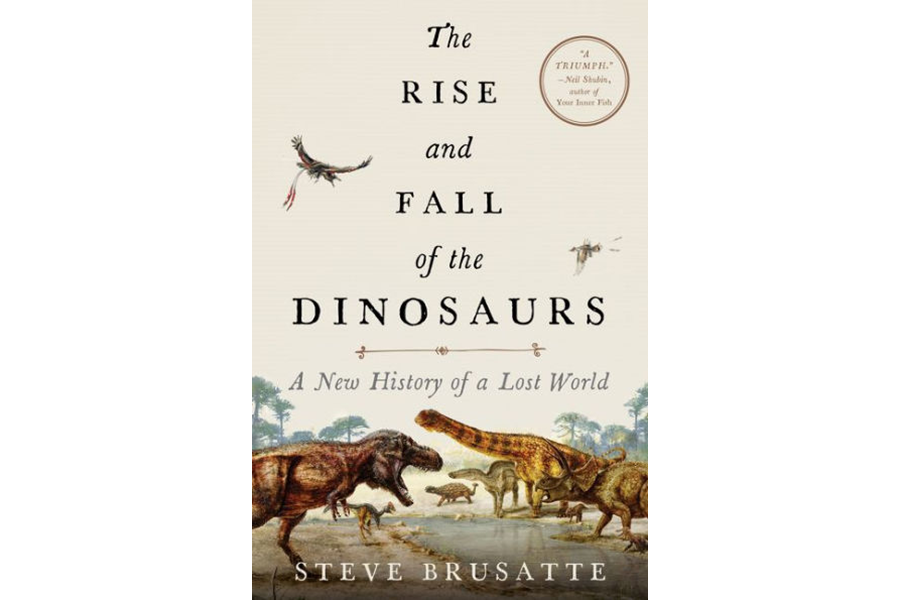
The Rise and Fall of the Dinosaurs: A New History of a Lost World by Steve Brusatte

Published in April of 2018.

I don’t know anything about dinosaurs. Actually, I didn’t know anything about dinosaurs.

After reading Brusatte’s accessible, enthusiastic, but not-dumbed-down primer The Rise and Fall of the Dinosaurs, I feel as if I know quite a lot.

This may be a classic case of the dangers of acquiring a little knowledge. When you don’t know much about a subject, it easy to feel as if you know almost everything there is to know after reading a single book.

So in this review, I will not regale you with stories of how dinosaurs evolved, how they hunted, why they got so large, and how they became extinct. Although I could. Nor will I explain in great detail how birds evolved from dinosaurs.  How birds are dinosaurs! Although you would be impressed with my arguments.

The Rise and Fall of the Dinosaurs may be the best book on dinosaurs ever written for a popular audience. I have no idea, as this is the only book on dinosaurs that I’ve ever read.  Unless you count reading Michael Crichton’s Jurassic Park when I was a junior in college (history major).

(click the image)

What I’m sure of is that The Rise and Fall of the Dinosaurs is one of the most enthusiastic books ever written on the joys of grad school, and the pleasures of being an academic.

After reading this book I wanted to either:  A) Get a PhD in paleontology, or B) Hang out with a paleontologist.

Brusatte (Columbia PhD, 2012) makes the life of an academic seem less like a job, and more like an incredible adventure of exotic travel combined with world-changing discoveries. Paleontologist’s get to tromp around the globe digging up bones and unearthing fossils, all while debating the history of evolution over beers and spicy food with the world’s coolest academics.

So much of academia nowadays is doom and gloom. On the day I wrote this review, Bryan Alexander came out with a new piece - which is really difficult to argue with by the way - on how American higher ed is overbuilt.  

I have no idea if the job market for paleontologists is better than that of other PhDs. If paleontology grad students make it through their PhDs faster than everyone else. If the discipline of paleontology is as vibrant and exciting as Brusatte, a professor at the University of Edinburgh, makes it seem.

I do know that this is a book with zero hand-wringing about academia. This is a book that details the pure joy of discovering an academic discipline, and then spending one’s life within a community of scholars engaged in an ongoing series of rich intellectual debates.

We need more book-length defenses of the wonders of academic disciplines, and the pleasures of academic life.

The Rise and Fall of the Dinosaurs is a great book to read if you just might be interested in dinosaurs. I imagine that if this book was passed out to every incoming first year student that we may see a surge in major switching.

What are your favorite popular science books written by professors?

What are you reading?

Source: www.insidehighered.com

Fake or Real? What Children Think of Dinosaur Fossils and Replicas

Tuesday, July 17, 2018

Photo: Naturalis Biodiversity Centre

Children find that both dinosaur fossils and replicas belong in a museum, but they appreciate the real objects more. This is shown by research from Leiden University and Naturalis Biodiversity Center. 'Children look beyond superficial looks and attach great value to less obvious characteristics, such as the history of an object.'

Real objects
Science museums find it important to show real objects to their audience. Not so strange, when the question 'Is it real?' is one of the most frequently asked questions by museum visitors. But, how do visitors interpret the difference between real and fake? And how do they value real objects? To this end, Master's student Dylan van Gerven and researcher Anne Land-Zandstra of Leiden University together with Welmoet Damsma of Naturalis examined how children think about real dinosaur fossils and about replicas. The results of the research can help museums to bring their objects to life more.

The dinometer
In Naturalis seventy children from eight to twelve years old got to work with the Dinometer: a life-sized abacus on which they indicated how much certain objects belonged in a museum. It involved two real objects and two replicas. The two real objects were a T. rex phalanx and the paw print of a dinosaur. The two replicas of the phalanx looked identical, but one had supposedly belonged to famous TV biologist Freek Vonk. The children assessed the complete objects, but also indicated how much a small piece of the object was still museum worthy.

The results
The test with the Dinometer showed that children appreciated the real fossils more than the replicas, although they found that both objects belonged in a museum. However, even a very small piece of a real fossil, according to them, was worth more than the replicas. A small piece of replica, on the other hand, was ‘just a fake piece of a replicated dinosaur fossil’ and did not belong in a museum. The replica of Freek Vonk did score higher than the 'normal' replica.

Dinosaur contagion
When children reason why an object belongs in a museum, they do not only look at the appearance. They also value the association with the past that the object brings about. A dinosaur fossil, for example, is associated with the large T. rex. In addition, they have the feeling that 'something' of the dinosaur still sticks to the object. ‘So, a dinosaur once stood in this clay. You do not see that every day!’ one of the children said. This argument is called contagion and seems to underlie the appreciation of real objects in museums.

So, because the phalanx once was part of a real dinosaur and because a dinosaur once stood in the clay, the objects still have a connection with it and thus belong in the museum. 'We found it special to see that these children are thinking about the story of such a fossil, that it really belonged to a dinosaur,' adds Land-Zandstra.

Bringing objects to life
Science museums can make use of these outcomes by thinking carefully about which associations and stories are hidden behind an object. They can then show them explicitly. 'Children are also very capable of appreciating that deeper layer of an object. A nice example of different layers of authenticity can be seen at Naturalis' own T. rex Trix. This object includes the story of the dinosaur itself, the adventure of the excavation and the exciting work of paleontological research into the life of Trix,’ according to Land-Zandstra.

Photo: Naturalis Biodiversity Centre

Research collaboration
Land-Zandstra explains that this study is the beginning of a research collaboration between Naturalis and the Science Communication and Society department at Leiden University. The goal is to do more research on how visitors deal with real objects. 'For example, we have already investigated how families talk about objects, such as a dinosaur egg or a stuffed spider. It is nice to see that the results of this research find their way directly in the museum in the form of family activities or text signs.'

Source
Gerven van, D.; Land-Zandstra, A. & Damsma, W., 2018. Authenticity matters: Children look beyond appearances in their appreciation of museum objects. International Journal of Science Education, Part B, DOI: 10.1080/21548455.2018.1497218

Contagion
'Contagion means that previous contact with of the object, for example with a living dinosaur, continues to act on the object after the physical contact has been severed', explains van Gerven. He illustrates this with a striking example: "Suppose there are two glasses, one of them containing a cockroach. I thoroughly clean both glasses so that they are both 100% clean and then fill them with water. Then you will see that every person prefers to drink from the glass that did not had a cockroach in it, even though both glasses are just as clean.'

Source: www.universiteitleiden.nl

A-Nother-Level: Pupil Creates Life-Size Dinosaur From Scrap Metal

Tuesday, July 17, 2018

A FOSSIL-MAD teenager has stunned his teachers by creating a life-size dinosaur from scrap metal for an A-level project.  William Wisson-Burton, 17, spent eight months creating the 27-foot-long, 15ft high allosaurus in his dad’s workshop.  The giant model has taken 400 hours of work and was made using cast off metal and pieces of chain.

A FOSSIL-MAD teenager has stunned his teachers by creating a life-size dinosaur from scrap metal for an A-level project.

William Wisson-Burton, 17, spent eight months creating the 27-foot-long, 15ft high Allosaurus in his dad’s workshop.

The giant model has taken 400 hours of work and was made using cast off metal and pieces of chain.

Offcuts: William made the dinosaur from bits of scrap metal

Jaw-dropping: William works on the allosaurus’s head

The finished model is now proudly standing outside the teenager’s home and will be submitted as part of his A-level in paleontology — the study of fossils.

William from Godmanchester, Cambridgeshire, said: ‘When I was given the extended project task in October, the only thing I had to think about was how big the structure was going to be.

‘I also thought it was a good idea to tie it in with Jurassic World: Fallen Kingdom, which came out in the cinemas last month.’

Links to the past: William was given the huge chain that makes up the dinosaur’s neck, spine and tail

The year 12 student, who has his eyes on paleontology courses at either Portsmouth and Birmingham University, was donated the large chain for the dinosaur’s spine by a company in Wisbech.

He also received expert guidance on putting together the huge metal skeleton from workers at his father’s civil engineering company in Godmanchester.

He said: ‘One of the engineers was happy to teach me the basic skills that go into making a sculpture like this.’

Pupil’s pet: William with his completed allosaurus

The size of William’s construction is practically the same as the allosaurus would have looked 150 million years ago, which averaged around 28 feet in length but could reach as much as 39 feet.

William said he chose to create an allosaurus rather than a T. rex because the latter’s 42ft length wouldn’t quite fit in his workshop.

The dinosaur fanatic will show off his hard work at a market place event at Hills Road Sixth Form College tomorrow.

Bone idol: William wants to pursue a career in paleontology PICTURES: SWNS

He said: ‘When it goes on display tomorrow, it will be the first time any of my friends have seen it — they’ve only seen photos so far.

‘It has got a big fan base, though.’

The Allosaurus was a top predator and featured in the film Jurassic World: Fallen Kingdom.

Source: www.metro.news

Is One of the Original Jurassic Park Cast Members About to Return?

Saturday, July 14, 2018

©  UNIVERSAL PICTURES

After Jeff Goldblum made his return to the Jurassic Park franchise in Jurassic World: Fallen Kingdom, we've been anticipating which other original cast members could make a comeback.

And luckily, the person we'd most like to see return seems open to the possibility.

Speaking to Deadline, Laura Dern, who played Dr Ellie Sattler in the original 1993 film, didn't rule out making an appearance in the next Jurassic World movie, instead teasing: "I think you have to ask the filmmakers."

But Dern did go on to explain why it would make sense to see Dr Sattler again.

"It's a good time for powerful, feminist characters to be honoured," Dern said. "I loved Ellie. I feel the proudest that a feminist, sassy, take-no-prisoners energy, who was integral to the storyline in saving the day, was honoured.

"I've had so many kids – boys and girls – for a couple decades now, come up to me saying, 'I became a palaeontologist because of you'. And I love that it's boys and girls."

©  REX SHUTTERSTOCK MOVIESTORE COLLECTION

And Dern is particularly fond of the character, who also made a cameo in 1997's The Lost World: Jurassic Park – plus, she loves dinosaurs.

"You realise, that's when you feel really lucky to be part of something iconic, that it can shape a path for a person," Dern added.

"That's really moving. I love her, and I love dinosaurs, and there is something extraordinary about getting to live out something that we all carry from childhood."

Source: www.digitalspy.com

Dinosaurs More Calorie-Conscious Than Humans!

Monday, July 16, 2018

Vegetables consumed by herbivore dinosaurs 150 million years ago had a higher nutritional value than the ones human beings consume in the polluted environment of the 21st century.

In a recent study, researchers have measured the nutritional value of herbivore dinosaurs' diet by growing their food in atmospheric conditions similar to that many years ago.


Previously, researchers believed that plants grown in an atmosphere with high carbon dioxide levels had low nutritional value.

But a new experimental approach led by Fiona Gill at the University of Leeds has shown that this is not necessarily true.

The team grew dinosaur food plants, such as horsetail and ginkgo, under high levels of carbon dioxide mimicking atmospheric conditions similar to when sauropod dinosaurs, the largest animals ever to roam Earth at that point of time.

An artificial fermentation system was used to simulate digestion of the plant leaves in the sauropods' stomachs, allowing the researchers to determine the leaves' nutritional value.

The findings showed that many of the plants had significantly higher energy and nutrient levels than previously believed.

This suggests that the megaherbivores would have needed to eat much less per day and the ecosystem could potentially have supported a significantly higher dinosaur population density, as much as 20 percent greater than previously estimated.

"The climate was very different in the Mesozoic era - when the huge brachiosaurus and diplodocus lived - with possibly much higher carbon dioxide levels. There has been the assumption that as plants grow faster and/or bigger under higher CO2 levels, their nutritional value decreases. Our results show this isn't the case for all plant species," Gill said.

"The large body size of sauropods at that time would suggest they needed huge quantities of energy to sustain them. When the available food source has higher nutrient and energy levels it means less food needs to be consumed to provide sufficient energy, which in turn can affect population size and density," he added.

The research didn't give the whole picture of dinosaur diet or cover the breadth of the plants that existed at this time, but a clearer understanding of how the dinosaurs ate helped scientists understand how they actually survived.

"The exciting thing about our approach to growing plants in prehistoric atmospheric conditions is that it can be used to simulate other ecosystems and diets of other ancient megaherbivores, such as Miocene mammals - the ancestors of many modern mammals," he further said.

The study appears in the Paleontology journal.

Source: www.business-standard.com

Hong Kong Dinosaur Hunters Make Amazing Discoveries in Mongolia While Retracing Steps of Famous 1920s Explorer

Sunday, July 15, 2018

Dr Scott Nowicki (left) with his drone equipment. Picture: courtesy of Fisher Creative / The Explorers Club Hong Kong Chapter

Almost a century after Roy Chapman Andrews led an expedition across the Gobi Desert and uncovered the first nest of dinosaur eggs ever found, Explorers Club Hong Kong employs NASA technologies to see what is left to discover.

I scrutinise the small pebbles, mud and shards of fossilised bone strewn over the desert floor in Bugiin Tsav, in southern Mongolia. A few metres higher up the cliff site, Chinzorig Tsogtbaatar is doing the same.

Dressed in sturdy boots and khakis, Chinzo, for short, is a PhD fellow at the Institute of Palaeontology and Geology at the Mongolian Academy of Sciences, in the capital Ulan Bator. He is examining the windswept slopes for traces of ancient fauna. We are part of an inter­national team searching for dinosaur fossils in the Gobi Desert.

I glimpse a flash of white next to a large boulder. Instinctively, I know it’s not a stone and scratch away at the encasing mud with my fingers. I shout over to Chinzo, who joins me in excitement. Other colleagues are quickly at hand and together we carefully remove more of the mud and sand.

“It is probably the skull top of a Tarbosaurus,” Chinzo says. Seeing my blank expression, he adds, “Tarbosaurus is the cousin of the North American Tyrannosaurus rex. These were the most intimidating predators that have ever lived.”

Ever since the first fossils were found and catalogued in the early 19th century, dinosaurs have enriched the fantasies of children – and not a few adults. One of those fascinated youngsters was American Roy Chapman Andrews. Born in 1884 and driven to explore from a young age, he would become a scientist, an adventurer and a daredevil; the role model for George Lucas’ legendary character Indiana Jones, some say.

In the early 1920s, following a number of successful expedi­tions across China, he convinced several wealthy American businessmen, among them John D. Rockefeller and J.P. Morgan, to back a series of expeditions into the Mongolian Gobi. The main aim of what would later be known as the Central Asiatic Expeditions was to find evidence to support the theory that the cradle of mankind was in central Asia, rather than East Africa.

After lengthy preparations in the midst of the communist assumption of power in the new Mongolian People’s Republic and rumblings of civil war in China, Andrews set off into the Gobi with a unique team. He had recruited specialists in a variety of fields and led a convoy of Dodge motor cars with 25-horsepower engines into the desert. He intended to use the latest technology to maximise his chances of making significant scientific discoveries.

A few months into the 1922 expedition, the first in the series, the convoy became lost in the desert and began to run short on supplies. While Andrews was asking local herds­men for directions, one of his team strolled away from their car and realised that they had stumbled upon a treasure trove of fossils, a spot they named the Flaming Cliffs, a reference to the red sandstone of the area.

As well as finding a range of as yet unknown dinosaur species, the team made a sensational discovery: the first nest of dinosaur eggs ever found. Four further expeditions fol­lowed, the last in 1939, during which countless more dinosaur and mammal fossils were discovered, putting Andrews on the cover of Time magazine and in 1934 helping him become director of the American Museum of Natural History.

American explorer Roy Chapman Andrews’ expedition in the Gobi in the late 1920s. Picture: Alamy

And it was there that this story began.

[I knew] we would need to inno­vate in order to set a new standard for palaeontological pros­pecting. This is how the use of Nasa imaging and mapping tools, previously only used to better understand the geology of Mars, became a central feature of the expedition

- Michael Barth, founder and chairman, Explorers Club Hong Kong

“Playing in the American Museum of Natural History as a kid, the dinosaur exhibit was my favourite,” says Michael Barth, founder and chairman of the Hong Kong chapter of the Explorers Club, and the organiser of the Roy Chapman Andrews Centennial Expedition. “The larger-than-life stories of Roy Chapman Andrews were just as big a part of the exhibit as all of those amazing fossils. Knowing that the centennial anniversary of Andrews’ original explorations in the Gobi Desert was coming up, I wanted our chapter to be the first to honour his memory and accomplishments in a more meaningful way than simply staging a recreation of his original expeditions.”

Together with Matt Prior, a fellow director at the Explorers Club Hong Kong, Barth put together a 35-strong team of palaeontologists, geologists, archaeologists and other scientists, with the aim of revisiting some of the original exploration sites and using modern technology in a new phase of exploration.

“We knew that - as on Andrews’ original expedi­tions, in which he innovated in a number of ways, including being the first to trade camels for cars to cover more ground - we too would need to inno­vate in order to set a new standard for palaeontological pros­pecting,” says Barth, who is lucky enough to stumble upon a dinosaur egg himself during our time in Mongolia. “This is how the use of Nasa imaging and mapping tools, previously only used to better understand the geology of Mars, became a central feature of the expedition.”

Nearby, Dr Scott Nowicki is finishing his checks on a small drone equipped with a thermal camera. Nowicki is lead R&D scientist at Quantum Spatial, a United States company focus­ing on sensor technology, and his gadgetry has been used on recent missions to the Red Planet.

“We are looking for sandstones and mudstones and shales that were deposited during the Cretaceous era, using technology that allows us to map the presence of different compositional layers and different physical materials that are indicative of the presence of fossils,” Nowicki explains, as his drone lifts into the cloudless Gobi sky.

The thermal and multispectral cameras on the drones allow for the collection of data across a wide area. This is then compared with satellite data and correlated with observations made on the surface.

“The three-dimensional maps we create, down to the centimetre level, will aid in the exploration of the Gobi for years to come,” says Nowicki, who, with his cowboy hat and bent over his laptop in full concentration, looks like a 21st-century Indiana.

“Take your time, look carefully and when you find something interesting, take a photo and mark it on the GPS” is the introduction to dinosaur hunting that I receive from “The Doctor”.

Professor Khishigjav Tsogtbaatar, director of the Institute of Palaeontology and Geology, is one of the most respected dinosaur experts on the planet. Over the past 30 years, he has participated in numerous expeditions to unearth the secrets of the past and he is the lead scientist on this expedition.

The sandstone formations around us are about 70 million years old, dating back to a period often referred to as the Maastrichtian or late Cretaceous. That was when dinosaurs were at their most prolific, shortly before a meteor is believed to have brought an abrupt end to their existence.

“This used to be a washout, probably a river, which was a source of water,” says Tsogtbaatar. “Most of what we find here are animals that got surprised when drinking.”

It is difficult to imagine, in this now lifeless desert, the scenes of the past: hundreds of animals of various sizes – large carnivorous beasts, smaller plant eaters and tiny mammals – feasting beside a modest river, the scene suddenly shattered by a mudslide.

Evidence of the disaster millions of years ago is easy to find. I literally trip over what look like strange pieces of rock that must have only recently been exposed by wind. Their colour seems wrong, as do the small, sharp protrusions on two of the sides. They are vertebrae, most likely those of a small theropod – a meat-eating dinosaur of the same family as the Tarbosaurus. Disappointingly, they are too eroded to be of any scientific use.

The Doctor has had more luck, however, and with a small brush he is carefully revealing a piece of fossil buried in the mud.

“I think it's the rib of a Tarbosaurus,” he says. “It looks very well preserved.”

Chinzorig Tsogtbaatar and other team members use papier-mâché to protect fossils. Picture: courtesy of Mike Sakas / The Explorers Club Hong Kong Chapter

Once an interesting fossil has been discovered and its GPS coordinates marked, the palaeontologists must decide whether to take it away or, this being a prospecting expedi­tion, to leave it for further examination at a later date. If they decide to take a fossil but it proves too delicate to pick up, a process called jacketing will be used, whereby the fossil will be coated and covered in papier-mâché and then transported, with the surrounding soil, to a laboratory at the Institute of Palaeontology and Geology.

Ideally, though, fossils of interest will be covered and excavated slowly, over a period of days and weeks, during an expedition planned for later in the year.

“We need to cover it well, as poaching is a big problem,” Tsogtbaatar says. “Recently, the Mongolian government has increased the penalties for fossil smuggling, but there is still too little being done.”

It is not just drones and GPS systems that have revo­lution­ised palaeontology in recent years. In his book The Rise and Fall of the Dinosaurs (2018), American palaeontologist Steve Brusatte explains that we live in a golden age of dinosaur exploration. A new generation of scientists has collected fossils at an unprecedented rate. Somewhere in the world, one new species of dinosaur is being found, on average, every week.

New ways of studying fossils have helped palaeontologists understand the biology and evolution of dinosaurs in previously unimaginable ways. CAT scans are being used to look deep into skull and bone, and we now know, for instance, that the T. rexwas probably not such a stupid brute after all.

Computer modelling gives new insights into how dino­saurs moved and high-powered microscopes can reveal their pigmentation. Recent analysis of fossils in China has shown that many theropods (a dinosaur suborder characterised by hollow bones and three-toed limbs) had feathers, hinting at ancestry shared with birds.

Even with the benefits of modern technology, though, time spent in the Gobi can be unpleasant. Midday temper­atures close to 50 degrees Celsius bring prospecting activities to a temporary standstill.

The logistical challenges of this expedition are immense. It will have covered a distance of 1,600km over a period of two weeks (June 5-20), making camp at five potential fossil sites, the third being Bugiin Tsav and the first having been in the Oosh mountain region, in Ömnögovi province.

Whereas Andrews used Dodge cars, today’s team is travelling in seven SUVs, with three trucks in support, all provided by Hong Kong-based Infiniti Motor, an expedi­tion partner.

We explore the Ikh Khongil canyon, in the Nemegt Basin, a place that was beyond the reach of Andrews’ vehicles but has since given up seven full Tarbosaurus skeletons and countless other treasures, including, in 1990, the 20cm-long skull and some other bones that palaeontologists determined had belonged to a two-metre-long lizard that lived about 80 million years ago.

Chinzo discovers the tooth of a Tarbosaurus. Fourteen centimetres long, it gives some indication of how big these creatures were.

The same evening, a hard day of prospecting behind us, we set up camp in Ukhaa Tolgod. The desert is now painted onto the team’s green and khaki shirts, their wearers, after more than 10 days on the hot sands, having taken on a distinct odour. Photos and GPS markers of fossils are logged and saved for future excavations, and plans are made for the following days.

Being an Explorers Club team, everyone has a story to share; tales of climbs in the jungles of Myanmar and the deep valleys of Bhutan allow us to momentarily forget the showers and cold drinks we all long for as we relax in a circle.

“Look at the horizon,” Chinzo suddenly shouts. “Sandstorm!”

A giant wall of sand has suddenly appeared in the distance – and it is racing towards us.

Strong gusts rattle through the camp, the sand making it almost impossible to see. Together with some of the other expedition members, I cling onto the ropes and poles of our dining tent, but the gusts prove too strong. With a big “swoosh”, the pegs are ripped up and, like a giant sail, the tent is taken by the wind.

In the distance, I make out the figure of The Doctor, sitting on a camp chair outside his tent, apparently unperturbed by the storm. As I run over, he offers vodka.

“Mongolian custom – have a drink and the storm will pass quickly,” he says.

Perhaps I take too little, because the storm only rises in intensity. As evening turns into night, the winds keep up their onslaught. There is little left to do but wait out the storm in our tents, as sand is blasted against the canvas walls, which often feel set for take-off.

It rages for more than 13 hours, but we see the storm out. And the following day, we reach the Flaming Cliffs. Almost a century of excavations since Andrews’ discovery have made this particular site ever less attractive to palaeonto­logists, and the advanced imaging technology we are using and our drones fail to uncover many more secrets here.

Despite Andrews’ failure to prove his “Out of Asia” theory, the American did return from his expeditions having made a multitude of discoveries. Almost 100 years later, our team can count itself successful, too.

Discoveries credited to the use of the latest technology include 250 new likely fossil locations, five entirely new areas, three potential new species and hundreds of fossilised bones.

The Roy Chapman Andrews Centennial Expedition finds the hind leg of an ostrich-like dinosaur from 65 million years ago, a turtle intact from 70 million years ago, neck vertebrae of a dinosaur with a long neck and tail from the same period, and the arm of another ostrich-like dinosaur, this one dating back 70 million years.

As a kid who grew up daydreaming of being on expeditions in far-flung, exotic places together with Andrews, and then to share his luck in finding a rare theropod dinosaur egg, it’s mind-blowing, my childhood dream realised

- Michael Barth

For many of the team, though, the lasting reward is the experience of actually finding fossils – of being Indiana Jones for a few days.

“As a kid who grew up daydreaming of being on expeditions in far-flung, exotic places together with Andrews, and then to share his luck in finding a rare theropod dinosaur egg,” says Barth. “It’s mind-blowing, my childhood dream realised.”

Source: www.scmp.com

47Mn-Year-Old Fossils Hint Rajasthan's Deserts Had a Marine Life

Saturday, July 14, 2018

47mn-year-old fossils hint Rajasthan

In the deserts of Rajasthan's Jaisalmer district, paleontologists have stumbled upon nearly 47 million-year-old fossils of primitive whale, shark teeth, crocodilian teeth and turtle bones, which according to experts suggest that the area was under sea in the pre-historic age.

The Geological Survey of India (GSI) has been conducting research on fossils in different parts of Gujarat and Rajasthan for over a year.

Findings: Geologist say most important finding was primitive whale's fragmented jaw

A number of fossils of vertebrates such as whale, shark-teeth and crocodilian-teeth belonging to middle Eocene Epoch were unearthed from Bandah village in Jaisalmer.

The research was carried out by senior-geologists Krishna Kumar and Pragya Pandey under the supervision of Debasish Bhattacharya, the director of Paleontology Division.

Kumar said the most important aspect in this finding is a fragmented-jaw and vertebrae of a primitive-whale.

Faunal record: Faunal record show shallow marine deposition million years ago: Geologists

The presence of the marine fossils of Middle Eocene period indicates that about 47 million years ago, there was a sea in this area, Kumar said.

The senior geologist added that faunal record shows similarity with earlier reported fauna of middle Eocene Harudi formation, Kachhch Basin and Gujarat, thus representing similar shallow marine deposition under tropical-temperate conditions.

Fact: The timeline of the Middle Eocene period

The Eocene Epoch constitutes the middle part of the Paleogene period (65-23 million years ago), preceded by the Paleocene and succeeded by the Oligocene epoch (34-23 million years ago); all of these periods and epochs were part of the Cenozoic Era (65 million years ago).

Source: https://in.news.yahoo.com

Eocene Epoch

Wednesday, July 18, 2018

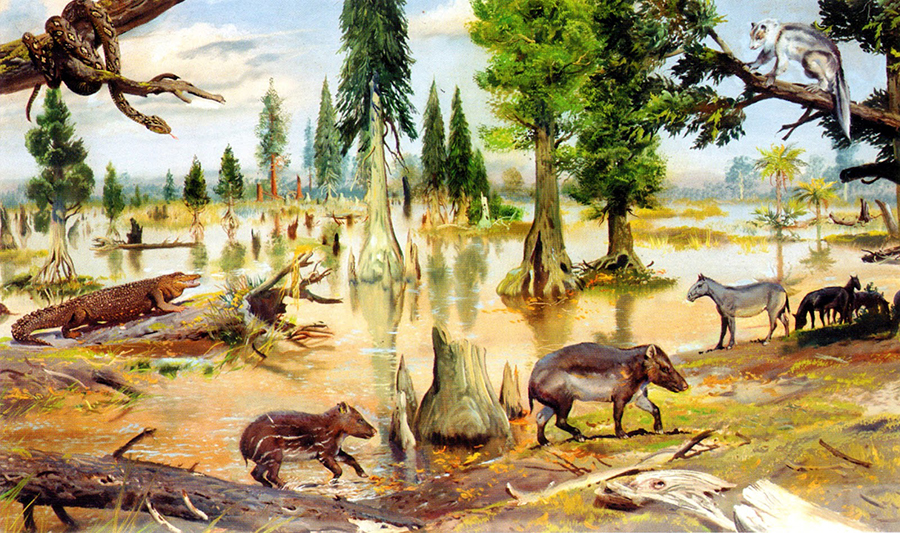
Eocene marsh fauna by Zdenek Burian 1976

Eocene Epoch, second of three major worldwide divisions of the Paleogene Period (66 million to 23 million years ago) that began 56 million years ago and ended 33.9 million years ago. It follows the Paleocene Epoch and precedes the Oligocene Epoch. The Eocene is often divided into Early (56 million to 47.8 million years ago), Middle (47.8 million to 38 million years ago), and Late (38 million to 33.9 million years ago) epochs. The name Eocene is derived from the Greek eos, for “dawn,” referring to the appearance and diversification of many modern groups of organisms, especially mammals and mollusks.

Eocene rocks have a worldwide distribution. The International Commission on Stratigraphy (ICS) has recognized several stages and their temporal equivalents (ages) on the basis of characteristic rocks and fossils; they are, from earliest to latest, the Ypresian, Lutetian, Bartonian, and the Priabonian. Lower Eocene assemblages are poorly represented in both England and the Patagonian region of South America. Later Eocene vertebrate faunas are somewhat better developed in areas outside of North America; however, it is in North America, especially the western United States, that the most abundant and extensive Eocene terrestrial vertebrate record exists. Eocene rocks were deposited in much the same regions as those of the preceding Paleocene Epoch. During the Eocene, climates were warm and humid—temperate and subtropical forests were widespread, whereas grasslands were of limited extent. For example, the Eocene forests of Oregon were made up of trees and plants similar or identical to those now found in Central and South America.

Eocene (50Ma) © Ron Blakey, NAU Geology

During the Eocene, the vertebrates of North America and Europe were very similar; many genera existed in both regions, indicating that an interchange between the regions was possible. Early Eocene faunas mirrored those of the preceding Paleocene with the addition of newer types; however, the archaic Paleocene groups gradually became extinct.

Among terrestrial vertebrates, the start of the Eocene is marked by the appearance of two new groups of animals: the perissodactyls, or odd-toed ungulates, and the artiodactyls, or even-toed ungulates. The perissodactyls include the horses, rhinoceroses, and tapirs; among the artiodactyls are the deer, cattle, and sheep. An early horse ancestor, the dawn horse, known in North America as Eohippus, is among the fossil perissodactyls found in the lower Eocene rocks of both North America and Europe. Artiodactyls, rare during the early Eocene, became abundant later in the epoch.

The world in the Eocene, 50 million years ago

Archaic primate forms from the Paleocene Epoch declined during the Eocene as many of their ecological niches were usurped by the more-efficient rodents. Vertebrate groups arising during the Middle Eocene were not as widespread as those of the early Eocene; the isolation that resulted allowed different evolutionary trends to occur in the ungulate groups of North America and Europe. By late in the Eocene Epoch this isolation had ceased, and North American and European groups once again came into contact with one another.

The Eocene Epoch marks the first appearance in the fossil record of the two completely marine mammal groups, the cetaceans (whales, porpoises, and dolphins) and the sirenians (akin to the modern manatees and dugongs). Similarly, the Eocene provides the first elephant-like animals and the early bats. In addition, gastropods (a class of mollusks containing snails, slugs, and limpets) underwent great diversification, and many bird orders that were in essence modern appeared during the Eocene.

Source: www.britannica.com

Paleogene Period

Wednesday, July 18, 2018

Titanoboa, a Paleogene Period 40-Foot Long Snake

Learn about the time period that took place 65 to 23 million years ago.

AT THE DAWN of the Paleogene—the beginning of the Cenozoic eradinosaurs, pterosaurs, and giant marine reptiles were conspicuously absent from the face of the Earth. Rodent-size (and perhaps larger) mammals emerged, suddenly free to fill the void. Over the next 42 million years, they grew in size, number, and diversity. As the period came to a close, life-forms still common today filled the seas, dominated the land, and had taken to the air.

Paleogene Climate

During the Paleogene the continents drifted farther apart, heading toward their modern positions. Oceans widened the gaps, Europe severed its last ties with North America, and Australia and Antarctica finally parted ways. As the climate significantly cooled and dried, sea levels continued to drop from late Cretaceous levels, draining most interior seaways.

The world in the Paleogene Period

The cooling and drying trend began in earnest following a sudden temperature spike about 55 million years ago. Sea surface temperatures rose between 9 and 14 degrees Fahrenheit (5 and 8 degrees Celsius) over a period of a few thousand years, killing off numerous single-celled marine organisms called foraminifera, along with some other invertebrates. This event also profoundly affected northern forests, previously full of deciduous hardwoods with sequoias and pines. The new, more humid subtropical conditions nurtured abundant palms and guavas. Land mammals responded in kind, radiating and diversifying into many new forms.

As the climate cooled and dried following the warming, forests gave way to open woodlands and grasslands in the northern hemisphere and started to support thundering herds of grazing mammals.

Mammalian diversification

Fish filled in the oceans, food to fuel sharks, which were fast ruling the waters in the absence of the giant mosasaurs and plesiosaurs of the Cretaceous. Squid and other soft-bodied cephalopods replaced their shelled relatives, which once filled the middle rung on the food chain. Sea snails and bivalves that were similar to modern forms lurked on the ocean bottom. New types of foraminifera and sea urchins replaced those that had died off in earlier mass extinctions.

First Whales

But the biggest development in the seas was the appearance of whales in the mid- to late Paleogene. The huge animals evolved from land mammals that took to the seas.

Bones of a Basilosaurus, a genus of early whales that lived in the Eocene, the second epoch of the Paleocene era. The fossil bones are shone here with the ribs in the foreground and the vertebrae behind. PHOTOGRAPH BY RICHARD BARNES

Meanwhile, smaller reptiles that survived the Cretaceous, such as turtles, snakes, crocodiles, and lizards, basked in the tropical warmth along the coasts. Birds, the holdouts of the dinosaur age, diversified and flourished in the skies. But the rapidly evolving mammals stole the show. Starting from a fairly humble position 65 million years ago, primates, horses, bats, pigs, cats, and dogs had all evolved by the close of the period, 23 million years ago.

Source: www.nationalgeographic.com

Pages