nandi's blog

Everything You Thought You Knew About Dinosaur Colours is Wrong

Tuesday, July 24, 2018

An artistic rendering of a Spiclypeus shipporum is pictured here. By Mike Skrepnick

The new science of paleocolour is shining a light into what dinosaurs looked like and how they lived.

Paleoartist Robert Nicholls is modelling the head of a Tyrannosaurus rex. A fossil skull dictated the shape of the head but the colour is, at present, informed guesswork. Should he evoke the sorts of earth tones associated with many modern reptiles and amphibians? Or look to the bright, flamboyant plumages of some modern birds – the only dinosaurs to survive into the twenty-first century? Up until now we have only been able to guess, but soon that may change.

Long thought an impossible dream, the emerging field of palaeocolour is revolutionising our view of the prehistoric world, turning it from black-and-white into glorious technicolour. So far only a handful of dinosaurs, insects and reptiles have been studied but, as Johan Lindgren, a scientist from the University of Lund, says, “We’re only just scratching on the surface.”

Finding evidence of colour in the fossil record will do much more than simply tell us what hue to paint a T. rex. Bones can fossilise. but behaviour does not. “When we look at the animals and plants we see in the world around us we see striking colours and colour patterns,” says Maria McNamara from the University of Cork. “Animals use colour for camouflage, for avoiding predators, for mating signals and also for signalling within their social group. So evidence of colour in animals has the potential to tell us about this very enigmatic aspect of the biology of ancient organisms.”

Despite this, it is only in the decade that palaeocolour has become an area of serious research. Scientists have known for decades that some fossil shells and insects appear to preserve colour but no one had been sure whether that colour was real or some by-product of the fossilisation process. In exceptional circumstances skin and feathers will fossilize – in much less than one per cent of all fossils discovered – but the colour of the fossil (typically black or brown) is not a guide to the colour of the living creature.

In 2006, Jakob Vinther – then a PhD student at Yale, now a lecturer at the University of Bristol – sat down to study the fossilized ink sac of a 200-million-year old squid relative. Since the nineteenth century fossil hunters have known about the preservation of such ink sacs – some even wrote letters using the ink - but for Vinther it proved a eureka moment. “I was looking at this ink and realizing that it’s identical to ink in living squid and so it must be composed of melanin. That’s the same pigment that we have and dinosaurs have.”

Pigments produce colour by the selective absorption of certain wavelengths of visible light. Typical pigments include melanins, carotenoids (bright reds and yellows) and porphyrins (greens, reds and blues). Other colours – known as structural colours -- are produced by light scattering nanostructures. (The brilliant iridescent colours on a peacock’s tale, for example.) Melanin controls, among other things, our hair and eye colour. It is produced and stored in tiny cellular bags called melanosomes, and these come in two forms. A sausage-shaped type produces black shades; a round-shaped variety creates rusty reddish hues.

Combinations of these melanins alongside absence of pigment create grey, brown and white colours. If pigments had been preserved in the ink sacs, Vinther reasoned, then melanin – or the melanin-bearing melanosomes - might also be found in fossilised skin and feathers.

He found his answer in the fossil skull of a small, 55-million-year-old bird from his home country of Denmark, preserved with a dark halo of feather impressions and two stains where the eyes use to be. “I was sat there [looking for evidence of melanosomes] zooming in with the microscope, and suddenly I was like, blimey, they’re there! We can put colours in fossil dinosaurs.”

His supervisor Derek Briggs was sceptical. The structures Vinther described were already well known and classified – as bacteria. “They are the same size and shape as bacteria and they’re found on these rotten carcases where you would expect to find decay bacteria,” explains MacNamara. “It all seemed very plausible.” Seeking further evidence, Vinther and Briggs looked at a fossil feather from the Cretaceous period with distinct black and white colour bands. Where the feather was black there were sausage-shaped melanosomes, where it was white there were no melanosomes (white indicates an absence of pigment). Had the melanosomes been bacteria they should have been seen on both the black and white parts of the feather.

Vinther published his initial findings in 2008, and then race to produce the first coloured dinosaur ensued, using the shape of the melanosomes to deduce hue and pattern. In 2010, two teams at the University of Bristol, one led by Vinther and one by Michael Benton, published within days of each other. They showed, respectively, that the birdlike Anchiornis huxleyi was crowned with a red crest, and the feathered dinosaur Sinosauropteryx prima had a reddish-brown striped tail.

Since then, further studies have built on Vinther’s original hypothesis, including work by Lindgren, who used a technique called time-of-flight secondary ion mass spectrometry (ToF-SIMS) to analyse the chemical composition of various fossils and found direct evidence of the chemical signature of melanin pigments. Elsewhere, McNamara has explored the preservation of non-melanin coloration methods, including the first systematic investigations of the fossil record of structural colour. In 2016 she published the first paper showing evidence of the preservation of carotenoid pigments, reconstructing a 10 million-year-old green-and-brown patterned fossil snake from northeastern Spain.

The are also concerns that the new field is developing too quickly, that claims are being made which, Lindgren suggests, state more than we actually know.

Credit: Guy Shield

One issue, as he sees it, is that a fossil may originally have contained not just melanin but other pigments or structural colours that didn’t survive the fossilisation process. “Then we would just get a false image. So the colour reconstructions don’t necessarily show what the animal actually looked like.” Another issue is that extrapolating the colour of a bird or dinosaur from a single isolated feather – or from the minute samples that are used in the ToF-SIMS technique – could be misleading. Imagine trying to determine the colouration of a modern-day peacock from pigments taken from just a few spots, Mary Schweitzer of North Carolina State University cautioned in a recent PNAS article.

For McNamara, a key point is that melanin itself is not yet properly understood. “We need to learn more about melanin in modern animas before we go near fossils. We really did jump in with two feet.” Melanin provides for much more than just colour – UV protection, for instance, and mechanical strength (the reason some birds have dark wing tips). She is interested in the fact that melanin exists not just in hair and skin but also in internal organs. “We’re going to try and find out what is controlling melanin evolution. We’ve always thought oh its for colour, oh its for sexual selection and camouflage, but if it’s in all these internal organs then maybe it evolved for a completely different purpose.”

Lindgren agrees. “In general there are still so many unknown factors,” he says. “My feeling is that as palaeontologists we have a tendency to oversimplify, to think A must point to B. But if you were to ask a biologist, we know that in the modern world there is never ever a single factor that leads to one thing.”

But for Vinther, the continual arguments about palaeocolour go too far. Every time he publishes a new paper, he wonders what people are going to say, what he will have to respond to. “It’s tiring and stressful. I wish people would spend more time advancing the field rather than holding it back with objections. Let’s move forwards. Let’s try and figure out what the frontiers and the limitations are in a quantifiable way.”

This July scientists in Australia announced the discovery of the world’s oldest colour, which turns out to be a rather fetching shade of bright pink. These porphyrin pigments, derived from microscopic sea-dwelling organisms, date back an astonishing 1.1 billion years, long before the existence of the insects and animals Vinther, McNamara and others are studying.

As our knowledge of ancient colour increases, scientists may be able to chart its progress through deep time, answering questions such as, what is it that drives colour evolution? Is it natural selection – the desire to hide yourself – or sexual selection – the desire to advertise? “Or was there ever a time when competition pressures were less and sexual selection wasn’t happening?” McNamara wonders. “What would colour patterns look like if they weren’t controlled by those factors? Would you just get really crazy patterns? We can’t assume that the world we see today has always been like this.”

And already palaeocolour can bring new insights into the daily lives of long-dead creatures. For instance, it had long been presumed that the small, four-winged Microraptor was nocturnal, based on the large size of its eye sockets. Then Vinther, Quanguo Li from the Beijing Museum of Natural History, and colleagues, discovered that the dinosaur possessed iridescent plumage (an example of structural colour) – something that would make no sense if this dinosaur were active only at night.

It can also tell us about the environment an animal lived in. Typically scientists gather clues by looking at other fossil animals and plants found nearby -- but this technique falls down if the animal’s body has been transported – by, for example, a river – away from the place where it had lived.

Vinther studied the fossil of a small, plant-eating dinosaur called Psittacosaurus, a relative of Triceratops, and concluded that it had a dark back and pale belly – a colour arrangement known as counter-shading. Common among modern animals ranging from whales to deer, both predators and prey use it to blend in with their surroundings. (Parts normally in shadow are light; parts normally exposed to the sky are dark.) The amount and distribution of the light and dark areas typically corresponds to different habitats e.g. open plains or dark forest floor. The counter-shading on the Psittacosaurus suggests that it lived in a habitat with diffuse light, such as a canopy forest.

In his workshop Nicholls shows me the model of the Psittacosaurus that he developed with Vinther. About the size of a Labrador, this rather cute looking creature has a distinctive parrot-billed beak and a dark brown and orange mottled back that becomes progressively paler, down to a creamy underbelly. “What I really like about this colour reconstruction work is that you’re the one defining what an animal looks like, down to the colour pattern, for the first time,” Nicholls says. “Being able to show people something that no one has ever seen before. That is the best.”

Source: www.wired.co.uk

Trending Science: Can a New Giant Dinosaur Finding Change Evolutionary History Books?

Friday, July 20, 2018

There’s more than one way to supersize a dinosaur. Scientists studying the ancient bones of sauropod relatives have found that they grew to multiton masses 30 million years before the appearance of their cousins, the titanosaurs. (Jorge A. González)

The fossil of the earliest-known giant dinosaur has been unearthed in Argentina. The discovery comes as somewhat of a surprise for the scientific community, given their belief that the biggest animals to have walked the Earth didn’t arrive so early in dinosaur evolution.

Move over Tyrannosaurus rex and Brontosaurus, there’s a new giant that just plodded onto the dinosaur scene. The impressive specimen, named Ingentia prima (the first giant) by the scientists who claim the discovery, lived between 210 and 205 million years ago in present-day Argentina, according to a study published in the journal ‘Nature Ecology & Evolution’.

The rise of the giants

Ingentia prima was a four-legged plant eater with a medium-length neck and elongated tail that probably measured about 10 metres long and weighed up to 10 tonnes. It belongs to a group of dinosaurs known as sauropods, which includes some of the largest land animals ever known to have existed. Scientists consider Ingentia prima the largest dinosaur and the biggest land animal of any kind up to that point in time. It was at least twice as large as the other plant eaters that shared its habitat.

Until now, it wasn’t apparent how dinosaurs grew to such massive proportions. Scientists believed that giant body sizes in dinosaurs weighing over 10 tonnes first appeared around 180 million years ago during the Jurassic period. Ingentia prima proves that this wasn’t the case, with gigantism apparently evolving during the Triassic period around 30 million years earlier than previously thought.

“We see in Ingentia prima the origin of gigantism, the first steps so that, more than 100 million years later, sauropods of up to 70 tonnes could come into existence like those that lived in Patagonia,” palaeontologist and study lead author Dr Cecilia Apaldetti of the National University of San Juan in Argentina told ‘Reuters’. She was part of the team that found the dinosaur.

Several of the dinosaur’s traits led the scientists to make the gigantism link. It possessed a bird-like respiratory system, connected to the development of air sacs inside the body that gave it large reserves of oxygenated air and kept it cool regardless of its large size.

How did it grow so big so quickly?

Later giant dinosaurs grew in a fast yet continuous manner. By examining Ingentia prima’s bones, the team reveals that it grew in quick spurts instead of continuously, but at an even higher rate. “We could observe in the bones [from the growth rings] that they had markedly high-growth periods,” said Dr Apaldetti in a ‘BBC’ interview.

“It is a new way to get body size in an early moment in evolutionary history,” she added. “This strategy was not used again in the history of dinosaurs.”

Ingentia prima is changing our understanding of how dinosaurs became giants and shedding new light on their evolution. But that’s not the only exciting news. The study suggests that there may be even bigger and stranger dinosaurs out there that remain to be discovered.

Source: Based on media reports / https://cordis.europa.eu

JURASSIC WORLD EVOLUTION Sells Over One Million Copies

Sunday, July 22, 2018

Jurassic World Evolution

British developer Frontier have announced that Jurassic World Evolution has sold over one million copies across all platforms since its release last month. This figure includes sales of both physical and digital copies.

Speaking to GamesIndustry.biz, Frontier CEO David Braben was quoted as saying the following:

“We are really pleased with Jurassic World Evolution and are delighted to have crossed the 1 million unit threshold so quickly…There is no doubt that initial sales have benefited from the worldwide awareness created by the film release, but it’s the quality of the game that’s really important and I believe our team have done a terrific job in creating a game that a wide range of players are now enjoying around the world”.

Seeing as Jurassic World: Fallen Kingdom has currently grossed over $1.1 billion dollars in theaters, it doesn’t come as much of a surprise that its video game tie-in would also be a huge hit. And although it’s only been available for less than two months, Steam have also added Jurassic World Evolution to their Platinum list of bestselling games of 2018, alongside PlayerUnknown’s BattlegroundsFar Cry 5Kingdom Come: Deliverance, and of course, Grand Theft Auto V.

Jurassic World Evolution was made on a production budget of £8 million (around $10.51 million when converted to US dollars), and although this does not include marketing costs, it’s still a somewhat modest amount when you consider the insane sums of money it usually costs to develop a major release video game these days. Universal, who own the Jurassic Park franchise, worked closely with Frontier throughout the development process to ensure that they would give fans the most authentic experience possible, and the actors Jeff Goldblum, Bryce Dallas Howard, and B. D. Wong, also reprized their roles from the film series in the game.

If you still haven’t played Jurassic World Evolution and you’d like to get a taste of what it’s like to run a theme park filled with dinosaurs, click the icons below to make all your dreams come true.

Jurassic World Evolution - PlayStation 4 Edition         Jurassic World Evolution - Xbox One Edition         Jurassic World Evolution - Steam

Source: www.dreadcentral.com

Skeleton and Scares: 120 Dinosaur Models, 70 Species and Pure Joy in Portugal's Dino Park

Friday, July 20, 2018

Skeleton and Scares: 120 dinosaur models, 70 species and pure joy in Portugal's dino park

Grandeur, exciting times, and complete astonishment are an understatement when standing nose-to-nose with one of the deadliest creatures the world has ever known – a full scale Tyrannosaurus rex!

But the T. rex is just one of the highlights on display at Portugal’s ‘dinosaur capital’ – a new theme park in of the most fossil-rich areas in Europe.

"We have 120 large-scale reproductions of 70 different species, spread over 10 hectares," Simao Mateus, Dino Park's scientific director told AFP. 

The park recently witnessed its inauguration and sits in a part of Portugal’s long famous palaeontologists, just for its fossil-rich character.

Just beside the park is the town of Lourinha, which has been dinosaur-mad ever since the remains of dozens of prehistoric creatures were discovered in the late 19th century.

"Lourinha is quite particular about its dinosaurs, so we should all enjoy" the new facility, Mateus said. 

Visitors to the park are welcomes by a giant model Supersaurus – one of the largest dinosaur genera.

Specially imported from Germany, the statues are dotted throughout the route guiding the budding palaeontologists through the era when dinosaurs used to dominate the Earth.

Imported from Germany, the resin statues are dotted throughout a forest route guiding budding palaeontologists through the eons when dinosaurs stalked the Earth.

But the pride of the area are two models of dinosaurs just because of the fact that they got discovered there.

Lourinhasaurus – gigantic four-legged herbivore similar to Brachiosaurus or Diplodocus -- that roamed the rainforests of western Laurasia around 150 million years ago. 

In the last six months since its opening, the numbers are impressive, with 1,75,000 visitors already visited the unique park despite a prolonged period of poor weather.

The experience offers children and adults to take a glance of a long-lost part of planet’s amazing past.

For park employee Filipa Pedro, who has been handing out stone blocks, hammers, chisels and other tools to this next generation of geologists, the experience offers children a glance of a long-lost part of the planet's past.

"Children love dinosaurs, they are like these mysterious creatures that come from their dreams," Park employee Filipa Pedro said to AFP. 

"Thanks to lots of cartoons and films on the subject, their knowledge is impressive. So this park is bound to please them."

Source: www.newsnation.in

Central Museum of Mongolian Dinosaurs

Sunday, July 22, 2018

The Gobi Desert on the Mongolia-China border is a beautifully desolate area, but millions of years ago, when dinosaurs roamed, it teemed with life. That combination makes it a world-class source of fossils. It’s the type of place where you can find protoceratops skulls, dinosaur eggs, and a full skeleton of Tarbosaurus bataar, all of which are on display at this museum in Ulaanbaatar. 

While the museum itself is a bit shabby and rarely appears on Ulaanbaatar itineraries, it holds some real paleontological gems within its walls. Its openly mounted skeletons of original fossils rather than cast copies are a rare sight to behold.

The first sight past the ticket booth is a showstopper: the dramatically lit Tarbosaurus bataar skeleton, which closely resembles a Tyrannosaurus rex, the famed North American predator. Another room (of three) contains a full skeleton of an Oviraptor, which stood at a height equivalent to a human’s chest.

The museum, constructed in 1974. A portion was renovated and opened in 2016 and the authorities dream of expanding it into a world-class institution of palaeontology and education.

Perhaps even more incredible than its collection is the museum’s origin story. While Mongolia is a treasure trove of dinosaur fossils, the country’s riches have long been smuggled beyond its borders. This was the case for the museum’s entire collection, until foreign courts mandated their return. The judgment of an American court to hand over the Tarbosaurus bataar skeleton in a case launched by Mongolia’s president prompted the museum’s founding. Another case made headlines when Nicolas Cage returned a Tarbosaurus bataar skull he had bought years earlier (the American actor was not accused of wrongdoing).

These successes have spurred more repatriation efforts and investments. So while it may be some time until live stegosauruses wander an amusement park, a shiny future for Mongolian paleontology appears within reach. 

“Walking dinosaur”, the only permanent exhibition of the museum, opened to the public in 27th March 2015.

Know Before You Go

Displays in Mongolian and English explain each specimen and offer informational tidbits, such as why it's entirely reasonable to ask if dinosaurs had feathers. A local, English-speaking guide is usually on hand as well. The museum is open everyday from 10 to 7 (summer) or 9 to 6 (winter), even during holidays such as Naadam.

Look for a giant depiction of a dinosaur erupting from the building's facade. That is the side entrance—walk clockwise to the front door. 

Source: www.atlasobscura.com

99-Million-Year-Old Snake Hatchling Found Encased in Burmese Amber

Friday, July 20, 2018

Xiaophis myanmarensis lived in a forest environment in what is now Myanmar. Image credit: Cheung Chung Tat.

The fossilized remains of an embryonic-to-hatchling snake have been found preserved in Cretaceous amber from Myanmar (also known as Burma).

The newly-reported specimen was obtained from an amber deposit in the Angbamo area in Myanmar’s Kachin province.

The fossil is a 1.6-inch (4.75 cm) long postcranial skeleton made up of 97 vertebrae; the snake’s head is missing. It dates from the Late Cretaceous period, approximately 99 million years ago.

“This snake, named Xiaophis myanmarensis, is linked to ancient snakes from Argentina, Africa, India and Australia,” said University of Alberta’s Professor Michael Caldwell.

“It is an important — and until now, missing — component of understanding snake evolution from southern continents, that is Gondwana, in the mid-Mesozoic.”

Photograph of the piece of amber containing Xiaophis myanmarensis and 3D reconstruction of its skeleton. Image credit: Ming Bai, Chinese Academy of Sciences.

“At 99 million years old, it dates back to the age of the dinosaurs, well before snakes started to differentiate into modern groups,” added Dr. Alessandro Palci, from Flinders University and the South Australian Museum, Australia.

“This Asian fossil helps shed light on how primitive snakes dispersed from the southern to the northern continents.”

“Although found in the northern hemisphere, it strongly resembles South American snakes that lived at the time.”

The amber fragment in which Xiaophis myanmarensis was found also provided important clues about its environment.

“It is clear that this little snake was living in a forested environment with numerous insects and plants, as these are preserved in the clast,” Professor Caldwell said.

“Not only do we have the first baby snake, we also have the first definitive evidence of a fossil snake living in a forest.”

Xing et al studied a second specimen with what appears to be a fragment of shed skin from a larger snake. The degree of preservation allowed the team to model the pigmentation pattern of the snake in life. Image credit: Ryan McKellar, Royal Saskatchewan Museum.

About 150 million years ago (Late Jurassic epoch), Myanmar was joined to Australia, Antarctica, Africa and South America, forming the supercontinent Gondwana.

Through continental drift, Myanmar eventually separated from Gondwana and drifted north, until it collided with Asia.

Xiaophis myanmarensis was part of the fauna that rode on this drifting landmass, which like a gigantic passenger ship transported all sorts of Gondwanan plants and animals to Asia,” said Professor Michael Lee, also from Flinders University and the South Australian Museum.

“In fact, even though this snake was found in the northern hemisphere it resembles Gondwanan snakes.”

Light photographs of probable snake shed skin: (A) overall view of the complete specimen; scale bar – 5 mm; (B) close-up of the left portion of the specimen showing converging scale rows (center top); scale bar – 1 mm; (C) close-up of the right mid-region of the specimen; scale bar – 1 mm. Image credit: Xing et al, doi: 10.1126/sciadv.aat5042.

Along with Xiaophis myanmarensis, the team found and studied a second piece of amber with what appears to be a fragment of shed skin from a much larger snake.

“The scales of the snake are diamond-shaped or ovoid diamond-shaped, with deep lines formed by skin between each scale. Some rows converge as observed ventrally in extant snakes,” the scientists said.

“No enlarged ventral scales can be observed. Light and dark areas distributed across the shed skin reveal color patterning.”

The degree of preservation allowed the researchers to model the pigmentation pattern of the animal in life.

The research is published in the journal Science Advances.

_____

Lida Xing et al. 2018. A mid-Cretaceous embryonic-to-neonate snake in amber from Myanmar. Science Advances 4 (7): eaat5042; doi: 10.1126/sciadv.aat5042

Source: www.sci-news.com

Akainacephalus johnsoni: New Armored Dinosaur Species Discovered

Saturday, July 21, 2018

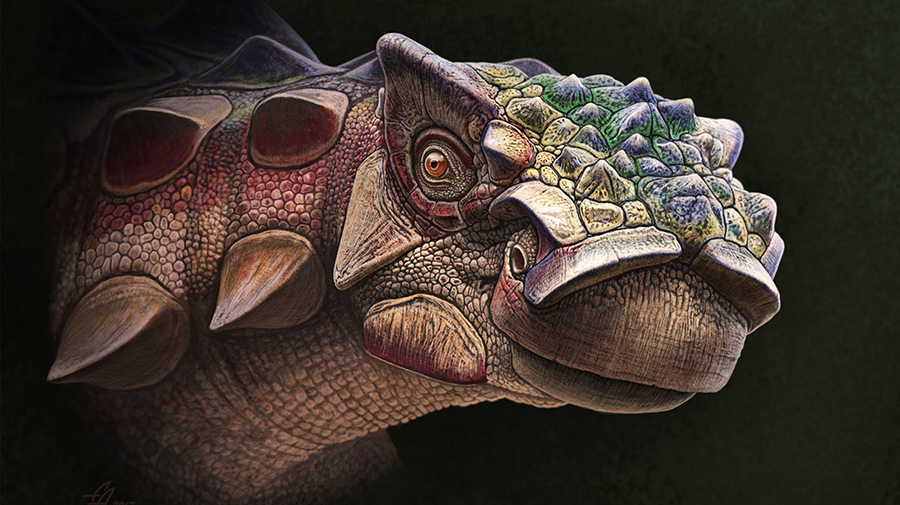
Life reconstruction of Akainacephalus johnsoni. Image credit: Andrey Atuchin, Denver Museum of Nature & Science.

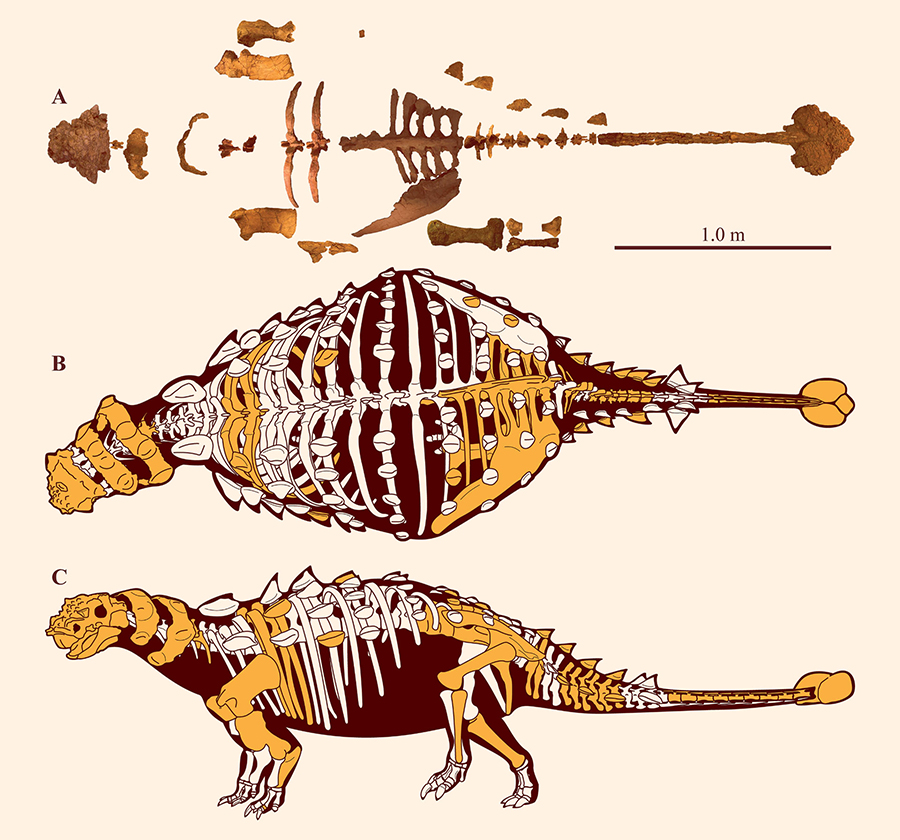
A new species of ankylosaurid dinosaur being named Akainacephalus johnsoni has been discovered by paleontologists Jelle Wiersma and Randall Irmis from the University of Utah, Natural History Museum of Utah, and James Cook University. The discovery is reported in the journal PeerJ.

Akainacephalus johnsoni lived approximately 76 million years ago and was 13-16 feet (4-5 m) long and 3.5 feet (1-1.5 m) tall at the hips.

This species belongs to a group of four-legged herbivorous armored dinosaurs called ankylosaurids (family Ankylosauridae) that lived in Asia and western North America during the Late Cretaceous period (100-66 million years ago). One of the unique features of these creatures is the presence of a characteristic bony tail club.

The fossilized partial skeleton of Akainacephalus johnsoni — including a complete skull, much of the vertebral column, a complete tail club, several fore and hind limbs elements, and bony body armor — was recovered from the Kaiparowits Formation in Grand Staircase-Escalante National Monument in Kane County, southern Utah.

Preserved elements and skeletal reconstructions of Akainacephalus johnsoni: (A) a composite showing all holotype skeletal material of Akainacephalus johnsoni anatomically arranged in dorsal view; (B-C) cartoon illustrating a full body reconstruction for Akainacephalus johnsoni in dorsal and left lateral view; preserved material in the skeletal reconstructions is highlighted in orange. Image credit: J.P. Wiersma & R.B. Irmis, doi: 10.7717/peerj.5016.

The unique arrangement of bony armor in the shape of small cones and pyramids covering the snout and head of this dinosaur is the key research finding indicating that it is closely related to Nodocephalosaurus kirtlandensis, an ankylosaurid dinosaur that lived about 77 million years ago in what is now New Mexico.

Surprisingly, Akainacephalus johnsoni and Nodocephalosaurus kirtlandensis are more closely related to Asian ankylosaurids such as Saichania and Tarchia than to other Late Cretaceous North American ankylosaurids, including Ankylosaurus and Euoplocephalus. Both of the latter species possess flat skull armor.

“A reasonable hypothesis would be that ankylosaurids from Utah are related to those found elsewhere in western North America, so we were really surprised to discover that Akainacephalus johnsoni was so closely related to species from Asia,” Dr. Irmis said.

Though ankylosaurids originated in Asia between 125 and 100 million years ago, they do not appear in the North American fossil record until around 77 million years ago.

Akainacephalus johnsoni once roamed the southern part of Laramidia, a landmass on the western coast of a shallow sea that flooded the central region, splitting the continent of North America in two.

This caused isolation along western and eastern portions of the North American continent during the Late Cretaceous period, between 95-70 million years ago.

“The geographic distribution of Late Cretaceous ankylosaurids throughout the Western Interior was the result of several geologically brief intervals of lowered sea level that allowed Asian ankylosaurid dinosaurs to immigrate to North America several times during the Late Cretaceous, resulting in the presence of two separate groups of ankylosaurid dinosaurs,” Wiersma said.

Artist’s interpretation of the newly discovered armored dinosaur Akainacephalus johnsoni. Illustration: Andrey Atuchin

“This lowering of sea levels exposed the Beringian land bridge, allowing dinosaurs and other animals to move between Asia and North America.”

“Such is exactly the case with Akainacephalus johnsoni; not only is this the first described and named Late Cretaceous ankylosaurid dinosaur from Utah, but this unique animal also strengthens the evidence that distinct northern and southern provincialism existed during the late Campanian stage in Laramidia, because to date, we don’t see this type of ankylosaurid dinosaurs in the fossil record of northern Laramidia.”

“From our observations we can conclude that at least two immigration events took place during Late Cretaceous times when lowered sea levels exposed the Beringian land bridge, connecting Asia with western North America.”

_____

J.P. Wiersma & R.B. Irmis. 2018. A new southern Laramidian ankylosaurid,Akainacephalus johnsoni gen. et sp. nov., from the upper Campanian Kaiparowits Formation of southern Utah, USA. PeerJ 6: e5016; doi: 10.7717/peerj.5016

Source: www.sci-news.com

Paleontologist uncovering the secrets of the dinosaurs of Aniakchak

Monday, July 23, 2018

Courtesy of Tony Fiorillo. This picture shows Hadrosaurid fossilized footprints taken from the Aniakchak National Park and Preserve.

Aniakchak National Monument and Preserve is one of Alaska’s least-visited parks, according to National Park Service statistics.

But that hasn’t stopped paleontologist Tony Fiorillo from exploring what he says is a prime area to study dinosaur ecology.

In 2001, Dr. Fiorillo found in Aniakchak the first record of a dinosaur in any Alaskan national park.

Since that trip, he has found dinosaur fossils in four Alaska national parks, including Denali National Park and Preserve, Wrangell-St. Elias National Park and Preserve and Yukon-Charlie Rivers National Preserve.

This summer, Dr. Fiorillo returned to Aniakchak with a team of scientists to better understand the climate and ecosystem during the time of the 70 million year-old fossils that date back to the Late Cretaceous Period.

He says 85 percent of fossilized footprints in the area are from Hadrosaurids, or duck-billed dinosaurs, indicating the Aniakchak area may have been a primary habitat for that species.

But he says there’s plenty more research left to uncover the secrets of the dinosaurs of Aniakchak.

“It’s really going to be a complete story when we’re done,” Dr. Fiorillo said. “And we feel like, because there’s so much information in this one area we’ve been working, this is going to be one of the best stories about dinosaur ecology anywhere in North America, or perhaps the world.”

He went on to say how exceptional it is to find “so much information from a place that’s so remote.”

Dr. Fiorillo says data from this summer’s trip to Aniakchak will be completely compiled by the spring, and he plans to return next summer to continue studying the area.

Dr. Fiorillo is the chief curator and vice president of research and collections at the Perot Museum of Nature and Science in Dallas, where several Alaskan discoveries are on display.

Source: www.ktuu.com

Giant Sexy Jeff Goldblum Statue Finds a Way (Into Our Hearts)

Friday, July 20, 2018

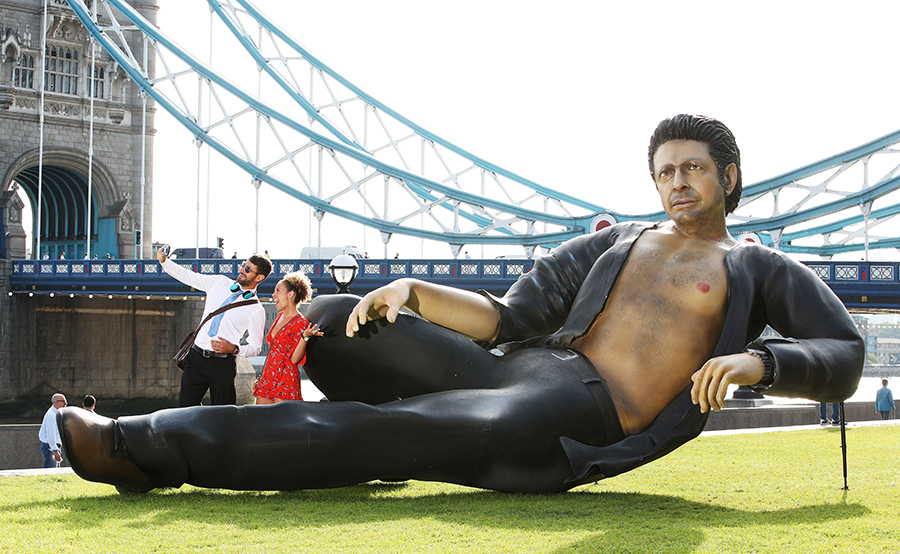
Now TV re-creates Jurassic Park's most famous meme with a 25-foot statue of Jeff Goldblum's torso in front of Tower Bridge to mark the 25th anniversary of the movie.  Joe Pepler/Now TV

The huge shirtless statue erected in London is even more impressive in person.

Jurassic Park got a Jurassic-sized tribute, with a 25-foot statue of actor Jeff Goldblum's torso placed in front of London's Tower Bridge.

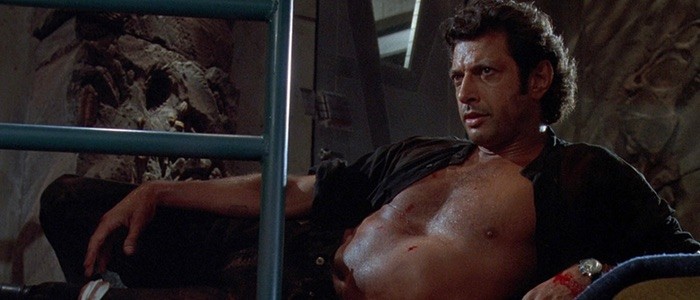
UK streaming service Now TV celebrated the 25th anniversary of the dino thriller Wednesday by paying homage to the film's most-memed moment -- Goldblum's mathematician character Ian Malcolm with his shirt unbuttoned, somehow looking sultry even after a T. Rex attack.

The giant statue of Goldblum stands at over 9.8 feet (3 meters) high and nearly 23 feet (7 meters) long, and weighs in at 331 pounds (150 kilograms). The impressive statue took more than six weeks and 250 painstaking hours to make.

CNET editor Andrew Hoyle got up close and personal with the statue. In the interest of journalism, of course.

Sexy Jeff Goldblum in Jurassic Park

Goldblum's torso meme has been shared by millions around the world, and even made into a Funko collectible toy.

"It's supposed to be Costa Rica, right?" Goldblum explained of his character's reasons for being topless in the movie in an interview with Yahoo in March. "So things are hot and I'm sure I'm in some sort of fever. All the logic is that we got to get some of these wet clothes off immediately. As I remember, I don't think anybody fought me on that." 

Even the viral memes of his shirtless character don't seem to faze Goldblum in the slightest.

When asked about his thoughts on the many seminaked memes made from the scene he said: "I admire them myself. It's great, the human body is beautiful in all ways."

Jurassic Park fans are encouraged to visit the lawns of Potters Field, on the south bank of the Thames, to see the extra large homage to Malcolm in person. 

Source: www.cnet.com

Preserving History: Museum Unveils New Dinosaur Footprint Exhibit

Thursday, July 19, 2018

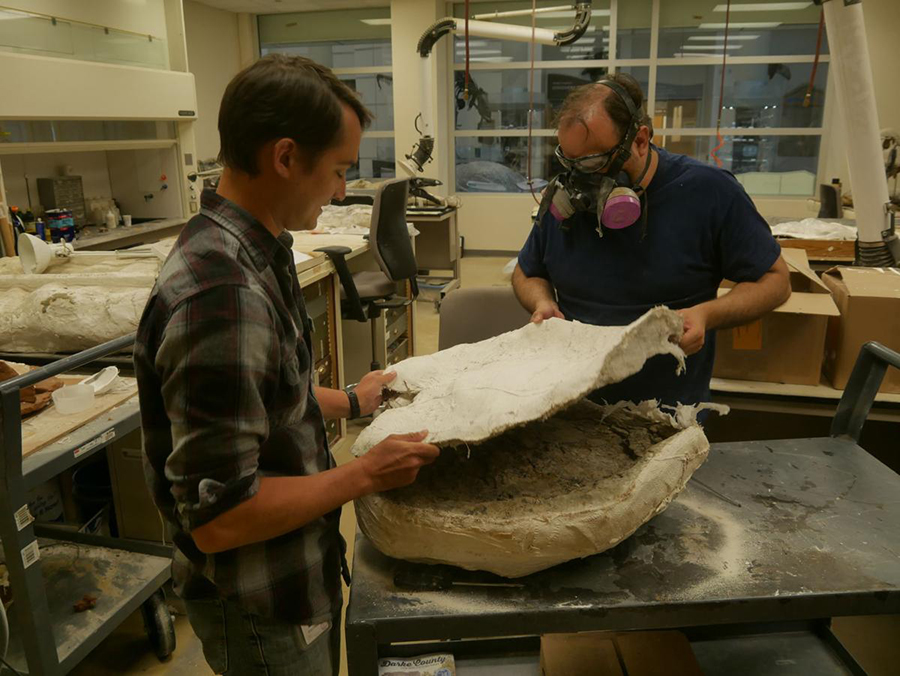
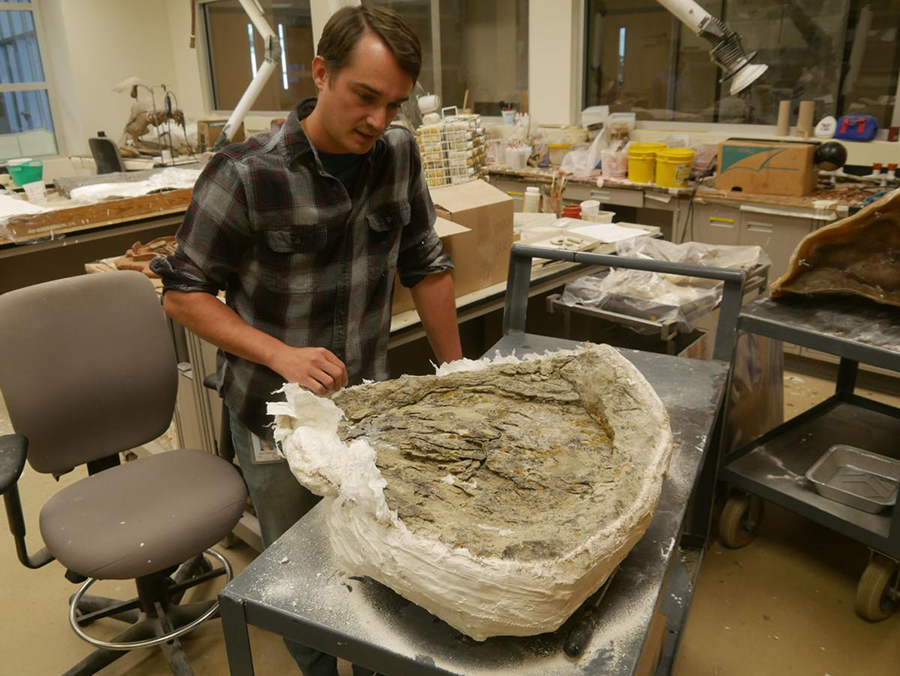
Virginia Museum of Natural History Assistant Curator of Paleontology Dr. Alex Hastings (left) assists VMNH Research Technician Ray Vodden as they remove a plaster cast from a rare dinosaur footprint Hastings recently collected in Wyoming. The footprint will be on display at the museum's Dino Festival, which takes place July 27 and 28.  Ben Williams

On Tuesday, the Virginia Museum of Natural History (VMNH) unveiled a remarkably well-preserved dinosaur footprint – and in less than two weeks, area residents will have the opportunity to see it for themselves.

VMNH Marketing and Public Relations Manager Zach Ryder said that the museum decided to unveil the footprint early so that people can begin getting excited for VMNH’s Dino Festival, which will take place on Friday, July 27 and Saturday, July 28.

“We’re going to have a lot of new things for people to check out,” Ryder said, including not only the new footprint, but also another new fossil that will be unveiled on the second day of the Dino Festival, along with plenty of dinosaur fossils that the museum has collected over the years that have never been put on public display.

The footprint that was unveiled Tuesday was collected by VMNH Assistant Curator of Paleontology Dr. Alex Hastings just a few weeks ago. The dig took place just outside of the town of Greybull, Wyoming in the “Morrison Formation,” a fertile source of dinosaur fossils dating from the late Jurassic period, about 150 million years ago. The dig was a joint partnership between VMNH and the University of Lynchburg.

The footprint, Hastings said, belonged to a sauropod, the family of giant, long-necked herbivorous (plant-eating) dinosaurs that includes diplodocus and brontosaurus.

“In the case of sauropods, they’re really big dinosaurs, so when they’re walking through the mud, they do a really good job at pressing that mud into compact layers,” Hastings said. “In lucky circumstances, those (footprints) will actually fossilize, along with the mud around it.”

Because these footprints are so heavily compressed, Hastings said, they will actually be stronger and heavier than the surrounding rock. Due to its weight, there was not much excavation required to obtain this particular footprint, he said, because it actually worked its way out from the surrounding earth and slid down a slope where Hastings and other team members found it intact.

“This is the first time I’ve seen one come out this well,” Hastings said. “Typically, sauropod footprints … break on impact. They’re not common at all, and I’ve never seen one this intact before. … In order to make sure it was nice and safe, though, we covered it in a layer of plaster in order to keep it in good shape when we had to take the long drive from Wyoming back to Virginia.”

VMNH Assistant Curator of Paleontology Dr. Alex Hastings discusses the uncommonly well preserved sauropod footprint he recently collected on a dig in Wyoming.  Ben Williams

When the plaster cast was removed on Tuesday morning, Hastings said, it was the first time the 150 million year old footprint had ever seen the light of day east of the Mississippi.

While Hastings has determined that the footprint belongs to a sauropod, he said, it’s difficult to tell exactly which species of sauropod left the print.

“Dinosaur footprints are a little bit difficult because a lot of the time – virtually every time – there are not bones associated with the footprints, so you don’t necessarily know which dinosaur goes with which footprint,” he said. “You can tell based on what is preserved in the footprint what type, so we definitely know it’s one of these sauropod dinosaurs, and we know it would have been something in the size range of diplodocus or brontosaurus; a really big, maybe 75 foot long animal weighing four tons easily. Beyond that, we can’t say exactly which species of sauropod dinosaur it is.”

Anyone wishing to see this piece of natural history in person will be able to do so during the Dino Festival, Hastings said.

“This is 100 percent the real sauropod dinosaur footprint,” Hastings said, not a cast. “The reason we’re doing this now is we want to have this out for people that come to the Dino Festival July 27 and 28. This will actually be ready and out for people to see and touch if they come to the festival.”

Dino Festival takes place Friday, July 27 from 11 a.m. to 7 p.m. and Saturday, July 28 from 9 a.m. to 3 p.m.

For more information, call 634-4141 or visit vmnh.net.

Source: www.martinsvillebulletin.com

Pages