
nandi's blog

Coral Reefs 'Weathered Dinosaur Extinction'
Saturday, August 11, 2018

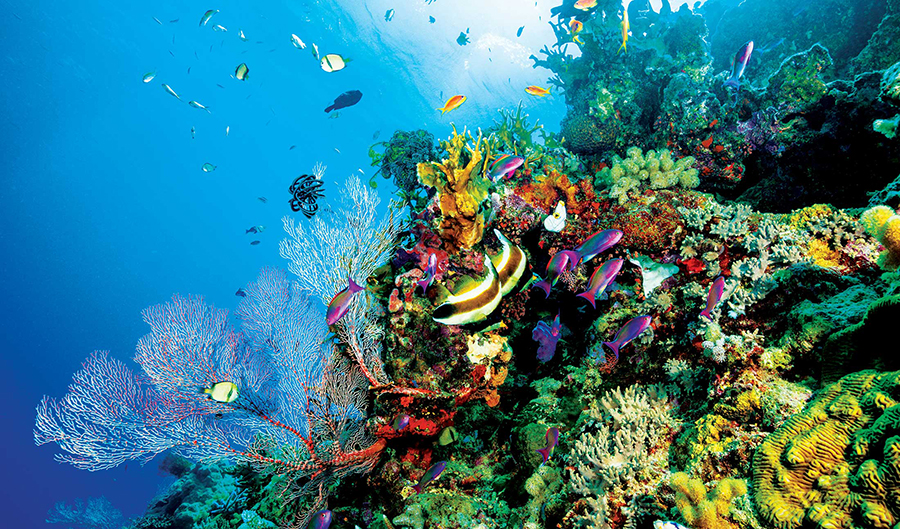
Australia's Great Barrier Reef is threatened by warming ocean temperatures

Corals may have teamed up with the microscopic algae which live inside them as much as 160 million years ago, according to new research.

The two organisms have a symbiotic relationship, meaning they need each other to survive.

But this partnership was previously thought to have developed about 60 million years ago.

The new findings suggest that reef algae may have weathered significant environmental changes over time.

This includes the mass extinction that wiped out most of the dinosaurs.

Algae's resilience to temperature changes has been of concern to scientists recently, as warming events on the Great Barrier Reef have seen the coral "bleached" of its algae.

The study, conducted by an international team of scientists, aimed to explore the diversity of algae species co-habiting with corals.

Looking at the species group Symbiodinium, the researchers found that it contained more varieties than previously thought. Although scientists had been aware of the algae's diversity, it had not been classified into many separate species - which now appears to be the case.

Using DNA analysis, the team found that these algae likely evolved and began their partnership with coral during the Middle Jurassic, well before the extinction event that affected the dinosaurs.

"Our recognition of the true origin of those microbes that give corals life is major revelation," lead author Prof Todd LaJeunesse told BBC News.

"They are way older than was previously estimated. Meaning that [this partnership has] been around for a hell of a long time!" added the Pennsylvania State University researcher.

Prof Mary-Alice Coffroth from the University of Buffalo, who was not involved in the study, hailed the new age estimate as "an important result."

"The threats of climate change and other anthropogenic perturbations have underscored the need for more intense study of reefs and coral resilience," she told the BBC.

The classification of more numerous Symbiodinium species is, she says, "a sorely-needed first step towards unravelling the mysteries of this important, but enigmatic group."

Prof LaJeunesse is optimistic about the study's implications for coral algae's resilience to climate change.

"It tells us that they are incredibly resilient and will likely be around for a long time. With that said, their survival of the current rapid changes in our climate may not be a pretty one. Ecosystem function may collapse," he said.

However researchers remain concerned that damage to coral reefs is accelerating in current conditions.

The team now hopes to study the various species of Symbiodinium more closely, comparing their genomes, ability to associate with different corals, and thermal tolerance to better understand how they will respond to the pressures of climate change.

The findings were published in the journal Current Biology.

Source: www.bbc.com

These Half-Billion-Year-Old Creatures Were Animals—But Unlike Any Known Today

Thursday, August 9, 2018

Artist’s reconstruction of Stromatoveris, an ancient marine animal J. HOYAL CUTHILL

So-called Ediacaran organisms have puzzled biologists for decades. To the untrained eye they look like fossilized plants, in tube or frond shapes up to 2 meters long. These strange life forms dominated Earth’s seas half a billion years ago, and scientists have long struggled to figure out whether they’re algae, fungi, or even an entirely different kingdom of life that failed to survive. Now, two paleontologists think they have finally established the identity of the mysterious creatures: They were animals, some of which could move around, but they were unlike any living on Earth today.

Scientists first discovered the Ediacaran organisms in 1946 in South Australia’s Ediacara Hills. To date, researchers have identified about 200 different types in ancient rocks across the world. Almost all appear to have died out by 541 million years ago, just before fossils of familiar animals like sponges and the ancestors of crabs and lobsters appeared in an event dubbed the Cambrian explosion. One reason these creatures have proved so tricky to place in the tree of life is that some of them had an anatomy unique in nature. Their bodies were made up of branched fronds with a strange fractal architecture, in which the frond subunits resembled small versions of the whole frond.

Jennifer Hoyal Cuthill at the Tokyo Institute of Technology and the University of Cambridge in the United Kingdom and Jian Han at Northwest University in Xi’an, China, have now found key evidence that the Ediacaran organisms were animals. They analyzed more than 200 fossils of a 518-million-year-old marine species named Stromatoveris psygmoglena. Paleontologists had previously concluded that the 10-centimeter-tall species was some sort of animal—in part, says Hoyal Cuthill, because it was found alongside other known animals, and all of the fossils are preserved in a similar way. Hoyal Cuthill and Han argue S. psygmoglena was also an Ediacaran organism, a rare “survivor” that somehow clung on through the Cambrian explosion.

he Stromatoveris fossils, which were all unearthed in Yunnan province in southwestern China, are beautifully preserved, Hoyal Cuthill says. As she examined specimen after specimen she became increasingly excited. “I began thinking: My goodness, I’ve seen these features before.” Like some of the strange Ediacaran organisms, Stromatoveris was made up of several radially repeated, branched fronds with a fractal internal architecture.

A fossil of one of the 200 or so types of Stromatoveris J. HOYAL CUTHILL

To find out what sort of animals Stromatoveris and the other Ediacaran organisms were, Hoyal Cuthill and Han ran a computer analysis that uses anatomical features to reconstruct evolutionary relationships. They found that Stromatoveris and the other Ediacaran organisms don’t belong to any living animal group or “phylum.” Instead, they cluster on their own branch in the animal evolutionary tree, between the sponges and complex animals with a digestive cavity like worms, mollusks, and vertebrates, the team reports today in Palaeontology. “This branch, the Petalonamae, could well be its own phylum, and it apparently lacks any living descendants,” Hoyal Cuthill says.

“It looks very likely [the Ediacaran organisms] are animals,” says Simon Conway Morris, a paleontologist at the University of Cambridge, who worked with Han on the first description of Stromatoveris in 2006, but who was not involved in the current study. At that point there were just a handful of known Stromatoveris fossils. The researchers argued that they were similar to some Ediacaran organisms, although others later questioned that link. Conway Morris says the new study “extends the story very nicely” by exploring the Ediacaran nature of Stromatoveris in more detail.

Geobiologist Simon Darroch at Vanderbilt University in Nashville is also comfortable with the idea that the Ediacaran organisms were animals and that a few survived into the Cambrian. But on a first look he is not convinced that Stromatoveris was one such survivor; he thinks the evidence that it had the fractal architecture of an Ediacaran organism isn’t strong—yet he’s open to persuasion.

If the new conclusion settles one mystery, though, it introduces another. The Ediacaran organisms represent the first major explosion of complex life on Earth, and they thrived for 30 million years. Their demise has been linked to the appearance of animals in the Cambrian Explosion, Hoyal Cuthill says. But that simple explanation doesn’t work as well if Ediacaran organisms were animals themselves, and some were still alive tens of millions of years later. “It’s not quite so neat anymore,” she says. “As to what led to their eventual extinction I think it’s very hard to say.”

Source: www.sciencemag.org

Boreal Dinosaurs Coming to the Surface

Friday, August 10, 2018

You don’t have to go too far outside of Grande Prairie to feel like you’re in an untouched wilderness. Down in the river valleys, past the quad trails and hiking paths, it’s a jumble of dense bush and eroding hillsides that await you. Fallen logs trip you up, dirt footrests collapse beneath you, and hills seem to grow higher and steeper as you climb them. And that’s all before you even start digging. These are some of the challenges faced by the intrepid people of the Boreal Alberta Dinosaur Project. A joint effort between paleontologists from universities and museums both international and from right here in northern Alberta, the Boreal Alberta Dinosaur Project aims to learn more about the Peace Region’s dinosaurs and other extinct creatures. Recently, they were also gracious enough to take the museum’s education staff, including myself, out for a few days of fieldwork in some pretty rustic but very important paleontology sites out in the local countryside.

Of all our fossil locations, the most famous one is, naturally, the Pipestone Creek Pachyrhinosaurus bonebed. This site is, of course, important and worth visiting for anyone with an interest in dinosaurs. But the Pipestone bonebed is far from the only dinosaur graveyard in the Grande Prairie area. Several other quarries, far less accessible and more mysterious, are known to paleontologists interested in the region’s dinosaurs. There’s a lot of fossils out there waiting to be collected and scientifically described, probably more than most people realize.

While we’re well-known for our horned dinosaur bonebeds in this neck of the woods, there’s actually a handful of duck-billed dinosaur sites being worked on too. These range from collections of sub-adults to potentially fully grown giants. As of this writing, the only duck-billed dinosaur confidently known from the Grande Prairie area is Edmontosaurus, an abundant species also known from localities in the heart of Edmonton and the badlands near Drumheller. While the bones of duckbills are fairly abundant, most species look pretty darn similar from the neck down, so skulls are needed so we can discern what’s what. Skulls are much harder to come by than most other bones, but duckbills often have big, elaborate crests on their heads that make it easy to tell which species you have, as long as you have the skull. It could even be that there’s duckbill species new to science up here, so keep an eye on the paleontology news over the next few years!

Some quarries hidden deep in the river valleys also preserve samples of a whole diverse paleo-ecosystem, contrary to most other bonebeds which are very abundant in only one type of dinosaur. Everything from fossil leaves and seeds to small aquatic reptiles to unknown species of dinosaur can be found here. This tells paleontologists a lot about what the environment of the Grande Prairie area 73 million years ago was like. At this time we would be in the middle of lush woodland cut by swampy rivers that were struck with seasonal floods. It was probably cool and frosty in the winter and hot and humid in the summer. The animals that inhabited this ecosystem belonged to the same families that occur better-studied rocks from southern Alberta, ranging from smaller creatures like turtles and crocodiles to Alberta’s classic dinosaur faunal groups. But these higher-diversity bonebeds also seem to be hinting that there’s undescribed species here unique to the Wapiti Formation of Alberta’s northwest.

You’ve probably noticed that I’ve been pretty vague about where exactly these other fossil sites in the area are located, and specifically what bones have been collected from them. There’s a good reason for this- fossil poaching, a problem that affects paleontologists around the world. Announcing the exact locations of poorly-understood fossil sites could open the gates for people who would collect the bones for themselves, keeping scientifically crucial fossils out of the reach of paleontologists. However, this isn’t to say that the general public can’t be involved in helping in the search for new dinosaurs. Many of the best fossil sites in the Grande Prairie area were discovered by amateurs who did the right thing and brought their discovery to the attention of paleontologists, who are always happy to hear about new exciting places to dig. So watch out for giant bones on your next canoe trip- we’re only just starting to scratch the surface of what’s up here.

Don’t forget to come out on a tour of the Pipestone Creek bonebed while there’s still some summer left! Plus, our yearly Night for the Museum fundraiser is coming up, so consider supporting your dinosaur museum!

Source: www.dailyheraldtribune.com

Early Jurassic Dinosaur Footprints Discovered in Guizhou

Saturday, August 11, 2018

Experts have recreate the looks of the lizard-foot dinosaurs which left the tracks in Maotai

A research team have discovered at least 250 dinosaur footprints in southwest China's Guizhou Province.

The footprints, scattered over an area of about 350 square meters, were found at the construction site of a wine factory in Maotai Township, home to China's famous alcohol brand, Kweichow Moutai.

Experts from China, the United States and Germany have said they are Sauropod footprints from the early Jurassic period.

It is believed to be the largest tracksite of Sauropods from the period ever found in China.


The fossilised footprints (pictured) were first found by workers from a liquor factory in Maotai, a renowned wine town in China. They were left 190 million years ago, according to experts

A research paper regarding the tracks was published in Geoscience Frontiers in July.

"It is rare to see footprints of Sauropods from the early Jurassic period in China. Although a few footprints have previously been discovered in Sichuan and Guizhou provinces and Chongqing Municipality, they were severely eroded," said Xing Lida, from the research team and a dinosaur footprint expert with China University of Geosciences.

"The new findings are well preserved and can help us to understand the distribution and evolution of dinosaurs in the early Jurassic period."

The research team is working with the wine factory and local authorities to roll out a protection plan for the footprints.

Sauropods were a group of huge, plant-eating, four-footed dinosaurs with long necks and tails, and one of the largest animals to ever walk the Earth.

Source: www.xinhuanet.com

Paleontologists Find Extraordinary 25-Million-Year-Old Teeth Of Mega-Shark in Australia

Saturday, August 11, 2018

Fossil enthusiast Philip Mullaly holds a tooth from an extinct great jagged narrow-toothed shark at the Melbourne Museum on Thursday. | AFP-JIJI

Citizen scientist Philip Mullaly and professional paleontologists have found a very rare set of fossilized shark teeth at Jan Juc, a renowned fossil site along Victoria’s Surf Coast.

“I was walking along the beach looking for fossils, turned and saw this shining glint in a boulder and saw a quarter of the tooth exposed,” Mullaly explained.

“I was immediately excited, it was just perfect and I knew it was an important find that needed to be shared with people.”

The teeth belonged to Carcharocles angustidens, an extinct species that’s closely related to the famous giant C. megalodon.

Carcharocles angustidens lived between 22 and 33 million years ago (Oligocene epoch). This shark grew up to 30 feet (9 m) in length, was the top predator and would have preyed on small whales.

“These teeth are of international significance, as they represent one of just three associated groupings of Carcharocles angustidens teeth in the world, and the very first set to ever be discovered in Australia,” said Dr. Erich Fitzgerald, senior curator of vertebrate paleontology at Museums Victoria.

Carcharocles angustidens teeth. Image credit: Museums Victoria.

Realizing the fossilized shark teeth was all from the same species, Dr. Fitzgerald and colleagues suspected that they came from one individual shark and there might be more teeth at Jan Juc. So, they organized two expeditions to excavate the site, where they were able to collect more than 40 shark teeth.

Most of the teeth belonged to Carcharocles angustidens, but in addition, they found something even more surprising — several teeth of a smaller shark, the sixgill shark (genus Hexanchus).

“These smaller teeth came from several different individuals and would have become dislodged from their jaws as they fed on the huge carcass of Carcharocles angustidens,” said Museums Victoria paleontologist Tim Ziegler.

“The teeth of the sixgill shark work like a crosscut saw, and tore into Carcharocles angustidens like loggers felling a tree. The stench of blood and decaying flesh would have drawn scavengers from far around.”

Carcharocles angustidens being feasted upon by several sixgill sharks. Image credit: Museums Victoria.

“Sixgill sharks still live off the Victorian coast today, where they live off the remains of whales and other animals. This find suggests they have performed that lifestyle here for tens of millions of years.”

Source: www.sci-news.com

Dinosaur Remains Found in Lagos, Nigeria, as Owner Insists on Settlement

Friday, August 10, 2018

According to reports, Dinosaur remains were found by a construction worker in Mowe, in the outskirts of Lagos. The landowner identified only as Oga Sunday however insisted that officials “settle” him before he can let them take the bones off his land.

The story which has since gone viral on social media garnered some reactions on the Twitter platform with a few people expressing their doubts about the authenticity of the news and the bones discovered.

Source: www.informationng.com

Coral Reefs Date Back to Dinosaur Age, 160m Years Ago, Says Study

Friday, August 10, 2018

‘Partnership’ with algae has helped corals to survive previous global climate events.

Coral reefs may date back to the age of dinosaurs, up to 160 million years ago, and are likely to have survived previous episodes of global warming, international research suggests.

Tropical reefs do still face an “existential threat” from man-induced climate change but their partnership with algae may have helped them to survive previous major climate events, the study published in scientific journal Current Biology says.

Research led by Dr Christian Voolstra, of the King Abdullah University of Science and Technology in Saudi Arabia, indicates that "modern” corals and their algal partners have been “entwined with each other” for 160 million years.

This is 100 million years earlier than previously thought, according to Dr Voolstra, associate marine science professor at the university’s Red Sea Research Centre.

“During their long existence, they have faced severe episodes of environmental change, but thanks to their biological characteristics have managed to bounce back after each,” he says.

Micro-algae, also known as zooxanthellae, live inside the cells of corals, allowing them to acquire energy from sunlight and to build the “massive, economically valuable reef formations upon which countless marine organisms rely for habitat”, the study says.

The team used genetic evidence, including DNA sequences and genome comparisons, to calculate the micro-algae’s approximate age of origin.

Dr Voolstra emphasised that discoveries like this did not change the fact that coral reefs were under threat from climate change but he said the information would improve conservation efforts.

Corals in Ireland

Irish specialists Prof Louise Allcock of NUI Galway and Dr Aaron Lim of University College Cork noted that the formations with this type of micro-algae off the Irish coast are limited to a few shallow water species of cup corals.

Cold water corals found in water depths of 600 to 1,600m are too far from sunlight for algae to survive, Prof Allcock explains.

“Lophelia reefs are probably tens of thousands of years old so won’t have experienced high CO2 regimes,”she says, but the families containing many reef building species could be up to 160 million years old.

“Our deep-water corals are still potentially vulnerable to climate change as the associated acidification of oceans makes it harder for them to form the carbonate required for their skeletons,”she says.

“It’s true that corals have survived periods in the past with high CO2 levels, but never have they had to cope with such a rapidly changing ocean which gives them little time to evolve.”

The cold water coral carbonate mounds which deepwater corals form here can be up to 100m tall, and can be up to 2.6 million years old, Dr Lim says.

“When conditions are favourable, the cold water corals grow, trap sediment and this helps to generate a mound feature. However, this isn’t constant. Over the past 2.6 million years there have been a number of shifts in the climate which have influenced when mound growth has been active or inactive,”he says.

“As for how they will pan out under modern environmental change, we are still unsure. However, work that we have recently carried out on one of these mounds shows that there have been clear signs of change.”

Source: www.irishtimes.com

Dinosaur-Killing Asteroid Impact Made Huge Dead Zones in Oceans

Thursday, August 9, 2018

About 66 million years ago, an asteroid more than 10 kilometers wide struck Earth, as seen in this artist’s rendering. The impact did more than bring an end to the reign of the dinosaurs. According to new research, it also ushered in a period of rapid global warming that helped deplete oxygen from vast stretches of the oceans. Credit: Mark Garlick/Science Photo Library/Getty Images

About 66 million years ago, an asteroid roughly 10 kilometers wide hit Earth in what is today the Gulf of Mexico. It brought annihilation: All the dinosaurs except for the birds went extinct; forests around the planet vanished temporarily, killing off all bird species that lived in trees; dust and other aerosols blocked the Sun, and global temperatures took a nosedive. The world plunged into a state analogous to nuclear winter.

Another fallout effect of the impact, according to new work, was a depletion of oxygen in the oceans triggered by rapid global warming following the impact and nuclear winter. Such anoxia, the researchers behind the work report, devastated marine life. What’s more, this episode of anoxia may have parallels to the rapid global warming and resulting ocean anoxia being wrought by human-driven climate change today.

“The global warming following the impact is one of the most rapid warmings in Earth’s history,” said Johan Vellekoop, a geologist at KU Leuven in Belgium who led the new research. “It’s on a human timescale.” He described that the postimpact warming happened over the course of only a few hundred to a few thousand years.

By comparison, humans have been injecting carbon dioxide (CO2) into the atmosphere—and driving global warming in the process—for about 200 years, since the start of the Industrial Revolution. Vellekoop and his team note in a paper published in Geology earlier this summer that as today’s warming continues unabated, the oceans appear poised to become anoxic once again.

An Unlucky Day

When the asteroid struck, it hit a platform of carbonate rock that was about 3 kilometers thick, creating a feature called the Chicxulub crater. Carbonate rock, when vaporized by something like a giant asteroid, releases CO2 into the atmosphere; previous work estimates that the amount of COinjected into the air after the impact equaled about 1,400 gigatons. By comparison, humans injected roughly 32.5 gigatons of CO2 into the atmosphere in 2017 alone.

After the impact, the event akin to nuclear winter descended, which saw global average temperatures fall by about 25°C, explained Timothy Bralower, a marine geologist at Pennsylvania State University who was not involved in the new research. The winter probably lasted for only a few years, and then as the dust cleared, global warming got going, and sea surface temperatures climbed by 1.5°C to 2°C.

And Then There Was Anoxia

For their study, Vellekoop and his team visited three Northern Hemisphere sites in Texas, Denmark, and Spain and took samples of marine rocks from strata right above the asteroid impact horizon. They tested the rocks for concentrations of the element molybdenum; “we found enrichments of molybdenum, which are indicators of low oxygen conditions,” said Vellekoop.

When oxygen is plentiful, it binds to molybdenum and removes it from seawater, he explained. When oxygen is scant, molybdenum sticks around in the seawater, where it can then incorporate into rocks like the ones the team tested. In rocks from Denmark, for instance, molybdenum concentrations jump from 1 or 2 parts per million to “up to 100 parts per million in the layer directly above the impact,” Vellekoop said.

This increase suggests ancient shallow oceans were relatively warm places, Bralower explained, because warmer ocean waters have a harder time retaining dissolved oxygen than colder waters. In such a world, there are oxygen “dead zones” where oxygen is scant or completely absent.

And dead zones, explains Vellekoop, would have helped devastate marine ecosystems, especially shallow-water seafloors where creatures like corals and bivalves dwelled, during postimpact warming. Such coastal waters, Vellekoop explains, “are the places with the highest diversity.”

A Mirror in the Past

In the course of geologic events, many things tend to happen on relatively long timescales. But an asteroid impact is an exception. It is, almost by definition, instantaneous.

Such rapidity, explained Ellen Thomas, a paleoceanographer at Yale University who was not involved in the work, makes this ancient warming analogous to today’s human-driven global warming, which is close to being as quick as asteroid-related warming. “Although the causes are slightly different, and the timescale may be different, the basic principles are the same,” she said.

Life can adapt in the face of such change, Thomas added, but how much it is able to do so depends on the rate of change. Basically, “the slower the change, the better it is for life,” she said.

Today, because some areas of the oceans are already showing signs of oxygen depletion, the threat is not as much from off planet as it is from within, Thomas explained. Thus, if temperatures continue to climb in the coming century, humanity seems poised to become its own kind of asteroid.

Citation: Joel, L. (2018), Dinosaur-killing asteroid impact made huge dead zones in oceans, Eos, 99, https://doi.org/10.1029/2018EO104123

Source: https://eos.org

Dinosaurs Were Sniffing Flowers Millions of Years Before Humans Even Existed

Thursday, August 9, 2018

You don’t normally think of dinosaurs doing the kinds of things that modern animals might do — like taking a nap in a grassy field or playing with each other as youngsters — but new research suggests that they may at least been taking the time to stop and smell the roses.

A new study led by Oregon State University entomologist George Poinar Jr reveals that ancient flowering plants had the same kind of fragrant scents as many flowers do today. In fact, Poinar even goes so far as to suggest that such pleasant scents might have played a role in attracting dinosaurs to certain areas.

The study focused on long-fossilized examples of flowering plants encased in hardened tree sap. This material, which is called amber, has the ability to preserve both animals and plants for incredibly long periods of time. By studying multiple examples of now-extinct flowers dating back as far as 100 million years, the researchers were able to determine that the same fragrant compounds that tickle our fancy today were present in ancient flowers from the Cretaceous period, when dinosaurs were abundant.

“I bet some of the dinosaurs could have detected the scents of these early flowers,” George Poinar explained. “In fact, floral essences from these early flowers could even have attracted these giant reptiles.”

Just as they are today, the scents were likely used by the plants to attract pollinators. Bugs were prevalent at the time, and many plants would have relied on them for pollination just like today’s flowers.

“It’s obvious flowers were producing scents to make themselves more attractive to pollinators long before humans began using perfumes to make themselves more appealing to other humans,” Poinar says.

Whether or not towering dinosaurs would have had any measurable interest in the fragrant flowers of the age is little more than a guess, but modern animals are regularly observed taking in the sweet scents, so it’s more likely than not.

Source: https://bgr.com

Coming To 4k Blu-ray: Jurassic World: 5-Movie Collection SteelBook Edition

Wednesday, August 8, 2018

Jurassic World: 5 Movie Collection 4k Blu ray

Well, hopefully you didn’t go out and buy that Jurassic Park 25th Anniversary Collection released just a month ago, because Universal has revealed a new 4k Blu-ray SteelBook with with all five of the franchise films that includes the newest installment: Jurassic World: Fallen Kingdom.

They really should have left an open sleeve (like they did with the James Bond “Bond 50” complete collection) for fans who purchased the 25th Anniversary edition so adding ‘Fallen Kingdom’ would be as easy as buying the single-movie. But why would they make it that easy?

The thing is though, this upcoming Jurassic World: 5-Movie Collection is packaged as a SteelBook — the seemingly indestructible case that features custom artwork appealing to film fanatics. And given the capacity limitations of the SteelBook, this collection contains 6 discs rather than the 8 contained in the 25th Anniversary edition, effectively condensing the extra bonus material down to one Blu-ray.

What also should be noted is the Jurassic World: 5-Movie Collection does not come with Blu-ray versions of the films, only 4k Blu-ray along with codes to redeem Digital 4k UHD copies.

As far as price, the SteelBook edition is currently $102.99 (List: $119.99) at Amazon and $74.99 at Best Buy. The Best Buy edition is obviously a better deal but their website doesn’t specify number of discs or whether any extras are included, whereas Amazon details a sixth disc (presumably a Blu-ray) that contains bonus material.

Jurassic World: 5-Movie Collection Detailed

Disc 1 – Jurassic Park:
Includes a digital copy of Jurassic Park (Subject to expiration. Go to NBCUCodes.com for details.)
Features High Dynamic Range (HDR) for Brighter, Deeper, More Lifelike Color

Disc 2 – The Lost World: Jurassic Park:
Includes a digital copy of The Lost World: Jurassic Park (Subject to expiration. Go to NBCUCodes.com for details.)
Features High Dynamic Range (HDR) for Brighter, Deeper, More Lifelike Color

Disc 3 – Jurassic Park III:
Includes a digital copy of Jurassic Park III (Subject to expiration. Go to NBCUCodes.com for details.)
Features High Dynamic Range (HDR) for Brighter, Deeper, More Lifelike Color
Feature Commentary with Special Effects Team

Disc 4 – Jurassic World:
Includes a digital copy of Jurassic World (Subject to expiration. Go to NBCUCodes.com for details.)
Features High Dynamic Range (HDR) for Brighter, Deeper, More Lifelike Color

Disc 5 – Jurassic World: Fallen Kingdom:
Includes a digital copy of Jurassic World: Fallen Kingdom (Subject to expiration. Go to NBCUCodes.com for details.)
Features High Dynamic Range (HDR) for Brighter, Deeper, More Lifelike Color

  • On Set with Chris & Bryce

  • The Kingdom Evolves

  • Return to Hawaii

  • Island Action

  • Aboard the Arcadia

  • Birth of the Indoraptor

  • Start the Bidding!

  • Death by Dino

  • Monster in a Mansion

  • Rooftop Showdown

  • Malcolm’s Return

  • VFX Evolved

  • Fallen Kingdom: The Conversation

  • A Song for the Kingdom

  • Chris Pratt’s Jurassic Journals

  • Jurassic Then and Now – Presented by Barbasol®

Disc 6:

  • Return to Jurassic Park: Dawn of a New Era

  • Return to Jurassic Park: Making Prehistory

  • Return to Jurassic Park: The Next Step in Evolution

  • Archival Featurettes

  • Behind the Scenes

  • Theatrical Trailer

  • Deleted Scenes

  • Return to Jurassic Park: Finding the Lost World

  • Return to Jurassic Park: Something Survived

  • Archival Featurettes

  • Behind the Scenes

  • Theatrical Trailer

  • Return to Jurassic Park: The Third Adventure

  • Archival Featurettes

  • Behind the Scenes

  • Dinosaur Turntables

  • Storyboards to Final Feature Comparison

  • Production Photographs

  • Theatrical Trailer

  • Deleted Scenes

  • Chris & Colin Take on the World

  • Welcome to Jurassic World

  • Dinosaurs Roam Once Again

  • Jurassic World: All-Access Pass

  • Innovation Center Tour with Chris Pratt

Jurassic World: 5 Movie Collection 4k Blu ray Back

Source: https://hd-report.com

Pages