nandi's blog

Diceratops hatcheri: The Mystery Dinosaur Being Kept in the Museum Basement
Friday, September 21, 2018

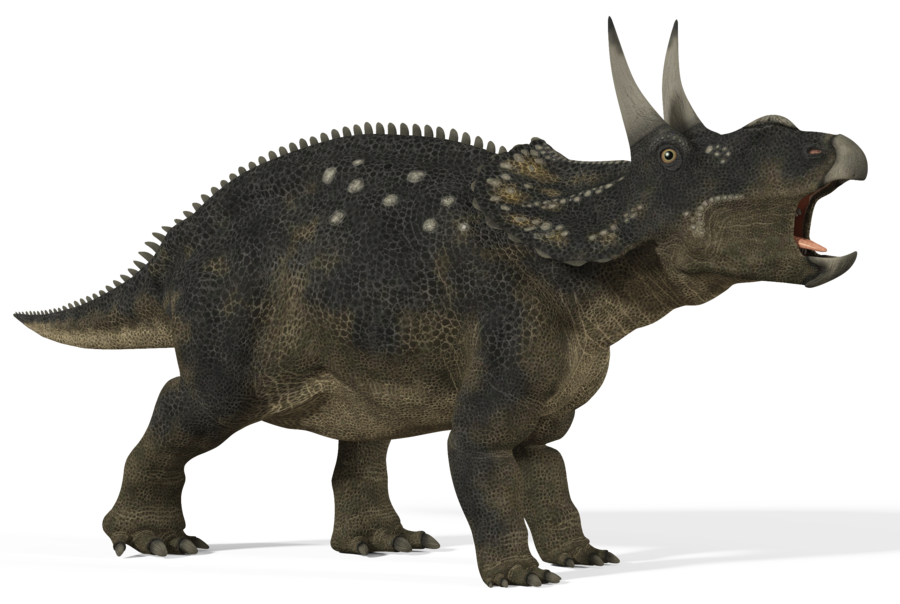
Diceratops_01 by 2ndecho

When the new fossil hall at the National Museum of Natural History in the US opens next June, it will show off hundreds of the Smithsonian's finest prehistoric specimens, including the newly acquired star of the Late Cretaceous show, "The Nation's T. rex".

But just a tiny sliver of the museum's 40 million fossils will be on display.

"You're covering three-plus billion years of life history, and there's only so much you can pack in there," said Hans-Dieter Sues, chairman of the museum's paleontology department.

Here's the story of a mysterious dinosaur that didn't make the cut.

First, a few details: It's not a whole dinosaur, just a six-foot-long (182 cms) skull. The rest of its body parts were probably carried off by ancient scavengers or swept away by the elements during the 66-68 million years between its death and its discovery in Niobrara County, Wyoming, in 1891.
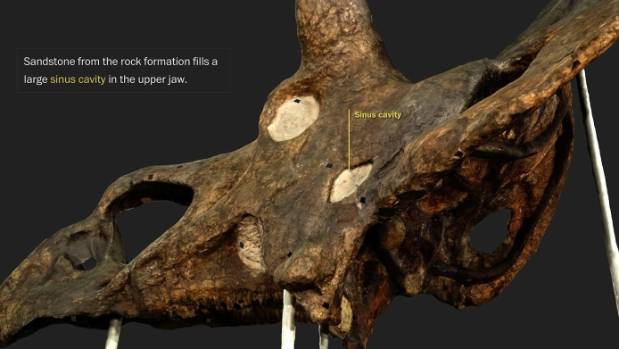
Sandstone from the rock formation fills a large sinus cavity in the upper jaw. SETH BLANCHARD/GABRIEL FLORIT/WA

It ate plants, had two horns over its eyes and looked mostly like a Triceratops, except for a smooth rise on its snout where the third horn would've been.

It has three names - four if you count the museum's catalogue number, USNM 2412 - yet paleontologists are not entirely sure what to call it.

In 1905, it was named Diceratops hatcheri. "Diceratops" means two-horned face; "hatcheri" is a nod to John Bell Hatcher, the famed fossil hunter who discovered it. It went by that name for over a century.

In 2007, however, a Russian author noticed that the name Diceratops already had been given to an insect in 1868. Two animals can't share the same name, so he renamed the dinosaur Nedoceratops, a rather mean-spirited label that translates as "insufficient horned face".

A year later, a Portuguese palaeontologist who hadn't heard about the renaming proposed tweaking the original just a bit, to Diceratus. Some references now list all three monikers so people don't get confused.

All those names may be superfluous anyway, Sues said, because most paleontologists now believe the skull belonged not to a different species but to a common Triceratops that, through illness or genetic mutation, had a nose that just didn't look like the others.
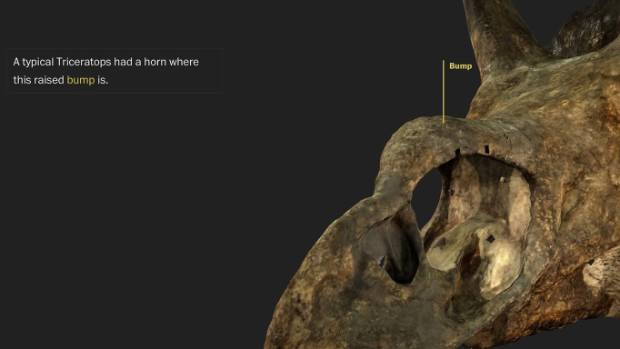
A typical Triceratops had a horn where this raised bump is. SETH BLANCHARD/GABRIEL FLORIT/WA

"It is the Rudolph of the triceratops!" joked Sues, who nevertheless doesn't care for giving fossils cute nicknames and probably won't be thrilled that, for simplicity's sake, we're calling this one Rudolph for the rest of this story.

In addition to an oddly shaped nose, Rudolph's skull has a frill that is perforated by three asymmetrical holes. Sues thinks they may have been caused by the same pathology that stunted the animal's horn because they appear too smooth to have been caused by damage.

"The problem with dinosaurs is you often have so few specimens," Sues said, so you see few variations. "If you had them only in fossil form, you might have a problem seeing that the skull of a German shepherd and the skull of a French bulldog are the same species."

In 2009, two scientists caused a palaeontological hubbub when they hypothesised that Triceratops was actually a juvenile Torosaurus, a 30-foot-long, six-tonne horned plant-eater, and that Rudolph may have been an adolescent link between the two. (Other scientists strongly disagreed.)

It is not merely Rudolph's lineage that is intriguing, Sues said, but also its discovery, or rather its discoverer.

Hatcher was a colourful fossil hunter who first worked for Othniel Charles Marsh, the first professor of paleontology at Yale. (Marsh's increasingly malicious rivalry with Philadelphia palaeontologist Edward Drinker Cope became known as the "Bone Wars". This was a huge story line in its day, when palaeontology was a relatively new science, and the most spectacular finds were coming out of what was literally the Wild West.)

Hatcher discovered many important dinosaur fossils, including Torosaurus. He was also known for his poker-player prowess, Sues said, and once had to rely on his six-shooters to help him escape a town in Argentina after a card game left some locals broke and angry.
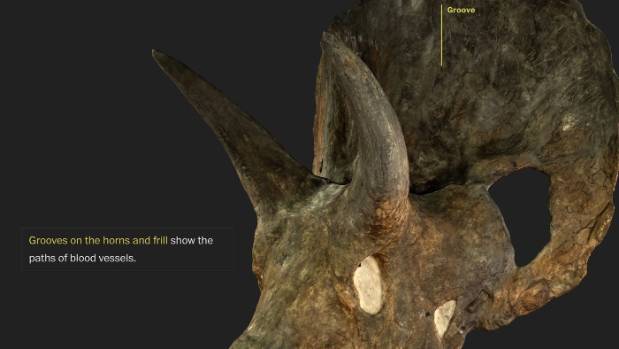
Grooves on the horns and frill show the paths of blood vessels. SETH BLANCHARD/GABRIEL FLORIT/WA

According to Hatcher's description in the 1907 reference work The Ceratopsia, he found Rudolph protruding from sandstone, nose-down and without a lower jaw, in the same general rock formation where he had found Torosaurus and many Triceratops.

Hatcher sent his fossil finds, including Rudolph, back east to Marsh's growing collection at Yale. After Marsh's death in 1899, the skull came to the Smithsonian among five train cars full of fossils that became the foundation of the museum's dinosaur collection.

Sues said we should not feel sorry for Rudolph the Flat-Nosed Triceratops, which grew to be a very large adult in a dino-eat-dino world.

And although its skull will rest among the trove of fossils in the basement of the museum rather than in the slick new fossil hall upstairs, it may have been dealt a better hand than the normal-horned Triceratops that will represent the species to the public. That one, Hatcher, has been posed lying on the ground, about to have its frill ripped off by the mighty Tyrannosaurus rex.

 - The Washington Post

Source: www.stuff.co.nz
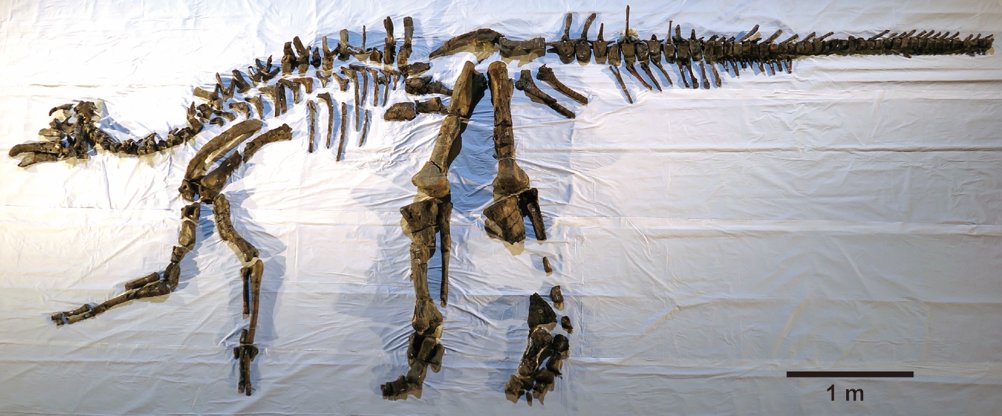
Japan's Largest Complete Dinosaur Skeleton Comes to Life

Friday, September 21, 2018

Credit: Hokkaido University

The unearthed bones of Mukawaryu, Japan's largest complete dinosaur skeleton, have now been prepared and pieced together, giving us a fuller and clearer image of the 72 million-year-old dinosaur.

Excavations of Mukawaryu, the largest complete dinosaur skeleton in Japan, began in 2013 in the Hobetsu district of Mukawa Town on Japan's northernmost island of Hokkaido by the Hokkaido University Museum and Hobetsu Museum research teams. Although many bones have not yet been identified, the majority have been, and those which can be pieced together now present a more accurate depiction of the dinosaur's anatomy.

Mukawaryu was recovered from marine deposits dating back to the Late Cretaceous Period around 72 million years ago. The skeleton has been identified as a duck-billed dinosaur (Hadrosauridae). These herbivores thrived in Eurasia, North and South America, and Antarctica.

The Mukawaryu skeleton revealed in 2017 was defined as a complete skeleton, as it contained more than 50 percent of the bones, but now an estimated 60 percent of the bones have been confirmed as well as 80 percent of the entire expected skeletal volume. With a significant amount of cranial bones pieced together in addition to more shoulder, forelimb, hip, hindlimb, and backbones, the skeleton is now more discernible.

"There are still many unidentified bones and fossils that need to be restored," said Associate Professor Yoshitsugu Kobayashi of the research team. "We will continue researching Mukawaryu, analyzing its bones, and unraveling more details of this creature. We also hope to further clarify its systematic position, determine any related species and the ecology of the environment it lived in."

Credit: Hokkaido University

Source: https://phys.org

New Creationist Theme Park Claims Dinosaurs Were Actually 900-Year-Old Lizards that ‘Never Stopped Growing’

Thursday, September 20, 2018

Pastor Kent Hovind shows off his Dinosaur Adventure Land theme park (Screen cap).

A new creationist theme park in Lenox, Alabama is run by a Baptist preacher who believes that dinosaurs only grew so large because they were lizards who lived for 900 years and never stopped growing.

In an interview with AL.com, creationist Kent Hovind explains how his new theme park, called Dinosaur Adventure Land, will teach young people about his own scientifically illiterate theories about the existence of dinosaurs.

“It’s very simple,” he tells AL.com. “Before the flood came, in the days of Noah, the Bible says that people lived to be 900 years old. Genesis Chapter 5 tells us that. Well, I taught biology and reptiles never stop growing. What would happen to a reptile if he could live to be 900? That’s the dinosaurs. No big mystery.”

Hovind says he understands that no credible scientists actually believe that dinosaurs are just lizards who grew so big because they happened to live to the ripe old age of 900, but he’s not concerned because he believes the scientists are being used by Satan to spread doubt about the Bible.

“So the devil, I think, is using the dinosaurs to teach boys and girls the earth is millions of years old, and it’s propaganda,” he says. “It’s not true at all.”

Source: www.rawstory.com

Can We Expect Jurassic World 3 To Blast Off Into Space?

Thursday, September 20, 2018

Will Jurassic World 3 Take Dinosaurs Into Space?

Jurassic World… in space?

That’s the elevator pitch doing the rounds this morning after ComicBook.com caught up with Juan Antonio Bayona to discuss Fallen Kingdom and the immediate future of the dino series.

A third (and perhaps final?) movie is already on the cards, which will see Colin Trevorrow climb aboard to close the book – not unlike how J.J. Abrams returned in time for Star Wars: Episode IX after launching The Force Awakens back in 2015.

For Trevorrow, though, the first port of call will be to deliver a satisfying finale for Universal’s rebooted saga. And one of the strategies CB suggested was to expand into space, where all sorts of sci-fi hijinks will ensue. Cloning and indeed resurrecting long-extinct species is one thing, but Fallen Kingdom‘s J.A. Bayona believes space travel may be a step too far.

Maybe, I don’t know. I think, somehow, what is interesting about the Jurassic franchise is that they reflect on the moment that we live in. This is something that comes from very early on in the original book from Michael Creighton. So, I don’t know, if we start to talk about going back to space, maybe there’s a possibility that in the future we will talk about that in the Jurassic movies.

Bryce Dallas Howard (Claire Dearing), on the other hand, is less convinced, and believes the Jurassic World franchise will only blast off into the cosmos when Universal et. al are fresh out of ideas.

Oh my goodness, dinosaurs in space. What if? What if dinosaurs were in space? I guess we’re gonna find out in Jurassic World 27! That would be jumping the shark, for sure.

In short, don’t hold your breath for a space-set Jurassic World 3. The untitled threequel will seemingly be unlike anything we’ve ever seen before though, all the while retaining the “science thriller” aspects that made the first Jurassic Park movie so special.

How Jurassic Park Made 'Velociraptors' the Most Beloved Dinosaur

Thursday, September 20, 2018

Owen (Chris Pratt) with a baby Velociraptor in “Jurassic World: Fallen Kingdom.” Universal Studios and Amblin Entertainment, Inc. and Legendary Pictures Productions, LLC.

Do you remember the first time you saw a dinosaur?

The question is simple and echoes through the trailer for the newest edition to the Jurassic Park franchise—dubbed Jurassic World: Fallen Kingdom—which debuted on Blu-Ray and DVD September 18, 2018. The very first time I saw a dinosaur was in the movie The Land Before Time. I was six and the cartoon dinosaurs captured my attention right away. Afterwards, I remember begging my parents to take me to the local science museum to see some actual fossils. When we walked into the exhibit hall, I remember standing in awe looking up at the massive skeleton in front of me. That first dinosaur happened to be a Tyrannosaurus rex (AKA T. rex), and I could really see why Littlefoot and the gang called them sharp teeth. 

But unlike Littlefoot, I wasn’t afraid; instead, I wanted to learn as much about the lizard king as possible. I devoured every book I could get my hands on. Then, in the summer of 1993, Steven Spielberg released his ode to dinosaurs— Jurassic Park —and a new flock of dinosaurs caught my attention. But one stood out above the rest: the Velociraptor.

See 25 years ago, before the film franchise that made dinosaurs mainstream, the word Velociraptor wasn’t in my vocabulary. All of my attention was focused on my beloved T. rex, with its tiny arms and lumbering gait, but with the release of each new chapter in the Jurassic Park franchise, I could feel my loyalties switching. These stealthy, hyper-intelligent pack hunters had worked their way into my heart (and maybe my nightmares).

The T. rex is ubiquitous; you can go to practically any science museum (and even Disney World) to see a T. rex skeleton. Perhaps no dinosaur is more cherished than the T. rex. The massive carnivore embodies all that enchants us about dinosaurs: the size, ferocity and even bizarre nature. We’re so smitten with T. rex that we are continually bringing the dinosaur back to life through art and film.

In 1990, just three years before Jurassic Park was released, an incredible discovery was unearthed in Montana—a fossilized skeleton dubbed specimen FMNH PR 2081. Given the moniker SUE after the person who discovered it, FMNH PR 2081 is the most complete and best preserved T. rex skeleton ever found. SUE is on permanent display at Chicago’s Field Museum, while several casts of the remains travel around to different museums, captivating visitor’s across the country. One such cast is on permanent display outside of the dinosaur attraction at Walt Disney World’s Animal Kingdom Park in Florida. 

Revived thanks to a combination of computerized special effects and puppetry, the film’s T. rex is a muscular, agile predator. One that is far more imposing than the lumbering, tail-dragging iterations that had appeared on film before, like the sharp teeth that tormented Littlefoot and friends.

An adult Tyrannosaurs Rex robotic dinosaur. Oli Scarff/Getty Images

Spielberg and the gang capitalized on the world’s love for T. rex, using their CGI wonder to help audiences fall in love with dinosaurs. Then slowly and systematically, over the next 25 years, the T. rex would step into the shadows, allowing a new (perhaps even deadlier) murderbird to take the spotlight.

Velociraptors’ presence continued to grow over the course of the next few films. We learned that these pre-historic birds of prey could open doors, hunted in packs and could even communicate with each other. But it wasn’t until the debut of Jurassic World in 2015 and the anthropomorphism of Blue—a female Velociraptor featured in the last two Jurassic World movies—that raptors really began to capture the hearts of the public.

Blue, Charlie, Delta and Echo may only be actors in motion capture suits, but in the film, they are a highly trained raptor squad able to follow commands and are used to help corral the Indominus rex—the real dino villain of the story—after it escapes. That plan is quickly thwarted as the squad learns the genetic hybrid is one of their own. However, the newly forged alliance quickly falls apart, and as the film progresses, the Indominus turns on its new raptor brethren, causing audiences to shed collective tears for each of the fallen raptors. 

Blue, the T. rex, and the Mosasaur eventually team up to form a dino hit squad, taking out the Indominus and saving the day. This scene is pretty much the only action the T. rex sees throughout the entire film, while the raptors steal the show. A switch from the first film in which the T. rex saves everyone from the Velociraptors, proving that “lizard king” is a fitting moniker for the massive predator.

Then, when the trailer for Fallen Kingdom dropped, and the world laid eyes on the baby raptor squad, that was all it took. Those fours tiny dinosaurs, led by Blue, have collectively sealed the Velociraptor’s fate as the most beloved dinosaur. Sure, the T. rex will forever be the lizard king, but right now Blue is the retail queen. And that all started with Jurassic Park.

Source: https://observer.com

A New Chinese Theme Park Points to the Future of Universal Orlando

Wednesday, September 19, 2018

Photo by Chad Sparkes/Flickr

Here in Orlando, there has been plenty of focus on the yet-to-be-announced new theme park that NBC Universal is working on for their upcoming southern campus, but the company's next park to open will be in Beijing. 

Slated to open in 2020, Universal has confirmed that the new resort will cost a whopping $6.5 billion, setting a new record for a theme park. While the budget is far beyond what Universal will likely spend in Orlando, the two projects do share other similarities, including being nearly the same size. 

We now have new leaks that confirm previously unknown details of the Beijing project, which point to what Universal has planned for Orlando. On the construction message board Theme Parx, a user known as Michael whose profile notes that he is one of the "top investigators" on the site shared various documents that he gathered from exploring Chinese-based, non-English social media platforms and websites. 

Then just last week, French-based Disney historian Alan Littaye posted on his site Disney and More other new sitework documents that corroborated the reports originally posted on the Chinese-based sites. 

Image via Weibo | Theme Parx Image orignaly posted on Weibo then later posted on Theme Parx via user Michael. Image via Weibo | Theme Parx

The lushly landscaped resort looks strikingly similar to Universal's current Orlando resort with three hotels, including one that looks like Orlando's Cabana Bay resort and another that seems to have design details of a formerly planned luxury hotel for Orlando. 

A waterway links the entire resort complex. Guests not staying on site would park in a surface lot, then cross through a CityWalk-like entertainment complex that looks slightly larger than Orlando's. The Studio's park would be on the right side with a second park that is planned for later located on the left side. On the bottom left of the map shows a Volcano Bay-themed water park. 

Over at the Studios park, the entrance would be under a large hotel that looks to be roughly 10 stories tall. Rooms at the hotel would look directly into the park. Other theme parks around the world, including Disneyland Paris and Tokyo DisneySea have similar entrances, but no Orlando parks currently offer hotel rooms that directly overlook the theme park area. 

One is strongly rumored for Epcot and the possibility of one for Universal Orlando's new theme park seems very possible, especially considering that these high demand rooms can typically demand higher rates. 

When Littaye posted his article he noted that the documents weren't detailed enough to learn about what each land within the new Studios park would include, but what Littaye didn't know at the time was that another document from the project had leaked roughly a week earlier on social news aggregation site Reddit that did provide more details on what the various lands would include. 

Altogether, the more than a dozen multiple maps and renderings from the new park that have leaked over the past four weeks provide us with a detailed look at the new resort and Studios park.

Overhead permit view of Universal Studios Beijing. Rides are in red, shows are in orange. Sixteen rides, nine shows. Three/four coasters.

Inside the Universal Studios Beijing park, we see a mix of Universal's biggest hit attractions. Guests will enter through a Hollywood-inspired Main Street-like corridor. Like Universal Studios Japan and Singapore, this entrance street has a large glass like cover

At the end of the street will be a large central lagoon. On the left side of the entrance street is an outdoor performance venue that looks nearly identical to the one located in Universal Studios Florida. Just beyond that is a clone of Orlando's Hulk roller coaster but here it is themed to Transformers. This Transformers-based land will also include a clone of the screen-based Transformers indoor ride. 

Moving into the back of the park, guests will enter Universal's first fully enclosed permanent land. Themed to Kung Fu Panda, the new area will have three carnival-style flat rides and what looks to be a large signature dark ride. Kung Fu Panda has been strongly rumored for Universal Orlando's new theme park, as part of a large DreamWorks-focused area that may also include other DreamWorks properties such as Trolls, Shrek, and How To Train Your Dragon. 

If Kung Fu Panda does come to the Orlando park, the same dark ride seen in Beijing plans will likely be included in the new land. 

Leaving the Kung Fun Panda land guests then enter a small land themed to the blockbuster film more WaterWorld. While the film is known as one of the biggest blockbuster flops in history, Universal has seen massive success with a water-based stunt show based on the franchise. Opening at Universal Studios Hollywood alongside the film's opening in theaters the stunt show quickly garnered a cult-like following and is still a must do for most visitors at the park. It was an opening attraction at both Universal Studios Japan and Singapore, leaving Orlando as the only Universal resort in the world to not feature the stunt show. With the Sinbad stunt show, which has some of the same stunts, closing at Orlando's Islands of Adventure, new rumors of WaterWorld coming to Orlando have cropped up but with extensive pyrotechnics and a finale that includes a seaplane crashing into the performance pool the show may be too loud for the existing Orlando parks that have residential areas nearby. The name WaterWorld also aligns with the strongly rumored "Fantastic Worlds" name for the new Orlando park. A small dining option also looks to be part of the Beijing mini-land. 

Next to the WaterWorld mini-land is Jurassic World. An exposed steel coaster anchors the land along with a water ride and an indoor ride, rumored to be themed to the gyro-sphere attraction seen in the first Jurassic World movie. 

Some have speculated that Universal might bring Jurassic World to the new Orlando park, but with government documents seeming to point towards a new family attraction in the works for the Jurassic Park area at Islands of Adventure, it seems unlikely a separate Jurassic World themed land would also be the works for Orlando. 

In the Islands of Adventure land, the new family attraction doesn't seem to align with anything we see in the Beijing park documents. The expansion plot in Orlando's Jurassic Park area was filled in with the Kong attraction a few years ago, so it is unlikely the gyro-sphere ride from Beijing is brought to Orlando. A rumored update to the Jurassic Park Visitor's Center in Orlando will likely include some of the same exhibits found in the Beijing park version. 

In the front right corner of the Beijing park sits Hogsmeade, with the Forbidden Journey ride, the Flight of the Hippogriff family coaster, and a retail street. An expansion plot beside Hogsmeade looks to be roughly the size and shape of Orlando's Diagon Alley. 

The final land found at Universal Studios Beijing will be Minion Land, which will be anchored by a copy of the simulator ride found at other Universal parks, including Universal Studios Florida. A secondary family attraction and an indoor play area are also located in the land. An expansion plot will allow the land to eventually nearly double in size. 

Back here in Orlando Despicable Me has become more and more a part of Universal Orlando with Minions now being regularly featured in marketing. 

The Despicable Me ride in Orlando has a much lower capacity than its counterparts in Hollywood and Japan. At Universal Studios Hollywood the Minions have a mini-land that also includes a spinner ride, similar to Orlando's Simpsons based Kang & Kodos' Twirl 'n' Hurl. In Japan, part of the former San Francisco area was recently transformed into Minion Park where both the simulator and a whip style flat ride, similar to the Alien Swirling Saucers found at Disney's Hollywood Studios. 

There have been rumors of a Despicable Me mini-land coming to Orlando, with a second trackless dark ride replacing Shrek, but more recently those plans seem to have been put on hold. One possible explanation for the delay is Universal may be looking at possibly moving Despicable Me to the new South Campus theme park. That would allow Universal to use the current ride building at Universal Studios Florida for a new attraction while also addressing the low capacity of the current attraction. 

One notable attraction missing from the leaked Beijing plans is Fast and Furious. As the only attraction Universal has announced for the new park its absence comes as a surprise but after the failure of the attraction at Universal Studios Florida it seems logical for Universal to pull the plug on it. Fast and Furious was to be set in a New York-themed section of the park that was to also have a live Bollywood style musical stage show. In the leaked documents, that show is set in a theater in the Hollywood themed entrance area. 

Here in Orlando, Universal Creative has an entire division focused on the Beijing park. The Beijing division of Universal Creative work out of a separate office complex a few miles away from the main Universal Creative office. Other Universal parks have been announced for South Korea and Russia. The South Korea project was canceled in 2017, but earlier this year saw a new push by local officials in South Korea. The Moscow resort is also slowly moving forward, but with political concerns now surrounding the project, it seems to be all but dead for the time being. A Universal Studios in Dubai was announced, but was officially canceled in 2016. With the international parks now all seeming to be either canceled or far from being realized, most of the focus within Universal Creative is on Beijing and Orlando. 

As the Beijing development moves from concept to construction, some of the Beijing team seem to be shifting to the upcoming Orlando park, which Universal has until now mostly relied on third-party creative firms to help develop. 

We should learn more about the Orlando plans in the coming months as Universal begins filing government documents that are required to be public in nature. Until then our best indication of what Universal Creative is capable of is Beijing. 

Source: www.orlandoweekly.com

How 'Jurassic World: Fallen Kingdom' Broke Hearts With The Brachiosaurus

Wednesday, September 19, 2018

Jurassic World: Fallen Kingdom went above and beyond to make sure audiences felt the emotional impact of a brachiosaurus' death.

The moment was so impactful, it became a popular meme and was one of the most talked about beats of any summer film in 2018. Speaking to ComicBook.com, Jurassic World: Fallen Kingdom director JA Bayona and Claire actress Bryce Dallas Howard opened up about crafting the devastating sequence.

When asked why he put the devastating moment in the film, Bayona explains that he always hoped it would resonate with moviegoers. "For the impact that created on you and I think somehow that moment reflects the ending of a dream," Bayona says. "It's the ending of Isla Nublar, the park. It had to be effective in order to pay tribute and justice to the idea we were trying to tell. It had to have impact."

In fact, the brachiosaurus and Isla Nublar going down was indicative of the entire film's plot moving forward. "It's one of those moments that helps you to understand the story you're telling," Bayona said. "It's like a landmark. So, you're going in that direction. The whole first section of the movie ends up in that shot, ends up in that moment."

The scene was as intense on set as it was in movie theaters, despite not actually having any island to look at or dinosaur to weep for. "That was really intense," Howard recalls. "The color of it is the color from ET's heart, like the red glow and the glow around it."

For the cast on set, Bayona went the extra mile to set the tone. "Something that's really cool about JA Bayona, the director, is that when he can, when there's no sound and he can have the flexibility, he will play music during a take," Howard said. "So, that's great for a number of reasons. One, because you have the sense of what the tone of the scene is, what the pace of the scene is, and then if it's sad and say, you're supposed to be imagining brachiosaurus being abandoned on the island, it helps if you're hearing the theme music to Jurassic Park. So, JA played the music to Jurassic Park during that scene and it's emotional. You're seeing the dream go up in flames."

Like much of the film, the moment is reflective of human relationships with animals. Though this instance was a natural disaster, the animals were left on the island after being created and brought there by humans who managed to escape. "Overall, these movies have become about the relationship between human beings and animals," Howard says.

Jurassic World: Fallen Kingdom is available on BLU-RAY and DVD from September 17, 2018.

Source: https://comicbook.com

Why Museums Need to Digitize Fossils to Understand Past Mysteries

Tuesday, September 18, 2018

Lost treasures are waiting to be found.

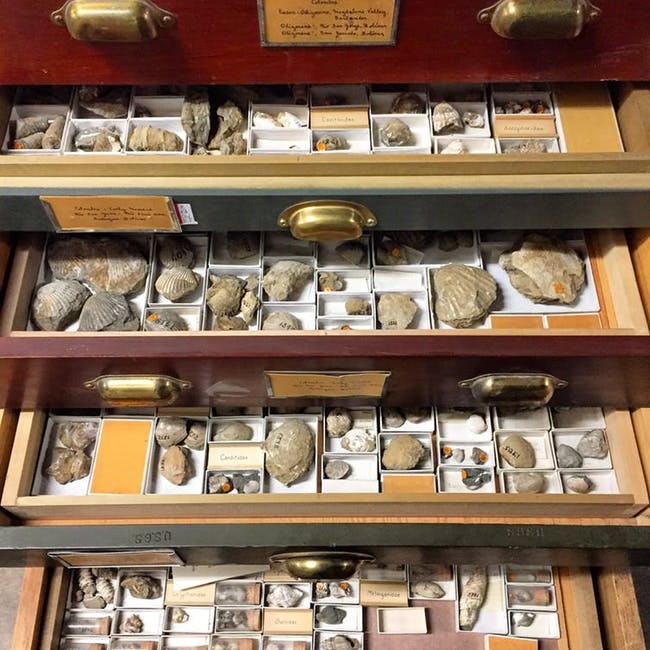
The great museums of the world harbor a secret: They’re home to millions upon millions of natural history specimens that almost never see the light of day. They lie hidden from public view, typically housed behind or above the public exhibit halls, or in off-site buildings.

What’s on public display represents only the tiniest fraction of the wealth of knowledge under the stewardship of each museum. Beyond fossils, museums are the repositories for what we know of the world’s living species, as well as much of our own cultural history.

For paleontologists, biologists, and anthropologists, museums are like the historians’ archives. And like most archives — think of those housed in the Vatican or in the Library of Congress — each museum typically holds many unique specimens, the only data we have on the species they represent.

The uniqueness of each museum collection means that scientists routinely make pilgrimages worldwide to visit them. It also means that the loss of a collection, as in the recent heart-wrenching fire in Rio de Janeiro, represents an irreplaceable loss of knowledge. It’s akin to the loss of family history when a family elder passes away. In Rio, these losses included one-of-a-kind dinosaurs, perhaps the oldest human remains ever found in South America, and the only audio recordings and documents of indigenous languages, including many that no longer have native speakers. Things we once knew, we know no longer; things we might have known can no longer be known.

But now digital technologies — including the internet, interoperable databases, and rapid imaging techniques — make it possible to electronically aggregate museum data. Researchers, including a multi-institutional team I am leading, are laying the foundation for the coherent use of these millions of specimens. Across the globe, teams are working to bring these “dark data” — currently inaccessible via the web — into the digital light.

Researchers must travel to visit non-digitized specimens in person, not knowing what they will find – if they’re even aware of their existence.

What’s Hidden Away in Drawers and Boxes

Paleontologists often describe the fossil record as incomplete. But for some groups, the fossil record can be remarkably good. In many cases, there are plenty of previously collected specimens in museums to help scientists answer their research questions. The issue is how accessible — or not — they are.

The sheer size of fossil collections, and the fact that most of their contents were collected before the invention of computers and the internet, make it very difficult to aggregate the data associated with museum specimens. From a digital point of view, most of the world’s fossil collections represent “dark data.” The fact that large portions of existing museum collections are not computerized also means that lost treasures are waiting to be rediscovered within museums themselves.

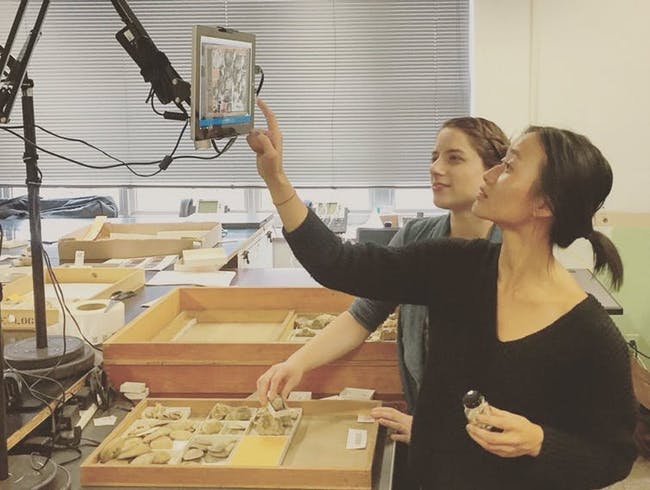
High-resolution photos are an important part of the digitization process.

With the vision and investment of funding agencies such as the National Science Foundation (NSF) in the United States, numerous museums are collaborating to digitally bring together their data from key parts of the fossil record. The University of California Museum of Paleontology at Berkeley, where I work, is one of 10 museums now aggregating some of their fossil data. Together through our digitized collections, we are working to understand how major environmental changes have affected marine ecosystems on the eastern coast of the Pacific Ocean, from Chile to Alaska, over the last 66 million years.

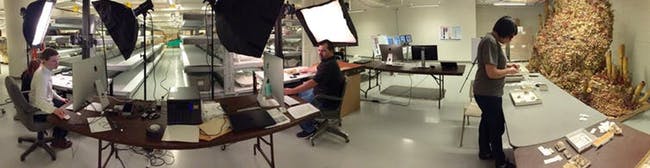
The digitization process itself includes adding the specimen’s collection data into the museum computer system if it hasn’t already been entered: its species identification, where it was found, and the age of the rocks it was found in. Then, we digitize the geographic location of where the specimen was collected, and take digital images that can be accessed via the web.

The Integrated Digitized Biocollections (iDigBio) site hosts all the major museum digitization efforts in the United States funded by the current NSF initiative that began in 2011.

Team members entering information about each fossil into a centralized database.

Significantly, the cost of digitally aggregating the fossil data online, including the tens of thousands of images, is remarkably small compared with the cost it took to collect the fossils in the first place. It’s also less than the expense of maintaining the physical security and accessibility of these priceless resources — a cost that those supposed to be responsible for the museum in Rio apparently were not willing to cover, with disastrous consequences.

Digitized Data Can Help Answer Research Questions

Our group, called EPICC for Eastern Pacific Invertebrate Communities of the Cenozoicquantified just how much “dark data” are present in our joint collections. We found that our 10 museums contain fossils from 23 times the number of collection sites in California, Oregon and Washington than are currently documented in a leading online electronic database of the paleontological scientific literature, the Paleobiology Database.

EPICC is using our newly digitized data to piece together a richer understanding of past ecological response to environmental change. We want to test ideas relevant to long- and short-term climate change. How did life recover from the mass extinction that wiped out the dinosaurs? How did changes in ocean temperature drive marine ecosystem change, including those associated with the isolation of the cooler Pacific Ocean from the warmer Caribbean Sea when the land bridge at Panama first formed?

To answer these questions, all the relevant fossil data, drawn from many museums, needs to be easily accessible online to enable large-scale synthesis of those data. Digitization enables paleontologists to see the forest as a whole, rather than just as a myriad number of individual trees.

In some cases – such as records of past languages or the collection data associated with individual specimens – digital records help protect these invaluable resources. But, typically, the actual specimens remain crucial to understanding past change. Researchers often still need to make key measurements directly on the specimens themselves.

For example, Berkeley Ph.D. student Emily Orzechowski is using specimens being aggregated by the EPICC project to test the idea that the ocean off the Californian coast will become cooler with global climate change. Climate models predict increased global warming will lead to stronger winds down the coast, which will increase the coastal upwelling that brings frigid waters from the deep ocean to the surface — the cause of San Francisco’s famous summer fogs.

The test she’s using relies on mapping the distributions of huge numbers of fossils. She’s measuring subtle differences in the oxygen and carbon isotopes found in fossil clam and snail shells that date to the last interglacial period of Earth’s history about 120,000 years ago, when the west coast was warmer than it is today. Access to the real-life fossils is crucial in this kind of research.

Once digitized, information about a fossil is available worldwide, while the specimen itself remains available to visiting researchers to make crucial observations or measurements.

Understanding response to past change is not just restricted to fossils. For example, nearly a century ago the director of the Museum of Vertebrate Zoology, Joseph Grinnell at the University of California, Berkeley, undertook systematic collections of mammals and birds across California. Subsequently, the museum re-surveyed those precise localities, discovering major changes in the distribution of many species, including loss of many bird species in the Mojave Desert.

A key aspect of this work has been a comparison of the DNA from the almost hundred-year-old museum specimens with DNA of animals alive today. The comparison revealed serious fragmentation of populations, and led to the identification of genetic changes in response to environmental change. Having the specimens is crucial to this kind of project.

This digital revolution is not just restricted to fossils and paleontology. It pertains to all museums collections. Curators and researchers are enormously excited by the power to be gained as the museum collections of the world – from fossils to specimens from live-caught organisms – become accessible through the nascent digitization of our invaluable collections.


This article was originally published on The Conversation by Charles Marshall. Read the original article here.

Source: www.inverse.com

9 Extinct Megafauna GIANTS That Are Out Of This World

Tuesday, January 24, 2017

Megafauna

Some of these massive beasts are familiar in form but enormous in size, while others are strange hybrids of modern-day animals.

Megafauna are simply big animals. Elephants are megafauna, as are giraffes, whales, cows, deer, tigers, and even humans. Megafauna can be found on every continent and in every country.

For every living species of megafauna, there are a large number of extinct megafauna. In the age before widespread settlement, without the pressures of human interference, animals were free to evolve into some truly awe-inspiring forms. Imagine beavers the size of bears or wild pigs larger than modern-day rhinoceroses, or even sloths as large as elephants.

Humans can be blamed for pushing many of the most recently extinct megafauna to their limits. It's generally agreed that the populations of many large animals plummeted in the first thousand years or so after humans hit a continent. Our earliest ancestors would, quite reasonably, have gone after the biggest animals they could to feed their families and kill the biggest predators to cut down on competition and attacks. Mix in human ingenuity, climatic changes, and hundreds and thousands of years and you soon get a land denuded of megafauna.

But looking farther back, past the dawn of humanity, and you'll find an even more interesting picture of megafauna. We're talking 50-foot sharks, giant otters the size of wolves, and weird beaver-turtle hybrids the size of a VW Beetle and the appetite of a cow. If we should ever perfect time travel, ecologists will be lining up for trips back to study the bizarre zoology of the past.

With that in mind, here are seven otherworldly examples of now-extinct megafauna.
 

Glyptodon

A relative of modern-day armadillos, glyptodons were armored mammals roughly the size of a Volkswagen Beetle that became extinct around 10,000 years ago. (Photo: Pavel Riha/Wikimedia Commons)

Glyptodons were enormous armored mammals that became extinct around 10,000 years ago. Roughly the size of a VW Beetle, the glyptodon were well-armored against attacks from predators. A relative of modern-day armadillos, they were unable to pull their head into their shell like turtles and relied on thick skull armor and sharp spikes for defense.
 

Argentavis

Argentavis could grow to be 24 feet wingtip to wingtip, which is twice the size of the Andean condor — one of the largest birds in the world today. (Photo: Wangyonglee/Wikimedia Commons)

The Argentavis has the distinction of being the largest flying bird ever discovered. The massive bird could grow to be 24 feet, wingtip to wingtip, twice the size of the Andean condor, which is one of the largest birds in the world today. The Argentavis is thought to have relied on thermal currents to say aloft. The creatures' huge size would have made takeoffs more difficult, and it's likely that they made their homes in the mountains where they could use mountain slopes and headwinds to aid in launching. Though it would certainly be frightening to find yourself under a soaring Argentavis, the living wouldn't have too much to worry about — it's believed that the bird was a scavenger that preferred its meals already-killed.
 

Paraceratherium

Paraceratherium, which stood 20 feet tall at the shoulder, lived around 25 million years ago in what is now Asia. (Photo: Dmitry Bogdanov/Wikimedia Commons)

The Paraceratherium were enormous beasts that lived around 25 million years ago in what is now Asia. Standing nearly 20 feet tall at the shoulder, Paraceratherium remain the largest known species of mammal to walk the Earth. Our fossil record of the Paraceratherium is relatively sparse, so it's hard to say what they looked like exactly, but the general scientific consensus is that they had long, muscular necks and heads not unlike a hornless rhinoceros. They would use their long reach to graze on tall trees.

The relative sizes of Paraceratherium, Elasmotherium, white rhinos, Indian rhinos, black rhinos and Sumatran rhinos compared to a human. (Photo: DagdaMor/Wikimedia Commons)

Megalania

This monitor lizard lived in Australia about 50,000 years ago. (Photo: Cas Liber/Wikimedia Commons)

Varanus priscus was a giant, carniverous goanna that may have grown up to 23 feet long (size estimates are still being debated) and weighed more than 4,000 pounds. This monitor lizard inhabited southern Australia during the Pleistocene and fed on other medium and large animals. It may have been venomous, and if it was, it would be the largest known venomous vertebrate.
 

Ground sloth

The ground sloth stretched 20 feet long and weighed up to 9,000 pounds. (Photo: Dallas Krentzel/flickr)

It's fitting that this next entry follows the massive Paraceratherium because the ground sloth is one of the few land mammals that could give the Paraceratherium a run for their money. Weighing up to 9,000 pounds and stretching 20 feet in length, the ground sloth ambled around the woodlands and grasslands of South America as recently as 10,000 years ago, supporting itself by eating grasses, shrubs and leaves. The ground sloth had the misfortune of overlapping with humanity's reign and was likely hunted to extinction as we trickled down from North America.
 

Megalodon

A megalodon skeleton on display at the Calvert Marine Museum in Solomons, Maryland. (Photo: Calvert Marine Museum/Wikimedia Commons)

Though the previous entries on this list were all large creatures, none of them were really anything a person would have to worry about. But not this one. Megalodon can be best thought of as a giant great white shark — a highly capable predator sitting at the top of the food web. It could grow to be more than 50 feet in length and sported teeth seven inches long. The megalodon dined on whales, dolphins, porpoises and giant sea turtles. The chart below says it all.

This chart compares the sizes of the megalodon with the whale shark, great white shark and a human. (Photo: Scarlet23/Wikimedia Commons)
 

Daeodon

This enormous, brawny pig lived around 20 million years ago in North America. (Photo: Jay Matternes/Wikimedia Commons)

Daeodon, like Megalodon, is worthy of a healthy dose of fear. They were enormous hulking towers of brawny pig that lived around 20 million years ago in North America. They could grow to be six feet high at the shoulder and weigh thousands of pounds. Fossilized remains of their teeth suggest that they were omnivorous, dining both on animals (some as large as modern-day cows) and plants. It's telling of their dominance of the food web that they belong to a family of animals nicknamed "hell pig" and "terminator pig."

Giant otter

Giant otters the size of wolves lived six million years ago. (Photo: The Cleveland Museum of Natural History/YouTube)

Around six million years ago, giant otters (Siamogale melilutra) the size of wolves and weighing up 110 pounds (twice the size of modern-day otters) lived in what is now Asia. Recently, American paleontologists excavating an ancient lake bed in the Yunnan Province in Southwestern China found a complete skull, jawbone and teeth. The teeth showed that the furry creatures lived on extra large shellfish and molluscs, which it cracked open with a powerful jaw.
 

Giant beaver

Giant beavers were plus-sized versions of the furry little creatures we know today. (Photo: Charles R. Knight/Wikimedia Commons)

Giant beavers, driven to extinction around 11,000 years ago, were plus-sized versions of today's furry little landscape engineers. They could grow more than eight feet in length and tip the scales at 200 pounds. Think of a beaver the size of a black bear — that's a big animal. Evidence suggests that giant beavers built lodges like modern-day beavers.

Source: www.mnn.com

Dinosaurs Were Once in Ireland, What Would They Have Looked Like?

Wednesday, September 19, 2018

Tyrannosaurus rex. GETTY IMAGES

Million years ago, not far from Belfast, dinosaurs once roamed Northern Ireland.

The Belfast Newsletter reports that "Evidence suggests that the Northern Ireland area was once home to at least two different kinds of dinosaur: Thyreophorans and theropod fossils have been discovered close to Ballystrudder in County Antrim,"

So. Thyreophora and theropoda would have roamed in Northern Ireland, not far from Belfast.

Thyreophorans, known as ‘shield bearers’ because of the plates and spikes on their body, had small brains in comparison to their body size. One example of this type of dinosaur is the Stegosaurus.

The Theropod, a word that means ‘wild beast’ in Ancient Greek, can be recognized by their three-toed limbs and hollow bones. Tyrannosaurus rex is an example. Therapods are the direct ancestors of today’s birds.

Stegosaurus, a type of thyreophora dinosaur. Credit: Getty Images

A great number of fossils discovered outside of Northern Ireland—in Sussex, on the Isle of Wight and around the Yorkshire coast in the UK—indicate these were all once dinosaur hotspots.

The most commonly found dinosaur fossil in the UK is Megalosaurus, meaning ‘great lizard,’ and was also the first dinosaur to be officially named. It was first discovered in Oxfordshire in 1824.

The majority of the world’s dinosaur fossils have been found in the U.S., which has recorded more than five thousand dinosaur fossil discoveries. More than 1,400 have been found in Canada. Although only 500 fossils have been discovered in Northern Ireland and the UK, the number found is still higher than in over 190 countries.

Source: www.irishcentral.com

Pages