nandi's blog

“Andrew”: The Smallest Diplodocus Skull Ever Discovered Reveals Clues About The Group's Evolution.

Friday, October 12, 2018

Reconstruction of the dinosaur “Andrew,” thought to be a young Diplodocus, in its environment. Andrew's teeth were different from those of adult Diplodocus and suggest that it ate a wider variety of plant types. ILLUSTRATION BY ANDREY ATUCHIN

Fossil of young long-necked dinosaur found—and nicknamed Andrew. The new fossil could reveal what life was like for juvenile giants.

Sauropods were the largest animals that ever lived on land. These plant-eating dinosaurs could reach 120 feet in length, and yet their heads were small enough that you could hold its skull in your arms. Despite a robust overall fossil record, until now scientists had only about 12 sauropod skulls from which to build an understanding of how these creatures lived.

Then came Andrew the Diplodocus -- the sauropod with the smallest skull ever discovered at less than a foot long (24 cm). Andrew’s skull reveals previously unknown aspects of the animal's immature anatomy, showing that juveniles were not just smaller versions of adults. Physically, the juveniles were more similar to their ancestors than to their own parents, according to a new study in the journal Scientific Reports.

An adult Diplodocus had peg teeth and a wide, square snout, which allowed the dinosaur to graze on softer plants like ferns. Andrew’s skull has peg teeth in the front, a narrow snout and spoonlike spatulate teeth in the back. The spatulate teeth, which are absent in adult Diplodocus, are found in some other sauropod groups.

  Lead author D. Cary Woodruff holds the fossil skull of Andrew, which is formally known as CMC VP14128. Photograph by John P. Wilson

Spatulate teeth allowed for grazing on tougher, more coarse foods. That Andrew’s skull has both led scientists to believe that younger dinosaurs ate more diverse foods.

“It’s kind of like having a Swiss Army knife in your mouth for teeth. Andrew and other young Diplodocus could basically selectively feed on really any of the different kinds of plants that they wanted to, which makes sense because these dinosaurs grew insanely fast, and so if you’re going to grow really fast you need to have a lot of energy,” said Cary Woodruff, a graduate student at the Royal Ontario Museum, and director of paleontology at the Great Plains Dinosaur Museum. “These young sauropods were basically taking Popeye’s message to heart -- eat all your greens and you’ll grow up big and strong.”

The difference in size and nutritional needs led scientists to suspect that juvenile Diplodocus lived in age-restricted groups in the forests. This may have protected them from predators and from being trampled by their much larger parents.

Woodruff and his team have hypothesized that as the dinosaurs grew, they developed to be more akin to their parents and lost their youthful ancestral characteristics.

Source: www.insidescience.org

Bryce Dallas Howard Wants 'Jurassic Park' Stars in 'Jurassic World 3'

Thursday, October 11, 2018

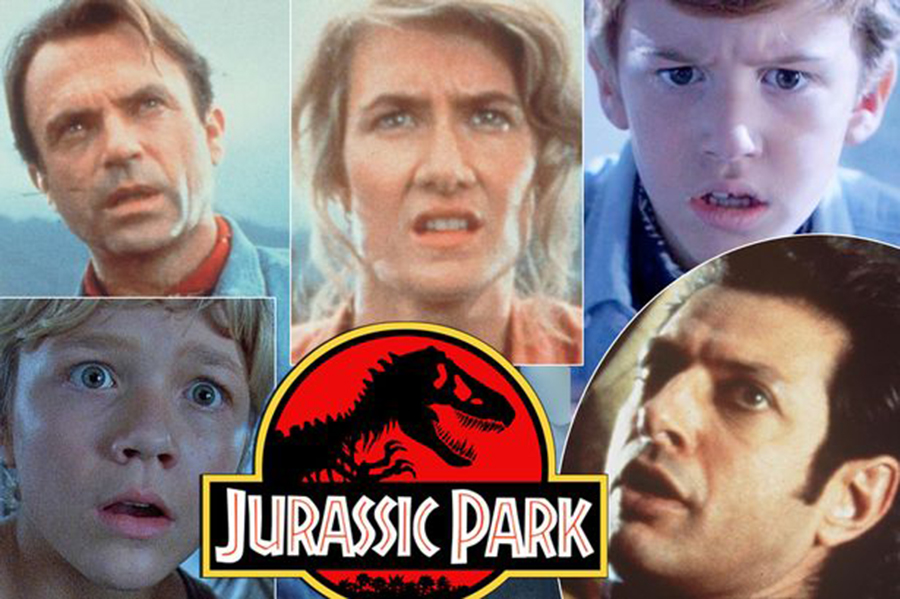
The original Jurassic Park cast.

Bryce Dallas Howard already knows what she wants to see happen in Jurassic World 3 — the reappearance of some of the stars from the original films. “I think there are characters from Jurassic Park who would be really exciting to catch up with and who I’d like to see become part of this adventure again,” she says down the line from Los Angeles.

In this summer’s Fallen Kingdom, Owen Grady (Pratt) and Claire Dearing (Howard) return to Isla Nublar three years after the destruction of the Jurassic World theme park to rescue any remaining dinosaurs on the island from a deadly volcano that threatens to leave them extinct once again. By the end, the dinosaurs that were lucky to escape the catastrophe on Isla Nublar are now living among us. “At the end of Fallen Kingdom we’ve opened Pandora’s Box and it can’t be shut again,” Howard, 37, says. “These animals are out in the world.”

It leads to some intriguing possibilities for director Colin Trevorrow, who will helm Jurassic World 3.

“I’m really excited because Colin and (co-writer) Emily (Carmichael) have been working on the script and already so much of what I’m hearing is really exciting,” she says of the threequel that hits theatres on June 11, 2021.

With the monster hit Fallen Kingdom now available on digital and Blu-ray with over an hour of bonus content, Howard spoke to the Sun about how the series has tried to have empathy for dinosaurs, being part of a franchise that’s a quarter century old and why she’ll always be in Chris Pratt’s corner.


To me, Fallen Kingdom tried to be about something that wasn’t just a straight-up thrill ride. It was making a statement about the other creatures we share the planet with. Did you feel like Fallen Kingdom was a film with something meaningful to say?

Sci-fi movies are always dealing with what-if questions. And, in Jurassic, we’re dealing with what if dinosaurs can be recreated? When Michael Crichton wrote the original book, he coined this phrase ‘syntelligence,’ which basically meant the danger of human beings is our fascination with technology without taking a moment to think through the potential consequences. It doesn’t mean we should stop progress, but we need to be developing and evolving our humanity at a more advanced rate than our technology… Eventually one day we’re going to be posed with this. It might not be dinosaurs, but genetic modification and cloning and a lot of the things that come up in these movies show us we need to think about these things and there are no easy solutions.

The first Jurassic was a massive hit. What was the challenge of coming back to do a sequel for something that was so universally beloved?

Basically it’s as simple as: we didn’t want to fumble, bumble it. What worked about the first one is that everyone involved was such a huge fan of the original and we were being mentored by Steve Spielberg. He knows the overall story and where we’re going with the third one. That gave us the sense that dad’s watching out for us and we’re not on our own.

Is Jurassic World 3 going to be the last one or are there more films planned in the series?

I don’t know if this is going to be the last one of this trilogy or what’s going to happen beyond the third one. But I think overall what’s exciting is this next movie will be the sixth one in the franchise and that represents over 25 years of storytelling.

Maybe we can get more of Jeff Goldblum’s Ian Malcolm, who had a brief cameo in Fallen Kingdom?

Yes, exactly.

Fallen Kingdom is the third biggest movie of the year. Does it blow your mind that the franchise is bigger now than it was when the first Jurassic Park came out in 1993?

Oh man, it’s awesome. I saw Jurassic Park in theatres when I was 12 years old and my son is going to be turning 12 in five months and, for me, as an individual, to get to be a part of this and reliving my childhood fantasies in a way and then to share this story with my own kids is truly idyllic. This is a beautiful chapter of my life. I just don’t want to fumble, bumble it because this is awesome (laughs).

We’re going to see you next year in the Elton John biopic Rocketman. I hear you sing. What else can we expect?

I do sing (laughs). I play Elton’s mother. I don’t want to make any sweeping declarations, but what I can say is it’s a musical that uses Elton’s music to tell us this story of his journey, but it’s done in a way that’s powerful and whimsical and theatrical and full of so much heart and humour. When we were doing the first read through, five minutes in I turned to (director) Dexter Fletcher and I mouthed to him, ‘This is going to work’ (laughs). It’s exciting to be a part of that.

I Googled you before doing this interview and I saw a blurb where you felt the need to defend the actions of Star-Lord, Chris’ character in the Marvel movies, who was accused of helping Thanos win at the end of Infinity War. Tell me about your relationship with him?

I think Chris is a remarkable human being. He’s got a special heart and spirit and he cares deeply about everyone. That’s not typical of someone who has his level of talent and looks like him … it’s a privilege to have this partnership with this person who I really respect.

So now I know why you defended Star-Lord.

Oh, yes, definitely.

______________________

Jurassic World: Fallen Kingdom is available now on Blu-ray and digital.

Source: https://torontosun.com

Somali Cavefish Reveals That First Mammal Survived Dinosaurs by Hiding in the Dark

Friday, October 12, 2018

A Somalian blind cavefish. After evolving for millions of years in darkness, it has lost the capacity to harness light for repairing DNA. Credit: Luca Scapoli

A genetic repair system activated by light turns out to exist in everything from germs to animals – except for mammals and eyeless cavefish in Somalia.

Eyeless fish that evolved for three million years inside caves in Somalia are an unlikely crutch for the theory that early mammals weathered the dinosaur age by going nocturnal. But that is the conclusion from a groundbreaking study of Phreatichthys andruzzii. Alternatively, our earliest ancestors may have burrowed to evade predation.

In either case, our diminutive and very distant forefathers lived in the dark, suggest Haiyu Zhao and colleagues in Current Biology, based on the genetic analysis of cave-dwelling fish.

What do long-isolated fish have to do with early mammals? The first mammals were a rat-like bunch: tiny and defenseless, except perhaps against marauding miniature millipedes. The “age of mammals” only began after dinosaurs almost died out around 65 million years ago (they didn’t go extinct), but in fact mammals and dinosaurs evolved almost in tandem during the Triassic.

So early mammals were already scuttling about some 200 million years ago. They just didn’t go far until the dinosaurs mostly disappeared. Paleontologists have always wondered how the tiny furry little things weathered the dinosaur age.

One mammalian strategy to avoid being eaten by the smaller predatory dinosaurs – assuming that T. rex and its ilk wouldn’t lower themselves to eat proto-rats – might have been to adopt a subterranean or exclusively nocturnal existence. Proto-mammal, the denizen of the night, has long been postulated; now a strange fish has strengthened the theory’s case.

Case of the missing genes

How many millions of years the pinkish, whiskered Phreatichthys lived in the lightless caves of Somalia is unclear – but it’s more than three, say the scientists. And while they were living there, the fish lost a specific system of DNA repair that harnesses visible light energy to fix damaged genetic material, Zhao and the team realized after sequencing it.

“DNA repair systems” are enzymes that fix DNA that gets damaged, for instance by radiation or toxins.

Other fish have this light-driven system; the most primitive of life-forms, bacteria and fungi, have it; reptiles have it; birds have it; worms and geckos have it. But placental mammals, and this fish, do not have it.

Since this DNA repair system lost by Phreatichthys exists in everything from germs to whale sharks, evidently it evolved very early in the scheme of life, and was kept as the single-celled animals evolved into multi-cellular animals. But it was evidently lost in this dark-dwelling fish – and the ancestor of all mammals.

This in turn indicates that its loss was no loss to them. Which in turn indicates that they lived in the dark.

The researchers say that discovering the piscine anomaly in the Somalian cave supports the “nocturnal bottleneck” theory: that ancestral mammals lived a subterranean or exclusively nocturnal existence as a strategy to avoid being eaten.

“We have revealed in a species of blind cavefish the loss of an ancient DNA repair system that is highly conserved,” says Nicholas Foulkes of Karlsruhe Institute of Technology, Germany. “Curiously, the only other animals previously known to lack photoreactivation DNA repair are placental mammals. So, what we see in this species of cavefish may be the first stages in a process that happened before in our ancestors in the Mesozoic era.”

Foulkes’ team, including first author Zhao, in collaboration with Cristiano Bertolucci at Italy’s University of Ferrara, had set out to study evolution in extreme environmental conditions, particularly the evolution of DNA repair systems. They note that Phreatichthys was a fantastic subject for them because the wee fish lived without any exposure to UV or visible light from the sun for more than 3 million years.

By the way, other species of fish discovered living in isolation in cave environments – but not as long as Phreatichthys – have normal, or even enhanced, photoreactivation mechanisms, says the team. But it had a long time to lose those genes.

Among other indications that the earliest mammals were nocturnal are the eyes. A 2012 paper in the National Center for Biotechnology Information journal finds support for the “nocturnal bottleneck” theory in mammalian eye structure.

Night-living vertebrates have big corneas relative to eye size, to enhance their visual sensitivity. Diurnal vertebrates have smaller corneas.

After examining 266 species, the paper concluded that the eye shapes of most diurnal and cathemeral mammals (the latter living by day or night, they don’t care) have eye shapes akin to nocturnal birds and lizards.

Humans are an exception to that rule, says that paper: Our eye shapes are like diurnal birds and lizards. That’s good to know. (It’s a case of convergent evolution.)

“Many features of modern mammals, such as the anatomy and function of the eye, show telltale features of a nocturnal life style,” Foulkes says. “It means we can now more confidently predict that mammalian ancestors experienced a prolonged period of evolution in complete darkness.”

Source: www.haaretz.com

Newly Described Fossils Could Help Reveal Why Some Dinos Got So Big

Thursday, October 11, 2018

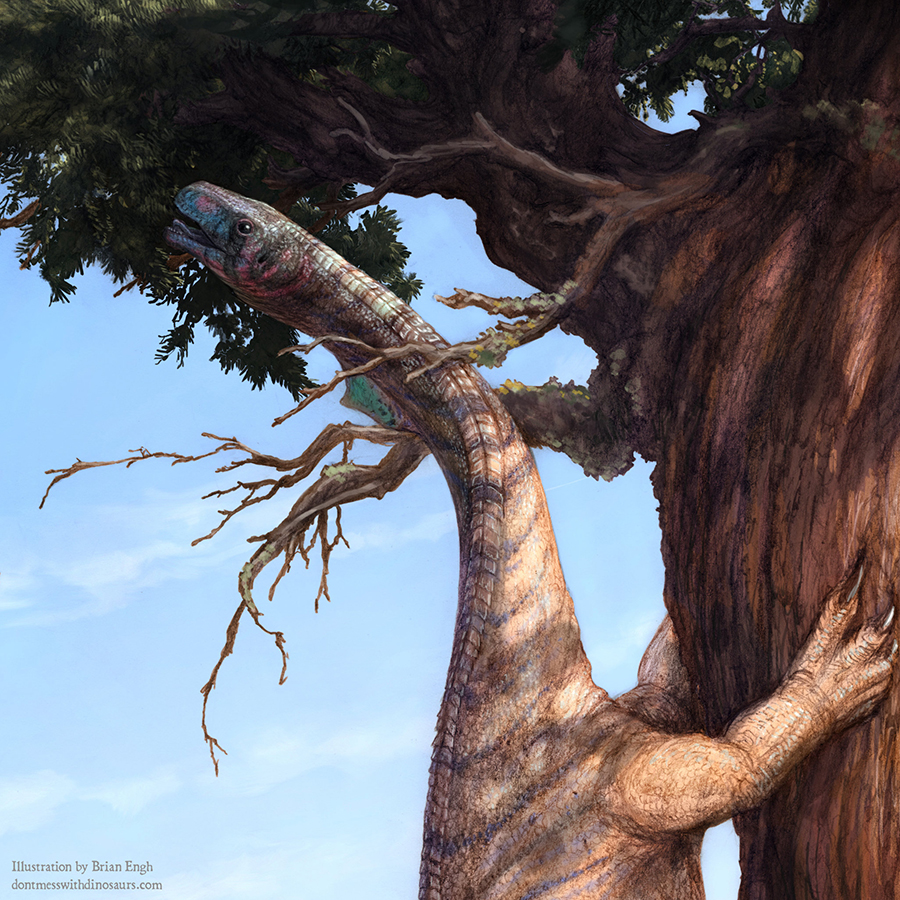
Artist's interpretation of Sarahsaurus aurifontanalis. The dinosaur was about the size of a car and had powerful forelimbs with large claws. It lived during the Early Jurassic in North America. Credit: Brian Engh

By the time non-avian dinosaurs went extinct, plant-eating sauropods like the Brontosaurus had grown to gargantuan proportions. Weighing in as much as 100 tons, the long-neck behemoths are the largest land animals to ever walk the earth.

How they grew so large from ancestors that were small enough to be found in a modern-day petting zoo has remained a mystery. A new, in-depth anatomical description of the best preserved specimens of a car-sized sauropod relative from North America could help paleontologists with unraveling the mystery.

Adam Marsh, a paleontologist at Petrified Forest National Park, led the description of the dinosaur while earning his master's degree from The University of Texas at Austin Jackson School of Geosciences. The findings were published on Oct. 10, 2018 in the journal PLOS ONE. Marsh co-authored the paper with his advisor, Jackson School Professor Timothy Rowe.

The dinosaur—called Sarahsaurus aurifontanalis — lived about 185 million years ago during the Early Jurassic. It could hold important clues about sauropods' size because it belonged to the dinosaur grouping that preceded them. Its evolutionary placement combined with the exquisite preservation of the specimens is giving researchers a detailed look into its anatomy and how it relates to its larger cousins.

"Sarahsaurus preserves in its anatomy the anatomical changes that were happening in the Late Triassic and Early Jurassic that were occurring in the evolutionary lineage," Marsh said. "It can help tell us how getting big happens."

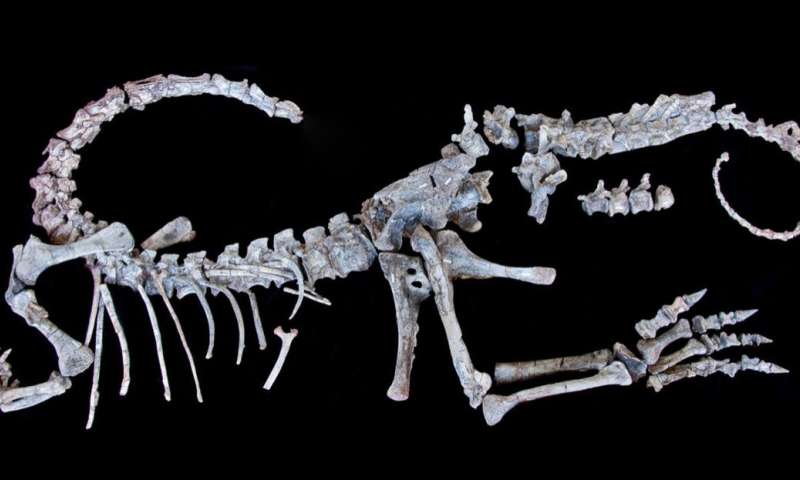
The description is based on two skeletons discovered in Arizona by Rowe in 1997. The bones belong to the Navajo Nation, which owns the land where the fossils were discovered, and are curated by the Jackson School Museum of Earth History Vertebrate Paleontology Collections. The bones are slightly crushed, and in some cases still linked together into body parts such as the hand and tail. The only major missing part is the skull.

Nearly complete skeleton of Sarahsaurus aurifontanalis; the only major missing piece is the skull. Paleontologist Adam Marsh used this skeleton and one other to describe the anatomy of Sarahsaurus. Credit: The Jackson School Museum of Earth History Vertebrate Paleontology Collections / The University of Texas at Austin.

"The specimens are well preserved in three dimensions and remarkably complete, which is very rare in the fossil record," said collections Director Matthew Brown. "Such complete specimens help paleontologists better understand the fragmentary and incomplete fossils remains we typically find."

Marsh describes Sarahsaurus as a "ground sloth-like" dinosaur. It stood upright, walked on its hind-legs and had powerful forelimbs with a large, curved claw capping the first finger of each hand. It had a lot in common with the earliest sauropod ancestors—like walking on two legs—but it was also starting to show features that would foreshadow how its massive relatives would evolve—such as an increase in body size and a lengthening of the neck vertebrae.

"It's starting to gain the characters of getting large compared to the earliest members of the group," Marsh said.

Size and neck-length are features that sauropods would take to extremes as they evolved. By studying these traits and others in Sarahsaurus, and seeing how they compare to those of other dinosaurs, scientists can help reveal how these changes occurred across evolutionary history and how different dinosaurs relate to one another.

For example, the anatomical review helped clarify the relationship between Sarahsaurus and two other sauropod relatives that lived in North America during the Early Jurassic. The researchers found that the three don't have a common North American ancestor—instead they evolved from dinosaur lineages that came to North America independently.

Marsh is currently working on another study that could shed more light on how sauropods evolved. Led by Sterling Nesbitt, an assistant professor at Virginia Tech and research associate at the Jackson School's vertebrate collections, the project involves tracking anatomical differences in dinosaur limb bones to determine which features relate to evolution and which relate to the age of an animal. Marsh said that the two Sarahsaurus skeletons examined for this paper are a great addition to the project.

"We've got two individuals from basically the same hole in the ground with different bumps and grooves on their femora," Marsh said. "It lends itself really well to this comprehensive anatomical description and it's going to be really important for comparisons of early dinosaur anatomy."

Source: https://phys.org

Scientists’ Experiments Could Make Jurassic World A Reality

Wednesday, October 10, 2018

Scientists are experimenting with a gene editing tool that could bring extinct animals back to life, making “Jurassic World,” Hollywood’s blockbuster film about dinosaurs come back to life, a reality.

The Crispr gene-editing tool contains the Cas9 gene, permitting scientists to edit genes with DNA from extinct creatures, according to The Wall Street Journal. The tool also allows researchers to edit the DNA of eggs, sperm and embryos, meaning scientists can affect the evolution of species.

“Crispr put de-extinction on the plate,” said American scientist Ben Novak, who has worked on a de-extinction project for the past six years, according to WSJ. Novak hopes to bring back the passenger pigeon, which went extinct in 1914. Thirteen baby pigeons sit at a facility in Melbourne, Australia, where Novak hopes to edit their DNA with genetic material that will bring the extinct bird back to life.

Harvard Medical School geneticist George Church also seeks to bring back an extinct creature. Church, who aims to revitalize the woolly mammoth species, has used ancient bones to sequence part of the mammoth’s genome by extracting DNA from mammoth remains. Woolly mammoth’s disappeared between 14,000 and 10,000 years ago, largely because of changing climate and human hunting.

Church hopes to create a hybrid that will share both the attributes of the extinct woolly mammoth and the Asian elephant.

Crispr has allowed scientists to create chicken and dairy cattle that are immune to disease, and mice have long been used in gene-editing research. Pigs edited with the Crispr tool are being used in research on kidney development. Researchers in China and the U.S. have also edited out gene mutations in human embryos.

Crispr and gene-editing technology, however, “doesn’t mean you are going to end up with an animal that behaves like a passenger pigeon or a woolly mammoth,” said ecology and evolutionary biology professor Beth Shapiro. She teaches at the University of California, Santa Cruz and authored the 2016 work, “How to Clone a Mammoth.”

Source: https://thelibertarianrepublic.com

Dinosaur Eggs Unearthed in Chinese City With History of the Giant Reptiles

Wednesday, October 10, 2018

Construction crew stumbles on fossilised nest identified as belonging to the Cretaceous period.

More than a dozen fossilised dinosaur eggs have been discovered at a construction site in the eastern province of Zhejiang, an area with a history of unearthing relics of the ancient reptiles.

According to local newspaper Zhezhong News, the giant eggs were uncovered when a construction crew was digging around in the city of Yiwu.

The eggs were sent to the Zhejiang Museum of Natural History on Friday where geologist Du Tianming said they dated from the Cretaceous period, between 145.5 million to 66 million years ago.

“We have found 15 intact dinosaur eggs so far,” said Du.

The Cretaceous period followed the Jurassic period, which most people think of as the age of the dinosaurs. In fact most animals and plants which lived in the Cretaceous period – including dinosaurs – went extinct, after which mammals began to rule the world.

Yiwu is famous as a manufacturing and exporting hub for wholesale merchandise such as socks or plastic flowers, but it is also capitalising on its association with dinosaurs.

Last year a dinosaur-themed water park opened in Yiwu and another one is currently under construction at Guanyintang, the part of Yiwu where, coincidentally, the latest clutch of dinosaur eggs was discovered.

Since dinosaur eggs were first discovered in the area in 1993, scientists have found more than 100 in Yiwu, according to the local authorities. Footprints of the reptiles were also found in the area last year.

Source: www.scmp.com

Models of Dinosaur Movement Could Help us Build Stronger Robots and Buildings

Wednesday, October 10, 2018

Researchers are using computer simulations to estimate how 11 different species of extinct archosaurs such as the batrachotomus might have moved. Credit: John Hutchinson

From about 245 to 66 million years ago, dinosaurs roamed the Earth. Although well-preserved skeletons give us a good idea of what they looked like, the way their limbs worked remains a bigger mystery. But computer simulations may soon provide a realistic glimpse into how some species moved and inform work in fields such as robotics, prosthetics and architecture.

John Hutchinson, a professor of evolutionary biomechanics from the Royal Veterinary College in Hertfordshire, UK, and his colleagues are investigating the locomotion of the earliest, small dinosaurs, as part of the five-year-long Dawndinos project which began in 2016.

"These dinosaurs have been hugely neglected," Prof. Hutchinson said. "People – including me – have mostly been studying the celebrity dinosaurs like T. rex."

About 225 million years ago, during the late Triassic period, these small dinosaurs were in the minority, whereas the bigger crocodile-like animals that lived alongside them were more numerous and diverse. Dinosaurs somehow went on to thrive while most other animals from that period became extinct.

Compared to their quadrupedal, heavy-built contemporaries, what stands out about these early dinosaurs is that they had an erect posture and could, at least intermittently, walk on two limbs. One theory is that their style of locomotion gave them a survival edge.

"The idea of this project is to test that idea," Prof. Hutchinson said.

The team has started to develop computer simulations to estimate how 11 different species of extinct archosaurs – the group of animals that includes crocodiles, birds, their relatives and dinosaurs – might have moved. They will focus on five different types of motion: walking, running, turning, jumping and standing.

Simulations

To test whether their simulations are accurate, the researchers plan to give the same treatment to their living relatives – crocodiles and birds – as well. They will then compare the results to actual measurements of motion to determine how good their computer models of extinct animals are.

"It will be the first time we ground-truth (test with empirical evidence) these methods very rigorously with the best possible data we can get," Prof. Hutchinson said.

So far, they've modelled the movement of a Mussaurus – an early cousin of giant plant-eating sauropod dinosaurs such as Brontosaurus. The Mussaurus was much smaller and researchers wanted to see whether it moved on four legs like its larger relatives. The first reconstructions of the animal had it on four legs because it had quite big arms, said Prof. Hutchinson.

Using scans of well-preserved fossils from Argentina, they were able to produce new models of its movement. Prof. Hutchinson and his team found that it was in fact bipedal. It couldn't have walked on four legs since the palms of its front limbs faced inwards and the forearm joints weren't capable of rotating downwards. Therefore, it wouldn't have been able to plant its front legs on the ground.

"It wasn't until we put the bones together in a 3-D environment and tried playing with their movements that it became clear to us that this wasn't an animal with very mobile arms and hands," Prof. Hutchinson said.

Robotics

The simulations produced during the project could be useful for zoologists. But they could have less obvious applications too, for example, helping to improve how robots move, according to Prof. Hutchinson.

Accurate models are needed to replicate the motion of animals, which robotics researchers often take inspiration from. Mimicking a crocodile, for example, could be of interest to create a robot that can both swim and walk on land.

Prof. Hutchinson also regularly gets contacted by film and documentary makers who are interested in using his simulations to create realistic animations. "It's hard to make bigger, or unusual, animals move correctly if the physics isn't right," Prof. Hutchinson said.

Understanding the locomotion of the very largest dinosaurs is the aim of a project being undertaken by paleobiology researcher Alexandra Houssaye and her colleagues from France's National Centre for Scientific Research and the National Museum of Natural History in Paris. Through their Gravibone project, which began last year, they want to pin down the limb bone adaptations that allow large animals to carry a heavy skeleton.

"We really want to understand what (bone features) are linked to being massive," Dr. Houssaye said.

Massive

So far, research has shown that the long bones in the limbs of bigger animals are more robust than those of smaller animals. But this general trend has only been superficially observed. The outer and inner  structures have adapted over time to help support animals' weight. For example, whereas smaller terrestrial animals have hollow limb bones, massive ones like elephants, rhinos and hippos have connective tissue in the middle.

Among the largest animals and their ancestors there are also other differences. The limb bones of modern rhinos, for example, are short and heavy. But their prehistoric relatives called Indricotherium, one of the largest land mammal that ever lived, had a less stocky skeleton. "It's interesting to see that the biggest didn't have the most massive (frame)," Dr. Houssaye said.

The team is studying both living and extinct animals, focussing on elephants, rhinos, hippos, prehistoric mammals and dinosaurs such as sauropods – a group that includes the biggest terrestrial animals of all time.

So far, they have compared the ankle bones of horses, tapirs, rhinos and fossils of rhinos' ancestors. They found that for animals of the same mass there were differences depending on if they were short and stout or had longer limbs. In less stocky animals, the two ankle bones tended to be more distinct whereas they were more strongly connected in those that were massively built, probably to reinforce the articulation.

"It's not only the mass (of the animal) but how the mass is distributed on the body," said Dr. Houssaye. "For us that was interesting."

3-D modelling

Their next step will be to scan different limb bones and analyse their inner structure. They will also use 3-D modelling to figure out how much weight different parts of the bones can handle in different spots, for example.

The results from the project could help make more efficient prosthetics for people and animals, Dr. Houssaye said. Designers will be able to better understand how different features of limb bones, such as thickness and orientation, relate to their strength, enabling them to create materials that are lighter but more resistant.

Similarly, Dr. Houssaye has also had interest from the construction industry which is looking for new types of materials and more effective building techniques. Pillars supporting heavy buildings, for example, could be made using less material by improving their inner structure instead.

"How a skeleton adapts (to heavy weight) has implications for construction," Dr. Houssaye said. '(Architects) are trying to create structures that are able to support heavy weight."

Source: https://phys.org

Dino Dig: Oklahoma Students Get Rare Opportunity to Study Fossils

Tuesday, October 9, 2018

Dino dig: Oklahoma students get rare opportunity to study fossils (KTUL)

School districts all over the country are going all out to get students interested in the sciences, and it turns out that Oklahoma has one of the best opportunities in the entire nation.

It’s a real Jurassic park.

Starting in January, school and youth groups can request to visit a dinosaur dig in Cimarron County, where they can dig for dinosaur bones and learn about the region’s history.

For three million years, the Cimarron River system has been cutting canyons in the western tip of the panhandle.

That's created unexpected beauty, that's different from the rest of our state and worth the trip to experience.

You can see dinosaur tracks in the creek bottoms and literally touch a different world with very different wildlife.

Fossils from those animals are found at the dig site.

Dr. Anne Weil of the OSU Health Science Center said, “We have one from the site that was more like a coyote, that with a crocodilian head and it could run around fast."

The area west of Boise City has provided some of the most impressive exhibits for the University of Oklahoma's Sam Noble Museum.

People from that museum and the OSU Health Science Center will teach young explorers how they are found.

When we visited, some Tulsa Boy Scouts were hunting for fossils in the Jurassic clay.

It's painstaking work that's done with a sharpened chopstick and a paint brush

It got their attention, and they learned it takes some patience.

You don’t just dig up a fossil. You remove everything around it until only the fossil remains.

The experience had the desired effect on the young men.

Boy Scout Ameer Abouhouli said, "It was a really great experience and I might want to be a geologist or something like that when I grow up."

The people who run the site love to see the kids get engaged in the effort and the outdoors.

They understand the need for us all to get away from our video screens.

Dr. Weil said, "I find the digital environment really enthralling. I could be on Facebook a lot of the time."

Putting a plaster cast on a dinosaur bone made these kids forget about video games.

They're also encouraged to forget about where they are working.

The location must be kept secret, to keep thieves away.

Kyle Davies of the Noble Museum said, “They don’t care about the science or anything else, and so they’ll just literally tear the place up trying to find that trophy that they can sell for big bucks somewhere."

Most of the visits for young people are done in the month of June.

While Oklahoma groups get preferential treatment, any youth group can apply.

Dr. Anne Weil schedules the visits and she would love to hear from you.

Source: https://ktul.com

Beginning of Dinosaur Era May Have Been as Explosive as the End

Tuesday, October 9, 2018

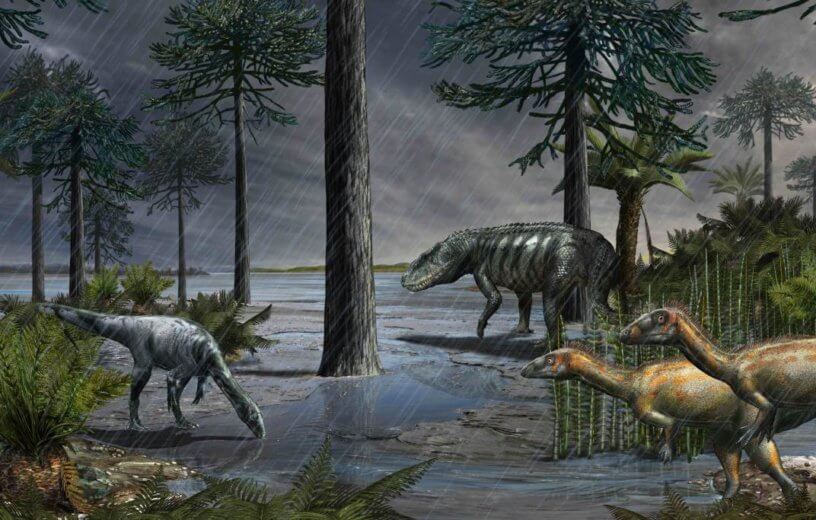
A life-scene from 232 million years ago, during the Carnian Pluvial Episode after which dinosaurs took over. A large rauisuchian lurks in the background, while two species of dinosaurs stand in the foreground, and some rhynchosaurs sit on the logs to the left. Based on data from the Ischigualasto Formation in Argentina. (Credit: © Davide Bonadonna.)

Scientists generally agree that dinosaurs died off as a result of a giant meteor hitting the Earth 66 million years ago, but a recent study now claims the end for the prehistoric creatures may have been no different than their oft-debated beginning.

The coalition of researchers from the United Kingdom and Italy who led the research argue that dinosaurs might not have gotten a foothold on the planet without another mass extinction 232 million years ago. Dinosaurs had already started to evolve by this point, but the mass extinction in question, named the Carnian Pluvial Episode, likely caused the diversification of the dinosaurs that led to their eventual conquest of the planet, the researchers say.

The scientists point to a prevalence of different dinosaur tracks starting in rock formations found in the Dolomites in northern Italy — a stark difference from rocks several million years older. The formations show a sudden explosion in dinosaur tracks within the formations, yielding similar findings to fossils unearthed in Argentina and Brazil and dating to the same period of time.

“We were excited to see that the footprints and skeletons told the same story. We had been studying the footprints in the Dolomites for some time, and it’s amazing how clear cut the change from ‘no dinosaurs’ to ‘all dinosaurs’ was,” explains study co-author Dr. Massimo Bernardi, a research associate at Bristol’s School of Earth Sciences, in a university release.

The point of the explosion of dinosaur tracks occurs at the end of Carnian Pluvial Episode, which scientists say was marked by climates shifting rapidly from dry to humid, and then back to dry, across the globe. It’s believed that massive eruptions in Western Canada led to periods of global warming, acid rain, and the extinction of many species both in land and water.

“The discovery of the existence of a link between the first diversification of dinosaurs and a global mass extinction is important,” notes co-author Mike Benton, a professor at Bristol. “The extinction didn’t just clear the way for the age of the dinosaurs, but also for the origins of many modern groups, including lizards, crocodiles, turtles, and mammals – key land animals today.”

The full study was published April 16, 2018 in the journal Nature Communications.

Source: www.studyfinds.org

A Mysterious Fossil Points to the Origins of Lizards and Snakes

Tuesday, October 9, 2018

The fossil of Megachirella, a 240 million-year-old lizard found in the Italian Alps.CreditCreditMUSE - Science Museum, Trento, Italy

The ancestors of today’s squamates were lost in time. Now paleontologists have identified the earliest known example: Meet Megachirella.

Some 240 million years ago, a storm rolled over the tropical edge of the supercontinent of Pangea and battered the coastal islands. Rain lashed forests of horsetails and ferns, sweeping plants and animals out to sea and burying them in silt.

Among the victims was a small reptile. At the time, it didn’t look like much. But recently in the journal Nature, an international team of scientists identified the animal, called Megachirella, as the earliest known ancestor of the squamates, the group containing lizards, snakes and wormlike amphisbaenians.

With 10,000 distinct species, squamates comprise one of the largest orders of land vertebrates on the planet. They’re found on six continents, have adapted to a dizzying array of habitats and range in size from 25-foot pythons to chameleons smaller than a pencil eraser. Extinct members of the group include massive snakes like Titanoboa and seafaring mosasaurs, which rivaled small whales in size.

Squamates “inhabit almost every single environment,” said Tiago Simões, a paleontologist at the University of Alberta, who coauthored the study. “They learned how to climb on glass, how to swim, how to glide. They can even run over water.”

But the origin of squamates has long been an enigma. The order belongs to a larger group called lepidosaurs, a category that also includes a sister lineage called the rhynchocephalians — represented today only by the humble tuatara, a small reptile in New Zealand.

The two groups diverged from a common ancestor in the distant past, but when and how that happened has been a mystery. Genetic data had long suggested that squamates originated somewhere during the Early Triassic Period, 252 to 247 million years ago, said Adam Pritchard, a paleobiologist at the Smithsonian National Museum of Natural History.

But when it came to fossil evidence, the only lepidosaurs anyone could find from the Triassic Period were the rhynchocephalians. The earliest known squamate fossils hailed from the later Jurassic period, leaving a frustrating 75 million-year gap between the shared ancestor and the appearance of what are now some of the planet’s most familiar animals.

“It’s as if we have definitive evidence of a family that had two siblings,” Dr. Pritchard said. “One sibling, you know a lot about their early life and how they grew up. And the other one, you have no information whatsoever about their childhood.”

At first, Megachirella didn’t appear to offer much insight.

The specimen was found by an amateur fossil hunter in 1999 in an outcrop of limestone in the Dolomite mountains of northern Italy. The slab, which dated to the middle Triassic Period, contained the front half of a small, slightly squashed skeleton with a large head and heavy forelimbs.

The remains were beautifully articulated, but somewhat hard to make out. When scientists formally named it in 2003, they described it as a primitive lepidosaur. Available technology wasn’t sufficient to probe deeper.

But in 2014, Dr. Simões — who specializes in untangling the evolutionary history of living and extinct squamates — came across a paper on the fossil that caught his interest. Looking at the anatomical figures, he knew right away that he was likely looking at a lizard — and a very early lizard.

A life scene in the Dolomites region, Northern Italy, about 240 million years ago, with Megachirella wachtleri walking through the vegetation. Davide Bonadonna

He contacted one of the paper’s authors, Massimo Bernardi, a paleontologist at the Museum of Science in Trento, Italy, and suggested that they run the fossil through high-resolution micro CT scanning in order to better see the compressed bones. Dr. Bernardi, who had been thinking along similar lines, agreed.

Under the high-tech gaze of the scanners, the scientists were able to digitally reconstruct the small crushed bones, picking out fine details of anatomy invisible to the naked eye. They found that portions of the animal’s braincase more closely resembled that of a modern iguana than those of other Triassic reptiles; so did the arrangement of teeth and the lack of perforations in the lower part of Megachirella’s vertebrae.

Even more intriguing were the animal’s wrist bones, shoulders and arms, more characteristic of those seen in living lizards. But Megachirella had some vestigial bits of anatomy that are absent in modern lizards and snakes: gastralia, belly-ribs still found in tuataras and crocodiles, and a small cheek bone called the quadratojugal.

Both Megachirella’s appearance in the middle Triassic and the later remains of rhynchocephalian fossils make a strong case that the earliest squamates emerged toward the end of the Permian, a period 270 million years ago that was abruptly shattered by one of the worst known mass extinctions. At the dawn of the following Triassic Period, over 90 percent of life on the planet had been wiped out.

The surviving animal groups rapidly diversified throughout the emptied world, said Michelle Stocker, a paleobiologist at Virginia Tech. The trees filled with chameleon-like drepanosaurs and eventually with the first pterosaurs; the oceans soon gave rise to the first marine reptiles; archosaurs morphed into bipedal crocodiles and skulking dinosaurs.

Lepidosaurs scurried along in the shadows, undergoing their own explosion in diversity. And while rhynchocephalians fared well for tens of millions of years, Dr. Pritchard said, it now seems that squamates gained on them, becoming even more common and diverse.

Somewhere in the Jurassic, 75 million years after Megachirella, the first recognizable lizards emerged, still bearing some of the anatomical markers of their distant ancestor.

“The Permian extinction opened the way for the origin of these lineages, and opened up opportunities for colonizing land and sea,” Dr. Simões said.

“A lot of the modern fauna in the world today — in terms of reptiles especially — originated at some point in the Triassic,” he added. “The first mammals are from the Triassic, the first dinosaurs are from the Triassic, and now we know the first lizards are from the Triassic, too.”

Megachirella’s mixture of archaic and modern anatomy is also a clue to which of today’s lizard families were the first to emerge, Dr. Simões said. This is a contentious topic. Since 2014, DNA-based family trees have suggested that geckos, of all things, were the earliest group of modern lizards to evolve.

But scientists who looked primarily at fossils championed the large and diverse iguanian family — a group that includes chameleons, iguanas and agamas — as the earliest modern lizards. Dr. Simões incorporated data from Megachirella’s anatomy into a larger data set he had assembled by studying squamate species from 50 museum collections in 17 countries. The resulting tree suggested that geckoes were indeed the first of the surviving lizard families to emerge, in the Jurassic period (though there’s no evidence they acquired their distinctive toe-pads until the Cretaceous period).

Iguanian fossils show up in the Cretaceous, and the genetic data groups them closely with monitor lizards and snakes, Dr. Simões said. By the end of the Cretaceous, the rhynchocephalians had all but vanished, leaving only the tuatara. But the squamates continued to diversify into their present array of forms.

“The amazing thing is that those few surviving lineages became very diverse,” Dr. Simões said. “Imagine how diverse the world must have been in the Mesozoic, with all the uncut branches of the reptile family tree still around.”

For Dr. Stocker, part of the value of Megachirella lies in the fact that so much information was pulled from its bones long after the fossil was discovered and described — a testament to the value of the dusty specimens lying in museum collections worldwide.

“Even the information we can get out of a fossil today, it might pale in comparison to what technology might let us understand about that extinct animal in the future,” Dr. Stocker said. “So it’s important that we take care of these fossils now for future researchers.”

There are still a lot of questions about both Megachirella and the winding path that squamates took to the present day. After all, a huge gap remains in the family history, and many extinct types have unclear links to modern species.

“We have more time between Megachirella and the other squamates than between humans and the last dinosaurs,” Dr. Simões said. “Explore the first 75 million years of any other family and you see an amazing amount of diversity in body plans and types.”

“If we keep looking in this period, we’re going find amazing things that we never dreamed of, or things that we never thought lizards could do.”

Source: www.nytimes.com

Pages