nandi's blog

Dinosaur Extinction Drove Pulses of Fish Diversification

Saturday, October 13, 2018

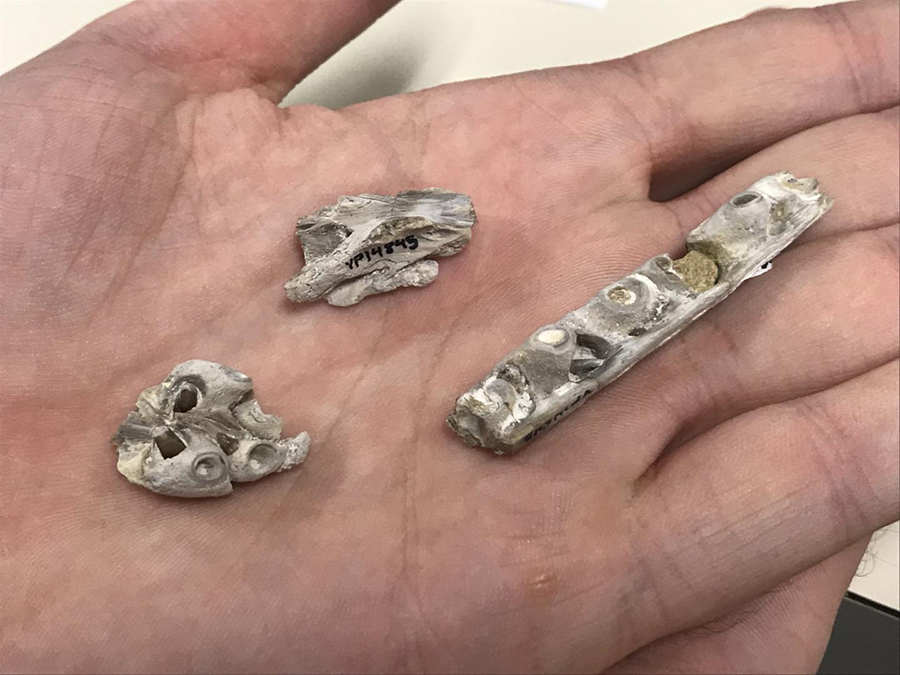
Selected 50-million-year-old microfossil fish teeth and shark scales (center) from the study site. The scale bar is 500 microns. Teeth imaged by E. Sibert on the Hull Lab Imaging System at Yale University.

A research team has found new evidence that fish rapidly evolved in two phases following the Cretaceous-Paleogene (K/Pg) mass extinction that occurred 66 million years ago.

The team, which included Yale’s Pincelli Hull, made the discovery by examining microscopic fish teeth preserved in sediments buried deep in the bottom of the Pacific Ocean. Elizabeth Sibert of Harvard led the research, which appears in the journal Proceedings of the Royal Society B.

“What most people don’t realize is that there is a huge number of fossils that capture changes across important events in the past, such as mass extinctions, but we often lack the technology to rapidly pull information from fossils,” Hull explained. “In my lab we’ve developed a way of rapidly extracting information about morphology from fossils. We worked with Dr. Sibert and colleagues to apply this method to the problem of understanding how the Cretaceous-Paleogene mass extinction affected fish evolution.”

Source: https://news.yale.edu

Guess What These Young Dinosaurs Ate When Their Parents Weren't Looking

Saturday, October 13, 2018

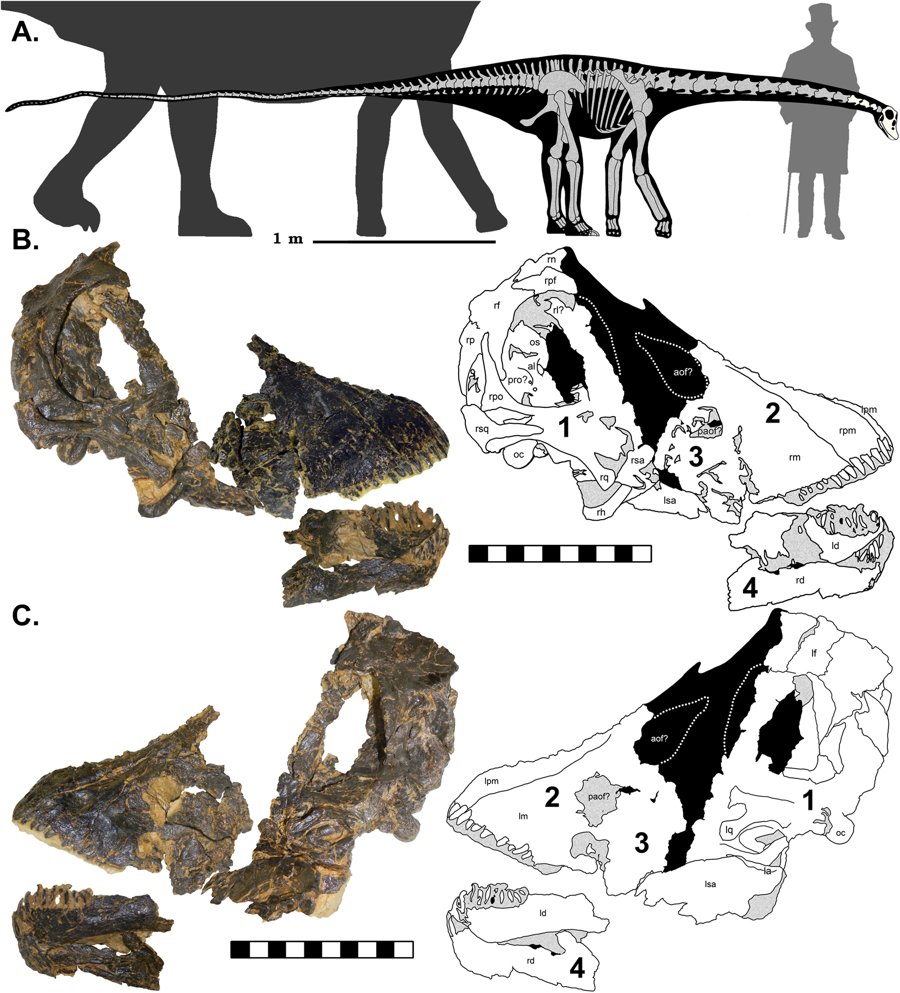
Skeletal reconstruction of CMC VP14128 to scale with a mature D. carnegii (dark grey). Grey bones are missing, while those in ivory are those present in CMC VP14128. Skeletal reconstruction based on the Diplodocus by S. Hartman. Silhouettes by S. Hartman and PhyloPic, modifications made. Skeletal reconstruction of CMC VP14128 redrawn from D. carnegii skeletal by S. Hartman. Human scale is Andrew Carnegie at his natural height of 1.6 m. Skeletal and silhouettes to scale. (B) CMC VP14128 in right lateral view with accompanying schematic. (C) CMC VP14128 in left lateral view with accompanying schematic. Schematics by DCW. The four portions of the skull numbered on accompanying schematics. Lateral views and schematics to scale. a: angular, al: alisphenoid, aof: antorbital fenestra, d: dentary, f: frontal, h: hyoid, l: lacrimal, m: maxilla, n: nasal, oc: occipital condyle, os: orbitosphenoid, p: parietal, paof: preantorbital fenestra, pf: prefrontal, pm: premaxilla, po: postorbital, pro: prootic, q: quadrate, sa: surangular, sq: squamosal. L and r before bone denotes if it is left or right. Credit: Scientific Reports (2018). DOI: 10.1038/s41598-018-32620-x

Imagine a crew of hungry toddlers and kindergartners with unrestricted access to the kitchen. Would they gorge themselves on candy, chips and ice cream?

For a type of fast-growing youngster that lived 150 million years ago, the answer instead was a diverse, nutritious diet, rich in tender greens.

That finding resulted from the discovery of a rare juvenile dinosaur skull belonging to one of those familiar, long-necked plant-eaters called sauropods. Unlike adults of this particular species, called Diplodocus, the young dinosaur had two different kinds of teeth—pencil-like teeth in the front, and flatter, spatulalike chompers in the back.

The dino's dental diversity and narrow snout allowed it both to pick out the choicest shoots and chew them to extract as many nutrients as possible, said lead study author D. Cary Woodruff, a Ph.D. student at the Royal Ontario Museum and the University of Toronto.

Proper nutrition would have been essential to fuel fast growth for the animals, which hatched from a cantaloupe-size egg and reached a staggering 60 feet in length by the time they were teenagers, he said.

"We're thinking of it like a mouth with a Swiss Army knife," Woodruff said.

Adults, on the other hand, had only the pencil-like front teeth, set in a wider, vacuum-shaped snout, suggesting they raked up vegetation indiscriminately and swallowed it without chewing, said Woodruff, who collaborated with researchers from Princeton University and the Cincinnati Museum Center, among other institutions. And given their different diets, adult and juvenile sauropods likely were eating apart from one another, Woodruff and his coauthors wrote in the journal Scientific Reports.

Peter Dodson, a prominent University of Pennsylvania dinosaur expert who was not involved with the research, said the skull was an important find. He agreed that the young dinosaur's two kinds of teeth would have enabled the animal to feed itself—coupled with a narrow snout for selective extraction of the most tender, easy-to-digest plants.

Good thing, because if young sauropods had relied on their massive, 100-foot-long parents for handouts, they would have been in danger, said Dodson, a professor in Penn's School of Veterinary Medicine as well as its department of earth and environmental science.

"It seems like a pretty fair bet that there wasn't parental care," he said. "They could've been stepped on without the parent knowing it."

Dinosaur-hunters get excited when they find a sauropod skull, as the bones from the heads of these massive animals were delicate and often did not survive the ravages of time. As a result, many museum skeletons of Diplodocus and other sauropods are completed with a cast from the skull of a different dinosaur—sometimes not even the same species.

The skull Woodruff analyzed—found in a Montana quarry by study coauthor Glenn Storrs, of the Cincinnati Museum Center—is especially unusual for its completeness and the fact that it came from such a young animal.

Woodruff estimated that the creature was 2 to 4 years old when it died. Even at that tender age, its skull was already 9 inches long, with a body stretching at least 15 feet from head to tail.


More information: D. Cary Woodruff et al. The Smallest Diplodocid Skull Reveals Cranial Ontogeny and Growth-Related Dietary Changes in the Largest Dinosaurs, Scientific Reports (2018). DOI: 10.1038/s41598-018-32620-x

Source: https://phys.org

Is This $48 Inflatable Dinosaur Costume Worth It?

Saturday, October 13, 2018

YES!

I am a nightmare Halloween dad because I am too cheap to buy my children new costumes every year, but I’m also too lazy to help them make fresh homemade ones. Five minutes of doing crafts ages my spine three years, and so my children are eternally nagging me to suck it up and plunk down $50 for some piece of shit costume at Spirit Halloween that is almost certainly coated in 100 layers of asbestos.

But this year, my 12-year-old daughter struck upon a tidy compromise, in which she offered to PAY for her own Halloween costume. You might think it’s monstrous to take money from a child for the simple right to have a nice outfit for trick-or-treating, but I am not plagued by such crises of consciousness. Besides, I’m the one who GAVE her allowance in the first place. Really, all I did was make a deposit on her future purchases.

For this Halloween, my daughter asked to buy an inflatable dinosaur costume, specifically this one, which costs $48 over at Amazon, depending on which size you get. You’ve likely seen this costume out in the wild, either on YouTube, or maybe from the time a Broncos cheerleader dressed as one for her squad’s routine.

I have no idea who invented the inflatable dinosaur costume. I have no idea why dinosaurs became the inflatable Halloween mascot of choice. All I know is that my daughter wanted one, and she had the dough, and so I let her buy it. I also told her not to break it before Halloween, but I already know that directive will go unheeded.

Anyway, my daughter spends the next few days incessantly asking if the package has arrived yet, because the bulk of childhood in 2018 consists of your little ones tracking some goddamn Amazon package, then ordering something else and repeating the process all over again. It finally comes and she immediately jumps into it.

Lemme tell you people something: that costume was worth EVERY GODDAMN PENNY. Every last one. If it had cost $70, I wouldn’t have even been mad. The second your child walks into the kitchen dressed as a fucking eight-foot dinosaur, all your problems fade away. It’s so breathtakingly, wonderfully stupid. I can’t get enough. She set the table in the costume the other night and I nearly died laughing. The girl even found a second use for the costume when she wore it to some protest the other day. NO ONE CAN IGNORE A DINOSAUR PROTESTER. Your voice will be heard, I assure you.

Of course, the real reason my kid got this costume was so she could make videos with it and rack up sweet likes from all her online friends. And so it has come to pass. Here’s a video of me in a bear costume (I had one lying around) fighting with her to settle the age old dispute of BEAR VERSUS DINOSAUR. Behold!

I’m gonna buy a dozen more of these things. If Trump conducted the rest of his presidency in one, I would vote for him.

Source: www.gq.com

Scientists Find 99 MILLION-YEAR-OLD Snail in Dinosaur-Era Amber

Saturday, October 13, 2018

PRESERVED: The soft tissue that makes up the snail's body was still intact. CHINA UNIVERSITY OF GEOSCIENCES

An international team of paleontologists announced in Beijing their discovery of a fossilized snail in a piece of amber dating back around 100 million years.

While most of snail fossils retain only the shell, the new discovery is the oldest example of soft tissues, such as the tentacles, of snail preserved in amber, according to Xing Lida, an assistant professor at the China University of Geoscience and leader of the team.

The snail in amber was found at Hukawng Valley in northern Myanmar, an area rich in amber fossil discoveries. Amber can contain different kinds of soft tissues, providing valuable palaeontological information.

"The pair of tentacles and the eyes of the snail have been preserved intact in the amber," said Xing.

The research was jointly conducted by scientists from China, Britain, Australia, and Canada.

The find is one of the most notable in the history of palaeontology as the soft tissue of the animal was preserved inside the amber.

Most other prehistoric snail discoveries have been of just their shell.

AMBER: The snail was found inside a piece of resin in Burma. CHINA UNIVERSITY OF GEOSCIENCES

The bombshell discovery was discussed this week in a paper by National Geographic explorer Lida Xing that was published in the journal, Cretaceous Research.

Co-author Jeffrey Stilwell called the find “extraordinary” compared to similar fossils uncovered in the past.

Mr Xing said: ”The pair of tentacles and the eyes of the snail have been preserved intact in the amber.”

The age of the snail means it would have been living at the same time as T. rex and Velociraptors during the Cretaceous Period.

The paper states: "The soft parts of the snail are very stretched, and this could represent a final attempt at escape to no avail.

“Given that the snail was seemingly entombed in tree resin while alive, this could account for the pronounced distortion in the preserved soft tissues."


Earlier this year, the perfectly preserved body of a dinosaur-era bird was found in a chunk of amber.

At the time, scientists described it as “game-changing”, saying it gave the clearest picture of avian evolution to date.

The bird measured approximately 2.4ins long and it would have had teeth inside its beak and dark feathers covering its body.


Source: www.dailystar.co.uk / www.xinhuanet.com

Did Mosasaurs Hunt Like Killer Whales?

Saturday, October 13, 2018

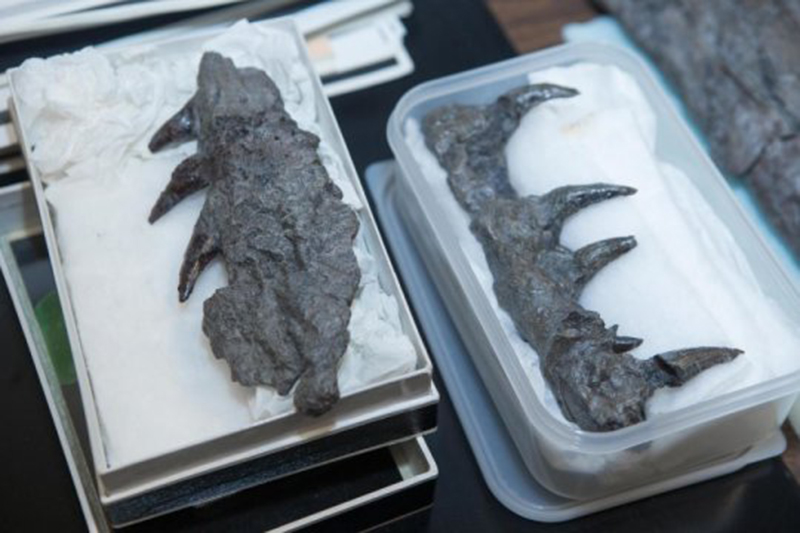
A plaster cast of mosasaur jaws show how sharp and ferocious their teeth were. Credit: Joseph Fuqua II/UC Creative Services

Did prehistoric sea creatures called mosasaurs subdue prey by ramming them with their bony snouts like killer whales do today?

It's a theory that University of Cincinnati biology professor Takuya Konishi proposed after taking a closer look at a newborn fossil specimen for his latest research study. Konishi will present his findings at October's Society of Vertebrate Paleontology conference in Albuquerque, New Mexico.

"Killer whales don't hunt big prey by biting. They hunt by ramming and tearing them apart after the prey is weak," Konishi said. "They are chasing fast-moving animals so they use inertia. If they were swimming full speed at you, they would generate a lot of force. And their snout is conspicuously protruding."

Mosasaur, the unlikely hero of the movie "Jurassic World," was an enormous marine reptile that lived in the time of Tyrannosaurus rex during the Cretaceous Period more than 65 million years ago. They had a similar body shape as today's orcas, with flippers, powerful tails and sharp teeth. Some grew bigger than orcas to nearly the size of a school bus.

Like orcas, they were the apex predators of the seas. The only thing mosasaurs had to fear were bigger mosasaurs.

In a study published this month in the Journal of Vertebrate Paleontology, Konishi re-examined fossils of a newborn mosasaur he first studied in Kansas while working on his master's degree in 2004. About 20 small fragments of skull were unearthed in 1991 by paleontologist Michael Everhart in a rock formation called the Kansas Chalk renowned for marine fossils.

Initially, the specimen was identified as a mosasaur called Platecarpus, a species commonly found in that area during the same period 85 million years ago. The family Mosasauridae features more than 30 genera of species, so identifying a particular specimen from a handful of fossil fragments can be daunting.

"A colleague of mine told me mosasaurs are boring because they all look the same. That's sort of true," he said. "But once you know more about them you can begin to tell them apart."

Some mosasaurs had short, powerful jaws capable of crushing the shells of sea turtles. Others had pointy teeth that suggested they feed mostly on fish.

Konishi was inspired to take a second look after a fellow researcher demonstrated how particular bones called quadrates were not as reliable in identifying species as researchers once thought. The telltale fossils of adults of different species look very similar in juveniles.

In the many years since Konishi first examined the baby mosasaur, he has become an expert on these seagoing lizards, including the largest of them called Tylosaurus. This was the creature that inspired "Jurassic World," a meat-eating monster capable of hunting other mosasaurs and marine reptiles.

In re-examining the skull fragments from the newborn mosasaur, Konishi found it did not resemble other specimens of Platecarpus. While Platecarpus and other mosasaurs have teeth that begin virtually at the tip of their snouts, Tylosaurus has a bony protrusion called a rostrum that extends out from its face like an orca that might have served to protect its front teeth when they slammed into prey.

"It's a subtle feature perhaps by horned dinosaur standards, but for us it really signifies what kind of mosasaur you're looking at," Konishi said. "If you have this protruding snout in this part of western Kansas, you're a Tylosaurus."

Like many other kinds of baby animals today, the baby mosasaur had not yet developed certain telltale features found in adults, Konishi said.

"The degree of snout development was nowhere near that of an adult, which made me look elsewhere such as the braincase to call it Tylosaurus in the end. It was the ugly duckling that hadn't yet become the graceful swan," Konishi said.

Unlike other mosasaur species, Konishi said the tylosaur had broader and more robust facial bones connected to a sturdy cranial vault that would have provided support as a battering ram.

Konishi pulled up a dramatic photo showing a breaching orca pummeling a large dolphin with its snout. The dolphin, a species called a false killer whale, was struck so hard that its body was contorted at a painful-looking angle.

"When orcas hunt dolphins and small whales, they subdue them by ramming them. And when you look at them, you see they have a protruding snout as well," Konishi said.

The fossils represent the youngest and smallest specimen of Tylosaurus ever found. Everhart confirmed to Konishi that the baby mosasaur was found alone with no associated fossils. Mosasaurs didn't lay eggs but gave birth to live young. That suggests the specimen was a free-swimming newborn rather than an embryo when it died, he said.

Just how the baby mosasaur perished is a matter of speculation. Only its skull was found. Konishi said the mosasaur could have succumbed to countless mishaps from predation to accident to disease.

It took a miracle of improbability that the baby mosasaur was found in the first place, he said.

Finding any baby dinosaur, or marine reptile in this case, is extremely rare for the simple reason that baby animals often end up as someone else's dinner. The bones of baby animals are lighter and more likely to scatter. But in this case, bones that weren't chewed up reached the ocean floor where they were covered in sediment and remained for millions of years until the seas receded and the former ocean floor became the wheat fields and farmlands of today's Kansas.

"And luckily an expert on mosasaurs was searching in exactly that spot and had sharp enough eyes to find it -- all separated by about 85 million years," Konishi said.

"Most fossils are fragmentary. You almost never find an entirely articulated fossil in the ground. That's near fantasy," Konishi said. "Luckily, the remaining bones were buried and became fossilized."

Konishi's theory strikes a chord with orca experts such as Ken Balcomb, senior scientist with the nonprofit Center for Whale Research outside Seattle, Washington. Balcomb has been studying orcas for 43 years. He has seen firsthand the myriad clever methods they employ to hunt different prey.

"They pummel their prey quite a bit. They will throw their body against a gray whale. They'll ram great white sharks, too," Balcomb said.

But Balcomb said they're choosy about what and how they attack, often using their flukes or whole body rather than their heads. They even distinguish between different types of prey.

"They know which kinds of seals will fight back," Balcomb said. "So they're cautious. They don't want to get hurt."

Contributing to Konishi's study were Paulina Jiménez-Huidobro and Michael Caldwell, both of the University of Alberta. The study was funded in part by the Natural Sciences and Engineering Research Council of Canada.

Konishi said this better understanding of the development of baby mosasaurs could help scientists learn more about fossils of other baby dinosaurs and marine reptiles that look markedly different from their parents.

"We now have a bit better insight into how this trademark feature evolved in this lineage," he said. "It's a good starting point for more studies in the future."


Story Source:

Materials provided by University of CincinnatiNote: Content may be edited for style and length.


Journal Reference:

  1. Takuya Konishi, Paulina Jiménez-Huidobro, Michael W. Caldwell. The Smallest-Known Neonate Individual of Tylosaurus (Mosasauridae, Tylosaurinae) Sheds New Light on the Tylosaurine Rostrum and HeterochronyJournal of Vertebrate Paleontology, 2018; 1 DOI: 10.1080/02724634.2018.1510835

Source: www.sciencedaily.com

Paleontologist Who Named a Dinosaur 'Dynamoterror' Explains Why He Did It

Friday, October 12, 2018

Dynamoterror was about 30 feet long, hunting prey during the Late Cretaceous. (Western Science Center)

A terrifying meat-eater gets a sweet origin story.

In 2012, a team of paleontologists came across an unprecedented and fearsome discovery in the Menefee Formation in New Mexico. Buried within the ancient slope of shale, coal, and sandstone were the bones of a newly found species of tyrannosaur. Paleontologists officially announced in the journal PeerJ that they’d given this dinosaur a name that lives up to its bad-boy reputation: Dynamoterror dynastes.

Andrew McDonald, Ph.D., a curator at the Western Science Center in California, co-led the excavation that unearthed the D. dynastes. He tells Inverse that when he was a kid he saw the name Dynamosaurus in a magazine and it stuck with him (it is a pretty awesome name). That name isn’t used any more — now we use Tyrannosaurus — but McDonald says that “when my colleagues and I had the chance to name a new tyrannosaur, I wanted to use the Greek word ‘dynamis’ in the name.”

“Terror,” meanwhile, is a familiar Latin word and was fitting enough for a giant meat-eater. McDonald chose “dynastes,” also Latin, because it’s evocative and simply sounded baller. The full name, Dynamoterror dynastes, means “powerful terror ruler.”

“I think for us humans — including paleontologists — tyrannosaurs are among the most imposing and charismatic animals in Earth’s history, and I wanted a name that captured those qualities,” McDonald says.

McDonald and his team believe that this specific tyrannosaur lived around 80 million years ago. Dinosaur fossils from this time period are rarely found in western North America — only one other tyrannosaur has been named from around that time in this region, a massive species called Lythronax. (That carnivore’s name translates to “gore king,” so this new tyrannosaur is in good company.)

Because it’s so unusual to find these dinosaurs from this place and time, the Dynamoterror adds crucial new data on the anatomy and diversity of tyrannosaurs and represents one of the top predators from the Late Cretaceous ecosystem.

In total, the team found right and left frontal bones from the skull, a bone from the right hand, toe bones, and a bone from the left foot. The frontal skull bones are unlike those of other tyrannosaurs, which was a key indication that the team had uncovered something new. The Western Science center has created 3D digital models of these fossils, available for download here and here as a resource for paleontologists and citizen scientists.

“A new tyrannosaur is quite a thrill of all of us,” McDonald says, “of course from a scientific perspective and also simply for its wondrousness.”

Source: www.inverse.com

World’s Oldest Flying Squirrel Fossil Discovered

Thursday, October 11, 2018

Life appearance of the fossil flying squirrel Miopetaurista neogrivensis showing the animal ready to land on a tree branch. Image credit: Oscar Sanisidro / ICP.

An international team of paleontologists has found the world’s oldest flying squirrel fossil — an 11.63-million-year-old specimen of an extinct species called Miopetaurista neogrivensis — at the Abocador de Can Mata site in Barcelona, Catalonia, Spain.

Mammals can walk, hop, swim and fly; a few, like marsupial sugar gliders or colugos, can even glide.

Flying squirrels are the only group of gliding mammals to have achieved a significant diversity (52 species in 15 genera) and wide geographical distribution across Eurasia and North America.

To drift from tree to tree, these small animals pack their own ‘parachute:’ a membrane draping between their lower limbs and the long cartilage rods that extend from their wrists. Tiny specialized wrist bones, which are unique to flying squirrels, help to support the cartilaginous extensions.

The origin of flying squirrels is a point of contention: while most genetic studies point towards the group splitting from tree squirrels about 23 million years ago, the oldest remains — mostly cheek teeth — suggest the animals were already soaring through forests 36 million years ago.

However, recent studies show that the dental features used to distinguish between gliding and non-gliding squirrels may actually be shared by the two groups.

In 2002, Dr. Isaac Casanovas-Vilar of the Universitat Autònoma de Barcelona and colleagues unearthed a peculiar skeleton: first a tail and two thigh bones, big enough that the paleontologists thought it could be the fossil of a small primate.

“Due to the large size of the tail and thigh bones, we initially thought the remains belonged to a primate,” Dr. Casanovas-Vilar said.

“In fact, and much to the disappointment of paleoprimatologists, further excavation revealed that it was a large rodent skeleton with minuscule specialized wrist bones, identifying it as Miopetaurista neogrivensis.”

Combining molecular and paleontological data to carry out evolutionary analyses of the fossil, the researchers demonstrated that flying squirrels evolved from tree squirrels as far back as 31 to 25 million years ago, and possibly even earlier.

In addition, their results showed that Miopetaurista neogrivensis is closely related to an existing group of giant flying squirrels called Petaurista.

Their skeletons are in fact so similar that the large species that currently inhabits the tropical and subtropical forests of Asia could be considered living fossils.

“The problem is that these ancient remains are mainly teeth,” Dr. Casanovas-Vilar said.

“As the dental features used to distinguish between gliding and non-gliding squirrels may actually be shared by the two groups, it is difficult to attribute the ancient teeth undoubtedly to a flying squirrel.”

“In our study, we estimate that the split took place around 31 and 25 million years ago, earlier than previously thought, suggesting the oldest fossils may not belong to flying squirrels.”

“Molecular and paleontological data are often at odds, but this fossil shows that they can be reconciled and combined to retrace history.”

“Discovering even older fossils could help to retrace how flying squirrels diverged from the rest of their evolutionary tree.”

The study is published in the journal eLife.

_____

Isaac Casanovas-Vilar et al. 2018. Oldest skeleton of a fossil flying squirrel casts new light on the phylogeny of the group. eLife 7: e39270; doi: 10.7554/eLife.39270

Source: www.sci-news.com

Dynamoterror dynastes: Newly Discovered Tyrant Dinosaur Stalked Ancient New Mexico

Wednesday, October 10, 2018

Dynamoterror was about 30 feet long, hunting prey during the Late Cretaceous. (Western Science Center)

The Dynamoterror, a relative of Tyrannosaurus rex, lived millions of years before other known species of tyrannosaur.

Tyrannosaurs often bear fierce names. Aside from the “tyrant lizard” Tyrannosaurus itself, there’s the “monstrous murderer” Teratophoneus, the “frightful lizard” Daspletosaurus, and the “gore king” Lythronax. But a new set of tyrannosaur bones extracted from the 80-million-year-old rock of New Mexico may have one of the most imposing names of all—Dynamoterror dynastes, the “powerful terror ruler.”

The remains of Dynamoterror were found in New Mexico’s Menefee Formation in 2012 during an expedition led by Western Science Center paleontologist Andrew McDonald and CEO of the Zuni Dinosaur Institute for Geosciences, Douglas Wolfe. During that year’s field season, expedition volunteer Eric Gutierrez found fragmented bones spilling out of the sandstone.* Dinosaurs are hard to find in this part of the San Juan Basin, making almost any find worth noting, but initial clues indicated that this find was something special.

“We could tell that it was a large theropod from the large fragments of hollow limb bones,” McDonald says, referring to the broader family that tyrannosaurs, ostrich mimic dinosaurs, raptors, birds and others belong to.

Time had not been kind to the bones of Dynamoterror, breaking and scattering the bones. It took years of puzzling together the recovered shards before the critical fragments—a pair of telltale skull bones called frontals—were pieced together, revealing the fossil’s identity as a previously-unknown tyrannosaur. The dinosaur is described in a paper published in PeerJ.

Although the fossil is scrappy, it still adds context to the broader picture of the roughly 25 distinct tyrannosaurs known so far. Not only is Dynamoterror new, but it falls in a specific tyrannosaur subgroup that contains some of the last and largest of the species, like T. rex itself.

T. rex lived between 68 and 66 million years ago, and many of its famous relatives—like Gorgosaurus and Albertosaurus—lived about 75 million years ago. Dynamoterror and its relative Lythronax from Utah are more ancient still, about 80 million years old. “This indicates that derived tyrannosaurs must have arisen at an even earlier date” than previously expected, New Mexico Museum of Natural History and Science paleontologist Thomas Williamson says. The find points to an older, as-yet-unknown diversification of these famous carnivores.
 

A scan of the Dynamoterror skull frontal bones, used to identify the species. (Western Science Center)

In life, McDonald and colleagues hypothesize, Dynamoterror would have been about 30 feet long. Far larger than the earliest tyrannosaurs, though not quite as big as the celebrity T. rexDynamoterror is comparable in size to a few other tyrannosaurs of similar age—large enough to earn top predator status in its ancient realm.

Back in this tyrannosaur’s heyday, McDonald says, “the Menefee would have been much like the swamps and forest of the southeastern U.S.—hot, humid, and lush.” Shovel-beaked hadrosaurs, armored dinosaurs, and horned dinosaurs were some of the neighbors Dynamoterror rubbed shoulders with and likely preyed upon.

What makes Dynamoterror stand out, however, is that it’s another piece in an emerging picture of dinosaur evolution running riot between 80 and 75 million years ago. Back in the Late Cretaceous, North America was split in two by the Western Interior Seaway, a warm stretch of water that washed over the middle of the continent, with the western half known to experts as Laramidia. From the stony records of this subcontinent, paleontologists have been finding a slew of unexpected dinosaurs.

Historic finds in the northern parts of Laramidia, such as modernday Alberta and Montana, revealed rich communities of dinosaurs such as tyrannosaurs, horned dinosaurs, armored dinosaurs and more. Fossils found in southern rocks of the same age were often given the same names as the northern species. But in the past three decades, paleontologists have started to put together a very different picture. New discoveries and fossil revisions have shown that the dinosaurs found in Utah, New Mexico, Texas and Mexico were not the same as those found in the north. If you were to walk from Mexico to Alaska 80 million years ago, you’d find a gradient of different dinosaurs as you hiked along.

Dynamoterror is part of this story, and an important one as it’s from an area with few known fossils. No dinosaurs had been named from the Menefee Formation until earlier this year, when an armored dinosaur called Invictarx was identifiedDynamoterror is now the second, and the fact that it differs from other known tyrannosaurs of a similar age indicates that there were distinct evolutionary pockets along the length of the ancient subcontinent.

The new tyrannosaur also points to what may yet be found. Both Dynamoterror and Lythronax are from southern North America and are about 80 million years old. There seems to be a bias against the preservation of dinosaurs in rocks of this age, Williamson says, but the few and often scrappy fossils that have turned up have indicated that dinosaur diversity was just as rich as it was in the 75-million-year-old rocks where preservation is better.The search is taxing, but it means there are more dinosaurs to dig up.

Some of them will likely be tyrannosaurs. To the north, McDonald says, “roughly contemporaneous rocks have yet to produce diagnostic tyrannosaurid material.” It could very well be that there were other unusual tyrant lizards in northern Laramidia, now entombed in the rocks, waiting to be uncovered and help fill in the picture of how these tyrants came to rule North America.

Source: www.smithsonianmag.com

Want A Super Easy Halloween Costume Idea? This 'Jurassic World' Dinosaur Mask Is Just $16.

Saturday, October 13, 2018

IMAGE: JURASSIC WORLD

Do you like dinosaurs? Are you getting ready for Halloween? Don't have enough time to put a costume together? Well, Amazon can help out with that.

The Jurassic World Indoraptor Halloween Maskimal is available for $16 at Amazon, which is $8.98 off the list price of $24.98.

A mask like this is pretty much all you need to make a decent, and fairly topical Halloween costume: 

IMAGE: JURASSIC WORLD

You can thank us later. :)

Smallest ever Tylosaurus fossil sheds light on species

Friday, October 12, 2018

This photo shows from left to right a partial snout with teeth and tooth bases, partial braincase, and a section of upper jaw with tooth bases.  CREDIT Credit: Ms. Christina Byrd, Paleontology Collections Manager at the Sternberg Museum of Natural History in Hays, Kansas.

The smallest Tylosaurus mosasaur fossil ever found has been revealed in a new study in the Journal of Vertebrate Paleontology and surprisingly it lacks a trademark feature of the species.

The fossil, likely to be that of a newborn, does not have the recognizable long snout typically seen in the species. The lack of this snout initially perplexed researchers, who struggled to identify which group of mosasaurs it belonged to.

After examining and comparing the fossil to young specimens of closely-related species, such as T. nepaeolicus and T. proriger which already had identifiable noses, researchers finally deemed it to be a young Tylosaurus.

Lead author Professor Takuya Konishi, of the Department of Biological Sciences at the University of Cincinnati said, "Having looked at the specimen in 2004 for the first time myself, it too took me nearly 10 years to think out of that box and realize what it really was--a baby Tylosaurus yet to develop such a snout.

For those 10 years or so, I had believed too that this was a neonate of Platecarpus, a medium-sized (5-6m) and short-snouted mosasaur, not Tylosaurus, a giant (up to 13m) mosasaur with a significantly protruding snout."

The lack of snout in the baby specimen found suggests to researchers that the development of this feature happens extremely quickly, between birth and juvenile stage - something that previous studies on the species had failed to notice.

Konishi further commented, "Yet again, we were challenged to fill our knowledge gap by testing our preconceived notion, which in this case was that Tylosaurus must have a pointy snout, a so-called 'common knowledge.'

As individual development and evolutionary history are generally linked, the new revelation hints at the possibility that Tylosaurus adults from much older rock units may have been similarly short-snouted, something we can test with future discoveries."

The fragments found include a partial snout with teeth and tooth bases, partial braincase, and a section of upper jaw with tooth bases. From this, they can estimate the entire baby skull to have been around 30cm (1ft) in total.

Tylosaurus belong to one of the largest-known groups of mosasaurs, up to 13m long, the front 1.8 m of that body being its head. The baby, therefore, was about 1/6 the size of such an adult.

Michael J. Everhart, a Kansas native and a special curator of paleontology at the Sternberg Museum of Natural History, Hays, Kansas, found the tiny specimens in 1991 in the lower Santonian portion of the Niobrara Chalk, in Kansas, which are now housed at the museum. The paper was co-authored by Paulina Jiménez-Huidobro and Michael W. Caldwell of the University of Alberta, Canada.

Source: www.eurekalert.org

Pages