nandi's blog

Jurassic World is Getting a Surprise Prequel... in LEGO

Tuesday, November 13, 2018

©  NBC UNIVERSAL

The two-part special will air on NBC later this month.

Surprise! Jurassic World is getting a prequel film entirely made of LEGO.

Courtesy of NBC Universal, LEGO Jurassic World: The Secret Exhibit will air on NBC in the US on November 29 and will be available to stream thereafter, with a DVD release scheduled for January next year.

The two-part prequel will give viewers a chance to see Owen Grady and Claire Dearing's early interactions — although as neither will be voiced by Chris Pratt or Bryce Dallas Howard respectively, we're not entirely sure how the story will fit into the canon, if at all.

It will, however, see Owen and Claire work together to round up the dinosaurs for display in Jurassic World, and will even feature Owen's first encounter with Blue.

A synopsis (via SlashFilm) for the prequel reads:

"With the grand opening of Jurassic World's new super-secret dinosaur exhibit just days away, only one thing is missing – the dinosaurs! In order to get the job done, Simon Masrani enlists his newly-hired assistant, Claire Dearing, to ensure the new attraction opens on time…or else.

"Unfortunately, Owen Grady, the animal behaviourist Claire hired to deliver the dinosaurs, is late. Things aren't looking too good for Claire…or for Owen, who just wants to deliver the dinosaurs, collect his paycheck and get off the island.

"But the mission to deliver the dinosaurs turns out to be far more difficult than anyone could have imagined. From a runaway Gyrosphere, hang gliding with a Pteranodon (how did they get out of the Aviary?!), to a high-speed game of chicken with a T. rex, Owen will earn his paycheck and then some. And Claire may just get promoted to Assistant Manager of Park Operations.

"Along the way, we get the first inklings of why Owen and Claire drive each other crazy, but despite their differences, they succeed and make a great team. Oh, and Owen meets Blue for the first time as he discovers he has a way with dinosaurs he never knew about!"

With the release of Jurassic World: Fallen Kingdom earlier this year and a third as-yet-untitled Jurassic World movie on the way, it seems an odd choice to release a LEGO prequel that seems very tenuously linked to the actual franchise.

But, hey ho. We're oddly looking forward to it.

LEGO Jurassic World: The Secret Exhibit will air on November 29 on NBC in the US.

Source: www.digitalspy.com

T. rex Pulverized Bones With an Incredible Amount of Force

Tuesday, November 13, 2018

New research using computer models to reconstruct the jaw muscle of Tyrannosaurus rex, has suggested that the dinosaur had the most powerful bite of any living or extinct terrestrial animal.

A strong bite and powerful teeth let the dinosaur get at nutritious marrow and salts.

A powerful bite, strong teeth and repeated crunching. This is what allowed Tyrannosaurus rex to pulverize the bones of its prey. That’s the conclusion of a new analysis of the giant predator’s chomp.

Bones have an inner cavity containing marrow and other nutrients. To access those goodies, some animals crunch through the dense outer protective layer of bone. Most do so by clamping their jaws together to crush the bone. Some meat-eating mammals, like spotted hyenas and gray wolves, can do this. But bone-crushing is unknown among living reptiles. Their upper and lower teeth simply don’t fit together in a way that allows them to clamp. Instead, most modern reptilian predators swallow bones whole to get at the nutrients.

Fossil evidence suggests tyrannosaurs, including T. rex, somehow pulverized the bones of their prey. But their teeth didn’t fit together like mammals’ do. So how did they crush those bones?

Paul Gignac and Gregory Erickson teamed up to figure this out. Gignac studies body structure as an anatomist at Oklahoma State University in Tulsa. And Erickson is a vertebrate paleontologist at Florida State University in Tallahassee. That means he specializes in fossils of animals with backbones.

Together, the two looked at fossils of the teeth from T. rex and at this dino’s prey. The duo also measured the bite strength of living dino relatives. For that, they studied birds — the only living dinosaurs. They also studied crocodiles, which are dinosaurs’ closest living relatives. From these, the researchers estimated the chomping force of a T. rex bite. They also predicted how much pressure the dinos’ teeth could exert at their tips.

A single bite could deliver a force up to 34,000 newtons, they now estimate. (A newton is a measure of force.) That’s more than twice the bite strength of a croc, the strongest living chomper. They also showed that the dinos’ teeth could exert intense pressure at their tips. That pressure could reach up to 3 billion pascals, the scientists estimate. (A pascal measures pressure, or the amount of force applied on an area.)

T. rex could crush bones thanks to that bite strength and the shape of its teeth, the scientists say. The massive pressure from those teeth helped create cracks that weakened bones. T. rex would also chomp over and over in the same spot to break bones.

These advantages may have helped the predator get the most out of its prey. Gignac and Erickson described their findings on October 20 here, in New Mexico, at the annual meeting of the Society for Vertebrate Paleontology.

Meeting: P.M. Gignac and G.M. Erickson. The biomechanics behind extreme osteophagy in Tyrannosaurus rex. Society of Vertebrate Paleontology 78th Annual Meeting. October 20, 2018. Albuquerque, New Mexico.

Source: www.sciencenewsforstudents.org

Sue The T. Rex Will Be Back On Display Dec. 21

Tuesday, November 13, 2018

The Field Museum began the de-installation of SUE the Tyrannosaurus rex from Stanley Field Hall earlier this year. | Sun-Times file photo

Don’t call it a comeback.

Sue the T. rex, a star attraction at the Field Museum since taking residence at the museums’s Stanley Hall, will be back on display beginning Dec. 21 after undergoing some updates, the museum said.

This time, the biggest T. rex skeleton ever found will be visible in Griffin Halls of Evolving Planet. The new home will “show what SUE’s world was like,” said the museum. The gallery will include animations showing how the dinosaur would have interacted with others and landscape displays so visitors can get a feel for what the world looked like when Sue was alive.

“We’re excited to finally complete our decadeslong plan to put SUE in a proper scientific context alongside our other dinosaurs and offer an experience that really shows off why SUE is widely considered the greatest dinosaur fossil in the world,” Field Museum President Richard Lariviere said.

Sue might look a little different to visitors, the museum said. That’s because more bones were added to the T. rex’s skeleton, bones that initially confused the scientists who discovered it. After years of research, the bones were identified as the gastralia, or belly ribs, that helped the dinosaur breathe.

Source: https://chicago.suntimes.com

Scientists Have Unraveled the Secret of the Preservation of Dinosaur Bones

Sunday, November 11, 2018

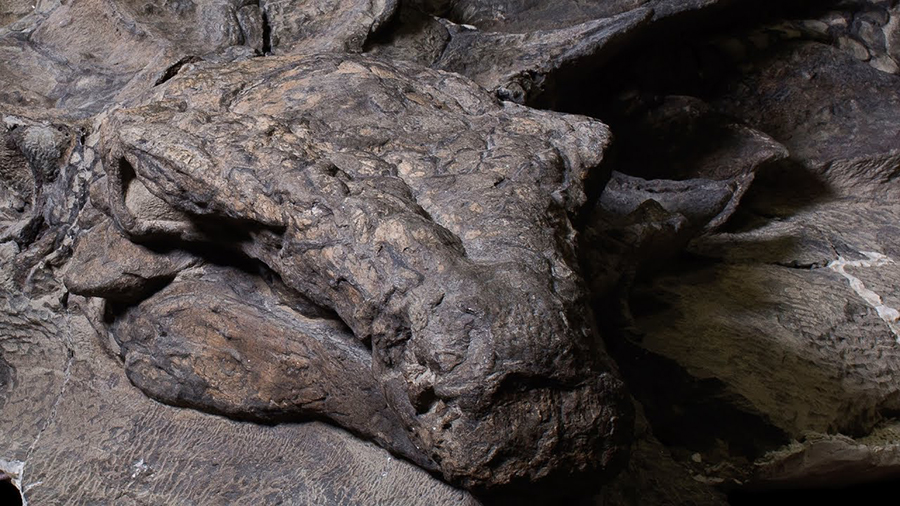
Borealopelta: World's best-preserved armoured dinosaur fossil.

According to the study, charred toast and preserved dinosaur bones have in common: a chemical that turns the original proteins into something new. This process will help to understand how the cells of the soft tissue remains of dinosaurs preserved hundreds of millions of years.

The question of preservation of fossil soft tissues in the bones of dinosaurs long been discussed among researchers. Hard tissues such as bones, eggs and teeth, very well maintained, and soft, — the blood vessels, cells and nerves contained within solid tissue is more delicate and considered, after the death of the body decompose very quickly, within approximately four million years.

However, dinosaur bones are much older than about 100 million years old, and sometimes they remain in organic structure. Various attempts to resolve the paradox was not given a definitive answer, but scientists from the universities of Yale, Brussels and Bonn, as well as the American Museum of natural history closer to solving this mystery. The results of their study published in the journal Nature Communications.

“We are committed to understanding fossils of proteins, examined 35 specimens of fossil bones, egg shells and teeth, in order to understand whether they maintain the protein soft tissues, their chemical composition and to determine under what conditions they managed to survive for millions of years,” says Jasmina, Wiman (Jasmina Wiemann), the study’s lead author.

Experimental maturation initiates glycoamylase / lipoxygenase in the sample eggshell / © Jasmina Wiemann

The researchers found that soft tissue is preserved in the samples oxidative environment, such as sandstones and shallow marine limestones. The soft tissue was converted into advanced glycation end products and lipid peroxidation (Advanced Glycoxidation and Lipoxidation end products — AGE and ALE), which are resistant to disintegration and destruction. Structurally, they are comparable with chemical compounds that turn dark bark on toasted toast.

AGE and ALE are characterized by a brownish color, which stains containing bones and teeth of dinosaurs. These compounds are hydrophobic, i.e., resistant to water and have properties that protect them from bacteria.

Scientists decalcified the fossil by applying combinational Microspectroscopy – non-destructive method for the analysis of both inorganic and organic sample – using existing soft tissue fossils. During this process, the laser energy directed to tissue, causes molecular vibrations, which are spectral traces for present chemicals.

“Our results show how chemical change explains the preservation of these soft tissues and determines the type of environment in which this process occurs. The main thing is to determine how the parameter settings in the area where this saving is likely to occur that will expand the evidence base of biology and ecology of ancient vertebrates,” says study co-author Derek Briggs (Derek Briggs), emphasizing that the study first of all, allow us to point to where the soft tissue can be found preserved in fossil bones, including sandstones, dunes, and shallow marine limestones.

Source: https://koztimes.com

Lyuba, The Woolly Mammoth Calf Who Died 41,800 Years Ago

Friday, November 16, 2018

Lyuba, a mummified woolly mammoth calf, at the Field Museum of Natural History in Chicago

Lyuba is a female woolly mammoth calf (Mammuthus primigenius) who died c. 41,800 years ago at the age of 30 to 35 days. She is by far the best preserved mammoth mummy in the world, surpassing Dima, a male mammoth calf mummy which had previously been the best known specimen.

Lyuba was discovered in May 2007 by a Nenets reindeer breeder and hunter Yuri Khudi and his three sons, in Russia's Arctic Yamal Peninsula. Khudi recognized that Lyuba was a mammoth carcass and that it was an important find, but refused to touch the carcass because Nenets beliefs associated touching mammoth remains with bad omens. Khudi travelled to a small town 150 miles away to consult his friend, Kirill Serotetto, on how to proceed. They notified the local museum director about the find, who arranged the authorities to fly Serotetto and Khudi back to the location of the find on the Yuribey river. However, they found that Lyuba's remains had disappeared. Suspecting that profiteers may have taken the mammoth, Khudi and Serotetto drove on a snowmobile to a nearby settlement, Novy Port. There they discovered Lyuba's carcass exhibited outside a local store. It turned out that the store owner bought the body from Khudi's cousin, who removed the body from its original location, in exchange for two snowmobiles. Lyuba's body suffered minor damage in the process, with dogs having chewed off her right ear and a part of her tail, but remained largely intact. With the help of the police, Khudi and Serotetto reclaimed the body and had it transported by helicopter to the Shemanovsky Museum in Salekhard. In gratitude for Khudi's role, the museum officials named the mammoth calf "Lyuba", a diminutive form of the name Lyubov' (Любовь, meaning "Love"), after the first name of Khudi's wife.

The mummified calf weighed 50 kg (110 lb), was 85 centimeters (33.5 in.) high and measured 130 centimeters (51 in.) from trunk to tail, roughly the same size as a large dog. Studies of her teeth indicate she was born in spring following a gestation similar in length to that of a modern elephant.

At the time of discovery, the calf was remarkably well-preserved; her eyes and trunk were intact and some fur remained on her body. Lyuba's organs and skin are in perfect condition. The mammoth was transferred to Jikei University School of Medicine in Japan for further study, including computer tomography scans. Additional scans were conducted at the GE Healthcare Institute in Waukesha, Wisconsin and at the Nondestructive Evaluation Laboratory of Ford Motor Company in Livonia, Michigan. Lyuba is believed to have suffocated by inhaling mud as she struggled while bogged down in deep mud in the bed of a river which her herd was crossing. Following death, her body may have been colonized by lactic acid-producing bacteria, which "pickled" her, preserving the mammoth in a nearly pristine state. Her skin and organs are intact, and scientists were able to identify milk from her mother in her stomach, and fecal matter in her intestine. The fecal matter may have been eaten by Lyuba to promote development of the intestinal microbial assemblage necessary for digestion of vegetation. Lyuba appears to have been healthy at the time of her death. By examining Lyuba's teeth, researchers hope to gain insight into what caused Ice Age mammals, including the mammoths, to become extinct 4500-4000 years ago.

Lyuba's permanent home is the Shemanovskiy Museum and Exhibition Center in Salekhard, Russia.

Lyuba was the subject of a 2009 documentary Waking the Baby Mammoth by the National Geographic Channel and of a 2011 children's book by Christopher Sloan, Baby Mammoth Mummy: Frozen in Time: A Prehistoric Animal's Journey into the 21st Century.

Source: https://en.wikipedia.org / www.natgeo.com

Why Big Dinosaurs Steered Clear of the Tropics?

Wednesday, June 21, 2017

 Image description: 212 million years ago in what is now northern New Mexico, the landscape was dry and hot with common wildfires. Illustration by Victor Leshyk.

For more than 30 million years after dinosaurs first appeared, they remained inexplicably rare near the equator, where only a few small-bodied meat-eating dinosaurs eked out a living. The age-long absence of big plant-eaters at low latitudes is one of the great, unanswered questions about the rise of the dinosaurs.

And now the mystery has a solution, according to an international team of scientists who pieced together a remarkably detailed picture of the climate and ecology more than 200 million years ago at Ghost Ranch in northern New Mexico, a site rich with fossils from the Late Triassic Period.

The new findings show that the tropical climate swung wildly with extremes of drought and intense heat. Wildfires swept the landscape during arid regimes and continually reshaped the vegetation available for plant-eating animals.

“Our data suggest it was not a fun place,” says study co-author Randall Irmis, curator of paleontology at the Natural History Museum of Utah and assistant professor at the University of Utah. “It was a time of climate extremes that went back and forth unpredictably and large, warm-blooded dinosaurian herbivores weren’t able to exist nearer to the equator – there was not enough dependable plant food.”

The study, led by geochemist Jessica Whiteside, lecturer at the University of Southampton, is the first to provide a detailed look at the climate and ecology during the emergence of the dinosaurs. The results are important, also, for understanding human-caused climate change. Atmospheric carbon dioxide levels during the Late Triassic were four to six times current levels. “If we continue along our present course, similar conditions in a high-CO2 world may develop, and suppress low-latitude ecosystems,” Irmis says.

Source: @The University of Utah

‘Jurassic World: Fallen Kingdom’: The Best Toys, Action Figures, & Lego Sets

Thursday, June 14, 2018

From three-foot tall T-Rex toys that can gobble up (and spit out) action figures to R/C Ptero-Drones and foam Raptor claws.*

There’s never a shortage of toys for dinosaur-obsessed kids, i.e. pretty much all kids. But now that Jurassic World: Fallen Kingdom is hitting theaters on June 22, there’s an entirely new crop of toys to get excited about. And, as the brains behind the much anticipated sequel are aware of the phenomenon called “merchandising,” the new release are exactly what we want to see stomping around our houses. There’s a lot to choose from, but you don’t need to be a paleontologist to see why we’ve unearthed these top ten selections. They’re at the top of the food chain, spared no expense. Check them out.

Jurassic World: Fallen Kingdom Super Colossal T-Rex

Let’s start with a guaranteed crowd pleaser — the Mattel Super Colossal T-Rex. Based on the iconic beast from the JW series, this toy is a whopping three feet tall, featuring authentic detail, movie-inspired markings, and articulated arms and legs for realistic action. The SC T-Rex also has extra-wide jaws that, when opened, can swallow mini dino action figures without even a burp. Want them back? No problem — just open up SC T-Rex’s belly and watch them fall right out. It’s like the miracle of birth, but much less messy.

BUY NOW $50

Jurassic World Pterano-Drone

A full-function, quadcopter drone married with a realistic Pteranodon, this remote control toy performs stunts and flies up to 25 feet in the air. The Pteranodon’s wings flap as it rises and falls, while an “Auto Circle” mode recreates the hunting of prey. Even better is the“Auto Land” mode, which swoops you in for the kill — or helps your kids land it without clipping the patio furniture. It charges via USB, and comes with a handful of replacement propeller parts, should it sneak up on the wrong woodpecker.

BUY NOW $71


Jurassic World Chomp ‘n Roar Blue Mask

Based on the breakout star of Jurassic World, Blue the velociraptor, the Chomp ‘n Roar Mask features realistic skin texture, movie accurate colors, and two rows of sharp teeth. The eyes move inward so you can focus on your next meal, and the electronic jaws open to different degrees — each with its own unique roaring sound effect. A comfy strap wraps around wearers’ heads, while eye and nose openings let them see and breathe.

BUY NOW $35

Jurassic World Blue Velociraptor Claws

Flex, bend, twist these treacherous talons — or just go to the dino nail salon and get these beauties buffed. Each foam set comes with an interior elastic band, which is perfect for any size hand. Worn along with the Chomp ‘n Roar Mask and even Chris Pratt won’t be able to tell you apart from the real thing.

BUY NOW $15

Jurassic World R/C Gyrosphere

One of the more innovative inclusions in the first Jurassic Worldmovie was the gyrosphere — an American Gladiators‘-esque giant motorized orb that rolled riders to and fro across the park. Mattel’s  R/C Gyrosphere Playset rolls in all directions, and is compatible with any 3 ¾” action figure. That means, if you’ve still got Flint, Quick Kick, Sgt. Slaughter and other G.I. Joes laying around, you can take them for a lovely jaunt amongst the ankylosauruses.

BUY NOW $34

Jurassic World T-Rex STEM Anatomy Kit

The JW T-Rex STEM Anatomy Kit is a fully functioning T-Rex toy to begin with. But, when you insert the special DNA key, you can pop off the right side and see how the dino guts function. Watch as muscles flex, lungs pump, and joints move  — all before reattaching the skin and bones to resume your playtime destruction. Just don’t forget to reassemble the organs. You don’t want your dog accidentally swallowing a T-Rex gallbladder.

BUY NOW $64

Jurassic World: Fallen Kingdom Grab ‘n Growl Indoraptor

Not much is known about the mysterious “Indoraptor”, other than it’s big, it’s black, and it’s badass. Rumored to be the new “villain” in the Jurassic World: Fallen Kingdom…uh…world, the Indoraptor is supposedly some sort of genetic hybrid, similar to the Indominus Rex, except it has some major upgrades including biological night vision (!!). The Grab ‘n Growl Indoraptor features red, glowing eyes, lifelike articulation, and screech sound effects, which only gets us more excited to see this beast on the big screen.

BUY NOW $45

Jurassic World LEGO Carnotaurus Gyrosphere Escape

This 577-piece Carnotaurus Gyrosphere Escape playset features the titular dino, three minifigures (Chris Pratt, Bryce Dallas Howard, and some dude named “Franklin”), a two-seater cab with a sunroof, and a detachable trailer that can launch its own Gyrosphere. Accessories include dino eggs, mini dinosaurs, and a tranquilizer gun. Plus, the set features lava, flames, and an eruption mechanism — everything a Carnotaurus needs for some delicious BBQ tourists.

BUY NOW $80

Jurassic World: Fallen Kingdom Reversible Plushies

If your kids want a less frightening dinosaur to hang with, check out these plushies. The Jurassic World: Fallen Kingdom Reversible Plushies boast realistic details, such as embossed scales, pointy spikes, and scary claws. And, each one can be folded back up inside itself to reveal a reversible dinosaur egg. The two-in-one transformable toys are available in Triceratops, T. Rex, Stegosaurus, and Velociraptor species, and are perfect for cuddling when you think there might be a real dinosaur lurking out by the garage. They’re sold as a set of four.

BUY NOW $70


*If you click a link on our site and buy something, we may earn an affiliate commission.

Source: www.fatherly.com

'Jurassic Park' Art Show Coming to DesignerCon

Sunday, November 11, 2018

Nychos/3D Retro

Artists are honoring the Steven Spielberg film for its 25th anniversary.

Art finds a way.

Jurassic Park is invading next week's DesignerCon, the Anaheim, Calif. convention focusing on art and design geared toward collectors and creators. The convention will feature a Jurassic Park art show timed to this year's 25th anniversary of Steven Spielberg's film.

"Most surprising was how much beauty could be found in some of the movie’s most terrifying scenes. We also realized there are no small moments in Jurassic Park," DesignCon curator Carmen Acosta tells The Hollywood Reporter of the show. "Our artists know this movie line for line, and many of their depictions come from small scenes that only fans who’ve watched the movie dozens of times would recognize. Our show covers the big moments everyone knows, but it will truly be an experience that speaks to those die-hard Jurassic Park fans out there."

THR was granted an early look at the art ahead of DesignerCon, which runs Nov. 16-18 at the Anaheim Convention Center. Check out some of the pieces below.

Nychos/3D Retro

Brad Albright

Emma McKee

Emma Munger

Johnny Rodriguez

Kyle James Patterson

M.K. Komins

Regan Russell

Ryan James Shumate

Source: www.hollywoodreporter.com

A Toast to the Proteins in Dinosaur Bones

Saturday, November 10, 2018

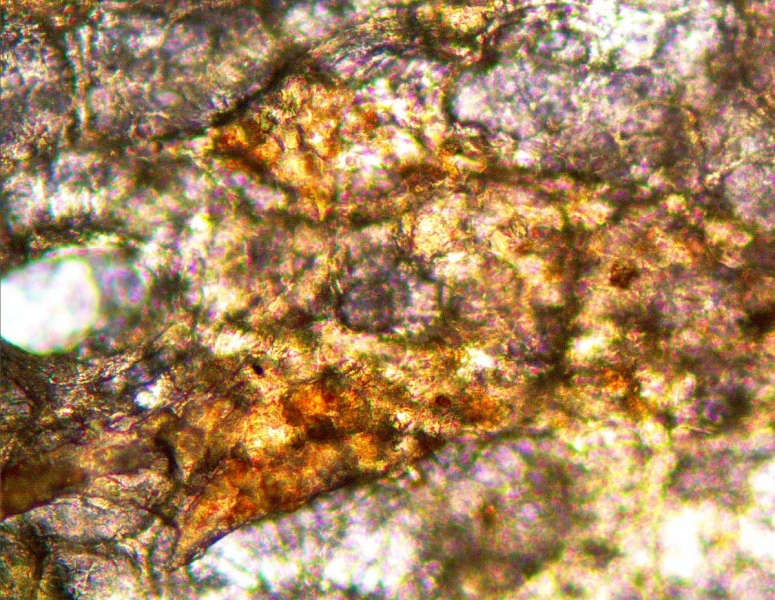
Dinosaur blood vessel with adjacent bone matrix that still contains bone cells. These structures have a perfect morphological preservation over hundreds of millions of years, but are chemically transformed through oxidative crosslinking. The extract comes from a sauropod dinosaur.  CREDIT Jasmina Wiemann/Yale University

Burnt toast and dinosaur bones have a common trait, according to a new, Yale-led study. They both contain chemicals that, under the right conditions, transform original proteins into something new. It's a process that may help researchers understand how soft-tissue cells inside dinosaur bones can survive for hundreds of millions of years.

A research team from Yale, the American Museum of Natural History, the University of Brussels, and the University of Bonn announced the discovery in the journal Nature Communications.

Fossil soft tissue in dinosaur bones has been a controversial topic among researchers for quite some time. Hard tissues, such as bones, eggs, teeth, and enamel scales, are able to survive fossilization extremely well. Soft tissues, such as blood vessels, cells, and nerves -- which are stored inside the hard tissue -- are more delicate and thought to decay rapidly after death. These soft tissues are composed mainly of proteins, which are believed to completely degrade within about four million years.

Yet dinosaur bones are much older, roughly 100 million years old, and they occasionally preserve organic structures similar to cells and blood vessels. Various attempts to resolve this paradox have failed to provide a conclusive answer.

"We took on the challenge of understanding protein fossilization," said Yale paleontologist Jasmina Wiemann, the study's lead author. "We tested 35 samples of fossil bones, eggshells, and teeth to learn whether they preserve proteinaceous soft tissues, find out their chemical composition, and determine under what conditions they were able to survive for millions of years."

The researchers discovered that soft tissues are preserved in samples from oxidative environments such as sandstones and shallow, marine limestones. The soft tissues were transformed into Advanced Glycoxidation and Lipoxidation end products (AGEs and ALEs), which are resistant to decay and degradation. They're also structurally comparable to chemical compounds that stain the dark crust on toast.

AGEs and ALEs are characterized by a brownish color that stains fossil bones and teeth that contain them. The compounds are hydrophobic, which means they are resistant to the normal effects of water, and have properties that make it difficult for bacteria to consume them.

Wiemann and her colleagues made their discovery by decalcifying fossils and imaging the released soft tissue structures. They applied Raman microspectroscopy -- a non-destructive method for analyzing both the inorganic and organic contents of a sample -- to the extracted fossil soft tissues. During this process, laser energy directed at the tissue causes molecular vibrations that carry spectral fingerprints for the chemicals that are present.

Co-author Derek Briggs, Yale's G. Evelyn Hutchinson Professor of Geology and Geophysics and a curator at the Yale Peabody Museum of Natural History, said the study points to localities where soft tissue may be found in fossil bones, including sandstones deposited from rivers, dune sands, and shallow marine limestones.

"Our results show how chemical alteration explains the fossilization of these soft tissues and identifies the types of environment where this process occurs," Briggs said. "The payoff is a way of targeting settings in the field where this preservation is likely to occur, expanding an important source of evidence of the biology and ecology of ancient vertebrates."

###

Additional co-authors of the study are Matteo Fabbri from Yale, Martin Sander and Tzu-Ruei Yang from the University of Bonn, Koen Stein from the University of Brussels, and Mark Norell from the American Museum of Natural History.

Source: www.eurekalert.org

Prognathodon kianda: Scientists Unveil Ancient Sea Monsters Found In Angola

Friday, November 9, 2018

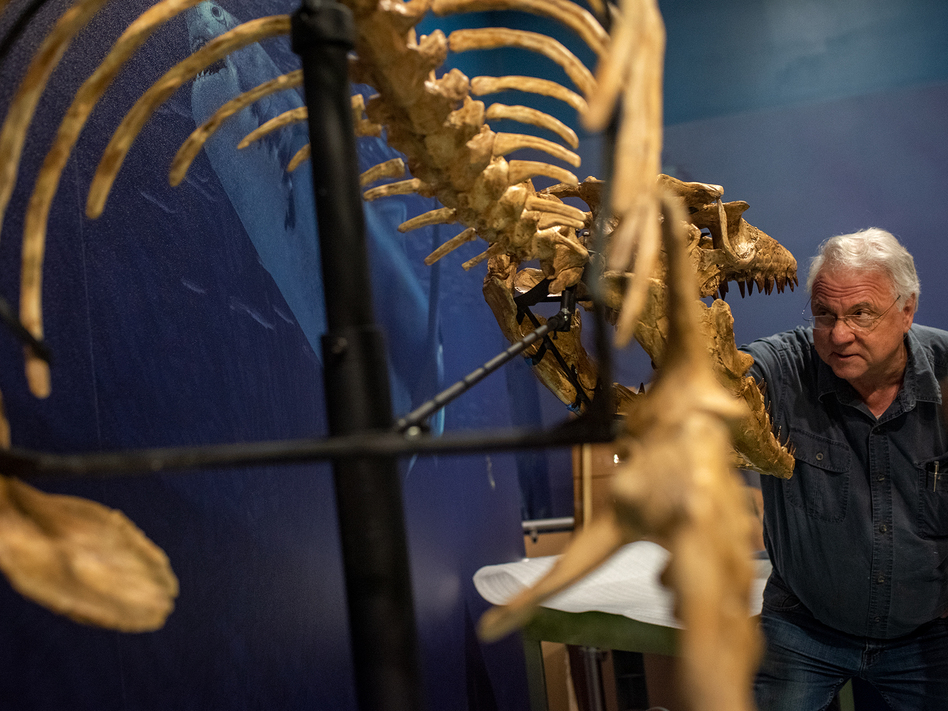
(Top) Louis Jacobs, professor emeritus of paleontology at SMU and co-curator of the Smithsonian exhibition, checks the skull of the mosasaur fossil replication. (Bottom) Michael Polcyn talks with Jacobs and Smithsonian project manager Jill Johnson about the display of fossils excavated along the coast of Angola.  / Madeleine Cook/NPR

When the South Atlantic Ocean was young, sea monsters ruled it.

Some of their bones have turned up along the coast of West Africa and are going on exhibit at the Smithsonian Institution in Washington, D.C. They tell a story of the bloody birth of an ocean.

The fossils of giant swimming reptiles called mosasaurs have been found in the rocky cliffs of Angola, overlooking the Atlantic. It's not a country known for fossils. Few scientists have looked there — half a century of civil war made it too dangerous. But geologically, Angola is special.

About 200 million years ago, Africa was part of the supercontinent Gondwana. Then, about 135 million years ago, that continent started unzipping down the middle. Among the remnants were Africa and South America, which slowly drifted apart. The South Atlantic Ocean filled in the gap between them. It was a time of oceanic turmoil: huge changes in sea level and temperature. It was a brand new habitat, and sea creatures fought to own it.

The mosasaurs won that fight and held on for more than 30 million years.

Paleontologist Louis Jacobs of Southern Methodist University in Dallas has been digging in Angola since 2005. He says fossils from its coastline tell the story of the ocean's earliest days and some of the first creatures that lived there.

"You have an ocean where you didn't have one before," Jacobs says, "and now you have fossils of these marine monsters that are found there. So why did that happen? And why is it them that are there?"

The mother lode of mosasaur bones from Angola are at SMU's paleontology department, where one of Jacobs' colleagues has been reconstructing a mosasaur skeleton for the Smithsonian.

Michael Polcyn started the task in his dining room, but the skeleton got so big that it's now hanging in the department's basement. It's hung up on rods and wires — a sinuous tail and neck, the rib cage and a feeble-looking arm. Mosasaurs looked part lizard and part orca, and they grew up to 50 feet long, about the length of a school bus. They probably had scales and a powerful tail fin similar to a shark's.

During a recent visit, Polcyn was using a pair of pliers to add what look like elongated fingers to one of the arms to make a front limb — a mosasaur paddle. The big tail provided thrust; the animal's four paddles helped it navigate.

"The way mosasaurs move is like lizards," Jacobs says, as if the creatures were still around and not denizens of an ancient past. "Their bodies flex a lot from side to side."

Adds Polcyn: "You can see it was a very optimized swimmer. This was a pursuit predator."

What did it pursue? "Whatever it could get its teeth into," Polcyn says, referring to the rows of 3-inch-long daggers that line the beast's 3-foot-long jaws.

The mosasaurs were not alone; there were turtles and sharks and other large reptiles at the time. But the mosasaurs were the marine equivalent of the tyrannosaurs on land.

The SMU basement has more rooms and lots more bones. Polcyn says Angola was a mosasaur jackpot. "The first time we set foot there, it was incredible," he says. "You couldn't walk one pace without coming across another fossil. The ground was just littered with fossils."

One in particular tells a grisly story. This mosasaur skeleton — Prognathodon kianda, one of six species found in Angola — lies flat on a table in a stone-like matrix, just as it was found in the Angolan rock. The tail is looped, the head twisted back in death. But there are two sets of smaller bones coiled halfway down the beast, as well as some shark's teeth.

It's actually three different mosasaurs — the big one and two smaller ones it ate, Jacobs explains. "They're in the stomach," he says. "And then after the big fella died, you see the shark's teeth from where it was scavenged." No match one-on-one for a living mosasaur, sharks lost their teeth as they ripped the flesh off the dead reptile.

Jacobs says their story is more than just how big and scary ancient reptiles could be. It's about how a new ocean and the conditions for new life were created. How the new Atlantic Ocean rose and warmed. How trade winds stirred up deep water full of nutrients. How those nutrients attracted fish and big turtles. And how they, in turn, attracted big sharks and, ultimately, an explosion of giant reptiles.

"Geology controls destiny," Jacobs says, "in the sense that biology has to adapt to the stage that it's put on."

It was a drama that might have continued if an asteroid hadn't hit the Earth and wiped out the giant reptiles and their dinosaur cousins.

Opening the door to us, the furry little mammals.

Source: www.capradio.org

Pages