nandi's blog

Gobiraptor minutus: New Species of Oviraptorid Dinosaur Unearthed

Friday, February 8, 2019

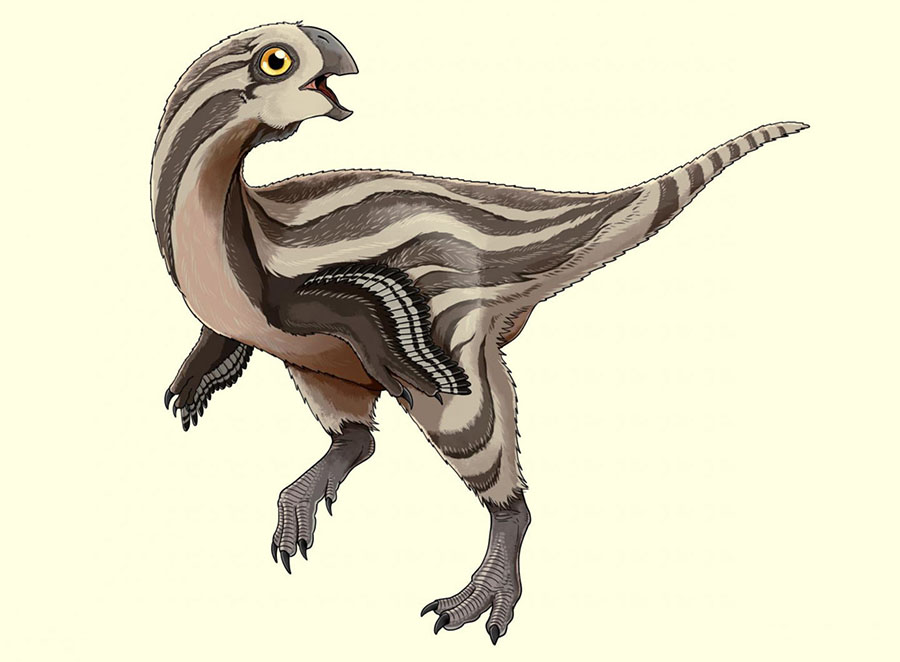
Gobiraptor minutus. Image credit: Do Yoon Kim.

A new species of oviraptorosaur has been unearthed in the Gobi Desert of Mongolia.

Named Gobiraptor minutus, the new dinosaur is thought to have lived between 80 and 70 million years ago (Cretaceous period).

The ancient creature was a member of Oviraptorosauria (oviraptorosaurs), a diverse group of feathered, bird-like dinosaurs from the Cretaceous of Asia and North America.

Its incomplete skeleton, including both cranial and postcranial elements, was discovered in the Nemegt Formation of Altan Uul III, Ömnögovi Province, Mongolia.

The specimen was analyzed by a team of paleontologists from Seoul National University, the University of Cape Town, China’s Institute of Geology and Mongolia’s Institute of Paleontology and Geology.

Gobiraptor minutus can be distinguished from other oviraptorosaurs in having unusual thickened jaws,” said Seoul National University’s Dr. Yuong-Nam Lee and colleagues.

“This unique morphology suggests that Gobiraptor minutus used a crushing feeding strategy, supporting previous hypotheses that oviraptorosaurs probably fed on hard food items such as eggs, seeds or hard-shell mollusks.”

Histological analyses of Gobiraptor minutus’ femur revealed that the specimen likely belonged to a very young individual.

“The finding of a new oviraptorosaur species in the Nemegt Formation, which consists mostly of river and lake deposits, confirms that these dinosaurs were extremely well adapted to wet environments,” the researchers said.

“Different dietary strategies may explain the wide taxonomic diversity and evolutionary success of this group in the region.”

The discovery was described in the journal PLoS ONE.

_____

S. Lee et al. 2019. A new baby oviraptorid dinosaur (Dinosauria: Theropoda) from the Upper Cretaceous Nemegt Formation of Mongolia. PLoS ONE 14 (2): e0210867; doi: 10.1371/journal.pone.0210867

Source: www.sci-news.com

Bajadasaurus pronuspinax: A Spiky-Necked Sauropod Skeleton Discovered in Argentina

Thursday, February 7, 2019

Bajadasaurus by RAPHTOR

Paleontologists identified a new species of sauropod that grew long, sharp spikes that resembled a mohawk at the back of their necks.

Called Bajadasaurus pronuspinax, the newly-discovered creatures are believed to be herbivores that walked the surface of Earth from the late Triassic period 230 million years ago to the end of the late Cretaceous 70 million years ago. Fossils of the dinosaur were unearthed in the Bajada Colorada Formation in the Neuquén Basin in Patagonia, Argentina in 2013.

An artist's sketch of the Bajadasaurus pronuspinax. The newly-discovered dinosaurs were unearthed in Argentina. Scientists believe that their long, thin spikes might have been used for defense to fend off predators.   ( Jorge A. Gonzalez )

Spiky Spines

According to the researchers, the fossils that were discovered still had most of its skull and a whole spine bone.

The Bajadasaurus belonged to the subgroup of sauropod (long-necked, four-legged dinosaurs) called dicraeosauridae. The researchers believe that like the Amargasaurus cazaui, another dicraeosauride, the Bajadasaurus' spikes were long, sharp, and thin. They grew along the spine of the creature.

Researchers think that the spikes were used to fight off predators, but they can never be sure. They believe that, instead of a weapon, the dinosaurs used the spikes as a warning device to fend off carnivores.

"A carnivore comes up, sees a gigantic spiny structure and thinks twice," stated paleontologist Pablo Galina, an author of the study, in a conversation with EFE.

The species--Bajadasaurus pronuspinax lived 140 million years ago has been found in Argentina's Patagonia.

They also believe that the spikes were covered by a keratin sheath, similar to horns of antelopes and other mammals.

"We think that had they been just bare bone structures or covered only by skin, they could have been easily broken or fractured with a blow or when being attacked by other animals," explained Galina.

They also think that like camels, the Bajadasaurus had humps where they stored fat in between spikes. The researchers shared that the spikes might have also acted as a kind of "sail" to regulate body temperature or make the dinosaur more sexually attractive to potential mates.

Bajadasaurus' Giant Predators

The Giganotosaurus carolinii, the biggest carnivorous dinosaur of all time, was also found in the Neuquén Basin in Argentina. It was first discovered in 1993.

The researchers believe that the Giganotosaurus, which lived during the late Cretaceous period, might have fed on the Bajadasaurus.

The newly-discovered dinosaur is the subject of the paper published in the journal Scientific Reports.

Source: www.techtimes.com

Glasgow Welcomes New Dinosaur Trix the T. Rex After Dippy Success

Tuesday, February 5, 2019

Glasgow welcomes new dinosaur Trix the T. rex after success of Dippy

Visitors to Glasgow will get an amazing opportunity to see one of the best preserved Tyrannosaurus rex skeletons when it visits Scotland on the last leg of its European tour.

The 67-million-year-old T.rex female is 39-foot long, around 13 feet high, weighs five tonnes and is nicknamed Trix.

Trix, the T. rex skeleton will greet visitors with her ferocious teeth and enormous head mounted at eye level when it goes on display at Glasgow’s Kelvin Hall from Easter this year for three months.

This is another major dinosaur coup for Glasgow. Trix’s visit comes just weeks after Dippy the Diplodocus skeleton cast went on display at the Kelvingrove Art Gallery and Museum just a stone’s throw from Kelvin Hall.

And for a few short weeks, both Dippy and Trix will be in Glasgow at the same time as Dino-fever turns the west end of the city into Scotland’s Dino-quarter.

The exhibition has been organised by The Hunterian at the University of Glasgow and Glasgow Museums and has been supplied by Naturalis Biodiversity Centre.

Steph Scholten, Director of The Hunterian, said: “Trix is a superb example of one of the world’s best preservedT.rex skeletons. Her arrival in Scotland will be a unique opportunity to see up close a real T.rex which is one of the fiercest predators to have ever lived.

Trix head with family

“I am so looking forward to welcoming visitors to Kelvin Hall and see their reaction to  the sheer size and scale of Trix. I can tell you, having gone nose to nose with this 67- million-year-old fossil myself, that this is an experience not to be missed.

“Through our strong partnerships both with Glasgow Museums and with European institutions we have been able to ensure that Trix was able to visit Scotland on her first and only British tour date.

“This is a major coup for Glasgow – with two dinosaurs, Trix and Dippy, visiting our city at the same time for a short while. Dino-fever will take over the west end of Glasgow as the city becomes the dinosaur capital of Scotland.”

The ‘T.rex in Town’ exhibition is touring European cities while she waits for a new museum building to be completed at Naturalis Biodiversity Centre in her home city of Leiden, in the Netherlands.

Glasgow is the final stop for Trix’s tour of Europe. Her Scottish visit will be the first and only stop outside mainland Europe. She has already visited Salzburg, Austria; Barcelona, Spain; Paris, France; and Lisbon, Portugal.

She will travel from her home in the Netherlands to Glasgow to go on display in the city from 18 April to 31 July 2019.

Chair of Glasgow Life, Councillor David McDonald, said: “We are immensely proud of our partnership with The Hunterian and Naturalis to bring one of the three most complete Tyrannosaurus rex skeletons ever discovered to Kelvin Hall in April.

“Trix, as she is affectionately known, is the only original T. rex skeleton on tour anywhere in the world.  It’s only when you see her up close that you begin to appreciate her actual size - she’s enormous. Glaswegians and visitors to the city will relish this unique opportunity to come face-to-face with one of the most terrifying predators ever to have stalked the earth.

Artist impression of T. rex Trix according to the latest scientific theories and showing her actual wounds. (Naturalis Biodiversity Center)

“Our enduring fascination with dinosaurs is down to the way they spark our imagination. They come in a huge variety of shapes and sizes and we find it amazing to think they really existed.

“Dippy, the Natural History Museum’s famous Diplodocus, opened to rapturous applause at Kelvingrove Museum last month and soon people will be able to marvel at not one, but two, incredible creatures – a mere dinosaur jump apart.

“We look forward to welcoming thousands of dinosaur fans to Glasgow over the coming months and trust these spectacular exhibitions will inspire curiosity about the natural world around us.”

Visitors will be able to find out more about Trix’s turbulent life from the information revealed by her bones in findings by an international research team of palaeontologists and geologists.

The Hunterian’s Curator of Palaeontology, Dr Neil Clark, said: “Trix was around 30 when she died – making her the oldest T.rex found to date. She is also one of the most complete T. rex fossil’s known and Trix may in fact be able to trace her ancestry back to the Middle Jurassic of Scotland.

“Scotland is one of very few places worldwide where Middle Jurassic bones can be found. The Hunterian collected the first dinosaur footprints on the Isle of Skye in 1982 and has been at the forefront of dinosaur research in Scotland since then. And along with Trix, we will have some of the Scottish dinosaur footprints on display during her visit to Kelvin Hall.

“It is very exciting to be able to get close to such an amazing T.rex specimen. It seems very fitting to welcome our dinosaur cousin to Scotland.”

Source: www.eveningtimes.co.uk

Metal From Dinosaur-Killing Asteroid Kills Cancer Cells When Blasted With Light

Tuesday, February 5, 2019

Iridium, a metal associated with the asteroid that ended the Cretaceous era can act like  a stealth bomb, entering the nucleus of a cancer cell. muratart/Shutterstock

A new compound based on Iridium, a rare metal which landed in the Gulf of Mexico 66 M years ago, hooked onto albumin, a protein in blood, can attack the nucleus of cancerous cells when switched on by light, University of Warwick researchers have found.

The treatment of cancer using light, called Photodynamic therapy, is based on chemical compounds called photosensitizers, which can be switched on by light to produce oxidising species, able to kill cancer cells. Clinicians can activate these compounds selectively where the tumour is (using optical fibres) thus killing cancer cells and leaving healthy cells intact.

Iridium with its organic coat which is hooked up to the protein albumin (HSA). Together that enter cancer cells and deliver the iridium photosensitizer to the nucleus. On irradiation with blue light, the iridium not only glows green, but converts oxygen in the cell to a toxic form called triplet oxygen, which kills the cell. Credit: University of Warwick

Thanks to the special chemical coating they used, the Warwick group was able to hook up Iridium to the blood protein Albumin, which then glowed very brightly so they could track its passage into cancer cells, where it converted the cells' own oxygen to a lethal form which killed them.

Not only is the newly formed molecule an excellent photosensitiser, but Albumin is able to deliver it into the nucleus inside cancer cells. The dormant compound can then be switched on by light irradiation and destroy the cancer cells from their very centre.

The bright luminescence of the iridium photosensitiser allowed its accumulation in the nucleus of tumour cells and its activation leading to the cancer cell death to be followed in real time using a microscope.

Professor Peter Sadler, from the Department of Chemistry at the University of Warwick comments:

"It is amazing that this large protein can penetrate into cancer cells and deliver iridium which can kill them selectively on activation with visible light. If this technology can be translated into the clinic, it might be effective against resistant cancers and reduce the side effects of chemotherapy"

The purple stain for cancer cell nuclei overlaps perfectly with the emission of green light from the iridium-albumin conjugate, showing the protein has delivered the photosensitiser to the nucleus of cancer cells. Credit: University of Warwick

Dr. Cinzia Imberti, from the University of Warwick comments:

"It is fascinating how albumin can deliver our photosensitiser so specifically to the nucleus. We are at a very early stage, but we are looking forward to see where the preclinical development of this new compound can lead."

"Our team is not only extremely multidisciplinary, including biologists, chemists and pharmacists, but also highly international, including young researchers from China, India and Italy supported by Royal Society Newton and Sir Henry Wellcome Fellowships."

The paper 'Nucleus Targeted Organoiridium-Albumin Conjugate for Photodynamic Cancer Therapy' has been published in Angewandte Chemie International Edition.

More information: Pingyu Zhang et al, Nucleus-Targeted Organoiridium-Albumin Conjugate for Photodynamic Cancer Therapy, Angewandte Chemie International Edition (2018). DOI: 10.1002/anie.201813002

Provided by: University of Warwick

Source: https://phys.org

Could Evolution Lead to a Return of Dinosaurs?

Sunday, February 3, 2019

The king is dead: the world’s largest Tyrannosaurus Rex fossil, aka Sue, discovered in 1990 – one of the dinosaurs believed to have died out after an asteroid strike on Earth ( Getty )

Jurassic Park” scenario is not likely, but birds may pose key to appreciating extinct species.

Because of the success of the Jurassic Park franchise, the idea that dinosaurs can be brought back using DNA found in blood stored in a mosquito preserved in amber seems to be on the verge of technological possibility.

The only problem is, the science isn’t remotely there.

Susie Maidment, a vertebrate paleontologist at the Natural History Museum in London, doesn’t agree with the science in Spielberg’s hit 1993 blockbuster. “We do have mosquitoes and biting flies from the time of the dinosaurs, and they do preserve in amber,” Maidment told Live Science. “But when amber preserves things, it tends to preserve the husk, not the soft tissues. So, you don’t get blood preserved inside mosquitos in amber.”

The dinosaurs died out 66 million years ago, while the oldest DNA found on record dates back only 1 million years.

“Although we have what appears to be blood from mosquitos up to 50 million years old, we haven’t found DNA, and in order to reconstruct something, we need DNA.” Maidment explained.

That doesn’t mean there aren’t intriguing possibilities. Even though the T. rex went extinct tens of millions of years ago, Jamal Nasir, a geneticist in the UK at the University of Northampton, says that evolution isn’t planned and is ever changing.

“Evolution is largely stochastic and evolution doesn’t necessarily have to go in a forward direction; it could have multiple directions. I would argue that going back to dinosaurs is more likely to happen in reverse, because the building blocks are already there.”

Researchers are quick to point out that we still do have animals much like the dinosaurs living among us today — birds.

“Dinosaurs are still with us,” Maidment reveals. “They say dinosaurs went extinct, but only the non-avian dinosaurs went extinct. Birds are dinosaurs, and birds are still evolving, so we will certainly see new species of birds evolving and those will be new species of dinosaur.”

Read the full story at Live Science

Source: www.realclearlife.com

Antarctanax shackletoni: Iguana-Sized Reptile Roamed Antarctica 250 Million Years Ago

Saturday, February 2, 2019

Along the banks of a river, three archosaur inhabitants of the dense Voltzia conifer forest cross paths: Antarctanax shackletoni sneaks up on an early titanopetran insect, Prolacerta broomi lazes on a log, and an enigmatic large archosaur pursues two unsuspecting dicynodonts, Lystrosaurus maccaigi. Image credit: Adrienne Stroup, Field Museum.

Some 250 million years ago (early Triassic period), an early relative of dinosaurs and crocodiles lived in what is now a frozen continent, Antarctica, according to an international team of paleontologists from the United States and South Africa.

The ancient creature, named Antarctanax shackletoni, was a carnivore that hunted bugs, early mammal relatives, and amphibians.

Its small, incomplete skeleton was collected from Graphite Peak in the Transantarctic Mountains during a 2010-2011 expedition.

The fossil specimen consists of portions of the backbone, limbs and skull.

Antarctanax shackletoni was an archosaur, an early relative of crocodiles and dinosaurs,” said lead author Dr. Brandon Peecook, a paleontologist at Field Museum.

“On its own, it just looks a little like a lizard, but evolutionarily, it’s one of the first members of that big group. It tells us how dinosaurs and their closest relatives evolved and spread.”

The most interesting thing about Antarctanax shackletoni, though, is where it lived, and when.

“The more we find out about prehistoric Antarctica, the weirder it is. We thought that Antarctic animals would be similar to the ones that were living in southern Africa, since those landmasses were joined back then. But we’re finding that Antarctica’s wildlife is surprisingly unique,” Dr. Peecook said.

About two million years before Antarctanax shackletoni lived Earth underwent its biggest-ever mass extinction event — the end-Permian mass extinction. Climate change, caused by volcanic eruptions, killed 90% of all animal life.

The years immediately after that extinction event were an evolutionary free-for-all — with the slate wiped clean by the mass extinction, new groups of animals vied to fill the gaps.

The archosaurs, including dinosaurs, were one of the groups that experienced enormous growth.

“Before the mass extinction, archosaurs were only found around the equator, but after it, they were everywhere,” Dr. Peecook said.

“And Antarctica had a combination of these brand-new animals and stragglers of animals that were already extinct in most places — what paleontologists call ‘dead clades walking.’ You’ve got tomorrow’s animals and yesterday’s animals, cohabiting in a cool place.”

The discovery of Antarctanax shackletoni bolsters the idea that Antarctica was a place of rapid evolution and diversification after the end-Permian mass extinction.

“The more different kinds of animals we find, the more we learn about the pattern of archosaurs taking over after the mass extinction,” Dr. Peecook said.

“Antarctica is one of those places on Earth, like the bottom of the sea, where we’re still in the very early stages of exploration.”

Antarctanax shackletoni is our little part of discovering the history of Antarctica.”

“Fossil exploration in Antarctica is really difficult, given all of the logistics involved. But since so little work has been done the potential for making important new discoveries is high — and that’s what Antarctanax shackletonirepresents,” said senior author Professor Christian Sidor, a researcher at the University of Washington and curator of vertebrate paleontology at the Burke Museum of Natural History & Culture.

“The same rocks that yielded Antarctanax shackletoni also yield some of the earliest mammal relatives from after the mass extinction.”

The study was published in the Journal of Vertebrate Paleontology.

_____

Brandon R. Peecook et al. A novel archosauromorph from Antarctica and an updated review of a high-latitude vertebrate assemblage in the wake of the end-Permian mass extinction. Journal of Vertebrate Paleontology, published online January 31, 2019

Source: www.sci-news.com

Scientists Find Bird Foot in Dinosaur-Era Amber

Friday, February 1, 2019

A team of Chinese, American and Canadian researchers have discovered amber containing a bird foot dating back around 100 million years.

The specimen was excavated at Hukawng Valley in northern Myanmar, an area rich in amber fossil discoveries. The result of the research was published by Scientific Reports.

"The bird foot is less than 7 millimeters long and well-preserved," said Bai Ming from the Institute of Zoology under the Chinese Academy of Sciences, co-author of the paper.

"This allows the researchers to build a high-definition three-dimensional model of the foot through computed tomography (CT)," Bai said.

The researchers found ragged fractures on the model, suggesting the bird foot was already broken before it was encased in resin which later formed into amber, according to Xing Lida, a leading scientist of the study from the China University of Geosciences in Beijing.

"The foot was probably left by predators or scavengers," Xing said.

Source: www.china.org.cn

Koreamegops samsiki: New Fossil Spiders With 'Glowing' Eyes Found in South Korea

Friday, February 1, 2019

The defining specimen of Koreamegops samsiki, a newfound species of spider that lived in what is now South Korea between 106 and 112 million years ago. PHOTOGRAPH BY PAUL ANTONY SELDEN

The ancient arachnids had eyes that shone in the dark—a key adaptation for night vision.

IF YOU COULD time-travel to Korea 110 million years ago, you'd see an eerie spectacle if you walked out at night with a flashlight: Each sweep of your beam would make the landscape sparkle as innumerable spider eyes glinted in the dark.

In a new study in the Journal of Systematic Paleontology, a team led by Korea Polar Research Institute paleontologist Tae-Yoon Park unveils ten fossils of tiny spiders, each less than an inch wide. The remains contain two new species and a first for paleontology: a spider's version of night-vision goggles.

In some animals' eyeballs, a membrane called the tapetum (tuh-PEE-tuhm) sits behind the retina and reflects light back through it. If you've ever seen a cat's eyes seem to glow green at night, that's their tapeta at work. By giving the retinas a second chance to absorb light, tapeta boost the night vision of moths, cats, owls, and many other nocturnal animals. So, too, in these ancient spiders, whose silvery tapeta still shine in the fossils.

Two fossil specimens from the extinct spider family Lagonomegopidae had reflective eyes, a feature still apparent under light. Image credit: Paul Selden.

“They're so reflective—they clearly stick out at you,” says study coauthor Paul Selden, a paleontologist at the University of Kansas. “That was a sort of eureka moment.”

The find sheds further light on the ancient behavior of spiders, some of modern Earth's most important predators by mass.

“These fossils are extraordinary, and it’s always a thrill when something of the visual system is preserved,” Nathan Morehouse, a University of Cincinnati biologist who studies spider vision, writes in an email. “More exciting to me and other vision scientists is the glimpse that the tapetum offers into the lifestyle of these ancient animals. They were likely nocturnal hunters!”

The eyes have it

Some of the newfound spiders belong to an extinct group known as the lagonomegopids, some of which loosely resembled today's jumping spiders. The new fossils are the first lagonomegopids ever found in rock—all previous fossils of the group come from amber, or fossilized tree resin.

Source: www.nationalgeographic.com

The 210-million-Year-Old Smok Was Crushing Bones Like a Hyena

Saturday, February 2, 2019

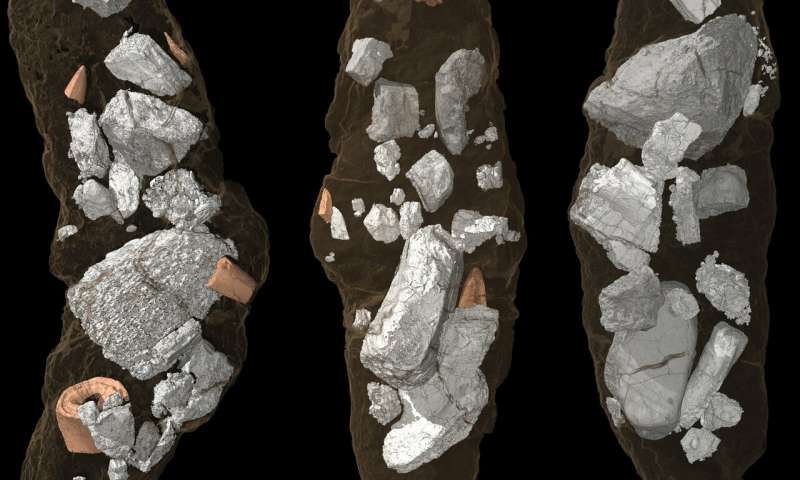
Coprolites, or fossil droppings, of the dinosaur-like archosaur Smok wawelski contain lots of chewed-up bone fragments. This led researchers at Uppsala University to conclude that this top predator was exploiting bones for salt and marrow, a behavior often linked to mammals but seldom to archosaurs. Credit: Jakub Kowalski

Coprolites, or fossilized droppings, of the dinosaur-like archosaur Smok wawelski contain lots of chewed-up bone fragments. This led researchers at Uppsala University to conclude that this top predator was exploiting bones for salt and marrow, a behavior often linked to mammals but seldom to archosaurs.

Most predatory dinosaurs used their blade-like teeth to feed on the flesh of their prey, but they are commonly not thought to be much of bone crushers. The major exception is seen in the large tyrannosaurids, such as Tyrannosaurus rex, that roamed North America toward the end of the age of dinosaurs. The tyrannosaurids are thought to have been osteophagous (voluntarily exploiting bone) based on findings of bone-rich coprolites, bite-marked bones, and their robust teeth being commonly worn.

The researchers found several crushed teeth in the fossil droppings, probably belonging to Smok wawelski itself. The teeth were crushed against hard food items and involuntarily ingested. Credit: Gerard Gierlinski

In a study published in Scientific Reports, researchers from Uppsala University were able to link 10 large coprolites to Smok wawelski, a top predator of a Late Triassic (210 million year old) assemblage unearthed in Poland. This bipedal, 5-6 meters long animal lived some 140 million years before the tyrannosaurids of North America and had a T. rex-like appearance, although it is not fully clear whether it was a true dinosaur or a dinosaur-like precursor.

Three of the coprolites were scanned using synchrotron microtomography. This method has just recently been applied to coprolites and works somewhat like a CT scanner in a hospital, with the difference that the energy in the X-ray beams is much stronger. This makes it possible to visualize internal structures in fossils in three dimensions.

Coprolites, or fossil droppings, of the dinosaur-like archosaur Smok wawelski contain lots of chewed-up bone fragments. This led researchers at Uppsala University to conclude that this top predator was exploiting bones for salt and marrow, a behavior often linked to mammals but seldom to archosaurs. Credit: Martin Qvarnström

The coprolites were shown to contain up to 50 percent of bones from prey animals such as large amphibians and juvenile dicynodonts. Several crushed serrated teeth, probably belonging to the coprolite producer itself, were also found in the coprolites. This means that the teeth were repeatedly crushed against the hard food items (and involuntarily ingested) and replaced by new ones.

Further evidence for a bone-crushing behaviour can also be found in the fossils from the same bone beds in Poland. These include worn  and bone-rich fossil regurgitates from Smok wawelski, as well as numerous crushed or bite-marked bones.

Reconstructed skeleton, University of Warsaw

Several of the anatomical characters related to osteophagy, such as a massive head and robust body, seem to be shared by S. wawelski and the tyrannosaurids, despite them being distantly related and living 140 million years apart. These large predators therefore seem to provide evidence of similar feeding adaptations being independently acquired at the beginning and end of the age of dinosaurs.

More information: Martin Qvarnström et al, Tyrannosaurid-like osteophagy by a Triassic archosaur, Scientific Reports (2019). DOI: 10.1038/s41598-018-37540-4

Provided by: Uppsala University

Source: https://phys.org

How we Know that Ancient African People Valued Fossils and Rocks

Wednesday, January 30, 2019

The trilobite manuport (Bainella sp) from Robberg on the Cape south coast was carried at least 10 km to a small cave shelter. For scale, the bar is 10 cm long. Author Supplied

It's been nearly 50 years since geologist and author Dorothy Vitaliano coined the term "geomythology". This refers to the study of oral traditions from around the world that explain geological and other natural phenomena through metaphor and myth. Geomythology also involves investigating how pre-scientific cultures interpreted the geological and fossil phenomena they encountered in the world around them.

There are many benefits to this work. One is that it confirms how much knowledge and insight existed in pre-scientific cultures. Another is that a knowledge of local geomythology can help palaeontologists to identify and study important fossil sites.

There's a lot of information about geomythology from places like North AmericaEurope and China. But very little is known about this field on the African continent, and particularly in southern Africa. We found this surprising: the region is home to the "Cradle of Humankind", a world heritage site. It's of critical importance in the origin of modern humans and has a tremendous fossil record, which includes numerous vertebrate trackways – the footprints that ancient species left as they moved around the landscape.

This evidence, coupled with the remarkable tracking ability of groups like the San, suggests that early southern African cultures might have been aware of this evidence in stone and what it represented: remarkable creatures that no longer existed.

We set out to better understand southern Africa's geomythology. This was done using our combined knowledge, as well as literature searches. Our study features 21 sites across southern Africa – and also lists sites elsewhere in Africa, like Uganda, Tanzania, Cameroon and Algeria – that show evidence of geomythology among pre-scientific societies.

Our hope is that this work will form a foundation for further studies, and that in time a diverse non-western, indigenous palaeontological and geomythological heritage will become evident in southern Africa. The resulting knowledge may shed new light on how our ancestors thought and behaved.

Two categories

Two main categories of geomythology emerged in our study. The first were manuports. These are unmodified objects like fossils or quartz crystals that are found in places where they couldn't possibly have occurred naturally. Manuports would have made people curious enough to pick them up, carry them and store them.

We found examples of these in several places in South Africa and Lesotho. One of the most fascinating manuports was the remarkable fossil of a Karoo reptile, which was reportedly found being used as a pot lid in a Griqua hut around 1830. This specimen went on to become very important in the elaboration of the study of continental drift.

Quartz – and its relationship to beliefs on spiritual sight – figured prominently in our findings. One notable example was a large quartz crystal manuport from the southern Cape: it was found wedged into the eye socket of an infant in a burial site in a cave shelter.

Arguably the most famous and certainly the oldest known manuport in the world is the "Makapansgat cobble". It resembles a human face, and has been dated to 2.95 million years. The inference is that someone appreciated the facial likeness – and maybe the red colour – and picked it up in the earliest known example of symbolic thinking.

The second major category involved spatial associations between rock art and dinosaur skeletons and trackways, particularly in South Africa's eastern Free State and Lesotho.

The most compelling example was at Mokhali Cave. This is a rock art site containing an image of a dinosaur footprint beside bird-like images, close to dinosaur trackways and dinosaur bones.

Buttressing such evidence were ethnographic studies which document myths of prehistoric monsters that may have made the tracks. These examples were complemented by a petroglyph resembling a dinosaur track in the northern Cape and  in the Cederberg with images that resemble mammal-like reptiles from the Permian period. These images were perhaps inferred from people's awareness of trackways and fossils, and what these represented.

Future inspiration

These sites, and others we studied, share some commonalities with sites on other continents. But they have a uniquely African flavour, such as the San in the Kalahari Desert carrying fulgurites (rocks created by the fusion of sand during lightning strikes) to use in ceremonies to ward off lightning or to summon rain.

And, as we suggest in our study, geomythology – and those curious collectors from so long ago – can be a powerful way to inspire more people on the continent to become interested in Africa's palaeoscience.

Source: https://phys.org

Pages