nandi's blog

Dinosaur Tracks Make Fresh Impression at Valley Forge Park

Friday, March 29, 2019

In this Feb. 28, 2019 photo combination shown are fossilized dinosaur footprints and a non-dinosaur reptile, lower right, a relative of the modern crocodile, on paving stones at the Valley Forge National Historical Park in Valley Forge, Pa. A volunteer at the park outside Philadelphia recently discovered dozens of fossilized footprints on flat rocks installed to pave a section of hiking trail. (AP Photo/Matt Rourke)

The national park on the site where George Washington and the struggling Continental Army endured a tough winter during the American Revolution boasts a new feature that’s a couple of hundred million years old – dozens of fossilized dinosaur footprints discovered on rocks used to pave a section of hiking trail.

The trace fossils, as they are known, are scattered along a winding trail at Valley Forge National Historical Park, on slabs purchased in 2011 from a nearby commercial quarry.

To the untrained eye, they appear as indistinguishable bumps in the sandstone rock, with the largest about 9 inches long. On a recent weekday, hikers, joggers and dog walkers used the trail, oblivious to the marks of prehistoric animals beneath their feet.

Those marks drew the attention of Tom Stack not long after he began working as a volunteer park ambassador at Valley Forge in 2017.

Stack, who has a background in geology and paleontology, recognized the approximately 210 million-year-old rocks known as argillite as being similar in age and type to fossil-bearing rocks used to construct a 1930s-era bridge on the Gettysburg battlefield, about 100 miles to the west.

Most of the tracks left in what were once muddy flats consist of three-toed foot impressions from the early days of dinosaurs, although Stack also found footprints from a non-dinosaur reptile, a relative of the modern crocodile. The largest would have been a bipedal theropod that was 6 to 9 feet long and 4 to 6 feet high.

“They’re subtle, they’re not easy to spot, but once you learn the characteristics of them, given the right sunlight angle and, at times, the moisture on the rock, then they are easier to identify,” Stack said.

There are also distinctive patterns in the rock thought to be caused by the cracking of dried mud, and from the ripples of a lake or river.

The National Park Service requested the exact location of the rocks not be publicized, to help protect them from being damaged or removed. Officials said visitors will be told about the rocks and how park resources are protected, but not where to find them. The 5-square-mile park has about 30 miles of trail.

The dinosaur footprints Stack found are not unique or even particularly rare, and don’t add to the body of scientific knowledge about the creatures, said National Park Service paleontology program coordinator Vince Santucci. They date from later in the Triassic period and before the Jurassic era that’s so familiar to moviegoers.

“There’s no question that they are” dinosaur trace fossils, said Santucci, who examined them in person last April. “They’re consistent with the tracks that occur in equivalent-age beds all over the East Coast.”

More than 270 National Park Service properties contain some sort of paleontological resource, from Dinosaur National Monument in Colorado and Utah to the fossils scattered in rock used to build the Lincoln Memorial and Capitol Reflecting Pool in Washington, D.C.

Most fossils found on Park Service land are still where they were discovered, in the original bedrock location. But others were moved by human activity, including a set of burrows from an ancient species that appear on the rock facade of a visitor’s center bathroom at Valley Forge. Those rocks originated outside the park.

There also happens to be a significant Ice Age fossil location beneath the Valley Forge Park, the Port Kennedy bone cave. First discovered in 1871, it has produced fossils that include giant tapirs, ground sloths and saber-toothed cats. Port Kennedy is considered one of the most important mammal fossil sites in North America, with some findings having been displayed at the park visitor center, although most are at the Academy of Natural Sciences in Philadelphia. That 750,000-year-old site was lost after a quarry was filled – partly with asbestos – before being rediscovered by scientists in 2005. It is not accessible to the public.

There are at least 35 Park Service properties known to have fossil tracks of ancient vertebrates, and vandalism and theft have been a problem. Federal law prohibits visitors from disturbing park elements.

A park spokesman said there have been preliminary discussions about developing an interpretive program to give visitors information about the trace fossils. Stack said the park should consider removing rocks that contain the best fossils, to prevent damage or theft.

“I would think they are of value as an educational tool,” said Helen Delano, a senior scientist with the Pennsylvania Geologic Survey. “Dinosaurs are a wonderful way to hook people into paying attention to the geological environment. Every kid loves dinosaurs.”

Stack said the rocks are abundant, cheap and durable, so they have long been used for paving, sidewalks, garden walls and similar features in the Philadelphia area.

Source: www.pattayamail.com

Remains of 700,000-Year-Old Giant Bear Found in Argentina's San Pedro

Saturday, March 30, 2019

The bear belonged to the Arctotherium angustidens species

The remains belonged to the most powerful carnivore of Argentina's Quaternary Period.

The fossil of a 700,000-year-old giant bear was discovered by a team of paleontologists in the Argentinian town of San Pedro, north of Buenos Aires.

The remains of what is said to be the most powerful carnivore of Argentina's Quaternary Period were discovered by a team of San Pedro's Paleontological Museum, during a routine mineral extraction tour.

According to the museum's Paleontology director, Jose Luis Aguilar, the bear was of the Arctotherium angustidens species and it would have had a body mass of about 800 kg (1873 lbs). “Of all bears, prehistoric and current, the Arctotherius was the most carnivorous of all,” Aguilar said.

The team was surprised by the high state of preservation of the remains. “The most amazing thing is the state of conservation with which the skull of the complete animal was found, that is to say, skull, jaw, all its dentition,” said Aguilar.

Source: www.theweek.in

Quaternary Period

Tuesday, April 2, 2019

Quaternary Period Landscape Beach Towel featuring the photograph Quaternary Period Landscape by Publiphoto

Quaternary is the current and most recent of the three periods of the Cenozoic Era in the geologic time scale of the International Commission on Stratigraphy (ICS). It follows the Neogene Period and spans from 2.588 ± 0.005 million years ago to the present. The Quaternary Period is divided into two epochs: the Pleistocene (2.588 million years ago to 11.7 thousand years ago) and the Holocene (11.7 thousand years ago to today). The informal term "Late Quaternary" refers to the past 0.5–1.0 million years.

The Quaternary Period is typically defined by the cyclic growth and decay of continental ice sheets associated with Milankovitch cycles and the associated climate and environmental changes that occurred.

The Quaternary Period follows the Neogene Period and extends to the present. The Quaternary covers the time span of glaciations classified as the Pleistocene, and includes the present interglacial time-period, the Holocene.

This places the start of the Quaternary at the onset of Northern Hemisphere glaciation approximately 2.6 million years ago. Prior to 2009, the Pleistocene was defined to be from 1.805 million years ago to the present, so the current definition of the Pleistocene includes a portion of what was, prior to 2009, defined as the Pliocene.

Quaternary stratigraphers usually worked with regional subdivisions. From the 1970s, the International Commission on Stratigraphy (ICS) tried to make a single geologic time scale based on GSSP's, which could be used internationally. The Quaternary subdivisions were defined based on biostratigraphy instead of paleoclimate.

This led to the problem that the proposed base of the Pleistocene was at 1.805 Mya, long after the start of the major glaciations of the northern hemisphere. The ICS then proposed to abolish use of the name Quaternary altogether, which appeared unacceptable to the International Union for Quaternary Research (INQUA).

In 2009, it was decided to make the Quaternary the youngest period of the Cenozoic Era with its base at 2.588 Mya and including the Gelasian stage, which was formerly considered part of the Neogene Period and Pliocene Epoch.

The Anthropocene has been proposed as a third epoch as a mark of the anthropogenic impact on the global environment starting with the Industrial Revolution, or about 200 years ago. The Anthropocene is not officially designated by the ICS, but a working group has been working on a proposal for the creation of an epoch or sub-period.

Artist's impression of Earth during the Last Glacial Maximum

The 2.6 million years of the Quaternary represents the time during which recognizable humans existed. Over this geologically short time period, there has been relatively little change in the distribution of the continents due to plate tectonics.

The Quaternary geological record is preserved in greater detail than that for earlier periods.

The major geographical changes during this time period included the emergence of the Strait of Bosphorus and Skagerrak during glacial epochs, which respectively turned the Black Sea and Baltic Sea into fresh water, followed by their flooding (and return to salt water) by rising sea level; the periodic filling of the English Channel, forming a land bridge between Britain and the European mainland; the periodic closing of the Bering Strait, forming the land bridge between Asia and North America; and the periodic flash flooding of Scablands of the American Northwest by glacial water.

The current extent of Hudson Bay, the Great Lakes and other major lakes of North America are a consequence of the Canadian Shield's readjustment since the last ice age; different shorelines have existed over the course of Quaternary time.

Source: https://en.wikipedia.org / www.natgeo.com

Carcharocles megalodon: A Study That Has Plenty of Bite

Friday, March 29, 2019

The teeth of the mega-tooth macro-predatory shark megalodon (or Carcharocles megalodon), which ruled for 18 million years until it went extinct about three million years ago, underwent a transformation. ILLUSTRATION BY TIM SCHEIRER, CALVERT MARINE MUSEUM

Carcharocles megalodon, also known simply as the Megalodon or “Meg,” is arguably the largest macro-predator the world has ever known. The species populated the Earth’s oceans for 18 million years from about 20 million to 2.5 million years ago.

Megalodon’s immediate ancestor, known as Carcharocles chubutensis, was another huge shark with equally impressive teeth.

And in a paper titled “The Transition Between Carcharocles Chubutensis and Carcharocles Megalodon (Otodontidae, Chrondrichthyes); Lateral Cusplet Loss Through Time,” which was recently published in the Journal of Vertebrate Paleontology, a team of paleontologists led by former Calvert Marine Museum Department of Paleontology intern Victor Perez described how the teeth of the ancestor of Megalodon (Carcharocles chubutensis) underwent its final transformation into the teeth of Carcharocles megalodon.

The very gradual transformation, which took roughly 12 million years, involved the loss of serrated lateral cusplets at the base of the cutting edge of the tooth. The results of the study are exciting because they show that some small evolutionary changes occur very gradually and may take many millions of years.

From the time of the extinction of dinosaurs 66 million years ago, the triangular teeth of the lineage of sharks that culminated in Megalodon changed in shape, evolved a serrated cutting edge, and increased significantly in size.

These massive sharks were well equipped to hunt, kill, and dismember large marine mammals such as whales and dolphins.

The loss of the serrated lateral cusplets (an ancestral feature) in these teeth is recorded in sediment preserved in the Calvert Cliffs on the western shore of the Chesapeake Bay. The sediments in and around Calvert Cliffs preserved the teeth of both species, and recorded the millions of years during which this final evolutionary transformation in the shape of the Megalodon tooth took place.

In the older sediments, most of the teeth bear lateral cusplets, but as one ascends through successively younger strata, the percentage of teeth without lateral cusplets increases until lateral cusplets all but disappear in the youngest beds.

For some reason which is not entirely resolved, in spite of its global dominance as a marine apex predator, Megalodon became extinct about three million years ago. And one or more of the following factors may have contributed to its demise: Eruption of a supernova, which cooled global temperatures; closure of the Isthmus of Panama; the extinction of groups of whales that Megalodon preyed upon, and/or competition with more modern predators like the great white shark (Carcharodon carcharias).

The research project was a collaboration between the Calvert Marine Museum, the University of Florida, the National Museum of Natural History in Washington and the University of Maryland, College Park.

To see the paper, go to http://bit.ly/JVPMegTeeth.

Source: www.somdnews.com

This Newly Discovered Mastodon Species Roamed California for Millions of Years

Thursday, March 28, 2019

Illustration: Brian Engh/Western Science Center

If you ponder mammoths, certain species of which died out a mere 3,000 or so years ago, their existence is but a breath away from our own. Echoes of their lives can be seen in today’s elephants, which lumber across our world in ways that might not be so different than their ancient relatives. Mammoths are almost tangible in that way.

Fewer people know of mastodons, the stockier, and in some cases, hairier, forest-dwelling cousins of mammoths. Just like some species of mammoth, the American mastodon (Mammut americanum) lived throughout North America during the Pleistocene. Their extinction came some 10,000 to 12,000 years ago.

The predominant species, excavated and studied from coast-to-coast for over 200 years, has been Mammut american.

Until today.

In a new paper published in PeerJ, Alton Dooley, Jr. and colleagues announce the discovery of Mammut pacificus, a new species of mastodon specific to a small segment of the North American West. It is the first new North American mastodon species to be recognized in 50 years.

None of the six authors expected this result from their research. In fact, they explored every other avenue exceptdefining a new species in the years leading up to this paper.

“I felt like I was fighting tooth and nail against a new species,” Dooley, Jr. told me, “and every time I tried to fight, the data kept hammering me down!”

“One of the reasons that we didn’t expect this is [because] it’s a Pleistocene megafaunal animal. The Pleistocene is so well studied. That’s not to say we understand everything about it, but it’s not that long ago, [and therefore] there are huge Pleistocene collections all over the world,” said Dooley, who is executive director of the Western Science Center. “I’m shocked that there’s a mastodon taxon that went unrecognized for so long.”

Adding to the surprise is that none of the fossils studied in this research was excavated recently. Many were carefully collected from what is now known as Diamond Valley Lake and eventually stored at the Western Science Center in Hemet, California. A team of diggers lead by co-author Kathleen Springer worked to excavate as many fossils as possible in the 1990s. They uncovered 100,000 Pleistocene fossils. Any thing else now remains under billions of gallons of water—an emergency water reservoir for southern California.

It is important to note, however, that 100 individual mastodons were found in that dig, known as the Diamond Valley Lake assemblage. That is the largest number of mastodons in the southwest not found in a tar pit, and it certainly added to the overall data set. [Full disclosure: I contributed to a crowdfunding campaign that supported the initial research of this study three years ago.]

With narrower molars than their American mastodon cousins, more vertebrae in the pelvis, a lack of any lower tusk in the jaw and a slightly different femur, these differences may point to one reason why this species remained hidden in plain view.

“Naming a new species, especially in the fossil record, can as much a ‘decision’ as a ‘discovery,’” Adrian Lister, a proboscidean expert at the Natural History Museum of London, told me via email. “Unless the new species is quite obviously unique, it will have one or more close relatives, as is the case here, so the question becomes: Should these be considered separate species or just subspecies or some other kind of variety? Even for living species, where we have much more information… there is often disagreement among taxonomists as to what constitutes a species.”

“In the case of the mastodons, I think the authors have a reasonable basis for erecting a new species. The differences are not major…[b]ut the differences are consistent, and importantly, the authors show this difference has both a clear geographical basis (California and maybe adjacent states) and also persisted through the 2 million years or so of the Pleistocene,” Lister wrote. “That is indicative of an entrenched geographical and presumably genetic difference that makes the erection of a new species defensible.”

Eric Scott, co-author of the new study and a paleontologist who worked with Kathleen Springer to excavate the Diamond Valley Lake assemblage, often met with Dooley, Jr. to debate the meaning behind the fossil data.

“There was a concrete difference in these animals that was consistent across a geographic area,” Scott said. “And, this was the important part to me, it was consistent for a prolonged period of geological time. I had the same issue with [fossil] horses. If you have an anatomical configuration of a horse that’s different in one area than it is anywhere else, and it holds that anatomy for tens of thousands of years, that suggests that it’s not exchanging genetic information with any of those other horses, which is reproductive isolation, which is the biological definition of a species. [We were] seeing the same thing with these mastodons.”

Kathleen Springer, the main force behind the Diamond Valley Lake excavations and now a geologist at the U.S. Geological Survey, is justifiably excited.

“[T]his is a spectacular result, from the perspective of vertebrate paleontology and the process of science,” she wrote in an email. “[It is also] testimonial for the necessity and utility of natural history museums.”

Her work at the new USGS Radiocarbon Laboratory provided new radiocarbon dating for many of the mastodons studied in this research, using “material that had never been attempted prior (eggshell, Succineidae gastropod shells, and plant fibers).”

What does this research mean for the average person and why should we care? Aside from augmenting our knowledge of Pleistocene megafauna, it increases our understanding of life on this planet. It takes us one step closer to knowing how that life evolved, existed, and eventually went extinct. And it certainly encourages even more questions that beg to be answered: Why, for example, did this particular species evolve with these particular anatomical traits? What does that say about the environment in which it lived?

Brett Dooley, another co-author of the paper and an educator at the Western Science Center, expressed the hope that having the research published in an open-access journal will encourage more people to read about the new mastodon.

“I’m [also] hoping that people from the Hemet region will take some pride in it, as [naming a new species] isn’t something that happens every day. I hope that they can appreciate that and take a sense of ownership for it themselves.”

Source: https://gizmodo.com

Scientists to Dig Jurassic Site in Wyoming this Summer

Wednesday, March 27, 2019

Hunting ground: A huge dinosaur footprint, with wheelbarrow for scale, in Jurassic Mile

They're calling it the "Jurassic Mile," where dinosaurs once chased prey through muck and some of the biggest creatures of 150 million years ago lumbered over a tropical flood plain.

This summer, the Children's Museum of Indianapolis will coordinate a project that will bring over 100 scientists from the U.S. and Europe on a three-month dig at a newly discovered site in the Bighorn Basin of northern Wyoming.

Organizers aren't saying exactly where the site is to discourage any looters and curiosity-seekers — suffice it to say it's on a square mile (2.6 square kilometers) of private ranchland outside Cody, about 100 miles (160 kilometers) east of Yellowstone National Park.

Discovered just a few years ago, the Jurassic Mile already has yielded fossils from some of the biggest dinosaurs of the late Jurassic Period. Among them are long-necked plant-eaters that may be diplodocus- and brachiosaurus-type dinosaurs, professor Phil Manning from the University of Manchester in Great Britain.

Scientists in 2018 dug up an over 6-foot (2-meter) brachiosaur scapula, or shoulder bone. There are also preserved tracks from both predatory and prey dinosaurs.

"It's a snapshot in time of what the Jurassic would have looked like. And if you were to invent a site, the perfect site which allows you to interpret the Jurassic, this would be that site," said Manning, who is scientist in residence at the Indianapolis museum.

The $27 million project, funded in part with a $9 million Lilly Endowment grant, will help bolster the museum's collections, but scientists representing a variety of institutions and disciplines will also take part.

"There's a whole range of fossil plants, small vertebrates and invertebrate fossils that may be discovered there," said Richard Herrington, acting director of science at the Natural History Museum in London.

So far, paleontologists are focusing on two key areas, including what appears to have once been a pond with dinosaur tracks on its shore.

"A few beasties clearly ended up in the mire, as it were. And there's shed predatory dinosaur teeth associated with that. So watering holes are a great place to drink and also great place for predators to pick up some food as well," said Manning.

Another area from roughly the same time period appears to have been a bend in a large, lazy river, where the floating corpses of dinosaurs came to rest before being buried in sediment.

Only a small fraction of the site has been excavated, however. Another layer altogether contains remains of ichthyosaur, a type of large marine reptile.

The University of Manchester, where Manning is chair of natural history, the Natural History Museum in London and the Naturalis Biodiversity Center in Leiden, the Netherlands, are among the institutions taking part along with the children's museum.

Source: www.greensburgdailynews.com

We've Discovered a Massive Dinosaur-Era River Delta Under the Sea

Wednesday, March 27, 2019

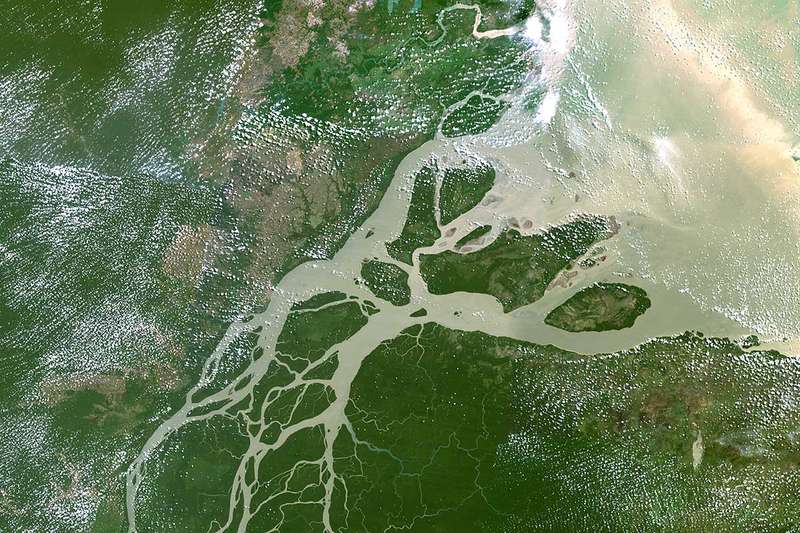
The Amazon delta was a tenth the size of a recently discovered dinosaur-era delta Planet Observer/Universal Images Group via Getty Images

A vast floodplain 10 times the size of the Amazon delta existed during the early days of the dinosaurs. It is the largest known delta from Earth’s history and may have been a crucial habitat.

During the Triassic Period when dinosaurs first appeared, all of Earth’s continents were joined together in a Supercontinent called Pangaea.

Part of northern Pangaea is preserved under the Barents Sea between Norway and Russia. Tore Grane Klausen, whilst at the University of Bergen in Norway, and his colleagues took data from wells drilled in the sea bed and combined this with seismic data to map the rock layers.

The team found preserved sediments from a delta that existed 237 to 227 million years ago. A delta is a wide, flat plain of muddy sediment that forms when a river meets a larger body of water, like a lake or ocean.

The remains span the entire Barents Sea and are 10 times the size of today’s largest deltas, in the Amazon and the Ganges. This equates to 1.65 million square kilometres, or about 1 per cent of the land area of modern Earth.

The team hasn’t officially named the discovery, but has informally called it the Snadd delta because it was found in rocks called the Snadd formation.

Delta plain dinosaur stomp

A delta forms when rivers carry sediments downstream then dump them by the coast. The accumulated sediments form vast, fertile plains that can support huge numbers of plants and animals.

The ancient delta was on the north coast of Pangaea. It was fed by multiple rivers, formed by intense monsoon rains, flowing north from a mountain range, which contained huge volumes of sediment.

The animals that would have lived in the delta haven’t been studied in detail, but they included amphibians called labyrinthodonts that often lived in wetlands. The plant life included lots of ferns and some conifers.

“Everywhere you look, you can pick up these sandstone samples with imprints of ferns,” says Klausen. Just off the coast, crocodile-like pliosaurs and dolphin-like ichthyosaurs ruled the seas.

Much of the rest of Pangaea was less hospitable. The regions close to the equator spent much of the Triassic as extremely hot and dry deserts, so the delta may have been a major centre of biodiversity.

This ancient flood plain was also long-lived, steadily growing for periods of 2 to 5 million years at a time. This suggests sea level didn’t change much, in line with the established idea that the Triassic had a steady “greenhouse” climate with little or no ice at the poles.

Journal reference: GeologyDOI: 10.1130/G45507.1

Source: www.newscientist.com

80 precious plant fossils exhibited in Nanjing

Saturday, April 27, 2019

Some fossil specimens of Austrohamia acanthobractea from the Daohugou biota

More than 80 precious plant fossils were exhibited in Nanjing, Jiangsu Province, recently. 

The fossils span from 400 million to 18 million years ago. 

"The Archaefructus liaoningensis in my hand is a representative of the earliest flowers. It's about 125 million years old," said Li Guoxiang, Curator of Nanjing Museum of Paleontology. 

Li said Archaefructus liaoningensis once grew in water. 

Thanks to volcanic ash and other reasons, it slowly evolved into fossils and was preserved forever. 

In the late Jurassic Period, the climate was warm and humid, perfect for these plants' growth.Volcanic ashes preserved the fossils, Li said. 

The fossils were collected by Nanjing Institute of Geology and Paleontology under Chinese Academy of Sciences.

Source: www.ecns.cn

Paleontologists Discover 518 Million-Year-Old Fossil Site in China

Wednesday, March 27, 2019

A reconstruction of early Cambrian ocean life in South China. Image credit: Dongjing Fu.

Animal life exploded in diversity and form during the Cambrian Period about 500 million years ago. An international team of paleontologists has discovered an early Cambrian fossil site in China — the Qingjiang biota — that contains a variety of specimens, more than half of which are previously undescribed. The 518 million-year-old fossil site rivals previously described Cambrian sites, such as the Burgess Shale of British Columbia and the Chengjiang fossil site in China’s Yunnan province, and should help to elucidate biological innovation and diversification during the Cambrian period.

A little more than 500 million years ago, early animal life on Earth exploded in diversity and form in an evolutionary event that would graft the initial branches of most major animal phyla onto the tree of animal life — the Cambrian explosion.

Much of what is known about the Cambrian explosion has been learned from the fossil record at sites where the geological echoes of this early life have been preserved.

Perhaps no other assemblages to date have been more important to our understanding of the Cambrian explosion than the Burgess Shale and Chengjiang localities — both of which contain large and diverse collections of well-preserved fossils, including soft-bodied organisms, which rarely make it into the fossil record.

The discovery of the Qingjiang site — new Burgess Shale-type Lagerstätte (a geologist’s term for a deposit of extraordinarily well-preserved fossils) — was made by Northwest University’s Dr. Dongjing Fu and colleagues from Guizhou University, Northwest University and Pomona College almost by accident.

The paleontologists were working in the mountains and came down to the banks of the Danshui River, located in Hubei Province, when they noticed some rocks had an odd pin-striped pattern — a telltale sign of layers of mud deposited rapidly by ancient storms similar to those found at the famous Chengjiang site.

The arthropod Leanchoilia from the Qingjiang fossil site, China. Image credit: Fu et al, doi: 10.1126/science.aau8800.

In addition to the high taxonomic diversity, Qingjiang fossils are characterized by near-pristine preservation of soft-bodied organisms — including juvenile or larval forms, arthropod and worm cuticles and jellyfishes — and such soft-tissue features as eyes, gills and guts.

More than 4,000 specimens have already been collected, with 101 species identified — of these species, 53 are new to science and names have to yet to be assigned.

“This finding enriches our view of the early animal world and offers us really remarkable views of the simplest animals,” said team member Professor Robert Gaines, from Pomona College.

“One of the most incredible things about this finding is the pristine condition of many of these specimens — fossils that haven’t been substantially affected by impacts of time, and in them you can clearly see soft tissues like eyes, tentacles and gills.”

“The discovery promises to shed light on the evolution of Cambrian ecosystems across space and time. Nowhere do have a more pristine fossil record of early Cambrian life and such a diversity of organisms — and this is just the beginning.”

paper reporting this discovery is published in the journal Science.

_____

Dongjing Fu et al. 2019. The Qingjiang biota — A Burgess Shale-type fossil Lagerstätte from the early Cambrian of South China. Science 363 (6433): 1338-1342; doi: 10.1126/science.aau8800

Source: www.sci-news.com

Huge T. Rex Fossil Suggests Many Dinosaurs Were Bigger Than We Thought

Tuesday, March 26, 2019

Scotty holds the title of the world’s largest T. rex Amanda Kelley

As if Tyrannosaurus rex wasn’t terrifying enough already. A skeleton in Canada belonged to a T. rex that was comfortably heavier than any other previously found, making it the largest land predator on record. The discovery means we may have underestimated just how large predatory dinosaurs could grow.

T. rex was one of the last non-bird dinosaurs to evolve, and it has long been considered a contender for the largest ever predatory dinosaur. That case was made even stronger following the discovery of Sue – a 90 per cent complete T. rex skeleton unearthed in 1990.

Sue was described as the largest animal of its kind in the world, but this title now belongs to the Canadian newcomer: Scotty.


Read More: Meet Scotty, World’s Largest Specimen of Tyrannosaurus rex


“We’re talking about basically a 400-kilogram difference,” says Scott Persons at the University of Alberta, Canada. According to his team’s calculations, Sue weighed an impressive 8460 kilograms, but Scotty tipped the scales at 8870 kilograms. To put it another way, Scotty was a couple of adult male lions heavier than Sue.

Scotty was actually discovered about the same time as Sue, in the early 1990s (it earned its name from a bottle of scotch whisky used by the excavators to toast the find). But because its bones were encased in particularly hard rock, freeing them took decades.

“It wasn’t until now we’ve been able to take a step back and look at the specimen as a whole,” says Persons. “And doing so there’s an oh gosh moment, because the specimen really is enormous.”

Strictly speaking, Scotty is not the longest or tallest T. rex found, but its bones are the heftiest. Persons and his colleagues used a few methods to work out how heavy Scotty would have been, including using the circumference of Scotty’s thigh bones to calculate how much weight the legs were capable of supporting.

Bulking up

The team suspect they know why Scotty was so heavy: its bones suggest it was an exceptionally old individual, probably in its early 30s. T. rex might have reached its maximum body length and height earlier in adulthood, but then bulked up as it became older and mature.

The idea has big implications. Similar meat-eating dinosaurs known as theropods might have followed the same trend, bulking out only after many years.

But given that life for these animals was tough, very few individuals will have reached that full potential, meaning fossils of the oldest and bulkiest theropods will be very rare. In other words, we might be underestimating how big they could grow.

Steve Brusatte at the University of Edinburgh says many palaeontologists have been waiting a long time for a full description of Scotty. “It is probably our best look yet at what one of the largest, oldest, most fully grown adults would have looked like,” he says.

That Scotty seems to be the heaviest T. rex ever found is a reminder that our sample sizes for giant theropods are small, says Brusatte. “New discoveries can reveal even bigger or weirder individuals.”

One mystery is why T. rex could grow to be so large, says Persons. For other gigantic theropods there are mitigating factors that might explain how they survived – for instance, living in water to support their body weight or hunting very slow-moving dinosaurs that weren’t difficult for a heavy predator to catch.

But T. rex lived on dry land and had to hunt relatively fast-moving duck-billed dinosaurs, he says. “So why do tyrannosaurs go down this road of gigantism? We don’t know the answer to that.”

Journal reference: Anatomical RecordDOI: 10.1002/ar.24118

Source: www.newscientist.com

Pages