nandi's blog

How Long Did The Dinosaur Extinction Last?

Wednesday, April 10, 2019

What time scale would the extinction of the dinosaurs happened over? Weeks or months or centuries?


How long did the dinosaur extinction last? We asked Geologist John Underhill to weigh in...

John - Well, let's go back to when it actually happened. So the mass extinction event actually wiped out three quarters of animal and plant species at the Cretaceous-Tertiary boundary called the K-T boundary.

Chris - How do you know?

John - Well you look at the fossil record beforehand and immediately thereafter in the strata that are displayed and you see the changes that occur over that. That happens around 66 million years ago going back to the radioactive decay and dating of the earth and so on, and it's actually marked by a tremendous concentration of an unusual mineral called iridium. We don't actually find it in the UK, so we have to look elsewhere for the actual golden bullet, if you like.

Chris - It's like a signature. You're saying that written into the strata, which we can date, is this mineralogical fingerprint if you like?

John - That's right, although not present in the UK. Even recently in the last couple of weeks there have been good reports about North Dakota and some of the samples in that particular area.

Chris - So are you saying then that this stuff is not naturally found on Earth, therefore it came in with whatever 'did' for the dinosaurs because we can see it appearing at the right point in time when we know that event is likely to have happened?

John - So there's certainly an event, that's definitely right. And this is where we get to the nub of the issue because we can date an impact crater. We can identify one in northern Mexico, a place called Chicxulub, and it's located beneath the Yucatan Peninsular and it appears to be the smoking gun, if you like for the iridium.

Chris - How big is the crater?

John - The crater is tens of kilometres across. It caused massive instability in the continental shelf in northern Mexico.

Chris - So how big would the thing that came in have to have been to have made a crater that big?

John - Of that size. I mean, it's the size that you see on the Moon with some of the craters there and so on. But whether it was actually the golden bullet that did for the dinosaurs is really coming back to the nub of the question that has been asked. Because there is another possibility in terms of what caused the toxic atmosphere at that time and that is actually major eruptions, what are called the Deccan Traps in India which occurred over a period of 66 to 65 million years ago. And one of the interesting things about this particular event is, of course, about 150 to 200 thousand years after the iridium anomaly we see a number of dinosaurs and other species staggering on beyond the iridium anomaly, and this suggests that actually there may have been a double whammy that 1) you had the meteorite impact, but moreover the toxic atmosphere was actually being created by the volcanic debris and the like that was going up into the air, and that makes it more consistent with other mass extinction events through the rock record, which have all been tied back to large igneous provinces. So it's probably the two things together. And to answer the question: it was tens of thousands of years, not instantaneous.

Source: www.thenakedscientists.com
'Exquisitely Preserved' Dinosaur Skin Trace Discovered in South Korea

Tuesday, April 9, 2019

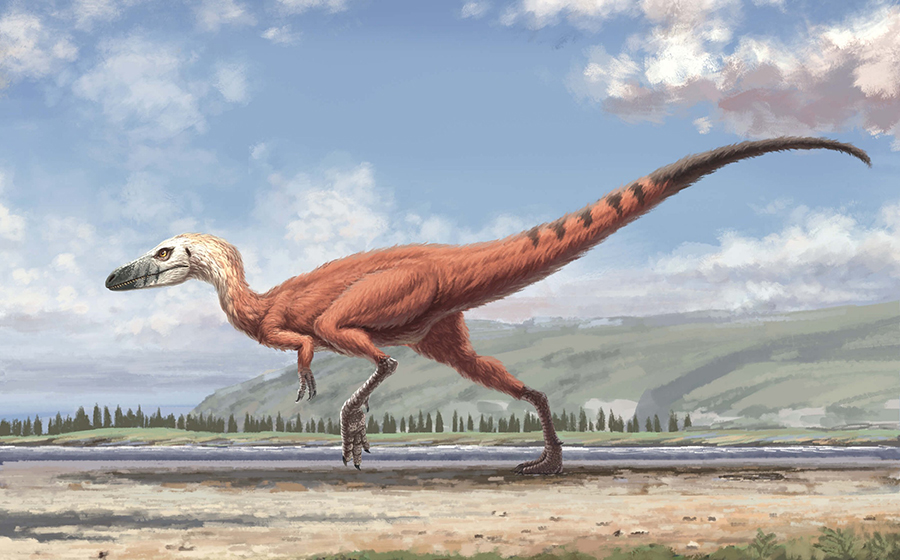
A small dinosaur—probably about the size of a blackbird—stalks a lakeshore. That animal left footprints in the mud that hardened and lasted for over 110 million years, until a team of scientists uncovered them in South Korea. (Artist’s interpretation by Zifeng Wang.)

Several footprints and exquisitely-preserved skin impressions made by a small theropod dinosaur approximately 120 million years ago (Aptian age of the Early Cretaceous Period) have been found in the Jinju City area in Korea.

Paleontologists are used to finding dinosaur bones and tracks. But remnants of soft tissue, like muscles or skin, are rare and often not well preserved. A very small percentage of tracks – much less than 1% – show skin traces.

Kyung-Soo Kim, PhD, of Chinju National University of Education recently found a set of very small tracks with perfect skin traces near Jinju City, Korea. CU Denver Professor Emeritus of Geology Martin Lockley, PhD, – with Kim, Jong Deock Lim of Korea and Lida Xing of Beijing – wrote a paper about the skin traces for the journal Scientific Reports. They described the skin as “exquisitely-preserved.”

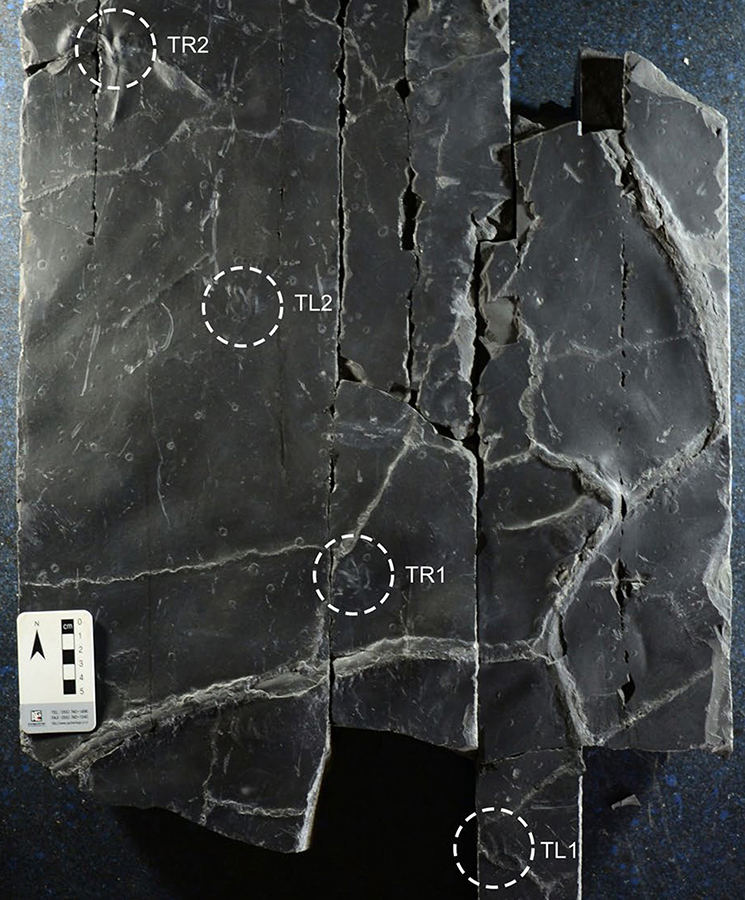
Four-track Minisauripus trackway. Image credit: Kim et al, doi: 10.1038/s41598-019-38633-4.

First dinosaur tracks ever found with perfect skin impressions

“These are the first tracks ever found where perfect skin impressions cover the entire surface of every track,” Lockley said. The skin patterns of different groups of dinosaurs varied and, like fingerprints, were signatures of differences in anatomy.

The skin traces come from tracks of the smallest known theropod, the Minisauripus. The footprints are only an inch long, and the scientists were able to find perfectly preserved skin traces on them. This was the 10th discovery of a site with Minisauripus tracks and the first to show skin traces.

The tracks, found during large-scale excavations, were nearly lost. Kim, who is in charge of predevelopment paleontological survey and rescue, was able to stop the excavation when he spotted the first track on a broken slab. With the help of his team, he found four more tracks with perfect skin traces.

How to perfectly preserve dinosaur skin

“The tracks were made on a very thin layer of fine mud,” Lockley said, “rather like a coat of fresh paint only a millimeter thick.” When the blackbird-sized dinosaur stepped on this firm, sticky surface, the skin texture of the foot was reproduced perfectly, without slipping or sliding.

Evidence shows that, just before the tracks were made, there had been a rain shower leaving water-drop impressions. In one place, the dinosaur had stepped on a fresh rain drop mark, proving rain came first, and the dinosaur step came second. All this delicate evidence was preserved by being gently covered with more fine mud.

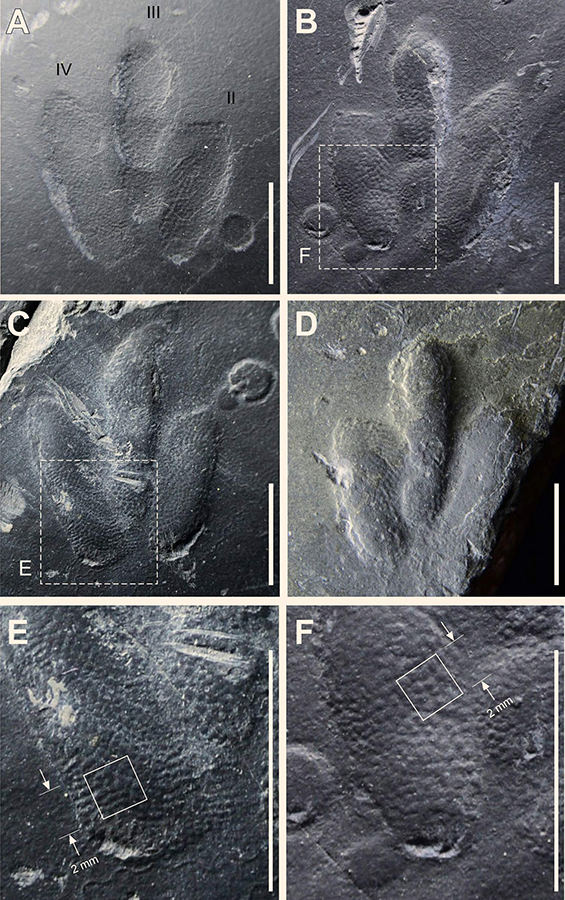
Minisauripus: natural impression (A) and cast (B) of track TL 2 showing area enlarged in frame F; note skin traces in hypex area between digits II and III; (C) natural cast of track TR1, showing area enlarged in frame E; note narrow, digit II intersecting raindrop impressions; (D) isolated track t; note skin traces in hypex area between digits II and III; E and F details of skin trace ornament in 2.0 x 2.0 mm areas of digits IV and II respectively from tracks TL2 and TR1; casts show in frames B-F are essentially replicas of the living foot. Image credit: Kim et al, doi: 10.1038/s41598-019-38633-4.

The ultimate secret of skin care

The texture of the dinosaur skin is the grade of a medium sandpaper, but with the tiny scale traces in perfect arrays, like a well-woven fabric. Each little scale trace is only a third- or a half-millimeter in diameter and very similar to rare examples of mummified skin seen on the feet of a couple of feathered birds from China. But the team noted that, although the skin texture is the same, the shape of the feet of the Chinese birds and the Korean dinosaur were quite different.

The paper reports the skin pattern as similar to examples from much larger, carnivorous theropod dinosaur tracks, in which scales are much larger but never preserved across the whole footprint.

The more distantly-related giant brontosaurs had scales that left traces 2-3 centimeters in diameter, the size of a quarter. So the delicate, perfectly-preserved Minisauripus skin texture is like a shrunken version of the skin of a much larger relative, with no shrinkage of the skin traces.

“This is the ultimate secret of skin care,” Lockley said.

Source: www.cudenvertoday.org

Newly-Discovered Fossils Reveals Life in Cambrian Period

Thursday, April 11, 2019

A student from the Department of Geology carries out research on a fossil from the Qingjiang biota in Northwest University in Xi'an, capital of northwest China's Shaanxi Province, April 8, 2019. [Photo/Xinhua]

A newly-discovered trove in central China containing soft-bodied fossils that date back 518 million years sheds new light on the diversity of early animal life during the Cambrian Period, according to Chinese and foreign researchers.

The site of the Burgess Shale-type fossil deposit, the Qingjiang biota, is on a bank of the Danshui River, near its junction with the Qingjiang River in Changyang Tujia Autonomous County, Hubei Province.

Among the 4,351 specimens so far analyzed from the type locality, 109 categories have been recognized and 53 percent of them are new, said Fu Dongjing, associate professor at Northwest University in Xi'an, capital of Shaanxi Province, and the first author of the study published in March in the U.S. journal Science.

The diversity of species in the Qingjiang biota may surpass that of all other Burgess Shale-type biotas, such as the Burgess Shale in Canada, discovered in 1909 and the Chengjiang biota in southwest China's Yunnan Province, discovered in 1984, she added.

The Qingjiang biota was first discovered in the summer of 2007 when a Northwest University team led by professor Zhang Xingliang was doing field research in Changyang. On a riverside, using a geological hammer Zhang knocked off a stone containing a Leanchoilia arthropod fossil, which is typical of the Burgess Shale-type fossils. Shortly after, the team found a Naraoia fossil at the same site. It was also the discovery of a Naraoia fossil by Chinese paleontologist Hou Xianguang at the Chengjiang area in 1984 that led to the discovery of the Chengjiang biota, some 1,050 km away from the site of the Qingjiang biota.

Since then, the Early Life and Environment research team at Northwest University visited the Qingjiang area twice or three times each year when the river water levels are low. In 2014, the team confirmed the huge potential of the fossil deposit, a sedimentary deposit that exhibits extraordinary fossils with exceptional preservation.

"As half of the species of the fossils are new, we have spent a lot of time reading literature," said Fu. She hopes the Chengjiang and Qingjiang biotas will be world-famous biotas.

The Earth has 4.6 billion years of history. It was a chaotic mass with no life at all until around 4 billion years ago, when single-celled creatures like living prokaryotes appeared in the sea. It was not until the Ediacaran-Cambrian transition, about 541 million years ago, that a burst of diversification happened to the living things on Earth, which paleontologists call the "Cambrian explosion." However, a better understanding of the animal explosion still needs much scientific research.

"Biostratigraphic studies show that the Qingjiang and Chengjiang biotas, located in different paleogeographic regions, are contemporaneous in age. Both dated back about 518 million years to the peak of the eruptive appearances of animal phyla. The scientific value of the two biotas is highly complementary," said Zhang.

"Further large-scale excavation of the Qingjiang biota will provide first-hand materials for the discovery and exploration of new body plans and new animal categories," Zhang said.

"Future studies of the Qingjiang biota will help us understand phylogeny of animals and find more evidence of life evolution," said Shu Degan, academician of the Chinese Academy of Sciences who leads the early life research team.

Unlike other Cambrian fossil deposits, the Qingjiang biota appears to contain a high proportion of jellyfish and comb jellies, which are extremely rare at other sites, according to the study.

The Qingjiang fossils represent near-pristine examples of Burgess Shale-type preservation that have not experienced alteration through metamorphosis as in the Burgess Shale or deep oxidative weathering as seen in Chengjiang fossils, according to the study. Soft-bodied fossils are preserved as prominent, dark-colored, organic carbon comprehensions on fresh, gray claystone, making the biota valuable for geochemical and taphonomic study.

"The past 10 years have seen a big jump in the discovery of new Burgess Shale-type fossil localities, based on detailed mapping and highly focused collection efforts, including several near the original Burgess Shale locality," commented Allison Daley, a paleontologist at the University of Lausanne in Switzerland who was not involved in the study, in her article published along with the Qingjiang biota paper.

The Qingjiang biota from China "stands out among these for the extreme abundance of the fossil material and the exceptionally high fidelity of anatomical preservation, " Daley said.

The research team will continue to conduct a comprehensive multi-disciplinary study of the Qingjiang biota to further explore the origin of animal life and in-depth scientific questions regarding the Cambrian explosion, said Fu.

Follow China.org.cn on Instagram and Facebook to join the conversation.

Source: www.china.org.cn

Real-Life Jurassic Park as Scientists Confident of Cloning Extinct STONE AGE Creature

Wednesday, April 10, 2019

CLONE: The perfectly-preserved body was found in the Batagai depression in Yakutia (Pic: The Siberian Times)

JURASSIC Park got a little bit closer to reality today with news that scientists are ‘confident' of cloning a 42,000 year old extinct species.

The ginger-coloured foal died when it was just one or two weeks old, some time during the late Stone Age, around 42,170 years ago (PHOTO).

But its body has been perfectly preserved in near perfect condition in Siberian permafrost, and scientists are optimistic that they will obtain enough genetic material to clone the animal and bring its extinct species back to life.

MUMMY: A Yakut horse is one of the contenders to act as surrogate to the cloned creature (Pic: Getty)

The joint Russian-South Korean research team is led by South Korean cloning expert Professor Hwang Woo-suk, who is also closely involved in efforts to revive the woolly mammoth using cells taken from features preserved in the Siberian ice.

The foal is an example of the cold-resistant Lenskaya breed which died out some 4,000 years ago.

"Researchers are confident of success of the project," said a source at the North East Federal University in Yakutsk - the world’s coldest city - which is hosting the work, reports The Siberian Times .

"The attempts will continue until the end of April this year.”

PRECEDENT: The experiment could pave the way for the reintroduction of the woolly mammoth (Pic: The Siberian Times)

Work is so advanced that the team are already selecting a surrogate mother for the ancient horse.

Russian researcher Dr Lena Grigoryeva said: "There are seven researchers involved in the project on the Korean side and everyone is positive about the outcome."

She said that once successfully cloned, the embryo will be implanted in a Korean horse.

"The Korean horse will fit in perfectly," she said. "They have been used in cloning for a while and the technology is mastered to perfection.

"Besides, the Korean horse is quite ancient too.

"It is a successor of Mongolian horse."

INTERNATIONAL: The team is a collaboration between Korean and Russian scientists (Pic: The Siberian Times)

Another option under consideration is to use a Yakut horse - a breed native to eastern Siberia which succeeded the Lenskaya species.

Yakut horses are a hardy breed which can survive temperatures as low as minus 60ºC.

Source: www.dailystar.co.uk

What The Cast Of Jurassic Park Are Doing Now (2019)

Wednesday, April 10, 2019

The original movie is a landmark blockbuster but what are the Jurassic Park cast up to now? Jurassic Park is based on the bestselling novel by Michael Crichton (Westworld). The story revolves around a billionaire who creates a theme park filled with cloned dinosaurs, but he and a group of survivors are left stranded when the dinosaurs escape and start eating the guests.

Jurassic Park combined a great cast, smart writing, and groundbreaking CGI effects to become one of Steven Spielberg's best movies. The director originally considered using stop-motion effects to bring the dinosaurs to life but opted for CG instead, which soon became a movie staple. Jurassic Park kicked off a major franchise that runs to this day with Colin Trevorrow's Jurassic World 3 set for release in 2021.

Jurassic Park remains the best of the series, however, and keeps finding new fans. Here's what the Jurassic Park cast is up to now.

Sam Neill as Dr. Alan Grant

After William Hurt passed on the role, Sam Neill made Alan Grant his own and later returned to the part for Jurassic Park III. The veteran star has been keeping busy in recent years, including roles in Peter RabbitThe Commuter and a cameo in Thor: Ragnarok.

Laura Dern as Dr. Ellie Sattler

Laura Dern played fan favorite Ellie Sattler in the film, Grant's partner who proves to be a resourceful survivor. Dern's recent work includes playing Vice Admiral Holdo in Star Wars: The Last Jedi, Diane in TV series Twin Peaks: The Return and Renata Klein in Big Little Lies.

Jeff Goldblum as Dr. Ian Malcolm

Jeff Goldblum stole the show from the rest of the Jurassic Park cast as Ian Malcolm, the cool, quirky mathematician. Goldblum returned to the character for 1997's The Lost World: Jurassic Park and for a cameo in 2018's Jurassic World: Fallen Kingdom. Goldblum also appeared in major roles in Thor: Ragnarok and Hotel Artemis.

Joseph Mazzello as Tim Murphy

Joseph Mazzello's Tim was the young grandson of John Hammond (played by the late, great Richard Attenborough) who is placed in danger when the dinosaurs escape. Mazzello was most recently seen playing John Deacon in biopic Bohemian Rhapsody and also starred in and directed baseball comedy Undrafted in 2016.

Ariana Richards as Lex Murphy

Ariana Richards' Lex is Tim's big sister and the siblings accompany Alan Grant to safety following the T-Rex escape. Ariana Richards and Joseph Mazzello briefly reprised Lex and Tim in The Lost World, but Richards' has since stepped away from acting, with her last credit being 2013 horror movie Battledogs. She now works as a professional artist.

BD Wong as Dr. Henry Wu

BD Wong plays Henry Wu in Jurassic Park, the chief genetic engineer at InGen. Wu is a relatively small part in the original, but the character would become more significant in both Jurassic World and Fallen Kingdom, where Wong reprised the part. The actor has also appeared in Bird Box and as Hugo Strange on TV series Gotham.

Martin Ferrero as Donald Gennaro

Martin Ferrero played Hammond's "blood-sucking" lawyer who meets a memorably awkward death. Ferrero appears to have retired from filmmaking, with his last role being 2001's The Tailor Of Panama, but he reprised Donald Gennaro for a 2011 CollegeHumor video and for a voice-over role in 2015 vide0 game Lego Jurassic World.

Wayne Knight as Dennis Nedry

Knight's Dennis Nedry deserves most of the blame for the mess at the park and meets a literally sticky end at the jaws of the Dilophosaurus. Outside of the Jurassic Park cast Knight is probably best known as Newman from Seinfeld, with recent work including miniseries The Truth About The Harry Quebert Affair and movie drama Blindspotting.

Samuel L. Jackson as Ray Arnold

Samuel L. Jackson's Arnold was the memorably sardonic engineer of Jurassic Park. Jackson's career has really flourished in the years since, and in 2019 alone he has appeared in GlassCaptain Marvel, in addition to upcoming blockbusters Spider-Man: Far From Home and Shaft.

Source: https://screenrant.com

Convolosaurus marri: ‘Birdlike’ Dinosaur Finally Has Name Decades After Discovery

Tuesday, April 9, 2019

A Convolosaurus marri dinosaur skeleton photographed at the Perot Museum of Nature and Science on Tuesday, April 2, 2019. The tiny Texas dinosaur finally has a name nearly 35 years after its discovery among fossils collected at Proctor Lake in Comanche County, Texas. The bird-like and agile Convolosaurus marri comes from the largest trove of dinosaur fossils ever discovered in Texas. (Shaban Athuman/The Dallas Morning News via AP)

About 120 million years ago, flocks of small dinosaurs bounded from plant to plant in an open floodplain southwest of what is now Fort Worth. They stood on two legs as they foraged for leaves and shoots. The smallest hatchlings were about the length of your hand, while the largest measured 9 feet from head to tail.

“They were birdlike and very agile, slender, fast-running dinosaurs,” said Kate Andrzejewski, a postdoctoral fellow at Southern Methodist University and lead author of a highly anticipated new paper in the journal PLOS ONE that describes these creatures for the first time.

The dinosaurs, which Andrzejewski and her colleagues named Convolosaurus marri, make up the largest trove of dinosaur fossils ever discovered in Texas. Convolosaurus means “flocking lizard” in Latin, and marri honors SMU alumnus and patron Ray Marr, president of Marr Oil & Gas.

When a college student first spotted the remains in 1985, the news made headlines around the world. Rusty Branch, a sophomore geology major at Tarleton State University, came upon the remains while on an outing with friends at Proctor Lake.

The bones were lying in the red dirt like rocks, only Branch knew there was something different about them. He lifted one to his mouth. The porous nature of some fossil bones causes them to stick lightly to the tongue. When the object felt sticky, he got in his car, drove to the nearest phone, and called his adviser to tell him of his find.

Branch, who now lives in Fort Worth and works for a geoscience company, spent the summer of 1985 camped out by the lake with his adviser, Phillip Murry, and a team of researchers. Paleontologists from top institutions joined them.

“It was a great experience for a young kid in college,” he told The Dallas Morning News . “I got to hang out with some of the best folks in the world and learned a huge amount.”

The more they dug, the more bones they found.

Some were nearly complete skeletons and belonged to animals of all ages and sizes. From 1985 to 2017, students and staff at SMU worked to prepare the specimens, which were delicate and difficult to remove from the encasing rock.

“It was clear that this was probably a new species and that a full understanding of the skeleton in all its growth stages was what was deserved for this wonderful dinosaur,” said Louis Jacobs, professor emeritus of earth sciences at SMU and co-author of the new study. Ultimately, researchers dug up 488 bones, including the remains of at least 29 dinosaurs.

Such a trove of fossils is extremely rare. “Most dinosaur species are known from one or a very small number of fossils,” said Matthew Carrano, curator of dinosauria at the Smithsonian’s National Museum of Natural History in Washington, D.C., who was not involved in the study. “When you talk about something where you’ve got dozens of individuals, that puts it in rare company among dinosaurs.”

Most of the finds are housed at SMU’s Shuler Museum of Paleontology, where Andrzejewski made them the focus of her dissertation. Other specimens are on display at the Perot Museum of Nature and Science, at the Fort Worth Museum of Science and History, and at the Proctor Lake Corps of Engineers office.

Convolosaurus marri probably lived in the Proctor area for hundreds if not thousands of years, Andrzejewski said. They lived in herds to protect themselves from predators, which included primitive crocodiles and dromaeosaurs, raptor-like meat-eating dinosaurs. Jacobs said he thinks of C. marri as the dinosaur equivalent of gazelles, because they were fast-moving and wary of attacks.

They were also far smaller than some of the best-known dinosaur species.

“It challenges the still-prevalent public misperception that all dinosaurs were big,” said Anthony Fiorillo, a paleontologist and chief curator of the Perot Museum of Nature and Science, which houses a composite skeleton of a 3-foot-long Convolosaurus marri. It’s displayed under the general label “Proctor Lake Ornithopod,” which the museum will update. “I’ve had dogs bigger than this dinosaur.”

It’s unknown how they died out, but Andrzejewski said there’s no evidence of an attack or natural disaster. Most likely, they perished during a period of drought, and then a flood came along and preserved their bones in mud.

Convolosaurus marri is an early relative of hadrosaurs, the common duckbill dinosaurs that emerged about 20 million years later. Their discovery helps fill a gap in scientists’ knowledge of the mid-Cretaceous, an interval that spanned from around 120 million years ago to 90 million years ago and witnessed the bloom of the first flowering plants.

Northern Texas is one of the best places in the world to study that time, Jacobs said. That’s because our region was part of a flat shelf area bordered by a growing ocean. As waters rolled across and receded from that shelf, they left a well-dated sequence of rocks and sediments from which dinosaur bones continue to weather out.

The Proctor Lake area has the oldest specimens from that interval, and DFW International Airport, where duckbill dinosaurs have been found, contains the youngest.

“If you want to know about that transition,” Jacobs said, “one of the few places that you can go is here.”

Source: www.abqjournal.com

Top Ten Dinosaur Discoveries

Wednesday, April 10, 2019

Tyrannosaurus © James Robins

Michael J. Benton, expert palaeontologist and author of 'The Dinosaurs Rediscovered', reveals his top ten dinosaur discoveries that have changed our understanding of dinosaurs over the last 30 years.

The Dinosaurs Rediscovered is the new book by expert palaeontologist Michael J. Benton, summarised perfectly by Steve Brusatte, author of The Rise and Fall of the Dinosaurs: The Untold Story of a Lost World who says, ‘If you want to know how we know what we know about dinosaurs, read this book!’

1 Some dinosaurs had feathers that carried patterns of colourful stripes and blobs.

Feathers are made of a tough protein called keratin and they can be fossilised. Deep inside the feathers are melanosomes, capsules that contain the pigment melanin, and the shape of the melanosome tells us the colour of melanin, such as black, brown, grey, blonde, or ginger. These melanosomes are preserved beautifully in the fossils…

2. Tyrannosaurus rex had a bite force that was ten times more powerful than that of the biggest biter today, the Great white shark.
We can never go back in a time machine to test this, but we have modern engineering models. The researcher makes a perfect 3D digital model in the computer of a T. rex skull, and then subjects it to stresses and strains to work out what was possible. The engineering software is used to design aircraft, tower blocks and bridges, and it works. Therefore, it works for fossils too…

3. Equally though, T. rex could not gallop or run, but ambled along at a leisurely pace.
Palaeontologists had big debates over whether T. rex could run or just amble along slowly. Engineering testing gives us the answer – it could walk briskly at best. If T. rex broke into a run, it would break its legs. How do we know that? When you run, you express a multiple of your body weight – up to ten times -through the leg that hits the ground. Think of that for a 5-tonne T. rex!

4. Dinosaur babies all hatched from eggs, and they were tiny – a 1 kg baby vs. a 50-tonne mother.
The first dinosaur eggs were discovered 150 years ago, and since then hundreds of nests and eggs have been dug up. Some of them even contain the tin y bones of the unhatched baby inside. So, we can match the egg (and baby) to the parent dinosaur that laid the egg, and then work out the relative sizes of mother and hatchling baby.

P 210 Diplodocus © James Robins

5. The sauropods such as Diplodocus or Brontosaurus got to be so huge (50 tonnes) compared to an elephant (5 tonnes) because they had a combination of low-input warm-bloodedness (so they didn’t have to eat a huge amount), tiny babies and egg-laying, and minimal or no parental care.
Palaeontologists have debated how the giant dinosaurs could survive – they were 50 tonnes (ten times the size of an elephant), so how could they pack in enough food? It was all down to their reptilian physiology and behaviour – they did not spend a lot of energy on keeping their body temperature constant (nine-tenths of what a mammal eats is for this) or in child care (lay lots of eggs and leave them) – so they ate about a tenth of what a mammal of the same size has to eat.

6. Dinosaurs dominated the Earth for 165 million years, but they rose to dominance only after some major changes in climate.
We think of dinosaurs as taking over the world at the expense of all the primitive reptiles they replaced. But it took them 30-40 million years to achieve dominance. The first dinosaurs were small, maybe 1 metre long, and fed on small, lizard-sized prey, but they were not ecologically important until after a dramatic episode of global wetting and drying climates 230 million years ago.

7. Dinosaurs had a super-efficient respiration system like a bird, drawing the air into their lungs, then passing it through air sacs around the backbone, and back out through the mouth; this is a much better way to exchange oxygen and carbon dioxide than the tidal system in mammals.
This helped them to be huge (see Q. 6). In mammals, we breathe in and out, but there is ‘dead space’ in our lungs of slightly rotten air that doesn’t budge. In birds (and dinosaurs), they breathe in air rich in oxygen, and it passes rapidly to additional air sacs, then to the body, and they expel the spent air. They can process twice as much air twice as fast as mammals.

P 70 Anchiornis © James Robins

8. The giant plant-eating sauropods divided niches by feeding in different ways – some pulled back on tree branches, stripping the leaves off as they did so, whereas others crunched leaves and branches whole.
How can we know this without a time machine? It’s all down to engineering study of the jaws and teeth. Some species have deep jaws and powerful muscles for chomping their plant food, but others have all the teeth at the front of their jaws, and strong neck muscles, so they grasped a leafy branch, and pulled back, stripping leaves that they then swallowed whole.

9. So far, nobody has found any dinosaur DNA, and indeed this is unlikely as DNA is a very fragile molecule that breaks up in 100 years or less.
This was the classic story of ‘Jurassic Park’, the Michael Crichton book and film from the 1990s, but it’s unlikely. DNA is a very delicate molecule that breaks up as soon as you die. It’s even difficult to read the DNA of an animal that died 100 years ago, let along 100 million years. Some molecules like melanin (see Q. 1) are tough; others (like DNA) are not.

10. Dinosaurs may have been in decline – just a little – for the last 40 million years of the Cretaceous, as climates got colder, but they were then done for by the meteorite strike 66 million years ago.
The meteorite definitely hit the Earth – we have its crater and the stuff it threw up and out – glassy beads, tsunami waves, and iridium-enriched dust. But were the dinosaurs at full force when the meteorite hit the Earth? New work suggests they were already in decline – just a little – up to 40 million years before the end, probably linked to cooling climates.


Expert palaeontologist Michael J. Benton reveals how our understanding of the dinosaurs has been transformed by huge strides in technology in his new book The Dinosaurs Rediscovered.

Source: https://thamesandhudson.com


Researchers Are Studying Dinosaur Fossils Discovered By A Palm Beach Paleontologist In North Dakota

Tuesday, April 9, 2019

Eloise Ogden/MDN Triceratops, one of the largest and heaviest of the horned dinosaurs, once lived in what is now North Dakota. It is in the Geologic Time Gallery in the North Dakota Heritage Center and State Museum.

Dinosaur fossils uncovered five years ago in North Dakota by Palm Beach County Paleontologist Robert DePalma prove the magnitude of an asteroid that struck the Earth roughly 66 million years ago and wiped out more than three-quarters of all species.

According to scientists, the asteriod struck the Yucatan Peninsula, killed the dinosaurs that roamed the planet and caused the Earth's first ice age. 

“What this particular discovery shows us is the magnitude of those waves that came from the Gulf of Mexico penetrating all the way inside,” says Florida International University (FIU) professor and sedimentologist Florentin Maurrasse, who has been analyzing DePalma's samples. 

Maurrassee joined Sundial to talk about the details he has discovered about the asteroid.

Maurrasse: Just visualize a boulder 10 kilometers across or six miles across hitting the Earth. Visualize this hitting Dade County for instance. What would you see? It's incredible. You would have materials flying all over the world from that impact site and the rocks at that impact site will be molting up flying as a little splash of liquid rocks and then they fall back to the Earth.

The asteroid strike was in Yucatan, Mexico. You've been down there. What do you see when you're there? What do you find there that tells you what happened?

There is a break between the sediments. You see sets of rocks, or what we call sediments, that look very different from the one below and the one above. When you look very close then you see there are some kind of structures and all kinds of deposits that really don't belong there. 

Basically when you look at the layers over the millions of years there is that one layer that tells us this is where there was a stop of life. Everything ended here because there was something cataclysmic happened.

Exactly.

Why are you so fascinated by asteroid strikes and end of Earth, life-ending cataclysms?

When we look at the geologic record there are always species that come in and out. They become extinct but for a long time geologists and paleontologists could not answer the question why at that particular level we had this sudden extinction of not just the dinosaurs, but hundreds and thousands of species all over the world. So it was a big puzzle until of course the Alvarez's find some deposits in Italy and then they proposed the impact hypothesis, which slowly became really very well known and accepted. So it defies the fascination of all that it is so exceptional to find the evidence that could have really wiped out all species all of a sudden.

So this evidence that DePalma found is the definitive piece of evidence we need. Can we now say this as if this is what happened?

Oh yeah that's definitive evidence. What this particular discovery shows us is the magnitude of those waves that came from the Gulf of Mexico penetrating all the way inside, more than 1,500 kilometers from the impact site. So that was extraordinary.

Source: www.wlrn.org

Meet ‘Skinny,’ the 155 Million-Year-Old Dinosaur Greeting Visitors at Heathrow Airport

Saturday, April 6, 2019

Courtesy of Aguttes.

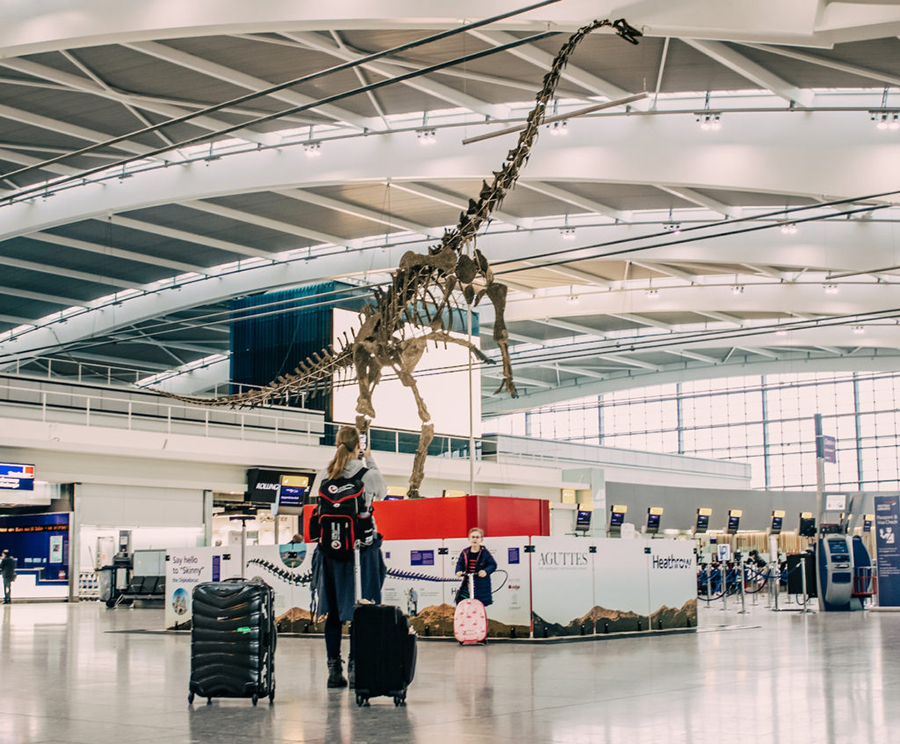
The dinosaur skeleton has been installed at Heathrow airport's terminal 5 before it hits the auction block in June.

Don’t be alarmed by the 20-ton dinosaur skeleton looming overhead as you wait for your next flight at Heathrow. That’s “Skinny,” a cousin of the Diplodocus who scientists unearthed in Wyoming in 2012.

The 155 million-year-old specimen will be on view at the London airport’s Terminal 5 until the end of May before heading to the French auction house Aguttes in Paris this June, with an estimated price tag of £2 million ($2.6 million). But before that, some one million travelers will be able to gawk at the incredible creature that is rarely seen outside of a museum context.

The Heathrow skeleton is especially remarkable because you can see an imprint of the animal’s skin on parts of its bones. Studies suggest that the 43-foot-long dinosaur belongs to a previously unknown vegetarian species. It is mounted on stainless steel support structures that allows the skeleton’s position to be moved.


Increasingly, collectors are beginning to incorporate natural history into their art collections. The market for prehistoric creatures has been steadily growing in recent decades, ever since the record-breaking sale of a 40-foot-long Tyrannosaurus rex named Sue sold at Sotheby’s in 1997 for a whopping $8.4 million.

“Their sheer size awes people, they are immense and that is part of their fascination for collectors,” says Eric Mickeler, a specialist in natural history and an advisor to Aguttes. “They are powerful symbols which act as memento mori and remind us of the outcome of all species over the ages.”

Aguttes seems to be taking the marketing for jurassic creatures a step further by installing the monumental skeletons in public spaces. Last year, it installed a dinosaur skeleton in the Eiffel Tower before holding its sale at the base of the French monument. That dinosaur, an unknown species, sold for €2 million ($2.3 million). 

Follow Us on Facebook HERE and Instagram HERE.

Source: https://news.artnet.com

New Species of Extinct Pig-Footed Bandicoot Discovered

Tuesday, April 9, 2019

Chaeropus yirratji. Image credit: Peter Schouten / Western Australian Museum.

An international team of researchers from Australia and the United Kingdom has discovered a new species of pig-footed bandicoot which has been extinct for more than half a century.

The pig-footed bandicoot (Chaeropus ecaudatus) was unique, and unlike any other mammal due to its ability to walk on two toes on its front legs, and one toe on its hind legs.

“The pig-footed bandicoot was one of the most unique, and possibly one of the weirdest animals on the planet. No other mammal walked on two toes on its front legs and one toe on its hind legs,” said lead author Dr. Kenny Travouillon, curator of mammalogy at the Western Australian Museum.

“The animal was believed to be amongst the smallest grazing mammals that have ever lived and its speed, for its size, was legendary.”

The pig-footed bandicoot evolved along with bilbies and other bandicoots more than 20 million years ago and was found throughout central and south Australia and in Victoria.

The species was named and scientifically described in 1838 by the Irish naturalist William Ogilby.

“Aboriginal people knew about these animals for around 65,000 years before the marsupials were first recorded by Europeans in 1838,” Dr. Travouillon and colleagues said.

“Unfortunately it took just over 150 years from its discovery by Europeans for it to go extinct. The last bandicoots are thought to have vanished by the 1950s.”

“The rapid extinction of the pig-footed bandicoot means that it was never properly studied in its environment, so little is known about these extraordinary animals or their ecology and behavior.”

“To better understand these bizarre creatures, we reassessed all 29 modern pig-footed bandicoot remains that survive (including bones, taxidermy animals and wet specimens), as well as fossil and subfossil bones held in museums and universities around the world.”

By using a combination of traditional morphology, morphometrics, paleontology and molecular phylogenetics, the scientists discovered there were in fact two different species. DNA from specimens collected by Sir Thomas Mitchell in 1946 confirmed the existence of two species.

“Although very similar, the two species have some distinct differences,” Dr. Travouillon said.

“The newly-identified species, named Chaeropus yirratji, has fewer holes in its palate compared to Chaeropus ecaudatus and it has different shaped teeth, suggesting different diets.”

Chaeropus yirratji also has much longer feet, meaning it would have been able to take longer strides and therefore move faster.”

“While knowledge of this new species arrived too late to save it from extinction, hopefully the lesson learnt demonstrates the urgency and importance of supporting biodiversity research,” said Roberto Portela Miguez, senior curator in charge of mammals at the Natural History Museum in London.

The team also used fossil records and Aboriginal oral accounts recorded in the 1980s to trace the two species’ distribution.

Chaeropus yirratji was thought to have lived in sandy environments in central Australia and Chaeropus ecaudatus lived in the southern peripheral areas of the arid zone of Australia. Both species were thought to inhabit areas of Western Australia.

“This research increases our understanding of past biodiversity and enhances our knowledge of the diversity of mammals. It also helps build a more comprehensive picture of the true impact we had and are still having on the natural world,” Miguez said.

“Every species matters because each species plays a part in the ecosystems they naturally occur and the extinction of one species could lead to the collapse of these complex systems.”

The research is published in the journal Zootaxa.

_____

Kenny J. Travouillon et al. 2019. Hidden in plain sight: reassessment of the pig-footed bandicoot, Chaeropus ecaudatus (Peramelemorphia, Chaeropodidae), with a description of a new species from central Australia, and use of the fossil record to trace its past distribution. Zootaxa 4566 (1); doi: 10.11646/zootaxa.4566.1.1

Source: www.sci-news.com

Pages