nandi's blog

Suskityrannus hazelae: Small T. rex Relative Found in New Mexico

Wednesday, May 8, 2019

An artist’s rendering of how Suskityrannus hazelae may have looked. Image credit: Andrey Atuchin.

A new species of predatory tyrannosauroid dinosaur that lived about 92 million years ago (Cretaceous period) has been identified from fossils found in New Mexico.

The new dinosaur, named Suskityrannus hazelae, was a tiny relative of Tyrannosaurus rex, about 9 feet (2.7 m) long and 3 feet (0.9 m) tall at the hip.

The ancient creature weighed between 20 and 41 kg, compared to a Tyrannosaurus rex’s weight of up to 9 tons.

Its diet likely consisted of the same as its larger meat-eating counterpart, with Suskityrannus hazelae likely hunting small animals.

Suskityrannus hazelae gives us a glimpse into the evolution of tyrannosaurs just before they take over the planet,” said Dr. Sterling Nesbitt, a paleontologist in the Department of Geosciences at the Virginia Tech College of Science.

“It also belongs to a dinosaurian fauna that just proceeds the iconic dinosaurian faunas in the latest Cretaceous that include some of the most famous dinosaurs, such as Triceratops, predators like Tyrannosaurus rex, and duckbill dinosaurs like Edmontosaurus.”

Dr. Sterling Nesbitt and the partial skeleton of Suskityrannus hazelae, which he found at age 16 in 1998. Image credit: Virginia Tech.

Two partial skeletons of Suskityrannus hazelae were found on 1990s expeditions to the Zuni Basin in western New Mexico.

Suskityrannus hazelae has a much more slender skull and foot than its later and larger cousins, Tyrannosaurus rex,” Dr. Nesbitt said.

“The find also links the older and smaller tyrannosauroids from North America and China with the much larger tyrannosaurids that lasted until the final extinction of non-avian dinosaurs.”

The findings were published in the journal Nature Ecology & Evolution.

_____

Sterling J. Nesbitt et al. A mid-Cretaceous tyrannosauroid and the origin of North American end-Cretaceous dinosaur assemblages. Nature Ecology & Evolution, published online May 6, 2019; doi: 10.1038/s41559-019-0888-0

Source: www.sci-news.com

Paleontologists Find Dinosaur Fossils in Russia's Yakutia

Wednesday, May 8, 2019

© Vladimir Yatsyna/TASS

Paleontologists from Saint Petersburg State University have unearthed the remains of giant herbivorous dinosaurs in Yakutia’s Suntar Region, and this discovery may change the current view on ancient pangolins, expert Pavel Skuchas told TASS.

The remains are about 130 million years old. Those were very primitive species, and similar animals in the southern regions had gone extinct much earlier, the scientist said.

"We were lucky to find dinosaur bones and thus prove that they had lived in those places," the scientist continued. "We have discovered giant dinosaurs, and at this stage we assume they come from a well-known Chinese family."

"The bones that we found are one of the northernmost remains and the northernmost discovery for the Cretaceous Period — about 130 million years ago," he said. "In fact, there used to be a real "Jurassic Park", where those fossils had once lived — very primitive for their time."

The paleontologists found bones of the stegosaurs — large four-legged dinosaurs, which had spikes on their tails and ridges on their backs. They were herbivores. Scientists have carried on studies and hope to describe a new, previously unknown species of dinosaurs.

According to the expert, the findings can provide more information about where the dinosaurs had lived and how they spread out. Formerly, specialists thought stegosaurs did not chew their food, but only grabbed it with teeth and swallowed it immediately.

"The traditional scientific descriptions read that they would grab a branch and swallow the leaves without chewing it, thus, respectively, their teeth were not worn down," the scientist told TASS.

 "However, the teeth that we found have worn away, in a complex way, so we believe the dinosaurs that we have found chewed their food actively, and this is why our knowledge about the ancient lizards’ digestion may be reviewed."

Another question the scientists hope to answer is where the dinosaurs living in northern areas could multiply. Traditionally, scientists believe they used to migrate to produce offspring. However, researchers from Saint Petersburg State University managed to find very small bones, which belonged to young dinosaurs. This may indicate that the lizards not only came for a season to the territory of modern Yakutia, but also multiplied there.

Source: http://tass.com

10 Most Memorable Quotes From The Jurassic Park Franchise

Tuesday, May 7, 2019

The original Jurassic Park movie, directed by Steven Spielberg, wasn’t just a great movie. It changed Hollywood forever. It pioneered CGI technologies and brought extinct species to life, leaving audiences in awe. As a result, it became the highest grossing movie of all time and sequels continued for decades to come.

We’re currently in the middle of the rebooted franchise, the Jurassic World trilogy, which has expanded the fictional universe so much that dinosaurs now co-exist with humans in the United States. Despite all the dinosaur action, the Jurassic Park movies still have some lines of dialogue that stick in your head after watching them. Here are the 10 Most Memorable Quotes From The Jurassic Park Franchise.

10 “YOUR SCIENTISTS WERE SO PREOCCUPIED WITH WHETHER OR NOT THEY COULD, THEY DIDN’T STOP TO THINK IF THEY SHOULD.”

The Jurassic Park movies are at their best when they aren’t just showing dinosaurs creating carnage in a failed theme park; they address the moral considerations of cloning and the use of fossils to create new life. Essentially, John Hammond plays God in Jurassic Park and humanity pays the price.

It’s a cautionary tale. The ethics of bringing dinosaurs back to life – as well as a lot of today’s most questionable scientific accomplishments – are summed up perfectly in this line of dialogue: “Your scientists were so preoccupied with whether or not they could, they didn’t stop to think if they should.”

“YOU DIDN’T ASK FOR REALITY; YOU ASKED FOR MORE TEETH!”

In Jurassic World, Claire has asked the scientists to create a bloodthirsty predator called the Indominus Rex to get ticket sales up. Dr. Henry Wu swiftly outlines the insanity of that plan.

“You are acting like we are engaged in some kind of mad science, but we are doing what we have done from the beginning. Nothing in Jurassic World is natural! We have always filled gaps in the genomes with the DNA of other animals, and if their genetic code was pure, many of them would look quite different, but you didn’t ask for reality; you asked for more teeth!”

“WHEN YOU GOTTA GO, YOU GOTTA GO.”

One of the most memorable moments in the Jurassic Park franchise is when the lawyer Donald Gennaro is running from the T-rex and decides to hide in the bathroom. The T-rex tears the roof off from over him and then eats him on the toilet. It’s a great example of how the movies can balance terror with a healthy dose of humor.

Another hilarious little moment that adds to the scene is when Ian Malcolm sees Gennaro fleeing and watches him run into the bathroom while being pursued by a T-rex and says, “When you gotta go, you gotta go.” Jeff Goldblum’s comic timing with the line is perfect.

“WELCOME TO JURASSIC WORLD.”

The 2015 Jurassic Park reboot changed the title to Jurassic World, seemingly for no reason. The park was up and running and it had been given a new name – exactly why wasn’t clear.

But now that we’ve seen where the franchise was going, with all the dinosaurs being unleashed on mainland America at the end of Jurassic World: Fallen Kingdom, the new title has been totally recontextualized. Jeff Goldblum’s returning character Ian Malcolm summed it up perfectly in the movie’s final moments: “Welcome to Jurassic World.” Our own world is Jurassic World now. We’re in a new era of history.

“SOME OF THE WORST THINGS IMAGINABLE HAVE BEEN DONE WITH THE BEST INTENTIONS.”

Jurassic Park III is not the best film in the franchise. In fact, it might even be the worst. But it does have this interesting quote. The most annoying character in the movie is easily Billy, the overenthusiastic grad student who won’t leave Alan Grant alone.

When Grant finds out that they’ve been hunted by raptors because Billy stole their eggs, Billy tells him he did it “with the best intentions.” Grant retorts, “Some of the worst things imaginable have been done with the best intentions. You know, as far as I’m concerned, you’re no better than the people who built this place.”

“IF THE PIRATES OF THE CARIBBEAN BREAKS DOWN, THE PIRATES DON’T EAT THE TOURISTS.”

John Hammond’s dinosaur theme park was a huge undertaking, and it didn’t help that every time he tried to defend what is undeniably incredible work in the field of cloning, someone – usually Ian Malcolm – would undercut it with a joke.

He tried to say that all theme parks experience issues with malfunctions when they first open: “All major theme parks have had delays. When they opened Disneyland in 1956, nothing worked – nothing!” But then Ian Malcolm presents a pretty ironclad counter-argument: “But if The Pirates of the Caribbean breaks down, the pirates don’t eat the tourists.” That’s hard to deny.

“GOD CREATES DINOSAURS. GOD DESTROYS DINOSAURS. GOD CREATES MAN. MAN DESTROYS GOD. MAN CREATES DINOSAURS.”

The first sentence in this quote would later form the title of Dr. Ian Malcolm’s book, God Creates Dinosaurs. He wrote the book after the events of the first movie and it caused conflict for him in the second, since writing it at all was a direct violation of the non-disclosure agreement that Hammond had made him sign when he first came to the park.

It’s an apt way to explain the millions of years of events prior to the movie: “God creates dinosaurs. God destroys dinosaurs. God creates man. Man destroys God. Man creates dinosaurs.” This is followed by Ellie Sattler’s wishful thinking for a post-Jurassic Park future, delivered perfectly by the great Laura Dern: “Dinosaurs eat man. Woman inherits the Earth.
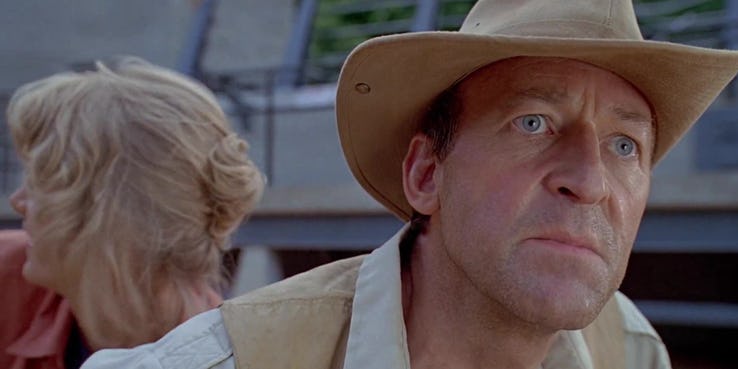
“CLEVER GIRL.”

Although he’s a hunter, Robert Muldoon has a great respect for the animals he hunts. A lot of the brash, gun-toting dinosaur hunters in the Jurassic Park movies mock the dinosaurs and see them as inferior, but not Muldoon. He can recognize when he’s been bested by the cunning survival skills and animal instincts of his prey.

When a velociraptor manages to sneak up on him and he realizes he’s about to be killed, he simply says, “Clever girl.” He’s actually proud of this raptor for being able to creep up to him and kill him. Most people would just scream.

“WE CAN DISCUSS SEXISM IN SURVIVAL SITUATIONS WHEN I GET BACK.”

It’s a surprise that Ellie Sattler doesn’t come up in more people’s discussions of feminist movie characters, because she’s faced with a lot of sexism in the Jurassic Park movies and she doesn’t take any of it. First, she suggests that after men have idiotically brought dinosaurs back to life and been killed by them, women will inherit the Earth.

Then when Hammond suggests he should head out to the breaker house, just because he’s a man, she sighs, “We can discuss sexism in survival situations when I get back,” before going off to do it herself. Not only is she sick of men assuming she’s not capable – she follows it up by being more capable than them.
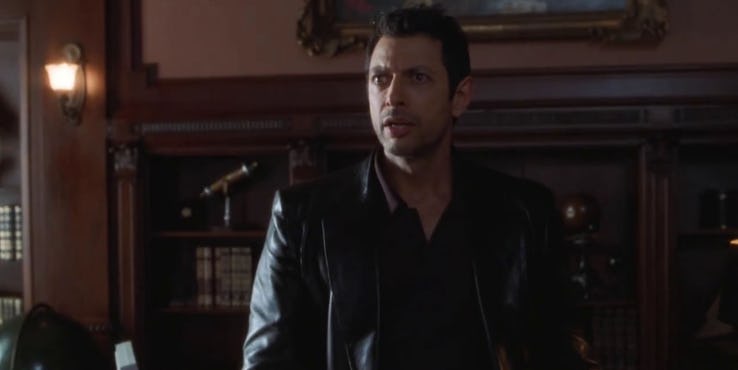
“LIFE FINDS A WAY.”

“Life finds a way,” as well as various derivatives of it, is easily the most recognizable and memorable quote from the Jurassic Park franchise. In four words, it sums up exactly what the movies are about.

Initially, they’re about humans trying to play God, but when that turns out poorly for them, thanks to nature doing its thing, they realize that it’s wrong to play God (even though they keep doing it in sequel upon sequel). In other words, life finds a way. Malcolm elaborates on his point in The Lost World: “These creatures require our absence to survive, not our help. And if we could only step aside and trust in nature, life will find a way.”

Source: https://screenrant.com

Ediscetus osbornei: Newly-Discovered Whale Genus Named After West Texas Paleontologist

Wednesday, May 8, 2019

Newly-discovered whale genus named after West Texas paleontologist

A whole genus of a whale, never been seen, was just uncovered.

Imagine discovering a fossil. Maybe something that came from a plant or marine life that can be identified through research.

But what if you discovered a whole genus of a whale that has never been discovered before?

That was the story for ECISD's Chief Innovation Officer Jason Osborne a few years ago. Now, that whale genus is currently being studied by scientists, who named the whale genus after him.

Osborne has been studying paleontology for the last twenty years. But one day, one of his explorations would change his life and science forever.

"I'll never forget the day I discovered this whale," said Osborne.

The story starts back in 2012. Deep into the swampy waters of the Edisto River in South Carolina is where Osborne was scuba diving for the U.S. Geological Survey and for his non-profit, PaleoQuest.

It's not the type of scuba diving as you'd like to think. It's in water so dark you can see only a few inches in front of you, not to mention, it's infested with alligators, venomous snakes, glass and he's making that dive in underwater caves. That's where he would make an unbelievable discovery of a whale skull never discovered before.

"This one in particular was so unique and so foreign," said Osborne. "It took me 13 hours of underwater excavation to get it out."

After a lengthy process of research with scientific partners, the genus of this whale now has a name called Ediscetus osbornei, taken from Osborne's last name.

"I never thought I would have something named after me," said Osborne.

Osborne found the Ediscetus osbornei whale was a type of whale that wasn't too large, yet the skull told a story about it's feeding behavior.

"It also had this long telescoping snout," said Osborne. "Based on its snout and its teeth, it would snap at its prey."

Osborne's discovery is published in the Journal of Vertebrate Paleontology, one of the largest paleontologist publications in the world.

Although the Ediscetus osbornei may just be at the first chapter,many years are to come for science to discover more of its story.

It's a reminder that even in the deepest depths of our minds, our questions of life can open doors and maybe behind them, we can find missing pieces of time and how they won't be the tail end of history.

"I want it to create enough curiosity people become interested to work with stuff I've done and to support that through grants and i could get back in the water to find more," said Osborne.

 To look at the journal, you can view it by clicking here.

Source: www.newswest9.com

Museum For Natural Sciences will Exhibit New Dinosaur

Tuesday, May 7, 2019

Arkhane is positioned in a natural hunting position. © Museum for Natural Sciences

A new dinosaur fossil will be exhibited in the Museum for Natural Sciences in Brussels starting from Tuesday 7 May.

The dinosaur is called "Arkhane", and it is an eight metres long allosaurian, between 152 and 157 million years old. Allosaurs are carnivorous bipedal (walking on two legs) dinosaurs, and Arkhane is definitely a new species, according to the experts at the museum.

Its exceptionally well-preserved skeleton is the property of a private collector who wishes to stay anonymous. Experts at the Brussels' museum studied the skeleton, and it will now be exhibited for 11 months.

The name of the dinosaur, "Arkhane", was chosen by its owner and is a combination of the Latin 'Arcanus', which means enigmatic and secret, referencing the new species, and 'Genghis Khan', the conqueror, referencing its position at the top of the food chain.

The fossil is for 70% complete and is missing a few ribs, cervical vertebrae and half of its skull. The skeleton is 8.7 metres long and 2.6 metres tall and stems from the upper Jurassic period

Arkhane walked on his hind legs and was able to reach 30 to 55 kilometres per hour. Its muscular tail was the counterweight to its massive chest and head. Allosaurians were slender, agile and "only" weighed between 700 and 1,500 kilograms.

The skeleton was dug up in 2014 at Barnum-Kaycee, Wyoming, barely 250 meters from the site where the team of the Royal Belgian Institute of Natural Sciences (KBIN) has been digging for two years. 

The private collector gave the fossil to the museum with two goals in mind: identify the specimen and, therefore, examine through scientific research whether it is a new species. Secondly, show the skeleton to as many people as possible, spark interest in science and possibly also let young people discover the profession of palaeontologist.

More info can be found on the museum's website.

Source: http://brusselstimes.com

Fossil Fecal Forensics

Saturday, May 4, 2019

Credit: Luke Groskin

While the fossilized skeletons stick out in images from books or movies in our mind as the primary evidence that dinosaurs and other prehistoric creatures walked the earth, they can’t tell us the whole story of how extinct organisms lived. For that, you need fossilized poop, called coprolites.

“These little magic packages can provide really special perspectives on ancient life,” says Karen Chin, an associate professor of geological sciences at the University of Colorado, Boulder.

“Skeletal fossils don’t always tell you too much about the behavior of animals,” she says. “In addition to diet, [coprolites] can also tell you about what organisms might have been living along with the animal that defecated, and coprolites can also tell you about the conditions under which they were preserved.”

Everyone poops. This adage even applies to prehistoric creatures—from crustaceans to dinosaurs—that lived on land and in the sea. Over the course of any given organism’s lifespan, piles of poop were produced countless times. Unfortunately for those seeking fossilized examples of excrement, poop just doesn’t fossilize as well as bones or shells. Ancient feces fossilized only if a mineralizing agent covered it relatively quickly after it was produced. If mineralization was successful and decomposition was avoided, then feces could fossilize, forming a coprolite. 

While it may seem like a less glamorous side of science, the study of petrified poo is incredibly important.

When Dr. Chin began studying these coprolites, she found they contained unexpected surprises. Coprolites from herbivorous dinosaurs had more than just leaf matter inside of them. She found dung beetle burrows, snail shells, and tiny pieces of conifer wood. The pieces of conifer wood were no ordinary pieces of wood—they had actually been rotting before being ingested. This is incredibly intriguing as rotting wood isn’t on the diet of many organisms, even herbivores such as these dinosaurs.

In Choteau Mountain’s Two Medicine Formation in Montana and the Kaiparowits Formation in Utah, fossil body parts, coprolites, and trace fossils, which are fossilized indicators of an organism’s presence, can be found. These two formations contain fossils dating back to the late Cretaceous period, which is the period just before dinosaurs went extinct. Famous dinosaurs such as triceratops and Tyrannosaurus rex roamed the area, and fossils of these species along with many other creatures, are found in the Two Medicine and Kaiparowits Formations.

For this activity, you’ll step into the shoes of Dr. Karen Chin to see what you’re able to gather from coprolite samples from the Two Medicine and Kaiparowits Formations. You’ll try to answer the same question Dr. Chin pondered: Why is there wood in fossilized poop created by herbivorous dinosaurs?

Source: www.sciencefriday.com

A dinosaur’s Running Gait May Reveal Insights Into the History of Bird Flight

Saturday, May 4, 2019

MEEP MEEP  Caudipteryx, a peacock-sized dinosaur (illustrated) that lived about 125 million years ago, was a fast runner. The jostling from its gait may have caused its feathery forelimbs to flap, in a possible precursor to active flapping, a study finds. COREY FORD/ALAMY

An early winged dinosaur couldn’t fly, but it could run. Now, with assists from a robotic dino and young ostriches wearing artificial wings, a study suggests that the dinosaur’s running gait caused its wings to flap, in what may have been an evolutionary precursor to flight.

Caudipteryx was a peacock-sized dinosaur with feathered and winglike forelimbs that lived about 125 million years ago. Running at speeds of about 2.5 to 5.8 meters per second sent vibrations through its body, causing its wings to flap vigorously, scientists report online in PLOS Computational Biology. If true, the results suggest that some dinosaurs had to run before they could fly — adding a new wrinkle to a long-standing debate over whether the earliest fliers were flappers or gliders.

Some researchers have suggested that the delicate, thin shafts in the feathers of primitive birds such as Archaeopteryx, which lived about 150 million years ago, wouldn’t have stood up to rigorous flapping, and so those animals probably glided between trees (SN: 6/5/10, p. 12). Other researchers analyzing the wing length, light bodies and powerful hind limbs of early winged dinosaurs such as Microraptor, which lived about 120 million years ago, suggest that these early fliers could have launched themselves into the air rather than needing to gently glide (SN: 10/26/16, p. 9). And a recent study of the wings of Archaeopteryx found that, feathers aside, its arm bones were strong enough to withstand short bursts of active, flapping flight (SN: 4/14/18, p. 9).

The new study takes a different tack, turning from the anatomy of early fliers to that of a dinosaur unable to fly, although it had an early form of wings. Caudipteryx looks about as much like Archaeopteryx as an ostrich does a sparrow, with a body far too large for its small, winglike forelimbs. But like Archaeopteryx, it was a maniraptoran, a group of dinosaurs that includes birds and some nonavian dinosaurs. Caudipteryx also had several birdlike features, including pennaceous feathers on its forelimbs like the feathers of modern birds, with barbs spreading out to the side from a central quill.

Like modern ostriches or emus, Caudipteryx was probably a pretty fast runner, says study coauthor Jing-Shan Zhao, a mechanical engineer at Tsinghua University in Beijing. These factors made the dinosaur the right candidate to examine how running might have played a role in the evolution of flight.

SIMPLIFIED DINO To calculate the kinds of vibrations that running might have produced within Caudipteryx’s body, researchers imagined the dinosaur as a simple system of masses (white boxes) representing its limbs and body, and springs (coils). Y.S. TALORI ET AL/PLOS COMPUTATIONAL BIOLOGY 2019

In particular, Zhao and his colleagues wanted to see how Caudipteryx’s running gait might have jostled its forelimbs, perhaps causing them to flap involuntarily. Hypothetically, with strong enough vibrations — and if the wings were large and strong enough — such flapping could generate enough lift to leave the ground.

That’s a mechanics problem, so the researchers took a mechanical approach. Led by Yaser Saffar Talori, a mechanical engineer also at Tsinghua University, the team considered the dinosaur as a simplified system of masses and springs. The researchers divided the dino into different bits of mass — body, right and left wings, right and left legs, neck and head, and tail —  and then imagined that each of those bits of mass were attached to the others by springs. Jostling caused by running would produce vibrations throughout the body.

Based on its skeletal proportions, the team estimated that Caudipteryx could reach a maximum running speed of about 8 meters per second. But simulations suggested that even at lower speeds from about 2.5 to 5.8 meters per second, the dinosaur’s gait would have created strong enough vibrations that caused its wings to flap.

Robo-dino and living ostriches put that conclusion to the test. After building a life-size robotic Caudipteryx, the researchers put it to work on a treadmill. And they outfitted several young ostriches — each about the same weight as a middling Caudipteryx, at 5 kilograms — with artificial wings equipped with sensors that could detect the forces of lift and thrust, or drag, and watched the birds run. The team also tried out five different feather sizes on the wings.  

These additional tests, Zhao says, validated the simulation’s results: Caudipteryx would have flapped its wings as it ran. And the artificial ostrich wing tests revealed that the longer the feathers were, the greater lift that the ostriches could get, although they never got nearly enough lift to actually get off the ground. The results suggest that this passive wing flapping may have been an evolutionary precursor to later active wing flapping, Zhao says.

WORKOUT A life-size Caudipteryx robot on a treadmill allowed researchers to investigate whether a running motion might cause the dinosaur’s wings to passively flap. Y.S. TALORI ET AL/PLOS COMPUTATIONAL BIOLOGY 2019

Other researchers aren’t so sure. Caudipteryx lived about 25 million years after the first bird ancestors, such as Archaeopteryx, began to fly, so the dinosaur isn’t a direct ancestor of birds. “We cannot consider its morphology as a 100 percent valid model for the ancestral bird,” says Andrea Cau, a vertebrate paleontologist who is a collaborator with the Giovanni Capellini Paleontological Museum in Bologna, Italy. But, he adds, “it would be interesting to apply this model to a large sample of feathered dinosaurs.”

The role of passive flapping in the evolution of flight is indeed a novel question, and the suite of methods that the team used is “ambitious and creative,” says John Hutchinson, an evolutionary biomechanicist at the Royal Veterinary College in London.

But, he says, he wasn’t convinced by the study that Caudipteryx must have flapped its wings while running. For one thing, he says, the study’s simplification of a bird into masses and springs raises the question of “how biologically relevant the motions are, since animals are far more complex than that.” For example, the animal might have avoided the drag due to passive flapping by using its muscles to hold its forelimbs closer to its body.

And passive flapping may represent only a modest incremental step between two bigger milestones among the ancestors of birds: bipedal running and active flapping, Hutchinson adds.  “However, this study does lay groundwork that could be built upon and tested more rigorously. So perhaps it will inspire deeper insight in the future.”

Source: www.sciencenews.org

Paleontology is Sexy! A Selection of Recent Discoveries

Thursday, May 2, 2019

A modern lion skull (above) compared to the left part of a Simbakubwa kutokaafrika jaw (below) photographed by Matthew Borths. On the right, a rendering of Simbakubwa kutokaafrika (image credits Mauricio Anton).

The 2019 started with a relatively high number of paleontological discoveries published in highly ranked journals showing that paleontology is sexy indeed! Here you can find a small selection of the most recent ones. The studies in micro- and macropaleontology published earlier this year, provide a large contribution to our understanding of organism evolution and response to peculiar environmental conditions which can be used to predict future ecosystem reactions. Paleontology is therefore not only fascinating but it is a valid instrument for assemble a possible scenario of biotic changes in the future.

A gigantic carnivore from the earliest Miocene of Kenya

A relatively young adult of a gigantic carnivore from the early Miocene (ca. 22 million years ago) was discovered at Meswa Bridge, Kenya. The researchers, Borth M. and Stevens N., called the now extinct carnivore Simbakubwa kutokaafrikaSwahili for “big lion from Africa” since this predator would have played a lion-like role. It is the oldest known member in a group of extinct mammals called hyaenodonts, so named due to their dental resemblance to hyenas, even though the groups are also unrelated. The specimen was known from most of its jaw, portions of its skull and parts of its skeleton. It was larger than a modern polar bear, it weighed up to 1,500 kilograms, measured 2.4 meters long from snout to rump and stood 1.2 m tall at its shoulders.The study was published in the Journal of Vertebrate Paleontology and helps connect some of the evolutionary steps for this group which were near the top of the food chain in theAfrican ecosystems where early apes and monkeys were also evolving. The fossil may also help scientists better understand why these apex predators ultimately did not survive.

A modern lion skull (above) compared to the left part of a Simbakubwa kutokaafrika jaw (below) photographed by Matthew Borths. On the right, a rendering of Simbakubwa kutokaafrika (image credits Mauricio Anton).

Exceptional preservation of mid-Cretaceous marine arthropods and the evolution of novel forms via heterochrony

A new, exceptionally preserved crab from the mid-Cretaceous of Colombia and the United States was discovered by Luque et al. The completeness of the fossil remains shed light on the early disparity of the group and the origins of novel forms.This ancient crab was named Callichimaera perplexa, which means “perplexing beautiful chimera”, and lived during late Cretaceous (ca. 95 to 90 million years ago). The name references the mythical chimera from Greek mythology, which had a lion’s head, a goat’s body and a snake’s tail. The C. perplexa had large unprotected compound eyes, small fusiform body, and leg-like mouthparts suggesting larval trait retention into adulthood via heterochronic development (pedomorphosis), while its large oar-like legs represent the earliest known adaptations in crabs for active swimming. The authors, who published their study in Science Advances, think that these creatures lived in the water, swimming more than crawling  around on land (due to the unusual legs) and were active predators.

A rendering of Callichimaera perplexa (Image credits Oksana Vernygora / University of Alberta). On the right dorsal, frontal, and ocular features in Callichimaera perplexa, from the mid-Cretaceous of Colombia (Luque et al. 2019) .

Unlaid egg discovered in an Early Cretaceous bird fossil

A new enantiornithine, Avimaia schweitzerae gen. et sp. nov., from the Lower Cretaceous Xiagou Formation was described by Bailleul et al. The discovery is of great importance since it tetifys the oldest documented case of a common reproductive disorder: called “egg-binding,” where an egg becomes trapped inside a bird. The fossilized bird was in fact found with an unlaid egg two-dimensionally preserved within the abdominothoracic cavity. Ground-sections reveal abnormal eggshell proportions, and multiple eggshell layers best interpreted as a multi-layered egg resulting from prolonged oviductal retention. The find, reported in Nature Communications, belonged to a sparrow-size flyer that lived in northwestern China ca. 110 million years ago. The team has named the bird Avimaia schweitzerae (Avimaia means “mother bird”; and schweitzerae honors paleontologist Mary Schweitzer.)

A rendering of the female individual Avimaia schweitzerae dead in the water on the left (with an unlaid egg not visible inside its abdomen), represents the fossilized individual discovered in China. Illustration by Michael Rothman. In the center and right side, photograph and line drawing of the holotype of Avimaia schweitzerae, IVPP V25371. a Photograph of the partial skeleton with feather impressions, and the crushed preserved egg between the pubes; b interpretive line drawing, with white arrows indicating the two fragments extracted for microscopic analysis with a super-imposed CT-scan revealing the egg and underlying elements of the right pelvis in dorsal (synsacrum) and medial (ilium) view (from Bailleul et al. 2019).

A new African Titanosaurian Sauropod Dinosaur from the middle Cretaceous of Southwestern Tanzania

Paleontologists recently discovered a new titanosaurian sauropod – a giant, plant-eating dinosaur – and named it Mnyamawamtuka moyowamkia. A common component in Cretaceous African faunas, titanosaurian sauropods diversified into one of the most specious groups of dinosaurs worldwide and this discovery is helping paleontologists understanding how, where and when the mightiest of land animals evolved. Mnyamawamtuka moyowamkia lived around 100-110 million years ago, during the middle of the Cretaceous and was found in the Mtuka Member of the Galula Formation  (Aptian–Cenomanian) in southwest Tanzania.

Mnyamawamtuka moyowamkia.

Titanosaurs are best known from South America, Tanzania, Egypt, and other parts of the African continent. The new specimen described by Gorscak and O’Connor in PlosOne preserves teeth, elements from all regions of the postcranial axial skeleton, parts of both appendicular girdles, and portions of both limbs including a complete metatarsus. This finding adds a bit more detail to the picture of what ecosystems on continental Africa were like during the Cretaceous.

All these findings make you wonder: ‘what else is out there for us to discover?’

Source: https://blogs.egu.eu

Chewing Versus Sex in the Duck-Billed Dinosaurs

Friday, May 3, 2019

Mounted skeleton of Parasaurolophus cyrtocristatus, Field Museum of Natural History

The duck-billed hadrosaurs walked the Earth over 90-million years ago and were one of the most successful groups of dinosaurs. But why were these 2-3 tonne giants so successful? A new study, published in Paleobiology, shows that their special adaptations in teeth and jaws and in their head crests were crucial, and provides new insights into how these innovations evolved.

Called the 'sheep of the Mesozoic' as they filled the landscape in the Late Cretaceous period, hadrosaurs walked on their hind legs and were known for their powerful jaws with multiple rows of extremely effective teeth. They also had hugely varied head display crests that signalled which species each belonged to and were used to attract mates. Some even trumpeted and tooted their special call, using nasal passages through the head crests.

Researchers from the Universities of Bristol and the Catalan Institute of Paleontology in Barcelona used a large database describing morphological variety in hadrosaur fossils and computational methods that quantify morphological variety and the pace of evolution.

Dr. Tom Stubbs, lead author of the study and a researcher from Bristol's School of Earth Sciences, said: "Our study shows that the unique hadrosaur feeding apparatus evolved fast in a single burst, and once established, showed very little change. In comparison, the elaborate display crests kept diversifying in several bursts of evolution, giving rise to the many weird and wonderful shapes."

The skulls of three hadrosaur dinosaurs, Lambeosaurus lambei (top left), Gryposaurus notabilis (top right), Parasaurolophus walkeri (lower). Credit: Albert Prieto-Márquez.

Professor Mike Benton, the study's co-author from Bristol's School of Earth Sciences, added, "Variation in anatomy can arise in many ways. We wanted to compare the two famous hadrosaur innovations, and by doing so, provide new insights into the evolution of this important dinosaur group. New numerical methods allow us to test these kinds of complex evolutionary hypotheses."

"Our methods allowed us to identify branches on the hadrosaur evolutionary tree that showed rapid evolution in different parts of the skeleton," said co-author Dr. Armin Elsler. "When we looked at the jaws and teeth, we only saw fast evolution on a single branch at the base of the group. On the other hand, the bones that form the display crests showed multiple fast rate branches."

Dr. Albert Prieto-Márquez, co-author and world-leading expert on hadrosaurs from the Catalan Institute of Paleontology in Barcelona, added: "Our results suggest that evolution can be driven in different ways by natural selection and sexual selection. Hadrosaurs apparently fixed on a feeding apparatus that was successful and did not require massive modification to process their food. On the other hand, sexual selection drove the evolution of more complex  shapes, and this is reflected by multiple evolutionary bursts."

Provided by University of Bristol / https://phys.org

Ice Age Bear and 12,000-Year-Old Human Skeleton Found in Mexican Underwater Cave

Friday, May 3, 2019

PHOTO: A diver holds the jaw and vertebra of one of the fossilised animals. (Supplied: ETSU)

The remains of long-extinct predators dating back to the last Ice Age have been unearthed by underwater cave explorers in Mexico.

Among the discoveries was the skull of a short-faced bear known as Arctotherium wingeia formidable Ice Age predator which weighed around 150 kilograms.

The fossilised remains of wolf-like creatures known as Protocyon troglodytes were also found in the Yucatán cave on the eastern Yucatán Peninsula.

The findings are a coup for researchers, who previously believed both species only lived in South, not Central, America.

"This discovery expands the distribution of these carnivorans greater than 2,000 kilometres outside South America," palaeontologists from East Tennessee State University wrote in the journal Biology Letters.

"Their presence... suggests a more complex history of these organisms in Middle America."

A collection of ground sloths and an early human — who most likely died falling into the cave some 12,000 years ago — were also unearthed in the same site, known as Hoyo Negro, or Spanish for "black hole".

According to researchers, that means humans may have been around to interact with the animals.

"The [Hoyo Negro] pit is bell shaped... and served as a natural trap for animals moving through the cave in the late Pleistocene," the paper said.

"Mammals discovered on the surface of the [cave] floor include multiple ground sloth species... tapirs, sabertooth cats, cougars, gomphotheres, bears, canids and a relatively complete human skeleton.

"In addition, bones and trackways of extinct fauna are known from the upper passages."

A diver recovers the skull of a short-faced bear. (Supplied: ETSU)

Another skeleton, believed to be one of the oldest genetically intact human skeletons ever found in the Western hemisphere, dating back 13,000 years, was uncovered in the same cave in 2007.

Scientists said the skeleton belonged to a teenage girl, who too may have fallen to her death after venturing into the dark passages of Hoyo Negro.

At the time, researchers concluded that the Ice Age humans who first crossed into the Americas over a land bridge that formerly linked Siberia to Alaska did in fact give rise to modern Native American populations rather than hypothesised later entrants into the hemisphere.

Source: www.abc.net.au

Pages