nandi's blog

50-Million-Year-Old Fossil Captures a Swimming School of Fish

Friday, May 31, 2019

The 50-million-year-old fossil from the Green River Formation in the U.S. contains the remains of 259 fish. Mizumoto et al.

While fossils provide us clues of the basic anatomy and biology of extinct animals, rarely are they able to hint at how these ancient creatures socialized or behaved. This is simply due to the fact that freezing multiple creatures in the same moment in time would require a lot of natural phenomena to happen at just the right moment.

But a stunning and extremely rare 50-million-year-old fossil of hundreds of extinct fish seems to give exciting new clues of ancient marine animal behavior.

A new study published in the journal Proceedings of the Royal Society B has examined what the study’s researchers believe to be a fossilized school of an extinct fish species called Erismatopterus levatus. The very well-preserved fossil features an imprint of 259 fish — all of which are under an inch long and almost all facing the same way — in a slab of limestone rock.

“It looks like an actual fish shoal,” Dr. Nobuaki Mizumoto, who studies animal behavior at Arizona State University and co-authored the study, told the New York Times. Mizumoto came across the fossil in 2016 while he was on vacation with his wife visiting the Fukui Prefectural Dinosaur Museum in Katsuyama, a small city in Japan.

Mizumoto and his team believe the fossil shows a school of fish in action, revealing that fish developed this distinct behavior much earlier than previously thought.

The fossil is about 22 inches wide and 15 inches tall, and originally came from the Green River Formation. The formation spans the U.S. states of Wyoming, Colorado, and Utah.

The fossil of the extinct fish species Erismatopterus levatus, which Dr. Nobuaki Mizumoto spotted at a museum while on vacation in Japan. Mizumoto et al.

To test their theory that the fossil captured a school of live fish seconds before they were buried together — rather than dead fish that accidentally collected together in the rock — the team measured each fish, mapped out its position, and ran 1,000 different simulations of the school’s possible movements.

The anticipated trajectories of the fish that were simulated using a projection model suggest that the fossilized fish were likely a school that was sticking together. There were only eight fish in the entire school whose heads weren’t pointed in the same direction as the rest.

Moreover, the study states that the team found “traces of two rules for social interaction similar to those used by extant fishes,” which involves attraction (when fish move closer to their neighbors) and repulsion (when they distance themselves from their neighbors).

Fish form schools, or shoals, as a way to gain extra protection from predators, and possibly as a way to save energy by reducing friction. Without a sole leader, fish are able to swim in perfect synchronization.

Despite the exciting implications of the study, some scientists are skeptical of the finding.

“I can’t picture a three-dimensional school of fish sinking to the bottom and maintaining all their relative positions….That makes no sense to me,” argued paleontologist Roy Plotnick, who was not involved in the study. The study authors acknowledged the possibility that the fish could have been buried after dying and gathering together.

Although researchers cannot confirm exactly how the fish died, they hypothesize that a suddenly collapsed sand dune could have buried the school in mere seconds, maybe knocking a few out of their original positions in the group in the process.

The explanation behind the unique fossil has been left a mystery but whatever the case may be, one thing is clear: that fossilized group of fish still looks pretty cool.

Source: https://allthatsinteresting.com

Homo Sapiens May Have Had Several Routes of Dispersal Across Asia in the Late Pleistocene

Thursday, May 30, 2019

Illustrated dispersal routes from the results of the Least Cost Path analysis: The three routes from the "wet" simulations and the single route from the "dry" simulation are presented together in conjunction with palaeoclimatic extents (glaciers and palaeolakes). Sites: 4. Obi-Rakhmat, 5. Shugnou, 8. Denisova, 9. Ust-Karakol, 10. Kara-Tenesh, 11. Kara-Bom, 12. Luotuoshi, 14. Gouxi, 15. Lenghu 1, 17. Chikhen Agui, 18. Tsagaan Agui, 19. Tolbor 4, 20. Kharganyn Gol 5, 21. Orkhon 1 & 7, 22. Makarovo 4, 23. Kandabaevo, 24. Varvarina Gora, 25. Tolbaga, 27. Shuidonggou 1, 28. Shuidonggou 9, 42. Yushuwan, 70. Shibazhan (75075). I. 'Altai' Route, II. 'Tian Shan' Route, III. 'Tarim' Route, IV. "Revised Overland' Route. Base map raster is from naturalearthdata.com.  CREDIT Li et al, 2019

A new model identifies unexpected potential paths for the spread of human culture and technology.

Homo sapiens may have had a variety of routes to choose from while dispersing across Asia during the Late Pleistocene Epoch, according to a study released May 29, 2019 in the open-access journal PLOS ONE by Feng Li of the Institute of Vertebrate Paleontology and Paleoanthropology in Beijing and colleagues.

After leaving Africa, Homo sapiens dispersed across the Asian continent during the Late Pleistocene, but it isn't known exactly what routes our species followed. Most models assume that the Gobi Desert and Altai Mountain chains of North and Central Asia formed impassable barriers on the way to the east, so archaeological exploration has tended to neglect those regions in favor of seemingly more likely paths farther north and south.

In this study, Li and colleagues use Geographic Information Systems (GIS) software alongside archaeological and paleoclimate data to reconstruct the conditions of North and Central Asia over the Late Pleistocene and to identify possible routes of travel. Their data suggest that the desert and mountain regions were likely impassable during cold and dry glacial periods, but that during warmer and wetter interglacial times it would have been possible for human populations to traverse these regions via at least three routes following ancient lake and river systems.

The authors caution that these data do not demonstrate definite routes of dispersal and that more detailed models should be constructed to test these results. However, these models do identify specific routes that may be good candidates for future archaeological exploration. Understanding the timing and tempo of Homo sapiens dispersal across Asia will be crucial for determining how culture and technology spread and developed, as well as how our species interacted with our extinct cousins, the Neanderthals and Denisovans.

Roberts adds: "Our modelling of the available geographic and past climate data suggest that archaeologists and anthropologists should look for early human presence, migration, and interaction with other hominins in new parts of Asia that have been neglected as static voids. Given what we are increasingly discovering about the flexibility of our species, it would be of no surprise if we were to find early Homo sapiens in the middle of modern deserts or mountainous glacial sheets all across Asia. Indeed, it may be here that the key to our species' uniqueness lies".

###

Citation: Li F, Vanwezer N, Boivin N, Gao X, Ott F, Petraglia M, et al. (2019) Heading north: Late Pleistocene environments and human dispersals in central and eastern Asia. PLoS ONE 14(5): e0216433. https://doi.org/10.1371/journal.pone.0216433

Funding: This study was funded by Max-Planck-Gesellschaft (DE) to Nicole Boivin, Strategic Priority Research Program of Chinese Academy of Sciences grant XDB26000000 to Feng Li, and Youth Innovation Promotion Association of the Chinese Academy of Sciences grant 2017102 to Feng Li. The funders had no role in study design, data collection and analysis, decision to publish, or preparation of the manuscript.

Competing Interests: The authors have declared that no competing interests exist.

In your coverage please use this URL to provide access to the freely available article in PLOS ONE:http://journals.plos.org/plosone/article?id=10.1371/journal.pone.0216433

Source: www.eurekalert.org

Phuwiangvenator yaemniyomi & Vayuraptor nongbualamphuensis: Two T. rex Little Cousins Discovered

Thursday, May 30, 2019

Phuwiangvenator yaemniyomi (left) and Vayuraptor nongbualamphuensis. Image credit: Adun Samathi / Rheinische Friedrich-Wilhelms Universität Bonn.

The two new species, named Phuwiangvenator yaemniyomi and Vayuraptor nongbualamphuensis, roamed the Earth approximately 125 million years ago (Cretaceous period).

Their fossilized remains were found in the Sao Khua Formation of Thailand.

Both ancient creatures belong to Megaraptora (megaraptors), a group of medium- to large-sized theropod dinosaurs with a long snout and large claws.

“The relatives of this group of carnivorous predatory dinosaurs include Tyrannosaurus rex,” said Adun Samathi of the Rheinische Friedrich-Wilhelms Universität Bonn and colleagues.

“Like T. rex, they ran on their hind legs. Unlike the tyrant lizard, however, their arms were strong and armed with long claws.”

“They also had more delicate heads that ended in a long snout.”

Phuwiangvenator yaemniyomi was likely a fast runner. At about 20 feet (6 m) long, this dinosaur was considerably smaller than T. rex (approximately 40 feet, or 12 m, in length).

Vayuraptor nongbualamphuenisis measured approximately 15 feet (4.5 m) long.

“Perhaps the situation can be compared with that of African big cats. If Phuwiangvenator yaemniyomi were a lion, Vayuraptor nongbualamphuenisis would be a cheetah,” Samathi said.

“Megaraptors have so far been discovered mainly in South America and Australia,” he added.

“We have compared the Thai fossils with the finds there. Various characteristics of Phuwiangvenator yaemniyomi indicate that it is an early representative of this group. We take this as an indication that the megaraptors originated in Southeast Asia and then spread to other regions.”

The study was published in the journal Acta Palaeontologica Polonica.

_____

Adun Samathi et al. 2019. Two new basal coelurosaurian theropod dinosaurs from the Lower Cretaceous Sao Khua Formation of Thailand. Acta Palaeontologica Polonica 64 (2): 239-260; doi: 10.4202/app.00540.2018

Source: http://www.sci-news.com

Bagualosaurus agudoensis: The "Great-Great-Grandfather" of Giants: New Brazilian Dinosaur Species Brings Leads About the Origin of the Huge Herbivorous Dinosaurs

Wednesday, May 29, 2019

Artistic representation of the landscape in Agudo (Rio Grande do Sul), 230 million years ago – Art: Jorge Blanco

A study published at the British journal Zoological Journal of the Linnean Society unveils the discovery of a new dinosaur species, which lived in the Triassic Period, about 230 million years ago.

The fossil was found in the Agudo municipality, in Rio Grande do Sul, the southernmost state of Brazil, and it was studied by paleontologists from the Federal University of Santa Maria (UFSM), the Federal University of Rio Grande do Sul (UFRGS) and the São Paulo University (USP). The new species, named Bagualosaurus agudoensis, is part of the Sauropodomorpha lineage, which includes the largest known dinosaurs: herbivores quadrupeds with large magnitudes and long necks, such as the Brontosaurus and the Brachiosaurus, which lived in the Jurassic period.

Even though it is not as giant as its relatives from the Jurassic and Cretaceous periods, the Bagualosaurus was considered large for its period. According to paleontologist Flávio Pretto (UFSM) – who led the study in pursue to his PhD in Geosciences in the Graduate Program at UFRGS – explains, 230 million years ago, when the first dinos began to appear on the planet, the majority of them were small animals, who barely had 1.5m from their snouts to the tip of their tails, while the Bagualosaurus exceeded 2.5m in length.

In addition to being larger than its relatives of the same period which were omnivores, the Bagualosaurus presented teeth which were adapted to feed on plants. Even though it is not possible to confirm with certainty if it had a strictly herbivorous diet, Pretto explains that their teeth and skull shapes indicate that plants were an important part of these animals’ diet, and it is unlikely they also ate meat. "This new eating habit was crucial so the Sauropodomorpha could reach large sizes, as it would be seen millions of years later," the paleontologist states.

Bagualosaurus_agudoensis-novataxa_2018-Pretto_Langer_et_Schultz--paleoArt-Jorge_Blanco (1)

"One of the interesting aspects of the Bagualosaurus is that the animal presents characteristics of dinosaurs which are typically herbivores (for instance, the leaf-like teeth, with a high dental crown, along with a relatively small skull). And, at the same time, it was a large dinosaur for the period standards (competing in size with a significant share of the other herbivore animals of its period)," explains Pretto. Until the moment, these characteristics were thought to have appeared only later, in Sauropodomorphas. "With the Bagualosaurus, we now know this tendency seems to have appeared earlier in the lineage," he adds.

The Bagualosaurus is the seventh dinosaur species attributed to the Rio Grande do Sul Triassic, and it probably lived with four others – Pampadromaeus barberenaiSaturnalia tupiniquimBuriolestes schultzi and Staurikosaurus pricei. According to the study's co-authors Max Langer and Cesar Schultz, professors at the Biology Department at USP and the Paleontology Department at UFRGS, respectively, dinosaurs’ fossils that ancient are quite rare, with well-preserved skeletons discovered only in the South of Brazil and in the Northwest of Argentina. Thus, almost everything known about the dawn of dinosaurs comes from these South American fossils. Now, with the Bagualosaurus discovery, the origin of gigantism among herbivore dinosaurs begins to be unraveled.

Translated by Hannah dos Santos Kahn, under the supervision and translation revision of Professor Elizamari Becker (PhD) – UFRGS/IL.

Scientific article

PRETTO, Flávio A.; LANGER, Max C.; & SCHULTZ, Cesar L. A new dinosaur (Saurischia: Sauropodomorpha) from the Late Triassic of Brazil provides insights on the evolution of sauropodomorph body plan. Zoological Journal Of The Linnean Society, May 25th, 2018.

Keywords: Dinosaurs; Rio Grande do Sul Dinosaurs; Rio Grande do Sul Fossils; Paleontologia Triassic Paleontology

Source: http://www.ufrgs.br

Best Dinosaur Toys

Wednesday, May 29, 2019

They are mighty. Hear them roar.

LEGO 75934 Dilophosaurus on the Loose Review

Tuesday, May 28, 2019

Of the new LEGO Jurassic World sets, 75934 Dilophosaurus on the Loose is on the smaller end of the scale. Yet it’s possibly one of my favourite Jurassic World sets released to date.

For just £19.99, you get quite a lot in LEGO 75934 Dilophosaurus on the Loose, really. You of course get a Dilophosaurus, albeit a smaller, more basic one, as well as three minifigs, some kind of hovercraft vehicle, and a cool little gift shop.

On the minifig front, LEGO has put together Owen Grady, a park worker, and Hudson Harper for this set. All three have two faces. Owen looks happy on one side and furious on the other, while the park worker and Hudson Harper can either look happy or terrified.

All three also have printing on both the front and rear of their torsos. The park worker is wearing a shirt, with a name badge attached on the front and an attractive Jurassic World logo on her back. Hudson Harper, on the other hand, is sporting a Jurassic World T-Shirt under a Jurassic World hoodie. You therefore get a glimpse of the Jurassic World logo on both his front and back. Owen Grady looks pretty much the same as always.

I can’t particularly remember a hovercraft being in the Jurassic World films, though my memory could be failing me. Either way, the one included in this set is pretty cool. It’s quite possibly bigger than you’d expect, and though it’s a simple build the end result is impressive. In terms of play elements, it has a net that you can fire out of the front, allowing you to trap dinosaurs or any nefarious agents.

The best thing about LEGO 75934 Dilophosaurus on the Loose, however, is undoubtedly the gift shop. Themed around a dinosaur’s gaping mouth, it’s surprisingly full of detail, and very enjoyable to build. Out front is a box which contains some popcorn and multiple posters. Hung up are a couple of hats that any visitor to Jurassic World would look cool in. And there are a couple of signs to attract the attention of those who pass by. Behind the stall, there’s a shovel and sweeping brush, too, to deal with any incidents. All in all, it’s much better than I thought it would be.

Unfortunately, it’s the dinosaur that lets 75934 Dilophosaurus on the Loose down. It’s smaller and simpler than the one found in sets like 75931 Dilophosaurus Outpost Attack. All you have to do is attach its jaw and then it’s done. Still, for a cheap set which includes three minifigs and extras, it’s not too bad.

Overall, the set took me just over 30 minutes to build, and that included carefully applying eight stickers – three on the hovercraft, and five on various items for the gift shop. It’s not a hard build at all, but the variety of what’s included makes it rather fun. And while it’s most definitely intended as a play piece, I feel the neat gift shop would look great in a Jurassic World-themed display. The cherry on top is two new minifigs that are worth adding to your collection – the park worker and Hudson Harper.

Needless to say, LEGO 75934 Dilophosaurus on the Loose gets a big thumbs up from me.


75934 Dilophosaurus on the Loose

  • Release date: 1st June 2019

  • Number of pieces: 168

  • Price: £19.99

Source: www.gamespew.com

A Dinosaur Museum in Escondido May Become Extinct

Saturday, May 25, 2019

Keith Roynon, founder of Roynon Museum of Earth Sciences and Paleontology stands in the museum with a backdrop of a reproduction of a Tarbosaurus dinosaur.(Howard Lipin / The San Diego Union-Tribune)

Since he was a small child growing up near Santa Rosa, Keith Roynon, 81, has been collecting fossils, rocks and minerals and sharing his collection with the public

Barring a last-minute miracle in the form of a committed benefactor, Keith Roynon’s dinosaur museum in Escondido will close for good next month.

“We’re running out of time,” said Jeannie Nutter, director of the Roynon Museum of Earth Science and Paleontology. “We need someone, a company or someone, who could give us $75,000 a year for five years.”

The museum, which has been in its Grand Avenue location across the street from the old Palomar Hospital building for the past four years, is making enough money to pay the rent and the electric bills.

But it’s been operating with only one paid staff member all this time while Roynon, who will turn 82 this summer, has been putting in long hours, six days a week, as an instructor to thousands of schoolchildren and as a docent always there with a greeting smile.

“He needs to retire,” Nutter said. “It’s time. He’s noticing it. We call him the energizer bunny but he’s slowing down.”

She said it would be truly impossible to replace Roynon, but it must be done for his sake. But the money to hire a replacement isn’t there. They’ve tried everything to raise the funds, but are now scheduled to close for good on June 29. They are engaged in negotiations with other museums in hopes that one will agree to acquire the entire collection of fossils, rocks, gems and rare dinosaur eggs.

But hope remains that an influx of major cash might still be coming.

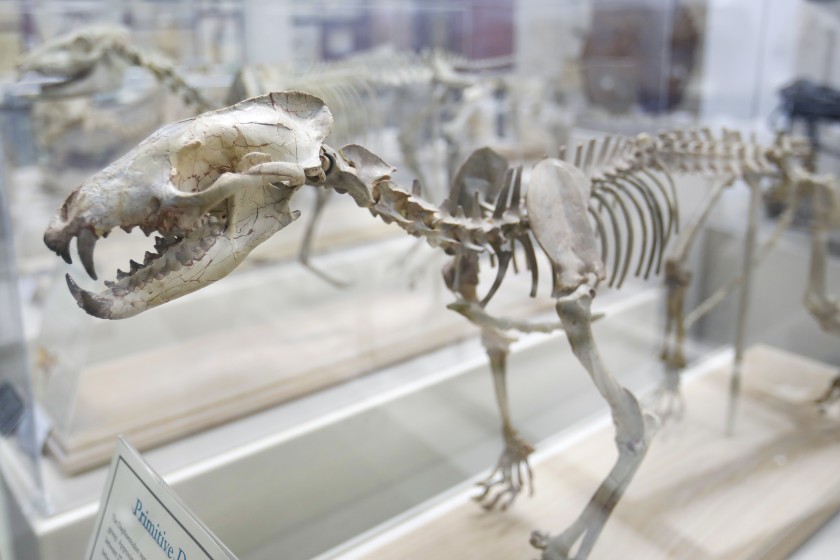
                A primitive dog is one of the prehistoric fossils on display at the Roynon Museum of Earth Sciences and Paleontology, May 23, 2019 in Escondido, California. Unless something changes, the museum is scheduled to close on June 30. (Howard Lipin/The San Diego Union-Tribune)

Back in the late 1990s, Roynon retired from his jobs as a surgical equipment salesman and part-time antiques dealer.

“When I turned 60, I decided to hang it up and retire and take life easy,” he said. “Then look what I did. It was like jumping out of the frying pan right into the open fire.”

Since he was a small child growing up near Santa Rosa where he would go up to the nearby hills and collect sharks teeth, Roynon has been collecting fossils and minerals.

“Nobody has had a fuller life than Mr. Roynon,” he said speaking in the third person. “I’ve hiked the Alps. I’ve been all over the western United States digging fossils. My years in the mountains collecting fossils from Montana to Mexico have been very fulfilling. If I died tomorrow, I’d have absolutely no regrets.”

When he retired, his collection of artifacts was vast. One day, his wife, Judy, a school teacher, asked if he would mind if some of her students came by to take a look. The visits went well and the word spread. Soon, Roynon had converted a large garage at his Escondido home into a private museum and he began having bus loads of children come there on field trips for interactive lessons.

In 2000, he formed a nonprofit and for the next 15 years he entertained and educated thousands of kids.

“As he says, it was never about the money,” Nutter said. “It’s about inspiring the kids.”

But then one neighbor complained to the city about the traffic Roynon’s home was causing and reluctantly City Hall got involved. They weren’t happy about it, but the activities in the garage were not a permitted use in the residential neighborhood.

Eventually, Roynon was told he had to stop what he was doing out of his home and a search began for a new site in a better-suited part of town. Many who loved Roynon came together, donations flowed, and a new 5,000-square-foot space was found at 457 East Grand Ave. It became a real museum, open to the public, that charged a nominal entrance fee and even had a gift shop.

But it also consumed Roynon’s life and time.

“Our problem is I’m getting to the age I can’t put the hours I have been into this anymore,” he said.

“I still have a lot of energy but there comes a time when your mind starts talking to you and saying, ‘Buddy, you better slow down.’ You better listen to your mind.”

The museum remains open until the end of next month. Its hours can vary and visitors should check its website -- roynonmuseum.org -- before heading over.

Nutter said she and others suggested they start moving some of the collection out before the closing, but Roynon would have none of it.

“He said we aren’t removing anything from here until the last kid walks out the door.”

Source: www.sandiegouniontribune.com

Two Thirds of Portugal's Large Mammals Extinct in Last 1M Years

Sunday, May 26, 2019

Almost half of all mammals have become extinct, with the proportion reaching two-thirds in the case of large mammals.

"It is overwhelming", Otávio Mateus of the Faculty of Science and Technology at Lisbon’s Universidade Nova told Lusa, adding that scientists.

The study, which shows that the country’s current biodiversity of mammals is only "a fraction" of what it was a million years ago.

Of 77 species of mammals found in fossil form in Portugal, only 41 or 54 percent still exist. Nineteen species, such as hyenas, have disappeared from what is now Portugal, and a further 11 – such as the straight-tusked elephant (Palaeoloxodon antiquus) - have become extinct.

The fauna and environment of the Iberian peninsula was once, according to Mateus, similar to that of Africa today.

"There were already humans and they lived [alongside] the fauna, but the emergence of humans has contributed to this extinction," he said.

The results emerged in the Master's thesis in Paleontology by Dário Estraviz López, who on defended his work, securing a mark of 19 out of 20, according to a statement released by the university.

"We are seeing enormous extinction of mammals in the last million years, which in paleontology is not that long a time," said Mateus, who supervised the thesis.

The data also makes it possible to assess the quality of the fossil record in Portugal, which is "very good" where large mammals are concerned, and may attract other researchers to the country, according to the academic.

"Less than a million years ago there were ancestral species of rhinoceros, elephants, hippopotamus and leopards in Portugal - all extinct today," writes Otávio Mateus. The pattern found in the study, he continues, is similar to that in the rest of Europe over a million years, which is "very fast in geological terms".

The extinction coincided with "the proliferation of humans", which should prompt reflection, Mateus argued in comments to Lusa.

Source: www.theportugalnews.com

The Origin of Earth’s Water

Saturday, May 25, 2019

Illustration of a comet, ice grains and Earth’s oceans. SOFIA found clues in Comet Wirtanen’s ice grains that suggest water in comets and Earth’s oceans may share a common origin. (Credit: NASA/SOFIA/L. Cook/L. Proudfit)

Earth is known as the only planet on the solar system to sustain life. Aside from this, it is also identified to have large amount of water and its axis being stabilized by the moon. Researchers from the University of Münster (Germany) was able to show for the first time, the role of moon on bringing water on the planet. Studies found that the formation of moon 4.4 billion years ago caused to bring water on Earth.

The moon was formed when Earth was hit by a body with the same size as Mars, also called Theia. At first, it was thought that Theia comes from the inner solar system near Earth but later on it turns out that it was originated from the outer solar system and carried large quantities of water, according to Phys.

It might be impossible and shocking to know that Earth has water since it came from dry inner solar system. So how can this be possible? The solar system was formed 4.5 billion years ago and based on previous studies, it is structured where dry and wet materials are separated. The dry material which is called non-carbonaceous meteorites come from inner solar system while the wet material which is rich in water called carbonaceous meteorites come from outer solar system. Even though studies have showed that the carbonaceous meteorites are responsible for water on Earth though it still a mystery on how and when it happened.

"We have used molybdenum isotopes to answer this question. The molybdenum isotopes allow us to clearly distinguish carbonaceous and non-carbonaceous material, and such from the outer and inner solar system," said Dr. Gerrit Budde, paleontology in Münster University and the lead author of the study.

Researchers also found out that Earth's molybdenum isotopic composition lies between the carbonaceous and non-carbonaceous meteorites. It was observed that some of Earth's molybdenum comes from the outer solar system and plays an important role because of its iron-loving property.

"The molybdenum which is accessible today in the Earth's mantle, therefore, originates from the late stages of Earth's formation, while the molybdenum from earlier phases is entirely in the core," said Dr. Christoph Burkhardt, second author of the study.

Based on the results, it shows that carbonaceous material came late on earth given that it was from the outer solar system. Provided this fact, molybdenum was supplied by Theia whose collision with the planet happened 4.4 billion years ago leading to the moon's formation. Nevertheless, it can be concluded that molybdenum in earth's mantle also came from the outer solar system which only means that Theia also originated from the outer solar system. Scientists believed that the collision provided enough carbonaceous material which supplied great amount of water on Earth.

"Our approach is unique because, for the first time, it allows us to associate the origin of water on Earth with the formation of the Moo. To put it simply, without the Moon there probably would be no life on Earth," explained Thorsten Klein, professor of Paleontology at the University of Münster.

Source: www.sciencetimes.com

Chinese Researchers Discover 300,000-Year-Old Ancient Human Fossils

Saturday, May 25, 2019

Different types of ancient human fossils in contrast: A. Human fossil from Hualong Cave B. Peking Man fossil from Zhoukoudian site C. Fossil of Nanjing Homo erectus D. Human fossil found at the Dali Man site E. Human fossil found at Jinniushan Site F. Fossil of Maba Man. (Photo: China News Service)

Chinese paleontologists have discovered more than 30 ancient human fossils that dated back to about 300,000 years, at an excavation site in Dongzhi County in east China's Anhui Province.

They have also found more than 100 stone artifacts used by ancient humans as well as mammalian fossils of over 40 species. The discoveries are expected to shed new light on how ancient humans in the East Asia continent had evolved, according to the paleontologists.

The fossils and artifacts were discovered during archaeological excavations over the past 15 years at the site, which experts believe to be a collapsed cave, said Wu Xiujie, a member of the research team and a professor with the Institute of Vertebrate Paleontology and Paleoanthropology of the Chinese Academy of Sciences.

Wu Xiujie, professor with the Institute of Vertebrate Paleontology and Paleoanthropology of the Chinese Academy of Sciences, displays the fossils discovered at an excavation site in Dongzhi County in east China's Anhui Province. (Xinhua/Ma Shurui)

"In the cave, we not only have discovered a large number of ancient human fossils, but also found a variety of evidences of ancient human behaviors, which could shed light on scenarios of their life," Wu said.

The fossils include a human skull of the Middle Pleistocene Epoch (from 781,000 to 126,000 years ago) that contains a largely complete facial structure, most of the brain cranium, and one side of the mandible.

The site was first discovered in 2004, when mammalian fossils were accidentally found when a local farmer was building a sheep-holding pen. The first excavation of the site was conducted in the summer of 2006, which yielded a partial human frontal bone, a molar, and stone artifacts. 

Source: www.shine.cn / Xinhua

Pages